The CBC CPT Code You Bill Depends on What Was Performed
The CBC CPT code you bill depends on the specific panel performed, whether a differential was run, and whether that differential was automated or manual. No single code fits every CBC, which is exactly where billing errors start.
This isn’t a theoretical risk. Two separate contractors, reviewing the same two codes, documented providers getting it wrong in opposite directions.
CMS has audited this exact code pair from two directions. One Medicare Administrative Contractor’s CERT review found labs coding 85027 when the documentation supported 85025, undercoding, and leaving earned revenue unbilled.
A separate MAC’s review of the same pair found the reverse: labs billing 85025 when the order specified only a plain CBC with no differential, upcoding. Both are real, government-audited findings.
The lesson isn’t “watch for upcoding” or “don’t leave money on the table” on its own. It’s that the code has to match what was ordered and what was performed, every time, because CMS has caught practices failing in both directions.
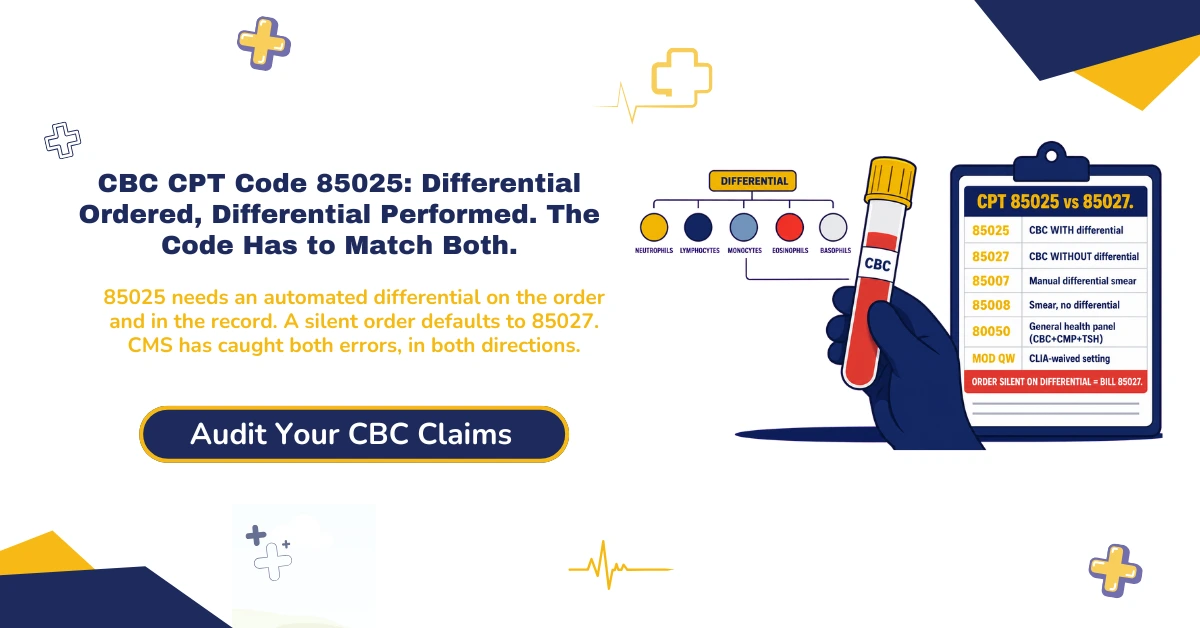
Four codes cover the ground: 85025 for a CBC with an automated differential, 85027 for a CBC without one, and 85007 and 85008 for the manual-differential scenarios this guide covers below.
This reference walks through the 2026 NCCI rules on what you can bill together, reference-lab billing under Modifier 90, the ICD-10 pairing that drives most denials, the CLIA and QW requirements, and the panel logic that decides when the CBC stands alone.
CPT 85025: CBC With Automated Differential, and the Documentation That Protects It
CPT 85025 covers a complete blood count, automated, including hemoglobin, hematocrit, red blood cell count, white blood cell count, and platelet count, plus an automated differential white blood cell count.
What the AMA Descriptor Requires
In plain terms, the code includes the RBC count, WBC count, hemoglobin, hematocrit, and platelet count, plus the automated breakdown of white blood cell types: neutrophils, lymphocytes, monocytes, eosinophils, and basophils.
That five-part breakdown is what makes 85025 more than a headcount. It tells a clinician which white cell line is elevated or suppressed, which is where the diagnostic value sits.
The Three-Part and Five-Part Differential Question
85025 covers an automated differential whether the analyzer produces a three-part or five-part breakdown. A lab running a three-part analyzer still reports 85025, not a different code, as long as an automated differential was performed.
Sources that call 85025 specifically a “five-part” code narrow the rule further than the code itself requires. The waived Sysmex XW-100, covered later, runs a three-part differential and still bills under 85025.
The rule is about method, not brand or cell-count depth. If the analyzer generated the differential automatically, 85025 is the code.
Matching this code to what was performed, not what’s usually ordered or what the analyzer usually produces, is the exact discipline CMS’s CERT findings show practices getting wrong in both directions.
CMS has documented claims where 85025 was billed but only a plain CBC was ordered, and claims where the reverse happened. Matching the code to the order, every time, is what our medical billing team verifies before a claim goes out.
CPT 85027: CBC Without Differential, and the Default Rule for an Ambiguous Order
CPT 85027 covers an automated complete blood count, sometimes called an automated hemogram, without the differential white blood cell count.
What 85027 Includes and Excludes
What’s included: the RBC count, total WBC count, hemoglobin, hematocrit, and platelet count. What’s excluded: the breakdown of white blood cell types by category. Same core hemogram, no differential.
Think of 85027 as the base model. It counts and measures the cells, but it doesn’t sort the white cells into types, which is the piece 85025 adds.
The National Government Services Default: What “Just CBC” Means
National Government Services, a Medicare Administrative Contractor, has published guidance that when a physician’s order specifies only “CBC” with no mention of a differential, the correct code is 85027, not 85025.
That single rule closes a gap most billing teams handle by guessing. When the order is silent, the code isn’t 85025 by default, it’s 85027.
The same guidance traces back to CERT findings that a contractor was re-coding submitted 85025 claims down to 85027 when the order didn’t call for a differential, the upcoding half of the both-directions problem.
That re-coding is the whole point. A contractor didn’t reject those claims, it paid them at the lower code, because the documentation supported 85027 and nothing more. The difference is small per claim and large across a lab’s volume.
Here’s where it bites in practice. An order set defaults to “CBC,” the analyzer runs a differential anyway out of habit, and the biller reaches for 85025 because that’s what the machine produced. The order didn’t ask for it.
The order governs. If the treating clinician wanted the differential, the order or the note has to show it, not the analyzer’s default behavior.
Manual Differential and the 2026 NCCI Rules That Govern What You Can Bill Together
CPT 85007 and 85008: The Two Manual Differential Codes
Two codes cover the manual side. CPT 85007 is a blood smear microscopic examination with a manual white blood cell differential count. CPT 85008 is the same smear examination without a manual differential.
| Code | What it covers |
|---|---|
| 85007 | Blood smear, microscopic examination, with a manual white blood cell differential count |
| 85008 | Blood smear, microscopic examination, without a manual differential |
Hard Rule One: Analyzer-Triggered Smear Review Isn’t Separately Billable
Per the CMS NCCI Policy Manual effective January 1, 2026, when a clinician orders 85025 or 85027 and the lab runs an internal smear review purely because the analyzer’s own flags triggered it, that review isn’t separately billable as 85007 or 85008.
It’s part of completing the ordered automated test, not a distinct service. The analyzer flagged something, the lab confirmed it, and that confirmation rides with the original code.
Labs get tripped up here because the smear review is real work. Someone looked at cells under a microscope. But the rule keys on why: if the analyzer triggered it, it isn’t separately billable.
Hard Rule Two: 85025 Plus 85007 Is Generally Not Permitted
85027 plus 85007 is permitted when both are separately ordered and performed. 85025 plus 85007 is generally not permitted, because it duplicates payment for the differential.
The exception is narrow. Both methods have to be independently reasonable and necessary, with the specific clinical reason, unexpected critical values, suspected blast cells, or analyzer interference paired with real concern, spelled out in the documentation.
This is tighter than what circulates. Several sources call 85025 plus 85007 typically fine depending on payer rules. The current CMS NCCI Policy Manual states a narrower rule than that.
The Modifier 59 Scenario Every Lab Eventually Hits
Picture two physicians ordering labs for the same patient minutes apart. One orders a plain CBC, the other orders a CBC with differential. Both run, and the claim edit needs Modifier 59 to show the two services are distinct.
NCCI doesn’t only check CPT codes against other CPT codes, it checks CPT combinations against HCPCS Level II codes too, and our HCPCS and CPT billing guide covers how those edits fire.
For the full Modifier 59 documentation standard that supports this exact two-order scenario, see our modifier 59 billing guide.
Independent and Reference Laboratory Billing: Modifier 90, CLIA, and Place of Service 81
When the Specimen Is Drawn in One Place and Processed in Another
When the entity that draws the blood isn’t the entity that runs the CBC, the billing rules change.
If an independent lab sends a specimen to a separate reference laboratory for processing, the billing entity reports Modifier 90 to show that a reference lab, not the biller itself, performed the test.
The modifier is a truth-in-billing signal. It tells the payer the test was referred out, so the claim reflects who did the work and gets priced correctly.
Place of Service 81, the independent laboratory setting, only applies when the specimen was drawn at the independent lab’s own facility. Collected somewhere else, a hospital, a physician’s office, a patient’s home, and POS 81 doesn’t apply even when the independent lab runs the analysis.
This trips up labs that assume POS 81 follows the analysis. It doesn’t. It follows the draw site. A CBC drawn at a hospital and run at an independent lab isn’t a POS 81 claim.
CLIA Certification and Medicare Specialty 69
The enrollment requirements stack up. The lab has to hold a valid CLIA certificate, operate as a standalone entity rather than part of a hospital or physician’s office, and be enrolled with Medicare under Specialty 69.
Any deviation from that structure breaks it. A hospital outreach lab or a physician office lab means POS 81 no longer applies, no matter how routine the CBC is.
Why it matters: a CBC is one of the highest-volume tests a reference lab runs. A structural mismatch here doesn’t cost one claim, it repeats across every referred specimen until someone catches it.
For the complete specimen-collection-location decision tree and the CMS Claims Processing Manual citation behind it, see our independent laboratory billing guide.
Medical Necessity and ICD-10 Pairing: What Gets a CBC Claim Paid
The Three-Element Rule
Medical necessity for a CBC claim rests on three aligned elements: a physician’s order, a documented clinical indication in the record, and an ICD-10 code on the claim that reflects that indication, all inside Medicare’s National Coverage Determination 190.15 framework.
Each element carries weight. The order has to exist and trace to the treating clinician. The indication has to be specific, fatigue alone or “labs ordered” doesn’t clear the bar, and it has to connect to a real clinical concern.
The ICD-10 code has to match what’s in the chart, not a convenient nearby code. When the diagnosis on the claim and the reason in the note drift apart, the CBC CPT code that follows them gets flagged.
This is the biggest single driver of CBC denials, and it’s rarely a coding-knowledge problem. The coder knew the code. The chart didn’t hand them a diagnosis that supported it.
Screening Codes vs Diagnostic Codes: Why Z13.0 Gets CBC Claims Rejected
Z13.0, the screening code for diseases of the blood and blood-forming organs, fits only asymptomatic, routine screening. When a patient has symptoms or a known condition, a diagnostic code is required instead.
A confirmed hypothyroidism patient getting a CBC for routine monitoring should be coded to the confirmed diagnosis, not a vaguer symptom code and not a screening code.
For the coding logic that separates a confirmed diagnosis code from a symptom code in an ongoing monitoring scenario, see our hypothyroidism ICD-10 coding guide, which walks through this using E03.9.
The Advance Beneficiary Notice Nobody Explains
When the diagnosis submitted doesn’t meet a payer’s medical necessity criteria, the CBC claim can be denied outright. That’s where the Advance Beneficiary Notice comes in.
The patient signs an ABN acknowledging in advance that they may be personally responsible for the cost if Medicare decides the test wasn’t medically necessary. It’s a patient-communication step, and it has to happen before the test, not after the denial.
Skipping the ABN is where practices lose twice. The claim denies, and without a signed notice, the lab often can’t bill the patient either. The test gets done and nobody pays for it.
A diagnosis that doesn’t match the clinical reason in the chart is a top reason a CBC claim gets denied. Our denial management services trace that mismatch to the documentation gap behind it, not the rejected line in front of you.
Modifiers for CBC Billing: QW, 91, 90, and the One That Doesn’t Apply
Four modifiers matter for CBC billing: QW, 91, 90, and 59. The last one, Modifier 59, already showed up in Section 4’s same-day scenario.
| Modifier | When it applies |
|---|---|
| QW | CLIA-waived test performed under a Certificate of Waiver |
| 91 | Medically necessary repeat CBC on the same date of service |
| 90 | Specimen sent to a reference laboratory for analysis |
| 59 | Distinct same-day service, per the Section 4 two-order scenario |
| 26 / TC | Do not apply to a routine CBC; 85025 and 85027 aren’t component-split |
Modifier QW and the CLIA Waiver Reality
QW denotes a CLIA-waived test in Medicare’s CLFS data layout. It applies when the CBC is performed in a physician office lab holding a CLIA Certificate of Waiver, not a reference laboratory, per the CMS Claims Processing Manual Chapter 16.
The waiver setting is the trigger. A point-of-care analyzer in a clinic holding a Certificate of Waiver bills with QW; the same test run in a high-complexity lab doesn’t.
The Sysmex XW-100 Example
CMS assigned the code 85025QW for CBC parameters and the automated differential when performed on the Sysmex XW-100 analyzer, effective November 6, 2017, in CMS MLN Matters MM10418.
That’s one documented example of how QW gets assigned at the analyzer-model level, not the only CLIA-waived option on the market. Other analyzer models carry their own waived designations through the same process, tracked on the CDC CLIA Waived Test List.
The XW-100 matters for another reason. It runs a three-part differential and still bills under 85025QW, which confirms the earlier point: 85025 keys on an automated differential, not a five-part one.
Modifiers 91 and 90
Modifier 91 applies to a medically necessary repeat CBC on the same date of service, distinct from a duplicate claim submitted in error. Modifier 90 applies when the specimen goes to a reference laboratory, covered in Section 5.
Why Modifiers 26 and TC Don’t Belong on a Routine CBC
85025 and 85027 aren’t split into technical and professional components the way imaging studies are. Appending Modifier 26 or TC to a routine CBC is generally not appropriate.
Doing it is a documented reason claims come back unpaid rather than denied outright, since the claim processes but pays incorrectly, which is harder to catch than a clean rejection.
What CPT 85025 Costs: The 2026 CLFS Rate and Why It’s Not a Physician Fee Schedule Number
What a CBC with differential costs depends heavily on who’s paying and where the test runs. The spread is wide.
What Independent Labs, Hospitals, and Insured Patients Each Pay
| Setting | Typical CBC cost |
|---|---|
| Independent lab, self-pay (e.g. Quest, Labcorp) | $25 to $30 for an uninsured patient |
| Hospital outpatient department | $60 to $150 or more, with a facility fee layered on top |
| Insured patient, medically necessary | Most cost covered; an applicable copay or deductible applies |
| Medicare and Medicaid (CLFS) | Roughly $8 to $10 nationally; varies by year |
The Medicare and Medicaid rate, set through the Clinical Laboratory Fee Schedule, runs well below either commercial figure. It’s commonly cited around $8 to $10 nationally, though the exact amount varies by year.
The gap between the hospital price and the CLFS rate surprises patients most. The same test can cost far more in an outpatient department than Medicare pays a lab, because of the facility fee.
Why 85025 Shows a Different Rate-Setting Mechanism Than an E/M Code
Unlike an E/M or procedure code priced through work RVUs, a geographic cost index, and an annual conversion factor, CPT 85025 is priced under the separate Clinical Laboratory Fee Schedule.
That’s why a standard Physician Fee Schedule lookup can show $0 and no RVUs for this code. It isn’t that Medicare doesn’t pay for a CBC, it’s that the payment lives in a different schedule entirely.
This catches people checking the wrong tool. They pull up the PFS lookup, see nothing for 85025, and conclude the test isn’t reimbursable. The number’s on a different schedule.
The 2026 PAMA Reporting Window Currently Open
CLFS rates come from the weighted median of private payer rates, refreshed on a roughly three-year cycle. Under the current window, the data collection period ran January 1 to June 30, 2025, and the reporting period runs May 1 to July 31, 2026.
Labs billing 85025 or 85027 at meaningful volume have a reporting obligation during this window. There’s no phase-in payment reduction in 2026, but the rates set in this cycle shape CLFS payment for years.
CBC in a Panel: When 85025 Stands Alone and When It Becomes 80050
Does a CBC ordered alongside other labs ever have to be billed differently than a standalone CBC? Sometimes. The rule depends on which other tests were ordered with it.
CBC and CMP Together: Why This Pairing Doesn’t Trigger Bundling
The Comprehensive Metabolic Panel, billed under 80053, doesn’t include a CBC as one of its components. So a CBC CPT code and CPT 80053 can be billed together on the same claim without a panel-bundling problem.
That pairing is common in emergency department visits and annual wellness exams. Two separate panels, two separate codes, no bundling edit, because neither one contains the other.
The mental model is containment. Bundling edits fire when one code already includes another. Since the CMP and the CBC share no components, they sit side by side on the claim cleanly.
The General Health Panel: What Turns Three Separate Codes Into One
The general health panel, CPT 80050, requires all three of a specific set: the full Comprehensive Metabolic Panel, a CBC, and a Thyroid Stimulating Hormone test.
The CBC piece can come through the automated route, 85025 alone or 85027 paired with 85004, or the manual route, 85027 paired with 85007 or 85009. When all three components are ordered and performed, the panel code applies instead of the separate codes.
Miss one of the three and billing 80050 anyway gets the claim denied. The panel code is a promise that all three were done.
The Component-Code Rule Almost Nobody States Precisely
Individual component codes, hematocrit alone, hemoglobin alone, automated RBC, WBC, or platelet counts alone, aren’t separately reimbursed when billed alongside 85027 for the same provider, patient, and date of service.
If any of those components were already reimbursed and 85027 then gets billed, the 85027 payment itself gets reduced by whatever was already paid. Billing the pieces instead of the panel code they belong to is a quiet, avoidable loss.
This is precise for a reason. A lab that reflexively bills components can watch a chunk of the CBC payment evaporate on adjustment, and the remittance rarely spells out why in plain language.
A Live 2026 Payer Policy Change Worth Knowing
A major California commercial payer discontinued coverage of the general health panel code entirely, effective February 1, 2026, following a provider bulletin the previous November.
Claims submitted with the panel code after that date get denied, and affected practices now bill the CMP, CBC, and TSH as three separate components. A coding rule correct a year ago can go wrong without the CPT code itself ever changing.
Documentation That Survives a 2026 Audit: The CMS Numbers Behind Every CBC Denial
This isn’t a theoretical compliance risk. CMS has measured it directly, and the numbers are specific.
The Improper Payment Rate CMS Published
CMS’s compliance data puts the improper payment rate for blood count lab tests at 12.1%, with a projected improper payment amount of $26.4 million, per the CMS Blood Count Lab Tests Compliance Guide.
The single largest driver, 92.2% of improper payments during the most recent reporting period, is insufficient documentation. Not an incorrect CPT code, not a missing modifier, documentation that doesn’t clearly establish the test was medically necessary and ordered by the treating clinician.
Read that number again. More than nine in ten of these improper payments trace to documentation, not coding. The claim was often coded fine; the chart behind it couldn’t back the claim up.
Does a CBC Order Need a Signature?
Here’s the nuance several competitors overstate. The treating clinician has to order the lab test, and tests not ordered by the treating clinician aren’t reasonable and necessary.
But Medicare doesn’t require a signed order for many clinical diagnostic lab tests. What’s required instead is documented intent: the record has to show the clinician’s intent to order the specific test, in an authenticated medical record, per CMS Lab Test Order Requirements.
The distinction is practical. You don’t need a signature chase on every requisition, but you do need a note that shows the clinician meant to order this specific test for this specific patient.
What a Defensible CBC Order Looks Like in the Chart
An order that survives review states the reason for the CBC in the assessment or plan, not a vague “labs ordered” note.
It links to a diagnosis code that’s in the patient’s problem list or documented as a new symptom, and it carries the ordering provider’s NPI on the requisition, a small detail that drives a disproportionate share of avoidable Medicare rejections when missing.
Why a Physician Orders a CBC Without a Differential in the First Place
A differential white blood cell count breaks down which type of white cells are elevated or suppressed, which is what points toward infection, an immune disorder, or a blood cancer.
A routine annual physical on a symptom-free patient, or ongoing monitoring of a stable, already-diagnosed condition, often doesn’t need that breakdown. The total white blood cell count alone confirms nothing has changed.
Think of it like a smoke alarm versus a full inspection. The total count tells you whether something’s off. The differential tells you what and where.
A patient presenting with unexplained fever, fatigue, easy bruising, or a suspected infection needs the differential, because the type of white cell response is what narrows the diagnosis.
This clinical distinction is what should drive the code choice. Not habit, not what the order set defaults to, and not what got billed last time for the same patient.
The Five CBC Coding Errors That Trigger the Most Denials
The Errors, Ranked
Five errors surface more than any others, and every one traces back to a rule from earlier in this guide.
Ranking them matters because the fixes stack. Clear the top two and a large share of CBC CPT code denials disappear before you touch the rest.
| # | Coding error | Why it denies |
|---|---|---|
| 1 | Billing 85025 with no differential performed, or 85027 when the record supported 85025 | Both directions of the exact error CMS’s CERT reviews caught |
| 2 | Billing 85025 and 85027 together for the same specimen | Automatic duplicate edit under current NCCI rules |
| 3 | Missing 85007 when a manual differential was performed, or adding it to 85025 without the required documentation | Missed revenue or a duplicate-differential denial |
| 4 | A diagnosis code that doesn’t match the chart | The single largest driver behind the CMS improper-payment numbers |
| 5 | Missing the ordering provider’s NPI on the requisition | A small omission with an outsized denial rate |
How a Documentation Gap Becomes a Denial Weeks Later
A documentation gap rarely gets caught at the point of service. It surfaces weeks later, when the claim hits a payer’s automated review or a post-payment audit.
By then, the clinical reasoning behind the original order is harder to reconstruct than it would have been the same day. The people involved have moved on to the next hundred patients.
That reconstruction gap is the hidden cost. A same-day fix takes a note. A ninety-day fix takes a chart review, an appeal, and sometimes a write-off.
Once a CBC claim gets flagged weeks after the service, the fix usually isn’t about that one claim, it’s about the workflow gap behind it. Our accounts receivable services recover the claims already stuck in that gap while fixing the process creating new ones.
For the root-cause framework behind clearinghouse-level rejections that compound this before a claim even reaches the payer, see our clearinghouse rejection prevention guide.
CBC Billing for California Laboratories and Practices: Credentialing, CLIA, and Full-Cycle Support
Independent and Reference Laboratory Billing in California
Independent and reference laboratories billing CBC panels under Place of Service 81, and physician practices billing in-office CLIA-waived CBC testing under Modifier QW, run two structurally different workflows. Getting the CBC CPT code right is only the starting point for either one.
The two workflows look similar on the surface and diverge underneath. The reference lab lives in Modifier 90 and POS 81 rules; the physician office lab lives in CLIA-waiver and QW rules. Mixing them up is where clean claims stop being clean.
Whichever way a CBC is billed, reference lab under Modifier 90 or in-office analyzer under Modifier QW, the claim still has to clear the same documentation, ICD-10, and NCCI checks in this guide. That’s the work our California lab billing services handle statewide.
CLIA Enrollment and the Medicare Specialty 69 Timeline
An independent laboratory billing under Place of Service 81 needs an active CLIA certificate and Medicare enrollment under Specialty 69 before its first claim can go out clean.
A physician office lab running CLIA-waived point-of-care CBC testing needs its own Certificate of Waiver on file, correctly matched to the billing entity submitting the claim.
Either enrollment gap, caught after claims start going out rather than before, becomes a backlog of unpaid or denied claims. Fixing it retroactively costs far more than setting it up right the first time.
That enrollment timeline, CLIA certification, Medicare Specialty 69, and payer-specific credentialing, is exactly what our credentialing and contracting services manage before a lab’s first claim goes out.
CBC CPT Code 85025: Frequently Asked Questions
These are the CBC CPT code questions that come up most, answered straight.
Can you bill 85025 and 85027 together?
No. Billing both for the same specimen on the same date triggers an automatic NCCI duplicate edit, since 85025 already includes everything 85027 covers plus the differential.
What is the CPT code for CBC with differential?
CPT 85025 covers a complete blood count performed with an automated differential white blood cell count. CPT 85027 covers the same test without the differential.
What is the modifier for 85025 and 85027?
Modifier QW applies under a CLIA Certificate of Waiver. Modifier 90 applies when a reference laboratory performs the analysis. Modifier 91 applies to a medically necessary repeat test on the same date. Modifiers 26 and TC generally don’t apply.
Can 85025 and 85014 be billed together?
No. Individual component codes, including hematocrit alone, hemoglobin alone, and automated RBC, WBC, or platelet counts alone, aren’t separately reimbursed when billed alongside 85027 for the same date of service.
Does Medicare cover a CBC blood test?
Yes, when a treating clinician orders it and ties it to a documented medical necessity, a specific sign, symptom, or condition, rather than routine asymptomatic screening. Payment runs through the Clinical Laboratory Fee Schedule, not the Physician Fee Schedule.
What is the CPT code for CBC and CMP?
A CBC, billed as 85025 or 85027, and a Comprehensive Metabolic Panel, billed as 80053, can be billed together on the same claim, since the CMP doesn’t include a CBC as one of its components.
Why would a doctor order a CBC without a differential?
Routine screening and stable chronic-disease monitoring often need only the total counts a CBC without differential provides. A suspected infection, immune disorder, or blood cancer workup needs the differential to identify which white cell type is elevated or suppressed.
What diagnosis will cover CPT 85025?
Coverage generally requires a diagnosis reflecting a real clinical indication, categories including anemia, infection or inflammation, bleeding or clotting disorders, and malignancy workups, rather than a routine screening code. Medicare’s National Coverage Determination for blood counts is the governing source.
The CBC CPT Code Decision Checklist
When the order and the documentation are clear, the code follows a short path. Four decisions cover almost every CBC.
| Decision | Answer and code |
|---|---|
| 1. Was a differential performed? | No: bill 85027. Yes: go to decision 2. |
| 2. Automated or manual differential? | Automated: bill 85025. Manual: bill 85027 plus 85007, unless separate documented medical necessity justifies adding 85007 to 85025. |
| 3. Who performed the test? | Billing entity in a CLIA-waived setting: add Modifier QW. Separate reference lab: add Modifier 90. |
| 4. Part of a full CMP, CBC, and TSH order? | Yes, all three performed: bill 80050. No, or only some performed: bill the components separately. |
ClaimMax RCM is California’s medical billing and credentialing partner for independent laboratories, reference labs, and physician practices billing CPT 85025 and its full sibling code family, from CLIA enrollment through denial recovery.
When the CBC claims stack up faster than the fixes, our laboratory revenue cycle management team handles the full path, coding, documentation, denials, and enrollment, so the revenue lands.