Coding errors cost the U.S. healthcare system roughly $36 billion every year. Around 12% of the 5 billion claims processed annually contain inaccuracies. The single most common error category is picking the wrong code system: CPT when it should have been HCPCS, or HCPCS when it should have been CPT.
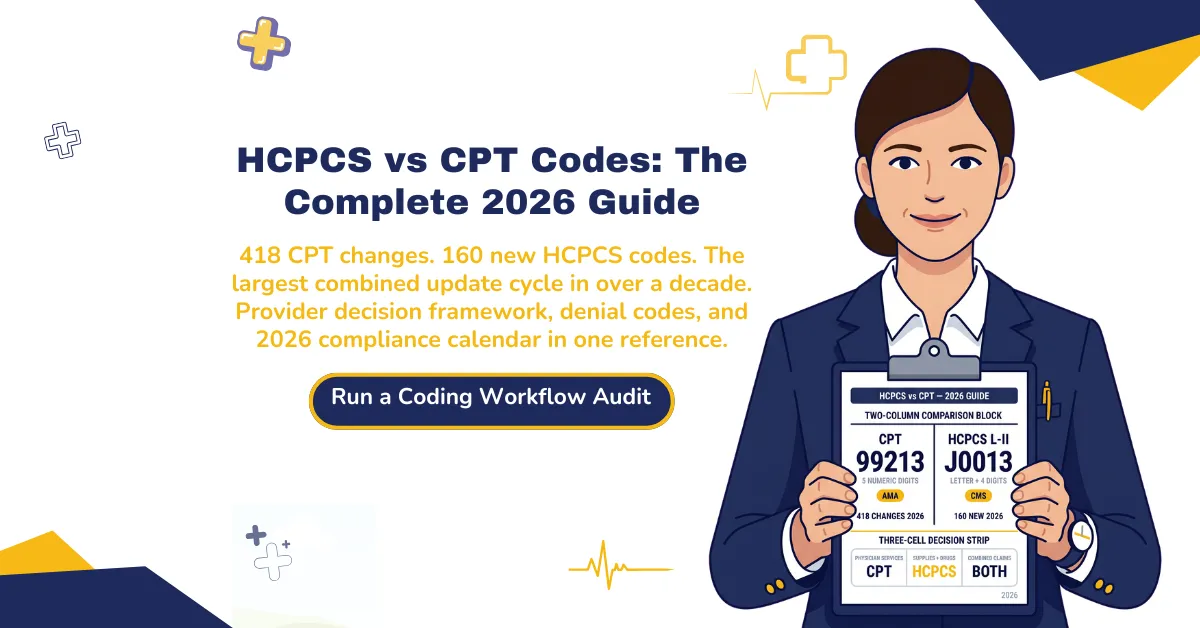
CPT codes are 5-digit numeric codes maintained by the American Medical Association (AMA) and used to describe physician services, procedures, and surgeries. HCPCS Level II codes are alpha-numeric codes (1 letter + 4 digits) maintained by the Centers for Medicare and Medicaid Services (CMS) and used primarily for products, supplies, drugs, and services not covered by CPT. For 2026, the AMA released 418 CPT changes effective January 1, while CMS released 160 new HCPCS Level II codes in the January 2026 quarterly update.
Picking the wrong code level isn’t a soft error. Most payer claim scrubbers reject mismatched code submissions before the claim ever reaches a human reviewer. The 2026 update volume across both systems is higher than any prior cycle, and CMS implemented a no-grace-period rule for discontinued codes that makes errors more expensive to recover from.
This guide covers the complete HCPCS vs CPT framework, all 2026 updates for both systems, the decision framework for code selection, denial codes that wrong choices trigger, specialty-specific decision logic, and the outsourcing decision framework. Every 2026 regulatory reference is sourced from CMS.gov, AMA, and Federal Register publications cited throughout.
This guide is written by certified billing specialists who manage CPT and HCPCS coding decisions across thousands of monthly claims. Every 2026 regulatory reference is sourced from CMS.gov, AMA, and Federal Register publications cited throughout.
What Is HCPCS? The Complete Definition
The Healthcare Common Procedure Coding System (HCPCS), pronounced “hick-picks,” is a standardized medical coding system maintained by the Centers for Medicare and Medicaid Services (CMS). HCPCS was established in 1978 to provide a standardized framework for describing medical items and services delivered to patients. In 2003, under 42 CFR 414.40(a), the Department of Health and Human Services formally delegated authority to CMS to maintain this code set.
The acronym originally stood for HCFA Common Procedure Coding System, named after the Health Care Financing Administration. When HCFA was renamed the Centers for Medicare and Medicaid Services in 2001, HCPCS retained its acronym while the governing body changed. That history matters because older billing manuals and legacy systems still reference HCFA coding, which is the same code set.
CMS needed a coding system separate from CPT because CPT didn’t cover everything Medicare and Medicaid needed to bill. Durable medical equipment, ambulance services, injectable drugs, and supplies required standardized codes. CPT didn’t have them. HCPCS Level II filled that gap, and it’s been the backbone of Medicare and Medicaid billing ever since.
HCPCS in Plain English
Here’s the plain version. CPT covers what doctors do during patient visits. HCPCS Level II covers everything else billed to Medicare and Medicaid that CPT doesn’t capture: the wheelchair after surgery, the ambulance ride to the hospital, and the chemotherapy drug administered in the office.
HCPCS is divided into two levels. Level I codes are the same as CPT codes maintained by the AMA. Level II codes are alpha-numeric codes maintained by CMS. We’ll break down each level in detail in the next section.
Both HCPCS and CPT are recognized under HIPAA as adopted code sets for electronic healthcare transactions. Using either code system incorrectly creates HIPAA compliance issues alongside the obvious billing problems.
External authority links:HCPCS official page | 42 CFR 414.40(a) | AAPC HCPCS Level II Coding
What Is CPT? The Definitive 2026 Breakdown
Current Procedural Terminology (CPT) codes are 5-digit numeric codes developed and maintained by the American Medical Association (AMA). CPT codes describe medical, surgical, and diagnostic services performed by physicians and other healthcare professionals. CPT is also referred to as HCPCS Level I, and CPT codes represent approximately 80% of the entire HCPCS code set, according to AHRQ HCUP.
For 2026, the AMA released CPT 2026 on September 11, 2025, with Category I codes effective January 1, 2026. The 2026 release contains 418 total editorial changes, including 288 new codes, 84 deletions, and 46 revisions. That’s the largest CPT update cycle in recent years.
CPT is the universal billing language for physician services. All payers accept CPT codes. HIPAA mandates CPT for electronic transactions. Without CPT, providers have no standardized way to communicate what clinical service was performed.
Why CPT Codes Are Copyrighted
Here’s something most coding guides skip. CPT codes are AMA copyrighted. Commercial use, including embedding CPT in billing software or training materials sold for profit, requires a valid AMA license. HCPCS Level II codes, by contrast, sit in the public domain and require no license to use.
CPT isn’t only updated once a year. The AMA releases Category II codes three times yearly (March 15, July 15, November 15) and Category III codes biannually. A billing system that only refreshes CPT in January is missing year-round Category II and III releases, which creates undercoding exposure throughout the year.
The official 2026 CPT code set is available through the AMA and through authorized distributors. Verify your billing system uses a current AMA-licensed CPT feed before assuming your 2026 codes are loaded correctly.
External authority links:CPT 2026 code set release | CMS HCPCS overview
HCPCS Levels Explained: Level I, Level II, and the Discontinued Level III
HCPCS contains three levels historically, though only two remain operational today. Understanding all three levels matters because some legacy systems and older training materials still reference Level III, which was discontinued December 31, 2003.
Level I: The CPT Equivalence
HCPCS Level I codes are identical to CPT codes maintained by the AMA. The same 5-digit numeric code (for example, 99213 for an established patient office visit) functions as both a CPT code and an HCPCS Level I code. The distinction is administrative, not structural. When billing Medicare or Medicaid, the code is technically referred to as HCPCS Level I. When billing commercial payers, the same code is referred to as CPT.
Level II: The Alpha-Numeric Code Set
HCPCS Level II codes are alpha-numeric codes consisting of one letter followed by four numeric digits (for example, J0013, A4295, G0568). CMS maintains Level II codes and updates them quarterly. Level II identifies products, supplies, drugs, and services not covered by CPT, including durable medical equipment, ambulance services, injectable medications, and certain professional services that CMS classifies separately. The full Level II taxonomy spans 17 letter families covered in the next section.
Level III: The Discontinued Local Codes
HCPCS Level III codes were local codes developed by state Medicaid agencies, Medicare contractors, and private insurers for use within specific programs and jurisdictions. The Health Insurance Portability and Accountability Act of 1996 (HIPAA) required CMS to adopt consistent national coding standards, which eliminated the need for local codes.
Level III codes were discontinued December 31, 2003, to comply with HIPAA’s standardization requirements. Don’t confuse HCPCS Level III with CPT Category III, which is a separate code set introduced in 2001 for emerging technologies and remains active today. They’re entirely different code systems despite the similar naming.
HCPCS Levels at a Glance:
| Level | Maintained By | Format | Status | What It Covers |
|---|---|---|---|---|
| Level I (CPT) | AMA | 5 digits numeric | Active | Physician services, surgeries, diagnostics |
| Level II | CMS | 1 letter + 4 digits | Active | DME, drugs, ambulance, supplies, non-physician services |
| Level III | State Medicaid, MACs, private insurers | Local format | Discontinued December 31, 2003 | Local services within specific programs |
External authority links:CMS HCPCS overview | ASHA Introduction to Billing Code Systems | HHS.gov HCPCS guidance
CPT Code Categories: Category I, II, and III for 2026
CPT codes are organized into three distinct categories, each with a different purpose, release cadence, and billing implication. Knowing which category a code belongs to changes how you document the service, when you use it, and whether the payer reimburses it the same way.
Category I: Standard Medical Procedures
Category I CPT codes are 5-digit numeric codes that describe the most commonly performed medical, surgical, and diagnostic procedures. Category I codes are released annually each January 1 and represent the bulk of routine medical billing. For 2026, the AMA introduced 288 new Category I codes among the total 418 changes effective January 1, 2026.
Category I divides into six main sections covering distinct service domains: Evaluation and Management (99202 to 99499); Anesthesia (00100 to 01999); Surgery (10004 to 69990); Radiology (70010 to 79999); Pathology and Laboratory (80047 to 89398); and Medicine (90281 to 99607). For specialty-specific CPT code coverage, our occupational therapy CPT codes guide walks through one vertical’s complete code set in 2026 detail.
Category II: Performance Measurement Codes
Category II CPT codes are supplemental tracking codes used for performance measurement and quality reporting. Category II codes are 4 digits followed by the letter F (for example, 4000F). These codes don’t drive reimbursement directly but feed into quality programs like MIPS and Medicare value-based care frameworks.
Here’s a detail most CPT guides skip. Category II codes aren’t released only annually. The AMA releases Category II codes three times yearly: March 15, July 15, and November 15. Billing systems that only refresh CPT in January are missing year-round Category II updates.
Category III: Emerging Technology and Experimental Procedures
Category III CPT codes are temporary codes used to track emerging technologies, services, and procedures not yet widely adopted. Category III codes are 4 digits followed by the letter T (for example, 0710T for noninvasive arterial plaque analysis). The AMA releases Category III codes biannually, and 27% of new 2026 codes are Category III, including several breakthrough AI diagnostic codes covered in Section 10.
Category III codes have a 5-year lifespan. After 5 years, they either get promoted to Category I (becoming permanent) or sunset out of the code set. Tracking Category III codes correctly matters because they often represent cutting-edge services your practice may already be providing without proper billing.
CPT Category Reference for 2026:
| Category | Format | Purpose | Release Cadence | 2026 Volume |
|---|---|---|---|---|
| Category I | 5 digits numeric | Standard procedures and services | Annual (January 1) | 288 new codes |
| Category II | 4 digits + F | Performance measurement tracking | 3x yearly (Mar 15, Jul 15, Nov 15) | Various |
| Category III | 4 digits + T | Emerging tech and experimental procedures | Biannual electronic | 27% of all new 2026 codes |
External authority links:AMA CPT Category I overview | AMA Category III emerging tech | AAPC CPT Category Guide
HCPCS Level II Code Families: A Through V Letter Breakdown for 2026
HCPCS Level II codes follow a structured letter-and-number system. Each code begins with a single alphabetical letter (A through V, with several gaps) followed by four numeric digits. The opening letter immediately signals the service category. Level II spans 17 active letter families covering everything from ambulance services and durable medical equipment to injectable drugs, behavioral health services, and quality measurement.
The opening letter isn’t just an organizational system. It signals billing rules, coverage scope, and update cycles. J codes (drugs) update on the first business day of every quarter. E codes (durable medical equipment) update biannually in January and July. Knowing which family a code belongs to tells you when to expect changes and how to track compliance.
The January 2026 HCPCS Level II Alpha-Numeric File released by CMS on January 12, 2026, contains 160 new codes, 101 deletions, and approximately 300 revised descriptors. The April 2026 file, updated March 18, 2026, brought additional refinements. Quarterly updates aren’t optional for clean claims operations.
HCPCS Level II Code Families and 2026 Updates:
| Letter | Category | Examples | 2026 Notes |
|---|---|---|---|
| A | Transportation, medical/surgical supplies | A0425 (ambulance ground mileage), A4351 (catheter), A4295 to A4297 (hydrophilic catheters NEW 2026) | 3 new A codes in 2026 |
| B | Enteral and parenteral therapy | B4034 (enteral feeding supply) | Stable in 2026 |
| C | Hospital outpatient (OPPS) temporary | C1725 (catheter), C9305 and C9306 DISCONTINUED 2026 | 19 new C codes; 2 codes retired and replaced with J codes |
| D | Dental procedures (CDT) | D0120 (periodic oral evaluation) | Maintained by ADA |
| E | Durable Medical Equipment (DME) | E0118 (crutches), E0260 (semi-electric hospital bed) | Stable in 2026 |
| G | Temporary professional services | G0442 (annual wellness visit), G0568 to G0570 (psychiatric care NEW 2026), G0660 to G0668 (TEAM remote E/M NEW 2026) | 14 new G codes in 2026 |
| H | Behavioral health/substance abuse | H0001 to H2037 (state Medicaid use) | State-specific application |
| J | Drugs administered other than oral | J0135 (adalimumab), J0013 (esketamine NEW 2026 replaces S0013) | Major drug code overhaul; multiple C-to-J replacements |
| K | DME supplies (DMEPOS contractor use) | K0001 (standard wheelchair) | Stable in 2026 |
| L | Orthotic and prosthetic procedures | L3300 (ankle foot orthosis), L8701 to L8702 (NEW 2026) | New L codes added |
| M | Professional and quality measure services | M1426 to M1503 (NEW 2026, 78 quality measure codes) | 78 new M codes in 2026 |
| N | Reserved (not currently used) | None active | Reserved status |
| P | Pathology and laboratory services | P9010 (blood specimen) | Stable |
| Q | Temporary miscellaneous | Q5160 (biosimilar NEW 2026), Q4411 (tissue product NEW 2026) | 25 new Q codes in 2026 |
| R | Diagnostic radiology services | R0070 (portable X-ray transportation) | Stable |
| S | Non-Medicare commercial codes | S0013 DISCONTINUED 2026 (replaced by J0013) | S codes phasing out |
| T | State Medicaid agency only | T1015 (FQHC encounter) | State-specific |
| U to V | State-specific/commercial use | V2599 (vision services) | Stable |
This table looks dense, but most coders work primarily within 4 or 5 letter families based on their specialty. A behavioral health practice lives in H codes and CPT psychotherapy codes. A DME supplier lives in E and K codes. An infusion clinic lives in J codes.
Here’s the critical 2026 compliance point. CMS implemented a no-grace-period rule for discontinued codes. Any claim using S0013 for an esketamine dose administered January 2, 2026, will deny automatically. The replacement code J0013 must be used. Same situation for C9305 and C9306, which were discontinued and replaced with permanent J codes.
The official 2026 HCPCS Level II file is published as a public-use file on CMS.gov. The January 2026 Alpha-Numeric HCPCS File was updated January 12, 2026. The April 2026 file was updated March 18, 2026. Subscribe to the CMS HCPCS Level II Listserv for instant update notifications. If your denial management workflow isn’t built to catch discontinued-code denials as they appear, see how our denial management workflow handles this at scale.
External authority links:CMS HCPCS Quarterly Update | AAPC HCPCS Letter Guide
HCPCS vs CPT: The Master 2026 Comparison Table
HCPCS and CPT differ across four operational dimensions: purpose, structure, usage, and update cadence. CPT covers physician services and procedures. HCPCS Level II covers products, supplies, drugs, and non-physician services. The master comparison table below maps every attribute providers and coders need to make the right code-selection decision in 2026.
HCPCS vs CPT: Complete 2026 Comparison:
| Attribute | CPT (HCPCS Level I) | HCPCS Level II |
|---|---|---|
| Full Name | Current Procedural Terminology | Healthcare Common Procedure Coding System Level II |
| Governing Body | American Medical Association (AMA) | Centers for Medicare and Medicaid Services (CMS) |
| Code Format | 5 numeric digits (e.g., 99213) | 1 letter + 4 digits (e.g., J0013, A4295) |
| Established | 1966 (AMA) | 1978 (CMS) |
| Ownership | AMA copyrighted | Public domain |
| Update Cadence | Annual (January 1) plus year-round Cat II/III releases | Quarterly (January, April, July, October) |
| 2026 Changes | 418 total (288 new + 84 deleted + 46 revised) | 160 new + 101 deleted + 300 revised descriptors |
| Effective Date | January 1, 2026 (Category I) | Quarterly across 2026 |
| Primary Use | Physician and clinical services | Supplies, DME, drugs, ambulance, non-physician services |
| Applicable Payers | All payers (commercial, Medicare, Medicaid) | Primarily Medicare and Medicaid; some commercial |
| Modifier Style | 2-digit modifiers (25, 51, 59, 95) | Alpha modifiers (KX, GA, GZ, RT, LT) |
| Claim Form | CMS-1500 (professional) | CMS-1500 and UB-04 |
| Application Process | CPT Editorial Panel via AMA | MEARIS digital platform via CMS |
| HIPAA Status | Adopted code set | Adopted code set |
| Major 2026 Focus | RPM expansion, AI diagnostics, leg revascularization, hearing devices, prostate biopsy | Drug code overhaul, behavioral health G codes, DME refinements |
The table answers most HCPCS vs CPT questions in one glance. If you’re billing a physician service, your default is CPT. If you’re billing a supply, drug, or non-physician service to Medicare or Medicaid, your default is HCPCS Level II. The exceptions, especially payer-specific preferences, are covered in the next section.
In 2026, providers face the highest combined coding-change volume in over a decade. The AMA’s 418 CPT changes plus CMS’s 160 new HCPCS codes mean billing teams must update chargemasters and claim scrubbers approximately 40 to 60 times throughout 2026 across the two systems combined.
Picking CPT when the service requires HCPCS Level II (or vice versa) creates automatic claim denials. The wrong code level isn’t a soft error. Most payer claim scrubbers reject mismatched code submissions before the claim ever reaches a human reviewer.
Both CPT and HCPCS Level II are HIPAA-adopted code sets. Using either system incorrectly creates compliance exposure beyond the obvious billing problems. CMS audits and commercial payer pre-payment reviews increasingly flag code-level mismatches as red flags for further investigation.
External authority links:CMS HCPCS official page | AMA CPT 2026
When to Use CPT vs HCPCS: The 2026 Decision Framework
The CPT-vs-HCPCS decision isn’t a coin flip. It’s a workflow with 6 specific decision points. When coders apply the framework consistently, the right code level becomes obvious in seconds. When teams skip the framework, denials spike.
Step 1: Service Identification. What was actually performed? Physician work? Supply provided? Drug administered? Equipment dispensed? Each maps to a different code system.
Step 2: Payer Analysis. Who’s paying? Medicare and Medicaid have HCPCS preferences. Commercial payers vary. Some commercial payers won’t accept HCPCS codes that Medicare requires.
Step 3: Code Type Determination. CPT for physician services and procedures. HCPCS Level II for supplies, drugs, ambulance, DME, and certain non-physician services. Both for combined encounters.
Step 4: Modifier Selection. CPT modifiers (25, 51, 59, 95) for CPT codes. HCPCS Level II modifiers (KX, GA, GZ, RT, LT) for HCPCS codes. Apply correctly to avoid denials.
Step 5: Documentation Verification. Does the documentation support the code selected? Documentation must match the code’s definition exactly.
Step 6: Pre-Submission Validation. Run the claim through NCCI edits and MUE checks. Validate code combinations before submission.
Use CPT When You’re Billing Physician or Clinical Services
When the encounter involves physician work (diagnosis, surgical intervention, lab interpretation, radiology reading, or therapeutic service), the default is CPT. The table below covers the most common 2026 scenarios.
| Scenario | CPT Code Section |
|---|---|
| Office visit and E/M | 99202 to 99499 |
| Surgical procedure | 10004 to 69990 |
| Lab tests ordered by physician | 80047 to 89398 |
| Radiology imaging | 70010 to 79999 |
| Psychotherapy session | 90832 to 90839 |
| Remote Patient Monitoring (2026) | 99445, 99470 (new shorter-duration RPM) |
| AI-assisted diagnostics (2026) | 0710T, 0902T, 0992T, 0993T |
Use HCPCS Level II When You’re Billing Supplies, Drugs, or Non-Physician Services
When the encounter involves a product, supply, injectable drug, equipment, or non-physician professional service billed to Medicare or Medicaid, the default is HCPCS Level II.
| Scenario | HCPCS Code Section |
|---|---|
| Wheelchair and DME | E codes |
| Injectable drug administration | J codes |
| Ambulance service | A codes (A0425 typical) |
| Hydrophilic urinary catheters (2026) | A4295 to A4297 |
| Psychiatric collaborative care (2026) | G0568 to G0570 |
| TEAM remote E/M (2026) | G0660 to G0668 |
| Biosimilar drugs | Q codes (Q5160 example) |
| Esketamine nasal spray (2026) | J0013 (replaces discontinued S0013) |
| Orthotic and prosthetic | L codes |
Here’s where coders trip up most. Many encounters require both CPT and HCPCS codes on the same claim. An office visit with a steroid injection: CPT 99213 for the visit plus J3301 for the injectable drug. A surgery with implanted DME: CPT for the procedure plus L codes for the device. Knowing when to combine codes prevents undercoding losses.
Different specialties have different combination patterns. Section 14 walks through specialty-specific decision logic for ABA therapy, FQHCs, behavioral health, home health, occupational therapy, dental, and pediatric/EPSDT billing. For the medical billing service that handles the framework correctly across multiple payers and specialties, the code-selection decision flows from a validated workflow, not guesswork.
External authority links:CMS HCPCS coding decisions | AAPC HCPCS vs CPT decision guide
CPT vs HCPCS Level II Modifiers: How They Differ in 2026
Modifiers are 2-character codes appended to a CPT or HCPCS code that change how the payer interprets the service. The wrong modifier (or missing modifier) can convert an approvable claim into a denied claim instantly. CPT and HCPCS modifiers follow different rules and use different formats.
Common CPT Modifiers (2-Digit Numeric)
CPT modifiers are 2-digit numeric codes maintained by the AMA and appended to CPT codes when the service was performed differently than the standard code description. For example, modifier 25 indicates a significant, separately identifiable E/M service performed on the same day as another procedure. CPT modifiers are universally recognized by all payers.
The most operationally important CPT modifiers in 2026 are: 25 (significant separate E/M same day), 51 (multiple procedures), 59 (distinct procedural service), 26 (professional component), TC (technical component), 76 (repeat procedure same provider), and 95 (telehealth service via real-time audio-video). Modifier 95 use expanded significantly with 2026’s permanent telehealth classification across most commercial payers.
Common HCPCS Level II Modifiers (Alpha Format)
HCPCS Level II modifiers are alphabetical (or alpha-numeric) 2-character modifiers maintained by CMS. HCPCS modifiers are used primarily for Medicare and Medicaid claims and identify specific service circumstances like anatomical location, advance beneficiary notice status, or medical necessity coverage.
The most operationally important HCPCS Level II modifiers in 2026 are: KX (specific required documentation on file), GA (waiver of liability statement issued, ABN signed), GZ (item or service expected to be denied as not reasonable and necessary), RT and LT (right or left side anatomical), LD and LC (left descending or left circumflex coronary artery), and RC (right coronary artery). Each modifier has specific documentation requirements that must be met before appending.
CPT vs HCPCS Level II Modifiers at a Glance:
| Modifier Type | Format | Maintained By | Example Use | Common Modifiers |
|---|---|---|---|---|
| CPT Modifiers | 2 digits numeric | AMA | Service variation indicators | 25, 51, 59, 26, TC, 76, 95 |
| HCPCS Level II Modifiers | 2 characters alpha or alpha-numeric | CMS | Anatomical, ABN, coverage indicators | KX, GA, GZ, RT, LT, LD, LC, RC |
Here’s a 2026 detail many billing teams miss. Modifier 95 (CPT) is now the standard telehealth modifier across most commercial payers. Modifier GT (HCPCS Level II) was deprecated for most professional services years ago but persists in some legacy systems. Telehealth services in 2026 generally use modifier 95, not GT.
Modifier mismatches are one of the top denial categories. A claim with modifier 25 on the wrong code, or modifier KX without supporting documentation, gets denied. Modifier rules in 2026 are tighter than ever, especially for telehealth and remote monitoring services.
External authority links:AAPC CPT modifier guide | CMS HCPCS modifier guidance
2026 CPT Updates: The 418 Code Changes Every Provider Must Know
The CPT 2026 code set was released by the AMA on September 11, 2025, with Category I codes effective January 1, 2026. The release contains 418 total editorial changes: 288 new codes, 84 deletions, and 46 revisions. The 2026 update is one of the largest CPT change cycles in recent years and brings major restructuring across remote monitoring, AI diagnostics, leg revascularization, hearing devices, prostate biopsy, and behavioral health telehealth.
CPT Update 1: Remote Patient Monitoring: Five New Shorter-Duration Codes
Before 2026, RPM billing required at least 16 days of monitoring data within a 30-day period per codes 99454, 98976 to 98978. For 2026, the AMA introduced 5 new codes covering shorter monitoring periods of 2 to 15 days, including 99445 and 99470. This change recognizes that meaningful patient monitoring occurs over shorter timeframes than the legacy 16-day threshold required.
For practices offering RPM services, the new shorter-duration codes mean previously unbillable monitoring episodes (those falling between 2 and 15 days) now generate revenue. Billing systems must be updated to capture the new codes properly, and documentation requirements must align with the shorter-period descriptors.
CPT Update 2: AI Diagnostic Coding: A Brand New Category
For the first time, 2026 introduces a dedicated CPT framework for AI and algorithm-assisted services. New Category I code 0710T covers noninvasive arterial plaque analysis. New Category III codes include 0902T (ECG algorithmic analysis), 0992T (perivascular fat analysis for cardiac risk), and 0993T (the same with concurrent CT scan). Documentation must capture algorithm versioning, human oversight, and decision logic.
AI-assisted diagnostic billing isn’t just about code selection. Documentation must reflect which algorithm was used, the algorithm version, the level of physician oversight, and the clinical decision integration. Audit risk for AI codes is elevated because the technology is new and CMS scrutiny is high.
CPT Update 3: Leg Revascularization: Complete Overhaul
The leg revascularization code family was completely overhauled for 2026. The AMA deleted the previous codes and replaced them with 46 new territory-based codes (37254 to 37299). The new framework categorizes interventions by four vascular regions: iliac, femoral/popliteal, tibial/peroneal, and inframalleolar. The new codes also distinguish straightforward versus complex lesions.
Any claim using legacy leg revascularization codes for dates of service on or after January 1, 2026, will deny automatically. CMS does not provide a grace period. Vascular surgery practices must crosswalk every legacy code to the new family before submitting January 2026 claims.
CPT Update 4: Hearing Device Services Overhaul
Legacy hearing aid CPT codes 92590 to 92595 were deleted and replaced with a new family of 12 codes (92628 to 92642) covering the full audiology care pathway: candidacy evaluation, device selection, fitting, and follow-up. These new codes are statutorily excluded from Medicare coverage and lack assigned RVUs, allowing audiologists more flexibility to negotiate market-driven rates with commercial payers.
CPT Update 5: Prostate Biopsy Restructuring
Prostate biopsy codes were completely restructured for 2026. New biopsy codes 55705 to 55715 specify both approach (transrectal, transperineal, in-bore) and guidance method (ultrasound, MRI-fusion). The restructuring brings CPT alignment with modern minimally invasive prostate biopsy techniques and clinical workflow.
CPT Update 6: Behavioral Health Telehealth Expansion
The AMA expanded CPT Appendices P and T to include additional behavioral health codes deliverable via audio-video or audio-only technologies. Appendix P captures services equivalent to in-person care via real-time audio-video. Appendix T covers audio-only equivalents. The expansion increases telehealth flexibility for behavioral health practices serving rural and underserved populations.
Major 2026 CPT Updates at a Glance:
| Update Theme | Code Range | Volume | Effective Date |
|---|---|---|---|
| RPM shorter-duration | 99445, 99470 plus 3 others | 5 new codes | January 1, 2026 |
| AI diagnostics (Category I + III) | 0710T, 0902T, 0992T, 0993T | Multiple new codes | January 1, 2026 |
| Leg revascularization | 37254 to 37299 | 46 new codes (legacy deleted) | January 1, 2026 |
| Hearing device services | 92628 to 92642 | 12 new codes (92590 to 92595 deleted) | January 1, 2026 |
| Prostate biopsy | 55705 to 55715 | New restructured codes | January 1, 2026 |
| Behavioral health telehealth | Existing codes added to Appendix P and T | Various | January 1, 2026 |
External authority links:AMA CPT 2026 release | AMA CPT 2026 changes | ACS Bulletin CPT 2026 surgery | CMS 2026 PFS Final Rule
2026 HCPCS Updates: The 160 New Codes and 101 Deletions Providers Must Know
The January 2026 HCPCS Level II Alpha-Numeric File released by CMS on January 12, 2026, contains 160 new codes, 101 deletions, and approximately 300 revised descriptors. The April 2026 file, updated March 18, 2026, brought additional refinements. Major updates span A codes (catheters), C codes (outpatient devices), G codes (psychiatric and TEAM remote E/M), J codes (drugs), M codes (quality measures), and Q codes (biosimilars and tissue products).
HCPCS Update 1: New A Codes for Hydrophilic Urinary Catheters
CMS introduced 3 new A codes for 2026: A4295, A4296, and A4297. These codes cover intermittent urinary catheters with hydrophilic coating. The addition fills a long-standing classification gap. Existing codes A4351 and A4352 had their descriptors clarified to specify whether catheters include surface coatings such as silicone or similar materials.
HCPCS Update 2: 19 New C Codes for Outpatient Device Innovation
CMS added 19 new C codes for 2026 covering advanced implantable devices, including integrated neurostimulators, and new injectable products used in hospital outpatient settings. C codes function under the Hospital Outpatient Prospective Payment System (OPPS) for temporary devices and drugs. Two C codes (C9305 and C9306) were discontinued and replaced with permanent J codes carrying identical descriptors.
HCPCS Update 3: 14 New G Codes for Psychiatric Care and TEAM Remote E/M
CMS added 14 new G codes for 2026 covering two major service categories. G0568 to G0570 support psychiatric collaborative care management, allowing structured behavioral health integration reporting. G0660 to G0668 introduce team-based remote E/M services, aligning with established E/M levels for coordinated care team delivery.
G codes identify professional health care services that could otherwise be coded in CPT but where CMS determined a Level II code should be issued. CMS doesn’t have a public application process for G codes. They’re established through notice-and-comment rulemaking specifically to support Medicare policy. Non-Medicare insurers may also adopt them.
HCPCS Update 4: 78 New M Codes for Quality Measurement
CMS added 78 new M codes for 2026 covering quality measurement services across the M1426 to M1503 range. M codes identify professional services and medical services not described elsewhere in HCPCS Level II. Notably, CMS phased out the term “Social Determinants of Health” (SDoH) in descriptors for codes G2076 and G2077, replacing it with “upstream drivers” language.
HCPCS Update 5: 25 New Q Codes for Biosimilars and Tissue Products
CMS added 25 new Q codes for 2026, including Q5160 for the brand-name biosimilar bevacizumab-nwgd and Q4411 for AmnioMatrixF4X (a human cell, tissue, or cellular or tissue-based product used as a wound cover and barrier). Q codes are temporary miscellaneous codes that often graduate to permanent classification after data accumulation.
HCPCS Update 6: J Code Drug Overhaul and the No-Grace-Period Rule
The J code drug overhaul for 2026 deletes obsolete or discontinued drug codes and adds replacements for active products. The most operationally significant change is S0013 (esketamine nasal spray) being discontinued and replaced with new code J0013 effective January 2026. Claims using S0013 for January 2026 dates of service deny automatically because CMS implemented a no-grace-period rule for discontinued codes.
For drug billing, CMS encourages providers to use the Average Sales Price HCPCS-NDC crosswalk to identify the correct billing and payment code for each applicable product. The crosswalk is updated quarterly and is the authoritative reference for J code selection.
Major 2026 HCPCS Updates at a Glance:
| Update Theme | Letter Family | Volume | Key Codes |
|---|---|---|---|
| Hydrophilic catheters | A | 3 new codes | A4295, A4296, A4297 |
| Outpatient devices | C | 19 new plus 2 retired | C9305 retired, C9306 retired |
| Psychiatric collaborative care | G | 3 new codes | G0568 to G0570 |
| TEAM remote E/M | G | 9 new codes | G0660 to G0668 |
| Quality measurement | M | 78 new codes | M1426 to M1503 |
| Biosimilars and tissue products | Q | 25 new codes | Q5160, Q4411 |
| Esketamine nasal spray | J | 1 new (replaces discontinued S0013) | J0013 |
For practices managing CPT and HCPCS coding internally, the 2026 update volume across both systems is unprecedented. Combined CPT and HCPCS changes total over 700 code-level updates in a single year. A robust revenue cycle management workflow that handles these updates correctly is the difference between clean claims and denial spirals.
External authority links:CMS HCPCS January 2026 file | CMS HCPCS Level II Coding Decisions | Federal Register | AAPC 2026 HCPCS Level II update
Common HCPCS vs CPT Billing Mistakes and the CARC/RARC Denial Codes They Trigger in 2026
Picking CPT when the service requires HCPCS Level II (or vice versa) doesn’t just cause delayed payment. It triggers specific Claim Adjustment Reason Codes (CARCs) and Remittance Advice Remark Codes (RARCs) that payers use to communicate why the claim was denied. Knowing which denial codes connect to which coding mistakes is the difference between fixing the issue once and fixing the same denial repeatedly.
The average denied claim costs $150 to $500 in lost revenue and 2 to 4 hours of staff time to research and resubmit. Incorrect codes delay payment by 30 to 60 days on average. Frequent code-level errors trigger payer scrutiny that can compound into prepayment review status.
Top HCPCS vs CPT Code-Selection Errors and the CARCs/RARCs They Trigger:
| Denial Code | Description | Common HCPCS vs CPT Trigger |
|---|---|---|
| CARC 11 | Diagnosis inconsistent with procedure | ICD-10 code doesn’t support the CPT/HCPCS code submitted |
| CARC 16 | Claim/service lacks information | Missing modifier on CPT or HCPCS code |
| CARC 22 | Care covered by another payer (COB) | Medicare HCPCS code submitted to commercial primary payer |
| CARC 50 | Non-covered services, not medically necessary | HCPCS Level II code without supporting documentation; missing modifier KX |
| CARC 96 | Non-covered charge | Using HCPCS code for service that requires CPT |
| CARC 97 | Payment included in another service | CPT and HCPCS bundled inappropriately; missing modifier 25 or 59 |
| CARC 109 | Claim not covered by this payer | HCPCS Level II submitted to payer that doesn’t recognize the code |
| CARC 167 | Diagnosis not covered | CPT/HCPCS code not appropriate for documented diagnosis |
| CARC 181 | Procedure code invalid on date of service | Using discontinued code (S0013, C9305, legacy leg revasc codes) for 2026 dates |
| CARC 197 | Precertification absent | HCPCS code requires prior auth; CPT may not |
| RARC N115 | Determination based on LCD | HCPCS code conflicts with Local Coverage Determination |
| RARC N130 | Consult payer policy | Using HCPCS code that has commercial payer-specific rules |
CARC 181 (procedure code invalid on date of service) is the highest-risk denial code for 2026. With CMS implementing the no-grace-period rule for discontinued codes, any claim using S0013 (Esketamine, replaced by J0013), C9305, C9306, or legacy leg revascularization codes for a January 2026 or later date of service triggers automatic CARC 181 denial. Same situation for deleted hearing aid CPT codes (92590 to 92595).
Three categories drive the bulk of recoverable revenue: documentation-based denials (CO-50, CARC 167, CARC 11), authorization-based denials (CARC 15, CARC 197), and coordination-based denials (CARC 22, CARC 109). Practices that build automated denial categorization workflow into their RCM cycle recover significantly more than practices that work denials reactively.
Five Real Denial Scenarios:
A patient receives a wheelchair after surgery. The biller submits CPT 97542 (wheelchair management training) instead of HCPCS Level II E1130 (wheelchair). The payer issues CARC 96 (non-covered charge) because the service category doesn’t match the code submitted. Resubmission requires the proper E code with required documentation modifiers.
A patient gets an office visit and a steroid injection on the same day. CPT 99213 plus J3301 are submitted without modifier 25 on the E/M code. The payer issues CARC 97 (payment included in another service) because the visit was bundled into the procedure. Correction requires modifier 25 documentation.
A behavioral health practice bills S0013 for an esketamine nasal spray dose administered February 5, 2026. The claim denies with CARC 181 (procedure code invalid on date of service) because S0013 was discontinued effective January 1, 2026. The replacement code J0013 must be used.
A practice submits HCPCS code G0442 (annual wellness visit) to a commercial payer that doesn’t recognize G codes for non-Medicare patients. The claim denies with CARC 109 (claim not covered by this payer). Correction requires resubmission with the appropriate CPT preventive medicine code.
A DME supplier bills HCPCS code K0823 (power wheelchair, group 2) without modifier KX (specific required documentation on file). The claim denies with CARC 50 (non-covered, not medically necessary). Correction requires modifier KX with documentation supporting medical necessity per the LCD.
If your practice sees these denial codes regularly, the issue isn’t your coders. It’s the volume of CPT and HCPCS changes hitting in 2026 combined with payer-specific code preferences. A specialized denial management workflow built around CARC and RARC patterns can recover 60% to 80% of denials within 30 days.
External authority links:CMS Claim Adjustment Reason Codes | X12 CARC code list | AAPC denial management guide
HCPCS vs CPT vs ICD-10: How the Three Code Systems Work Together
Three code systems govern medical billing in the U.S. healthcare system: ICD-10-CM (diagnoses), CPT (physician services and procedures), and HCPCS Level II (supplies, drugs, ambulance, and non-physician services). Each system answers a different question on the claim. ICD-10 explains why the patient was treated. CPT explains what the physician did. HCPCS Level II explains what was supplied or administered.
ICD-10-CM (International Classification of Diseases, 10th Revision, Clinical Modification) is the diagnosis code set maintained by the National Center for Health Statistics (NCHS) and CMS. ICD-10-CM codes are alphanumeric, ranging from 3 to 7 characters (for example, E11.9 for Type 2 diabetes without complications).
On a typical claim, ICD-10 codes establish medical necessity. CPT and HCPCS codes describe what was performed or supplied. The two must align. A CPT code submitted with an ICD-10 diagnosis that doesn’t support medical necessity triggers CARC 11 (diagnosis inconsistent with procedure) or CARC 167 (diagnosis not covered).
ICD-10 vs CPT vs HCPCS Level II: Complete Comparison:
| Attribute | ICD-10-CM | CPT (HCPCS Level I) | HCPCS Level II |
|---|---|---|---|
| Full Name | International Classification of Diseases, 10th Revision, Clinical Modification | Current Procedural Terminology | Healthcare Common Procedure Coding System Level II |
| Maintained By | NCHS and CMS | American Medical Association (AMA) | Centers for Medicare and Medicaid Services (CMS) |
| Format | Alphanumeric, 3 to 7 characters | 5 numeric digits | 1 letter + 4 digits |
| What It Reports | Diagnoses, conditions, reasons for encounter | Physician services, procedures, surgeries | Supplies, drugs, ambulance, DME, non-physician services |
| Update Frequency | Annual (October 1) | Annual (January 1) plus year-round Cat II/III | Quarterly (January, April, July, October) |
| Example Code | E11.9 (Type 2 diabetes without complications) | 99213 (office visit, established patient) | J0135 (adalimumab injection) |
| Used For | Establishing medical necessity | Billing physician work | Billing supplies and drugs |
Here’s the most common cross-coding mistake. A coder selects a CPT code that’s clinically accurate but submits it with an ICD-10 diagnosis that doesn’t establish medical necessity for that specific procedure. The CPT may be perfect, but the claim still denies because the diagnosis-procedure linkage is broken.
For inpatient procedures, ICD-10-PCS (Procedure Coding System) is used instead of CPT. ICD-10-PCS is a 7-character alphanumeric code set used by inpatient facilities for billing the procedure side of inpatient stays. Outpatient and physician practice billing relies on CPT and HCPCS Level II, not ICD-10-PCS.
That makes four primary code systems in U.S. healthcare billing: ICD-10-CM (diagnoses), ICD-10-PCS (inpatient procedures), CPT (outpatient and physician procedures), and HCPCS Level II (supplies, drugs, non-physician services). Mastering all four is what separates competent coders from senior credentialed coders.
External authority links:CDC ICD-10-CM official | AHIMA coding resources | CMS ICD-10 page
CPT vs HCPCS in Specialty Verticals: Decision Logic by Practice Type
Different specialties make different CPT-vs-HCPCS decisions because the services they provide map differently to the two code systems. A behavioral health practice lives in different code families than a DME supplier. Knowing your specialty’s typical decision pattern speeds up code selection and prevents specialty-specific denial spikes.
ABA (Applied Behavior Analysis) Therapy
ABA therapy uses CPT codes 97151 to 97158 for behavior identification assessment, treatment, and management services. Some state Medicaid programs require HCPCS H codes (H2014, H2019) instead of CPT codes for ABA services. Always verify state Medicaid policy before submitting because the same service can require either system depending on payer.
FQHC (Federally Qualified Health Center) Billing
FQHC encounters use HCPCS code T1015 (clinic visit, all-inclusive) for the encounter itself, regardless of the specific physician services delivered during the visit. The underlying CPT codes (E/M, procedures) are still documented but T1015 drives the encounter-based payment. FQHC billing combines both code systems but follows encounter-based reimbursement logic.
Behavioral Health and Substance Abuse Services
Behavioral health uses CPT 90791 (psychiatric diagnostic evaluation), 90832 to 90838 (psychotherapy), and 99202 to 99499 (E/M for medication management). For Medicaid behavioral health services, HCPCS H codes (H0001 to H2037) cover state-specific service descriptions. Psychiatric collaborative care management got new G codes in 2026 (G0568 to G0570). Behavioral health practices typically use both CPT and HCPCS depending on the service and payer.
Home Health Services
Home health services use HCPCS G codes for the various therapy and skilled nursing visit categories. Examples include G0151 (home health physical therapy services) and G0153 (home health speech-language pathology services). The TEAM Remote E/M codes added in 2026 (G0660 to G0668) also apply to home health coordinated care delivery.
Occupational Therapy
Occupational therapy uses CPT codes in the 97000 series, especially 97165 to 97168 for OT evaluations and 97530 (therapeutic activities). HCPCS modifiers (KX, GA, GZ) are critical for Medicare OT billing because they signal documentation status and ABN issuance. Modifier KX in particular is required when the patient exceeds the therapy threshold. Our complete occupational therapy CPT codes guide walks through the full 2026 OT code set in detail.
Dental Services
Dental services use the CDT (Current Dental Terminology) code set maintained by the American Dental Association. CDT codes are technically HCPCS Level II D codes (D0120 to D9999) but they’re maintained separately from the rest of HCPCS Level II. Some medical-dental crossover services use CPT codes for the medical billing component.
Pediatric and EPSDT Services
Pediatric services typically use CPT preventive medicine codes (99381 to 99385 for new patients, 99391 to 99395 for established). For EPSDT (Early and Periodic Screening, Diagnostic, and Treatment) services under Medicaid, HCPCS T codes are common (T1023 for screening). State Medicaid programs vary significantly in EPSDT coding requirements.
Across every specialty, the universal truth holds: CPT for physician services and procedures, HCPCS Level II for supplies, drugs, and non-physician service categories. Specialty differences come from which code families dominate the daily workflow and which payer-specific rules apply. The decision framework from the prior section still drives every individual code choice.
External authority links:CMS specialty coding resources | AAPC specialty coding library | ASHA SLP and audiology coding
The 2026 HCPCS and CPT Compliance Calendar Every Provider Needs
Tracking the 2026 HCPCS and CPT update calendar is operational infrastructure, not optional reading. Practices that miss quarterly HCPCS updates accumulate denials. Practices that miss CPT mid-year electronic releases miss billable services. Here’s the complete 2026 calendar every billing operation should have on the wall.
2026 HCPCS and CPT Compliance Calendar:
| Date | Action Required | Source |
|---|---|---|
| January 1, 2026 | CPT 2026 Category I codes effective (418 changes: 288 new + 84 deleted + 46 revised) | AMA |
| January 1, 2026 | HCPCS Q1 2026 update effective (160 new + 101 deletions + 300 revised) | CMS |
| January 1, 2026 | 2026 Medicaid NCCI Policy Manual effective | CMS |
| January 12, 2026 | CMS publishes January 2026 Alpha-Numeric HCPCS File | CMS |
| March 15, 2026 | CPT Category II electronic release | AMA |
| March 18, 2026 | CMS publishes April 2026 Alpha-Numeric HCPCS File | CMS |
| April 1, 2026 | HCPCS Q2 2026 update effective | CMS |
| May 18, 2026 | Deadline: Register for B1 2026 HCPCS Public Meeting | CMS |
| June 1 to 2, 2026 | B1 2026 HCPCS Level II Public Meeting (hybrid format) | CMS |
| June 3, 2026 | Deadline: Written comments to CMS for B1 2026 Meeting | CMS |
| July 1, 2026 | HCPCS Q3 2026 update effective; SNF CB CR 14427 effective | CMS |
| July 6, 2026 | CR 14427 SNF Consolidated Billing implementation date | CMS |
| July 15, 2026 | CPT Category II electronic release | AMA |
| October 1, 2026 | HCPCS Q4 2026 update effective | CMS |
| November 15, 2026 | CPT Category II electronic release | AMA |
| November 2026 | AMA releases CPT 2027 code set | AMA |
| December 1, 2026 | CMS publishes Annual List of CPT/HCPCS Codes for 2027 | CMS |
The calendar tells a story. CPT updates are concentrated at January 1 with year-round Category II/III releases. HCPCS Level II updates hit four times a year. Combined across both systems, your billing operation needs to absorb code changes approximately every 6 to 8 weeks throughout 2026.
The First Biannual (B1) 2026 HCPCS Level II Public Meeting on June 1 to 2, 2026, is the operational governance event of the year. CMS reveals preliminary coding decisions, benefit category determinations, and payment determinations for proposed Level II codes. Manufacturers, providers, and stakeholders can submit written comments through June 3, 2026.
Practical implementation: set calendar alerts 30 days before each effective date. The 30-day buffer gives time to crosswalk codes, update billing systems, train staff, and run test claims. Practices that wait until the effective date to update systems already have January denials hitting their AR by week two.
External authority links:CMS HCPCS Quarterly Update Calendar | CMS HCPCS Public Meeting | AMA CPT update schedule
NCCI Edits: How HCPCS and CPT Interact in 2026 Compliance
The National Correct Coding Initiative (NCCI), maintained by CMS, is the rule set that governs which CPT and HCPCS codes can be billed together and which cannot. NCCI edits exist to prevent improper coding combinations that would result in inappropriate payment. Every CPT and HCPCS claim submitted to Medicare and most Medicaid programs runs through NCCI edits before payment.
NCCI has two main edit types: Procedure-to-Procedure (PTP) edits and Medically Unlikely Edits (MUEs). PTP edits identify code pairs that should not be reported together (for example, a code that’s already bundled into another code). MUEs cap how many units of a particular code can be billed for the same patient on the same day.
| Edit Type | What It Checks | Example |
|---|---|---|
| PTP (Procedure-to-Procedure) | Code pairs that should not be billed together | CPT 99213 + 99214 same date (one E/M per visit) |
| MUE (Medically Unlikely Edit) | Maximum units billable per patient per date of service | More than 1 unit of CPT 11042 (debridement) per anatomic site |
CMS posted the 2026 Medicaid NCCI Policy Manual on December 31, 2025, with effective date January 1, 2026. The 2026 manual includes updated PTP edits and MUEs aligned with the 2026 CPT and HCPCS changes. State Medicaid programs adopt the manual but with state-specific variations.
NCCI doesn’t just check CPT codes against other CPT codes. NCCI also checks CPT against HCPCS Level II combinations. Submitting a CPT code that’s bundled into a HCPCS code (or vice versa) without the appropriate modifier triggers automatic denial. Modifier 59 (distinct procedural service) is often the resolution.
Both CPT and HCPCS are HIPAA-adopted code sets. Using either code system incorrectly creates HIPAA compliance exposure beyond the obvious billing problems. Documentation must support every code submitted, and code combinations must respect NCCI rules.
Modern claim scrubbers run NCCI edits before claim submission. A practice without pre-submission NCCI validation submits claims that will deny at the payer. The cost difference between fixing an error before submission and after denial is roughly 10 to 1 in time and revenue.
External authority links:CMS NCCI official page | CMS Medicaid NCCI Policy Manual | AAPC NCCI guide
Update Cycle Reality: Why Annual-Only Updates Break Billing in 2026
CPT and HCPCS Level II have different update cycles, and that operational difference creates one of the highest-impact compliance risks in 2026 billing. CPT codes update annually each January 1, plus year-round Category II and III electronic releases. HCPCS Level II codes update quarterly: January, April, July, and October. A billing system that only refreshes once a year is structurally non-compliant.
Here’s what happens with annual-only updates. The practice loads the January 2026 CPT and HCPCS files. By April 2026, CMS releases the Q2 HCPCS update with new codes. The practice doesn’t load it. By July, claims are denying with CARC 181 (procedure code invalid on date of service). The denial spiral begins.
Every quarter, CMS publishes a new HCPCS Alpha-Numeric File. Drugs and biological products update on the first business day of each quarter (January, April, July, October). Non-drug and non-biological items update biannually in January and July. Modern billing operations need automated quarterly file ingestion.
CPT itself isn’t only annual. Category II codes release three times yearly (March 15, July 15, November 15). Category III codes release biannually. AMA also issues early-release codes for certain immunization products. Comprehensive CPT compliance means tracking electronic releases, not just the annual codebook.
Combined across both systems, 2026 will deliver approximately 50 to 70 distinct code-update events that affect billing operations. That breaks down to roughly one significant code update event every 5 to 7 days. Practices without an automated update workflow can’t keep pace with that cadence manually.
Practical implementation requires three things. First, automated quarterly HCPCS file ingestion. Second, CPT subscription with mid-year electronic release notifications. Third, pre-submission claim scrubbing with current NCCI edits. Without all three, the practice is structurally exposed to update-cycle denials.
External authority links:CMS HCPCS Quarterly Update | AMA CPT Category release schedule
The 2026 HCPCS vs CPT Coding Error Cost Calculator: What Wrong Codes Actually Cost Your Practice
Coding errors cost the U.S. healthcare system roughly $36 billion annually. About 12% of all claims contain inaccuracies. The most common error category is wrong code selection at the system level: CPT vs HCPCS. For an individual practice, the financial impact compounds across direct denial losses, staff rework time, audit exposure, and delayed payment cycles.
Each denied claim costs $150 to $500 in lost revenue depending on service value. The denial itself isn’t the only cost. Researching, correcting, and resubmitting takes 2 to 4 hours of staff time per denial. At a loaded staff cost of $35 to $50 per hour, the rework alone runs $70 to $200 per denial.
Undercoding (using a lower-paying code when a higher-paying code is documented) costs 15% to 25% of potential revenue per affected claim. For a practice with $2 million in annual collections and 5% of claims undercoded, that’s $30,000 to $50,000 in annual revenue left uncaptured.
Audit exposure carries the highest single-event cost. Medicare can demand recoupment of payments up to 6 years retroactively. Audit costs, including legal fees, administrative time, and document production, routinely run $50,000 or more per audit even when the practice is ultimately found compliant. Repeated NCCI violations are the most common audit trigger.
Incorrect codes delay payment 30 to 60 days on average. For a practice with $200,000 in monthly receivables, a 30-day delay on 10% of claims represents $20,000 trapped in AR cycles instead of working capital.
Annual Coding Error Cost Framework for a $2 Million Practice:
| Cost Category | Per-Claim Impact | Annual Practice Impact (5% error rate) |
|---|---|---|
| Direct denial loss | $150 to $500 | $40,000 to $130,000 |
| Staff rework time | $70 to $200 | $18,000 to $52,000 |
| Undercoding revenue loss | 15% to 25% of claim value | $30,000 to $50,000 |
| Cash flow trapped in AR | 30 to 60 day delay | $20,000+ in AR |
| Audit exposure (per event) | $50,000+ | Variable; high-impact single events |
| Total Annual Impact | N/A | $108,000 to $282,000+ |
For a $2 million practice with a 5% coding error rate, annual impact lands between $108,000 and $282,000. That’s 5% to 14% of annual revenue lost to coding errors that pre-submission validation could have caught.
In 2026 specifically, the 700+ combined CPT and HCPCS code-level changes mean error rates spike unless billing operations are explicitly built for the update volume. Practices that maintained acceptable error rates in 2024 routinely see error spikes in early 2026 from missed code transitions.
If your practice is leaking revenue at these levels and AR cycles keep extending, the issue usually isn’t your team’s effort. It’s the operational infrastructure around CPT and HCPCS update management. A specialized AR follow-up workflow combined with denial prevention typically recovers 60% to 80% of these losses within 90 days.
External authority links:MGMA practice operations data | MedCareMSO industry data
The 2026 HCPCS vs CPT Provider Action Plan: An 18-Step Implementation Checklist
This is the action plan. 18 specific steps, sequenced for the 2026 calendar, that ensure your practice handles the CPT and HCPCS update volume correctly. Print this checklist. Walk through it with your billing team. Each item maps to a real implementation requirement, not generic advice.
Q1 2026 Actions:
- Download January 2026 HCPCS Alpha-Numeric File from CMS.gov (effective January 1, 2026)
- Update billing system with all 418 CPT 2026 changes effective January 1, 2026
- Crosswalk legacy leg revascularization codes to new 37254 to 37299 family (vascular surgery practices)
- Crosswalk legacy hearing aid CPT codes 92590 to 92595 to new 92628 to 92642 family (audiology practices)
- Map discontinued S0013 to new J0013 (Esketamine) for behavioral health practices
- Map discontinued C9305 and C9306 to permanent J code replacements (hospital outpatient)
Q1 to Q2 2026 Actions:
- Activate new RPM codes 99445 and 99470 for short-duration monitoring (RPM-billing practices)
- Verify AI-coded diagnostic documentation includes algorithm versioning details
- Update behavioral health telehealth CPT documentation per Appendix P and T expansions
- Incorporate G0568 to G0570 (psychiatric collaborative care) in behavioral health billing
- Add G0660 to G0668 (TEAM remote E/M) to coordinated care fee schedule
- Update SDoH code descriptors to “upstream drivers” language for G2076 and G2077
Q2 to Q4 2026 Actions:
- Register for B1 2026 HCPCS Public Meeting (deadline May 18, 2026)
- Subscribe to HCPCS Level II Listserv at CMS.gov for instant update notifications
- Verify AMA CPT 2026 license is current for commercial billing system use
- Train billing staff on no-grace-period rule for discontinued codes
- Review July 2026 SNF CR 14427 changes for SNF Consolidated Billing impact
- Set Q4 2026 (October 1) calendar alert for next quarterly HCPCS update
The checklist works in sequence. Q1 actions are mandatory before submitting January 2026 claims. Q1 to Q2 actions activate revenue from new code categories. Q2 to Q4 actions maintain compliance throughout 2026 and prepare for 2027 transitions. Skipping early actions cascades denial risk into later quarters.
If you can only complete one action from this list, complete action 14: subscribe to the CMS HCPCS Level II Listserv. The Listserv pushes update notifications directly to your inbox the moment CMS publishes them. That single subscription removes most of the operational risk from missing quarterly updates.
Track each checklist item with a date completed and the staff member responsible. Quarterly review meetings should walk through the checklist status. Items left incomplete by their target quarter become risk markers that need escalation to billing leadership.
Should You Outsource HCPCS and CPT Coding? The 2026 Decision Framework
Outsourcing CPT and HCPCS coding isn’t always the right answer. For some practices, in-house coding with the right team and tooling outperforms any outsourcing arrangement. For other practices, the 2026 update volume combined with denial complexity makes outsourcing the operational rescue. Here’s the honest decision framework, including when in-house wins and when outsourcing wins.
When In-House Coding Makes Sense
In-house coding wins when the practice has dedicated CPC-credentialed coders with continuing education time, an automated billing system that ingests quarterly HCPCS files, pre-submission NCCI scrubbing, and a denial management workflow with measurable KPIs. Single-specialty practices with stable code patterns and consistent staff also tend to do well in-house because the learning curve compounds over time.
When Outsourced Coding Wins
Outsourcing wins when the practice is multi-specialty, has high coding turnover, lacks pre-submission NCCI validation, or sees denial rates above 5%. Outsourced RCM partners pool expertise across many practices, run automated quarterly update workflows at scale, and absorb the training burden of code transitions. The 2026 update volume specifically tips many practices toward outsourcing because keeping pace internally is operationally expensive.
In-House vs Outsourced HCPCS and CPT Coding Decision Matrix:
| Decision Dimension | In-House Wins When… | Outsourcing Wins When… |
|---|---|---|
| Practice Size | Solo to small group, single specialty | Multi-specialty, multi-location |
| Coding Volume | Stable monthly volume, predictable mix | Variable volume, seasonal spikes |
| Code Complexity | Routine code patterns | Frequent edge cases, multiple payers |
| Denial Rate | Below 3% | Above 5% |
| Staff Stability | Tenured CPC team with continuing ed budget | High turnover, training burden |
| System Sophistication | Modern billing system with NCCI scrubbing | Legacy system without pre-submission validation |
The in-house cost picture often misses hidden line items: continuing education time (40+ hours per coder annually), AAPC membership ($199 per coder), CPT codebook subscriptions, billing system upgrades, denial management software, and audit insurance. Loaded cost per in-house CPC coder typically runs $75,000 to $95,000 annually.
Outsourced RCM typically prices as a percentage of collections (3% to 8% depending on specialty and volume) or as fixed monthly fees. The percentage model aligns vendor incentives with practice revenue. For a deeper walk-through of the financial case, our companion guide on the benefits of outsourcing your revenue cycle management covers cost analysis, capacity comparison, and strategic implications. The difference between medical billing and full revenue cycle management is also worth reviewing before making the decision.
For 2026 specifically, the 700+ combined CPT and HCPCS code-level changes tilt the math toward outsourcing for practices without robust internal update workflows. Practices that struggled with 2025’s update cadence will struggle more in 2026 unless they invest heavily in update infrastructure or partner with a specialized RCM operator.
If your decision matrix tilts toward outsourcing, the next step is finding a partner that handles the update cadence, denial complexity, and specialty-specific code patterns of your practice. Claimmax RCM specializes in CPT and HCPCS coding workflows engineered for the 2026 update volume. The next step is a conversation about whether the fit makes sense.
External authority links:MGMA outsourcing benchmarks | AAPC certification overview
HCPCS vs CPT Frequently Asked Questions
These are the questions providers ask most often about HCPCS vs CPT coding. Each answer is structured for direct application: lead with the answer, follow with the operational specificity.
What is the difference between CPT and HCPCS codes?
CPT codes are 5-digit numeric codes maintained by the American Medical Association (AMA) used to describe physician services and procedures. HCPCS Level II codes are alpha-numeric codes (1 letter + 4 digits) maintained by the Centers for Medicare and Medicaid Services (CMS) used primarily for products, supplies, drugs, ambulance services, and non-physician services not covered by CPT. CPT updates annually each January 1; HCPCS Level II updates quarterly.
What are HCPCS codes?
HCPCS (Healthcare Common Procedure Coding System), pronounced “hick-picks,” is a standardized medical coding system maintained by CMS since 1978. HCPCS is divided into Level I codes (the same as CPT codes maintained by the AMA) and Level II codes (alpha-numeric codes for supplies, drugs, ambulance, DME, and non-physician services). HCPCS Level II codes consist of one letter followed by four numeric digits.
What are the different types of CPT codes?
CPT codes are organized into three categories. Category I codes are 5-digit numeric codes for standard medical, surgical, and diagnostic procedures, with 288 new codes added for 2026 effective January 1. Category II codes are 4 digits plus F for performance measurement tracking, released three times yearly. Category III codes are 4 digits plus T for emerging technologies and experimental procedures, released biannually.
Are HCPCS and CPT codes compatible?
Yes, HCPCS and CPT codes are designed to work together on the same claim. HCPCS Level I codes are identical to CPT codes. HCPCS Level II codes complement CPT by covering services CPT doesn’t include. Many encounters require both code systems simultaneously. Compatibility between codes is checked through NCCI edits before claim submission.
Which payer requires HCPCS codes instead of CPT?
Medicare and Medicaid are the primary payers requiring HCPCS Level II codes for many services. Medicare typically requires HCPCS Level II for supplies, durable medical equipment, ambulance services, and most injectable drugs. Some commercial payers also accept HCPCS Level II codes, but commercial preference often favors CPT when both options exist. Always verify payer-specific code preferences before submission.
Is J3490 a CPT or HCPCS code?
J3490 is a HCPCS Level II code, not a CPT code. J3490 is the unclassified drug code used for injectable drugs that don’t have a specific HCPCS J code assigned yet. The “J” prefix immediately identifies J3490 as a HCPCS Level II drug code maintained by CMS. The four-digit numeric portion (3490) identifies it within the J family as the unclassified drug entry.
Why do we use both CPT and HCPCS codes?
Both code systems exist because CPT alone doesn’t cover everything providers bill. CPT focuses on physician services and procedures. HCPCS Level II fills the classification gap for supplies, durable medical equipment, ambulance services, injectable drugs, and certain non-physician professional services. Using both systems together allows providers to bill the complete service package delivered during a patient encounter.
What is HCPCS code J0013?
J0013 is the HCPCS Level II code for Esketamine nasal spray (1 mg). J0013 became effective January 1, 2026, replacing the discontinued S0013 code. Behavioral health practices billing esketamine for treatment-resistant depression must use J0013 for January 2026 dates of service forward. Claims using S0013 for 2026 dates of service deny automatically due to the no-grace-period rule.
Which HCPCS codes are not paid by Medicare?
Several HCPCS codes are not payable by Medicare even though they’re billable to Medicaid or other payers. Common examples include H2017, H0015, H2035, H0038, and T1023, which are state Medicaid behavioral health and screening codes. The new hearing device service codes (92628 to 92642) are also statutorily excluded from Medicare coverage and lack assigned RVUs.
What are the four primary medical coding systems?
Four primary code systems govern U.S. healthcare billing. ICD-10-CM covers diagnoses and reasons for encounter. ICD-10-PCS covers inpatient procedures. CPT (HCPCS Level I) covers outpatient and physician procedures. HCPCS Level II covers supplies, drugs, ambulance services, and non-physician services. Clean claims require correct codes from multiple systems aligned together.
Is HCPCS only used for Medicare?
No, HCPCS Level II is not exclusive to Medicare. HCPCS Level II is the primary code set for Medicare and Medicaid, but many commercial payers also accept HCPCS codes, especially for medical supplies, durable medical equipment, and certain injectable drugs. Commercial coverage of specific HCPCS codes varies by payer contract and benefit design.
What four things are covered by HCPCS Level II codes?
HCPCS Level II codes primarily cover four service categories: durable medical equipment including wheelchairs, hospital beds, and oxygen equipment (E codes); prosthetics and orthotics including artificial limbs and braces (L codes); medical supplies including catheters, surgical dressings, and bandages (A codes); and drugs and biologicals including injectable medications administered outside hospitals (J codes). Additional categories include ambulance services, behavioral health services, and quality measurement.
External authority links:CMS HCPCS official | AMA CPT overview
Mastering HCPCS vs CPT in 2026: Your Next Step
HCPCS vs CPT in 2026 isn’t a choice between two competing systems. It’s a coordinated workflow where CPT covers physician services, HCPCS Level II covers supplies and non-physician services, and both systems combine for clean claims. The 418 CPT changes and 160 new HCPCS codes effective January 1, 2026, raise the operational stakes for every practice. Getting this right is the difference between clean claims and a denial spiral.
Three operational capabilities separate practices that thrive in 2026 from practices that struggle. First, automated quarterly HCPCS file ingestion. Second, CPT subscription with mid-year electronic release tracking. Third, pre-submission NCCI validation. Without all three, the practice is structurally exposed to denial spirals as 2026 unfolds.
Coding errors cost the U.S. healthcare system $36 billion annually. For an individual practice, the impact runs $108,000 to $282,000 per year on a $2 million revenue base. The 2026 update volume compounds the risk for practices without robust update workflows. The cost of inaction in 2026 is measurable and material.
Claimmax RCM specializes in CPT and HCPCS coding workflows for healthcare providers across primary care, behavioral health, FQHC, ABA, home health, occupational therapy, and specialty practices. Our certified billing specialists track every quarterly HCPCS update and every annual CPT release, run pre-submission NCCI validation, and integrate denial prevention into the standard claim workflow.
If your practice is feeling the pressure of 2026’s CPT and HCPCS update volume, the next step is a conversation. Contact Claimmax RCM and we’ll review your current coding workflow, identify the specific gaps creating denial risk, and walk through what a partnership would look like for your practice.