How Psychotherapy CPT Codes Work: Two Decisions, Every Session
Psychotherapy CPT codes report mental health services to payers, and they’re primarily divided by session duration and whether the service is performed as a standalone therapy session or alongside an E/M service. Those two decisions set the code on every claim you submit.
The first decision is duration. The second is whether a prescriber handled medication management in the same visit. A therapist running a standalone session bills one code. A prescriber who adjusts medication and runs therapy in one appointment bills two.
Per the CPT mid-point rule, a session must exceed the halfway mark of the code’s stated time to qualify. That one rule governs every individual psychotherapy code, which is why the minutes matter more than the label.
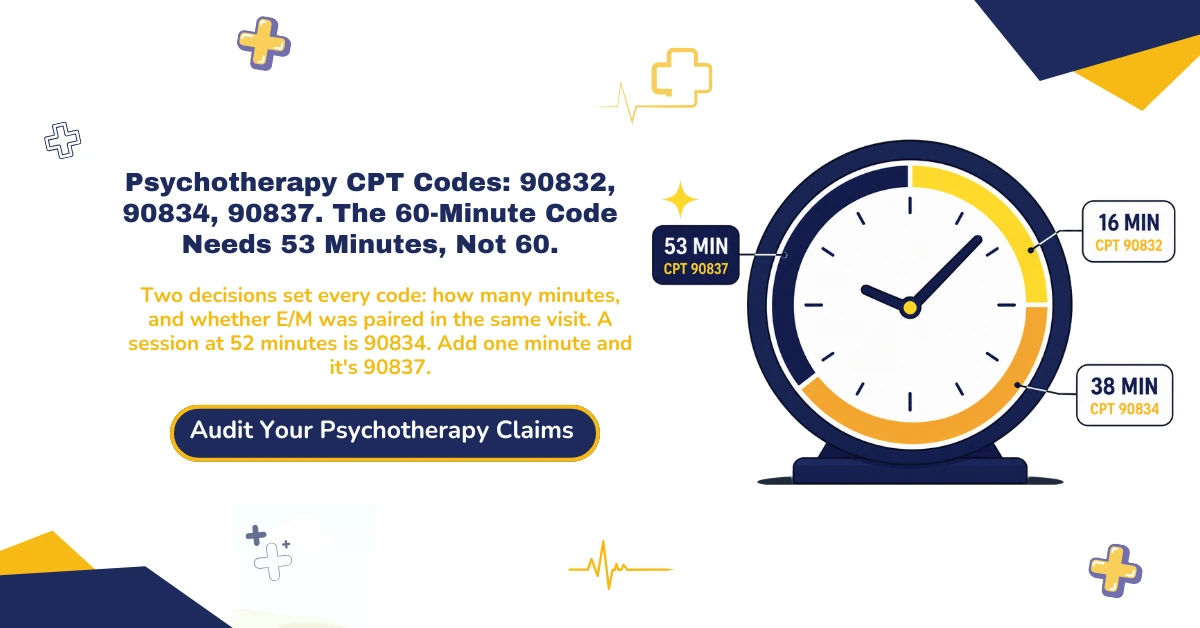
Most billing teams call 90837 the 60-minute code, and most type “60 minute psychotherapy CPT code” when they look it up. That label matches what the AMA prints, but it sets up a documentation error, because CPT 90837 requires 53 minutes, not 60.
A session that ends at 55 minutes is 90837. A session that ends at 52 minutes is 90834. The minute band sets the code, and the round number on the label is what trips practices up.
This guide walks through every individual psychotherapy code, the add-on codes for therapy paired with an E/M visit, the full 2026 Medicare rates, the telehealth rules including modifier 93’s permanent status, the crisis-code exclusion list, and the documentation format auditors accept on first review.
CPT 90832: Individual Psychotherapy, 30 Minutes (16 to 37 Minutes)
CPT 90832 is the billing code for individual psychotherapy sessions lasting 16 to 37 minutes of face-to-face therapeutic time. Under the AMA’s CPT mid-point rule, the session has to run at least 16 minutes to qualify.
CMS-published guidance states that psychotherapy should never be reported under 16 minutes, so 15 minutes of face-to-face time isn’t billable as psychotherapy under any individual code.
The American Psychiatric Association CPT Primer sets the same floor: more than 15 minutes of face-to-face time before psychotherapy is billable.
Who Bills CPT 90832 and When
LCSWs, LPCs, LMFTs, psychologists, and other non-prescribing therapists bill 90832 as a standalone code. A psychiatrist or PMHNP who performs no medication management during the visit can use 90832 as a standalone too.
When the same provider runs both medication management and a 16-to-37-minute therapy session in one appointment, the correct pair is an E/M code (99211 through 99215) plus the add-on 90833, not 90832. That single distinction prevents the most common E/M-plus-therapy billing error.
What the Documentation Must Show for 90832
The note has to record start and stop times or total face-to-face time. Write the actual clock notation. “Session: 2:10 PM to 2:38 PM (28 minutes of individual psychotherapy)” clears every CMS and MAC reviewer on first pass. “Approximately 30 minutes” doesn’t.
CPT 90832 pays $85.84 under the 2026 Medicare Physician Fee Schedule at the non-facility rate. LMFT and LMHC providers, who bill Medicare at 75 percent of the fee schedule since their January 2024 eligibility, collect roughly $64.38 for a 90832 session.
CPT 90834: Individual Psychotherapy, 45 Minutes (38 to 52 Minutes)
CPT 90834 is individual psychotherapy lasting 38 to 52 minutes of face-to-face therapeutic time. Under the CPT mid-point rule, a session has to reach at least 38 minutes to qualify for 90834.
A session of 37 minutes or less is 90832. A session of 53 minutes or more is 90837.
The 38-Minute Floor and the 52-Minute Ceiling
The 38-minute floor and the 52-minute ceiling decide whether you bill 90832, 90834, or 90837. A session documented at 50 minutes is 90834. A session documented at 53 minutes is 90837. A session documented at 52 minutes is 90834.
The documented time is the only thing that sets the code, so write the actual clock times in the note. The format from the 90832 section applies here without change.
CPT 90834 2026 Rates by Provider Credential
The 2026 Medicare rate for CPT 90834 at the non-facility rate is $113.90. An LMFT or LMHC provider billing Medicare collects 75 percent of that, or roughly $85.43.
Commercial payer rates vary by market. For the full payer-by-payer 90834 rate analysis covering BCBS, Aetna, UHC, and Cigna, see ClaimMax RCM’s complete 90834 billing guide.
UHC typically requires prior authorization for individual psychotherapy after 20 to 30 sessions, which hits 90834 and 90837 in roughly equal measure. Knowing that threshold before you submit the 21st claim prevents the most common mid-course 90834 denial.
CPT 90837: Individual Psychotherapy, 60 Minutes (53 Minutes or More)
CPT 90837 is individual psychotherapy for 53 minutes or more of face-to-face therapeutic time. The AMA CPT descriptor labels it “60 minutes,” and that label is where the documentation risk starts.
The 53-Minute Threshold: The Number That Prevents the Most Common 90837 Audit
The threshold for CPT 90837 is 53 minutes, not 60 and not “about an hour.” A session documented at 53 minutes qualifies. A session documented at 52 minutes is 90834, no matter how close it sits to the hour mark.
RAC auditors reviewing 90837 claims don’t look for notes that say “60-minute session.” They look for start and stop times that confirm at least 53 minutes of face-to-face contact.
A note reading “2:00 PM to 2:52 PM” is 90834. A note reading “2:00 PM to 2:53 PM” is 90837. That minute-level precision has to sit in the clinical record before the claim goes out.
Billing CPT 90837 for a session documented at 50 minutes is upcoding under CMS guidelines. RAC contractors carry a six-year lookback for psychotherapy upcoding, and CGS Medicare has flagged 90832, 90834, and 90837 for documentation evidence review.
The risk isn’t theoretical. The CPT code for 60 minutes of psychotherapy is 90837, requiring 53 minutes or more.
CPT 90837 Documentation: The Clock-Time Standard
The note has to show actual start and stop times. The CMS-model format reads: “Session began at 10:05 AM and concluded at 11:01 AM (56 minutes of face-to-face psychotherapy).”
That format clears an auditor on first review and protects against the OIG’s most common 90837 finding, which is psychotherapy time not documented.
These requirements follow CMS Billing and Coding Article A57480, which sets the documentation standard for psychiatry and psychology services.
Beyond the time, the note records the modality (CBT, DBT, EMDR, solution-focused, or other), the specific interventions and patient response, a mental status observation, a risk assessment, and progress toward treatment-plan goals.
CPT 90837 2026 Rates: Medicare and Commercial
The 2026 Medicare rate for CPT 90837 is $167.00 at the non-facility rate. At POS 10, the patient’s home, that full rate applies. At POS 02, telehealth from a facility site, the facility rate applies, and the telehealth section below gives the dollar difference.
LMFT and LMHC providers billing at 75 percent of the fee schedule collect roughly $125.25. For BCBS commercial rates by market and credential, see ClaimMax RCM’s BCBS 90837 reimbursement guide.
Psychotherapy Add-On Codes 90833, 90836, and 90838: When E/M and Therapy Happen Together
Therapy without medical evaluation and management bills as 90832, 90834, or 90837. When a psychiatrist or PMHNP delivers both medication management and therapy in the same visit, those services bill together as an E/M code (99211 through 99215) plus one of three add-on codes.
The add-on codes mirror the standalone time bands, but they can’t stand alone. They need the E/M code as the primary service.
How the Add-On Code Pairing Works
Three add-on codes exist. CPT 90833 covers 16 to 37 minutes of therapy delivered alongside an E/M visit. CPT 90836 covers 38 to 52 minutes. CPT 90838 covers 53 or more minutes.
All three carry a plus sign in the CPT codebook and pair with an E/M code on the same claim.
Therapy time for these codes counts separately from E/M time. The minutes a prescriber spends reviewing medication response, adjusting dosage, and documenting the E/M decision don’t count toward the therapy minutes, and the reverse holds too.
Both services have to be significant and separately identifiable per CMS guidance. That separation is the most common add-on denial trigger.
Add-on codes 90833, 90836, and 90838 are reportable only by providers with E/M services in their scope. LCSWs, LPCs, LMFTs, and psychologists who don’t perform E/M or medication management can’t use them.
The Combined Billing Dollar Comparison for 2026
Picture a prescriber who spends 20 minutes on medication management (E/M code 99214) and 20 minutes on CBT in the same visit (add-on code 90833). At 2026 Medicare rates, 99214 pays $135.61 and 90833 pays $81.50.
The combined claim produces $217.11, against $167.00 for billing 90837 alone for the same total time. The combined approach captures $50.11 more from one well-documented visit. For the E/M rate methodology behind this math, see our 99214 reimbursement guide.
NCCI Bundling Rules and the Modifier 25 Requirement
The NCCI edits set bundling rules for these add-on codes. Many payers require modifier 25 on the E/M code to show that the evaluation and management service was significant and separately identifiable from the therapy on the same day.
Without modifier 25, a payer may bundle the E/M into the therapy and pay one rate. Verify each payer’s modifier 25 rule before the first combined claim, because the requirement varies and isn’t universal.
CPT 90838 pays $136.61 in 2026, the highest-paying add-on code.
Billing Psychotherapy Sessions Over 60 Minutes: The 2023 Rule Change That Still Catches Practices Off Guard
Billing teams keep asking one question: what CPT code covers a therapy session that runs 90 minutes or two hours? The answer surprises most of them, so it helps to see what changed.
What Happened to CPT 99354 and 99355 for Psychotherapy
Before 2023, providers reporting a prolonged therapy session added 99354 and 99355 to the primary psychotherapy code. That ended on January 1, 2023. The AMA deleted 99354 and 99355 with the 2023 CPT revisions, and those codes no longer exist as reportable services.
Any claim pairing 99354 or 99355 with a psychotherapy code denies. Two units of 90837 on one claim to approximate 90 minutes denies too, since psychotherapy codes report as one unit per day.
CPT 99417 replaced 99354 and 99355 in certain E/M prolonged-services situations, but it can’t attach to psychotherapy codes because it belongs to the E/M framework. Providers who don’t perform E/M services can’t report 99417, and it can’t append to a standalone psychotherapy code.
How to Bill a 90-Minute Psychotherapy Session Today
Per CMS-published guidance, prolonged services can still apply to standalone 90837 when the session involves 90 minutes or more of direct patient contact.
The reporting mechanism depends on the MAC jurisdiction and current payer policy, since the original codes are deleted and any replacement varies by contractor.
The defensible approach is simpler than the question suggests. Document the full time and bill one unit of 90837.
The 90837 descriptor reads “53 minutes or more” with no stated upper ceiling, so a 90-minute session documented with precise clock times bills as 90837 without a prolonged-services add-on.
If your MAC jurisdiction needs prolonged-service reporting, confirm the current code with your MAC directly. Don’t pull the mechanism from a prior-year guide that still references the deleted 99354 and 99355.
A 90-minute session doesn’t need a code modification to bill. It bills as 90837, documented with precise start and stop times.
CPT 90785 Interactive Complexity: The Add-On Code Worth $14 to $15 Per Session That Most Practices Miss
CPT 90785 is an add-on code for interactive complexity that pays roughly $14 to $15 per session, with geographic variation, when it applies. It doesn’t change the primary code. It doesn’t add session time.
It documents that specific communication factors made the session more complex, and that complexity carries a billable value most outpatient behavioral health practices never capture.
The Four Specific Communication Factors That Qualify a Session for 90785
The American Psychiatric Association Interactive Complexity Guide defines interactive complexity as specific communication factors that complicate delivery of a mental health procedure, and it names four qualifying factors.
The patient has someone legally responsible for their care, such as a minor or an adult with a guardian. Others attend at the patient’s request, such as family members or interpreters.
The session pulls in third parties, such as schools, probation officers, or child welfare. A communication barrier arises from the patient’s developmental stage, cognitive limits, or acrimonious family dynamics.
An interpreter’s presence alone doesn’t qualify unless that presence itself complicates the clinical interaction. Translating words without communicative complexity falls short of the threshold.
Which Primary Codes Can Pair with 90785 (And Which Cannot)
CPT 90785 may be reported with 90791, 90792, 90832, 90833, 90834, 90836, 90837, 90838, and 90853. That’s the complete qualifying primary code list.
CPT 90785 cannot be reported with the crisis psychotherapy codes 90839 or 90840. When a session qualifies as both a crisis service and an interactive-complexity service, the crisis code wins. Report 90839, and 90840 if applicable, without adding 90785.
What the Documentation Must Show
The note has to name the specific qualifying factor. “Used interpreter for a Spanish-speaking patient whose family members held conflicting treatment views” is documentation. “Session involved communication barriers” isn’t. The specificity of that factor description is what protects the add-on code on audit.
Telehealth Psychotherapy CPT Codes: POS 10 vs POS 02, Modifier 93, and What’s New for 2026
Behavioral health telehealth gets statutory treatment under Medicare that most specialties don’t share. No geographic restriction limits where the patient sits. No originating-site rule applies. Those flexibilities run through December 31, 2027 under the Consolidated Appropriations Act, 2026.
You don’t need to check whether a patient lives in a rural area to bill psychotherapy telehealth.
Place of Service 10 vs Place of Service 02: The $42-Per-Session Revenue Difference
Two place-of-service codes drive how Medicare pays for telehealth psychotherapy. POS 02 applies when the patient sits anywhere other than home, such as a clinic, a school, or a workplace. POS 10 applies when the patient is in their private home.
POS 10 reimburses at the non-facility rate, the higher one, and POS 02 reimburses at the facility rate. For CPT 90837 in 2026, that gap runs about $42 per session. Across 100 sessions, POS 10 versus POS 02 is a $4,200 swing.
The POS distinction applies to every individual psychotherapy code and to family codes 90846 and 90847 by telehealth. For the full POS 02 rate breakdown and the POS 10 documentation requirements, see ClaimMax RCM’s POS 02 telehealth billing guide.
Modifier 95 and Modifier 93: The Right Modifier for Every Telehealth Scenario
Modifier 95 identifies a synchronous telemedicine service delivered over real-time, two-way audio-video. It’s the primary telehealth modifier for most commercial payers and Medicare, and it rides on the claim alongside the psychotherapy code.
The note has to document delivery over a real-time interactive audio-video platform. A missing modifier 95 ranks among the five most common telehealth denial causes. For Appendix P requirements, denial codes, and 2026 POS pairing, see ClaimMax RCM’s modifier 95 billing guide.
Audio-Only Psychotherapy and the 2026 Permanent Status of Modifier 93
For patients who can’t access or consent to video, Medicare covers audio-only psychotherapy for behavioral health. The modifier for audio-only telehealth is modifier 93.
As of 2026, modifier 93’s coverage for behavioral health audio-only services is permanent, and it doesn’t expire under the current regulatory framework. That’s a real shift from the temporary authority that governed audio-only billing through the public health emergency.
Where part of your patient population uses audio-only sessions, that revenue stream is now stable.
Audio-only billing carries requirements. The provider and patient need an established relationship formed in person at some prior point. The patient lacks video access or can’t consent to it. The provider documents both the inability to use video and the clinical rationale for proceeding.
Don’t append modifier 93 for a patient who prefers a phone call.
2026 Telehealth Policy Timeline Billing Teams Must Know
Two deadlines matter. The mandatory in-person visit requirement for home-based mental health telehealth, the rule requiring an in-person visit before the first home session and annually after, is delayed past December 31, 2027.
You don’t need an in-person prerequisite for telehealth patients in any session before January 1, 2028. And CPT 90849, multiple-family group psychotherapy, joined the Medicare Telehealth Services List effective January 1, 2026.
CPT 90839 and 90840: Psychotherapy for Crisis and the Codes You Cannot Bill With Them
CPT 90839 covers psychotherapy for crisis, billed for the first 60 minutes. CPT 90840 is the add-on for each additional 30 minutes of crisis psychotherapy beyond the first 60.
What Qualifies as a Crisis Psychotherapy Session
A crisis session requires a presenting problem that’s life-threatening or complex and demands immediate attention for a patient in high distress.
The work includes an urgent assessment and history of the crisis state, a mental status exam, mobilization of resources to defuse the crisis and restore safety, and a disposition decision.
A routine session with a high-risk client that happens to run long doesn’t qualify. This is a distinct service category for patients in acute crisis.
90839 covers the initial 60 minutes whether the session ran 30 minutes or the full 60, and CMS guidance applies the code to sessions of 30 to 74 minutes for that initial unit.
A crisis session under 30 minutes bills as 90832 or 90833, with an E/M code if one applies. 90840 reports each additional 30 minutes past the 74-minute mark.
The Complete CMS Exclusion List for 90839 and 90840
CMS instructs that 90839 and 90840 cannot be billed with CPT 90791 or 90792, with any code in the range 90785 through 90899, or with any code in the range 90832 through 90838.
A patient can’t bill both a diagnostic evaluation and a crisis session on the same date, and a crisis session can’t bill alongside a standard psychotherapy session for the same patient on the same date.
That exclusion list governs every crisis claim, and it’s the pre-submission scrub rule billing teams most need in their claims-editing workflow.
Per CMS Billing and Coding Article A57480, Medicare’s Coverage Database publishes this exclusion list directly, the same source covering the documentation standards referenced earlier in this guide.
The 150 Percent Payment Multiplier and HCPCS G0017/G0018
Crisis psychotherapy carries a payment premium no other psychotherapy category receives. Payment for crisis psychotherapy equals 150 percent of the fee schedule amount for services furnished in non-facility sites.
The 2026 Medicare rate for CPT 90839 is $160.32 and for CPT 90840 is $77.16, both reflecting standard non-facility calculations before any multiplier adjustment tied to specific billing scenarios.
For certain non-facility crisis scenarios, CMS guidance indicates that HCPCS codes G0017 and G0018 may apply in addition to or instead of the standard CPT codes.
Practices billing crisis psychotherapy outside a traditional office, such as a community mental health center or a mobile crisis context, should verify whether G0017 and G0018 apply to their site before submitting, since the standard CPT codes alone may not capture the full reimbursement.
Family and Group Psychotherapy Codes: 90846, 90847, 90849, and 90853
90846 vs 90847: The Difference Is Whether the Patient Is in the Room
CPT 90846 is family psychotherapy without the patient present, for sessions lasting 50 minutes. CPT 90847 is family psychotherapy with the patient present, also called conjoint psychotherapy, also at 50 minutes.
The clinical format picks the code, not the session length, since both share the same reference duration. Use 90846 when the work addresses the family system without the identified patient in the room, such as parent coaching focused on a child’s behavior.
Use 90847 when the patient participates alongside family members in the same session.
Document who attended and the clinical reason for the format. A note that says “family session” without naming which members attended and why the patient was or wasn’t present invites a payer request for more documentation.
The 2026 Medicare rate for CPT 90846 is $105.88. CPT 90847 pays $109.55.
90853: The Group Billing Error That Costs Practices Revenue
CPT 90853 covers group psychotherapy other than a multiple-family group. The code bills per patient per session, not once for the whole group. A therapist running a six-person group bills 90853 six separate times, once for each patient, each on that patient’s own claim.
Billing 90853 once for the group as a unit under-bills the session by a wide margin and ranks among the most common revenue-loss patterns in group-format practices.
CPT 90853 excludes recreational activities, play, eating together, art or music therapy outside a clinically structured framework, excursions, sensory stimulation, general socialization, and motion therapy.
The group has to target a specific clinical problem, such as depression, substance use, or social anxiety. CPT 90853 pays $30.39 per patient per session in 2026.
90849: New to the Telehealth List in 2026
CPT 90849 covers multiple-family group psychotherapy, used when several family units meet together, common in partial hospitalization and intensive outpatient settings. It bills per session, not per family unit.
As of January 1, 2026, CPT 90849 joined the Medicare Telehealth Services List, so multiple-family group psychotherapy now bills as a telehealth service under Medicare, which prior years didn’t allow. CPT 90849 pays $40.42 in 2026.
Psychotherapy CPT Codes 2026 Rate Table: Medicare, LMFT/LMHC, and Quick Reference
The table below pulls every 2026 Medicare rate, time threshold, and LMFT/LMHC adjusted rate from this guide into one quick-reference format.
| CPT Code | Description | Time Threshold | 2026 Medicare Rate | LMFT/LMHC Rate |
|---|---|---|---|---|
| 90791 | Psychiatric diagnostic evaluation | No time requirement | $173.35 | $130.01 |
| 90792 | Psychiatric diagnostic evaluation with medical services | No time requirement | $202.08 | Not billable by LMFT/LMHC |
| 90832 | Individual psychotherapy, 30 minutes | 16 to 37 minutes | $85.84 | $64.38 |
| 90833 | Psychotherapy add-on with E/M, 30 minutes | 16 to 37 minutes | $81.50 | Not billable (E/M scope required) |
| 90834 | Individual psychotherapy, 45 minutes | 38 to 52 minutes | $113.90 | $85.43 |
| 90836 | Psychotherapy add-on with E/M, 45 minutes | 38 to 52 minutes | $103.21 | Not billable (E/M scope required) |
| 90837 | Individual psychotherapy, 60 minutes | 53 or more minutes | $167.00 | $125.25 |
| 90838 | Psychotherapy add-on with E/M, 60 minutes | 53 or more minutes | $136.61 | Not billable (E/M scope required) |
| 90839 | Psychotherapy for crisis, first 60 minutes | 30 to 74 minutes | $160.32 | $120.24 |
| 90840 | Psychotherapy for crisis, each additional 30 minutes | Add-on | $77.16 | $57.87 |
| 90846 | Family psychotherapy without patient present | 50 minutes (26 minute minimum) | $105.88 | $79.41 |
| 90847 | Family psychotherapy with patient present | 50 minutes (26 minute minimum) | $109.55 | $82.16 |
| 90849 | Multiple-family group psychotherapy | Per session | $40.42 | $30.32 |
| 90853 | Group psychotherapy | Per patient per session | $30.39 | $22.79 |
| 90785 | Interactive complexity (add-on) | N/A | $14 to $15 (varies by region) | About 75% of national rate |
The 2026 conversion factor behind these rates is $33.40 per relative value unit for non-Qualifying APM participants and $33.57 for QPP participants.
Commercial payer rates typically run 120 to 200 percent of these Medicare baselines, varying by region, payer, and credential, with the highest commercial reimbursement generally found in high-cost-of-living states for 60-minute individual psychotherapy.
Psychotherapy Documentation That Survives an Audit: CGS Warnings, RAC Lookback, and OIG Findings
The Clock-Time Documentation Standard
Every time-based psychotherapy code needs documented start and stop times or a clearly stated total face-to-face duration.
The format that clears every payer and MAC on first review states the actual clock times: “Session began at 10:05 AM and concluded at 10:52 AM (47 minutes of face-to-face psychotherapy).”
“Approximately 45 minutes” or “standard session” doesn’t meet the standard, and it’s the documentation gap auditors cite most.
Past the time, every note needs the modality used, the interventions described in behavioral terms (not “good rapport” but “used cognitive restructuring to address catastrophic thinking”), the patient’s response, a risk assessment, and progress toward the treatment plan.
Why CGS Medicare Flagged 90832, 90834, and 90837 for Review
CGS Medicare, a MAC covering several states, has issued guidance flagging CPT 90832, 90834, and 90837 for documentation evidence assessment. That isn’t a blanket warning against billing these codes.
It signals that claims-editing systems and manual reviews are calibrated to check whether the documented time supports the billed code, and whether a provider’s repeated 90837 use lines up with genuine 53-plus-minute sessions instead of a default habit.
RAC contractors carry a six-year lookback for psychotherapy upcoding, so a documentation gap found in a 2026 audit can trigger recoupment on claims back to 2020.
What OIG’s National Audit Found
The HHS Office of Inspector General has run national audits of psychotherapy billing, including telehealth-delivered sessions, and found recurring failure patterns across sampled claims.
The two most common findings: psychotherapy time not documented well enough to support the billed code, and telehealth services billed without the correct place-of-service code or required modifier.
These aren’t isolated practice-level slips. They’re documented, national-scale patterns that shape how hard payers and auditors scrutinize behavioral health claims.
Preventing the Most Common Psychotherapy Claim Denials
The Top Denial Patterns and Their CARC Codes
The frequent psychotherapy denials trace to a small set of causes. Missing or thin time documentation produces a CO-16 denial, claim lacks information needed for adjudication, or a medical-necessity denial depending on the payer.
Incorrect telehealth coding, a missing modifier 95 or a wrong POS, produces denials that often show as CO-B7 or a payer-specific telehealth rejection. Billing 90791 on the same date as an individual psychotherapy code produces a same-day-service denial, usually CO-97.
Exceeding a payer’s session-count threshold without a current authorization produces a CO-197.
When a CO-197 repeats across multiple claims for the same patient and payer, the individual claim isn’t the root issue. The gap is a missing front-end process for tracking session counts against payer-specific authorization triggers.
CGS Medicare has flagged 90832, 90834, and 90837 for documentation evidence review, and RAC audits carry a six-year lookback for psychotherapy upcoding.
ClaimMax RCM’s behavioral health billing team runs a pre-submission documentation review on every individual psychotherapy claim to catch missing start-stop times before they reach the payer.
When CO-197 denials repeat across claims from the same payer, the cause is almost always a missing session-count tracking workflow, not the claim in front of you.
Denial management services trace the pattern to its source and fix the front-end process, not just the rejected claim.
Payer-Specific Prior Authorization Thresholds
Prior authorization rules for individual psychotherapy vary by payer. Medicare doesn’t require prior authorization for standard individual psychotherapy codes. UHC typically requires authorization after 20 to 30 sessions, depending on plan. Aetna often lands near the same 20-session range.
BCBS rules vary by state plan and need direct verification. Medicaid runs from no authorization in some states to a requirement after a low single-digit visit count in others, such as a trigger after the eighth visit in certain state programs.
Tracking session counts against these thresholds before the authorization-required visit is a front-end eligibility and prior authorization job, not a downstream fix applied after a denial lands.
Eligibility and prior authorization services that monitor these thresholds keep the CO-197 from happening in the first place.
Psychotherapy Billing and Credentialing in California: LMFT, LCSW, and LMHC Enrollment
California Medi-Cal Psychotherapy Billing Specifics
California’s Medi-Cal program reimburses psychotherapy at a share of the Medicare rate that varies by managed care plan and county.
Behavioral health delivered through Medi-Cal’s specialty mental health system, for patients meeting medical-necessity criteria for specialty care, follows a separate billing pathway from the managed care plan’s mild-to-moderate benefit, and each pathway carries its own enrollment and authorization rules.
A practice billing both pathways for different patients runs two distinct credentialing and billing workflows at once, not one generic Medi-Cal process.
California has raised behavioral health reimbursement in recent years as part of broader state investment in mental health access, though the increase varies by county and managed care plan and needs direct verification rather than one statewide assumption.
LMFT and LMHC Medicare Enrollment Since 2024
Licensed Marriage and Family Therapists and Licensed Mental Health Counselors became eligible Medicare providers on January 1, 2024, reimbursed at 75 percent of the Medicare Physician Fee Schedule.
Enrollment runs through the CMS-855I paper application or PECOS online, and it typically takes 60 to 120 days from submission to approval.
A new LMFT or LMHC joining a practice needs that enrollment started well before their first scheduled Medicare patient, since claims submitted before enrollment completes will deny.
LMFTs and LMHCs can’t bill CPT 90792 under any circumstances, since that code requires prescriptive authority outside their scope. They also can’t report the E/M-paired add-on codes 90833, 90836, or 90838, since those need an E/M service in the provider’s scope.
ClaimMax RCM is California’s best billing and credentialing company for psychotherapy and psychiatry practices, managing individual psychotherapy billing for LCSWs, LPCs, LMFTs, psychologists, and PMHNPs across California and nationwide.
On the enrollment side, California psychotherapy billing services and credentialing and contracting services keep a new provider’s first claim from stalling on an incomplete PECOS file.
Psychotherapy CPT Codes: Frequently Asked Questions
What is the CPT code for a 60-minute psychotherapy session?
The CPT code for 60 minutes of psychotherapy is 90837, though the threshold is 53 minutes or more, not exactly 60. A session documented at 52 minutes or less is 90834, not 90837.
Who uses CPT codes for psychotherapy?
Psychiatrists, psychologists, licensed clinical social workers, licensed professional counselors, licensed marriage and family therapists, licensed mental health counselors, and psychiatric mental health nurse practitioners all use the same psychotherapy CPT codes when billing Medicare, Medicaid, and commercial payers.
Can I bill 90791 and 90837 on the same day?
No. Most payers and CMS guidance restrict billing a full psychiatric diagnostic evaluation and a full psychotherapy session on the same date for the same patient. Schedule the diagnostic evaluation and the first psychotherapy session on separate dates.
Do I need a modifier for telehealth psychotherapy sessions?
Yes. Modifier 95 applies to synchronous audio-video telehealth. Modifier 93 applies to audio-only sessions and carries permanent coverage status for behavioral health as of 2026. The correct place-of-service code, 02 or 10, applies alongside the modifier.
What is the difference between 90846 and 90847?
CPT 90846 is family psychotherapy without the patient present. CPT 90847 is family psychotherapy with the patient present, also called conjoint psychotherapy. The clinical format, not session length, picks the code.
Is 90837 risky to bill?
CPT 90837 isn’t a high-risk code when the session ran 53 minutes or more and the note shows actual start and stop times. The risk comes from billing 90837 as a default habit without time documentation that supports the threshold.
What CPT codes can be billed with interactive complexity (90785)?
CPT 90785 may be reported with 90791, 90792, 90832, 90833, 90834, 90836, 90837, 90838, and 90853. It cannot be reported with the crisis psychotherapy codes 90839 or 90840.
What is the 2026 Medicare rate for CPT 90834?
The 2026 Medicare non-facility rate for CPT 90834, individual psychotherapy at 45 minutes, is $113.90. The full psychotherapy CPT codes rate table above gives the payer-credential breakdown for every code.
Getting Psychotherapy CPT Codes Right in 2026
Every psychotherapy CPT code traces back to the two questions from the start of this guide: how many minutes the session ran, and whether an E/M service happened alongside it.
Getting these codes right in 2026 means documenting actual clock times, knowing the full crisis-code exclusion list, and tracking the telehealth modifier and place-of-service rules that set reimbursement.
Psychotherapy billing is one piece of a working revenue cycle that also runs eligibility verification, prior authorization, credentialing, claim submission, and denial recovery as one connected workflow.
See how those pieces fit together for California psychotherapy and psychiatry practices in ClaimMax RCM’s behavioral health revenue cycle management.