| Quick AnswerThe 99496 CPT code description defines a high-complexity transitional care management service for patients seen within 7 calendar days of discharge from a hospital, skilled nursing facility, or other inpatient setting.The 2026 Medicare national average rate for CPT 99496 is about $298, roughly a 10% increase over the 2025 rate of $272.68, under the CMS CY 2026 Physician Fee Schedule Final Rule (CMS-1832-F).Billing CPT 99496 takes three elements: interactive contact with the patient or caregiver within 2 business days of discharge, high-complexity medical decision-making across the 30-day period, and a face-to-face visit within 7 calendar days of discharge.Only one physician or non-physician practitioner can bill CPT 99496 per patient per discharge, and the code reports once during the 30-day TCM period.ClaimMax RCM manages CPT 99496 billing for primary care and internal medicine practices as a structured workflow, tracking every 2-business-day contact deadline and 7-day visit window at the patient level before any claim goes out. |
Here’s what trips practices up: the 99496 CPT code description rewards high-complexity post-discharge care, but the payment only lands when the 2-business-day contact, the 7-day visit, and high MDM are all documented. Miss one, and the claim either downcodes to 99495 or denies.
What Does the 99496 CPT Code Description Mean? The Official AMA Definition
The Official CPT 99496 Description: Three Required Elements
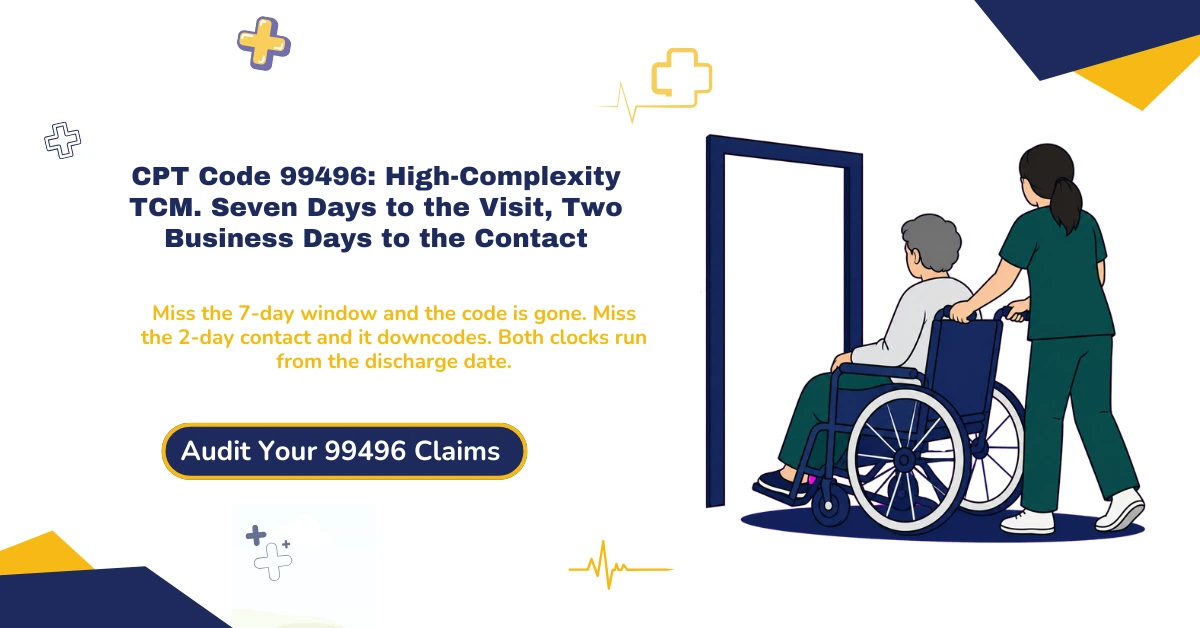
The 99496 CPT code description sits in the Evaluation and Management range as the high-complexity transitional care management code. It calls for three things: communication with the patient or caregiver within 2 business days of discharge, high-level medical decision-making across the 30-day period, and a face-to-face visit within 7 calendar days of discharge.
- Interactive contact within 2 business days: The provider or clinical staff reaches the patient or caregiver by phone, email, or direct contact within 2 business days of discharge. Weekends and federal holidays don’t count, so a Friday discharge makes Monday the first business day and Tuesday the second.
- High-complexity medical decision-making: The case has to require high-level MDM during the service period. The three MDM elements are the number and complexity of problems addressed, the amount and complexity of data reviewed, and the risk of complications, morbidity, or mortality from how the patient is managed.
- Face-to-face visit within 7 calendar days: One face-to-face visit with the billing physician or qualified NPP happens within 7 calendar days of discharge, counting the discharge date as Day 1. A visit on day 8 means 99496 won’t bill, though 99495 may still apply if the visit lands within 14 days with moderate MDM.
- Medication reconciliation by the visit date: CMS requires medication reconciliation and management on or before the date of the face-to-face visit. Doing it after that visit doesn’t meet the requirement.
The 7-Day vs 14-Day Hospital Follow-Up Window
Billers often call 99495 and 99496 the hospital follow-up codes, and the follow-up window is what separates them.
CPT 99496 requires the hospital follow-up, the face-to-face visit, within 7 calendar days of discharge. CPT 99495 allows a hospital follow-up within 14 calendar days. Shorter window, higher MDM, higher code.
Who Can Bill CPT 99496? Provider Eligibility and Clinical Responsibility
Physicians of any specialty can bill CPT 99496. Four types of non-physician practitioners qualify too: nurse practitioners, physician assistants, certified nurse-midwives, and clinical nurse specialists. All of them need to be credentialed with the payer and enrolled under their own NPI before the first 99496 claim goes out.
The billing provider owns the 30-day TCM period. Clinical staff under that provider’s direction handle the non-face-to-face work, the coordination calls, patient education, and medication-management support, but the required face-to-face visit belongs to the billing physician or qualified NPP.
Only one physician or NPP bills CPT 99496 per patient per discharge. When a hospitalist discharges the patient and a primary care physician runs the post-discharge care, one of them has to be the designated biller for that 30-day period. Bill both, and the second claim denies as a duplicate.
Provider enrollment across payers blocks TCM revenue before it ever starts. Our complete 13-step RCM billing workflow maps where TCM billing fits, from patient registration through denial recovery.
CPT 99495 vs CPT 99496: What Is the Difference?
The 99496 CPT code description identifies high-complexity TCM, while 99495 covers the moderate-complexity version. The table below lines them up side by side.
| Feature | CPT 99495 (Moderate TCM) | CPT 99496 (High TCM) |
|---|---|---|
| MDM level | Moderate complexity | High complexity |
| Face-to-face visit deadline | Within 14 calendar days of discharge | Within 7 calendar days of discharge |
| Hospital follow-up window | Within 14 days | Within 7 days |
| Initial contact | Within 2 business days of discharge | Within 2 business days of discharge |
| Patient risk profile | Meaningful post-discharge risk | Multiple comorbidities, high readmission risk, or serious acute events |
| 2026 Medicare national average | About $220 | About $298 |
| Work RVU | 2.11 | 3.05 |
| TCM period | 30 days from discharge | 30 days from discharge |
| One-provider rule | One provider per 30-day period | One provider per 30-day period |
CPT 99495 vs CPT 99496 at a glance. Rates are 2026 national averages and vary by locality.
What Does CPT Code 99495 Mean?
CPT code 99495 is the moderate-complexity transitional care management code. It applies when a provider manages a patient’s care after discharge from an inpatient facility, the case needs at least moderate MDM, and the face-to-face visit happens within 14 calendar days.
The 2026 Medicare national average for 99495 runs about $220, below 99496’s $298. Moderate MDM reflects lower complexity and a longer follow-up window. Both codes cover a 30-day period that starts on the discharge date.
Why the Rate Difference Between 99495 and 99496 Matters for Code Selection
Practices that default to 99495 for every TCM encounter leave money on the table when the chart supports high MDM. The 99496 CPT code description rewards that added complexity, and the gap runs roughly $78 per claim. At 40 TCM claims a month, that’s about $3,120 in legitimate revenue the practice earned but didn’t capture.
Code selection here isn’t about time. Both codes cover the same 30-day period. What decides it is the documented MDM level and whether the face-to-face visit happened within 7 days for 99496 or within 14 days for 99495.
Upcoding 99496 on moderate-MDM documentation is a compliance risk. Undercoding 99495 on clear high-MDM documentation is lost revenue. ClaimMax RCM’s billing specialists review the TCM complexity documentation before submission so the code matches the chart. The MDM threshold here mirrors the one in new-patient E/M selection, which our CPT 99204 billing and MDM guide breaks down.
The Three Requirements for Billing CPT 99496 in 2026
Meeting all three requirements behind the 99496 CPT code description is where TCM billing breaks. The problem is the workflow, not the coding.
Requirement 1: Interactive Contact Within 2 Business Days of Discharge
For 99496, a provider or clinical staff member makes interactive contact with the patient or caregiver within 2 business days of the discharge date. Phone, email, or in-person all count. A voicemail with no response back doesn’t.
Business days, not calendar days. Weekends and federal holidays don’t count. A Friday discharge closes the window at end of business Tuesday. If the deadline lands on a federal holiday, the next business day applies.
Document every attempt. Each one goes in the medical record with the date, time, method, and the name of the staff member who made it. CMS accepts two or more documented unsuccessful attempts as meeting the requirement when the rest of the TCM criteria are met.
Who makes the contact. The billing physician doesn’t have to make the call. Clinical staff under the physician’s direction can, as long as they can address patient status and needs beyond just booking the appointment. Scheduling alone isn’t an interactive contact.
That 2-day contact starts the clock on the visit. For 99496, that means a hospital follow-up within 7 days of the discharge date.
Requirement 2: Face-to-Face Visit Within 7 Calendar Days of Discharge
The 7-calendar-day window starts on the discharge date, which counts as Day 1. A Monday discharge needs the face-to-face visit by the following Sunday at the latest. Calendar days mean weekends count, so a Saturday or Sunday visit still qualifies.
The face-to-face visit belongs to the billing physician or qualified NPP, not a care coordinator. It covers the patient’s clinical status, a review of the care plan, and medication reconciliation if that’s not already done. The date of service on the claim is this visit date, not the discharge date and not the end of the 30-day period.
CMS has allowed the TCM face-to-face visit to be furnished by telehealth since 2014, when it meets Medicare’s telehealth rules. With the Medicare telehealth extension running through December 31, 2027, the 7-day visit can be met by interactive audio-video for the foreseeable future. Audio-only doesn’t satisfy the face-to-face requirement.
This hospital follow-up within 7 days rule is the single most common reason 99496 won’t bill. When the visit slips to day 8 or later, the code is off the table no matter how clean the documentation is.
Requirement 3: High-Complexity Medical Decision-Making Throughout the 30-Day Period
High MDM rests on three elements, the same ones CMS points to in the TCM booklet:
- Problems: the number and complexity of problems addressed during the period.
- Data: the amount and complexity of data reviewed, including records, tests, and outside notes.
- Risk: the risk of complications, morbidity, or mortality from how the patient is managed.
Patients juggling several chronic conditions at once, say heart failure, COPD, and diabetes, who need multiple medication changes, close monitoring, and coordination across specialists, land in high-complexity territory. So do recent serious events like stroke, heart attack, or severe decompensation. Significant diagnostic uncertainty, complex social factors, or a high readmission risk usually pushes the case to 99496 over 99495.
Documented high MDM is what separates transitional care management billing at the 99496 level from a 99495 claim.
Tracking the 2-day contact, the 7-day visit, and the 30-day period at the same time, for every discharged patient, is the part that breaks TCM billing at the workflow level. Our TCM medical billing service builds those deadline triggers into the pre-submission workflow so no TCM claim misses its window across your full caseload.
CPT 99496 Billing Guidelines: Date of Service, Place of Service, and Frequency Rules
What Is the Correct Date of Service for CPT 99496?
The date of service on a 99496 claim is the date of the face-to-face visit, not the discharge date and not the end of the 30-day period. Billing the discharge date is a common error that triggers a CO-4 denial.
The place of service has to match where the visit happened. Matching the date of service to the visit date is the rule that most billing errors break first.
What Place of Service Code Does CPT 99496 Use?
| Setting | POS code | What it means |
|---|---|---|
| Office visit (standard) | POS 11 | Office, the most common TCM face-to-face setting |
| Telehealth, patient not at home | POS 02 | Telehealth at a site other than the patient’s home |
| Telehealth, patient at home | POS 10 | Telehealth in the patient’s permanent residence |
Use POS 02 when the patient is at home for a telehealth visit, and the claim pays the facility rate instead of the higher non-facility rate. For 99496, that’s a silent underpayment, not a denial, so it surfaces in payment posting, not denial reports.
When 99496 runs alongside hospital outpatient E/M on the same day, POS assignment drives the rate. Our place of service billing guide covers how POS choice changes reimbursement and which combinations need POS verification first.
How Often Can CPT 99496 Be Billed? The Frequency Rule and Readmission Scenario
Only one CPT code 99496 line bills per discharge episode during the 30-day period. One provider, one claim, one code from the 99495/99496 pair.
If the patient goes back into a qualifying inpatient setting and gets discharged again, a new 30-day period starts with that second discharge. The practice can bill again, but only one provider bills per discharge, and the same provider can’t file the second claim if another provider already billed the first.
CMS’s Recovery Audit Contractors run an approved issue called Transitional Care Management: Excessive Units, aimed at practices that bill 99495 or 99496 more than once in a 30-day discharge period. The review looks for duplicate billing across providers who share a patient.
What Is the 1111F Code and When Does It Apply to CPT 99496?
When a patient doesn’t meet the full criteria for 99495 or 99496, but medication reconciliation still happened within 30 days of discharge, report CPT Category II code 1111F with the date it was performed.
Code 1111F is a quality-reporting code, not a billable service, so it generates no payment. It sits alongside the 99496 CPT code description framework only when TCM criteria are partly met, the reconciliation is done but the 7-day visit or the contact window wasn’t.
CPT 99496 Modifier Rules: Modifier 25, Modifier 95, and the G2211 Question
Does CPT 99496 Need a Modifier?
CPT 99496 doesn’t need a modifier for standard Medicare Part B billing. When it’s the only service on the claim for the visit date, it goes in clean.
Two situations change that: a separately identifiable E/M service on the same date, and a face-to-face visit furnished by telehealth. Outside those, the code carries no mandatory modifier for standard outpatient billing.
Can You Bill CPT 99214 and CPT 99496 Together?
Yes, but with real limits. The face-to-face visit that 99496 requires is already bundled into the TCM service, so you can’t bill it again as a separate E/M. A 99214 only rides alongside 99496 when the provider handles a separate, significant problem that’s distinct from the transitional-care work.
When that happens, Modifier 25 goes on the 99214 to flag it as a significant, separately identifiable service, and the documentation has to stand on its own for both the TCM work and the extra E/M. Payers scrutinize same-day TCM-plus-E/M closely, and some deny it even with Modifier 25.
The cleaner path is often a separate E/M on a different day inside the 30-day period. CMS allows additional E/M visits after the face-to-face visit, billed on their own date of service.
Modifier 25 documentation works the same whether the same-day service is a TCM code or a minor procedure. Our CPT 99214 Medicare reimbursement guide covers the Modifier 25 rules and the CO-97 denials that hit when it’s missing.
Can CPT 99496 and G2211 Be Billed Together?
Not on the same line, and here’s the mechanics. G2211 is an add-on that only attaches to office and outpatient E/M codes, 99202 through 99215, plus home-visit codes 99341 through 99350 as of 2026. CPT 99496 isn’t on that list.
Because the TCM face-to-face visit is bundled into 99496 rather than billed as a separate office E/M, there’s no eligible base code for G2211 to attach to inside a TCM claim. Append G2211 to a 99496 line and it denies.
This isn’t a duplicate-payment rule. CMS doesn’t treat G2211 as duplicative of care management. A provider can still bill G2211 on a separate qualifying office E/M visit and report TCM in the same service period, as long as each code stands on its own documentation.
Modifier 95 for Telehealth CPT 99496: POS Code and Documentation Rules
When the 99496 face-to-face visit is furnished by interactive audio-video telehealth, Modifier 95 flags it as a synchronous telehealth encounter. Use POS 02 when the patient isn’t at home and POS 10 when the patient is in their permanent residence.
Medicare doesn’t strictly require Modifier 95 when POS 10 is on the claim, but many commercial payers do, so adding it keeps the claim clean across payers. Audio-only doesn’t meet the face-to-face requirement, and commercial telehealth rules for 99496 vary, so verify each plan before the encounter.
2026 Medicare Reimbursement Rate for CPT 99496: How the $298 Rate Is Calculated
What Does Medicare Pay for CPT 99496 in 2026?
The 2026 Medicare national average for the 99496 CPT code description is about $298 in a non-facility setting, roughly 10% over the 2025 rate of $272.68. That payment comes from the code’s total RVUs, run through the CY 2026 conversion factor of $33.4009 for non-qualifying APM clinicians and adjusted by the geographic practice cost index for each locality.
Work RVUs are only part of it. CPT 99496 carries a work RVU of about 3.05, but the payment reflects the full total RVU, work plus practice expense plus malpractice. High-cost localities pay above the $298 average; lower-cost ones pay below it.
Here’s the formula: [(work RVU x GPCI) + (PE RVU x GPCI) + (MP RVU x GPCI)] x conversion factor. To pull your exact locality rate, enter 99496 in the CMS Physician Fee Schedule look-up tool with your MAC locality.
Commercial Payer Rates for CPT 99496 in 2026
Commercial payers set their own 99496 rates through individual contracts, and most land in the same neighborhood as Medicare or somewhat above it.
| Payer | 2026 CPT 99496 rate (directional) |
|---|---|
| Medicare Part B (non-facility) | About $298, national average |
| Commercial plans (typical range) | Roughly $290 to $320, varies by contract |
These are directional averages, not quotes. Actual rates swing by contract, specialty, NPI, and location, and the only way to know a specific plan’s rate is the contract or the remittance. A practice’s payer mix, not the code, usually explains why TCM collections differ from the Medicare baseline.
Why the 2026 Rate Increased About 10% from 2025
The bump traces to the CMS CY 2026 Physician Fee Schedule Final Rule, CMS-1832-F, effective January 1, 2026. The conversion factor rose to $33.4009 for non-QP clinicians, up from the 2025 figure, which lifts every code tied to it.
TCM codes also dodged the 2.5% efficiency adjustment CMS applied to roughly 7,700 procedural codes this year. Care management and E/M services were left out of that cut, so 99496 picks up the conversion-factor increase without the offsetting reduction.
Can You Bill CPT 99496 as Telehealth? 2026 Rules and the 2027 Extension
Is CPT 99496 a Covered Telehealth Service Under Medicare?
Yes. CPT 99496 is a covered Medicare telehealth service. CMS added the TCM codes, 99495 and 99496, to the Medicare telehealth list back in 2014, which lets the required face-to-face visit be furnished by telehealth. This isn’t a COVID-era flexibility waiting on renewal; TCM telehealth eligibility predates the pandemic.
2026 Telehealth Rules for CPT 99496: Modifier 95, POS Codes, and the Audio-Only Limit
Modifier 95 marks the 99496 visit as a synchronous audio-video telehealth encounter. POS 02 applies when the patient is at a clinic or other non-home site; POS 10 applies when the patient is in their home.
Audio-only doesn’t meet the face-to-face requirement for 99496 under Medicare. If the patient can’t do video, the visit has to happen in person to count as the TCM face-to-face encounter.
Commercial payers run their own telehealth rules for 99496 separate from Medicare. Check each plan’s coverage, modifier expectations, and originating-site rules before sending a telehealth TCM claim.
Does Medicare Still Cover Telehealth in 2026 and 2027?
Yes. Medicare covers telehealth through December 31, 2027, under the Consolidated Appropriations Act, 2026, signed in February 2026. The coverage reaches patients at any location in the United States, including the home, which removes the old originating-site limits that applied before the pandemic flexibilities. See the Medicare telehealth policy updates for the current dates.
For TCM telehealth documentation and visit-format guidance across payers, the AAFP Transitional Care Management toolkit is a solid reference.
Concurrent Billing with CPT 99496: What You Can and Can’t Bill Together
What E/M Codes Can Be Billed Alongside CPT 99496?
The required face-to-face visit for 99496 is bundled into the TCM service, so you can’t bill it again as a separate E/M. Submitting 99214 or 99213 for the same date as that required visit draws a bundling denial under NCCI edits.
When the patient needs another medically necessary office visit later in the 30-day period, for a separate issue distinct from the transitional-care work, that visit bills on its own date with the right E/M code, 99213, 99214, or 99215. CMS allows those subsequent E/M visits after the face-to-face visit.
TCM bundling denials and subsequent-E/M rejections follow predictable NCCI patterns. When the same denial repeats across patients from one payer, the cause is usually a configuration or documentation gap, not a coding misunderstanding. Our clearinghouse rejections and denial code guide walks the NCCI edit structure and the resubmission workflow.
When Can CPT 99496 and Chronic Care Management Be Billed Together?
Since the CY 2022 Physician Fee Schedule, CMS lets practices bill TCM and Chronic Care Management, codes 99487, 99489, 99490, and 99491, in the same calendar month. The catch is double-counting: the time and effort you count toward the TCM service can’t also count toward the CCM threshold.
Practices that log the same minutes for both, or count CCM time that overlaps the active TCM work, draw denials on the CCM claim. The usual culprit is a care coordinator logging CCM time during the TCM window because the software doesn’t flag the overlap. Configure the system to keep the two service periods separate.
What Codes Can’t Be Billed with CPT 99496?
Three categories of codes can’t sit on a CPT code 99496 claim. First, G0181 (home health care plan oversight) and G0182 (hospice care plan oversight), since they overlap the coordination TCM already covers. Second, a second TCM code in the same 30-day period, because only one TCM code bills per discharge.
Third, TCM can’t be billed during a post-operative global surgery period. When any part of the 30-day window falls inside a global period billed by the same practitioner, Medicare won’t pay the TCM service. CMS spells these exclusions out in its Transitional Care Management Services booklet.
CPT 99496 Denial Patterns: Common CARC Codes and How to Prevent Them
The Five Most Common Denial Patterns for CPT 99496 Claims
| Denial scenario | Likely CARC | Fix |
|---|---|---|
| Contact not documented within 2 business days | CO-50 or CO-97 | Add a discharge-day EHR trigger that creates a next-business-day contact task |
| Face-to-face visit fell outside the 7-day window | CO-4 or CO-50 | If the visit was within 14 days with moderate MDM, downcode to 99495 and resubmit; 99496 can’t be resubmitted |
| MDM documented below high complexity | CO-50 | Audit MDM against the E/M table before submission; if Problems, Data, and Risk don’t all reach high, bill 99495 |
| Duplicate billing by a second provider or claim | CO-18 or CO-96 | Designate the billing provider at discharge and lock the TCM task to them |
| G0181 or G0182 billed during the active TCM period | CO-97 | Flag G0181 and G0182 for any patient with an open TCM episode before submission |
Common 99496 denials, the CARC codes that signal them, and the upstream fix. Exact CARC codes vary by payer edit logic; treat these as patterns to expect, not guarantees.
These five patterns cover the bulk of 99496 CPT code description billing failures, and each one is preventable with a pre-submission check instead of a post-denial appeal.
Does CPT 99496 Require Prior Authorization?
Traditional Medicare doesn’t require prior authorization for TCM. A clean 99496 claim with the contact, the visit, and the documentation goes through without a precert.
Medicare Advantage and commercial plans are a different story. Some apply their own utilization-management or prior-auth rules to care-coordination services, and a few route post-acute or care-management review through a benefits manager. When a plan does require authorization and it’s missing, the claim denies, often as CO-197, with little chance of retroactive approval. Verify each plan’s rules before the visit.
For practices juggling Medicare Advantage and commercial authorization rules next to Medicare claims, the authorization work has to run in parallel with discharge tracking. Our prior authorization services for care management handle plan-specific requirements so the 7-day window never gets lost to a preventable administrative denial.
Building a Pre-Submission Checklist That Prevents 99496 Denials
- Discharge setting: Confirm the discharge date and that the discharge was from a qualifying inpatient setting.
- Contact documented: Confirm the interactive contact was documented within 2 business days, with date, time, method, and staff name.
- Visit in window: Confirm the face-to-face visit falls within 7 calendar days of discharge.
- No duplicate: Confirm no other provider in the group already billed a TCM claim for this discharge.
- Credentialing active: Confirm the billing provider holds active credentialing with the patient’s plan.
- No global period: Confirm no global surgery period is open for this patient with the same practitioner.
When the same 99496 denial keeps landing across patients from one payer, the problem sits upstream of the claim, not in the denial itself. Our denial management services team traces the break by category, fixes the source, and builds the pre-submission catch so it stops repeating.
CPT 99496 Billing: Frequently Asked Questions
Is CPT Code 99496 Covered by Medicare?
Yes. CPT 99496 is covered under Medicare Part B through the Physician Fee Schedule, and Traditional Medicare doesn’t require prior authorization for it. Coverage applies when the patient moves from a qualifying inpatient facility to a community setting and all three TCM requirements are met and documented.
How Long Does the TCM Service Period Last for CPT 99496?
The 99496 service period runs 30 days, starting on the discharge date and continuing through the next 29 days. The 2-day contact, the 7-day face-to-face visit, and the ongoing non-face-to-face coordination all have to fall inside that window. The claim goes out after the face-to-face visit, not at the end of the 30 days.
Can CPT 99496 and 99213 Be Billed on the Same Day?
Yes, under the same limits that apply to 99214. The 99213 only bills alongside 99496 when the provider handles a separate, significant problem distinct from the transitional-care work, with Modifier 25 on the 99213.
The documentation has to support both the TCM service and the extra E/M on their own. Same-day claims like this get scrutinized, so a separate E/M on a different day inside the period is often cleaner.
Our CPT 99213 billing decision guide lays out the low-complexity MDM threshold and the documentation language that supports a same-day E/M.
What Happens to CPT 99496 Billing if the Patient Is Readmitted?
If the readmission happens before the required face-to-face visit, 99496 can’t be billed for that discharge, since the requirement wasn’t met. If it happens after the face-to-face visit, the practice can still bill 99496 for the first discharge as long as the other criteria were met first.
A second discharge starts a fresh 30-day period and a new billing opportunity, but only if all three requirements are met again from that second discharge.
Why Is Medicare Denying G2211 When Billed with 99496?
Because 99496 isn’t an eligible base code for G2211. The G2211 add-on only attaches to office and outpatient E/M codes, 99202 through 99215, plus 2026 home-visit codes 99341 through 99350.
The TCM face-to-face visit is bundled into 99496 rather than billed as a separate office E/M, so there’s no base code for G2211 to attach to. This is a base-code rule, not a duplicate-payment penalty, and G2211 can still be billed on a separate qualifying E/M visit in the same period.
How Do You Bill 99496 When the Patient Lives in a Nursing Facility?
CPT 99496 applies when the patient transitions to a community setting, and a nursing home, assisted living facility, rest home, or domiciliary all count as community settings. A discharge to a skilled nursing facility for a skilled stay is different; that skilled stay isn’t a qualifying community destination.
When the patient’s residence is the nursing or assisted-living facility, bill the place of service that matches where the face-to-face visit happened.
Can ClaimMax RCM Handle CPT 99496 Billing for My Practice?
Yes. ClaimMax RCM manages CPT 99496 transitional care management billing for primary care, internal medicine, and multi-specialty practices as a structured workflow inside the full revenue cycle. The team tracks the 2-business-day contact, the 7-calendar-day visit, and the 30-day period at the patient level, built into the pre-submission workflow rather than a manual checklist.
If your practice bills TCM and wants those five denial patterns caught before claims go out, our medical billing specialists for TCM programs can review your current workflow.
Does ClaimMax RCM Handle Full Revenue Cycle Management for TCM Practices?
ClaimMax RCM runs complete revenue cycle management for practices billing CPT 99496 and the full TCM code set, from eligibility verification and pre-submission documentation review to denial management, AR follow-up on aged TCM receivables, and credentialing for NPPs billing TCM under physician oversight.
For practices building or scaling a TCM program that needs support past claim submission, our primary care revenue cycle management services cover every stage from discharge notification to payment reconciliation.
CPT 99496 Billing Comes Down to Workflow, and ClaimMax RCM Builds It
CPT 99496 billing isn’t a coding problem. It’s a workflow problem. The code itself is clear enough: high-complexity MDM, a 2-day contact, a 7-day visit, a 30-day period. What breaks it is running that timing across dozens of discharged patients at once.
ClaimMax RCM is a full-service medical billing and revenue cycle management company that manages CPT 99496 transitional care management billing for primary care, internal medicine, and multi-specialty practices across the United States, tracking every TCM deadline at the patient level inside the pre-submission workflow.
Practices that get TCM coding right keep more of the roughly $298 per claim they earned. ClaimMax RCM makes sure the workflow behind the claim matches the revenue it should bring in. Reach out to review your current TCM billing cycle.
Sources
- Centers for Medicare & Medicaid Services. Transitional Care Management Services booklet (MLN 908628). cms.gov
- Centers for Medicare & Medicaid Services. Recovery Audit Program, Approved Topic 0225: Transitional Care Management: Excessive Units. cms.gov
- Centers for Medicare & Medicaid Services. Physician Fee Schedule Look-Up Tool. cms.gov
- Centers for Medicare & Medicaid Services. CY 2026 Medicare Physician Fee Schedule Final Rule (CMS-1832-F).
- American Academy of Family Physicians. Transitional Care Management: Medicare codes and toolkit. aafp.org
- Telehealth.HHS.gov. Medicare telehealth policy updates. telehealth.hhs.gov
- Centers for Medicare & Medicaid Services. Calendar Year 2026 Telehealth FAQ. cms.gov