













Floating Contact
Text Message
+1 (916) 299-5335

Outsource Credentialing and Contracting Services for Practices That Refuse to Lose Revenue to Preventable Credentialing Errors

Most practices don’t lose revenue at the claim level. They lose it at the credentialing level. CAQH attestations that expired three months ago. NPI taxonomy codes that don’t match what your billing system submits. Payer contracts you signed without anyone checking the fee schedule. Every error compounds across every claim cycle that follows.

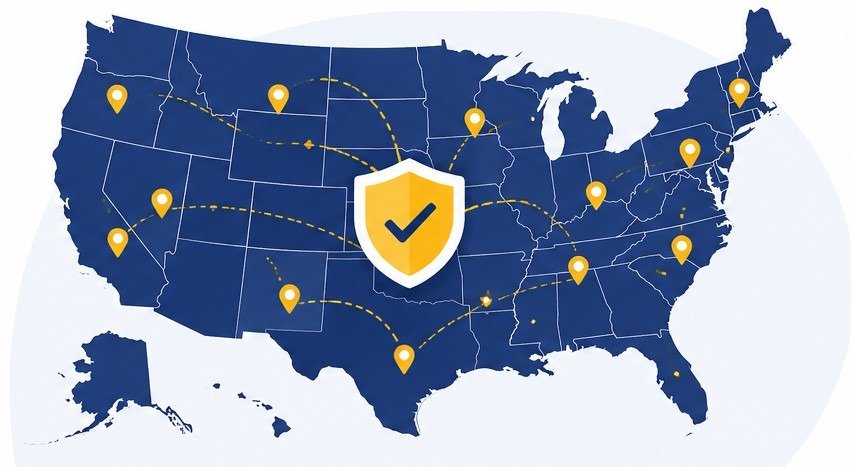
ClaimMax RCM delivers outsource credentialing and contracting services built around one operational rule. Every application goes through the 9-Point Credentialing Integrity Audit before it reaches a payer. Your dedicated credentialing specialist runs the audit within 24 hours of intake, verifying every system that determines clean claim submission. The result is a 99.6% credentialing accuracy rate, a 70% reduction in credentialing-related claim denials, and coverage across all 50 states and 900+ commercial payers. ClaimMax is a full revenue cycle management company, so your credentialing files arrive billing-ready from day one. Standalone credentialing services can’t offer that.

When credentialing accuracy is the foundation, not the afterthought, your clean claims start from claim one.

Comprehensive Credentialing and Contracting Services for U.S. Healthcare Providers

ClaimMax RCM handles the full credentialing-contracting-enrollment trifecta as one integrated workflow under your dedicated credentialing specialist. Our outsource credentialing services connect directly into the billing workflow because ClaimMax is a full revenue cycle management company. Credentialing in medical billing without billing context creates the data mismatches that block clean claim submission downstream.

99.6% Accuracy Rate

Our 9-Point Audit verifies every system before any application reaches a payer, eliminating data mismatches between NPI, CAQH, NPPES, and PECOS records.

70% Fewer Denials

Our claims-accuracy methodology eliminates the data mismatches that cascade from credentialing errors into months of preventable denials across every claim cycle.

One Dedicated Specialist

Your dedicated credentialing specialist manages your file from intake through contract execution, with single-point accountability and zero handoffs between team members.

50 States Covered

We manage credentialing and contracting across Medicare, Medicaid, BCBS, Aetna, UnitedHealthcare, Cigna, Humana, Anthem, and every major commercial payer network nationwide.

RCM-Integrated Credentialing

Every credentialing file is built with NPI taxonomy alignment, CPT code coverage, and ERA enrollment baked in from intake forward.

Request our compliance documentation

Comprehensive Credentialing and Contracting Services for U.S. Healthcare Providers

ClaimMax RCM handles the full credentialing-contracting-enrollment trifecta as one integrated workflow under your dedicated credentialing specialist. Our outsource credentialing services connect directly into the billing workflow because ClaimMax is a full revenue cycle management company. Credentialing in medical billing without billing context creates the data mismatches that block clean claim submission downstream.

Provider Enrollment

Provider enrollment is the first phase of your credentialing and enrollment workflow. Your specialist manages NPI registration, CAQH ProView setup, NPPES alignment, PECOS enrollment, and payer-specific applications. Every file passes our 9-Point Audit before submission. Result: active payer status, provider ID issuance, and billing-ready files.

CAQH Maintenance

CAQH (Council for Affordable Quality Healthcare) profiles drive every payer’s credentialing decision. Expired attestations and outdated documents rank among the top three causes of credentialing delay. ClaimMax maintains your CAQH profile continuously with attestation renewals tracked on a deadline calendar. Result: active status, current documents, faster reviews.

Medicare & Medicaid

Medicare applications fail most often from taxonomy mismatches between NPI Registry and PECOS records, broken reassignment links, and address inconsistencies. Medicaid rules vary by state. Our medicaid credentialing experts manage state applications across all 50 states plus Medicare PECOS enrollment. Result: active Medicare billing and Medicaid participation.

Commercial Insurance

Commercial insurance credentialing and contracting requires payer-specific knowledge across BCBS, Aetna, UHC, Cigna, Humana, Anthem, and 900+ networks. Every payer maintains different portals and panel rules. ClaimMax prepares payer-specific applications with our 9-Point Audit running pre-submission verification. Contracting covers fee schedule review and CPT code coverage.

Recredentialing

Credentialing isn’t a one-time event. Most payers require recredentialing every 2 to 3 years; Medicare mandates revalidation on a 5-year cycle. Missed deadlines trigger billing interruption and network termination. ClaimMax tracks every expiration date across your active payer roster and submits renewals before deadlines hit. Result: uninterrupted participation.

Hospital Privileges

Hospital privileges credentialing operates as a separate workflow from payer enrollment. Providers need a privileges application managed through the medical staff office across admitting, courtesy, and surgical categories. ClaimMax coordinates privileges applications in parallel with payer enrollment so both processes advance simultaneously. Result: admitting rights and surgical privileges.

Contract Review

Most providers sign payer contracts without reviewing fee schedules, locking in below-market reimbursement for years. ClaimMax reviews every in-network contract for CPT code coverage, fee schedule accuracy, dispute resolution terms, and network obligations before signature. When rates fall below market benchmarks, we pursue negotiation. Result: revenue-protected contract terms.

EFT/ERA Enrollment

EFT and ERA enrollment completes the credentialing-to-billing connection. Without active electronic funds transfer and electronic remittance advice setup, payments arrive by paper check and reconciliation breaks. ClaimMax enrolls every credentialed provider in EFT and ERA simultaneously with payer activation. Result: electronic payments from claim one and automated remittance posting.

This is what RCM-integrated credentialing actually looks like

The ClaimMax Credentialing Process: Six Stages of Claims Accuracy From Intake to Activation

Every denied claim ClaimMax handles moves through five distinct workflow stages. Each stage has a defined SLA, defined ownership, and defined deliverable. The work isn’t generic appeals filing. The work is structured: triage within 24 hours, construct payer-specific appeals, escalate through multi-level pathways, coordinate clinical peer reviews, and track recovery continuously per HFMA root-cause analysis standards.

Step 01 / 07

Intake Audit

Within 24 hours of onboarding, your dedicated specialist runs our 9-Point Audit. We verify NPI registration, CAQH attestation, NPPES alignment, PECOS accuracy, taxonomy validation, state license, DEA, malpractice currency, and TIN. Every error gets caught before any application reaches a payer. Result: 99.6% credentialing accuracy aligned to NCQA Standards.

01  ·  FOUNDATION
Step 02 / 07

Payer Mapping

Before selecting target payers, we analyze your specialty, geographic location, patient demographics, and reimbursement goals. Open versus closed panel status varies by region, and submitting to a closed panel without an appeal strategy wastes months. This credentialing process for providers is strategic planning that standalone credentialing companies skip entirely.
02  ·  PRE-SERVICE
Step 03 / 07

Data Synchronization

Five critical systems must contain identical information before submission: NPI Registry, CAQH ProView, NPPES, PECOS, and the NPDB. Mismatches trigger payer rejections without explanation. ClaimMax synchronizes data across all five before submission. Medicare PECOS rejections stem most often from taxonomy mismatches between NPI and PECOS records.

03  ·  CODING
Step 04 / 07

Application Submission

Every payer maintains different forms, portals, and submission rules. ClaimMax prepares applications specific to each payer using current portal requirements, not outdated templates. We verify every document at primary source before submission, including license dates, malpractice limits, and board certification. Credentialing in medical billing depends on this submission discipline.

04  ·  RECONCILIATION
Step 05 / 07

Contract Activation

Payer approval triggers immediate contract review. ClaimMax verifies every in-network contract for fee schedule accuracy, CPT code coverage, dispute resolution terms, and network participation obligations before signature. EFT and ERA enrollment completes at this stage. RCM-integrated credentialing produces clean claims from claim one because credentialing was built with billing in mind.

05  · RECOVERY
Step 05 / 07

Payer Engagement

Payer queues stall without active engagement. ClaimMax conducts structured payer follow-up on every active application through portal status checks and direct payer communication. When a payer requests documentation, we respond same business day in the insurance credentialing process. Closed-loop tracking with same-day escalation on every file.

05  · RECOVERY

One specialist. Six stages. Clean claims from claim one.

Credentialing Documentation Checklist: What ClaimMax Requires at Intake

Credentialing accuracy starts with documentation completeness. Missing or expired documents at intake trigger the credentialing delays that cascade into claim denials downstream. ClaimMax requests four document categories at intake, all of which feed our 9-Point Audit before any application reaches a payer.

Provider Identity Documents

  • Government-issued photo ID
  • Social Security card or W-9 (for tax verification)
  • NPI confirmation letter from NPPES
  • CAQH ProView login credentials
  • Curriculum vitae with no employment gaps

Education and Licensure Documents

  • Medical school diploma (and translations if international)
  • Residency and fellowship completion certificates
  • Board certification documents
  • Current state medical license for each practicing state
  • DEA registration certificate
  • Any expired or surrendered licenses (full disclosure required)

Practice and Insurance Documents

  • Malpractice insurance certificate (current and 5-year history)
  • Claims history if any malpractice events occurred
  • Practice address and contact information
  • TIN documentation
  • Group practice affiliations and EIN
  • Hospital affiliation letters (if seeking privileges)

Disclosure and Background Documents

  • NPDB self-query report
  • Disclosure of any sanctions, exclusions, or actions
  • OIG and SAM.gov exclusion checks (we run these)
  • Employment history with no gaps (10-year lookback minimum)
  • Three professional references with current contact information

Request our compliance documentation.

Why Practices Outsource Credentialing Services to ClaimMax

In-house credentialing teams face a structural problem. Payer rules change weekly. CAQH attestations expire on rolling schedules. State Medicaid policies vary by state and shift without notice. Six reasons practices outsource credentialing services to ClaimMax instead of staffing this work internally, all of which connect directly to claim accuracy downstream.

Visual treatment: 6 benefit blocks. Each block EXACTLY 45 words. Uniform structure.

Specialist Expertise

Your in-house team handles credentialing as one task among many. Your ClaimMax credentialing specialist handles credentialing every day across hundreds of payers. Specialty-specific knowledge accumulates over thousands of files. Result: faster issue resolution, fewer rejections, and payer-specific submission accuracy.

Cost Reduction

Hiring a credentialing coordinator costs $55,000 to $75,000 annually plus benefits, software, training, and turnover. Outsource credentialing services eliminate that overhead entirely. Practices pay only for active credentialing work, not for downtime between provider onboardings. The math favors outsourcing for most practices.

Faster Approval Cycles

Standalone provider credentialing services routinely complete enrollment 30 to 60 days faster than in-house teams because dedicated specialists know which payer portals load slowest and which documentation triggers holds. ClaimMax targets 75 to 105 day completion against the 4 to 6 month industry baseline.

RCM-Integrated Workflow

Outsourcing credentialing to a standalone credentialing company creates a handoff gap between credentialing and billing. ClaimMax eliminates that gap because we handle both. NPI taxonomy alignment, CPT code coverage verification, and ERA enrollment all happen within one workflow without a single handoff.

Scalability

Adding a new provider, expanding to a new state, or onboarding a multi-location group strains in-house credentialing capacity instantly. ClaimMax scales without bottleneck because our specialists work across hundreds of files weekly. Our credentialing and contracting capacity absorbs the load without delay.

Specialist expertise without the in-house overhead

Specialty-Specific Credentialing Services for Healthcare Providers

Credentialing requirements differ by specialty. Therapists face payer-specific licensure documentation. Nurse practitioners navigate scope-of-practice variation. PT/OT/SLP providers manage Medicare and commercial network nuances. Telehealth providers credential across multiple states. Doctors face specialty board certification requirements. Dental, chiropractic, and optometry providers face distinct credentialing tracks. ClaimMax handles each specialty with dedicated payer-specific expertise.

Behavioral Health & Therapists

Insurance credentialing for therapists requires specialty-specific documentation including LCSW, LPC, LMFT, PhD, or PsyD licensure verification, plus state-specific scope-of-practice documents. Most commercial payers maintain separate credentialing tracks for mental health providers under behavioral health carve-out contracts. Our therapist credentialing services manage license verification, supervised practice documentation, and behavioral health network panel applications across BCBS, Aetna, Optum, and Magellan.

Nurse Practitioners & PAs

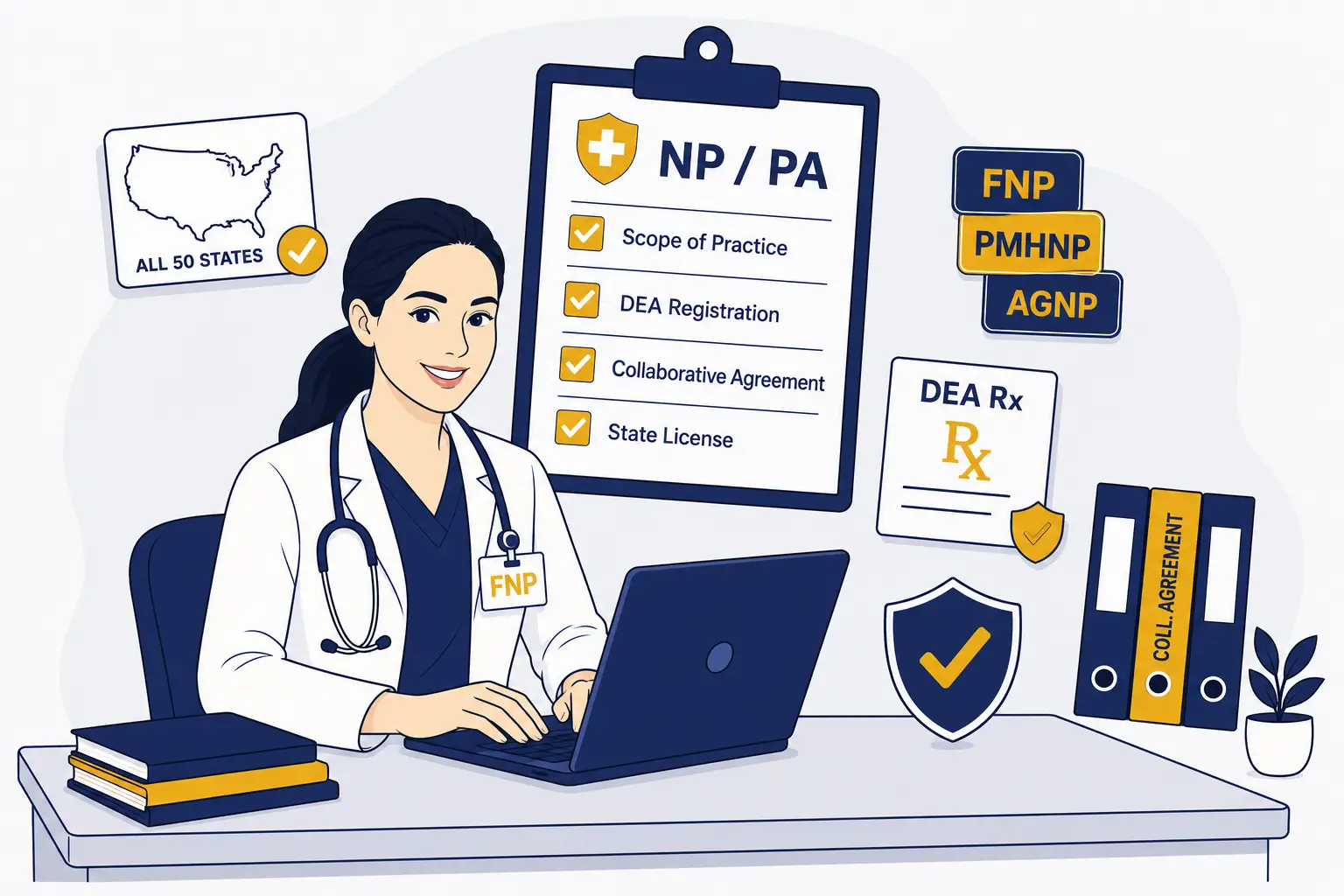
Insurance credentialing for nurse practitioners involves scope-of-practice documentation that varies state by state. Some states grant full practice authority while others require collaborative agreements with supervising physicians. NP credentialing also addresses prescriptive authority, DEA registration, and specialty certification (FNP, PMHNP, AGNP, ACNP). ClaimMax handles NP, PA, and CNM credentialing across all 50 states with state-specific compliance built into every application.

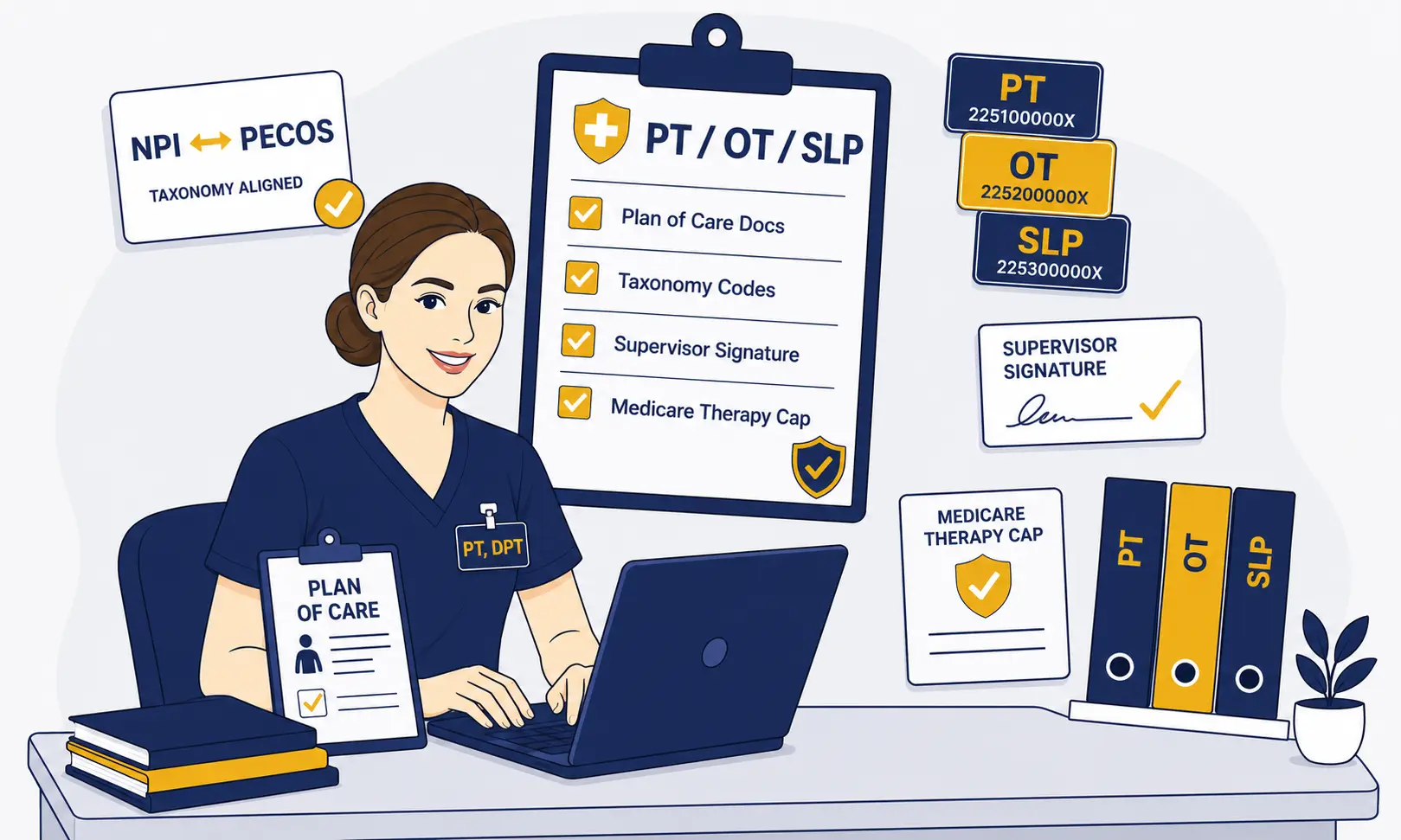
PT, OT, and Speech-Language Pathology

Physical therapy, occupational therapy, and speech-language pathology providers face Medicare Therapy Cap rules, plan-of-care documentation requirements, and supervisor signature requirements that vary by payer. Each discipline maintains separate billing taxonomy codes that must align between NPI Registry and PECOS. ClaimMax credentials PT, OT, and SLP providers with discipline-specific payer applications and taxonomy alignment to prevent claim rejections.

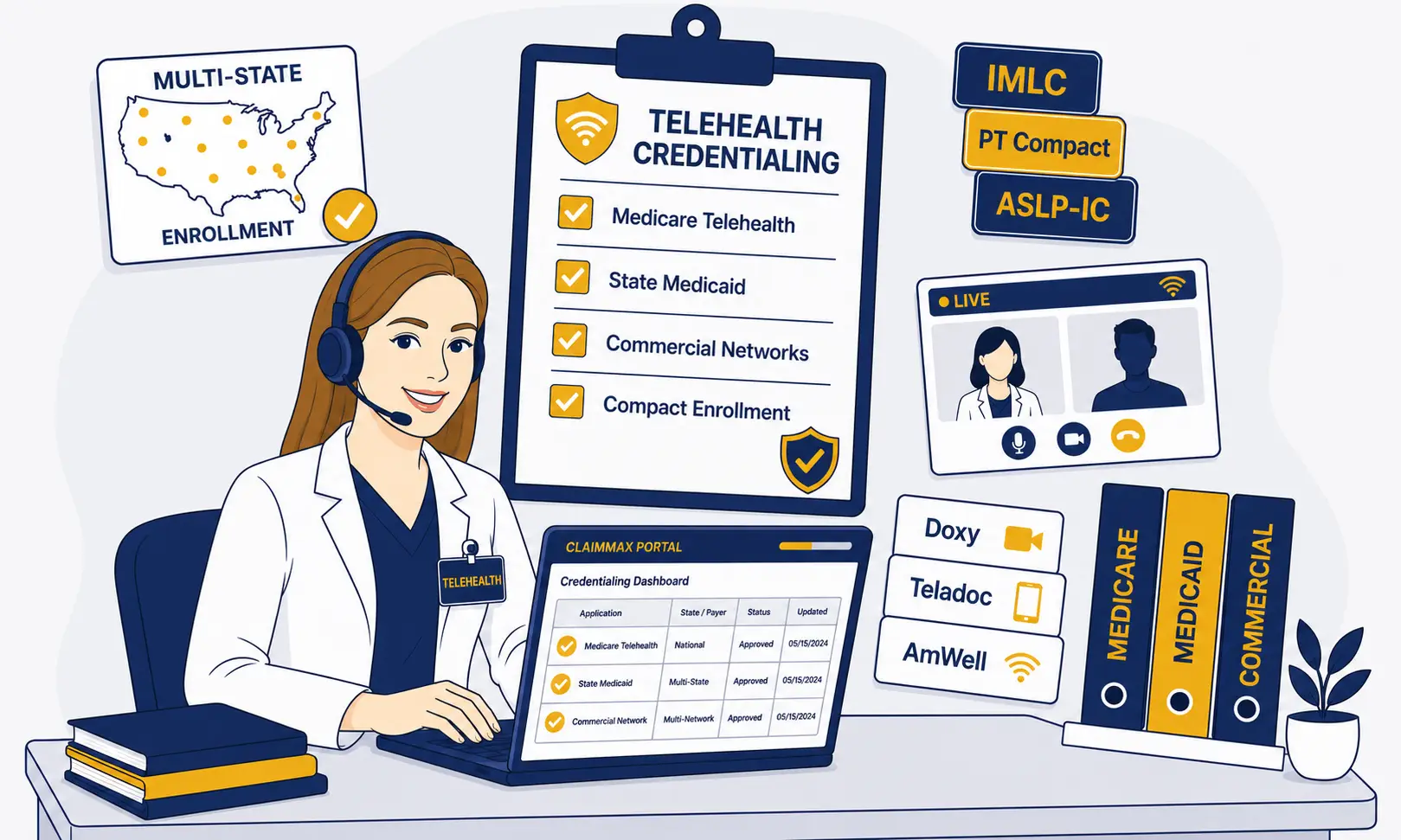
Telehealth Providers

Telemedicine credentialing requires enrollment in every state where patients receive care, not only where providers practice. Multi-state licensure compacts (IMLC, PT Compact, ASLP-IC) accelerate licensure but each compact state still requires separate payer enrollment. ClaimMax manages multi-state telehealth credentialing with payer-specific telehealth policy verification across Medicare telehealth, state Medicaid telehealth programs, and commercial telehealth networks like Doxy, Teladoc, and AmWell.

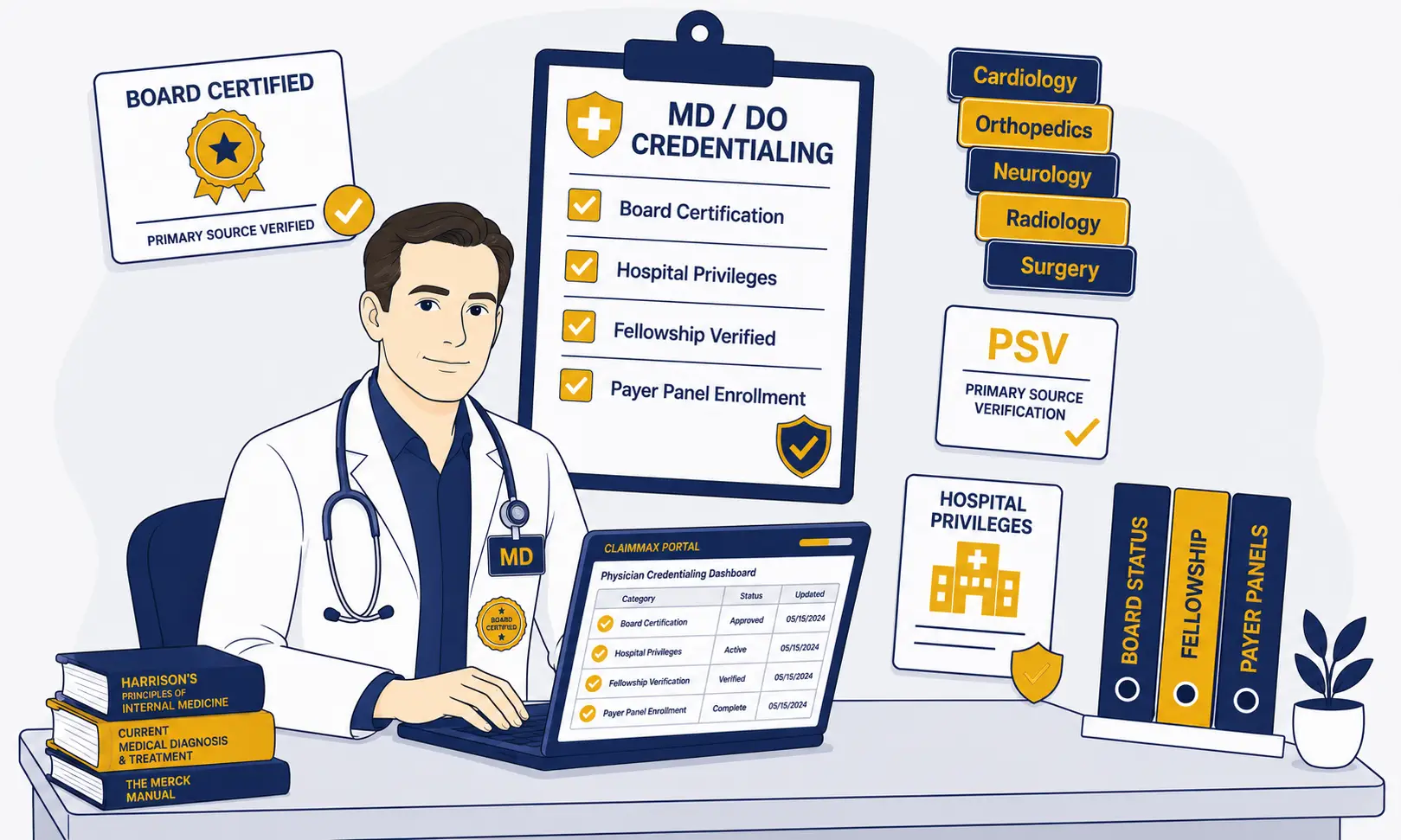
Doctors (MDs and DOs)

Doctor credentialing services cover MD and DO providers across specialties including cardiology, orthopedics, radiology, neurology, dermatology, family medicine, internal medicine, surgical specialties, OB/GYN, and emergency medicine. Each specialty maintains board certification verification requirements, hospital privileges coordination, and specialty-specific payer panels. ClaimMax credentials medical doctors with primary-source verification of board status, fellowship completion, and specialty-aligned payer participation across all networks.

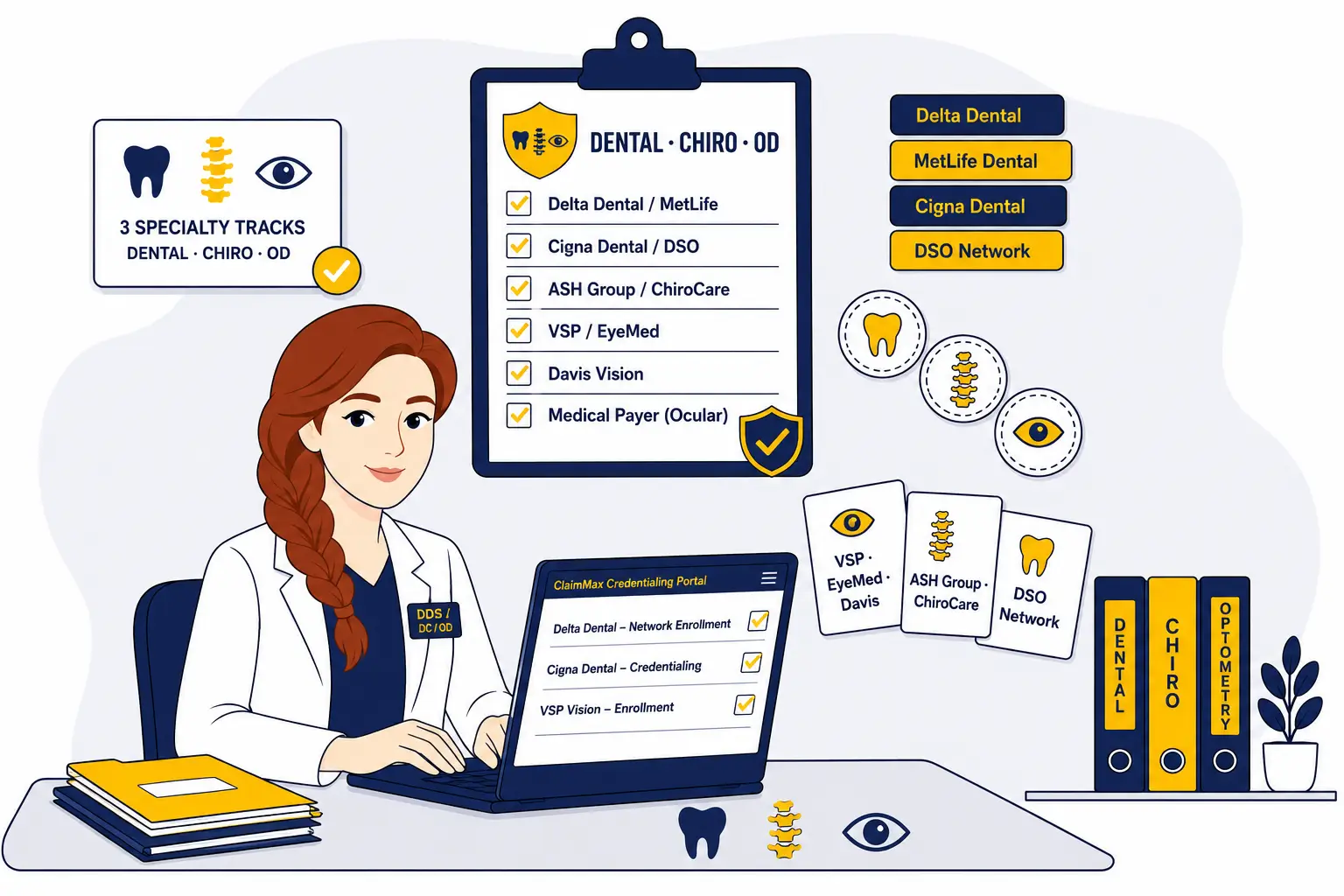
Dental, Chiropractic & Optometry

Dental, chiropractic, and optometry providers face distinct credentialing tracks separate from medical payer networks. Dental credentialing requires Delta Dental, MetLife Dental, Cigna Dental, and DSO network applications. Chiropractic credentialing addresses ASH Group, ChiroCare, and limited commercial network panels. Optometry credentialing covers VSP, EyeMed, and Davis Vision plus medical payer participation for ocular medical billing. ClaimMax handles each track with network-specific expertise.

Your specialty has its own payer rules. We know them

Credentialing and Contracting Coverage: All 50 States, 900+ Payers

ClaimMax credentials providers with Medicare, Medicaid, and 900+ commercial payers across all 50 states. Payer-specific knowledge matters because every payer maintains different application forms, portal requirements, panel rules, and documentation standards. Three payer categories drive every credentialing engagement, each requiring distinct expertise and operational discipline.

Medicare Credentialing

Medicare provider credentialing operates through PECOS (Provider Enrollment, Chain, and Ownership System) and requires CMS-855 form submission tailored to provider type. Most Medicare rejections trace back to three errors: taxonomy code mismatches between NPI Registry and PECOS, broken reassignment links in group practice setups, and address inconsistencies between NPPES and CMS-855.

ClaimMax handles initial enrollment, reassignment management, revalidation on the 5-year cycle, and CMS-855 submissions for solo, group, and multi-state practices. Result: active Medicare billing status without enrollment-related claim denials, aligned to CMS regulations and PECOS requirements.

We verify the PECOS taxonomy match before every submission

Medicaid Credentialing

Medicaid credentialing for providers varies dramatically by state. Each state maintains different enrollment portals, panel rules, fee schedules, and managed care arrangements. Some states require separate credentialing for Medicaid managed care organizations (Molina, WellCare, Anthem Medicaid, BCBS Medicaid plans). 

Our medicaid credentialing experts manage state-specific applications across all 50 states, including Medicaid managed care credentialing where applicable. We track state-by-state revalidation deadlines, policy changes, and managed care contract requirements. Result: active Medicaid participation across every state where your practice serves Medicaid beneficiaries, with managed care contracts verified.

We track every state revalidation deadline across all 50+ states

Commercial Insurance Credentialing

Commercial insurance credentialing and contracting requires payer-specific expertise across 900+ networks. ClaimMax credentials providers with BCBS plans, Aetna, UnitedHealthcare, Cigna, Humana, Anthem, Tricare, TriWest, Multiplan, Optum, and every regional and national commercial payer.

Each payer maintains different portals (Availity, NaviNet, payer-specific systems), application forms, panel rules, and contracting timelines. We prepare payer-specific applications, manage credentialing committee review cycles, negotiate fee schedules when rates fall below market benchmarks, and verify CPT code coverage in every contract. Result: active in-network status with revenue-protected contract terms.

We credential across 900+ networks and review every contract first

Healthcare Providers Trust ClaimMax for Outsource Credentialing Services

ClaimMax credentials providers across solo practices, group practices, multi-location organizations, hospitals, and behavioral health networks. The metrics and testimonials below reflect operational performance ClaimMax delivers under our 9-Point Audit and dedicated-specialist model.

JM

We'd tried two other billing companies before ClaimMax RCM. Both promised results and delivered reports. What we actually needed was someone who understood our payer mix and fixed our AR problem. Within 90 days, our average AR days dropped from 58 to 29 and our denial rate went from 18% down to 6%. I don't think we'll ever go back in-house.

Dr. Jennifer M., MD

Lakewood Internal Medicine  ·  Denver, CO

MT

Our AR days were sitting at 74 when we made the switch. They're at 31 now. The billing team actually follows up on denials instead of just reporting them. That alone changed our cash flow significantly.

Marcus T.

Practice Administrator
Riverside Family Health  ·  Houston, TX

PO

We had three providers stuck in credentialing limbo for months. The team got all three enrolled and billing within six weeks. That was revenue we'd been leaving on the table without realizing it.

Dr. Patricia O., DO

Blue Ridge Medical Group  ·  Asheville, NC

SK

Our denial rate was sitting over 20%. The team categorized every denial by root cause, built payer-specific appeal templates, and got it under 5% in four months. Monthly collections haven't looked back since.

Sandra K.

Billing Manager
Premier Orthopedic Associates  ·  Phoenix, AZ

EW

I had real doubts about outsourcing dermatology billing because the codes are so payer-specific. The team knew our requirements better than our in-house biller ever did. We haven't had a clean-claim issue since.

Dr. Elliot W., MD

Clear Skin Dermatology  ·  Atlanta, GA

Frequently Asked Questions About Credentialing and Contracting Services

How long does credentialing take with ClaimMax?

ClaimMax targets 75 to 105 day completion for commercial insurance credentialing, 60 to 90 days for Medicare PECOS enrollment, and 75 to 120 days for state Medicaid applications. Industry baseline averages 4 to 6 months. Our 9-Point Audit and active payer engagement compress timelines compared to standalone credentialing services. Actual timing depends on payer-side variables outside any service’s control.
ClaimMax requires four document categories at intake: provider identity documents, education and licensure documents, practice and insurance documents, and disclosure and background documents. The full checklist includes 28 specific items spanning NPI confirmation, state licenses, malpractice insurance history, board certification, NPDB self-query, and OIG exclusion checks. Complete documentation at intake prevents credentialing delays downstream.
Yes. ClaimMax manages Medicare PECOS enrollment, CMS-855 form submissions (855I, 855B, 855R), revalidation on the 5-year cycle, and reassignment management. Our medicaid credentialing experts handle state-specific Medicaid applications across all 50 states, including Medicaid managed care plans like Molina, WellCare, Anthem Medicaid, and BCBS Medicaid affiliates where applicable.
ClaimMax credentials providers with Medicare, Medicaid programs in all 50 states, and 900+ commercial payers including BCBS plans, Aetna, UnitedHealthcare, Cigna, Humana, Anthem, Tricare, TriWest, Multiplan, and Optum. Each commercial payer maintains different portals, forms, and panel rules. Our specialists maintain current operational knowledge across every major commercial payer network nationwide.
The 9-Point Audit is ClaimMax’s pre-submission verification process. Within 24 hours of intake, your specialist verifies NPI registration accuracy, CAQH attestation status, NPPES data alignment, PECOS profile accuracy, taxonomy validation, state license tracking, DEA verification, malpractice currency, and TIN. Every error gets caught before any application reaches a payer, producing a 99.6% credentialing accuracy rate.
Pricing varies by provider count, specialty mix, payer scope, and ongoing maintenance requirements. ClaimMax provides transparent pricing after the free credentialing audit identifies your specific service needs. The math typically favors outsourcing for any practice with fewer than four credentialing-active providers because outsourcing eliminates the $55,000 to $75,000 annual cost of an in-house credentialing coordinator plus benefits.
Yes. Multi-state and telehealth credentialing is a ClaimMax core specialty. We coordinate state licensure, multi-state licensure compacts (IMLC, PT Compact, ASLP-IC), payer enrollment across every state where patients receive care, and ongoing renewal tracking across all jurisdictions. One dedicated specialist manages every state simultaneously, regardless of how many states your practice operates in.
ClaimMax completes AR onboarding within 30 days from signed agreement to first claim recovery work. Parallel approach means existing AR work continues during transition with zero recovery gaps. Aged AR cleanup starts in week 2. Full operational cutover happens at week 4 with dedicated account manager assignment.
Insurance AR involves payer relationships, claim corrections, appeals, and underpayment recovery handled by dedicated insurance AR specialists. Patient AR involves patient communication, statement workflows, payment plans, and HIPAA-compliant self-pay collections handled by dedicated patient AR specialists. Different teams, different protocols, same operational recovery standard across both tracks.
Yes. ClaimMax operates under HIPAA Privacy Rule, HIPAA Security Rule, and HITECH Act baseline. Every practice signs a Business Associate Agreement before AR work begins. PHI handling follows audit-trail protocols. Infrastructure runs SOC 2 compliant systems with 256-bit AES encryption. OIG Exclusion List screening completed quarterly across all AR specialists.

Get Your Free AR Aging Audit

Tell us where your accounts receivable stands. ClaimMax RCM provides a free AR Aging Audit that analyzes your aging report bucket by bucket, identifies recovery potential, surfaces underpayment opportunities, and quantifies revenue leakage. The audit is yours to keep, share with your team, or use however helps your practice grow. No commitment.

0 +

States Served

0 +

EHR Systems

0 h

Response Standard

Begin Your ClaimMax RCM Analysis