
The One Rule That Governs Every 88305 Claim
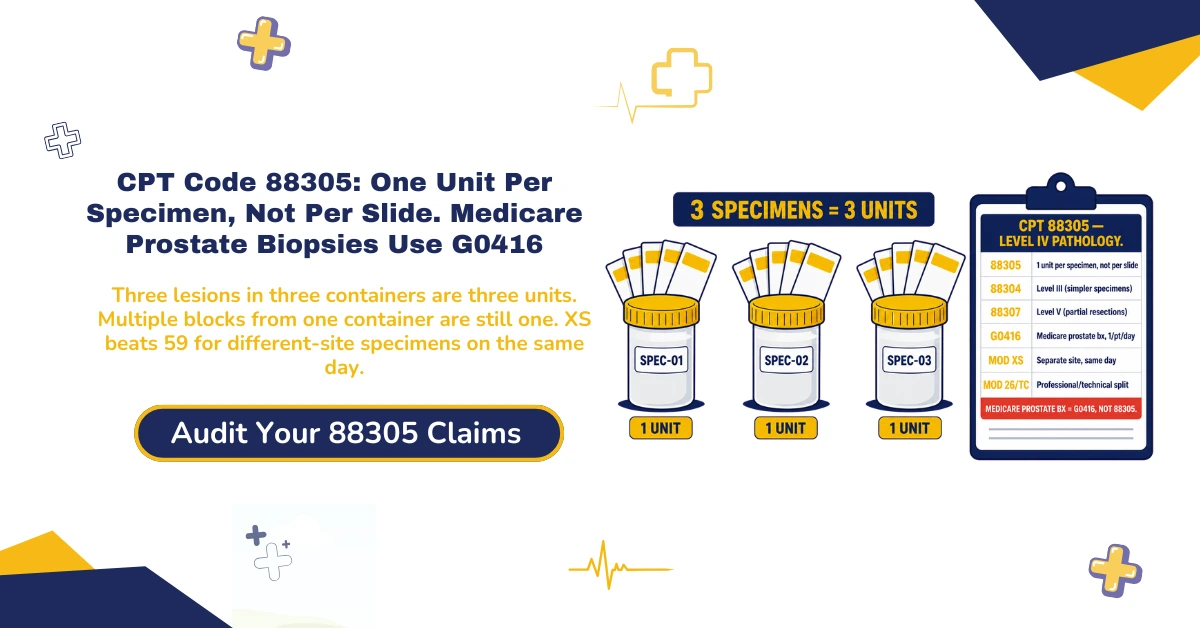
CPT code 88305 is billed once per separately accessioned specimen, not once per tissue block and not once per microscope slide. A single container that produces six slides during processing still counts as one unit.
Three skin lesions submitted in three separate containers, from one patient on the same date, are three units. Each one carries its own gross description, its own microscopic exam, and its own line on the claim.
That single rule clears up more billing confusion about CPT code 88305 than anything else you can know about it. It’s also the rule people state loosely, sometimes as ‘bill per body part,’ sometimes buried under a vague ‘check with your payer.’
Get it wrong in either direction and you either leave units unbilled or file a claim that looks like a duplicate.
Coders searching the 88305 CPT code descriptor land on the same line every time: Level IV surgical pathology, gross and microscopic exam. The specimen decides that level, not the technique.
The full picture takes six pieces: where 88305 sits on the Level I through VI scale, which specimens earn Level IV, the Medicare prostate exception, the four modifiers that apply, the component split, and the documentation that survives a 2026 audit.
Two items on that list trip up more claims than the rest: a Medicare rule most write-ups skip, and a modifier that one widely shared guide gets wrong. Both get settled below, with the exact code and the exact modifier to use.
Level I Through Level VI: Where 88305 Sits and How It Compares to 88304, 88307, and 88309
CPT code 88305 is determined by the specimen type submitted, not by whether molecular testing, genetic testing, or special stains were also performed. Those are separate, individually reportable services layered on top of the base pathology level.
A skin biopsy sits at Level IV because skin biopsies are listed at Level IV. Adding a special stain or a molecular test later doesn’t push it higher.
Why the Level Is Set by Specimen Type, Not by Technique
The AMA’s CPT codebook lists specific specimen types at each level. Level I holds simple, mostly gross-only specimens, and the list climbs through more complex tissue types up to Level VI.
A lab reports immunohistochemistry, special stains, and molecular tests alongside the base level when they’re medically necessary. They never move a specimen between levels.
88304 vs 88305: The Difference in One Table
The difference between CPT code 88304 and 88305 comes down to which specimen list the tissue appears on, not how long the exam takes. Read down the code column, find your tissue, and the level is set.
| Code | Level | Representative specimens and exam depth |
|---|---|---|
| 88304 | Level III | Simpler specimens, less detailed workup. Appendix without disease, newborn foreskin, hernia sac tissue. |
| 88305 | Level IV | Complete gross and microscopic exam with clinical correlation. Skin, GI mucosal, breast, and prostate needle biopsies. |
| 88307 | Level V | More complex, detailed evaluation. Partial organ resections and larger surgical specimens. |
| 88309 | Level VI | The most extensive specimens. Large resections that need the deepest evaluation. |
88305 vs 88307: When a Specimen Moves Up a Level
The difference between 88305 and CPT code 88307 shows up when the tissue itself is more extensive, a partial organ resection instead of a biopsy. The eventual diagnosis doesn’t decide the level.
The level assigned to a specimen depends on which specimen type it is, per the CPT codebook’s own list, not on the complexity of ancillary testing or the seriousness of the eventual diagnosis.
AAPC’s coding guidance makes the same correction. A brain biopsy sounds high-stakes, yet it stays at the level its specimen type sets, and CPT code 88309 sits at the top for the largest resections.
What Specimens Actually Qualify as CPT 88305, Across Every Specialty
88305 is one of the most cross-specialty codes in the whole pathology section. The specimen types it covers reach nearly every organ system a practice might biopsy.
Dermatology: Skin and Soft Tissue Biopsies
Dermatology sends punch, shave, and incisional skin biopsies. That includes specimens later diagnosed as melanoma, basal cell carcinoma, or squamous cell carcinoma.
It also includes biopsies taken for an inflammatory condition like hidradenitis suppurativa. The pathologist runs the same complete gross and microscopic skin exam a tumor specimen gets, so the code is 88305 either way.
Gastroenterology: Mucosal Biopsies
Gastroenterology sends mucosal biopsies from the colon, stomach, and esophagus. Most arrive during a diagnostic colonoscopy or an upper endoscopy.
Each polyp or biopsy site submitted in its own container is its own separately accessioned specimen, and its own billable unit.
A colon polyp or GI mucosal biopsy from a diagnostic colonoscopy is one of the most common specimens billed as 88305. For the procedure-side rules, including when the biopsy needs modifier 59 or XS, see our colonoscopy CPT code billing guide.
Urology, Nephrology, and Reproductive Specimens
Urology is the category with a big Medicare-specific catch, covered in full below. Under commercial payers, prostate needle biopsy specimens qualify for 88305.
Kidney tissue from a non-tumor partial resection also lands at this level. Nephrology and reproductive specimens follow the same per-specimen logic.
Breast, Lymph Node, and Endometrial Biopsies
Breast core needle biopsies, lymph node biopsies, and endometrial or cervical biopsies round out the core list. Each is a routine Level IV specimen under the same per-accession rule from the top of this guide.
Put together, 88305 covers specimen types across dermatology, gastroenterology, urology, nephrology, and reproductive medicine: skin biopsies, GI mucosal biopsies, prostate needle biopsies, breast core biopsies, lymph node biopsies, and endometrial biopsies.
Multiple Specimens, Multiple Units: How the Per-Specimen Rule Actually Works
The unit of service for CPT code 88305 is the individual specimen, defined by how it was accessioned. It isn’t the number of blocks cut, slides prepared, or stains applied to that one specimen.
The Three-Skin-Lesion Example
A pathologist receives three separately identified skin lesion specimens, from three different body sites, on one patient, same date of service. Each specimen is reported as its own unit of 88305, three units in total.
That holds as long as each lesion was submitted, accessioned, and examined as a distinct specimen, with its own gross description and its own microscopic findings.
So yes, 88305 can be billed more than once on the same day, once per separate specimen. The count the payer expects is the count documented at accession, not a number rebuilt later from the total fragments.
What Counts as a Separately Accessioned Specimen
A specimen is separately accessioned when it arrives in its own labeled container, with its own requisition detail naming its source, and gets its own gross and microscopic workup.
Several tissue fragments from one biopsy site, dropped in one container, stay one specimen and one unit. The pathologist can prepare several slides from that container and it’s still one.
The Medically Unlikely Edit and Why High Unit Counts Aren’t Automatically Suspicious
High unit counts on one claim aren’t a red flag on their own. A prostate biopsy session can submit 22 individual specimen cores, each needing its own gross and microscopic exam, so a big number can be clinically routine.
Bill 22 real cores as 22 units and the claim is defensible. Bill 22 units off six documented specimens and it isn’t.
The Medically Unlikely Edit sets an automated ceiling per date of service to catch outliers, not to cap legitimate high-count sessions. The CMS program that governs those per-day limits is published here: CMS Medically Unlikely Edits, Pathology and Laboratory Services.
The Medicare Exception: Why Prostate Needle Biopsies Use G0416, Not CPT 88305
Medicare does not reimburse CPT code 88305 for prostate needle biopsy specimens, regardless of the number of cores or containers submitted. HCPCS code G0416 applies instead.
The Rule, Stated Completely
G0416 is billed as one unit per patient per date of service, no matter how many prostate cores the lab received and examined. That’s a different logic from the per-specimen rule that governs every other 88305 specimen in this guide.
So a Medicare patient with 12 prostate cores in 12 containers is still one G0416 line, not 12 units of anything.
The exception is Medicare’s. Commercial payers may still accept 88305 billed per specimen for the same clinical scenario, so payer identity, not just specimen type, decides the correct code here.
The Triggering Procedure Codes
The procedure codes that flag this scenario are transrectal or transperineal prostate needle biopsies, commonly 55700 and the 55705 through 55714 range. Spotting them on the encounter is what should trigger the G0416 check before the pathology claim goes out.
Most labs catch this at the front end, or not at all.
Why This Gap Costs Practices Real Money
A lab that bills 88305 per specimen for a Medicare prostate patient, the same way it would for a commercial payer, has built the claim on the wrong code. This isn’t a modifier fix or an appeal-worthy documentation gap.
It’s a full code substitution, and it has to happen before submission. The denial that follows reads as a coverage problem, and no modifier rescues it.
Rebilling after that denial means pulling the original claim, swapping the code, and refiling inside the timely-filing window, work a five-second check at submission would have saved.
This same substitution pattern, a HCPCS code replacing the standard CPT code for a specific Medicare scenario, shows up in colonoscopy screening billing too. See our colonoscopy CPT code guide for how G0121 and G0105 work the same way.
Modifiers for CPT 88305: 26, TC, 59, XS, and the One Competitors Get Wrong
Four modifiers genuinely apply to 88305: 26, TC, 59, and 90. A fifth, the more specific XS, should often stand in for 59.
| Modifier | What it identifies | When to use it on an 88305 claim |
|---|---|---|
| 26 | Professional component | The pathologist’s interpretation and report. Use it when a separate entity reads the slides. |
| TC | Technical component | Accessioning, grossing, processing, and staining by the lab. Use it when a separate entity does the lab work. |
| 59 | Distinct procedural service | The generic distinct-service modifier. CMS wants the more specific X modifier instead when one fits. |
| XS | Separate structure | The right choice for specimens from different anatomic sites billed the same day. |
| 90 | Reference (outside) laboratory | A lab other than the billing entity ran the work. |
Modifier 26 and TC: The Professional and Technical Split
Modifier 26 marks the professional component, the pathologist’s read and report. Modifier TC marks the technical component: the accessioning, grossing, processing, and staining the lab performs.
One entity doing both bills the code globally, with no modifier. Two entities splitting the work each bill their own component, and neither adds the global code next to its component modifier for the same specimen.
Modifier 59 and the More Specific XS
Multiple specimens from different anatomic sites, billed the same day, sometimes need a modifier on the lower-valued line to show the services are distinct, not a duplicate.
CMS guidance on this modifier family points coders to the most specific option over a default modifier 59. For a different-site specimen, that specific option is XS, separate structure.
Correcting a Real Modifier Error Found in the Field
At least one currently published, actively ranking guide on this exact topic recommends a modifier called XU for the multi-specimen, different-site scenario. XU means something else: an unusual service that doesn’t overlap the main procedure’s usual components, not a separate anatomic site.
XS is the correct pick when the scenario is separate structures. CMS’s own guidance on this modifier family says to reach for the most specific X modifier, not the generic 59 and not a mismatched one. See CMS Modifier 59 and X-Modifier Guidance.
Modifier 90 for Reference Laboratories
Modifier 90 covers the reference-lab case. When a specimen goes to a separate reference laboratory for processing, 90 shows a lab other than the billing entity did the work.
A code combination that trips an automatic denial usually needs the most specific available modifier, not the most familiar one. Our HCPCS versus CPT billing guide shows how that same specificity principle drives code and modifier choices.
The Technical and Professional Component Split: CLIA, Independent Labs, and Who Bills What
Bill the global 88305 code when one entity, one lab or facility, does both the technical processing and the professional interpretation. Split it with Modifier 26 and Modifier TC when two separate entities divide that work.
Global Billing vs Component Billing
Never bill the global service and a component modifier line together for the same specimen by the same entity. The global payment already equals both components combined, so billing both creates a duplicate that gets caught and recouped.
Say the hospital lab grosses and stains the specimen and a contracted pathology group reads it. The lab bills TC, the group bills 26, and the date-of-service and CLIA details have to match on both claims.
CLIA Certification for the Technical Component
Surgical histopathology counts as high-complexity testing under CLIA. The lab performing the technical component needs a Certificate of Compliance or a Certificate of Accreditation that covers high-complexity testing, and a valid CLIA number has to appear on its claim.
Under Medicare, 88305 sits in the physician fee schedule benefit category, which is why its technical component is priced like a professional service, not a clinical-lab test.
Payers check the certificate type against the complexity of the test. A general certificate doesn’t cover high-complexity histopathology, and the claim can stall on that alone.
A lab billing technical-component work it isn’t certified to perform creates real payer-facing compliance exposure, separate from the coding question.
Where the work happens, the place of service, changes who bills the technical component and how. When a separate reference laboratory performs that work, the same CLIA and specimen-handling framework applies, and our independent laboratory billing guide lays out the full rules.
Where CPT 88305 Ends: The Boundary With 88112, 88323, and Special Stains
Three adjacent codes create real confusion about where 88305 stops. Each has a specific, resolvable answer.
88305 and 88112: The Cell Block Question
CPT 88112 covers a liquid-based cytology preparation, a fluid or cell-based technique, separate from the tissue-based exam 88305 covers.
A fluid specimen that runs both as a liquid-based cytology prep and separately as a cell block makes the cell-block portion separately reportable as 88305.
The cell block concentrates and embeds the cellular material like tissue. It stands on its own only when documentation supports it as a distinct, medically necessary preparation, not a routine byproduct of the cytology workup.
Picture a pleural fluid tap. The cytology prep answers one question, and the cell block lets the pathologist section and stain concentrated cells for a fuller read.
88305 and 88323: Two Different Consultation Scenarios
CPT codes 88321 through 88325 describe a separate service: a pathology consultation on slides, tissue, or material obtained, prepared, and interpreted somewhere else, by a different pathologist, referred for a second opinion.
A pathologist who receives material from another physician for first-time slide preparation and interpretation is doing 88305, split with Modifier TC if a separate entity handles the lab work. It isn’t 88323 stacked on 88305 for the same material.
The trigger is location and referral. Same building, first read, no second opinion, and you’re in 88305 territory, not the consultation codes. The consultation family and its line against 88305 are set out in the CMS NCCI Policy Manual, Pathology and Laboratory Services.
Special Stains and Immunohistochemistry: 88312, 88313, 88341, and 88342
Special stains report as 88312 for the first group and 88313 for each additional group. Immunohistochemistry reports as 88342 for the first antibody and 88341 for each additional one.
Both stay separately reportable alongside 88305 when medically necessary and documented. They aren’t part of the base pathology exam; they’re extra, individually justified services on top of it.
A skin biopsy read as 88305 with two special stains and one antibody bills as 88305, 88312, and 88342, each on its own line with its own medical-necessity note.
What CPT Code 88305 Actually Pays in 2026
CPT code 88305 is paid under the Medicare Physician Fee Schedule, priced from a work relative value unit times the annual conversion factor. That’s the same mechanism behind most physician-interpreted services, not the way a clinical lab test gets priced.
| Line | How it’s paid | 2026 figure |
|---|---|---|
| Medicare global (88305) | Work RVU times the conversion factor, non-facility | Work RVU x $33.4009, split roughly evenly between PC and TC |
| Professional component (Mod 26) | The pathologist’s interpretation | Roughly half of the global payment |
| Technical component (Mod TC) | The lab’s processing work | Roughly half of the global payment |
| Commercial average | Negotiated, major payers | About $70 to $100 per specimen |
| Commercial high | Specific markets and specialties | Over $200 per specimen in some contracts |
| G0416 (Medicare, prostate) | Per patient, per date of service | Separate PFS rate, one unit per patient per day |
The Medicare Baseline: Work RVU and the Conversion Factor
The global Medicare non-facility payment reflects 88305’s assigned work RVU times the 2026 conversion factor of $33.4009. When two entities split the work, that payment divides roughly evenly between the professional component under Modifier 26 and the technical component under Modifier TC.
Commercial Payer Range and Why It Varies So Widely
Commercial reimbursement runs wider. National averages across major payers cluster around $70 to $100 for this code, and negotiated rates in specific markets and specialties can top $200 per specimen.
The spread tracks geography, contract terms, and provider specialty more than any difference in the work itself.
G0416’s Separate Payment Rate
G0416, the Medicare substitute for prostate needle biopsy specimens, carries its own payment rate, separate from 88305’s. It reflects one unit per patient per date of service instead of per specimen, so a practice can’t treat the two rates as interchangeable.
Medicare’s coverage and payment detail for the code lives here: CMS G0416 Prostate Biopsy Billing Guidance.
Documentation That Survives a 2026 Audit
Getting the code and modifier right on an 88305 claim is necessary, not sufficient. The documentation behind it has to stand on its own for every element billed.
These billing guidelines for 88305 aren’t payer-specific niceties. They’re what an auditor rebuilds the claim from.
The CLIA Number Requirement
A valid CLIA certificate number, matched to the lab’s certified complexity level, has to appear on the claim for the technical component.
Bill this work under a certificate that doesn’t cover high-complexity testing, or leave the number off the claim, and you’ve opened a compliance gap the correct code can’t close. The federal certification standard for this testing is set out here: CLIA High-Complexity Testing Requirements.
The 42 CFR 414.510 Date-of-Service Rule
Under 42 CFR 414.510, the date of service for the technical component of 88305 is the date the specimen was collected, not the date the lab ran or read it. When collection spans two calendar days, the date of service is the day collection ended.
A narrow exception moves the date of service to the testing date only when specific stored-specimen conditions are met.
Holding or delaying an order to shift a test’s date of service away from a hospital encounter isn’t a billing technicality; it’s False Claims Act exposure. The rule and its exception sit in 42 CFR 414.510, Date of Service for Clinical Laboratory Tests.
What a Defensible Pathology Requisition Looks Like
A defensible requisition carries a short, consistent set of elements.
| Requisition element | Why it has to be there |
|---|---|
| CLIA certificate number | Proves the lab is certified for high-complexity testing. |
| Order traceable to the treating clinician | Shows the test was ordered, not self-generated. |
| Accession detail: source, laterality, collection date | Fixes the unit count and the date of service. |
| Gross description | Documents the specimen as received. |
| Microscopic description, final diagnosis, pathologist signature | Supports the professional component. |
| Separate-accession proof for each billed unit | Backs multi-unit claims against MUE review. |
The Denial Patterns Behind Most CPT 88305 Rejections
Denials on the medical code 88305 cluster into a few patterns, and most trace back to rules already covered here.
Named Payer Examples
Practices have reported Kaiser denials when a biopsy’s pathology comes back inconclusive or without a definitive diagnosis, even when the biopsy was well-indicated. The problem traces to how the diagnosis code on the claim is framed, not to the procedure.
The lesson isn’t Kaiser-specific. Any payer can deny when the diagnosis narrative doesn’t match a billable, medically necessary finding.
Payers including Horizon NJ Health have denied claims that pass specimen or unit thresholds when the documentation doesn’t clearly show each billed unit is a genuinely separate, separately accessioned specimen.
The Modifier and Coverage Errors Behind the Rest
An 88305 claim billed for a Medicare prostate needle biopsy, instead of the correct G0416, denies as a coverage mismatch, not a modifier fix.
A multi-specimen claim carrying XU where XS belonged, or no modifier where one was required, denies or gets flagged for the reason set out in the modifier section.
Both are preventable at submission. One is a code swap, the other is a modifier choice, and neither survives as an appeal if the underlying claim was wrong.
Getting the CPT code 88305 claim right on the first submission means the specimen count, the payer, and the modifier all line up before the claim goes out, not after the denial comes back.
When 88305 denials repeat across one payer or one denial reason, the fix is rarely the claim in front of you. It’s the workflow gap producing the same error every time, and our denial management services trace that pattern back to its source.
CPT 88305 Billing Across Specialties: Credentialing, Commercial Support, and Where ClaimMax RCM Fits
One Code, Five Specialties
Dermatology, gastroenterology, urology, nephrology, and reproductive medicine all submit specimens under this same code. Each specialty’s most common denial looks a little different, even though the underlying CPT code 88305 rules don’t change.
A GI practice tends to trip on unbundling multiple polyp specimens. For a urology-adjacent lab, the G0416 substitution is the usual miss. Dermatology practices most often stumble on the modifier for multiple lesion sites.
A California lab contracted with Anthem Blue Cross of California, for instance, still bills 88305 by the same per-specimen rules. The payer name changes the rate, not the unit logic.
Whether the specimen came from a colonoscopy, a prostate needle biopsy, or a skin excision, the same specimen-count, modifier, and medical-necessity checks apply. That cross-specialty consistency is what our pathology billing team manages for practices and labs, including California-based independent laboratories.
Practices billing across more than one specialty, a dermatology and GI group sharing lab services, say, need one coding and documentation standard everywhere the code shows up. Our multi-specialty billing services build that standard once and apply it across departments.
CLIA and Medicare Specialty Enrollment for Independent and Reference Labs
An independent or reference lab billing the technical component under a high-complexity CLIA certificate needs that certification current and matched to its Medicare enrollment before the first clean claim. A gap found after claims are flowing costs far more than one caught during setup.
CLIA certification and Medicare enrollment timelines are the setup work our credentialing and contracting services manage, so a lab’s first pathology claim isn’t delayed or denied by an incomplete file.
Hospital-Based Billing: How the Technical Component Gets Packaged Under OPPS
When the technical component of 88305 happens inside a hospital outpatient encounter, that work is typically packaged into the hospital’s Outpatient Prospective Payment System payment for the encounter, not paid as a separate line the way an independent lab’s technical component would be.
The professional component, the pathologist’s interpretation, is billed separately from that packaged technical payment, whatever the setting.
Picture a patient having a skin biopsy during a hospital outpatient visit. The facility captures the technical work in its OPPS rate, and the reading pathologist bills only the professional component with Modifier 26.
A hospital-based practice expecting to bill the technical component as a standalone line, the way an independent lab does, finds that payment already absorbed into the facility’s encounter payment.
It isn’t a denial to appeal. It’s a structural difference in how the two settings get paid, and it has to shape billing expectations from the start.
Hospital-based pathology billing runs on payment logic that looks nothing like independent lab billing for the same code. Our hospital revenue cycle management services are built around that OPPS packaging structure, not a generic workflow bolted onto a hospital.
CPT Code 88305: Frequently Asked Questions
What is CPT code 88305 used for?
CPT code 88305 covers Level IV surgical pathology, a complete gross and microscopic exam of a tissue specimen. It applies to routine biopsies: skin, GI mucosal, breast, endometrial, and most prostate needle biopsies.
How many units can you bill for CPT 88305?
The 88305 procedure code bills one unit per separately accessioned specimen. Multiple blocks or slides from one specimen stay one unit, and multiple specimens in separate containers, even same-patient same-date, bill separately.
What is the difference between CPT code 88304 and 88305?
The specimen type decides the level, per the CPT codebook’s list. 88304 covers simpler specimens like an appendix without disease. 88305 covers specimens needing a complete gross and microscopic exam, including most routine biopsies.
Does Medicare cover CPT code 88305 for a prostate biopsy?
No. Medicare requires HCPCS G0416 instead, billed once per patient per date of service regardless of core count. Commercial payers may still accept 88305 per specimen for the same scenario.
What modifier goes with CPT code 88305?
Modifier 26 for the professional component, Modifier TC for the technical component, Modifier 90 when a reference lab does the work, and Modifier XS, the more specific choice over generic Modifier 59, for specimens from different anatomic sites billed the same day.
Can CPT code 88305 and 88112 be billed together?
When a fluid specimen runs both as a liquid-based cytology prep and separately as a cell block, the cell block portion is separately reportable as 88305, as long as documentation supports it as a distinct, medically necessary preparation.
Can CPT code 88305 be billed with special stains or immunohistochemistry?
Yes. Special stains, 88312 and 88313, and immunohistochemistry, 88342 and 88341, stay separately reportable alongside 88305 when medically necessary and documented.
What is the 2026 Medicare rate for CPT code 88305?
The global non-facility payment reflects the code’s work RVU times the 2026 conversion factor of $33.4009, split roughly evenly between the professional and technical components. See the reimbursement section above for the full breakdown.
The CPT 88305 Coding Decision Summary
Four questions settle almost every 88305 claim.
| Ask | Then do this |
|---|---|
| What specimen type is this? | Matches the Level IV list (skin, GI mucosal, breast, endometrial, most prostate biopsies)? Use 88305. Simpler? Check Levels I to III. More extensive? Check Level V or VI. |
| How many separately accessioned specimens arrived? | Bill one unit per specimen, not per block or slide. |
| Who’s the payer, and is this a prostate needle biopsy? | Medicare plus prostate needle biopsy: bill G0416, one unit per patient per date of service. Otherwise: 88305 per specimen. |
| Any other specimens from different sites, same date? | Yes: add Modifier XS to the appropriate line, documented with the specific separate site. |
Run those four in order and the code, the count, the payer rule, and the modifier all fall into place.
Conclusion
CPT code 88305 comes down to one rule more than any other: the specimen decides the unit, not the block, not the slide, not how serious the diagnosis turns out to be.
Everything else here builds on that. The Level I through VI comparison, the G0416 exception, the right modifier for multiple specimens, and the CLIA and documentation standards that survive a 2026 audit all sit on top of that single fact.
Getting 88305 right across every specialty it touches is one part of a full pathology revenue cycle, from CLIA credentialing through claim submission to denial recovery. See ClaimMax RCM’s pathology and laboratory revenue cycle management services for how those pieces connect.
ClaimMax RCM manages 88305 billing across dermatology, gastroenterology, urology, nephrology, and reproductive medicine, from CLIA credentialing and Medicare enrollment through per-specimen coding accuracy and denial recovery.