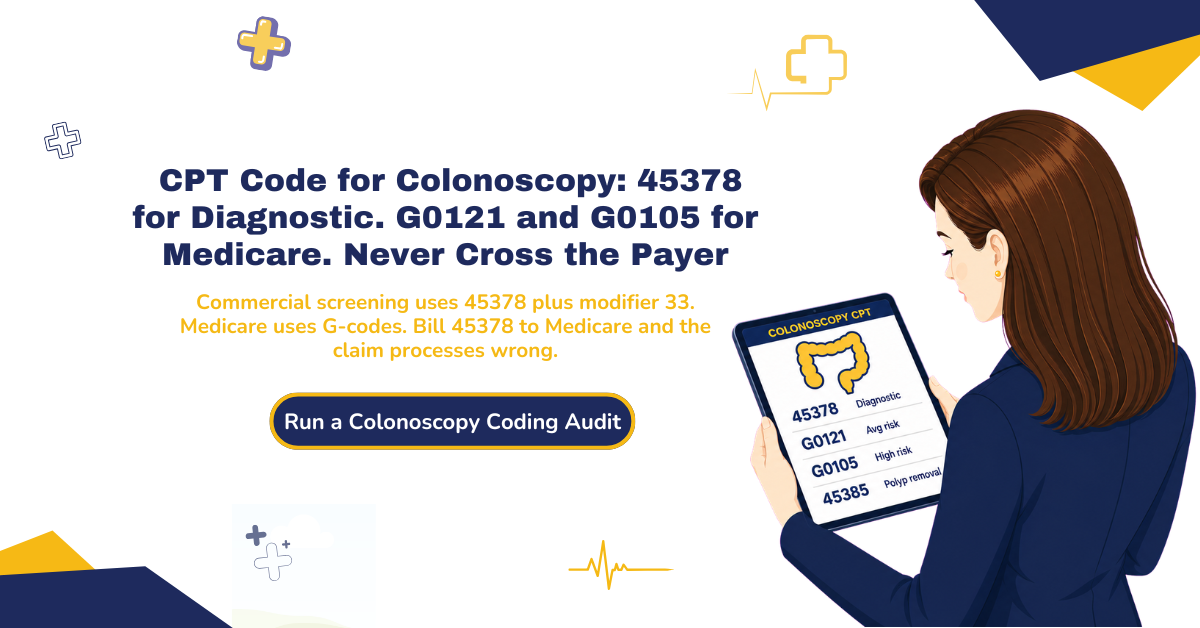
The CPT code for colonoscopy is 45378 for a standard diagnostic examination. For Medicare screening, the code is G0121 for average-risk patients and G0105 for high-risk patients, and the wrong code on a Medicare claim is a billing error that delays payment.
In 2026, three regulatory updates directly affect how GI practices code, submit, and get paid for colonoscopy: the CMS CY 2026 Physician Fee Schedule Final Rule CMS-1832-F, the updated NCCI Policy Manual effective January 1, 2026, and the Medicare coinsurance phase-down rule that changes patient cost-sharing for converted screenings through 2030.
Per CMS-1832-F, GI practices billing high-volume colonoscopy codes face a net reimbursement adjustment from both a -2.5% efficiency reduction applied to work RVUs and a new dual conversion factor structure, with the non-qualifying participant rate set at $33.42.
This guide covers the full 45378-45390 code set, G0105 and G0121 screening codes, modifiers PT, 33, KX, 59, 52, and 53, ICD-10 pairings including Z12.11 and Z86.010, anesthesia codes 00811 and 00812, NCCI bundling rules for same-session procedures, 2026 reimbursement rates under the dual conversion factor structure, and a clinical coding decision table for six common GI scenarios.
The NCCI Policy Manual effective January 1, 2026 updated Chapter 6 governing endoscopy bundling rules, making correct code selection and modifier application more compliance-critical for GI billing than at any prior point.
What Is the CPT Code for Colonoscopy?
The base diagnostic CPT code for colonoscopy is 45378. For Medicare, the code changes: G0121 for average-risk screening and G0105 for high-risk screening.
Commercial Insurance (Screening, No Intervention): The cpt code for screening colonoscopy on a commercial plan is 45378 with modifier 33 appended. Modifier 33 invokes zero patient cost-sharing under the ACA preventive mandate. Without modifier 33, the claim processes as diagnostic and the patient faces deductible and coinsurance.
Medicare (Average-Risk Screening): Use HCPCS G0121, not CPT 45378. G0121 is the Medicare cpt code for screening colonoscopy in average-risk patients, covered once every 10 years. Never substitute 45378 for G0121 on a Medicare screening claim. For the official coverage criteria and frequency limits, the CMS Medicare screening colonoscopy coverage rules are the authoritative source.
Medicare (High-Risk Screening): Use HCPCS G0105. It’s covered every 24 months for patients with personal or family colorectal cancer history. High risk means prior adenomatous polyps, colorectal cancer, IBD, or a family history of FAP or HNPCC.
Any Colonoscopy Where Intervention Occurs: The code changes to the specific therapeutic CPT (45380 for biopsy, 45385 for snare polypectomy). The base diagnostic code 45378 is replaced, not added to. A modifier (PT for Medicare, 33 for commercial) signals the original screening intent.
Is G0121 the same as 45378? No. G0121 is a Medicare-only HCPCS code for preventive screening. CPT 45378 is the cpt code for screening colonoscopy on commercial plans and for symptomatic diagnostic workups. They’re not interchangeable and never serve the same payer.
Getting the code and payer pathway right is the foundation of clean claim requirements for GI billing, and it starts before the procedure is scheduled.
The Complete 2026 Colonoscopy CPT Code Set: 45378 Through 45390
The colonoscopy CPT code set runs from 45378 to 45398. The logic is base-code-plus-upgrade: 45378 is the base code, and when the gastroenterologist performs any intervention during the procedure, the code upgrades to the specific therapeutic CPT that describes what was done.
The single most important rule: only one colonoscopy CPT code is reported per session, always the one that describes the highest-level service performed.
CPT 45378: Diagnostic Colonoscopy and the Base Code Rule
CPT 45378 covers a complete flexible colonoscopy with no tissue removal or biopsy. It includes collection of specimens by brushing or washing when performed and requires that the scope reach the cecum or the terminal ileum. Procedures that don’t reach the cecum aren’t coded as 45378 without modification.
For commercial insurance patients undergoing a screening, 45378 with modifier 33 is the correct cpt code for screening colonoscopy when no polyp or biopsy occurs. Modifier 33 is mandatory for zero patient cost-sharing. Without it, the payer applies the patient’s deductible.
Per the CMS NCCI Policy Manual effective January 1, 2026, CPT 45378 is the base diagnostic code for the colonoscopy endoscopy family. A diagnostic endoscopy is bundled into a surgical endoscopy and can’t be reported separately. A GI billing team that reports CPT 45378 alongside CPT 45385 on the same date of service will receive an automatic NCCI edit denial.
The therapeutic code absorbs the diagnostic base. This is the highest-intensity procedure rule. Separately, the incomplete colonoscopy rule applies: if the scope reached the splenic flexure but not the cecum, report 45378 with modifier 53 (discontinued procedure) and document the specific reason in the operative note.
If the scope didn’t reach the splenic flexure, the appropriate code is from the sigmoidoscopy series (45330 range), not 45378. Colonoscopy NCCI bundling denials from 45378 plus 45385 code pairs are among the most recoverable denials in GI billing, and the fix is a charge capture rule, not an appeal.
CPT 45380: Colonoscopy with Biopsy
CPT 45380 is colonoscopy with biopsy, single or multiple, using forceps to sample tissue. When any tissue sample is taken from any location during the colonoscopy, 45380 replaces 45378 for the session. Multiple biopsy sites using the same technique count as one unit of 45380.
The code change happens at the moment of tissue sampling regardless of how many samples are taken.
If the procedure started as a screening and a biopsy was taken, replace the screening code with 45380, then append modifier PT (Medicare) or modifier 33 (commercial). This answers the question of the CPT code for colonoscopy with biopsy directly: the CPT code for colonoscopy with biopsy is 45380, not 45378.
CPT 45384 and CPT 45385: Hot Biopsy Forceps and Snare Polypectomy
CPT 45384 covers removal of polyps by hot biopsy forceps, typically for diminutive polyps under 5mm. CPT 45385 covers removal by snare technique, for larger polyps requiring loop resection. The operative note must specify the technique used. “Polyp removed” without technique documentation forces the coder to query the physician before submitting, which adds claim lag time.
Multiple polyps removed by the same technique in the same session equal one unit of that code. Three polyps removed by snare equals CPT 45385, one unit. When both techniques are used on separate polyps in the same session, NCCI rules apply, addressed fully in Section 9.
The answer to the CPT code for colonoscopy with polyp removal is 45385 for snare technique and 45384 for hot biopsy forceps. The CPT code for colonoscopy with polyp removal is never 45378 once a polyp is taken.
CPT 45381 and CPT 45382: Submucosal Injection and Bleeding Control
CPT 45381 is colonoscopy with directed submucosal injection. It’s used for tattooing surgical sites, saline lifting for EMR preparation, or hemostasis. It’s separately billable and frequently undercoded because it’s omitted from the operative note. Billing teams should confirm submucosal injection documentation explicitly in the GI procedure note review checklist.
CPT 45382 is colonoscopy with control of bleeding by any method. The critical bundling rule: 45382 isn’t separately billable when bleeding control is inherent to a polypectomy. Cauterizing a polypectomy site after snare removal is part of 45385, not a separate 45382 service.
45382 is only separately billable when bleeding control is the standalone clinical service performed independent of any polypectomy.
CPT 45388 and CPT 45390: Ablation and Endoscopic Mucosal Resection
CPT 45388 is colonoscopy with ablation by any method, including argon plasma coagulation. It’s used for flat lesions or residual polyp tissue that requires ablation rather than physical removal. CPT 45390 is colonoscopy with endoscopic mucosal resection. EMR is a more complex intervention than standard snare polypectomy.
Per CMS MCD article A57342, CPT 45390 was added to the colonoscopy billing guidance effective October 1, 2024. GI practices still billing CPT 45385 for EMR procedures are systematically undercoding.
Any GI practice performing endoscopic mucosal resection should verify their charge capture system includes CPT 45390 as a billable code. If 45390 is absent from the chargemaster, EMR claims are either not billed or miscoded as 45385, both of which result in revenue loss.
This isn’t a coding judgment call. It’s a charge capture infrastructure gap. The CMS Medicare Coverage Database billing guidance for colonoscopy, article A57342, is the controlling Medicare authority for which colonoscopy CPT codes are payable and the effective dates of code additions including 45390.
| CPT Code | Procedure Description | When to Use | 2026 Notes |
|---|---|---|---|
| 45378 | Diagnostic colonoscopy, no intervention | Exam only, no biopsy or polyp removal | Base code; replaced by therapeutic code if any intervention occurs |
| 45380 | Colonoscopy with biopsy, single or multiple | Forceps tissue sampling from any site | Replaces 45378 when biopsy occurs; one unit regardless of number of samples by same technique |
| 45381 | Colonoscopy with submucosal injection | Tattooing, saline lift, hemostasis | Frequently undercoded; confirm in operative note |
| 45382 | Colonoscopy with control of bleeding | Standalone bleeding control only | Not separately billable when inherent to polypectomy |
| 45384 | Colonoscopy with removal by hot biopsy forceps | Diminutive polyps under 5mm | Specify forceps technique in operative note |
| 45385 | Colonoscopy with removal by snare technique | Snare polypectomy, any polyp size | Most commonly billed therapeutic code; one unit for multiple polyps by same technique |
| 45386 | Colonoscopy with dilation | Colonic stricture or narrowing | Dilation procedure required |
| 45388 | Colonoscopy with ablation | APC or other ablative technique | Flat lesions or residual tissue |
| 45390 | Endoscopic mucosal resection | Complex lesion requiring mucosal resection | Added to CMS MCD A57342 October 1, 2024; verify chargemaster includes this code |
| 45391 | Colonoscopy with endoscopic ultrasound | Submucosal lesion evaluation | Advanced subspecialty code |
| 45392 | Colonoscopy with EUS-guided needle aspiration | EUS needle biopsy | Advanced subspecialty code |
Descriptions are written by ClaimMax RCM’s billing team for operational reference. For official AMA code descriptors, refer to the CPT 2026 Professional Edition. For specialty-society clinical guidance on code selection, the AGA colonoscopy coding FAQ is the gastroenterology profession’s official reference.
Selecting the right code from this framework is step one of a clean GI claim, and payer-specific code pathways for Medicare and commercial insurance are the second step.
If your GI practice is generating denials on the 45378-plus-therapeutic code combination, ClaimMax RCM’s GI billing service identifies the specific NCCI edit pairs and corrects the charge capture workflow before the next claim submission cycle.
Medicare Screening Colonoscopy Codes: G0105 and G0121
Medicare doesn’t use the standard CPT code for colonoscopy screening. Medicare colonoscopy billing uses HCPCS G-codes instead. This single distinction generates more Medicare colonoscopy billing errors than any other claim mistake. The two codes are G0105 and G0121. Billing CPT 45378 on a Medicare screening colonoscopy is a coding error that results in incorrect claim processing.
G0105: High-Risk Screening and the ICD-10 Codes That Support It
G0105 is the colorectal cancer screening colonoscopy code for Medicare patients at high risk. High risk means a personal history of colorectal cancer, adenomatous polyps, or inflammatory bowel disease (Crohn’s disease or ulcerative colitis).
It also covers a family history of familial adenomatous polyposis or hereditary nonpolyposis colorectal cancer, or a first-degree relative (parent, sibling, or child) diagnosed with colorectal cancer or an adenomatous polyp.
The ICD-10 codes that support G0105 on the claim are Z80.0 (family history of malignant neoplasm of digestive organs), Z86.010 (personal history of colonic polyps), and Z85.038 (personal history of malignant neoplasm of large intestine). One of these codes must appear on the G0105 claim, or the payer has no clinical basis for the high-risk classification.
The AGA official screening colonoscopy coding FAQ is the specialty-society authority for G-code selection and high-risk criteria definitions.
G0121: Average-Risk Screening and the G0121 vs 45378 Distinction
G0121 is the colorectal cancer screening colonoscopy code for Medicare patients not meeting the high-risk criteria. Asymptomatic patients, with no personal or family colorectal cancer history, age 45 or older, qualify. The primary ICD-10 code is Z12.11 (encounter for screening for malignant neoplasm of colon). Z12.11 is the only ICD-10 that correctly pairs with a screening G-code.
Is G0121 the same as 45378? No, they’re not the same code and they’re not interchangeable. G0121 is a Medicare-only HCPCS code for preventive colonoscopy in asymptomatic Medicare beneficiaries. CPT 45378 is used for commercial insurance and for symptomatic or diagnostic workups.
A GI billing team that selects 45378 on a Medicare screening claim instead of G0121 has made a payer pathway error.
Medicare Coverage Frequency Rules
Medicare covers G0121 once every 10 years for average-risk patients, specifically at least 119 months after the last covered G0121. G0121 is also payable at least 47 months after a covered screening sigmoidoscopy (G0104). Medicare colonoscopy billing requires teams to verify the patient’s colonoscopy history before submitting.
Medicare covers G0105 once every 24 months (at least 23 months since the last covered G0105) for high-risk patients. Submitting G0105 before the 23-month threshold results in a Medicare frequency denial. A pre-submission Medicare colonoscopy billing eligibility inquiry that confirms the last covered colonoscopy date prevents this.
Some commercial payers require prior authorization for therapeutic colonoscopy procedures separate from screening, and ClaimMax RCM’s prior authorization verification for colonoscopy workflow manages these approvals before the procedure date. Active Medicare enrollment is also a prerequisite for billing G0105 or G0121. For GI practices onboarding new providers, see our Medicare provider enrollment for GI practices guide.
The KX Modifier: Post-Positive Stool Test Colonoscopy in 2026
Effective January 1, 2023, and continuing through 2026, a colonoscopy following a positive non-invasive stool-based test (Cologuard, FIT, mt-sDNA, or a blood-based biomarker test such as Shield) is treated as a complete colorectal cancer screening under Medicare. The provider bills G0105 or G0121 with the KX modifier appended. No deductible. No coinsurance. The patient pays nothing.
Per CMS Claims Processing Manual Chapter 18, if the KX modifier is missing on G0105 or G0121 for a post-positive stool test colonoscopy, Medicare returns the claim as “unprocessable.” Not denied. Unprocessable. Denied claims carry appeal rights. Unprocessable claims do not.
An unprocessable claim must be corrected and resubmitted from the beginning, with no appeal window and no retroactive payment protection during the correction period. The CMS Claims Processing Manual Chapter 18 KX modifier guidance is the primary authority for post-positive stool test colonoscopy billing requirements.
KX eligibility triggers should be automated in the billing workflow. When a patient’s chart shows a recent positive Cologuard, FIT, mt-sDNA, or blood-based biomarker test result, the KX modifier applies to the follow-up colonoscopy claim. Confirm the positive test result is documented in the medical record before appending KX.
Documentation is required for Medicare to process the zero-cost-sharing benefit. ClaimMax RCM’s eligibility verification workflow includes a Medicare frequency check for G0105 and G0121 and a KX modifier trigger review before every colonoscopy claim is submitted.
The Screening-to-Diagnostic Conversion: Code Changes, Modifiers, and 2026 Cost-Sharing Rules
The screening-to-therapeutic conversion is the single most common coding scenario generating GI billing errors. When a screening colonoscopy requires any intervention (biopsy, polyp removal, ablation), the CPT code for colonoscopy changes. The conversion rule is payer-dependent: Medicare and commercial insurance handle it differently and require different modifiers.
The Core Conversion Rule
A screening colonoscopy converts to therapeutic the moment any tissue is removed or sampled. The code changes from the screening code to the specific therapeutic CPT that describes the intervention performed. The original screening intent doesn’t determine which CPT code is billed.
The procedure that was done determines the CPT code. The modifier (PT or 33) signals the original screening intent.
For commercial insurance, sequence the ICD-10 codes as Z12.11 (screening intent, primary position) followed by the finding code (D12.6 for benign polyp, D12.3 for polyp of the transverse colon) in secondary position. For Medicare, modifier PT signals the screening intent, and diagnosis sequencing is less critical on Medicare claims.
Modifier PT for Medicare Converted Screenings
Modifier PT is “colorectal cancer screening test, converted to diagnostic test or other procedure.” It’s appended to the therapeutic CPT code on the Medicare claim. The G-code (G0121 or G0105) is replaced entirely by the therapeutic CPT.
The PT modifier is what tells Medicare the procedure began as a screening. Never append PT to the G-code. The G-code is gone the moment intervention occurs.
PT waives the Part B deductible. It does not waive the coinsurance in 2026. The patient still owes 15% of the Medicare-approved amount for the professional service. Practices that tell patients “you won’t owe anything since it started as a screening” are inaccurate in 2026 and will face patient disputes at collections.
Modifier 33 for Commercial Insurance Converted Screenings
Under the ACA preventive care mandate, appending modifier 33 to the therapeutic CPT code signals that the procedure was a covered preventive service. For non-grandfathered commercial plans, the patient owes nothing: no copay, no deductible, no coinsurance. The modifier invokes the ACA mandate.
ACA tri-agency FAQ guidance (Set 12, Q5; Part 51, Q7 and Q8; and Part 68) explicitly classifies polyp removal, anesthesia, and pathology biopsy examination as integral to preventive colonoscopy screening. These components are all covered without patient cost-sharing under non-grandfathered plans when modifier 33 is applied to the claim.
HHS ACA preventive colonoscopy cost-sharing guidance, specifically Part 51 Q7 and Q8, names polyp removal as integral to preventive screening and prohibits cost-sharing for non-grandfathered plans.
Medicare vs Commercial Conversion Decision Table
Use this table to confirm the correct code and modifier for each conversion scenario.
| Scenario | Medicare Billing | Commercial Billing |
|---|---|---|
| Screening, no findings | G0121 or G0105, no modifier | CPT 45378 with modifier 33 |
| Screening converts, snare polypectomy | CPT 45385 with modifier PT | CPT 45385 with modifier 33 |
| Screening converts, biopsy taken (the CPT code for colonoscopy with biopsy) | CPT 45380 with modifier PT | CPT 45380 with modifier 33 |
| Post-positive stool test colonoscopy | G0105 or G0121 with KX modifier | CPT 45378 with modifier 33 |
| Symptomatic diagnostic colonoscopy | CPT 45378, no G-code, no modifier | CPT 45378, no modifier 33 |
2026 Medicare Patient Coinsurance Consequences
When a Medicare screening colonoscopy converts to therapeutic under modifier PT, the patient’s deductible is waived but the patient owes 15% coinsurance on the Medicare-approved amount for professional services. This is the current 2026 rate. Facility coinsurance at hospital outpatient settings may also apply separately.
Per CMS MLN Matters MM12656, the coinsurance rate drops to 10% for calendar years 2027 through 2029. It’s fully waived for all dates of service on or after January 1, 2030. The CMS MLN Matters MM12656 coinsurance phase-down document is the official CMS source for the 2026 through 2030 Medicare colonoscopy cost-sharing timeline.
Practices must counsel patients before every colonoscopy that if a polyp is found and removed, the procedure converts and the patient owes 15% coinsurance in 2026. Pre-procedure counseling prevents post-procedure billing disputes. Practices that run benefit verification before colonoscopy can confirm the patient’s specific 15% coinsurance amount and communicate it before the procedure, not after.
The pre-procedure notification workflow starts with the eligibility verification workflow for GI billing, confirming both screening frequency eligibility and the applicable cost-sharing scenario before the appointment date.
The 2026 Colonoscopy Modifier Toolkit: PT, 33, KX, 59, 52, and 53
Modifier selection is the second most common cause of colonoscopy claim denials after picking the wrong CPT code for colonoscopy. The six modifiers covered are PT, 33, KX, 59/XS, 53, and 25. Each modifier applies to one specific payer-scenario combination, and using the wrong modifier in the wrong context is as damaging as using the wrong CPT code.
Modifier PT: Medicare Screening Conversion Signal
Append PT to the therapeutic CPT code (45380, 45385, 45388) on Medicare claims when the procedure started as a G-code screening (G0121 or G0105) and converted to therapeutic due to findings. The G-code is replaced. Never append PT to the G-code. The PT-flagged therapeutic CPT tells Medicare this was a converted screening.
PT waives the Part B deductible. It doesn’t waive coinsurance in 2026, so the patient owes 15%. For multiple therapeutic procedures in the same converted screening session, append PT to each therapeutic CPT code on the claim.
Modifier 33: Commercial Preventive Screening Signal
Append modifier 33 to CPT 45378 (no intervention) or any therapeutic CPT (45380, 45385) on commercial insurance claims when the colonoscopy was ordered as an ACA preventive screening. Modifier 33 invokes zero patient cost-sharing under the ACA mandate for non-grandfathered plans.
Without modifier 33 on a commercial preventive screening claim, the payer applies the patient’s deductible and coinsurance as if the procedure were diagnostic. The patient gets a bill they shouldn’t owe. This is a modifier omission failure, not a coverage dispute.
KX Modifier: Post-Positive Stool Test (2026 Compliance Rule)
Append KX to G0105 or G0121 when the Medicare colonoscopy follows a positive stool-based or blood-based biomarker test. The tests covered include Cologuard, FIT, mt-sDNA, and blood-based tests such as Shield. It’s effective January 1, 2023.
Per CMS Claims Processing Manual Chapter 18, a G0105 or G0121 claim without KX for a post-positive test colonoscopy is returned as unprocessable. Not denied. Unprocessable means no appeal right. Correction and resubmission are required from the beginning.
KX also waives both the Part B deductible and the coinsurance entirely for this scenario, making it more patient-favorable than modifier PT, which waives only the deductible. Billing teams that mistake KX-eligible colonoscopies for PT-eligible ones charge patients 15% they don’t owe.
Modifier 59 and XS: Same-Session Distinct Procedures
Use modifier 59 (commercial payers) or XS (Medicare) when two procedures from the same NCCI endoscopy family are performed in the same session on completely distinct anatomical sites using different techniques.
Example: 45385 for snare polypectomy at the sigmoid colon and 45380 for biopsy of an ulcerated area in the ascending colon. The NCCI edit pair requires a modifier to override the bundling edit.
Modifier 59 or XS doesn’t override an NCCI edit without documentation to match. The operative note must identify each lesion’s anatomical location and technique separately. A modifier applied to an undocumented claim is a compliance risk, not a billing workaround.
This is addressed fully in Section 9 with the NCCI bundling decision matrix. A pattern of modifier 59 applied without separate site documentation is a systematic workflow issue that requires revenue cycle correction before the next claim submission cycle, not individual claim appeals.
Per CMS NCCI Policy Manual Chapter 6 effective January 1, 2026, a distinct procedural service requires distinct clinical documentation, and the CMS NCCI Policy Manual Chapter 6 January 2026 is the authoritative source for colonoscopy endoscopy family bundling rules.
Modifier 53: Incomplete Colonoscopy
Append modifier 53 to CPT 45378 when the colonoscopy is started but discontinued before cecal intubation. The scope must have reached at least the splenic flexure for 45378 with modifier 53 to apply. If the scope didn’t reach the splenic flexure, use the sigmoidoscopy series (45330 range) instead.
The operative note must state the reason for discontinuation (patient intolerance, obstructing lesion, technical limitation) and the exact extent of the examination. Without this, modifier 53 is unsupported and the reduced-payment claim will deny on medical record review.
Modifier 25: Same-Day E/M Service
Append modifier 25 to the E/M code (not the colonoscopy code) when a separately identifiable evaluation and management service is performed on the same date as the colonoscopy. The E/M and the colonoscopy must address different clinical issues. Don’t append modifier 25 to the colonoscopy CPT itself.
ICD-10 Diagnosis Codes for Colonoscopy: Screening, Findings, and Denial Prevention
An incorrect ICD-10 code on a colonoscopy claim creates a medical necessity mismatch even when the CPT code and modifier are correct. The consequence is immediate denial based on diagnosis-to-procedure code inconsistency. The three ICD-10 categories that govern a clean CPT code for colonoscopy claim are screening intent codes, finding codes, and symptomatic presentation codes.
Z12.11: The Screening Primary Diagnosis Code
Z12.11 is “encounter for screening for malignant neoplasm of colon.” It’s the primary diagnosis code for all colonoscopy claims where the procedure intent is preventive screening. It pairs with CPT 45378 for commercial screening, G0121 for Medicare average-risk screening, and both therapeutic CPT codes when a converted screening needs ICD-10 sequencing.
Z12.11 must appear in the primary position on a converted screening claim, and the finding code is secondary. For the official ICD-10-CM definition and parenthetical inclusions, the ICD-10-CM code lookup for Z12.11 is the reference.
The sequencing rule matters for commercial payers specifically. If Z12.11 appears in secondary position behind a finding code on a commercial converted screening claim, many payers process the claim as diagnostic-from-the-start and apply the patient’s deductible. The intent of the procedure was preventive, and the ICD-10 primary position must reflect that intent to invoke modifier 33 coverage correctly.
Codes That Support High-Risk Screening (Z80.0, Z86.010, Z85.038)
G0105 requires a diagnosis code that establishes the patient’s high-risk status. The three primary supporting codes are Z80.0 (family history of malignant neoplasm of digestive organs), Z86.010 (personal history of colonic polyps), and Z85.038 (personal history of other malignant neoplasm of large intestine).
One of these codes must appear on the G0105 claim, or the payer has no clinical basis for the high-risk classification.
Billing G0105 with only Z12.11 and no risk-stratification code creates a mismatch. Z12.11 supports average-risk screening. G0105 is for high-risk patients. A claim that pairs G0105 with Z12.11 alone is internally inconsistent and will deny on medical necessity review.
Polyp and Finding Codes (D12 Family, K63.5)
When a colonoscopy finds a polyp, the finding code is added to the claim in secondary position. The D12 family covers benign neoplasms of the colon by segment: D12.0 (cecum), D12.3 (transverse colon), D12.4 (descending colon), D12.5 (sigmoid colon), D12.6 (colon, unspecified), and D12.7 (rectosigmoid junction).
Select the code that matches the documented polyp location. For segment-specific code selection, the CMS ICD-10-CM tabular list D12 benign neoplasm of colon entry provides the complete location breakdown.
K63.5 is “polyp of colon” and is used when the polyp isn’t yet pathologically classified. K62.1 covers rectal polyp specifically. When pathology returns with a classification, update the diagnosis code to match the finding. Billing K63.5 permanently when pathology has returned a specific result is a documentation lag that can cause inconsistency across claim submissions for the same patient encounter.
Diagnostic Colonoscopy Diagnosis Codes for Symptomatic Patients
A diagnostic colonoscopy ordered because the patient is symptomatic uses the symptom or condition code as the primary diagnosis, not Z12.11. Common symptomatic presentation codes include K92.1 (melena), K92.0 (hematemesis), K57.30 (diverticulosis without perforation), R19.5 (other fecal abnormalities), R19.7 (diarrhea), and K92.9 (disease of digestive system, unspecified).
Never use Z12.11 as the primary diagnosis for a symptomatic diagnostic colonoscopy.
The distinction matters for modifier application and patient cost-sharing. A symptomatic diagnostic colonoscopy doesn’t use modifier 33 or modifier PT because it was never a screening. It uses the symptomatic presentation code as primary diagnosis and the therapeutic CPT without a screening modifier.
Applying modifier 33 to a symptomatic diagnostic colonoscopy claim is a modifier misuse that can trigger a plan-level audit of preventive service billing.
Diagnosis code selection happens at the charge capture stage of the billing cycle. For practices where ICD-10 assignment is reviewed before claim submission, the 13-step revenue cycle management workflow maps where diagnosis validation fits in the pre-submission sequence.
Anesthesia CPT Codes for Colonoscopy: 00811, 00812, and the Modifier PT Rule
Anesthesia for colonoscopy is billed separately from the CPT code for colonoscopy, by the anesthesia provider, and uses a different code set. The two primary anesthesia codes for colonoscopy are 00811 and 00812. Which code applies depends on whether the colonoscopy is a Medicare screening or a diagnostic and therapeutic procedure.
CPT 00812: Screening Colonoscopy Anesthesia (Medicare)
CPT 00812 is anesthesia for lower intestinal endoscopic procedures with the endoscope introduced distal to the duodenum, for a screening colonoscopy. When a Medicare patient has a colonoscopy initiated as a screening (G0121 or G0105), the anesthesia provider bills CPT 00812.
For the anesthesia claim to qualify as screening, the procedure intent at scheduling must have been preventive, not symptomatic or diagnostic.
When the colonoscopy converts to diagnostic due to polyp removal, the anesthesia code changes. For a converted Medicare screening where modifier PT applies to the therapeutic CPT code, the anesthesia provider bills CPT 00811 with modifier PT appended. The PT modifier on the anesthesia code signals Medicare that the anesthesia was provided for what began as a screening.
This modifier PT on 00811 is a 2026 audit focus area. A practice where the surgical team applies PT correctly but the anesthesia team doesn’t creates a claim inconsistency that triggers coordination of benefits review. The AAPC anesthesia reporting for colonoscopy reference covers the 00811 and 00812 application framework.
CPT 00811: Diagnostic and Therapeutic Colonoscopy Anesthesia
CPT 00811 is anesthesia for lower intestinal endoscopic procedures with the endoscope introduced distal to the duodenum, not otherwise specified. This is the code for diagnostic colonoscopy anesthesia, therapeutic colonoscopy anesthesia where the procedure was never a screening, and any anesthesia service where 00812 doesn’t apply.
If the patient is asymptomatic but the anesthesia provider codes 00811 on a Medicare screening, the anesthesia claim processes as diagnostic and the patient may face unexpected cost-sharing.
The surgical CPT code (G0121 or 45385) and the anesthesia CPT code (00812 or 00811) must align with the same clinical scenario. Misalignment between the surgical claim and the anesthesia claim on the same date of service creates a payer review flag.
Billing teams managing GI practices where anesthesia is provided by a separate group need a cross-team modifier protocol to prevent this mismatch.
Anesthesia Cost-Sharing Under ACA and Medicare Rules
For commercial insurance, federal ACA tri-agency guidance explicitly classifies anesthesia as integral to preventive colonoscopy screening. Non-grandfathered plans can’t impose patient cost-sharing for anesthesia provided during a preventive colonoscopy. The anesthesia provider must apply modifier 33 to the anesthesia claim for the zero-cost-sharing protection to apply. Without modifier 33, the patient may receive an anesthesia bill they legally don’t owe.
For Medicare, when the colonoscopy is a standard screening and 00812 is billed, the anesthesia is covered as part of the screening benefit with no patient coinsurance under the current rules. When the colonoscopy converts to therapeutic (00811 with modifier PT), the anesthesia coinsurance rules mirror the surgical claim, and the patient may owe a coinsurance percentage.
Moderate sedation billed with G0500 or 99153 alongside a screening colonoscopy with modifier 33 is also covered without patient cost-sharing per CMS guidance. Medicaid colonoscopy anesthesia billing rules vary significantly by state and managed care organization, and for practices that serve Medicaid patients, they require separate verification for each MCO panel before claim submission.
Can You Bill 45380 and 45385 Together? NCCI Bundling Rules for Same-Session Procedures
Yes, you can bill CPT 45380 and CPT 45385 together in the same colonoscopy session, but only when specific NCCI conditions are met. The two conditions: the procedures must be performed on completely separate and distinct anatomical sites, and modifier 59 (commercial) or XS (Medicare) must be applied to the lower-valued code with operative note documentation to match.
The NCCI Endoscopy Family Bundling Rule
Per the CMS NCCI Policy Manual effective January 1, 2026, Chapter 6, CPT codes 45378 through 45398 all share the same base code (45378) and are in the same endoscopy family.
The NCCI endoscopy family rule governs every same-session CPT code for colonoscopy decision. When multiple endoscopic procedures from the same family are billed for the same date of service, the higher-valued procedure is paid at 100% and the lower-valued procedure is reimbursed at a reduced rate. The diagnostic base code payment is subtracted from the lower-valued procedure’s payment.
Colonoscopy billing 2026 rules shift quarterly. CMS posts changes to NCCI PTP edit files on a quarterly basis. The most recent update effective April 1, 2026, posted March 1, 2026, includes revisions to practitioner and hospital outpatient PTP edits that affect colonoscopy code-pair combinations.
A code pair that cleared the NCCI scrub in Q1 2026 may carry a new modifier requirement in Q2 2026.
Billing teams should run the current NCCI PTP edit file for any colonoscopy code pair before each submission cycle, per the CMS NCCI Chapter 6 endoscopy bundling update January 2026.
When 45380 and 45385 Can Be Billed Together
The same-session pairing is payable when the biopsy (45380) and the snare polypectomy (45385) are performed on completely separate and distinct lesions at different anatomical locations. Example: a snare polypectomy in the sigmoid colon (45385, primary, no modifier) and a biopsy of an ulcerated lesion in the ascending colon (45380, modifier 59 for commercial or modifier XS for Medicare).
These are two different lesions at two different anatomical sites. The modifier signals the clinical distinctness to the payer.
The documentation requirement is non-negotiable. The operative report must name each lesion’s specific anatomical location, the specific technique used for each (snare vs forceps), and the pathology specimens sent separately for each. Without all three documentation elements, modifier 59 or XS applied to the claim is unsupported.
An unsupported modifier on an NCCI edit pair is both a technical denial and a compliance flag if the pattern appears repeatedly.
The Multiple Endoscopy Payment Reduction Calculation
When 45380 and 45385 are billed together and properly documented, the payment calculation is: 45385 pays at 100% of its allowed amount (no modifier, primary code). 45380 pays at the difference between its full allowed amount and the 45378 base diagnostic code allowed amount.
This means 45380’s effective reimbursement is its value minus the base diagnostic value. The billing team should calculate this net payment when evaluating whether the documentation investment for the same-session pairing is revenue-justified.
For example, if 45385 pays $280 and 45380 pays $180, and the 45378 base value is $120, then 45380’s net payment in a bundled session is $180 minus $120, which equals $60. The total session reimbursement is $280 plus $60, which equals $340 instead of $280 plus $180, which would be $460 if they were separate sessions.
This reduction is built into the NCCI multiple endoscopy formula. It’s not a denial. It’s the correct payment structure for same-session procedures.
NCCI Same-Session Bundling Decision Matrix
Use this matrix to determine correct coding for same-session colonoscopy procedure combinations.
| Scenario | Correct Coding | Modifier Required |
|---|---|---|
| Snare polypectomy only | 45385 primary | None |
| Biopsy only | 45380 primary | None |
| Snare polypectomy + separate biopsy from different lesion, documented | 45385 primary (no modifier) + 45380 secondary (modifier 59 or XS) | 59 (commercial) or XS (Medicare) on 45380 |
| Biopsy then removal of same lesion same session | 45385 only | None, both procedures are for one lesion |
The same same-session bundling logic applies to CPT 45385 and CPT 45381. Both procedures must occur at distinct anatomical sites with separate documentation, and modifier 59 or XS applies to 45381 as the lower-valued code.
Most clearinghouses run NCCI PTP edit checks at submission. Claim scrubbing through a GI-optimized clearinghouse catches modifier 59 edit pair conflicts before the claim reaches the payer.
If NCCI bundling denials for 45380-plus-45385 code pairs are a pattern at your practice, ClaimMax RCM’s NCCI bundling denial recovery workflow identifies whether the denials are documentation failures, modifier errors, or genuine same-lesion coding violations, and builds the fix for each.
2026 CMS Reimbursement Update: Conversion Factor, Efficiency Adjustment, and GI Practice Impact
CY 2026 brought the most structurally complex physician payment update in Medicare history for colonoscopy billing 2026. Two changes drive it: the One Big Beautiful Bill Act’s temporary conversion factor increase and the CMS efficiency adjustment that partially offsets it. For gastroenterology practices billing high-volume colonoscopy codes, the net impact depends on their RVU mix.
The CY 2026 Dual Conversion Factor and the -2.5 Percent Efficiency Adjustment
Per CMS CY 2026 Physician Fee Schedule Final Rule CMS-1832-F effective January 1, 2026, the Physician Fee Schedule now uses two separate conversion factors. Qualifying APM participants receive a higher rate. Non-qualifying physicians receive the standard rate.
The One Big Beautiful Bill Act, signed July 3, 2025, raised the non-qualifying participant conversion factor to $33.42, up from the prior rate of $32.35. That’s a 3.62% effective increase for the conversion factor alone.
The efficiency adjustment offsets the conversion factor increase for high-volume procedural specialties. CMS finalized a -2.5% efficiency adjustment applied to work RVUs for non-time-based services. Colonoscopy CPT codes are non-time-based procedural codes.
For GI practices billing 45378, 45380, and 45385 at high volume, the work RVU reduction from the efficiency adjustment changes the net value of every colonoscopy code by partially or fully offsetting the conversion factor gain.
Net reimbursement for colonoscopy codes may be lower in 2026 than 2025 at some practices depending on their RVU mix.
GI practices should run a reimbursement impact analysis against their actual 2025 colonoscopy volume, comparing 2025 rates against 2026 rates using the CMS PFS Lookup Tool with the new RVU values and the $33.42 conversion factor. The calculation isn’t the same as multiplying the old RVU by the new conversion factor.
The CMS CY 2026 Physician Fee Schedule Final Rule summary covers the full conversion factor structure, RVU table updates, and efficiency adjustment methodology.
Site-of-Service Impact for Office-Based vs Hospital Outpatient GI
The CY 2026 practice expense methodology changes create a payment advantage for office-based endoscopy suites over hospital outpatient department settings. GI practices performing colonoscopies in their own office-based endoscopy suite benefit from higher non-facility practice expense RVU values in 2026. Hospital outpatient-based colonoscopy faces the larger net payment impact from the practice expense methodology change.
For practices considering whether to maintain or establish an in-office endoscopy suite, the 2026 site-of-service payment differential is a meaningful financial input. The CMS PFS Lookup Tool allows a direct comparison of the 2026 facility rate vs the non-facility rate for each colonoscopy CPT code at the practice’s geographic payment locality.
The 2026 Colonoscopy Patient Cost-Sharing Summary
All three patient cost-sharing scenarios in 2026 in one reference block: Medicare screening with no intervention means the patient pays nothing. Medicare converted screening with modifier PT means the patient pays 15% coinsurance, no deductible. Medicare post-positive stool test with KX modifier means the patient pays nothing, with deductible and coinsurance both waived.
Commercial insurance with modifier 33 means the patient pays nothing for polyp removal, anesthesia, and pathology under the ACA mandate for non-grandfathered plans.
The 15% Medicare converted screening coinsurance drops to 10% for calendar years 2027 through 2029 and is fully eliminated for all dates of service on or after January 1, 2030, per CMS MLN Matters MM12656. Front-desk staff who understand this colonoscopy billing 2026 timeline can counsel Medicare patients accurately and reduce post-procedure billing disputes.
Managing the cost-sharing communication across all three Medicare scenarios is a front-desk workflow that feeds directly into the revenue cycle. For GI practices that want these workflows built into a single managed billing operation, ClaimMax RCM’s full revenue cycle management services for GI practices cover every stage from pre-procedure eligibility to post-procedure denial recovery.
Six Colonoscopy Coding Scenarios: Decision Table for GI Billing Teams
Code selection varies by three factors: payer type, procedure intent, and what was found. These six scenarios are the coding reference for the most common GI billing situations in 2026, and each scenario lists the exact code, modifier, and ICD-10 pairing required. They translate the full CPT code for colonoscopy framework into claim-ready actions.
Scenario 1: Medicare Average-Risk Screening, No Findings
Clinical situation: asymptomatic Medicare patient, no personal or family colorectal cancer history, no prior polyps, colonoscopy finds nothing abnormal. Code: G0121. Modifier: none. Primary ICD-10: Z12.11. Secondary ICD-10: none. Billing team note: confirm the patient’s last G0121 date in Medicare eligibility.
If the prior colonoscopy was fewer than 119 months ago, the claim denies on frequency. Verify before scheduling, not after.
Scenario 2: Medicare Screening Converts to Snare Polypectomy
Clinical situation: Medicare patient scheduled for average-risk screening colonoscopy, a 12mm sigmoid colon polyp is found and removed by snare. Code: CPT 45385, the CPT code for colonoscopy with polyp removal (replaces G0121). Modifier: PT (appended to 45385). Primary ICD-10: Z12.11.
Secondary ICD-10: D12.5 (sigmoid colon benign neoplasm) after pathology, or K63.5 pending. Billing team note: the patient owes 15% coinsurance in 2026, deductible waived. Counsel before the procedure. Don’t tell the patient they owe nothing.
Scenario 3: Commercial Screening Converts to Biopsy
Clinical situation: commercial insurance patient, screening-intent colonoscopy, a suspicious flat lesion in the ascending colon is biopsied. Code: CPT 45380 (replaces 45378). Modifier: 33 (appended to 45380). Primary ICD-10: Z12.11. Secondary ICD-10: D12.2 (ascending colon) after pathology confirmation, K63.5 pending.
Billing team note: modifier 33 must be present. Without it, the payer applies the deductible. The patient legally owes nothing under the ACA mandate for non-grandfathered plans.
Scenario 4: Follow-Up Colonoscopy After Positive Cologuard
Clinical situation: Medicare patient had a positive Cologuard result. A follow-up colonoscopy is ordered. The colonoscopy finds and removes a polyp by snare. Code: CPT 45385 (because intervention occurred). Modifier: KX appended (post-positive stool test follow-up) plus PT appended (conversion to therapeutic).
Primary ICD-10: Z12.11. Secondary ICD-10: D12.6 or K63.5. Billing team note: both KX and PT apply here. Missing KX makes the claim unprocessable. The patient owes nothing, because KX waives both deductible and coinsurance.
Scenario 5: Symptomatic Patient, Diagnostic Colonoscopy with Biopsy
Clinical situation: patient presents with rectal bleeding. A diagnostic colonoscopy is ordered. A polyp is found and biopsied. Code: CPT 45380. Modifier: none (this was never a screening). Primary ICD-10: K92.1 (melena) or K62.5 (rectal bleeding by site). Secondary ICD-10: K63.5 (polyp of colon) or a D-code after pathology.
Billing team note: don’t apply modifier 33 or PT. This was diagnostic from the start. Applying a screening modifier to a symptomatic colonoscopy is modifier misuse.
Scenario 6: Incomplete Colonoscopy, Scope Reaches Splenic Flexure
Clinical situation: colonoscopy attempted for screening. Patient intolerance leads to discontinuation at the splenic flexure. The cecum isn’t reached. Code: CPT 45378. Modifier: 53 (discontinued procedure). Primary ICD-10: Z12.11. Secondary ICD-10: none. Billing team note: document the exact point of discontinuation and the clinical reason.
If the scope didn’t reach the splenic flexure, 45378 with modifier 53 doesn’t apply. Use the sigmoidoscopy series instead. For the official Medicare coverage description of follow-up colonoscopy after a positive stool-based screening test, the CMS Medicare coverage for follow-up colonoscopy after positive stool test page confirms the zero-cost-sharing benefit.
These six scenarios cover the most common GI coding decisions and colonoscopy billing 2026 situations. When a colonoscopy presents a more complex combination, like multiple polyp types, EMR alongside biopsy, or EUS-guided procedures, ClaimMax RCM’s GI billing team handles code selection and documentation review before submission.
Documentation Requirements and 2026 Audit Defense for Colonoscopy Claims
Documentation failures are the root cause of most recoverable colonoscopy denials. The three categories covered here are procedure note completeness, audit defense records, and the pre-submission checklist.
What the Operative Note Must Contain for Every Colonoscopy Claim
Five elements are mandatory. The reason for the procedure (screening or symptomatic and which symptom). Bowel prep quality (adequate, fair, or poor). Extent of examination (cecum reached, terminal ileum intubated if applicable, or extent stated if incomplete). All interventions performed (technique names, not just findings). The anatomical location of each finding and each intervention.
For polyp removal, the operative note must state the polyp’s size, the exact location by colon segment, the removal technique (snare vs forceps), and whether the polyp was retrieved for pathology. Missing any of these four elements makes the therapeutic CPT code unsupported if the claim is pulled on audit.
For an incomplete colonoscopy, the note must state the exact anatomical point reached and the reason for discontinuation. Clinical reasons (patient intolerance, obstructing lesion) are payable with modifier 53. Equipment failure isn’t a covered reason for incomplete colonoscopy payment in most MAC policies.
2026 RAC Audit Focus Areas for GI Practices
CMS Recovery Audit Contractors in 2026 are reviewing GI claims for three patterns: incorrect modifier PT versus KX application, anesthesia code misalignment between surgical and anesthesia claims (00811 vs 00812), and modifier 59 applied without supporting operative note documentation for separate anatomical sites.
A practice where any one of these patterns occurs across more than 3% of colonoscopy claims is at elevated RAC review risk.
Run a quarterly internal audit of colonoscopy claims using these three categories as the audit criteria. Pull 20 to 30 randomly selected claims per quarter, review the operative notes against the billed codes and modifiers, and document the findings. A documented internal audit program is a meaningful defense artifact if a MAC pre-payment review or RAC post-payment demand arrives.
The CMS RAC program colonoscopy audit guidelines are published on the CMS Recovery Audit Program page, where current and future RAC review topics are listed by specialty.
The Pre-Submission Compliance Checklist
Run this checklist on every colonoscopy claim before submission. Confirm Medicare frequency eligibility for G0121 (119-month lookback) or G0105 (23-month lookback) before scheduling. Confirm payer type drives code selection (G-code for Medicare, CPT 45378 for commercial, no cross-payer substitution). Confirm the operative note documents bowel prep quality, cecal intubation, all intervention techniques, and all anatomical locations.
Confirm modifier PT or 33 is applied when screening converts (PT for Medicare, 33 for commercial, never reversed). Confirm KX modifier is applied when the colonoscopy follows a positive stool-based or blood-based test on a Medicare claim. Confirm modifier 59 or XS on same-session multi-procedure claims has operative note support with separate site documentation.
Confirm 45378 isn’t billed alongside any therapeutic CPT code in the same session. Confirm the ICD-10 primary position is Z12.11 for converted screening claims on commercial insurance. Confirm 45390 is in the chargemaster for EMR procedures. Confirm the anesthesia team applies a matching modifier to their claim (PT on 00811 when the surgical claim carries PT on the therapeutic CPT).
Practices that run this checklist manually on every colonoscopy claim before submission are preventing the most recoverable denials in GI billing. For practices where the volume makes manual pre-submission compliance unsustainable, outsourcing GI billing to reduce pre-submission compliance errors eliminates the checklist as a staffing burden and builds it into the submission workflow.
If your GI practice’s last internal audit showed recurring modifier errors or documentation gaps on colonoscopy claims, ClaimMax RCM’s billing review identifies the root cause across your actual claim file and corrects the submission workflow before the next MAC review cycle.
Colonoscopy Billing Questions: PAA and PASF Reference for GI Billing Teams
Here are direct answers to the colonoscopy billing questions that GI billing teams ask most often.
What is the difference between 45380 and 45378?
CPT 45378 is a complete diagnostic colonoscopy with no tissue removal or biopsy. CPT 45380 is colonoscopy with biopsy using forceps, so the CPT code for colonoscopy with biopsy is 45380. When a biopsy occurs, 45380 replaces 45378 for the session entirely.
You never bill both codes together. The NCCI highest-intensity procedure rule governs this: the more complex code absorbs the diagnostic base.
What is the CPT code for a routine colonoscopy?
It depends on the payer. Commercial insurance uses CPT 45378 with modifier 33 for screening with no findings. Medicare uses G0121 for average-risk patients and G0105 for high-risk patients. When a polyp is found and removed, the CPT code for colonoscopy with polyp removal changes to the specific therapeutic CPT for the intervention performed.
What is the difference between G0121 and G0105?
G0105 is for Medicare patients at high risk for colorectal cancer, defined by personal or family history of colorectal cancer, adenomatous polyps, IBD, FAP, or HNPCC. G0121 is for average-risk Medicare patients. G0105 covers every 24 months. G0121 covers every 10 years. They’re never interchangeable on the same claim.
Is CPT 45380 preventive?
Not by itself. 45380 describes a diagnostic colonoscopy with biopsy. If the procedure started as a scheduled preventive screening, then for Medicare, append modifier PT (deductible waived, 15% coinsurance applies in 2026). For commercial insurance, append modifier 33 (zero patient cost-sharing under the ACA mandate for non-grandfathered plans).
Can you bill 45380 and 45385 together?
Yes, if they’re performed on completely separate lesions at distinct anatomical locations. Modifier 59 (commercial) or XS (Medicare) is required on 45380, the lower-valued code. The operative note must document each lesion’s location separately. 45385 pays at 100%. 45380 pays at its full value minus the CPT 45378 base diagnostic value.
Is CPT 45378 a screening colonoscopy?
For commercial insurance, yes. CPT 45378 is used for preventive screening with modifier 33. For Medicare, no. Medicare uses G0121 or G0105 for screening, not 45378. Billing 45378 on a Medicare preventive colonoscopy claim is a payer pathway error that results in incorrect claim adjudication.
Does Medicare cover colonoscopy every 5 years?
No. Medicare covers average-risk screening colonoscopy (G0121) once every 10 years. For high-risk patients, G0105 is covered every 24 months. The 5-year interval isn’t a Medicare benefit frequency for any colonoscopy code.
What is the difference between G0104 and 45330?
G0104 is for Medicare screening flexible sigmoidoscopy, asymptomatic patients only. CPT 45330 is for diagnostic flexible sigmoidoscopy in symptomatic patients. G0104 applies to Medicare. Most commercial payers prefer CPT codes for sigmoidoscopy. Neither code is interchangeable with colonoscopy codes (45378 family or G0121/G0105).
Is G0121 the same as 45378?
No. G0121 is a Medicare-only HCPCS code for preventive colonoscopy in asymptomatic Medicare beneficiaries. CPT 45378 is the commercial insurance code for the same clinical procedure. They serve different payers and are never substituted for each other on the same claim.
Does the CPT code 45380 need a modifier?
It depends on the clinical context. If the procedure began as a screening, then modifier PT for Medicare and modifier 33 for commercial. If 45380 is coding a purely diagnostic biopsy ordered for a symptomatic patient, no modifier is required. Never apply a screening modifier to a symptomatic diagnostic colonoscopy claim.
When to use G0105 vs 45378?
Use G0105 for Medicare high-risk screening colonoscopy only. Use CPT 45378 for commercial insurance screening (with modifier 33) or for symptomatic diagnostic colonoscopy across all payers. G0105 is Medicare-only. 45378 is for commercial and diagnostic scenarios. They never serve the same payer for the same clinical purpose.
How often can G0105 be billed to Medicare?
G0105 is covered by Medicare once every 24 months, specifically at least 23 months since the last covered G0105 claim. Submitting before the 23-month threshold results in a Medicare frequency denial. Verify the patient’s last G0105 date through Medicare eligibility inquiry before scheduling.
GI Colonoscopy Billing Support: ClaimMax RCM Handles Every Code, Modifier, and Payer Rule
Your GI practice loses revenue at three predictable points: incorrect screening-to-diagnostic conversion coding, NCCI bundling denials from same-session colonoscopy procedures, and missing modifier KX on post-positive stool test claims. Each one is preventable with the right pre-submission workflow.
ClaimMax RCM handles GI colonoscopy billing end to end: pre-procedure eligibility verification including G0105 and G0121 frequency checks, claim scrubbing with NCCI edit review, modifier PT and KX workflow triggers built into the submission protocol, and post-denial NCCI bundling recovery for same-session colonoscopy code pairs.
ClaimMax RCM’s GI revenue cycle management services cover every stage. For practices weighing the staffing math, outsourcing your GI billing builds the full compliance workflow in without adding headcount.
Want to see where the revenue is leaking? Book a billing audit call with our GI coding team. We’ll review 30 actual colonoscopy claims from your practice and show you exactly where the gaps are.