
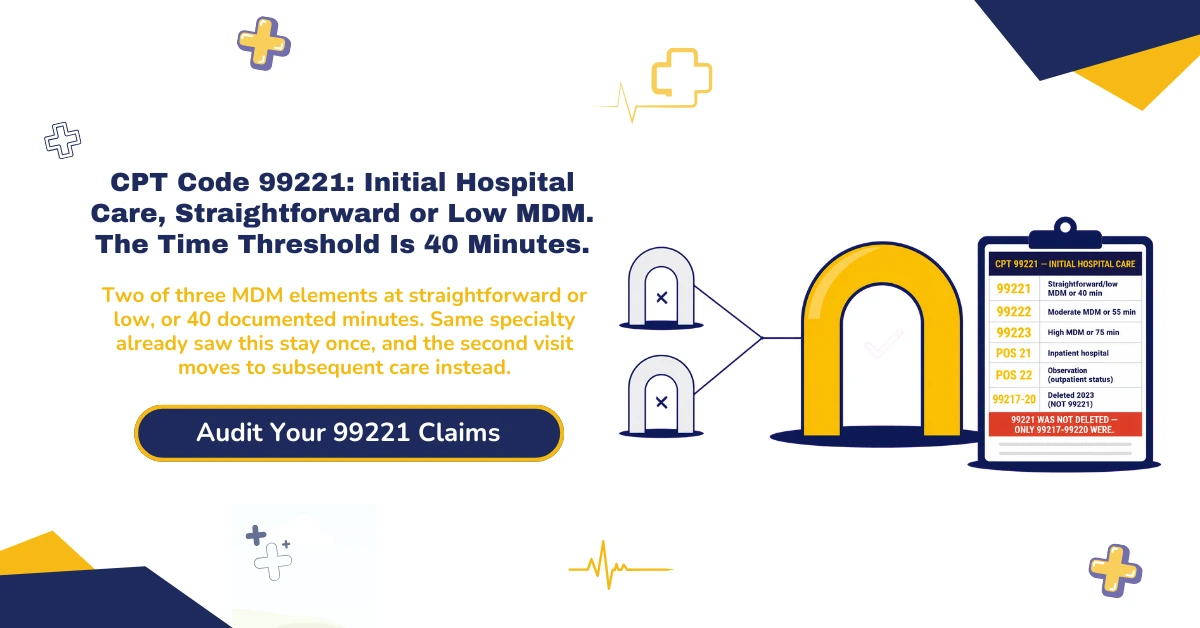
CPT 99221 reports initial hospital inpatient or observation care, billed once per day. The visit qualifies through straightforward or low medical decision making, or through at least 40 minutes of total time on the date of the encounter. New and established patients both qualify, as long as the encounter is a genuine first hospital or observation evaluation for that stay.
The code stays valid in 2026. The change happened around it in 2023: the separate observation codes were retired, and the code absorbed both inpatient and observation care into one family. This 2026 guide from ClaimMax RCM walks through how hospitalists, admitting physicians and billing teams should select, document and report CPT code 99221 under current rules.
| Field | Required information |
| Service type | Initial hospital inpatient or observation care |
| Reporting basis | Per day |
| MDM | Straightforward or low |
| Time threshold | At least 40 minutes |
| History and exam | Medically appropriate, does not set the level |
| Patient status | Inpatient or observation |
| Common POS | 21 or 22, depending on status |
| Adjacent codes | 99222 and 99223 |
What Is CPT 99221 in 2026?
Current CPT Code 99221 Definition
CPT code 99221 covers an initial hospital inpatient or observation evaluation and management service, reported once per day, for a patient who is new or established to the billing physician. A medically appropriate history and exam belong in the note, but neither one sets the code level on its own.
The level comes from medical decision making or from total time. It sits at the straightforward-or-low end of that scale, with a 40-minute floor when time is the basis for selection.
Was CPT 99221 Deleted in 2023?
No. The code was not deleted in 2023. The codes that disappeared were the separate hospital observation codes, 99217 through 99220. 99221 through 99223 were revised, not removed, and they now report both initial hospital inpatient and initial observation care under one family.
A biller who sees a resource still warning that 99221 is gone is looking at something written for a version of the rules that no longer exists.
What Changed on January 1, 2023?
Before 2023, inpatient admissions and observation stays ran on two separate E/M structures. That split closed on January 1, 2023. The former observation-only codes were retired, and the hospital inpatient family absorbed both settings.
History and exam stopped determining the code level at the same time. Selection moved entirely to medical decision making or total time, a shift that trips up coders who trained on the older system and never fully retired the habit.
The American Medical Association’s 2023 descriptor changes document identifies the deletion of the separate hospital observation codes alongside the revision, not deletion, of the 99221-99223 family. (AMA 2023 E/M changes)
When and Where Can CPT 99221 Be Reported?
Hospital Inpatient Care and POS 21
POS 21 represents inpatient hospital care. Use it when the hospital has classified the patient as an inpatient. Being inside a hospital building isn’t enough on its own. The professional claim’s status field needs to match the medical record and the facility’s own status determination, or the claim invites a mismatch denial before it ever reaches a human reviewer.
Observation Care and POS 22
Yes, the code can be reported with POS 22 when the practitioner delivers a qualifying initial observation evaluation in an on-campus hospital outpatient setting and the payer’s requirements are met. Observation patients remain outpatients for billing-status purposes, even though the same code family now covers both inpatient and observation encounters.
The descriptor and the MDM-or-time requirements don’t change between the two settings. Only the POS code and the underlying facility status do.
Who Can Report Initial Hospital Care?
A physician or a permitted qualified healthcare professional may report it when a qualifying first evaluation took place and the documentation supports it. That eligibility isn’t limited to whoever admitted the patient.
Same-physician and same-specialty group rules exist to stop two providers from the same practice billing two initial visits for one stay. CMS confirms that physicians and permitted practitioners performing qualifying initial evaluations may report initial hospital care, while modifier AI identifies only one of them: the principal physician of record. (CMS initial hospital rules)
| Status | Common POS | Code family |
| Formally admitted inpatient | 21 | 99221-99223 |
| Hospital outpatient observation | 22 | 99221-99223 |
| Emergency department before hospital care | 23 | ED code family, subject to same-day rules |
Accurate code selection depends on more than the E/M level alone. A connected hospital revenue cycle management process also needs to validate status, POS, practitioner role and modifiers before the claim goes out.
Practices seeing repeated status, POS or provider-role conflicts can use a hospital billing review to find the point where the claim and the medical record stop matching.
CPT 99221 Medical Decision-Making Requirements
How MDM Determines the Code Level
Medical decision making is one of two paths to 99221. It runs on a formal framework with three elements: problems addressed, data reviewed and analyzed, and risk of patient management. Two of those three elements need to meet or exceed the straightforward-or-low threshold.
History and exam stay clinically necessary where the patient’s presentation calls for them. They don’t move the needle on which code applies. (AMA CPT E/M guidance)
Number and Complexity of Problems Addressed
The count that matters is problems evaluated or managed during that day’s encounter, not everything sitting on the patient’s problem list. A self-limited issue counts differently than a stable chronic illness under active management, and a condition mentioned in passing without real assessment doesn’t count at all.
Straightforward-or-low patterns include one or two minor problems, one stable chronic illness, or one acute, uncomplicated issue that still requires hospital-level care.
Amount and Complexity of Data
| Category | What it covers |
| Records and tests | Reviewing outside notes, reviewing unique test results, ordering unique tests |
| Independent historian | Using a source other than the patient when the patient can’t reliably provide history |
| Independent interpretation | Reading a test personally when it isn’t separately billed |
| External discussion | Talking through management or results with an outside physician or QHP |
Data has to show analysis. Presence in the chart by itself doesn’t count. Listing three labs in a note doesn’t establish review. Stating what those results confirmed or changed about the plan does.
Risk of Patient Management
Risk relates to the management decisions made at that encounter, not to how alarming the diagnosis sounds on paper. Minor problems paired with minimal data and minimal management risk support the straightforward end of the scale.
A stable condition with a low-level treatment adjustment lands at the low end. Neither one gets decided by checking a box next to the word “moderate” without documented work behind it.
Straightforward vs. Low MDM
| Element | Straightforward | Low |
| Problems | Minimal | Limited |
| Data | Minimal or none | Limited |
| Management risk | Minimal | Low |
| Code-level effect | May support 99221 | May support 99221 |
Medical necessity and documented work still control the final answer. A quiet overnight stay doesn’t automatically qualify for 99221 if nothing was addressed, and a busy-sounding note doesn’t qualify for it either if the busy parts weren’t clinical decisions.
CPT 99221 Time Requirement: What Counts Toward 40 Minutes?
The code requires at least 40 minutes when total time is used for code selection. That’s the current threshold, and it replaced the older 30-minute standard years ago. Competitor pages that still cite 30 minutes, or describe the requirement as “typical face-to-face time,” are working from an outdated version of the rule.
The 40-Minute Threshold
Time is counted on the calendar date of the encounter, and it has to be met or exceeded, not approximated. It’s the alternative to MDM, not a supplement to it: a provider selects the code through one path or the other, not by blending both.
Activities Included in Total Time
- Preparing to see the patient
- Reviewing records and tests
- Obtaining or reviewing separately obtained history
- Performing a medically appropriate evaluation
- Counseling and educating the patient or family
- Ordering medications, tests or procedures
- Communicating with other professionals, when not separately reported
- Documenting in the health record
- Independently interpreting results, when not separately reported
- Coordinating care, when not separately reported
Activities Excluded From Total Time
- Travel
- General teaching not tied to this patient
- Any service reported and billed separately
- Clinical staff time
- Time spent on a different calendar date
- Duplicated time between two billing practitioners
Time Documentation Example
A defensible entry states the total minutes, the date, and what filled that time. It reads something like: total qualifying time on the date of encounter was 44 minutes, including chart review, patient evaluation, family counseling, order entry and documentation. A copied checklist of activities that never happened during the visit doesn’t belong in the note.
CMS’s May 2026 evaluation and management booklet covers hospital inpatient and observation reporting rules in detail, including which activities count toward total time. (CMS 2026 E/M guidance)
CPT 99221 vs. 99222 vs. 99223
Initial Hospital Care Comparison Table
| Code | MDM level | Minimum time |
| 99221 | Straightforward or low | 40 minutes |
| 99222 | Moderate | 55 minutes |
| 99223 | High | 75 minutes |
When 99222 Is More Appropriate
Moderate MDM supports 99222, and so does 55 minutes of total time when the visit is selected by time instead. Admission alone doesn’t justify the jump, and neither does a longer note.
Two of the three MDM elements have to reach moderate, or the total time has to hit 55 minutes. Nothing else decides it. For the full breakdown of moderate-level documentation and the 55-minute pathway, see ClaimMax’s CPT 99222 guide.
When 99223 Is More Appropriate
High MDM supports 99223, or 75 minutes when time is the basis. High acuity on its own doesn’t replace the documentation work.
The note still has to show two of the three MDM elements at the high level, with the specifics named rather than implied. ClaimMax’s CPT 99223 guide walks through that documentation pattern in the same depth this page covers 99221.
Avoiding Upcoding and Undercoding
Select the level the documented work supports, not the level that feels safest. Defaulting every admission to 99222 or 99223 creates the same audit exposure as defaulting every admission down to 99221 out of caution. Medical necessity, MDM and time all have to line up before a level gets billed.
Documentation Requirements for CPT 99221
Required Clinical Foundation
The note should establish the reason for the hospital or observation encounter, the relevant clinical status, a medically appropriate history and exam, the problems evaluated and managed, the assessment and plan, and the orders and treatment decisions made that day. Practitioner identity and date of service round out the baseline.
Documenting MDM
Show which problems were actively addressed that day, which data were reviewed or analyzed, and which management decisions created the documented risk. State plainly why the level billed was medically necessary. A condition copied into the problem list without evidence of evaluation or management that day doesn’t earn a place in the MDM count.
Documenting Time
Time-based notes need the total qualifying minutes, the main activities, and a description that matches everything else in the chart.
Exclude anything billed separately, and skip the generic attestation language that reads the same on every chart. A note that says the same thing for every patient tends to draw the same scrutiny for every patient.
Audit-Ready Documentation Checklist
| Validation point | What the record must show |
| Setting | Inpatient or observation status |
| POS | Consistent with actual status |
| Service type | Initial qualifying encounter |
| MDM | Supported by documented elements |
| Time | At least 40 minutes, if used |
| Medical necessity | Hospital-level service was reasonable |
| Practitioner | Correct NPI and role |
| Modifier | AI only where applicable |
| Signature | Complete and authenticated |
A pre-bill review within professional medical billing services can catch unsupported time, inconsistent POS, missing practitioner details and code-level mismatches before the claim ever reaches the payer. Repeated downcoding or documentation-related denials usually signal that a practice needs a focused pre-bill coding review, not another generic reminder to the front desk.
CPT 99221 Same-Day Admission and Discharge Rules
Same-day billing runs on two variables: the calendar date and how long the stay lasted. Get either one wrong, and the wrong code family goes out on the claim.
Same-Day Stay of Less Than 8 Hours
When admission and discharge fall on the same calendar date and the stay runs under 8 hours, the encounter uses the appropriate code from 99221 through 99223. Discharge-day management codes 99238 and 99239 don’t apply here.
The level within that range still depends on documented MDM or time, not on the short duration by itself.
Same-Day Stay of 8 to Under 24 Hours
Once the stay reaches 8 hours but stays under 24 on the same calendar date, the correct family shifts to 99234 through 99236. Those codes already include the admission and discharge work in one service.
Adding 99221 or a separate discharge code on top of that duplicates payment for work the combined code already covers.
Discharge on a Different Calendar Date
A different-date discharge with a stay under 8 hours total still reports only the initial hospital service. Once the total stay reaches 8 hours or more across two dates, the claim adds the applicable discharge-day management code alongside the initial service.
Unusual overnight cases that don’t fit either pattern cleanly are worth a call to the applicable MAC before submission.
Observation-to-Inpatient Conversion
A transition from observation to inpatient status doesn’t start a new stay. One hospital care service covers the calendar date, regardless of how the status changed partway through it.
| Admission and discharge scenario | Code direction |
| Same date, under 8 hours | Select 99221-99223 only |
| Same date, 8 to under 24 hours | Select 99234-99236 |
| Different dates, under 8 hours total | Initial hospital service only |
| Different dates, 8 hours or more | Initial service plus 99238 or 99239 |
| Observation changes to inpatient | One continuous stay, not a new initial service |
CMS’s current guidance confirms this same-day framework directly, including the rule that an observation-to-inpatient transition stays one continuous stay rather than a second admission.
Other-Site Services and Initial vs. Subsequent Hospital Care
Emergency Department Service Followed by Admission
When the same practitioner evaluates a patient in the emergency department and then admits that patient or places them in observation on the same date, Medicare generally folds the connected ED work into the initial hospital service.
Billing the ED code and the initial hospital code separately isn’t the default here. The note needs to show the whole same-date encounter as one connected episode of care.
Office Visit Followed by Admission on the Next Date
Medicare may pay both services when an office visit happens on one date and hospital admission or observation begins the next date, even if fewer than 24 hours separate the two. Each encounter still needs its own documentation and its own medical necessity.
Initial vs. Subsequent Care
“Initial” doesn’t simply mean the calendar date of admission. It means the first qualifying service from that physician, or from another physician of the same specialty in the same group, during the stay. Everything after that moves to the subsequent hospital care family, 99231 through 99233.
Status Changes Do Not Restart the Sequence
Moving a patient from observation to inpatient status doesn’t reset the count back to a second initial service. The sequence just continues.
| Scenario | General Medicare direction |
| Same practitioner, ED then admission on same date | Initial hospital service includes the connected ED work |
| Office service one date, admission the next date | Both services may be payable |
| Observation changes to inpatient | Do not report a second initial service |
| Same specialty and group already provided care | Evaluate subsequent hospital care instead |
| Different specialty provides the first qualifying evaluation | Separate initial reporting may be possible |
Once the encounter is no longer an initial service, the correct code comes from the subsequent hospital care family, 99231 through 99233. ClaimMax’s subsequent hospital care guide covers that sequencing, per-day reporting and the discharge-day conflicts that come up once a stay moves past its first qualifying visit.
CPT 99221 Modifiers, Consultations, Split/Shared Visits and Teaching Physician Rules
Does Code 99221 Always Need a Modifier?
No. A modifier isn’t automatically required on every claim. Modifiers communicate a specific practitioner role, a same-day procedure, a postoperative context or a shared-service arrangement, and none of them belong on a claim unless the documentation actually supports that scenario.
| Modifier | Potential use | Guardrail |
| AI | Principal physician of record under Medicare | Only the principal physician uses AI |
| FS | Medicare split/shared E/M visit | Physician and NPP must be in the same group |
| 25 | Significant, separately identifiable E/M with a same-day minor procedure | The additional E/M work must be distinct |
| 57 | Decision for major surgery | The E/M must establish the surgical decision |
| 24 | Unrelated E/M during a postoperative period | Documentation must show the service is unrelated |
Modifier 95 for telehealth isn’t automatic either. That depends on current payer policy, covered below.
Modifier AI and the Principal Physician
Medicare recognizes one MD or DO as the principal physician of record for a given stay, and that physician appends AI. Other physicians who perform qualifying initial evaluations don’t append AI simply because their own visit also qualifies for initial hospital care.
The modifier identifies a role. It doesn’t set the code level.
Medicare Hospital Consultation Rules
Medicare fee-for-service doesn’t pay CPT consultation codes as a separate payment family. A consultant reports the appropriate initial or subsequent hospital service instead, once the visit meets that code’s requirements.
CMS notes that the requirements for this code exceed those for lower-level consultation codes such as 99251 and 99252. Unlisted E/M code 99499 stays reserved for unusual cases where no payable code fits, and it typically requires manual review.
Split/Shared Initial Hospital Visits
A split or shared visit needs a physician and an NPP from the same group, with both personally performing part of the encounter. The billing practitioner has to perform the substantive portion, defined as more than half of the combined time or the substantive part of the MDM. (CMS split/shared guidance)
The claim carries modifier FS. The record names both practitioners, and the billing practitioner signs and dates it. Joint time only counts once, even when both practitioners were in the room together.
Teaching Physician Requirements
A teaching physician can’t rely on a resident’s note plus a routine cosignature alone. The physician has to personally perform the service, or be present for its critical or key portions, with that participation documented in the record. (CMS teaching physician guidelines)
Telehealth Must Be Verified by Code and Payer
Confirm the current Medicare Telehealth Services List, the applicable modifier, the applicable POS and any commercial or Medicaid policy before assuming this code is telehealth-payable. (Medicare Telehealth Services List)
2026 Reimbursement for Code 99221: RVUs, Locality and Payer Methodology
Why There Is No Single National Payment
Medicare payment depends on several moving parts: the work RVU, the practice-expense RVU, the malpractice RVU, the geographic practice cost indices for the specific locality, the conversion factor, the facility setting and whether the billing practitioner qualifies as an APM participant. A flat national number that skips all of that isn’t reliable, whatever a competitor page might publish.
2026 Medicare Conversion Factors
| Practitioner status | 2026 conversion factor |
| Qualifying APM participant | $33.57 |
| Nonqualifying APM participant | $33.40 |
CMS finalized these two separate conversion factors for 2026, the first year the fee schedule has run parallel rates for qualifying and nonqualifying APM participants. (CMS 2026 PFS Final Rule) Either figure is one component of the payment formula, not the final allowed amount on its own.
Professional CPT Payment vs. Hospital DRG
The code on this page represents the practitioner’s professional E/M service. A hospital’s DRG payment covers the facility side of an inpatient case, a separate calculation entirely. Combining the two into a single reimbursement figure produces a number that won’t match either payer’s actual remittance.
How Providers Should Verify the Rate
- Select the correct calendar year
- Enter the code
- Choose the applicable Medicare locality
- Confirm the facility or non-facility setting
- Verify qualifying APM participant status
- Compare the allowed amount against the remittance
- Check the payer contract for commercial claims
(CMS Physician Fee Schedule Lookup)
A repeated gap between the expected and posted payment can point to a contract-loading, bundling or underpayment problem rather than a coding problem. Structured accounts receivable services can identify and pursue those underpayments before an appeal or filing deadline closes.
Common CPT 99221 Denials, Downcoding and Audit Risks
| Denial or downcoding cause | What the payer may identify | Prevention or correction |
| Wrong service family | Initial code used after a prior same-specialty service | Validate initial vs. subsequent status |
| Unsupported MDM | Two required MDM elements aren’t evident | Connect problems, data and risk to the plan |
| Unsupported time | Less than 40 minutes, or nonqualifying time included | Validate same-date qualifying practitioner time |
| POS mismatch | Claim status conflicts with the actual record | Match POS 21 or 22 to actual status |
| Duplicate per-day service | Same physician or specialty group reports more than one daily service | Combine qualifying same-day work |
| Modifier error | AI, FS, 25, 57 or 24 lacks factual support | Apply modifiers only when conditions are met |
| Wrong same-day family | 99221-99223 used when 99234-99236 applies | Validate stay duration and discharge date |
| Medical necessity gap | Documentation doesn’t support hospital-level work | Connect hospital care to the patient’s condition |
The table leaves out one thing on purpose: a universal denial code for each row. Payers process similar problems differently, and the remittance advice and payer policy determine the real reason on any given claim.
Modifier 25 Audit Risk
A same-day E/M service billed alongside a minor procedure is generally included in that procedure’s payment unless the E/M is significant and separately identifiable, a bundling rule the current NCCI policy manual spells out in detail. (2026 Medicare NCCI Policy Manual)
Modifier 25 shouldn’t get added just to clear a system edit. In March 2026, OIG announced a project reviewing Medicare E/M payments made on the same day as minor surgery without modifier 25, which underscores how closely this pairing gets watched. (OIG modifier 25 review)
Pre-Bill Prevention Workflow
- Validate initial versus subsequent status
- Confirm MDM or time
- Validate POS against the actual record
- Check the rendering provider and modifiers
- Run same-day and duplicate-service edits
- Compare the note, the charge and the professional claim
- Track outcomes by payer
Repeated code-level reductions, duplicate-service edits and modifier-related rejections are a signal to move into a structured denial management services workflow that addresses both claim recovery and the upstream cause.
Code 99221 Examples: Correct and Incorrect Billing Scenarios
| Scenario | Correct direction | Why |
| Initial observation encounter supports low MDM | Report 99221 | Initial observation care and low MDM are supported |
| Initial hospital encounter documents 43 qualifying minutes | Report 99221 by time | At least 40 minutes were met |
| Patient admitted and discharged after 6 hours same date | Select the supported code from 99221-99223 | Same-day stay is under 8 hours |
| Patient admitted and discharged after 12 hours same date | Use the supported code from 99234-99236 | Same-day stay is 8 to under 24 hours |
| Same-specialty group already reported the initial service | Do not submit another initial service | Subsequent or combined per-day rules apply |
| Observation changes to inpatient later the same date | Do not report a second initial service | Status transition does not create a new stay |
Example Selected by MDM
A patient is placed in observation with one stable chronic illness under active management. The hospitalist reviews prior records, orders no new testing and adjusts an existing medication.
Two MDM elements land at the low level: a limited problem and a low-risk management decision. Together they support this code without needing to reach for time.
Example Selected by Time
A hospitalist spends 44 minutes reviewing records, examining the patient, counseling the family, ordering routine labs and documenting the encounter, all on the date of service. No separately reported procedure ran during that window.
The note states the total minutes and lists the activities, which is what makes the time pathway defensible.
Incorrect Duplicate Initial Service
A second physician from the same specialty and group sees the same patient later that day and writes a separate note, then bills a second initial hospital service. The separate note doesn’t fix the underlying problem. The visit belongs in the subsequent hospital care family instead.
Incorrect Same-Day Code Family
A patient is admitted and discharged after 9 hours on the same date, and the claim reports an initial hospital code alone. The stay crossed the 8-hour threshold, so 99234 through 99236 was the correct family from the start.
Frequently Asked Questions About Code 99221
Is CPT code 99221 still valid in 2026?
Yes, the code remains valid. The former separate observation code family was deleted in 2023, and the initial hospital family, 99221 through 99223, was revised to cover both inpatient and observation care.
How many minutes are required for code 99221?
At least 40 minutes when time is the basis for selection. Medical decision making works as the alternative path.
Can code 99221 be billed with POS 22?
Yes, for qualifying hospital observation care, as long as POS 22 accurately reflects the patient’s outpatient hospital status and the payer’s requirements are met.
Does modifier AI always apply?
No. Only the Medicare principal physician of record appends modifier AI to the claim.
Can code 99221 and 99238 be reported on the same date?
Discharge-day management shouldn’t accompany a same-date initial service. Select the correct family according to the length of stay instead.
Can the service be provided through telehealth?
There’s no universal yes here. Verify the current CMS telehealth list along with the payer-specific modifier and POS instructions before billing it that way.
Which companies offer CPT code 99221 billing audit services?
Look for certified coding expertise, real hospital E/M experience, a documented review of MDM and time, POS and modifier checks, same-day sequencing knowledge, denial analysis and payer-specific follow-up. ClaimMax RCM builds its hospital billing audits around exactly that list.
When to Request a Hospital E/M Billing Review
Recurring downcoding, POS 21 and POS 22 conflicts, duplicate initial-service denials, unsupported time, modifier AI or FS errors, same-day stay errors, underpayments and aged appeals are all reasons to have someone else look at the claim before the next one goes out the same way.
ClaimMax RCM’s revenue cycle management services connect hospital E/M documentation, code validation, claim submission, denial prevention, payment posting and AR follow-up under one accountable workflow. Medical billing runs at 3.49% of collections, with eligibility verification and prior authorization included at no extra charge, plus a free coding audit before any commitment.
Practices building out a hospital-based provider roster can add credentialing and payer enrollment starting at $120 per provider, handled by the same team that already knows the specialty and the payer mix.
That combination is what affordable, specialty-aware billing looks like at ClaimMax RCM: built to help hospitalists, orthopedic groups and any practice reporting this code collect what the documentation actually earns from the payer.
Request a Hospital E/M Claims Review
About This Guide
Author: Mateo Vargas, ClaimMax RCM. Mateo leads editorial standards at ClaimMax RCM and has spent 14 years inside medical billing operations across cardiology, surgical specialties, behavioral health and physician group practices. AAPC-certified. HIPAA-trained.
Reviewed by: The ClaimMax RCM coding and compliance team.
Published: July 16, 2026. Last reviewed: July 16, 2026.
Sources reviewed: American Medical Association CPT Evaluation and Management guidelines, the CMS Medicare Claims Processing Manual (Transmittal 11842), the CMS MLN006764 Evaluation and Management Services booklet (May 2026), the CMS CY 2026 Medicare Physician Fee Schedule Final Rule, and the HHS Office of Inspector General Work Plan.
Disclaimer: This guide is educational and reflects general Medicare fee-for-service policy as of the publication date. It is not legal or payer-specific billing advice. Commercial, Medicare Advantage and Medicaid plans can apply different rules. Confirm current requirements with CMS, the applicable Medicare Administrative Contractor, and each payer’s specific policy before submitting a claim.
CPT is a registered trademark of the American Medical Association. CPT codes and descriptors are the property of the AMA. This guide paraphrases their substance for educational purposes and does not reproduce official descriptor language.