
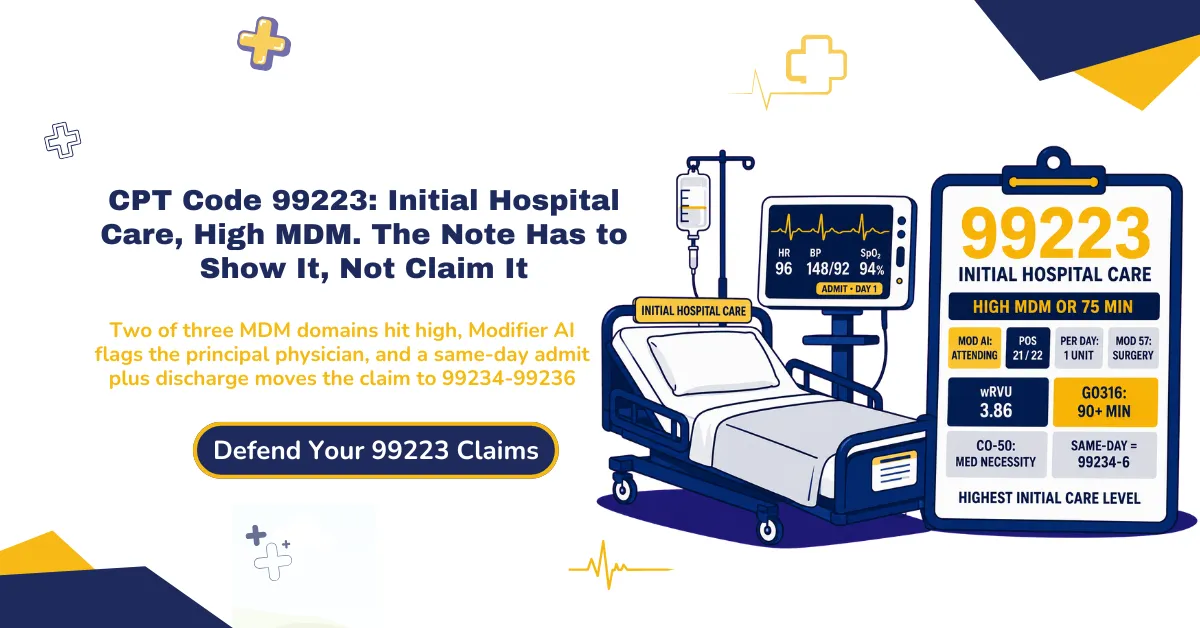
Three recurring problems downcode or deny the 99223 cpt code more than any other: a missing Modifier AI, an observation patient misclassified as inpatient-only, and MDM documentation that asserts high complexity without showing it. This guide closes all three gaps. The 99223 cpt code carries the highest reimbursement in the initial hospital care series, so each denial costs real revenue.
This guide is built for hospitalists, attending physicians, hospital-based billing teams, and surgical subspecialties billing initial inpatient and observation care encounters across Medicare Part B and commercial payers.
| Label | Value |
|---|---|
| CPT Code | 99223 |
| Service Category | Initial hospital inpatient or observation care, per day |
| AMA MDM Pathway | High complexity medical decision making |
| AMA Time Pathway | 75 minutes or more on the date of the encounter |
| Code Applies To | Inpatient and observation status patients (unified since January 1, 2023) |
| Work RVU (wRVU) | 3.86 [VERIFY against CMS RVU26B] |
| Total RVU | 4.68 [VERIFY against CMS RVU26B] |
| 2026 Conversion Factor | $33.40 (non-QP) and $33.57 (QP) [VERIFY] |
| 2026 Medicare Facility Rate | Approximately $156.32 [VERIFY facility vs non-facility label against CMS PFREV26B] |
| Per Diem Rule | Reported once per calendar day per physician or physician group of the same specialty |
| Modifier AI Required | Yes, for the principal physician of record on Medicare claims |
| Same-Day Admission + Discharge | Use CPT 99234-99236 instead of 99221-99223 |
| CERT Status | Projected high improper payment code (WPS Government Services CERT review) [VERIFY] |
| AUC Requirement | Paused. No AUC order required since January 1, 2024 |
CPT 99223 is the highest-level initial hospital inpatient or observation care code in the Evaluation and Management series. The admitting physician or qualified healthcare professional reports it on the first day of a hospital stay when the encounter requires either high-level medical decision making or a minimum of 75 minutes of total time on the encounter date.
Initial hospital care billing is one stage of the complete revenue cycle. ClaimMax’s guide to the 13 steps of revenue cycle management maps how charge capture, coding, and claim submission each affect CPT 99223 claim outcomes.
What Is CPT 99223? The 2026 AMA Definition and Scope
The 99223 cpt code covers initial hospital inpatient or observation care, reported per day, for evaluation and management. It requires a medically appropriate history and examination, plus either high-level medical decision making or 75 minutes of total time on the encounter date.
Providers can verify the complete code details and guidelines at the AAPC code reference for CPT 99223. This cpt code 99223 definition reflects the structure in place since the 2023 AMA restructuring.
The 2023 Observation Merger
This is the most misunderstood change affecting the code in 2026. Before January 1, 2023, observation-status patients were billed under a separate code family (CPT 99218-99220). Since January 1, 2023, the AMA restructuring consolidated hospital inpatient and observation care under a single code set, and CPT 99221-99223 now applies to both.
Code selection runs on MDM complexity or total time, whether the patient is admitted or placed under observation. The place of service code (POS 21 for inpatient, POS 22 for observation) still sets the facility versus non-facility payment rate. This 99223 cpt code definition resolves the inpatient-or-outpatient question coders ask most. [VERIFY the January 1, 2023 observation merger date, not 2021 or 2022.]
For observation-status patients billed at POS 22, ClaimMax’s guide to POS 22 hospital outpatient billing rules explains how the setting designation affects the Medicare payment rate and commercial payer processing. The AMA maintains detailed FAQs covering the 2023 E/M revisions, including the observation and inpatient unification, in its E/M Revisions FAQs updated January 26, 2026.
The code is a per-diem service. The same physician, or physicians of the same specialty within the same group practice, report it once per calendar day. When a continuous encounter crosses midnight, it’s reported once on the date the encounter begins, and this is the cpt code for inpatient admission on day one.
The next calendar day activates the subsequent hospital care codes (99231-99233), not a second 99223.
The Complete 2026 Hospital E/M Code Family: Where CPT 99223 Fits and When to Use It
Wrong-code-family selection draws an automatic claim denial before a human reviewer touches the claim. The four-family structure of hospital E/M coding clears most coding errors once a billing team has the inpatient cpt codes mapped.
| CPT Code | MDM Level | Time Threshold | When to Report |
|---|---|---|---|
| 99221 | Straightforward or Low | 40 min or more | First hospital day; lower-acuity admission |
| 99222 | Moderate | 55 min or more | First hospital day; moderate-complexity admission |
| 99223 | High | 75 min or more | First hospital day; high-acuity or high-complexity admission |
| 99231 | Low | 25 min or more | Second or subsequent hospital day; stable patient |
| 99232 | Moderate | 35 min or more | Second or subsequent hospital day; responding to treatment |
| 99233 | High | 50 min or more | Second or subsequent hospital day; unstable or complex course |
| 99234 | Low or Moderate | 45 min or more | Patient admitted AND discharged on the same calendar date |
| 99235 | Moderate | 70 min or more | Same-day admit and discharge, moderate complexity |
| 99236 | High | 85 min or more | Same-day admit and discharge, high complexity |
| 99238 | Under 30 minutes | N/A | Discharge day management, 30 minutes or less |
| 99239 | Over 30 minutes | N/A | Discharge day management, more than 30 minutes |
[VERIFY all time thresholds against AMA CPT 2026 guidelines before publishing.]
The outpatient new patient code that parallels CPT 99223 in MDM threshold is CPT 99205 (high complexity, 60 minutes). For practices billing across both inpatient and outpatient settings, ClaimMax’s CPT 99214 billing and reimbursement guide covers the moderate MDM documentation standard that maps to CPT 99222 in the inpatient series.
The Same-Day Admit and Discharge Trap: Why 99223 Draws Automatic Denials in This Scenario
This is the gap no competitor covers. When a patient is admitted to the hospital and discharged on the same calendar date, the correct code family is CPT 99234-99236, not CPT 99221-99223.
A claim that reports the 99223 cpt code for a same-day admit and discharge draws an automatic payer denial, because the code family is designated for per-day service across a multi-day stay.
A standard appeal won’t recover it, because the error sits in the code family selection rather than in the documentation.
99222 vs 99223: The MDM and Time Threshold That Separates Them
The difference between CPT 99222 and CPT 99223 is MDM complexity and time. CPT 99222 requires moderate MDM or 55 total minutes. CPT 99223 requires high MDM or 75 total minutes. High MDM means the patient’s condition threatens life or bodily function, calls for extensive data review, and carries high-risk management decisions.
Most hospital admissions qualify for CPT 99222. Reserve CPT 99223 for encounters where the documentation reflects high-acuity, high-complexity clinical decision making in full.
CPT 99222 requires moderate MDM or 55 minutes. CPT 99223 requires high MDM or 75 minutes. The reimbursement differential between them under the 2026 Medicare fee schedule is approximately $20 to $30 per encounter at the facility rate. [VERIFY the 99222 facility rate against CMS PFREV26B.]
On the first day of a hospital admission, the admitting physician reports from the initial hospital care series (99221-99223) based on MDM or total time. On the second hospital day, the treating physician moves to the subsequent hospital care series (99231-99233). When a patient is admitted and discharged on the same calendar date, the right code family is 99234-99236.
With the right code family confirmed, the next decision that controls reimbursement is the specific rate that applies based on setting and payer type.
2026 Medicare Reimbursement Rates and RVU Breakdown for CPT 99223
The facility rate and the non-facility rate are two different numbers for the same CPT code. A hospitalist billing team that configures its fee schedule on the wrong rate type miscalculates expected collections on every claim. Correct rate configuration starts with knowing both figures, and the 99223 cpt code reimbursement depends on which one applies.
| Setting | POS Code | 2026 Medicare Rate |
|---|---|---|
| Facility (inpatient hospital) | POS 21 | Approximately $156.32 [VERIFY: CMS PFREV26B, confirm facility rate] |
| Observation (on-campus outpatient hospital) | POS 22 | Approximately $156.32 (same formula; verify separately) [VERIFY] |
| Commercial BCBS benchmark | National average | $219.33 (PayerPrice June 2026) [VERIFY] |
| Commercial UHC benchmark | National average | $175.84 (PayerPrice June 2026) [VERIFY] |
| Commercial Aetna benchmark | National average | $214.84 (PayerPrice June 2026) [VERIFY] |
| Commercial Cigna benchmark | National average | $280.93 (PayerPrice June 2026) [VERIFY] |
Every rate cell marked [VERIFY] has to be confirmed against CMS PFREV26B before publication. Don’t interpolate. When the verified figure differs, use the verified figure.
RVU Breakdown for CPT 99223 in 2026
The work RVU for CPT 99223 is 3.86, reflecting the physician’s time, skill, and cognitive effort for high-acuity initial hospital care. The total RVU is 4.68, which includes the work, practice expense, and malpractice components. [VERIFY both against CMS RVU26B.] Health systems use the 3.86 work RVU to benchmark hospitalist productivity and compensation targets.
The 4.68 total RVU drives the Medicare payment calculation: total RVU multiplied by the applicable conversion factor.
The calculation runs as follows. At the 2026 non-QP conversion factor of $33.40: 4.68 total RVU times $33.40 equals $156.31 (rounded). This is the 99223 cpt code rvu math behind the published rate. [VERIFY this matches CMS PFREV26B for facility and non-facility rates separately.]
The 2026 Dual Conversion Factor: What Qualifying APM Participants Receive
2026 is the first Medicare Physician Fee Schedule year running two conversion factors at once. Qualifying APM Participants (QPs) use $33.57 per RVU. All other providers use $33.40 per RVU. For CPT 99223 at 4.68 total RVU, the difference is $0.80 per claim. Across a hospitalist group billing substantial initial hospital care volume, QPP participation status moves annual aggregate collections. [VERIFY the $33.40 and $33.57 conversion factors against the CMS CY2026 PFS Final Rule.]
Commercial Payer Rate Variance and Benchmarking
Commercial payer rates for CPT 99223 run well above Medicare. BCBS plans average $219.33, Aetna averages $214.84, Cigna averages $280.93, and UHC averages $175.84 on a national basis per June 2026 PayerPrice data.
Geographic location, specialty, and individual provider contract terms each move rates above and below these national averages. Verify contracted rates before assuming any benchmark applies to your specific payer agreements. Verify your MAC-locality-adjusted rate using the CMS Physician Fee Schedule search tool, and confirm wRVU and total RVU figures against the CMS PFS Relative Value Files (RVU26B, April 2026 release).
With verified 2026 rates established, the next decision that controls whether the claim pays at the rate it earns is whether the encounter’s medical decision making meets the high complexity threshold CPT 99223 requires.
High MDM Documentation for CPT 99223: The Three-Domain Framework Payers Actually Review
Most CPT 99223 downcoding happens because the clinical note asserts high complexity without showing it across the three MDM domains. Payer reviewers and RAC contractors score documentation against the same MDM framework. Understanding that framework is the audit defense that holds.
| MDM Domain | High Complexity Threshold for CPT 99223 |
|---|---|
| Problems Addressed | Acute illness threatening life or bodily function; severe exacerbation or progression of a chronic condition; or multiple complex conditions with significant comorbidity interaction that creates diagnostic uncertainty or management risk |
| Data Reviewed and Analyzed | Extensive: independent interpretation of test results; discussion with an external clinician; review of external records from multiple providers or sources; ordering and reviewing tests that require independent analysis |
| Risk of Management | High: high-risk medication management requiring intensive monitoring for toxicity; decision for major elective surgery with identified risk factors; diagnosis or treatment limited by social determinants of health; or complex shared decision making with the patient and family about long-term care options |
| Minimum Domains Required | Two of three domains have to reach the high complexity threshold |
The Documentation Pattern That Earns High MDM, and the Pattern That Gets Downcoded
The difference between a paid claim and a downcoded one shows up in the note itself.
BEFORE (downcoded documentation): “Patient admitted with sepsis. Multiple IV antibiotics started. Plan: continue current management, daily labs, monitor vitals.” This note lists a diagnosis and a plan, but it doesn’t record which problems the physician evaluated, what data was reviewed independently, or what made the management decisions high-risk. The MDM elements that would support high complexity are present at the bedside and absent from the record.
AFTER (defensible documentation): “Day 1 of septic shock requiring two vasopressors. Reviewed the outside hospital’s CT abdomen and blood cultures from 48 hours prior under independent interpretation. Discussed patient status and vasopressor titration with on-call nephrology. High-risk medication decisions include dopamine and vasopressin with active monitoring for cardiac toxicity. Complex family meeting held on escalation of care, including a goals-of-care discussion.” This note addresses all three MDM domains at high complexity by name, and it holds up on post-payment review.
The contrast isn’t the clinical care, which is identical in both notes. The contrast is what the record proves. CERT reviewers pay the second note and downcode the first, because the 99223 cpt code requires documentation that demonstrates the threshold rather than asserting it.
How CPT 99223 MDM Documentation Connects to the Outpatient High-Complexity Standard
The high-complexity MDM framework is the same structure across both inpatient and outpatient E/M codes. The time thresholds differ (75 minutes for CPT 99223 versus 60 minutes for CPT 99205), but the MDM elements, the three-domain structure, and the documentation requirements all run on the same AMA guidelines.
For practices billing across both settings, consistent MDM documentation training cuts audit exposure in both code families. See ClaimMax’s CPT 99205 billing and audit defense guide for high-complexity MDM documentation with outpatient-specific examples.
When high MDM isn’t documentable for a specific encounter, the time pathway gives providers a second route to CPT 99223 that doesn’t depend on MDM complexity.
Time-Based Billing for CPT 99223: The 75-Minute Threshold, Qualifying Activities, and G0316 Prolonged Services
When the encounter is complex but the MDM documentation doesn’t reach the high-complexity threshold, time is the alternative pathway. Total time on the date of the encounter has to reach 75 minutes to support the 99223 cpt code description time requirement.
What “Total Time” Includes for CPT 99223
Total time on the date of the encounter covers all physician time on that calendar date tied to that patient’s care:
- Pre-encounter chart review and record analysis
- Face-to-face examination of the patient
- Ordering and reviewing diagnostic tests and results
- Documenting the medical record, including the note itself
- Counseling the patient and family members
- Coordinating care with consulting physicians and external providers
- Supervising or discussing the care plan with other team members
- Time spent on the care plan after the patient encounter ends
Time contributed by nurses, medical assistants, or other support staff doesn’t count. Time documented by residents on their own, without the attending physician’s participation, doesn’t count. Only the billing physician or qualified healthcare professional’s time counts. The 99223 time total has to reach 75 minutes on the encounter date.
G0316 Prolonged Inpatient Services: When 75 Minutes Is Not the Endpoint
When billing CPT 99223 by total time and the encounter runs 15 or more minutes past the 75-minute mark, Medicare calls for HCPCS G0316 for prolonged initial hospital inpatient or observation care.
G0316 activates when total time on the encounter date reaches 90 minutes or more. For each additional 15-minute increment beyond 90 minutes, G0316 is reported once. G0316 is specific to Medicare fee-for-service billing and applies only when time is the code selection method for that encounter.
CMS’s MLN E/M Services Guide (MLN006764) documents the G0316 threshold, effective since 2023 and still applicable under 2026 CMS coverage policy. [VERIFY the G0316 90-minute threshold against the current MLN006764.] Review the CMS MLN Evaluation and Management Services Guide for the full prolonged-services rule.
Documentation Requirements When Billing CPT 99223 by Total Time
The compliant time format states a specific number and describes the activities the billing provider performed firsthand. Model language reads: “Total time on date of encounter: [X] minutes. Activities included: pre-encounter chart review, face-to-face evaluation, review of outside hospital records, coordination with nephrology, patient and family counseling, and EHR documentation.”
With MDM and time pathways both covered, the modifier rules that apply to CPT 99223 claims are the third configuration variable that decides whether the claim pays or denies.
CPT 99223 Modifier Rules: Modifier AI, Modifier 25, Modifier 57, and Teaching Physician Requirements
Modifier errors on CPT 99223 claims fall into four categories: the wrong modifier for the billing arrangement, a missing Modifier AI on principal physician claims, same-day billing without Modifier 24 or 25, and teaching physician claims without Modifier GC.
Each category draws a different denial type with a different resolution path. The cpt code 99223 description modifier rules below map each scenario to the modifier it requires.
| Billing Scenario | Modifier Required | Key Rule |
|---|---|---|
| Admitting physician coordinating overall care (Medicare) | Modifier AI | Only one physician in a group appends AI per admission |
| Consulting physician billing initial hospital care (non-attending) | None (no Modifier AI) | Consulting subspecialists don’t append AI unless they assume attending responsibility |
| Same-day minor procedure AND separate hospital visit | Modifier 25 on the E/M | E/M must document a separately identifiable clinical issue beyond the procedure |
| Initial hospital visit where surgeon decides to operate (global period) | Modifier 57 on the E/M | Required when the E/M results in a decision for major surgery within the 90-day global period |
| E/M during an unrelated condition in postoperative global period | Modifier 24 | E/M must address a condition unrelated to the original surgery |
| Teaching physician present with resident | Modifier GC | Teaching physician must document personal presence and direct supervision |
| Same-day discharge management billed separately | Modifier AI retained | 99223 and 99238/99239 aren’t billable on the same date by the same physician |
Modifier AI: Principal Physician of Record, the Most Missed Modifier on CPT 99223 Claims
Modifier AI marks the principal physician of record: the admitting physician who coordinates the patient’s overall inpatient care and oversees specialty consultations. Medicare requires Modifier AI on the initial hospital care CPT code (99221-99223) for the physician who holds that role.
Only one physician per admission in a physician group appends Modifier AI. Consulting subspecialists who bill initial hospital care for their specialty visit use CPT 99221-99223 without Modifier AI, unless they take on the attending physician role. A missing Modifier AI draws a payer hard edit on Medicare claims.
Only the principal physician of record appends Modifier AI to CPT 99223. When a consulting cardiologist, pulmonologist, or hospitalist sees the patient on admission day but doesn’t take on attending responsibility, they bill the appropriate level of initial hospital care without Modifier AI.
Modifier AI requirements for initial hospital care billing are documented in the CGS Medicare CPT 99223 fact sheet. [VERIFY the CGS fact sheet URL is accessible.]
Modifier 57: Decision for Surgery on the Same Day as CPT 99223
This is a gap no competitor covers. When a surgeon performs an initial hospital evaluation and, during that same encounter, makes the decision to proceed with major surgery inside the 90-day global surgical period, Modifier 57 has to go on CPT 99223.
Without Modifier 57, the E/M service bundles into the global surgical package and pays nothing on its own. Modifier 57 unbundles the E/M payment by recording that the evaluation produced a new decision for surgery that wasn’t made before.
Modifier 57 applies to CPT 99223 when the initial hospital evaluation results in a decision for major surgery during the 90-day global period. Without Modifier 57, the CPT 99223 claim bundles into the surgical global package, and the E/M claim pays zero.
Teaching Physician Documentation and Modifier GC
In academic medical center and teaching hospital settings, when residents take part in the encounter, Medicare applies teaching physician documentation requirements. The attending physician documents personal presence and direct supervision of the key portions of the encounter.
Modifier GC confirms that a resident performed part of the service under the supervision of a teaching physician. Teaching physician documentation that’s missing or boilerplate is a leading audit trigger in academic inpatient billing. Teaching physician requirements sit in CMS Medicare Claims Processing Manual Chapter 12.
A missing Modifier AI draws a payer hard edit that won’t clear without a corrected claim resubmission. ClaimMax RCM’s denial management services catch modifier configuration errors before they compound into AR aging problems.
2026 Split/Shared Visit Rules for CPT 99223: CMS Substantive Portion Standard
In most hospitalist and academic inpatient settings, both a physician and an advanced practice provider see the patient on admission day. When that happens, the CPT 99223 claim is a split/shared visit, and 2026 CMS policy sets specific documentation requirements that decide who may bill the code and at what level.
What Makes a CPT 99223 Encounter a Split/Shared Visit
A split or shared E/M visit happens when a physician and a qualified healthcare professional in the same group practice each perform a portion of the same initial hospital care encounter on the same date of service.
Both practitioners have to be in the same group practice. One billing professional submits the claim. The 2026 CMS rules decide which practitioner bills and what documentation supports the claim.
The 2026 Substantive Portion Standard: More Than Half of Total Time
The 2026 CMS definition of substantive portion for split/shared visits offers two methods, the same MDM-or-time structure that governs code selection. Under the time method, the physician who spent more than half of the total combined time of both practitioners on the encounter date performs the substantive portion and may bill under their NPI.
Under the MDM method, the physician who performed the substantive portion of the medical decision making may bill. The physician who performed the substantive portion signs and dates the medical record. CMS also requires that the documentation name both practitioners who took part in the encounter. [VERIFY the “more than half of total time” substantive-portion wording against CMS-1832-F.]
For CPT 99223 split/shared visits billed by time: when the attending physician spent 45 of 75 total minutes on the encounter, they performed the substantive portion and bill CPT 99223 under their NPI. When the APP spent more than half the combined time, the APP bills the appropriate level under their NPI, and CPT 99223 doesn’t apply.
The Documentation Failure That Generates Split/Shared Denials
The most common split/shared documentation failure for CPT 99223 is a note that names two practitioners but doesn’t record who performed which activities or how total time split between them. Auditors can’t pin down the substantive portion from a note that reads “attending reviewed and agreed.”
The attending physician’s own contribution has to appear in the attending’s own words, and a counter-signature alone won’t carry it.
These 99223 cpt code guidelines decide whether the claim survives a post-payment review.
Prior authorization verification applies to split/shared encounters the same way it applies to single-provider encounters. ClaimMax’s eligibility verification and prior authorization guide covers the documentation required before a hospital admission claim reaches the billing team, including whether the 99223 cpt code needs authorization for a given payer.
With split/shared billing documented to standard, the complete documentation checklist for a clean CPT 99223 claim is the next pre-submission gate.
CPT 99223 Documentation Checklist: What Payers Verify Before Paying and After
CPT 99223 documentation gets reviewed twice: before payment during prior authorization for Medicare Advantage plans, and after payment during MAC post-payment reviews and RAC audits. The checklist below covers what both review stages look for, and what does cpt code 99223 mean for each one in practice.
When billing CPT 99223 by high MDM, the clinical record has to support all of the following before the claim submits:
- Problems addressed: the specific conditions evaluated and treated on admission day, with their acuity stated in the assessment section by name, not implied by ICD-10 code alone
- Data reviewed and analyzed: each data source named by type, source, and date, not referenced as “records reviewed”
- Risk of management: the specific management decision and its risk level named in the note (drug name plus monitoring requirement, or surgery decision plus identified risk factors)
- Two of three MDM domains at high complexity: the note demonstrates the high MDM threshold rather than stating it
- Medically appropriate history and examination: present in the record, though no specific level of history or examination is required under 2026 AMA guidelines
- Billing physician’s participation: the note records that the billing provider evaluated the patient firsthand
- Modifier AI appended and supported: the record names the billing provider as the principal physician of record coordinating overall care
When billing CPT 99223 by total time, the clinical record has to include:
- A specific total time number in minutes, not ranges and not approximations
- A brief description of what that time covered, the categories of work the billing provider performed firsthand
- Confirmation that the total time fell on the same calendar date as the encounter
- Exclusion of any time billed separately as another service
Every item on this checklist is a clean claim requirement for hospital E/M billing. When any element is incomplete or inconsistent, the claim draws a pre-submission rejection or a post-submission denial. These 99223 cpt code requirements are what separate a first-pass payment from a correction-queue claim.
ClaimMax’s guide to clean claim requirements for hospital E/M billing covers the verification workflow that keeps CPT 99223 claims out of the correction queue. WPS Government Services documents projected high improper payment status for CPT 99223 based on CERT reviews, naming documentation gaps as the primary error pattern, in its guides and resources. [VERIFY the correct WPS CERT fact-sheet URL for CPT 99223 before publishing; the supplied link is the WPS guides index, not the specific CERT page.]
Three 2026 regulatory updates changed the compliance landscape for CPT 99223 billing, and most published guides haven’t caught up with them.
2026 Regulatory Updates That Affect Every CPT 99223 Claim
The AUC Program Is Still Paused: No AUC Order Required on CPT 99223 Claims
The Appropriate Use Criteria program for advanced diagnostic imaging was paused effective January 1, 2024, and CMS rescinded the AUC regulations at 42 CFR 414.94. CPT 99223 is an E/M code rather than an imaging code, yet some inpatient billing systems still prompt for AUC documentation when imaging is ordered alongside the admission E/M.
That prompt reflects pre-2024 rules. CMS has confirmed that no AUC consultation information belongs on any Medicare fee-for-service claim submitted after January 1, 2024, including claims that pair inpatient E/M with advanced imaging orders. Suppress AUC prompts from admission-day workflows. [VERIFY the AUC pause is still in effect per the CMS AUC status page.]
G2211 Expansion Effective January 1, 2026: Does It Apply to CPT 99223?
HCPCS G2211 is the Medicare add-on code for office and outpatient E/M visits where the provider serves as the longitudinal focal point for complex ongoing care. Effective January 1, 2026, G2211 expanded to include home and residence E/M codes.
G2211 doesn’t apply to inpatient hospital care codes, so CPT 99223 claims can’t include it. For complex patients who move from inpatient (CPT 99223) to outpatient follow-up (CPT 99215), G2211 may apply to the later outpatient encounter when all eligibility criteria are met.
Review longitudinal-care patients at discharge for G2211 eligibility on their first post-discharge outpatient visit. [VERIFY the G2211 expansion to home and residence E/M codes effective January 1, 2026 against the CMS CY2026 PFS Final Rule.]
Dual Conversion Factor Recap: Confirming QPP Status Before Q3 and Q4 Claims
The 2026 CMS PFS runs two conversion factors at once for the first time. Qualifying APM Participants (QPs) use $33.57 per RVU. All other providers use $33.40. The difference per CPT 99223 claim is $0.80.
Confirm QPP participation status in the CMS Quality Payment Program portal before setting 2026 fee schedule benchmarks for any billing system that processes CPT 99223 volume. CMS confirmed the AUC pause on its AUC program status page effective January 1, 2024.
With regulatory compliance confirmed, the next layer of CPT 99223 defense is knowing which audit patterns CMS contractors have flagged as high improper payment risk for this specific code.
CERT Audit Defense for CPT 99223: What CMS Contractors Are Finding and How to Protect Your Revenue
CMS Comprehensive Error Rate Testing reviews have flagged CPT 99223 as a projected high improper payment code. That designation means CMS contractors target this code in both pre-payment reviews and post-payment audits. Insufficient MDM documentation is the primary error pattern across CERT review cycles for the 99223 cpt code. [VERIFY the CPT 99223 CERT projected-high-improper-payment status with WPS Government Services.]
What the CERT Data Shows: The Three Error Patterns on CPT 99223
Pattern 1: documentation insufficient to support high MDM. The clinical note asserts high complexity but doesn’t show all three MDM elements at the high threshold. CERT reviewers look for specific language on problems addressed, data reviewed by name and date, and the risk level of the management decisions made.
Pattern 2: missing or inadequate total time documentation when billing by the time pathway. CERT reviewers keep finding that time-based claims for CPT 99223 lack a specific minute total or an activity description.
Pattern 3: status mismatch between the physician’s billing and the facility’s classification. The physician bills CPT 99223 as an inpatient encounter while the facility has classified the patient as observation-only. When physician and facility claim statuses differ, both claims face payer inquiry and possible recoupment.
The Two RAC Audit Topics That Target CPT 99223 Claims
RAC Topic 0037, Hospital Services, Excessive Units: both initial hospital care codes (CPT 99221-99223) and subsequent care codes (CPT 99231-99233) are per-diem services. RAC Topic 0037 targets billing that reports the same per-diem E/M code more than once per day for the same patient by the same physician, and the payer recoups without clinical review. [VERIFY RAC Topic 0037 active status on the CMS RAC program page.]
RAC Topic 0042, Outpatient Office Visit Codes Billed for Hospital Inpatients: office and outpatient visit codes (CPT 99202-99215) can’t be billed for patients admitted to a hospital setting. When a physician uses outpatient visit codes for a hospitalized patient instead of the correct inpatient codes, RAC Topic 0042 drives recoupment across all affected claims. [VERIFY RAC Topic 0042 active status on the CMS RAC program page.]
The fastest way to head off CERT and RAC audit exposure on CPT 99223 claims is a pre-submission scrubbing protocol that catches Modifier AI errors, POS mismatches, and duplicate per-diem billing before the claim leaves the billing system.
ClaimMax’s clearinghouse rejection prevention for E/M claims covers the pre-submission checks that clear the error patterns CERT reviewers find most. CMS publishes active Recovery Audit Contractor review topics, including RAC Topics 0037 and 0042, on the CMS RAC program page.
WPS Government Services lists CPT 99223 as a projected high improper payment code in its guides and resources.
Pre-submission prevention catches errors before claims submit. When denials still occur despite pre-submission controls, the denial code table below maps each CPT 99223 denial to its specific resolution path.
Denial Codes, ICD-10 Pairings, and Appeal Language for CPT 99223
CPT 99223 denials cluster around five root causes. Each carries a specific CARC code, and each has a documented resolution path. The tables below map every denial type to its root cause and first recovery action, so the billing team isn’t rebuilding the appeal from scratch on each denial.
| Denial Code | Description | Root Cause for CPT 99223 | First Recovery Action |
|---|---|---|---|
| CO-50 | Not medically necessary | High MDM not shown across two of three domains; documentation asserts complexity without showing it | Appeal with the complete admission note, the MDM elements documented by name, and a CMS NCD or MAC policy citation supporting high-complexity admission care |
| CO-11 | Diagnosis not consistent with procedure | ICD-10 primary diagnosis doesn’t reflect a high-acuity condition; an unspecified or low-complexity diagnosis paired with a high-complexity E/M | Pull the clinical note; recode the primary ICD-10 to the condition that drove the high-complexity admission; resubmit as a corrected claim with frequency code 7 |
| CO-15 | Missing or invalid authorization | Medicare Advantage or commercial prior authorization not obtained before admission; auth number missing from Box 23 | Check whether retro authorization is available from the payer; if not, appeal with medical necessity documentation and an emergency exception request where it applies |
| CO-16 | Missing information or documentation | Modifier AI missing from the principal physician’s claim; required supporting information absent from the claim form | Identify the missing element from the accompanying RARC code; supply it through the payer portal or resubmit as a corrected claim |
| CO-18 | Duplicate claim | Original CPT 99223 claim resubmitted before the first adjudicated; a second same-day initial care claim from a different provider in the group | Check the original claim status before any resubmission; verify whether Modifier AI was assigned correctly to head off duplicate per-diem billing |
| CO-4 | Modifier inconsistent with place of service | Modifier AI applied to a consulting physician’s claim rather than the attending; or an outpatient modifier applied to an inpatient POS | Review who the principal physician of record is on the admission; correct the modifier assignment before resubmitting |
| CO-97 | Service bundled into another service | CPT 99223 bundled into a same-day surgical procedure without Modifier 25; or bundled into the postoperative global period without Modifier 57 | Determine whether a separately identifiable E/M or a decision for surgery justifies the modifier; add the correct modifier and resubmit |
For the complete workflow on preventing and resolving CO-18 duplicate billing denials, including the claim status verification protocol before resubmission, see ClaimMax’s CO-18 duplicate claim denial recovery guide.
ICD-10 Codes That Support High MDM for CPT 99223
These diagnosis codes represent high-acuity inpatient presentations that support the high-complexity MDM threshold for CPT 99223 in most cases:
| ICD-10 Code | Description | MDM Element Supported |
|---|---|---|
| R65.21 | Severe sepsis with septic shock | Problems (threat to life) and Risk (high-risk vasopressor management) |
| I21.0x-I21.4x | Acute myocardial infarction | Problems (threat to life) and Risk (high-risk intervention decision) |
| J96.0x | Acute respiratory failure | Problems (threat to life) and Data (extensive diagnostic review) |
| I50.x | Heart failure | Problems (severe exacerbation of a chronic condition) and Risk |
| N17.x | Acute kidney failure (injury) | Problems (threat to bodily function) and Data (extensive lab review) |
| I63.x | Cerebral infarction | Problems (threat to life) and Data (imaging independent interpretation) |
| I95.x | Hypotension (septic, orthostatic, postprocedural) | Problems (hemodynamic instability) and Risk |
| A41.x | Septicemia and sepsis | Problems (threat to life) and Risk (high-risk antibiotic management) |
| J18.x | Pneumonia requiring inpatient care | Problems (severe infection) and Data (imaging and culture review) |
| K72.00 | Acute liver failure without coma | Problems (threat to life) and Data (extensive lab interpretation) |
[VERIFY all ICD-10 codes against FY2026 ICD-10-CM (effective October 1, 2025) before publishing.]
Hypotension (I95.x) is one of the most common high-acuity diagnoses supporting CPT 99223 medical necessity. ClaimMax’s hypotension ICD-10 coding guide covers the full I95 code specificity requirements, documentation standards, and inpatient DRG grouping considerations for billing teams that see hypotensive inpatient presentations often.
For Medicaid-insured inpatient patients, CO-50, CO-11, and CO-97 denials on CPT 99223 claims follow Medicaid-specific resolution workflows. ClaimMax’s Medicaid inpatient billing requirements guide covers the three-level appeal process and the documentation specific to Medicaid managed care. Verify all diagnosis codes against the official FY2026 ICD-10-CM files.
When CPT 99223 denial patterns repeat across billing cycles, the root cause sits upstream of the claim in a workflow gap, seldom in documentation alone. ClaimMax RCM’s denial management services team finds the pattern, traces it to the workflow failure, and clears it before it compounds into uncollectable AR.
For hospitalist groups and hospital billing teams that need a partner across every step from charge capture through denial recovery, the next section covers what ClaimMax provides.
ClaimMax RCM: Initial Hospital Care Billing, Denial Recovery, and Credentialing for Inpatient Providers
At hospitalist group volume, a 10% first-submission failure rate on CPT 99223 claims drives a real collections gap, one that compounds through AR aging, appeal overhead, and write-off risk when denial windows close. Most CPT 99223 denial patterns trace to upstream workflow failures that a structured RCM partner clears before claims submit.
ClaimMax RCM manages initial hospital care billing compliance, denial recovery, and payer credentialing for hospitalist groups, attending physicians, and hospital-based surgical subspecialties. The team reviews CPT 99223 claim patterns for root cause analysis, runs appeals inside payer windows, and holds Modifier AI and per-diem billing accuracy across every claim cycle.
Explore ClaimMax’s medical billing service to see how the inpatient billing workflow runs from charge capture through denial recovery. ClaimMax’s revenue cycle management services include denial tracking, appeal management, and quarterly billing compliance reviews for hospital-based practices. Contact ClaimMax RCM to review your CPT 99223 denial rate and receive a no-cost revenue cycle assessment.
This guide reflects the AMA CPT 2026 code set (effective January 1, 2026), the CMS CY2026 Physician Fee Schedule Final Rule (CMS-1832-F), CMS coding and coverage guidance including MLN006764 and Article-level CERT findings, the CMS RAC program review topics, and FY2026 ICD-10-CM (effective October 1, 2025), current as of the publish date. CPT codes and descriptors are owned by the AMA. CPT 99223 rates, RVU values, conversion factors, the G0316 and G2211 thresholds, RAC topic numbers, CERT status, and all ICD-10 pairings should be verified against current CMS, MAC, and AMA sources before claim submission. Authored by Dr. Mateo Vargas, CPC, CPB, ClaimMax RCM.