
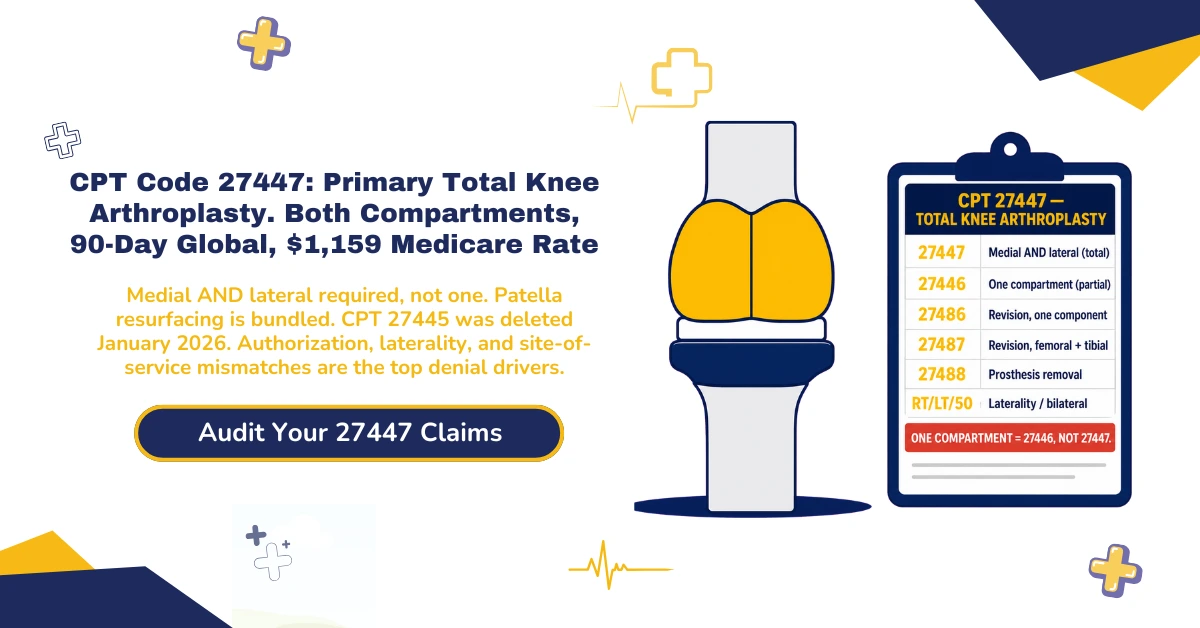
CPT code 27447 reports primary total knee arthroplasty, the replacement of the medial and lateral compartments of the knee, with or without patella resurfacing. It shouldn’t be used for a unicompartmental replacement or for revision of an existing knee prosthesis. Correct payment depends on documentation, diagnosis linkage, site of service, payer rules, and accurate modifier use.
This guide covers the whole billing picture for primary total knee arthroplasty: code scope, included work, related codes, the 2026 updates, site of service, authorization, documentation, modifiers, Medicare reimbursement, denials, and underpayments.
CPT 27447 sits at the center of high-value orthopedic claims, so small errors get expensive fast. ClaimMax RCM supports healthcare providers across the coding, claim submission, payment, denial, and AR stages of the revenue cycle.
If you searched the total knee replacement CPT code and landed here, 27447 is the primary code you want, and the details below decide whether it gets paid or denied.
Quick Reference: CPT 27447 at a Glance
Before the details, here is a quick reference for CPT code 27447 that coders and billers can scan in seconds.
| Field | Required content |
|---|---|
| Code | 27447 |
| Procedure | Primary total knee arthroplasty |
| Anatomical scope | Medial and lateral compartments; patella resurfacing included when performed |
| Procedure type | Primary, not revision |
| Global period | 90 days |
| Settings | Inpatient, HOPD, and eligible ASC cases |
| 2026 work RVU | 19.11 |
| 2026 national professional payment | Approximately $1,159.64 non-QP and $1,165.46 QP before locality adjustment |
| Main billing risks | Medical necessity, authorization mismatch, incorrect modifier, bundling, and site-of-service errors |
The 2026 work RVU and the national payment figures come from the AAHKS 2026 payment summary. They’re national averages before locality adjustment, not a guaranteed reimbursement rate.
Four things to keep in mind:
- The code requires replacement of both the medial and lateral compartments.
- Patella resurfacing is already included when it’s performed.
- Partial and revision arthroplasty need different codes.
- Payment depends on documentation, setting, locality, payer policy, and claim circumstances.
Practices handling high-value joint replacement claims need an orthopedic medical billing workflow that connects documentation, claim edits, payment posting, and denial follow-up on every 27447 CPT code claim.
What Is CPT Code 27447?
CPT code 27447 represents primary total knee arthroplasty. It covers the medial and lateral compartments and applies with or without patella resurfacing. It does not represent partial or revision surgery. The operative report has to support the full procedure that was performed.
Official Code Scope
The official descriptor reads: Arthroplasty, knee, condyle and plateau; medial AND lateral compartments with or without patella resurfacing. Three phrases carry the weight.
Medial AND lateral means both compartments, not one. With or without patella resurfacing means the kneecap work is optional and already bundled. Total knee arthroplasty means primary, not revision.
Each phrase answers a coding question: how many compartments, whether the kneecap counts, and whether the case is primary or revision.
Read closely, the 27447 CPT code description works like a checklist. Match the note to it, and code selection gets simpler.
For Medicare diagnosis support and billing context, the CMS TKA billing article lays out how the code and covered diagnoses connect. Confirm the version tied to your MAC jurisdiction.
What Anatomical Work Does the Code Represent?
The code covers work across the femoral condyles and the tibial plateau: preparing the bone, then placing the femoral component, the tibial component, and the polyethylene insert. The patellar component is added only when resurfacing is performed.
One caution. The descriptor requires the medial and lateral compartments, while patella resurfacing stays optional. Don’t write that all three compartments must always be replaced, because that isn’t what the code says.
That distinction matters when a coder reviews the note. The compartments treated and the components implanted drive the code, and the report should name them clearly. If you’ve seen it called the CPT code for TKA or the total knee arthroplasty CPT code, those describe 27447 too.
Is Patella Resurfacing Separately Billable?
No. Patella resurfacing is included when performed as part of the total knee arthroplasty this code describes.
The descriptor already accounts for it, so a separate same-knee patellar line can trigger an edit or a denial. Document whether resurfacing happened anyway, because the operative note should match the work.
This is a common scrubber flag on orthopedic claims. A patellar component billed on the same knee as the CPT code for total knee arthroplasty reads as double-reporting bundled work, and the line gets kicked back.
When Should CPT 27447 Be Used?
Use CPT code 27447 when the surgeon performs a primary total knee arthroplasty involving the medial and lateral tibiofemoral compartments. The operative report should clearly support the components replaced, the knee treated, and whether the procedure was primary rather than a revision of an existing prosthesis.
Clinical and Operative Triggers
Code selection follows the operative findings, not the scheduling sheet: what compartments were treated, what components went in, primary versus revision, which knee, and the final procedure performed.
Don’t let the preauthorization code override the operative report. If the planned code and the performed procedure differ, the note controls the claim. Coders sometimes see it written as procedure code 27447, but the rules are the same.
When the Code Should Not Be Used
Skip this knee replacement CPT code when the work doesn’t meet the full total-arthroplasty scope. Don’t report it for:
- A single medial compartment
- A single lateral compartment
- Patellofemoral-only arthroplasty without proper code analysis
- Revision of one existing component
- Revision of the femoral and tibial components
- Prosthesis removal
- Intraoperative work that doesn’t meet the total arthroplasty scope
Most of these are revision or partial scenarios that carry their own codes. Reporting 27447 for them is an upcoding risk.
Operative-Note Language Coders Should Confirm
Before the claim goes out, the operative report should establish the specifics that support the code:
- Right or left knee
- Primary procedure, not revision
- Medial and lateral involvement
- Femoral and tibial preparation
- Components implanted
- Whether the patella was resurfaced
- Any separately documented additional work
Medicare medical-necessity and documentation rules can be MAC-specific. The Medicare joint replacement LCD is one local coverage example, not a universal national rule, so check the policy for your jurisdiction.
Orthopedic claims like this need specialty-specific coding and documentation controls, which is why practices lean on specialty billing services built around how these procedures are documented and paid.
How Does CPT 27447 Compare With CPT 27446, 27486, 27487, and 27488?
CPT 27446 represents unicompartmental knee arthroplasty, while CPT code 27447 represents primary total knee arthroplasty involving the medial and lateral compartments. CPT 27486 and CPT 27487 apply to revision of previously implanted total knee components, and CPT 27488 reports removal of a knee prosthesis.
The family lines up like this:
| Code | Procedure category | Key coding trigger | Common mistake |
|---|---|---|---|
| 27446 | Primary unicompartmental arthroplasty | Medial or lateral compartment only | Reporting 27447 when only one compartment was treated |
| 27447 | Primary total knee arthroplasty | Medial and lateral compartments | Using it for revision surgery |
| 27486 | Revision TKA, one component | One prosthetic component revised | Failing to name the component |
| 27487 | Revision TKA, femoral and entire tibial component | Both major components revised | Reporting primary TKA instead |
| 27488 | Prosthesis removal | Existing knee prosthesis removed | Confusing removal with revision |
For code-family and billing context, the CMS joint arthroplasty article covers how these knee procedures are reported and supported.
Each row answers four questions: what the code is, when it applies, how it differs from 27447, and what error to avoid. The partial knee replacement CPT code and the revision codes are the ones most often confused with 27447.
CPT 27446 Versus CPT 27447
The difference is one word in the operative note: OR versus AND. CPT code 27446 covers one compartment, medial or lateral. 27447 covers both tibiofemoral compartments. Partial versus total.
What is CPT 27446? CPT 27446 reports primary unicompartmental knee arthroplasty, the replacement of a single knee compartment. It applies when only the medial or the lateral compartment is treated, not both. The partial knee replacement CPT code is 27446, not 27447.
CPT 27486 Versus CPT 27487
Both are revision codes, and the difference is scope. CPT code 27486 covers revision of one component. CPT 27487 covers revision of the femoral component and the entire tibial component.
The coder has to identify which components were removed and replaced. The revision total knee replacement CPT code depends on that scope, and a primary total knee code doesn’t apply because the revision was extensive.
Name the exact component scope in the claim. Vague wording like more complex revision doesn’t tell the payer what was done, and vague revision claims stall.
What About CPT 27445 in 2026?
| Coding alertCPT 27445 was deleted effective January 1, 2026. It should not be presented as a current 2026 reporting alternative or listed in an active code comparison for 2026 dates of service. |
Older articles that still list 27445 as an option are out of date. Confirm the current-year code set before submission.
What Changed for CPT Code 27447 in 2026?
The code remains the primary choice for total knee arthroplasty in 2026, with no verified descriptor rewrite to the 27447 CPT code itself. The most important 2026 developments involve Medicare valuation, the deletion of CPT 27445, continuing documentation scrutiny, and future navigation-code changes that don’t take effect until 2027.
2026 Medicare Valuation Snapshot
The 2026 valuation numbers worth knowing:
- Work RVU: 19.11
- Practice expense RVU: 11.59
- Malpractice RVU: 4.03
- National non-QP professional payment: approximately $1,159.64
- National QP professional payment: approximately $1,165.46
Don’t read these as a fixed check. They’re the starting point before locality, provider status, and claim circumstances adjust the allowed amount. The detailed math sits in the reimbursement section later.
CPT 27445 Was Deleted for 2026
CPT 27445 was deleted effective January 1, 2026. It shouldn’t appear in a current 2026 comparison as an active reporting choice, and articles that still recommend it are outdated. Confirm current-year code sets before claim submission.
A deleted code on a 2026 claim is an automatic rejection. The fix is using the current set.
The AMA panel action summary documents the CPT 27445 deletion, its effective date, and the 2027 navigation-code activity.
Navigation Changes Are a 2027 Development
This is where dated sources cause errors. AMA panel activity revised the CPT code 20985 descriptor, and deletion of 0054T and 0055T is scheduled for the 2027 CPT code set. Those are 2027 changes, not already-effective 2026 rules.
Coverage and payment for computer-assisted navigation stay payer-specific. Reportable and covered aren’t the same thing.
The simple rule: valuation and the 27445 deletion are live in 2026; the 20985 descriptor change and the 0054T and 0055T deletions land in 2027.
Medicare’s two 2026 conversion factors and the related payment-policy changes are detailed in the CMS 2026 PFS final rule.
Annual coding, authorization, claim-edit, and payment changes affect scheduling, claim edits, and payment review. end-to-end RCM services help keep those stages aligned as the code set turns over each year.
Is CPT Code 27447 Inpatient, Outpatient, or ASC?
This code isn’t limited to inpatient hospital care. Eligible total knee arthroplasty cases may be performed in an inpatient hospital, a hospital outpatient department, or a Medicare-certified ambulatory surgical center, subject to patient selection, medical necessity, payer policy, and facility requirements.
2018 Hospital Outpatient Milestone
27447 was removed from the Medicare Inpatient-Only list effective January 2018. That let qualifying cases receive hospital outpatient payment. It did not make every patient appropriate for outpatient surgery.
The 2018 change is covered in the AAOS TKA policy guidance.
2020 ASC Milestone
Separately, Medicare added total knee arthroplasty to the ASC Covered Procedures List for 2020. Keep the two milestones apart: 2018 was outpatient hospital, 2020 was ASC. ASC eligibility still depends on patient selection and payer requirements.
The 2020 ASC addition is summarized in the AAHKS 2020 ASC update.
How Professional and Facility Claims Differ
The professional and facility claims move separately:
| Setting | Surgeon or professional claim | Facility claim |
|---|---|---|
| Inpatient hospital | Professional service reported separately | Hospital uses the inpatient payment system |
| HOPD | Professional service reported separately | Hospital uses the outpatient payment system |
| ASC | Professional service reported separately | ASC submits the facility claim under ASC payment rules |
The surgeon’s professional claim and the facility claim are two different bills. The surgeon doesn’t receive the facility payment.
This trips up revenue tracking. A practice that only watches the professional payment can miss facility-side issues entirely, because those sit on a different claim.
Place of Service Coding
Three place-of-service codes come up: POS 21 for inpatient hospital, POS 22 for on-campus outpatient hospital, and POS 24 for an ASC. The setting on the claim has to match where the case was done.
A mismatch here is a fast denial. If the note says ASC and the claim says inpatient hospital, the payer sees a conflict before anyone reviews the surgery.
Place of service drives payment and edits more than people expect. Our POS 22 billing guide breaks down the outpatient-hospital setting in more detail.
What Should Be Verified Before a Total Knee Arthroplasty Claim Is Submitted?
Before a total knee arthroplasty claim goes out, verify active coverage, benefits, the payer’s authorization requirements, the approved code, laterality, rendering provider, facility, date range, site of service, diagnosis support, and the procedure documented in the operative report.
The total knee replacement CPT code is high-value, so payers scrutinize the authorization and the record more closely than they do a routine visit.
Eligibility Verification Comes First
Eligibility confirms the basics: active coverage, plan type, network status, deductible, coinsurance, benefit limits, and payer contact information. What it doesn’t confirm is that the procedure is authorized.
That gap is why eligibility verification services sit at the front of the workflow, before scheduling locks in.
Prior Authorization Must Match the Claim
Authorization mismatches are a top denial driver on these claims. The approval should match:
- CPT code and approved procedure type
- Right or left knee
- Rendering surgeon
- Facility and site of service
- Date or authorization period
- Diagnosis
- Member plan
A code or site-of-service change after authorization should trigger revalidation. The approval has to describe the surgery you bill. Recurring gaps have patterns worth fixing, which is the focus of our work on orthopedic prior authorization.
Documentation Must Support Medical Necessity
Medical necessity lives in the record: pain and functional limitation, effect on daily activities, imaging findings, conservative-treatment history, the exam, the diagnosis, laterality, and a complete operative report.
Don’t assume every payer wants exactly three months of conservative care. Some Medicare LCDs and commercial policies specify conservative-treatment requirements, while others apply different criteria.
Eligibility and authorization answer different questions, and confusing them causes denials. Our guide on eligibility versus authorization walks through the difference.
National Medicare OPD prior authorization categories are separate from payer-specific rules, as the CMS OPD authorization program explains. The CMS joint replacement guidance outlines the documentation and medical-necessity expectations.
Which Modifiers Can Be Used With CPT Code 27447?
Modifiers used with this code depend on laterality, whether both knees were treated, the surgical team, the complexity, and whether another service happened during the 90-day global period. Common possibilities include RT, LT, 50, 22, 58, 62, 78, 79, 80, 81, 82, and AS, but each one needs a specific billing circumstance and supporting documentation.
None of these are automatic. CPT 27447 gets a modifier only when the specific situation calls for it.
RT and LT for Laterality
RT identifies the right knee; LT identifies the left. The modifier, diagnosis, operative report, authorization, and claim all have to agree. Some payers require anatomical modifiers on unilateral claims, and edits vary, so verify the claim format.
On a right total knee replacement CPT code claim, RT should appear; on a left total knee replacement CPT code claim, LT should. The right total knee arthroplasty CPT code and left total knee arthroplasty CPT code follow the same logic.
A clean claim never mixes sides. Don’t pair an RT modifier with a left-sided diagnosis, an LT modifier with a right-sided operative report, or authorization for one knee with billing for the other.
Modifier 50 for Same-Session Bilateral TKA
Modifier 50 may identify procedures on both knees during one operative session. Reporting formats differ: some payers expect one line with modifier 50, while others want separate RT and LT lines. Verify the payer’s bilateral format, and don’t assume every payer pays exactly 150 percent.
Modifier 22 for Increased Procedural Services
Modifier 22 is only for work substantially greater than typical: severe deformity, extensive scar tissue, complex hardware removal, unusual anatomy, or markedly increased operative time.
The operative report and a separate supporting narrative should explain why the case was harder, what extra work occurred, and how much additional time or effort it took. Modifier 22 without that story usually gets stripped.
Co-Surgeon and Assistant-Surgeon Modifiers
The team modifiers break down like this:
| Modifier | Typical reporting context |
|---|---|
| 62 | Two surgeons acting as co-surgeons |
| 80 | Assistant surgeon |
| 81 | Minimum assistant surgeon |
| 82 | Assistant surgeon when a qualified resident is unavailable |
| AS | PA, NP, or CNS assistant at surgery |
Coverage and payment depend on payer policy, procedure eligibility, provider type, medical necessity, documentation, and teaching-hospital rules where they apply.
How Are Bilateral and Staged Total Knee Arthroplasties Billed?
Same-session bilateral total knee arthroplasty may require modifier 50 or a payer-specific RT and LT format. When the second knee is replaced later, during the first procedure’s global period, modifier 58 may apply if the surgery was staged or prospectively planned. Modifiers 78 and 79 cover different return-procedure situations.
Same-Session Bilateral Procedures
Both knees treated in one session means medical necessity documented for each knee, diagnosis laterality for both sides, and authorization for both. Units and line structure follow the payer’s instructions, so don’t default to two units for everyone.
Bilateral total knee replacement CPT code cases are where line formatting quietly costs money. Bill it the wrong way for a given payer, and part of the claim reduces or denies even though the surgery was correct.
Staged Second-Knee Procedure
Modifier 58 may apply when the second procedure was planned, staged prospectively, more extensive, or performed during the postoperative period, and the documentation supports that staged relationship. It’s how a planned second CPT code 27447 gets billed inside the first knee’s global window.
Don’t treat modifier 58 as automatic for every contralateral procedure. The record has to show the plan.
Related and Unrelated Procedures During the Global Period
Sort the return-procedure modifiers by situation:
| Modifier | Use when |
|---|---|
| 58 | Staged, planned, or more extensive related procedure |
| 78 | Unplanned related return to the operating room |
| 79 | Unrelated procedure during the postoperative period |
| 24 | Unrelated E/M service during the postoperative period |
One reminder: modifier 24 belongs on an eligible E/M service, not on the 27447 surgical line.
What the 90-Day Global Period Includes
The 27447 CPT code global period is a package, not a wall. Related routine care is inside it; distinct problems can fall outside it, but only with the right documentation and modifier.
Anything separately reportable during the 90 days needs a qualifying circumstance, the correct modifier, clear documentation, and payer-rule confirmation before it goes on the claim.
What Is Bundled Into CPT Code 27447?
Work that’s integral to performing the total knee arthroplasty is generally included in the code and shouldn’t be separately reported only because it appears in the operative note. Common examples include incidental synovial removal, meniscal work, osteophyte removal, routine preparation, and patella resurfacing. Separate same-session services need current NCCI and payer review.
Commonly Included Operative Work
Most of what shows up in a CPT code TKA operative note is already part of the primary procedure: synovectomy done as part of exposure, meniscal removal required for the arthroplasty, osteophyte removal, routine bone preparation, minimal integral grafting, patella resurfacing, trialing, component placement, and routine integral imaging.
Don’t treat every bone graft as automatically bundled, though. Routine or incidental work is included; separately identifiable major work may not be, and that’s a documentation-and-NCCI question.
Does CPT 27447 Include Anesthesia?
No. This code reports the surgeon’s total knee arthroplasty service, not the anesthesia professional’s separately billed service. When anesthesia is provided, the anesthesia professional submits the applicable anesthesia code and modifiers on their own claim. The surgeon shouldn’t add an anesthesia code to the 27447 line only because anesthesia was used.
Three different claims, three different parties:
| Claim type | Reporting party |
|---|---|
| Surgical professional claim | Orthopedic surgeon or surgical group |
| Anesthesia professional claim | Anesthesiologist or qualified anesthesia provider |
| Facility claim | Hospital or ASC |
Can CPT 20985 Be Reported With 27447?
Four separate questions decide it: Was computer-assisted navigation performed? Is the add-on reportable under the current code set? Does the payer cover it? Will the payer pay separately? Reportability doesn’t guarantee coverage or payment.
For 2026, CPT code 20985 stays relevant to navigation reporting, but payer policies may treat it as bundled, noncovered, or not medically necessary. Future descriptor changes accepted for 2027 aren’t live 2026 rules.
As one payer-specific example, the Aetna knee arthroplasty policy lays out its own stance on knee arthroplasty and related services. Treat it as one payer’s policy, not an industry rule.
How NCCI Edits Should Be Applied
Bundling questions come up on nearly every knee replacement surgery CPT code claim. Check the current-quarter PTP edit, review the policy rationale, and confirm whether the second service is distinct. Use modifier 59 or an X modifier only when its criteria are met, never because the scrubber rejected a line.
The 2026 CMS NCCI manual is the authority for these bundling edits and the modifier rules around them.
Which ICD-10-CM Codes Support CPT Code 27447?
ICD-10-CM diagnosis selection for total knee arthroplasty has to reflect the patient’s documented condition, laterality, and medical necessity. Common examples come from the M17 osteoarthritis family, but the right diagnosis depends on whether the disease is primary, post-traumatic, secondary, unilateral, or bilateral.
Common Osteoarthritis Diagnosis Examples
A few representative total knee replacement ICD-10 examples:
| ICD-10-CM | Description |
|---|---|
| M17.0 | Bilateral primary osteoarthritis of knee |
| M17.11 | Unilateral primary osteoarthritis, right knee |
| M17.12 | Unilateral primary osteoarthritis, left knee |
| M17.31 | Unilateral post-traumatic osteoarthritis, right knee |
| M17.32 | Unilateral post-traumatic osteoarthritis, left knee |
These total knee arthroplasty ICD-10 examples are representative, not a complete coverage list. Coverage and medical-necessity requirements vary by MAC, payer, plan, and the documented clinical condition.
Diagnosis and Laterality Must Agree
The diagnosis, the RT or LT modifier, the authorization, the imaging, the history and physical, the operative report, and the claim line all have to line up. The right total knee arthroplasty ICD-10 code belongs on a right-knee claim, and left knee arthroplasty ICD-10 on a left-knee claim.
Quick example: M17.11 shouldn’t support a left-knee claim unless the record and diagnosis are corrected before submission. Bilateral knee replacement ICD-10 selection, like M17.0, applies only when both knees are documented.
Is Z96.652 a Medical-Necessity Diagnosis for Primary TKA?
Z96.652 identifies the presence of a left artificial knee joint. It’s generally a status code, and by itself it doesn’t establish medical necessity for a new primary total knee replacement.
Status and complication codes can matter for follow-up, revision, or other situations, depending on the record. Don’t lead a new primary claim with the ICD-10 code for total knee replacement status because the patient will have an implant afterward.
For coverage specifics, go back to the CMS billing article cited earlier and confirm the article or LCD that applies to your MAC jurisdiction.
What Is the 2026 Medicare Reimbursement for CPT Code 27447?
The 2026 national-average Medicare professional payment for this code is approximately $1,159.64 for nonqualifying APM participants and $1,165.46 for qualifying APM participants before geographic adjustment. Actual payment varies by locality, provider status, claim circumstances, modifier use, and payer rules.
There’s no single Medicare number for this knee replacement CPT code. There’s a national average, and then there’s what your locality and contract pay.
2026 Medicare Payment Snapshot
The 2026 professional-payment components:
| Payment element | 2026 value |
|---|---|
| Adjusted work RVU | 19.11 |
| Practice expense RVU | 11.59 |
| Malpractice RVU | 4.03 |
| Non-QP conversion factor | Approximately $33.40 |
| QP conversion factor | Approximately $33.57 |
| Non-QP national professional payment | Approximately $1,159.64 |
| QP national professional payment | Approximately $1,165.46 |
These are national professional-payment figures before locality adjustment, and they’re not the total cost of surgery. The Medicare 27447 price lookup shows national-average information and doesn’t replace contract or locality-specific verification.
Professional Payment Versus Facility Payment
The surgeon’s professional claim is separate from the facility claim the hospital or ASC submits. Implant costs generally live in the facility billing environment, not the surgeon’s fee. So the professional payment isn’t the whole allowed amount for the episode.
Mixing the two is a common reporting error. The surgeon’s payment and the facility’s payment answer different questions, and the TKA CPT professional fee is only one piece.
Why the Final Allowed Amount May Differ
Plenty of factors move the final number:
- GPCI locality adjustment
- QP versus non-QP conversion factor
- Bilateral, co-surgeon, or assistant-surgeon rules
- Multiple procedure rules
- Payer contract and site of service
- Bundling
- Claim edits
This is why expected-versus-paid tracking matters. The total knee arthroplasty CPT code can be billed perfectly and still be underpaid if the contract rate loads wrong.
For locality-specific numbers, the CMS fee schedule lookup gives the adjusted amount for your area. Received payment should then be compared with the expected allowed amount, line by line. payment reconciliation services help practices compare the ERA or EOB with the expected amount and catch unexplained variances.
Why Are CPT Code 27447 Claims Denied or Underpaid?
These claims are commonly denied or underpaid because the authorization, laterality, diagnosis, site of service, modifier, operative report, or billed service doesn’t match payer requirements. Other problems include unbundling, global-period conflicts, missing medical-necessity evidence, incorrect bilateral reductions, and contract-payment errors.
Almost all of these are preventable, and the ones that slip through are usually fixable. A denied CPT code for TKA claim rarely means the surgery was wrong; it means something on the claim didn’t match.
The recurring issues and their fixes:
| Denial or payment issue | Likely cause | Record to review | Corrective action |
|---|---|---|---|
| Authorization mismatch | Wrong code, side, provider, facility, or date | Authorization and claim | Correct before submission or follow the appeal process |
| Medical necessity | Incomplete symptoms, imaging, or conservative-care history | Clinical record and payer policy | Submit complete supporting evidence |
| Laterality denial | Modifier and diagnosis conflict | Claim, authorization, and operative note | Correct the mismatch before resubmission |
| Bundling denial | Integral service billed separately | NCCI edits and operative report | Remove the bundled line or appeal only when distinct |
| Global-period denial | Routine postoperative service billed separately | Date of service and modifier | Apply the correct global rule |
| Site-of-service denial | Setting doesn’t meet payer criteria | Admission order and clinical record | Support the setting or follow reconsideration |
| Underpayment | Incorrect contract rate or reduction | Contract, ERA, and expected amount | Submit contractual reconsideration or appeal |
When the same denials keep landing, the pattern is the problem. orthopedic denial management reviews the denial reason, documentation, payer policy, and payment history before deciding whether a claim needs correction, reconsideration, or appeal.
What Should an Appeal Contain?
A strong appeal addresses the exact denial reason, not a blind resubmission:
- Denial notice and remittance details
- Payer policy and authorization
- Operative report and imaging
- Conservative-treatment and functional-limitation evidence
- Corrected coding where applicable
- A concise appeal narrative
- Timely-filing evidence
Specialty appeal support, like the AAOS TKA appeal resources, can help structure the clinical argument.
How to Identify an Underpayment
Underpayments hide in the remittance. A quick workflow:
- Calculate the expected allowed amount
- Review contract terms
- Compare the ERA at line level
- Check bilateral or assistant-surgeon reductions
- Review bundling and adjustment reason codes
- Decide on correction, reconsideration, or appeal
- Track the balance until final resolution
The trap is treating the first payment as final. On a high-dollar procedure, even a small contractual error is real money left behind.
Claims that stall or age out need dedicated follow-up, which is where healthcare AR recovery keeps unresolved balances moving instead of quietly becoming write-offs.
CPT Code 27447 Billing Examples for Orthopedic Practices
The correct claim structure for this code depends on laterality, whether the surgery was unilateral or bilateral, the timing of any second procedure, payer format, diagnosis support, and the services documented in the operative report.
A representative professional-claim scenario shows how the pieces fit. These aren’t universal submission instructions, since payer rules and documentation always control the final claim.
Scenario 1, Primary Right Total Knee Arthroplasty
End-stage right-knee osteoarthritis with failed, documented conservative management. The surgeon performs a right total knee arthroplasty. Report 27447 with modifier RT where required, M17.11 as a representative diagnosis, one unit unless payer rules say otherwise, and the appropriate site-of-service code.
The claim only holds if the note matches the CPT code for total knee arthroplasty scope: both compartments, primary procedure, right knee. That’s what supports 27447 and the 27447 CPT code description. This example is educational, so verify payer rules before submission.
If documented conservative care included joint injections, those are coded separately from the surgery; our CPT 20610 billing guide covers that arthrocentesis reporting.
Scenario 2, Same-Session Bilateral TKA
Both knees documented independently, authorization for both, and bilateral medical necessity. Report modifier 50 or the payer-required bilateral format, with a diagnosis that supports both sides. Don’t assume every payer uses identical line formatting.
Scenario 3, Staged Second Knee During Global Period
First knee already completed, second knee planned, and the procedure occurs during the first global period. Modifier 58 may apply, with separate authorization and laterality. The documentation should establish the staged plan.
Staged cases live or die on documentation. If the record doesn’t show the second knee was planned, modifier 58 won’t hold up on review.
Frequently Asked Questions About CPT 27447
What is CPT 27447?
The code reports primary total knee arthroplasty, covering the medial and lateral compartments, with patella resurfacing included when it’s performed. It doesn’t apply to partial or revision surgery. The operative report has to support the full procedure.
Does CPT 27447 include anesthesia?
No. The code reports the surgeon’s service, not the anesthesia professional’s. When anesthesia is provided, that professional bills the applicable anesthesia code and modifiers on a separate claim. The surgeon shouldn’t add an anesthesia code to the 27447 line.
What is the difference between CPT 27446 and 27447?
27446 is a partial, unicompartmental replacement of one knee compartment. 27447 is a total replacement of both the medial and lateral compartments. The operative report controls the choice: one compartment versus both, partial versus total.
Is CPT 27447 inpatient only?
No. It was removed from the Medicare Inpatient-Only list in 2018, and total knee arthroplasty was added to the ASC Covered Procedures List in 2020. Eligible cases may be inpatient, HOPD, or ASC, but patient and payer criteria still apply.
Can CPT 20985 be billed with total knee arthroplasty?
Sometimes. Computer-assisted navigation has to be performed and documented, the add-on has to be reportable under the current code set, and the payer has to cover and pay it. Reportability doesn’t guarantee coverage or separate payment, so verify the payer’s policy.
What is the global period?
The procedure carries a 90-day global period. Routine related postoperative care is generally included, while staged, related-return, and unrelated services require the correct circumstances, documentation, and modifiers to be billed separately.
What is the 2026 Medicare payment?
The 2026 national-average professional payment is approximately $1,159.64 for non-QP participants and $1,165.46 for QP participants, before locality adjustment. That’s the surgeon’s professional fee only; the facility payment is separate and billed by the hospital or ASC.
What documentation is most important?
Imaging findings, functional limitation, conservative-treatment history, the diagnosis, laterality, authorization, and a complete operative report. Together they support medical necessity and the code, and they’re what a payer reviews first when a claim is questioned.
Final Takeaway for Orthopedic Billing Teams
Correct billing for this code is a handful of things done consistently: pick the code from the operative report, document medical necessity, verify coverage and authorization, apply modifiers only when the situation calls for them, and check the payment against the contract. Miss one, and a high-dollar claim denies or underpays.
Practices that need CPT 27447 billing support can use ClaimMax RCM’s medical billing workflow to review coding, claim submission, payment posting, denials, and AR follow-up as one connected process.
Want a closer look? Get a Free Orthopedic Billing Audit to review authorization mismatches, modifier risks, documentation gaps, denials, and CPT-level payment variances before they become recurring revenue problems.
Last reviewed for 2026. Payment values reflect the 2026 Medicare Physician Fee Schedule and are national averages before locality adjustment; verify current CMS figures, NCCI edits, and payer policy before billing.