| Quick answerThe ICD-10-CM code commonly used for unspecified memory loss is R41.3, Other amnesia. R41.3 includes memory loss NOS and amnesia NOS when the provider has not documented a more specific diagnosis such as mild cognitive impairment, dementia, transient global amnesia, dissociative amnesia, or memory disturbance due to a known physiological condition. |
That’s the short answer. The longer answer is where claims get paid or denied.
Providers search memory loss ICD-10 and expect one clean code. R41.3 is usually it, but the official descriptor is Other amnesia, not memory loss, and that gap matters more than it looks.
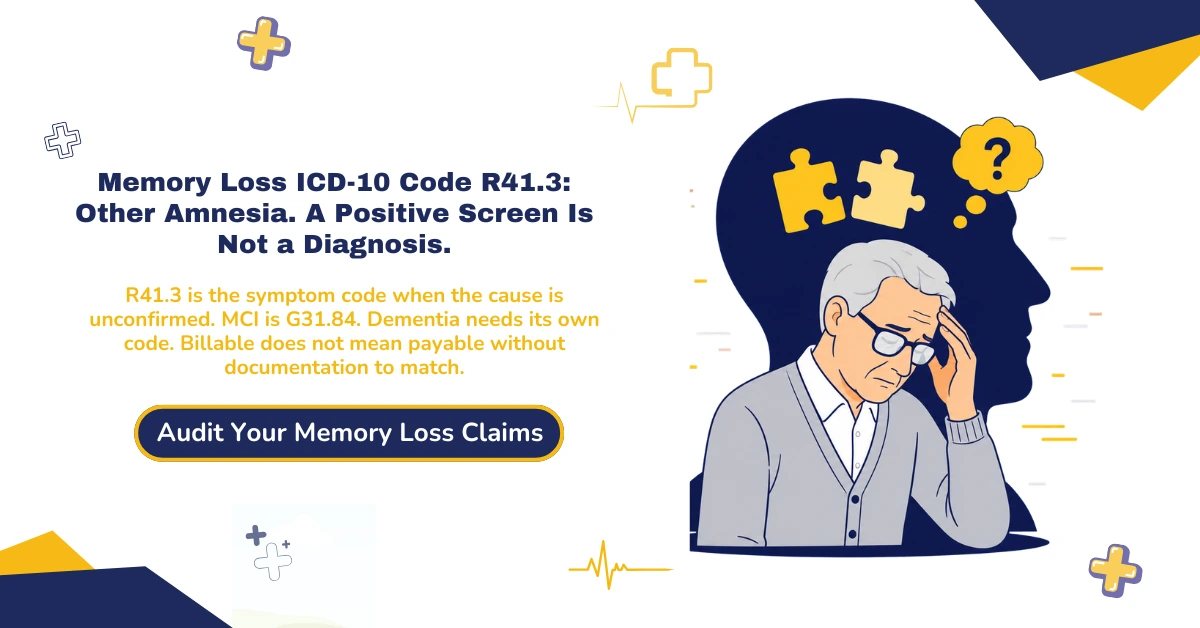
R41.3 is a symptom code, not a diagnosis of MCI, dementia, or Alzheimer’s disease. Use it only when the record doesn’t support something more specific. That single rule prevents a lot of memory loss ICD-10 denials.
ClaimMax RCM helps providers connect ICD-10-CM accuracy, documentation quality, and clean-claim submission before preventable denials reach the payer. Reach ClaimMax RCM if memory-loss claims keep getting delayed, because the issue is usually the documentation behind the code, not the code alone.
What Is the ICD-10 Code for Memory Loss?
The ICD-10 code for memory loss is R41.3, which officially covers Other amnesia. That’s where unspecified memory loss lands.
R41.3 Code Description
The official descriptor is Other amnesia, and R41.3 lists Amnesia NOS and Memory loss NOS as inclusion terms. You can confirm the R41.3 official descriptor and its Excludes1 notes directly.
It lives in the symptoms and signs chapter, not a disease category. That placement is the whole point: R41.3 describes a finding, not a confirmed condition.
Coders reach for R41.3 when the note says memory loss or amnesia and stops there. If the note goes further and names a cause, R41.3 usually isn’t the right pick anymore.
Why the Official Title Is Other Amnesia
Providers type memory loss ICD-10 into a search bar, but no ICD-10-CM code carries the title memory loss. The closest official code is R41.3, Other amnesia, and Memory loss NOS sits under it as an included term.
| Item | Detail |
|---|---|
| Code | R41.3 |
| Official descriptor | Other amnesia |
| Includes | Amnesia NOS, Memory loss NOS |
| Code type | Symptom or sign code |
| Use when | Memory loss or amnesia is documented without a more specific diagnosis |
| Do not use when | The record supports MCI, dementia, transient global amnesia, dissociative amnesia, or a known physiological cause |
Is R41.3 Billable for Reimbursement?
Yes, R41.3 is a billable ICD-10-CM code. Billable isn’t the same as automatically payable, though. Payment still depends on the service billed, medical necessity, payer policy, and the documentation behind the claim.
This is the trap that costs practices money. A valid code sails through the scrubber and still gets denied downstream when the service or the record doesn’t back it up.
Which 2026 ICD-10-CM Version Applies to Memory Loss Claims?
The code set you use depends on when the patient was seen, not when you drop the claim.
Use the Code Set Based on Date of Service
Code set selection follows the date of service. Bill a January 2026 encounter with the ICD-10-CM files in effect for that date, even if you submit the claim months later.
This trips up practices at fiscal-year boundaries. A claim held from September and submitted in October still uses the September code set, because the encounter date rules, not the billing date.
2026 and 2027 ICD-10-CM File Windows
FY 2027 ICD-10-CM files apply to encounters from October 1, 2026 through September 30, 2027. The FY 2026 files cover the windows before that, split at April 1, 2026. The CMS ICD-10-CM update files are the source to check.
| Date of Service | Applicable ICD-10-CM File |
|---|---|
| October 1, 2025 to March 31, 2026 | Initial FY 2026 ICD-10-CM files |
| April 1, 2026 to September 30, 2026 | April 1, 2026 ICD-10-CM update |
| October 1, 2026 to September 30, 2027 | FY 2027 ICD-10-CM files |
Don’t apply FY 2027 codes before October 1, 2026. Jumping ahead is a fast way to trigger a rejection for an invalid code on that date of service.
Was R41.3 Changed in the 2026 Update?
R41.3 remains the go-to memory loss ICD-10 code across these windows, with no code-specific revision identified for this update. Still, recheck the current files each fiscal year, because coding rules shift more often than people expect.
When Should Healthcare Providers Use R41.3 for Memory Loss?
R41.3 fits a specific situation: the provider sees a real memory problem but hasn’t pinned down why yet.
Use R41.3 when:
- The provider documents memory loss, impairment, forgetfulness, or amnesia without a more specific type.
- The symptom is relevant to the encounter.
- No definitive cause has been established.
- The record does not support a more specific code.
- The provider’s assessment supports it, not a patient complaint or a raw screening score alone.
Use R41.3 When Memory Loss Is Documented Without a Confirmed Cause
Use R41.3 when the provider documents memory loss, memory impairment, forgetfulness, or amnesia and no more specific type or cause is established. That’s the core memory loss ICD-10 scenario, and it’s more common than a clean diagnosis.
Two conditions have to hold. The symptom has to be relevant to the encounter, and the provider, not the patient’s problem list or a raw screening score, has to support it in the assessment.
Use R41.3 for Memory Loss NOS or Amnesia NOS
Use R41.3 when the record reads memory loss NOS or amnesia NOS. If the provider writes memory concerns and the final assessment stays nonspecific, R41.3 may be appropriate. If they write mild cognitive impairment, use G31.84. If they write age-related cognitive decline, use R41.81.
Use R41.3 During an Outpatient Diagnostic Workup
Use R41.3 during an outpatient workup when memory loss is the documented finding and the cause is still under evaluation. In the outpatient setting, you don’t code a rule-out as if it were confirmed. You code the symptom.
Documentation that supports R41.3 might read like this: Patient and spouse report progressive forgetfulness over six months, including repeated questions and missed appointments. Etiology not yet established. Cognitive evaluation and lab workup ordered. Assessment: memory loss.
That beats a vague memory issues note every time. It gives onset, course, functional impact, and a plan, which is what a memory loss ICD-10 claim needs to survive review.
Because R41.3 is only as strong as the documentation behind it, ClaimMax’s medical billing services focus on ICD-10 accuracy, charge review, and clean-claim submission before preventable payer edits occur.
ClaimMax RCM can help practices review vague memory-loss documentation before it becomes a coding or claim-submission problem.
When Not to Use R41.3 for Memory Loss
R41.3 is not a catch-all for every cognitive complaint. The moment the record gets more specific, a better code exists.
Think of R41.3 as the code you use before the picture is clear. Once the workup names something, the code should follow the diagnosis, not lag behind it.
Do Not Use R41.3 When a More Specific Amnesia Code Is Documented
If the note documents an inability to form new memories, R41.1 anterograde amnesia is more specific. If it documents memory loss for events before a point in time, R41.2 retrograde amnesia fits better. R41.3 is the fallback, not the default.
Do Not Use R41.3 When MCI or Dementia Is Established
When the provider establishes mild cognitive impairment, use G31.84. When dementia is documented, code the dementia. Submitting the memory loss ICD-10 symptom code after a specific diagnosis is established is a classic mismatch denial.
Do Not Use R41.3 for Transient Global Amnesia or Known Physiological Causes
Transient global amnesia has its own code, G45.4, and R41.3 carries an Excludes1 note for it. Dissociative amnesia maps to F44.0. When the memory disturbance is due to a known physiological condition, F04 or F06.8 applies, because the cause is no longer unspecified.
Do Not Code from a Screening Score Alone
A positive Mini-Cog, MoCA, or MMSE is a flag, not a diagnosis. Don’t convert a screen into MCI or dementia in the code unless the provider documents that diagnosis. Coders don’t diagnose from test results.
This matters for audits as much as denials. A chart that codes dementia off a screening score, with no provider diagnosis, is exactly what a payer reviewer pulls.
The overrides aren’t edge cases. In a typical neurology or primary care panel, a real share of memory complaints resolve into something more specific than R41.3.
This table maps the common overrides.
| Documentation Shows | Better Code | Why R41.3 May Be Wrong |
|---|---|---|
| Inability to form new memories | R41.1 | More specific anterograde amnesia is documented |
| Loss of memory before an event | R41.2 | More specific retrograde amnesia is documented |
| Transient global amnesia | G45.4 | Official Excludes1 note applies |
| Dissociative or psychogenic amnesia | F44.0 | Psychological or dissociative cause is established |
| Mild cognitive impairment | G31.84 | MCI is a diagnosis, not symptom coding |
| Age-related decline | R41.81 | Documentation supports age-related cognitive decline |
| Altered mental status | R41.82 | Mental status change is broader than memory loss |
| Other cognitive symptoms | R41.89 | Cognitive signs are not primarily memory loss |
| Known physiological cause | F04 or F06.8 | The cause is no longer unspecified |
| Confirmed dementia | F01 to F03, G30 with F02 | Memory loss is part of an established disease |
When memory-loss claims deny because the code doesn’t match the provider’s final assessment, ClaimMax’s denial management services help identify the root cause, correct the coding pathway, and prevent repeat denials. Most memory loss ICD-10 rejections trace back to this mismatch.
Before submitting cognitive or memory-loss claims, confirm whether the documentation supports R41.3 or a more specific diagnosis code.
R41.3 vs G31.84, Dementia and Cognitive Screening
R41.3 vs G31.84 turns on one question: did the provider name a diagnosis, or only a symptom? R41.3 covers memory loss or amnesia when the cause isn’t established. G31.84 is for documented mild cognitive impairment. Same patient, different codes, depending on what the provider concluded.
R41.3 vs G31.84 for Mild Cognitive Impairment
Use R41.3 for symptom-level memory loss with no confirmed cause. Use G31.84 when the provider documents MCI as the diagnosis. The memory loss ICD-10 symptom code and the MCI diagnosis code are not interchangeable, and the wrong one invites denials or audit questions.
The distinction sounds academic until a claim denies. A payer that sees G31.84 billed with only a positive screen, and no provider MCI diagnosis, has grounds to deny for insufficient documentation.
R41.3 vs Dementia Codes
Dementia codes apply when the provider establishes dementia, Alzheimer’s disease, vascular dementia, Lewy body dementia, or another dementia. At that point the disease replaces routine symptom coding. ClaimMax’s revenue cycle management services help connect documentation, diagnosis specificity, charge review, and payer follow-up in one workflow.
Why a Positive Cognitive Screen Does Not Automatically Change the ICD-10 Code
A positive cognitive screen does not automatically establish MCI or dementia. Screening is not diagnosis.
The Medicare AWV includes a check for cognitive impairment, and the Medicare Annual Wellness Visit guidance describes using direct observation, reports from family and caregivers, and brief cognitive tests.
For asymptomatic, community-dwelling adults 65 and older, the USPSTF cognitive screening recommendation says the evidence is insufficient to weigh the benefits and harms of screening. The code still follows the provider’s documented assessment.
Line up the situations and the logic:
| Situation | Better Code | Coding Logic |
|---|---|---|
| Provider documents memory loss only | R41.3 | Symptom-level memory loss without a confirmed cause |
| Provider documents mild cognitive impairment | G31.84 | MCI is specifically documented |
| Provider documents dementia | Dementia code family | Established disease replaces symptom coding |
| Patient has a positive screen only | Depends on provider assessment | Screening is not the diagnosis |
| Rule-out dementia, outpatient | Code the symptoms | Outpatient uncertainty rules apply |
If your charts show conflicting notes like memory loss, positive screen, and rule out dementia together, ClaimMax RCM can flag the coding risk before the claim goes out.
Medicare AWV Cognitive Assessment Requirements and Memory Loss Coding
Does AWV cognitive screening determine the ICD-10 code? No. It informs the evaluation, but the provider’s documented diagnosis controls the code. A patient reporting forgetfulness during an AWV doesn’t automatically become R41.3, and a positive brief screen doesn’t automatically become MCI or dementia.
Cognitive Impairment Checks During the Annual Wellness Visit
The Medicare AWV requires providers to check for possible cognitive impairment. Per CMS, that can happen through direct observation, reports from the patient, family, friends, and caregivers, and brief cognitive tests. It’s a detection step, not the final diagnosis.
This is where documentation habits matter. The AWV can surface a memory concern, but the coder needs the provider’s interpretation to turn that concern into a defensible code.
Why AWV Screening Does Not Automatically Support R41.3
Don’t code R41.3 only because a patient mentions forgetfulness during an AWV. And don’t code G31.84 or dementia only because a brief screen is positive. The code follows what the provider documents and assesses, not the screening step alone.
When AWV Findings Lead to a Separate Cognitive Assessment
If impairment is detected during an AWV or another routine visit, the provider may perform a more detailed cognitive assessment and care plan at a separate visit. The diagnosis code still depends on that documented assessment, not the wellness visit finding.
AWV findings map to coding risk like this:
| AWV Finding | Coding Meaning | Billing Risk |
|---|---|---|
| Patient reports forgetfulness | May support further evaluation | Does not automatically prove R41.3 |
| Family reports repeated questions | Supports collateral history | Provider must interpret and document |
| Positive brief screen | Triggers further workup | Does not establish MCI or dementia |
| Provider documents memory loss under evaluation | May support R41.3 | Needs onset, course, functional impact, and plan |
| Provider documents MCI | G31.84 may be more accurate | Must be supported by provider assessment |
CPT 99483 Billing and Documentation for Cognitive Assessment
CPT 99483 is not billed only because a patient reports memory loss. It requires a qualifying cognitive assessment and care plan, an independent historian, documented assessment elements, and diagnosis linkage that supports the service.
When CPT 99483 May Apply
CPT 99483 covers assessment of and care planning for patients with cognitive impairment when the requirements are met. Per the CMS cognitive assessment guidance, a Medicare patient with signs of cognitive impairment may get a separate visit to assess cognitive function and build a care plan.
Eligible providers are clinicians who can report E/M services, such as physicians, NPs, CNSs, and PAs. CMS also requires an independent historian for 99483.
The bar is high on purpose. This isn’t a code you attach to a quick memory complaint; it’s a distinct, documented assessment with its own requirements.
Documentation Elements CMS Expects
99483 includes elements comparable to a level 5 E/M visit: a comprehensive history, a comprehensive exam, and high-complexity medical decision-making. It’s a heavy service, and the note has to earn it.
Payers know 99483 is a high-value code, so they read the note closely. A thin note on a heavy service is one of the fastest ways to draw a records request.
Document these elements every time:
| Billing Item | What to Document | Why It Matters |
|---|---|---|
| Reason for assessment | Memory loss, cognitive concern, or documented impairment | Supports medical necessity |
| Independent historian | Name, relationship, and history provided | Required for 99483 |
| Cognitive findings | Exam, screen, staging, or clinical interpretation | Supports diagnosis linkage |
| Functional assessment | ADL, IADL, safety, decision-making capacity | Supports care plan need |
| Medication review | High-risk medications and reconciliation | Required care planning element |
| Written care plan | Safety, referrals, education, follow-up | Supports 99483 billing |
| Diagnosis link | R41.3, G31.84, dementia code, or other supported diagnosis | Prevents ICD-CPT mismatch |
ICD-10 and CPT Linkage for Memory Loss Encounters
Diagnosis coding has to match the documented condition and the service performed. R41.3 may be relevant during the workup, but G31.84, a dementia code, or another code may be more accurate. The memory loss ICD-10 code and the CPT service have to tell the same story.
That linkage is where cognitive claims quietly fail. The service can be real and the diagnosis valid, but if they don’t connect, the payer sees a mismatch and denies.
99483 may be billed separately from the AWV, and modifier 25 may be needed when a complete 99483 and an AWV happen on the same date. Some services can’t be billed the same day as 99483, including 99202 to 99215 office visits.
Why R41.3 Alone Does Not Guarantee Payment
R41.3 alone does not guarantee 99483 payment.
A valid diagnosis isn’t a paid claim. ClaimMax’s ICD-CPT billing support helps providers review ICD-CPT linkage, documentation completeness, modifier use, and payer-specific claim edits before cognitive assessment claims go out.
Before billing CPT 99483, confirm the note supports both the diagnosis and the service. ClaimMax RCM can help find the gaps before they turn into denials.
2026 Update: Alzheimer’s Biomarkers Do Not Automatically Determine the ICD-10 Code
New Alzheimer’s blood tests are changing the workup, but they aren’t changing the coding rules.
FDA-Cleared Blood Testing and Cognitive Decline
In 2025, the FDA cleared the Lumipulse G pTau217/beta-Amyloid 1-42 Plasma Ratio to aid in diagnosing Alzheimer’s disease in adults 55 and older who have signs of cognitive decline. The FDA Alzheimer’s blood test guidance says it isn’t a screening or stand-alone diagnostic test.
That last point is the one coders need. A test that supports a diagnosis is not the same as a test that makes the diagnosis, and the code follows the diagnosis.
Why Biomarker Results Still Require Clinical Interpretation
The coding implication is simple: biomarker results do not independently determine the ICD-10 code. Code assignment still depends on provider documentation. A positive biomarker doesn’t turn a memory loss ICD-10 symptom claim into an Alzheimer’s claim on its own.
This keeps the workflow honest. The lab result goes in the record, the provider interprets it, and the documented conclusion drives the code, not the number on the report.
Coding Implication for R41.3, MCI and Dementia
If the provider hasn’t established MCI, dementia, or Alzheimer’s disease, symptom-level coding may still apply when documentation supports it. If the provider does establish Alzheimer’s disease or dementia, use the appropriate disease and manifestation coding pathway instead of defaulting to R41.3.
The rule holds even as the science advances. A biomarker can sharpen the workup, but the documented diagnosis, not the test, still drives the code.
| Coding noteBiomarker results may support the diagnostic workup, but they do not independently assign R41.3, G31.84, or a dementia code. The code must follow the provider’s documented diagnosis for that encounter. |
Provider Documentation Checklist for R41.3 Memory Loss Claims
R41.3 is only as strong as the note behind it. This is what turns a vague memory-loss note into a defensible claim.
What the Provider Note Should Include
A strong memory-loss note captures the story, not only the symptom: source of the concern, onset and course, the type of memory problem, functional effect, any collateral history, assessment results, the differential, the diagnostic status, and the plan.
None of this is busywork. Each element answers a question the payer or an auditor will ask, and the note that answers them up front is the note that gets paid.
Use this as the pre-claim checklist:
| Documentation Element | What to Capture | Why It Helps the Claim |
|---|---|---|
| Source of concern | Patient, spouse, caregiver, or clinician | Supports clinical relevance |
| Onset and course | Start date, duration, progression | Shows medical necessity |
| Memory type | Recent, remote, new-memory formation, or unspecified | Helps choose R41.3 vs R41.1 vs R41.2 |
| Functional impact | Medication errors, missed appointments, ADL or IADL impact | Shows service need |
| Independent history | Relationship and details provided | Supports cognitive assessment requirements |
| Exam or screen | Tool, score, and provider interpretation | Avoids unsupported coding |
| Differential | Medication, infection, depression, sleep, substance, neurologic cause | Shows clinical reasoning |
| Diagnostic status | Symptom, MCI, dementia, or other diagnosis | Prevents wrong code selection |
| Plan | Labs, referral, imaging, follow-up, or safety counseling | Supports ongoing medical necessity |
Weak Documentation vs Strong Documentation
Weak notes are interchangeable. Memory issues. Forgetful. Those don’t tell a payer anything.
Strong notes are specific: progressive forgetfulness over six months, spouse reports repeated questions, missed two appointments, etiology under evaluation, workup ordered, assessment memory loss. That version supports R41.3 and the medical necessity behind any testing.
The gap between those two notes is the gap between a paid claim and a denial. Same patient, same visit, completely different outcome, driven entirely by what got written down.
Provider Query Language for Vague Memory-Loss Notes
When the note only says memory problems, query before you code.
Provider query example: Documentation states memory problems. Please clarify whether the final assessment is unspecified memory loss or other amnesia, anterograde amnesia, retrograde amnesia, age-related cognitive decline, mild cognitive impairment, dementia, dissociative amnesia, transient global amnesia, or memory disturbance due to a known physiological condition.
A clean query like that protects the whole claim. It turns a guess into a documented answer, which is what a memory loss ICD-10 audit wants to see. It also settles whether the diagnosis code for memory loss should be R41.3 or something more specific.
ClaimMax’s full RCM support helps practices connect documentation, coding review, claim submission, denial tracking, and follow-up into one clean workflow.
ClaimMax RCM can help billing teams turn vague memory-loss notes into compliant provider queries before claims are submitted.
Common Memory-Loss Coding Denials and How to Prevent Them
R41.3 is billable, but billable does not mean payable. That one sentence explains most memory-loss denials.
Practices lose real money here, quietly. A denied memory-loss claim rarely gets a second look, so it becomes a write-off instead of a fixable workflow gap.
Why R41.3 Claims Get Denied
Denials cluster into a few patterns. The note is vague. The CPT service isn’t supported by the diagnosis. The provider documented something specific, but R41.3 went out anyway. Cognitive testing lacks time, interpretation, results, or medical necessity.
Same-date AWV and 99483 billing gets mishandled without the right modifier logic. And post-stroke, dementia, TBI, or known-cause memory loss gets miscoded as unspecified when a more specific code was available.
None of these are exotic. They’re the everyday gaps a busy practice creates when coding, documentation, and billing aren’t talking to each other.
ICD-CPT Mismatch and Medical Necessity Problems
The biggest single driver is mismatch. Code validity doesn’t guarantee payment, and coverage depends on the service performed, payer policy, documentation, frequency limits, and coverage requirements. A memory loss ICD-10 claim that doesn’t match the service or the record is a denial waiting to happen.
The fix is upstream. Match the code to the final assessment, support the CPT service in the note, and confirm payer rules before submission, and most of these denials never happen.
These are the denials worth watching, and how to head them off:
| Denial Risk | Why It Happens | Prevention Step |
|---|---|---|
| Vague note says memory issues | The record lacks onset, course, and functional impact | Query the provider before coding |
| R41.3 used when MCI is documented | G31.84 may be more specific | Match the code to the final assessment |
| R41.3 used when dementia is established | Symptoms may be part of the disease | Use the dementia coding pathway when supported |
| CPT 99483 lacks independent historian | A CMS requirement is missing | Document historian and relationship |
| Cognitive testing lacks interpretation | Payer cannot validate medical necessity | Include score, limitations, and interpretation |
| AWV and 99483 same date mishandled | Modifier or documentation issue | Check same-day billing rules |
| Post-stroke deficit coded as R41.3 only | A sequela code may be more specific | Review the I69 code family |
| Known physiological cause ignored | An unspecified symptom code may be wrong | Code the documented cause when established |
How ClaimMax RCM Helps Prevent Repeat Denials
The pattern matters more than the single claim. Fix the root cause once, and the same denial stops showing up across every future memory-loss and cognitive claim.
When memory-loss claims keep denying for documentation gaps, ICD-CPT mismatch, or payer edits, ClaimMax’s claim denial support helps identify the root cause, correct the workflow, and prevent the same denial from repeating. Every denial gets categorized by CARC and RARC code and appealed through payer-specific workflows.
If your team is writing off memory-loss or cognitive assessment claims without a root-cause review, ClaimMax RCM can audit the denial pattern and show where clean claims are turning into lost revenue.
How ClaimMax RCM Supports Memory-Loss, Cognitive and Neurology Billing
For providers comparing medical billing companies, the questions are simple: is it affordable, and does it protect the claim?
Affordability alone isn’t the whole answer, though. A cheap billing service that misses coding and documentation risk on cognitive claims costs more than it saves.
Affordable Medical Billing at 2.99 Percent
ClaimMax RCM offers medical billing support at a 2.99% billing rate. For memory-loss, cognitive assessment, and neurology claims, that affordability comes paired with coding review, documentation checks, and denial management, so a low rate doesn’t mean a thin service. The memory-loss details still get the attention they need.
Cognitive and neurology claims are exactly where vague coding hurts. R41.3 gets overused, specific diagnoses get missed, and denials pile up, so the review layer earns its keep.
Payer Enrollment Options from $99 Per Insurance
The site’s pricing ticker shows regular payer enrollment at $99 per insurance. Enrollment and credentialing sit upstream of every claim, so getting them right keeps neurology, geriatrics, and primary care providers billing without gaps.
Specialty Billing Support for Cognitive and Neurology-Related Claims
ClaimMax serves practices across all 50 states and covers 50-plus specialty areas. That single-partner setup matters for cognitive and neurology work, where the coding is nuanced and the denials are specific.
A practice billing cognitive and neurology claims can’t afford guesswork on the coding. Whether R41.3 or a more specific code fits often decides whether the claim pays.
Providers who need affordable medical billing services and specialty medical billing services can use one partner for coding accuracy, payer follow-up, denials, and revenue cycle visibility.
For memory-loss, cognitive assessment, neurology, geriatrics, internal medicine, behavioral health, and primary care claims, ClaimMax can align documentation, ICD-10-CM coding, CPT linkage, denial management, and AR recovery under one revenue cycle. That keeps the R41.3 claims and the codes around them clean.
ClaimMax RCM at a glance:
| ClaimMax RCM Attribute | Blog-Relevant Value |
|---|---|
| Billing rate | 2.99% |
| Payer enrollment pricing | From $99 per insurance |
| Relevant services | Billing, RCM, denial management, AR follow-up |
| Specialty support | 50-plus specialty areas |
| Geographic reach | All 50 states |
| Best-fit readers | Providers, practices, coders, and RCM teams |
Request a free ClaimMax RCM billing audit if you want to know whether memory-loss, cognitive assessment, or neurology claims are being underpaid, denied, or coded too vaguely.
Frequently Asked Questions About Memory Loss ICD-10 Coding
What is the ICD-10 code for memory loss?
The ICD-10-CM code commonly used for unspecified memory loss is R41.3, Other amnesia. It includes memory loss NOS and amnesia NOS when the provider hasn’t documented a more specific diagnosis. If the record supports MCI, dementia, transient global amnesia, or a known physiological cause, another code may be more accurate for that encounter.
Is R41.3 billable?
Yes, R41.3 is a billable ICD-10-CM diagnosis code when documentation supports memory loss or other amnesia. Payment still depends on the service billed, payer policy, medical necessity, and documentation. R41.3 being billable doesn’t automatically make cognitive testing, imaging, or CPT 99483 payable, so the note has to support the service too.
What is the ICD-10 code for short-term memory loss?
The ICD-10-CM code commonly used for unspecified short-term memory loss is R41.3, when the provider documents memory loss without a more specific diagnosis. If the note says the patient can’t form new memories after an event, R41.1 anterograde amnesia may be more specific. Match the code to what the provider documented.
What is the diagnosis code for memory loss?
The diagnosis code for memory loss is commonly R41.3, Other amnesia, when the provider documents memory loss NOS or amnesia NOS without a confirmed cause. Verify the provider’s final assessment, because MCI, dementia, stroke sequelae, or transient global amnesia may need different codes. The memory loss ICD-10 pick should follow the documentation.
What is the dx code for memory loss?
The dx code for memory loss is commonly R41.3 when memory loss is unspecified and no more specific diagnosis is documented. The memory loss dx code shouldn’t be selected from a patient complaint alone. It should be supported by provider assessment, functional impact, and the plan for evaluation or follow-up on that visit.
What is the ICD-10 code for forgetfulness?
Forgetfulness is often coded with R41.3 when the provider documents clinically relevant memory loss or amnesia without a more specific cause. If the provider documents normal age-related cognitive decline, R41.81 may be more accurate. The note should clarify whether forgetfulness is a symptom under evaluation or part of an established diagnosis.
What is the difference between R41.3 and G31.84?
R41.3 is a symptom code for other amnesia or memory loss NOS when the cause isn’t established. G31.84 is used when the provider specifically documents mild cognitive impairment. A positive cognitive screen alone shouldn’t be coded as G31.84 unless the provider documents MCI as the diagnosis for the encounter.
Can R41.3 be used for dementia?
R41.3 shouldn’t routinely be used when dementia is established and memory loss is part of that disease process. When the provider documents Alzheimer’s disease, vascular dementia, or another dementia, the claim should follow the appropriate dementia coding pathway. R41.3 may apply earlier in the workup when only memory loss is documented.
Can R41.3 be used after a positive cognitive screening test?
Not automatically. A positive Mini-Cog, MoCA, or MMSE may support further evaluation, but the diagnosis code follows the provider’s documented assessment. If the provider documents memory loss under evaluation, R41.3 may fit. If they document MCI or dementia, another code may be more accurate for that visit.
Can a medical billing company help with memory-loss claim denials?
Yes. A medical billing company can review ICD-10-CM code selection, CPT linkage, modifier use, payer edits, and documentation gaps for memory-loss and cognitive assessment claims. ClaimMax RCM supports providers with billing at a 2.99% rate, payer enrollment from $99 per insurance, and denial prevention that keeps memory-loss claims clean.
Final Takeaway for Memory-Loss Coding
Memory loss ICD-10 coding is simpler than it looks and easier to get wrong than it should be. R41.3, Other amnesia, covers unspecified memory loss and amnesia NOS, but only when the provider hasn’t documented something more specific.
Everything else follows from that. Match the code to the final assessment, not the complaint or a screening score. Support the CPT service in the note. Confirm payer rules before submission. Those habits prevent most memory-loss denials.
One last reminder for the whole workflow: billable does not mean payable, and a screening score is not a diagnosis. Hold those two lines, and the coding takes care of itself.
When the coding is nuanced and the denials are specific, a billing partner that reviews ICD-CPT linkage and documentation earns its place. ClaimMax RCM helps providers keep memory-loss and cognitive claims accurate, clean, and paid.
Last reviewed: 2026. Reviewed against the April 1, 2026 ICD-10-CM update and the FY 2027 ICD-10-CM files effective October 1, 2026. Verify current CMS and MAC policy before you bill, since coverage and code sets change.