CPT 99490 Quick Answer for Healthcare Providers
| Quick answerCPT 99490 is the Medicare chronic care management billing code for the first 20 minutes of non-face-to-face CCM services in a calendar month. It applies to patients with two or more chronic conditions when clinical staff time, consent, a care plan, and monthly documentation support the claim. |
That definition is the easy part. Billing it cleanly is where practices lose money.
In plain terms, the 99490 CPT code description covers the between-visit care coordination that clinical staff handle each month, not an office visit.
CPT 99490 looks simple, but the claim leans on a stack of moving parts: consent on file, a care plan that’s kept current, monthly time logs that hold up, the right add-on logic, and no same-month conflict with another provider.
Get the workflow right and it’s steady monthly revenue. Get it wrong and the denials pile up fast.
ClaimMax RCM helps healthcare providers turn CPT-based billing workflows into cleaner claims and fewer unpaid balances. Reach ClaimMax RCM, and if your team handles CCM billing, this guide shows where 99490 claims break before they become denials, underpayments, or aging AR.
What Is CPT 99490?
CPT 99490 pays for the care coordination that happens between visits, not for the visit itself.
CPT 99490 in plain English
Think of it as the monthly billing code for managing a patient’s chronic conditions when nobody’s in the exam room. Clinical staff review labs, reconcile medications, update the care plan, call patients or caregivers, coordinate with specialists, and track transitions of care, then document that work.
None of that work is dramatic. It’s the steady, unglamorous coordination that keeps a patient with diabetes and hypertension out of the emergency room.
So what is chronic care management in billing terms? It’s the ongoing, non-face-to-face work of keeping a complex patient stable between appointments, and cpt code 99490 is how you bill the first 20 minutes of it each month.
CMS organizes chronic care management around specific service elements: eligibility, an initiating visit when required, consent, a comprehensive care plan, supervision, and the CCM code set. Its Chronic Care Management Services guidance spells out each one.
The 99490 CPT code description points to more than a 20-minute timer. It needs the right patient, the right consent, the right staff role, and the right monthly documentation behind the claim.
What CPT 99490 is not
CPT 99490 is not a face-to-face E/M visit. It’s not general admin work, not a duplicate monthly claim, and not a code for phone calls nobody wrote down.
The distinction matters because payers audit these claims. If the note reads like a visit or a vague activity log, it won’t survive review, and the payment gets clawed back.
Why CPT 99490 Matters for Provider Revenue in 2026
Chronic care management billing is worth getting right because it pays for real work that usually goes unbilled: the coordination that happens between office visits.
2026 payment-policy context
The 2026 rules matter here. The CY 2026 Physician Fee Schedule applies to dates of service on or after January 1, 2026, and CMS finalized two conversion factors: $33.57 for qualifying APM participants and $33.40 for everyone else.
CMS also confirmed that its 2026 efficiency adjustment excludes time-based services, and care management like 99490 sits in that excluded group. The specifics are in the CY 2026 Medicare Physician Fee Schedule final rule.
Don’t anchor your revenue math to one national number. CPT code 99490 reimbursement still depends on locality, GPCI, facility versus non-facility status, and whether the billing clinician uses the QP or non-QP conversion factor.
Medicare chronic care management reimbursement isn’t one figure. It’s a range that shifts by where and how you bill.
Why this is an RCM issue, not only a coding issue
For providers, CPT 99490 turns into a revenue cycle problem the moment eligibility, documentation, claim edits, payment posting, and denial follow-up stop talking to each other. Our revenue cycle management services connect those steps.
Revenue leaks in specific, boring ways: a patient who was never enrolled, consent that’s missing, a time log that’s too thin, a 99439 add-on nobody billed, a denial nobody worked, or a payment posted without an underpayment check.
If you’re not sure your CCM billing is being captured, submitted, and followed correctly, a revenue-cycle review will show where the monthly money is leaking.
CPT 99490 Requirements at a Glance
The table below is 99490 in one screen: what it covers, who it’s for, and where it tends to break.
| Requirement | 99490 rule |
|---|---|
| Service type | Non-complex chronic care management |
| Time | First 20 minutes per calendar month |
| Patient | Two or more chronic conditions |
| Condition duration | Expected to last at least 12 months or until death |
| Staff | Clinical staff under billing practitioner direction |
| Frequency | Once per patient per calendar month |
| Add-on | CPT 99439 for additional qualifying time |
| Documentation | Consent, care plan, time logs, monthly activity notes |
| Main risks | Missing consent, weak care plan, duplicate billing, time overlap |
These CCM requirements are why CPT 99490 belongs inside a structured medical billing services workflow, not a loose checklist. The correct cpt code for CCM only pays when every row is supported, and the 99439 CPT code add-on rides on the same foundation.
Before you bill a 99490 CPT code claim, confirm each line in that table is documented in the chart. A rule you can’t point to in the record is a denial waiting to happen.
Who Qualifies for CPT 99490?
Eligibility is where a lot of CCM revenue quietly disappears, because the wrong patient on the claim is an automatic problem.
| Quick eligibility answerA patient qualifies for CPT 99490 when they have two or more chronic conditions expected to last at least 12 months or until death, and those conditions put them at significant risk of decline, decompensation, acute exacerbation, or death. Two conditions is the floor, not a guarantee. |
Two chronic conditions are the starting point
The rule itself is short: two or more chronic conditions, expected to last 12 months or until death, with the patient at significant risk of acute exacerbation, decompensation, functional decline, or death. CMS’s Chronic Care Management Services guidance lays this out.
Medicare chronic care management coverage starts with those two conditions, but it doesn’t end there. The chart still has to show why the patient needs ongoing coordination.
Diagnosis codes do not replace medical necessity
Two ICD-10 codes on the claim are not the same as medical necessity. The codes support the claim, but the record has to show why these specific conditions create ongoing care-coordination risk for this patient.
CMS doesn’t publish one universal chronic care management diagnosis list that fits every situation. So the safer habit is to document the risk rationale, not paste a problem list and hope it reads as necessity.
If you’re asking what conditions qualify for chronic care management, the honest answer is any two chronic conditions that drive ongoing risk, backed by documentation that explains it.
Common qualifying examples
A few combinations show up constantly.
| Condition combination | Why it commonly qualifies |
|---|---|
| Diabetes and hypertension | Interacting conditions needing ongoing medication and monitoring |
| COPD and heart failure | High exacerbation risk with frequent coordination needs |
| Chronic kidney disease and diabetes | Overlapping management with real decline risk |
| Depression and chronic pain | Interacting conditions that affect adherence and function |
| Heart failure and atrial fibrillation | Ongoing medication and monitoring to prevent decompensation |
Coverage still has to be confirmed before the claim goes out. Our insurance eligibility verification services check active coverage, payer type, patient responsibility, and Medicare Advantage rules before a CCM claim is released.
Screen your Medicare panel before the month starts, not after the billing team is already chasing missing documentation.
Who Can Perform and Bill CPT 99490 Services?
The monthly CCM work usually isn’t done by the physician. It’s done by clinical staff, under the physician’s direction, and that CCM billing split is where compliance and denials both live.
Clinical staff can perform the monthly work
Nurses, medical assistants, and care coordinators can perform much of the monthly work where their scope of practice allows, as long as the practice has a compliant setup for who does what, how it’s supervised, and how the time is captured.
The point isn’t that staff can’t do the work. They can. The point is that the practice needs a documented workflow showing role assignment, supervision, and time capture, or the claim looks unsupported. CCM services in medical billing depend on that clarity.
The supervision rules aren’t optional. CMS addresses incident-to billing and external clinical staff arrangements in its Chronic Care Management FAQs, and general supervision requirements still apply.
The billing practitioner still owns the claim
Whoever performs the work, the billing practitioner owns the CPT 99490 claim. That means accountability for the care plan, the documentation, and the oversight. If the practice can’t show who did the work and who supervised it, the billing risk climbs before the claim is even submitted.
Billing readiness matters too. If Medicare enrollment, NPI, or payer participation isn’t current, even a perfect CCM claim stalls. Our credentialing and contracting services keep that foundation in place.
Do not confuse staff-time codes with practitioner-time codes
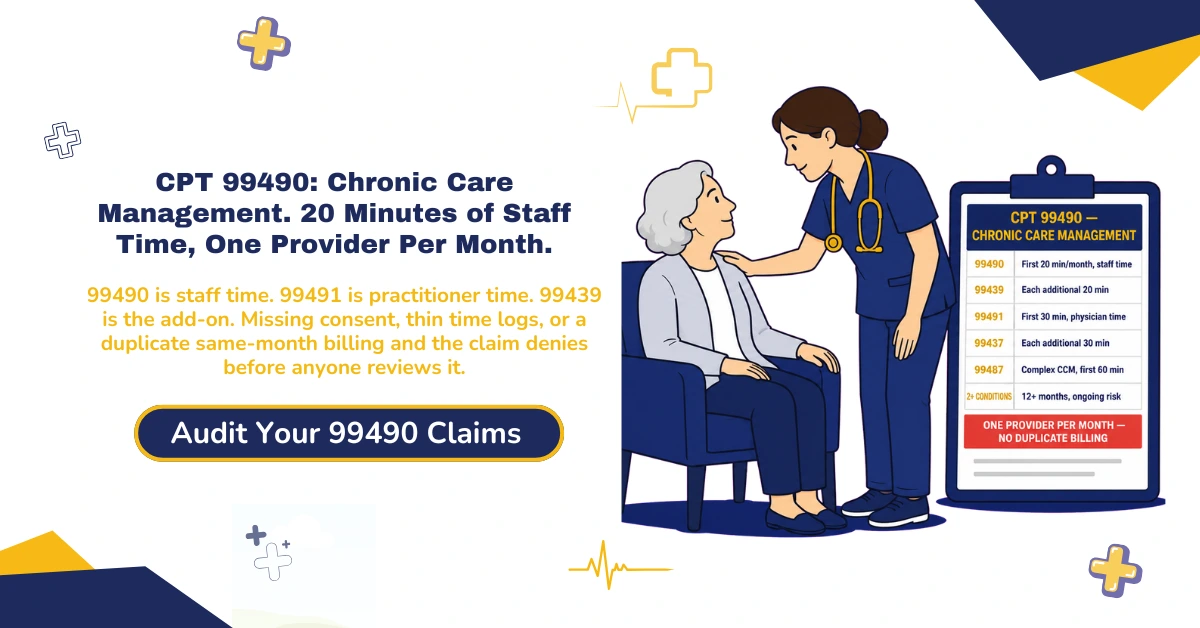
This is a common and expensive mix-up. CPT 99490 and 99439 count clinical staff time. CPT 99491 and 99437 count the physician’s or QHP’s personal time. They are not interchangeable, and the 99491 CPT code description does not describe complex CCM.
CPT 99490 vs 99439 vs 99491 vs 99487
This is where AI answers and quick summaries get it wrong most often. The CCM CPT codes aren’t one code with variations. They’re three separate pairs, split by who does the work and how complex the case is.
Keep the pairs straight and the whole family gets easier. Mix staff time with practitioner-only codes and you’ve built a denial into the claim. Read these chronic care management CPT codes as three pairs.
| Code | Role | Time | Use case |
|---|---|---|---|
| 99490 | Clinical staff under practitioner direction | First 20 minutes | Standard non-complex CCM |
| 99439 | Clinical staff under practitioner direction | Each additional 20 minutes | Add-on to 99490 |
| 99491 | Physician or QHP personally | First 30 minutes | Practitioner-performed CCM |
| 99437 | Physician or QHP personally | Each additional 30 minutes | Add-on to 99491 |
| 99487 | Clinical staff, complex CCM requirements | First 60 minutes | Complex CCM |
| 99489 | Clinical staff, complex CCM requirements | Each additional 30 minutes | Add-on to 99487 |
CPT 99490 and 99439
CPT 99490 is staff-directed, non-complex CCM for the first 20 minutes in a month. CPT 99439 is the add-on for each additional 20 minutes of qualifying clinical staff time. Both ride on the same base requirements.
The 99439 CPT code description is short: additional clinical staff time in the same month, billed only after the first 20 minutes are met and documented.
CPT 99491 and 99437
99491 is CCM personally performed by the physician or QHP, the first 30 minutes. 99437 is its add-on for each additional 30 minutes. This is practitioner time, not staff time, so you can’t count both for the same minutes. The 99491 CPT code description reflects that personal-time distinction.
CPT 99487 and 99489
Complex CCM is a different pair. 99487 covers the first 60 minutes of complex CCM, and 99489 is the add-on for each additional 30 minutes, when the complexity requirements are met. The 99487 CPT code description sits apart from the non-complex codes.
CMS separates these pairs deliberately. Its Chronic Care Management Services guidance keeps 99490 and 99439 for staff time, 99491 and 99437 for practitioner time, and 99487 and 99489 for complex CCM.
Common coding mistake to avoid
State it plainly: CPT 99491 should not be described as the complex CCM code. Complex CCM is reported with CPT 99487 and CPT 99489 when the requirements are met. Getting that wrong is how a claim gets miscoded and denied.
Why does this matter for revenue? A payer that sees practitioner-time codes billed with staff-time documentation, or complex CCM billed without complex requirements, denies the claim and may flag the account for review.
CPT 99490 Billing Requirements Before You Submit the Claim
Everything before this point was about getting the code right. Now comes the part that protects the payment. This is how to bill for chronic care management cleanly: a pre-claim checklist you run the same way every month.
The code doesn’t reward a loose monthly routine. It rewards a connected workflow, which is what billing workflow support is built to provide. Run these steps in order.
Step 1. Confirm eligibility and coverage
Start by confirming the patient is eligible and covered. Check Medicare, and check Medicare Advantage separately, because MA plans can carry their own rules. Insurance eligibility verification here prevents the claim that was never billable in the first place.
Step 2. Document consent before billing
Get consent, and document it before you bill. Consent should note that the patient understands cost-sharing may apply and that only one provider can bill CCM per month. Skipping this step is one of the most common denial reasons on the code.
Consent can be verbal or written depending on the setup, but it has to be recorded. Patient agreed with no detail is thin. Note what they were told about cost-sharing and single-provider billing.
Step 3. Build a patient-specific care plan
Build a comprehensive care plan that reflects this specific patient. A generic, copy-paste plan is a red flag on review. It should cover the patient’s conditions, goals, medications, and barriers, and get updated, not frozen in place.
Step 4. Track time by date, staff role, and activity
Track qualifying time as you go, by date, staff role, activity, and minutes. A defensible monthly log shows what was done, who did it, when, and why it mattered for the patient’s chronic conditions. Reconstructing time at month-end is how logs fall apart.
Chronic care management time tracking is the single most audited element. If the log doesn’t clearly total at least 20 minutes of qualifying activity, the claim can’t stand, no matter how sick the patient is.
Step 5. Review add-on code and same-month conflicts
Before you submit, check whether 99439 add-on time is supported, confirm no other provider billed CCM for this patient this month, and verify payer-specific rules. For exact allowed amounts, the CMS Physician Fee Schedule Look-Up Tool is the source to check before you project revenue on CPT 99490.
None of these steps are complicated on their own. The revenue problem is that they have to happen every month, for every enrolled patient, without gaps, and that consistency is what breaks in a busy practice.
These 99490 billing guidelines exist because the claim is easy to submit and easy to get wrong. A structured chronic care management billing workflow turns a monthly scramble into a repeatable process.
ClaimMax RCM can review CCM billing workflows before claims go out, so missing consent, thin time logs, and payer-specific issues get caught earlier, not after the denial.
CPT 99490 Reimbursement in 2026
Reimbursement is the question every provider asks first, and it’s the one with no single answer.
Why one reimbursement number is not enough
CPT 99490 reimbursement isn’t a fixed national figure. Medicare payment moves with the year, the locality, facility versus non-facility setting, the RVUs behind the code, the GPCI adjustment, and whether the billing clinician falls under the QP or non-QP conversion factor.
National averages are fine for rough planning. They’re not fine for projections you’ll hold someone to. Your MAC and your locality decide the real allowed amount, which is why medicare chronic care management reimbursement is a range, not a headline number.
This is also why competitor pages that print one confident dollar figure are misleading. The number they show might be right for one locality and off for yours by a noticeable margin.
How to verify the allowed amount
The defensible method is to look it up. Open the CMS Physician Fee Schedule Look-Up Tool, select year 2026, search 99490, then compare the non-facility and facility amounts for your locality.
Document the date you pulled the figure in your internal billing references. Rates change, and a screenshot from last year isn’t a 2026 number. Whatever the tool shows for your locality is what to plan around.
Patient cost-sharing and consent
Patients usually share the cost, which is why consent should mention it. Medicare Part B costs list the 2026 Part B deductible at $283, after which beneficiaries generally pay 20% of the Medicare-approved amount.
Don’t quote patients a fixed dollar amount, though. What they owe depends on the allowed amount, whether the deductible is met, any supplemental coverage, and the payer. For many, supplemental coverage picks up that 20%. For others it doesn’t.
Reimbursement doesn’t end when the claim pays, either. Our payment posting services reconcile the allowed amount, patient responsibility, contractual adjustment, and any underpayment risk, so a short payment doesn’t slip through.
If you bill CCM monthly, comparing posted payments against expected allowed amounts is how missed reimbursement stops hiding in the remittance.
CPT 99490 Documentation Checklist
Documentation is what turns a defensible 99490 claim into a paid one, and a vague claim into a repayment request. These 99490 billing guidelines live or die on the record.
Competitor guides usually stop at document the time and the care plan. That’s not enough to work from. A payer wants specifics.
Minimum documentation for each CCM month
At a minimum, each CCM month should prove these CCM requirements:
- The patient qualifies, with two or more chronic conditions documented.
- Consent was obtained, including cost-sharing awareness.
- A comprehensive, patient-specific care plan exists and is current.
- Time was tracked by date, staff role, activity, and minutes.
- The work related directly to managing the chronic conditions.
- The billing practitioner directed or supervised the work.
- Time was not double counted against another service.
And the correct code from the family was selected, staff time versus practitioner time versus complex CCM.
Miss any one of these and the claim gets shaky. The documentation has to stand on its own, because the person reviewing it, a payer analyst or auditor, wasn’t in the room and only sees what you wrote.
What a strong time log should include
A strong time log isn’t a running tally of CCM, 20 min. Chronic care management time tracking should show, for each entry: the date, the staff role, the minutes, the activity category, a patient-specific note, and the running monthly total.
What weak documentation looks like
Weak entries are vague and interchangeable. These show up constantly:
- Called patient.
- Care coordination.
- Updated chart.
- Reviewed meds.
Stronger versions say what happened and tie it to the care plan:
- Reviewed cardiology note and updated care plan for CHF medication adherence.
- Called patient about blood pressure log and documented a care-plan barrier.
- Coordinated a refill issue with the pharmacy for diabetes medication.
The problem with the weak entries isn’t that the work didn’t happen. It probably did. The problem is that the note doesn’t prove skilled, condition-specific care, so it reads as generic and gets denied.
CMS’s Chronic Care Management FAQs cover how clinical staff time, incident-to work, and time counting should be handled, and the same specificity principle runs through all of it. Clean chronic care management billing starts with clean notes.
A pre-billing documentation review catches vague time entries before they become payer questions, denials, or repayment risk.
Common CPT 99490 Denials and How to Fix Them
This is the section that pays for itself. Most CPT 99490 denials aren’t code errors. The code is fine. The chronic care management billing workflow behind it is weak.
Before submission, the billing team has to verify consent, eligibility, monthly time, the code family, payer policy, duplicate billing, and documentation quality. Miss one and the denial is usually predictable.
Think of denials here as a workflow diagnostic. Each denial reason points to a specific gap you can close, which is more useful than treating them as random bad luck. These 99490 billing guidelines are denial-prevention rules.
Missing or unclear patient consent
Consent has to be documented, and it should include cost-sharing awareness. If it’s missing or vague, the first claim can deny, and re-billing after the fact is harder than getting it right up front.
Time logs do not support 20 minutes
Generic time entries are a payer risk. If the log doesn’t clearly add up to 20 qualifying minutes with real activities, the claim can’t hold. Audit the logs before submission, not after the denial.
Duplicate CCM billing in the same month
Only one provider can bill CCM for a patient per calendar month. If a specialist’s office also billed it, your claim denies as a duplicate. Checking payer history and patient attribution avoids the collision.
Wrong code pairing or double counting
This is the code-family trap again. Staff time on 99490 and the 99439 CPT code, practitioner time on 99491 and 99437, complex CCM on 99487 and 99489. Mix these CCM billing codes, or count the same minutes twice, and the claim fails.
Weak care plan documentation
Copy-paste care plans fail because they don’t look patient-specific. If every plan reads the same, a reviewer reads that as a template, not care. Patient-specific updates are what make the plan defensible.
Medicare Advantage payer variation
Medicare Advantage plans can have their own rules, prior workflows, or claim-handling quirks. A process that works for traditional Medicare can still stumble on an MA plan, so verify the specific plan’s CCM policy.
The fix isn’t one-size-fits-all, either. Traditional Medicare and each MA plan may need slightly different verification and follow-up, so the billing team can’t assume one process covers every payer.
The pattern is consistent enough to put in one table.
| Denial risk | Why it happens | RCM fix |
|---|---|---|
| Missing consent | Consent was not documented before billing | Add consent verification before the first claim |
| Time below threshold | Monthly logs do not support 20 minutes | Audit time logs before submission |
| Duplicate billing | Another practitioner bills CCM that month | Check payer history and patient attribution |
| Wrong code family | Staff time is mixed with practitioner-only codes | Separate staff and practitioner time workflows |
| Weak care plan | Documentation is generic or outdated | Require patient-specific care-plan updates |
| Same-day overlap | CCM time overlaps with E/M work | Separate time allocation and modifier logic |
| Missed 99439 | Extra time is documented but not billed | Add a monthly add-on code review |
| Unpaid claim in AR | Denial is not worked quickly | Route to AR follow-up and the appeal queue |
Read down that fix column and a theme appears: almost every fix happens before submission, not after. Prevention is cheaper than appeals every single time.
Recurring denials are rarely about one claim. Our denial management services find the root cause behind a pattern, then fix the workflow before the next billing cycle repeats it.
And when CCM claims stall unpaid, they age. Our accounts receivable services work the aging queue and the appeals, so a denied monthly claim doesn’t quietly become a write-off.
ClaimMax RCM can find the root cause behind recurring CCM billing denials, then correct the workflow so the next cycle doesn’t repeat it.
Payment Posting and AR Follow-Up for CPT 99490 Claims
Clean 99490 billing doesn’t end when the claim is submitted, or even when it’s paid. The back end is where the last of the revenue gets won or lost.
Why paid does not always mean paid correctly
A paid claim isn’t automatically a correctly paid claim. Payment reconciliation compares the ERA or EOB against the allowed amount, the patient responsibility, and the contractual adjustment, so underpayments get caught instead of posted and forgotten.
Auto-posting is the usual culprit. When payments post automatically with no variance check, a short payment looks identical to a correct one, and the claim closes either way.
The gap between billed and allowed is where money hides. On a low-dollar monthly code, a small underpayment feels ignorable, until you multiply it across a full panel of CCM patients every month. That’s real chronic care management reimbursement walking out the door.
What happens when CPT 99490 sits in AR
Denied or unpaid CCM claims age, and aging claims get harder to recover. AR follow-up support routes denials to the right queue, works the appeals, and chases Medicare Advantage follow-up before the timely-filing window closes.
Timing is everything in AR. Every payer has a filing and appeal deadline, and a CCM claim that sits too long stops being recoverable, no matter how valid it was.
Recurring denial trends matter too. If the same reason keeps showing up, that’s not bad luck, it’s a workflow gap, and reporting it is how you fix the cause instead of re-working the symptom.
If CCM billing is paid inconsistently, a payment posting and AR review shows whether the problem is payer behavior, documentation, claim edits, or follow-up timing.
2026 Update: APCM, RHCs, FQHCs, and Care Management Strategy
CPT 99490 still matters in 2026, but it doesn’t sit alone anymore. It sits beside newer chronic care management services and pathways, and the smart move is knowing where each one fits.
CPT 99490 vs APCM in 2026
The core difference is counting. 99490 is minute-based; you track and bill by time. Advanced Primary Care Management is monthly and doesn’t require counting minutes at all.
CMS’s Chronic Care Management guidance frames APCM as a monthly pathway that bundles elements of several care-management services without minute counting. That’s a real shift in how the work gets documented and billed under the Medicare chronic care management program.
For a practice already good at time logs, the minute-based model isn’t a burden. It’s routine. For one that’s constantly reconstructing time at month-end, a monthly model removes the exact thing they keep getting wrong.
Don’t read that as APCM being automatically better. Practices with strong time tracking can keep using CCM and do fine. Practices that struggle to capture minutes may find APCM simpler. It’s a strategy choice, not an upgrade.
RHC and FQHC care management billing
RHCs and FQHCs have their own care-management billing rules, and they change. If you bill in that setting, verify current CCM Medicare guidelines before assuming the standard rules apply, because the details differ.
The safe posture is to check before you bill, not after. Assuming the standard rules apply in an RHC or FQHC is how a setting-specific denial shows up.
Why this matters for RCM planning
Code choice ripples through everything: staff workflow, documentation burden, monthly claim volume, denial risk, and payer follow-up. CMS’s APCM policy development is spelled out in the CY 2026 Medicare Physician Fee Schedule final rule.
The right pathway depends on your practice, not a template. Our RCM workflow support helps map documentation capacity, payer mix, and follow-up resources before you commit to a care-management model.
The pathways line up like this. Principal Care Management, for instance, focuses on one serious condition rather than the multi-condition model CCM requires.
| Pathway | Main operational feature | Best fit |
|---|---|---|
| 99490 CCM | Requires monthly time tracking | Practices with strong staff documentation |
| APCM | Monthly model without minute counting | Practices seeking simpler monthly care management |
| PCM | Focuses on one serious condition | Patients who do not fit multi-condition CCM |
| BHI or CoCM | Behavioral health integration | Patients with behavioral health care-management needs |
Before switching from minute-based CCM to another pathway, review your documentation capacity, payer mix, patient volume, and claim follow-up resources.
When Should Providers Outsource CPT 99490 Billing?
Not every practice should outsource CCM billing. But some clearly should, and the signs are practical, not mysterious.
The decision usually isn’t about capability. Your staff can do CCM. It’s about capacity and consistency, month after month, without gaps, while they’re also running the front desk and rooming patients.
Signs your CCM billing workflow is leaking revenue
Outsourcing starts to make sense when the monthly chronic care management billing keeps slipping. A few honest signs:
- Staff can’t keep up with monthly time tracking.
- Consent is inconsistent or missing.
- Care plans aren’t getting updated.
- The same claims get denied over and over.
- 99439 add-on time is documented but never billed.
- Payments are posted without an underpayment check.
- AR follow-up is slow, and Medicare Advantage claims stall.
One or two of these is a fixable in-house problem. Five or six is a pattern, and a pattern quietly costs real monthly revenue.
What ClaimMax RCM can support
A good RCM partner covers the whole cycle, not only claim submission. Our CPT billing support handles eligibility verification, claim submission, payment posting, denial management, AR follow-up, and reporting.
That includes working recurring CCM denials down to the root cause, and handling credentialing and payer readiness when enrollment or contract status is the thing holding claims up. CCM services in medical billing work best when every step connects.
What tends to change first is the denial rate. When consent, time logs, and code selection get checked before submission, fewer claims come back, and the ones that do get worked faster.
The value isn’t a pitch. It’s specific: fewer denied claims, cleaner documentation, faster follow-up, and monthly chronic care management services revenue that shows up instead of leaking out in ones and twos.
ClaimMax RCM can review your CCM billing workflow and show where documentation, claim submission, payment posting, or AR follow-up may be costing the practice monthly revenue.
CPT 99490 FAQs
What is CPT 99490?
CPT 99490 is the Medicare code for the first 20 minutes of non-face-to-face chronic care management in a calendar month. Clinical staff perform the work under a billing practitioner’s direction for a patient with two or more chronic conditions. It’s a monthly coordination code, not an office visit.
What is the 99490 CPT code description?
The 99490 CPT code description covers non-complex chronic care management: at least 20 minutes of clinical staff time per calendar month for a patient with two or more chronic conditions. It requires consent, a comprehensive care plan, and documented monthly time to be billable.
Who qualifies for chronic care management?
A patient qualifies with two or more chronic conditions expected to last at least 12 months or until death, and at significant risk of decline, decompensation, or acute exacerbation. Two conditions is the starting point; the record still has to show real ongoing care-coordination need.
How many minutes are required for CPT 99490?
At least 20 minutes of qualifying clinical staff time per calendar month. If the monthly log doesn’t clearly reach 20 minutes of documented CCM activity, the claim can’t be billed. Time beyond the first 20 minutes may be billable with the add-on code, 99439.
Can CPT 99490 be billed more than once per month?
No. The code is billed once per patient per calendar month. Only one provider can bill CCM for a patient in a month, so if another practitioner already billed it, your claim denies as a duplicate. Extra time that month uses 99439, not a second line.
What is CPT 99439 used for?
99439 is the add-on for additional clinical staff CCM time in the same month, billed for each extra 20 minutes after the first 20 are met. The 99439 CPT code description ties it directly to 99490, so it applies only once the base requirements are satisfied.
Is CPT 99491 complex CCM?
No. 99491 is CCM personally performed by the physician or qualified healthcare professional, not complex CCM. Complex CCM is reported with 99487 and its add-on 99489 when the requirements are met. Calling 99491 the complex code is a common miscoding mistake.
Does CPT 99490 require patient consent?
Yes. Consent must be obtained and documented before billing, and it should include the patient’s awareness of cost-sharing and that only one provider can bill CCM per month. Missing or vague consent is one of the most common reasons these claims deny.
Can CPT 99490 be billed with an office visit?
It can, but the time can’t be double counted. Minutes spent during a face-to-face E/M visit don’t count toward the 20 CCM minutes, and same-day billing may need careful time allocation and modifier review. Keep the CCM work and the visit work separate.
What documentation is needed for CPT 99490?
Documented consent, a comprehensive patient-specific care plan, a time log by date and staff role, the two or more chronic conditions, the monthly activities, and evidence of practitioner oversight. The log should total at least 20 minutes of qualifying, condition-specific work.
How much does CPT 99490 pay in 2026?
It varies. Payment depends on locality, facility versus non-facility status, GPCI, and the 2026 conversion factor, so there’s no single national number. Check the CMS Physician Fee Schedule Look-Up Tool for your locality and setting before projecting revenue.
Why do CPT 99490 claims get denied?
The usual reasons are missing or unclear consent, time logs that don’t support 20 minutes, duplicate CCM billing by another provider, wrong code pairing, weak care plans, and payer-specific rules. Almost all are preventable before submission, which is why a pre-billing review pays off.
Final Takeaway for Healthcare Providers
CPT 99490 is easy to define and hard to manage without a real workflow behind it.
If there’s one thing to take from this guide, it’s that the code is the easy part. The chronic care management billing around it is where the money is made or lost.
The claim depends on the right patient, documented consent, a current care plan, 20 tracked minutes, the correct code from the family, payer rules, a clean submission, accurate payment posting, and AR follow-up when something stalls. That’s a lot of links in one monthly chain.
Miss one link and the revenue leaks quietly: a denied claim here, an underpayment there, a month of coordination that never got billed.
None of it requires heroics. It requires consistency, the same steps done the same way every month, which is exactly what a busy practice struggles to protect on its own.
That’s the case for treating CCM billing as a full revenue cycle, not a coding task. ClaimMax RCM helps providers manage CCM billing from eligibility checks and claim submission to denial management, payment posting, and AR follow-up.
So the monthly care-management claims you’ve earned don’t quietly turn into lost revenue. If you want to see where yours are leaking, a workflow review is the place to start.
Sources and Editorial Notes
This guide was prepared using official CMS guidance, CMS Physician Fee Schedule information, Medicare.gov cost-sharing data, and ClaimMax RCM’s hands-on billing workflow experience. Rules and rates change, so verify current CMS guidance and locality-specific payment before you bill.
Every rule-based claim here is tied to a CMS or Medicare source at the point it’s made. Nothing in this guide is a substitute for your Medicare Administrative Contractor’s current policy or a coding professional’s review of a specific claim.
For additional coding and billing context, the AAFP chronic care management guidance is a useful association resource alongside the CMS sources cited throughout this article.
This article is educational, written for providers and billing teams, and current as of the 2026 Physician Fee Schedule final rule.