
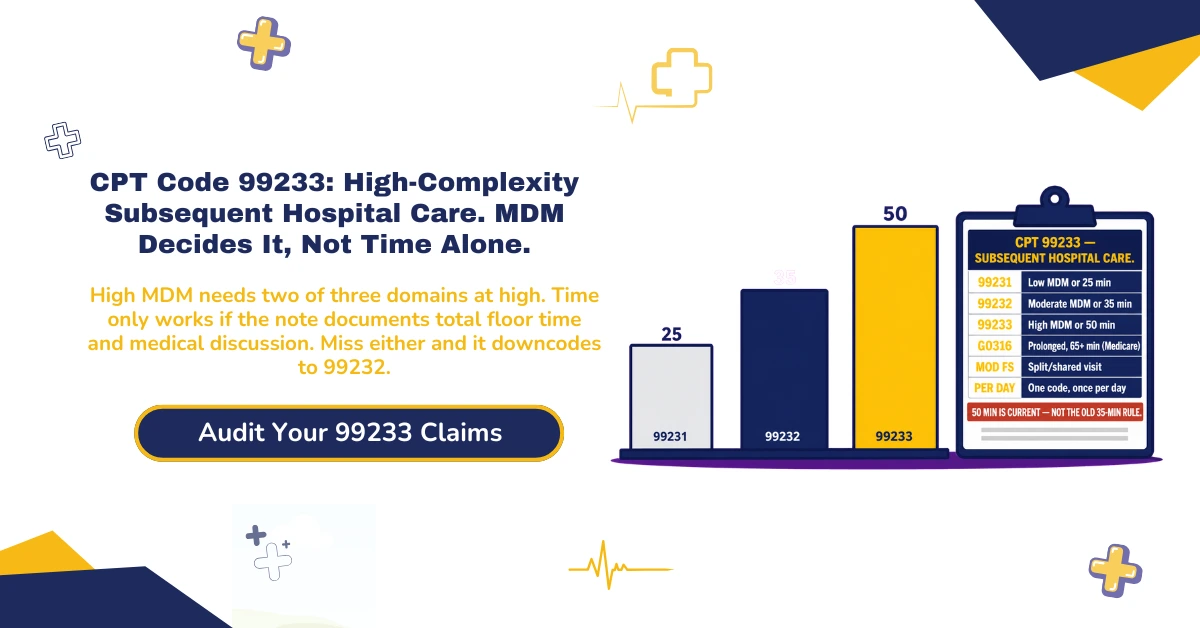
CPT code 99233 reports subsequent hospital inpatient or observation care, the highest level in the 99231 through 99233 family. Providers select it through high medical decision making or at least 50 minutes of qualifying total time on the date of the encounter. History and exam volume don’t determine the level. Medical necessity and documentation have to support whichever path applies.
| Field | Information |
|---|---|
| Code | 99233 |
| Service family | Subsequent hospital inpatient or observation care |
| MDM level | High |
| Time threshold | 50 minutes must be met or exceeded |
| Patient status | Inpatient or observation |
| Reporting frequency | Per day |
| Primary users | Physicians and qualified healthcare professionals |
| Main risk | Unsupported high-level reporting |
This guide walks providers and billing teams through the decisions that come with almost every 99233 claim: when the code fits, how to support high MDM, what counts toward the 50-minute threshold, how 99233 compares with 99231, 99232, and 99223, and what documentation keeps a claim from getting downcoded on review.
Later sections connect the clinical picture to a clean professional claim, from place of service through appeals.
ClaimMax RCM works with hospital-based providers on exactly this: turning documentation into coding, clean claim submission, and payer follow-up that holds up when a payer looks closer.
What Is CPT Code 99233?
Current CPT 99233 Description
CPT 99233 reports a subsequent hospital inpatient or observation evaluation and management service. Two paths select the level: a medically appropriate history and exam paired with high medical decision making, or total qualifying time of 50 minutes or more on the date of the encounter.
The patient can be new or established to the physician. “Subsequent” depends on whether the patient already received a professional service from that physician, or another physician of the same specialty and subspecialty in the same group, during the current stay. It has nothing to do with the three-year new-versus-established rule that governs office visits.
The code is reported once per day, no matter how many times the provider sees the patient.
Is CPT 99233 a 35-Minute or 50-Minute Code?
The current time threshold is 50 minutes. That single fact resolves one of the more persistent contradictions floating around search results for this code.
The 35-minute figure comes from guidance that predates January 1, 2023. Before that date, the subsequent hospital care codes used detailed history and detailed exam as part of level selection, and 99233’s typical time was listed at 35 minutes.
The 2023 overhaul of the hospital evaluation and management codes, detailed in the AMA E/M guidelines, replaced that structure with two selection paths: MDM level or total time, with new time values attached to each code.
Pages built on the older framework can still rank well because of age and backlinks, not because the information holds up. Providers and coders should verify against current AMA and payer guidance rather than trust a page’s position in search results.
| Topic | Outdated material | Current approach |
|---|---|---|
| Time | 35-minute typical time | 50 minutes must be met or exceeded |
| History | Detailed history helped determine level | Medically appropriate history |
| Examination | Detailed examination helped determine level | Medically appropriate examination |
| Level selection | Two of history, exam, and MDM | High MDM or qualifying total time |
| Observation | Separate observation code family | Combined inpatient and observation family |
When Should Providers Use CPT 99233?
Clinical Situations That May Support 99233
High-complexity subsequent management can support 99233 when the note shows real work behind the diagnosis. That includes:
- Severe exacerbation or progression of a chronic condition
- Acute illness threatening life or bodily function
- A significant new complication that developed during the stay
- Inadequate response to the treatment already in place
- Escalation or substantial modification of the management plan
- Complex data review, including interpretation and professional discussion
- High-risk medication or treatment decisions
A few grounded examples: pneumonia with worsening hypoxemic respiratory failure that requires treatment escalation. Sepsis with ongoing hemodynamic instability and an antibiotic change. Acute kidney injury complicating diuresis for decompensated heart failure. A postoperative complication that needs significant reassessment. A new arrhythmia that triggers medication changes and a specialist discussion.
None of that is automatic. A diagnosis on the problem list doesn’t support 99233 by itself. The provider has to address the problem that day and document the medical decision making or time that resulted from addressing it.
Situations That Usually Do Not Support 99233
A few patterns tend to land lower than 99233:
- A stable patient waiting on placement
- Routine postoperative follow-up with no complications
- Continuation of a plan that hasn’t changed
- A brief review with no meaningful management decision
- Copy-forward documentation that doesn’t reflect current work
- A long problem list without evidence any of it was addressed that day
- Work that belongs under discharge management or critical care instead
None of these rules out 99233 in every case. The right word is “usually,” because the documented work on that specific day is what decides the level, not the category the visit falls into.
Medical Necessity Still Controls the Level
Medical necessity sits above every other rule here. A provider can’t manufacture high MDM by ordering more tests, and a longer note doesn’t create a higher level of service on its own.
The level has to reflect the patient’s condition and the actual work performed that day. Each hospital day gets evaluated on its own; a patient can move from 99233 down to 99232 or 99231 as the condition stabilizes.
| Scenario | Likely direction | Reason |
|---|---|---|
| Worsening respiratory failure with treatment escalation | Evaluate 99233 | Potential high problems and high risk |
| Stable infection improving on unchanged therapy | Likely 99231 or 99232 | Lower management complexity |
| New shock requiring critical-care work | Evaluate 99291 | Critical care may be more appropriate |
| Discharge planning by the discharging physician | 99238 or 99239 | Discharge-day service family |
| Long note with an unchanged plan | Not automatically 99233 | Documentation volume isn’t MDM |
Repeated high-level hospital visits that don’t hold up on review usually trace back to one of three places: the documentation, the code selection, or the claim itself. Accurate 99233 reporting depends on documentation, charge capture, claim validation, and payer follow-up operating as one connected workflow inside effective hospital RCM services, and a focused review can tell you which one needs attention before a payer does.
CPT 99233 High Medical Decision Making Requirements
When 99233 is selected through medical decision making, the encounter has to reach the high level in at least two of the three MDM elements: problems addressed, data reviewed and analyzed, and risk of patient management. That “two of three” refers to the MDM elements themselves, not to history, exam, and MDM the way older guidance framed it.
Number and Complexity of Problems Addressed
A problem counts as addressed when the provider evaluated, assessed, or treated it that day, and the condition affected diagnostic or treatment decisions. Listing a diagnosis alone doesn’t meet that bar. A stable chronic condition only contributes when it shapes management on the date of service.
Two categories can reach the high level here: a chronic illness with severe exacerbation or progression, and an acute or chronic illness or injury that threatens life or bodily function. Either way, the note needs to show the condition’s current effect on management, not its presence on the chart.
Strong documentation answers a few questions directly: what changed since the last visit, why the condition still counts as severe, what management changed, and what clinical risk is being managed. None of it requires artificial phrasing, only an accurate reflection of the work performed.
Amount and Complexity of Data Reviewed and Analyzed
Data falls into three categories: tests, documents, orders, and independent historians; independent interpretation of a test; and discussion of management or test interpretation with an external physician or qualified professional. High-level data requires meeting at least two of those three categories.
Ordering a test and reviewing the same test isn’t two separate data points. The note should name the specific test, document, historian, interpretation, or discussion involved, not lean on a phrase like “all labs reviewed.”
Documentation that earns credit reads more like this: reviewed serial cultures and independently interpreted an imaging study not separately billed. Discussed antimicrobial strategy with infectious disease. Obtained history from a family member because the patient couldn’t reliably report symptoms, and reviewed an external transfer record.
Risk of Complications, Morbidity, or Mortality
High risk comes from the management decision, not the diagnosis attached to it. Qualifying examples include drug therapy that requires intensive monitoring for toxicity, a decision about major surgery with identified risk factors, a decision to hospitalize or escalate the level of hospital care, and a decision to de-escalate care because of a poor prognosis.
Routine medication administration isn’t automatically intensive toxicity monitoring, and hospitalization itself doesn’t automatically create high risk on every subsequent visit. The note has to show the decision and explain why it carried real risk.
Two Different “Two of Three” Rules
This is where a lot of confusion starts, because the phrase “two of three” shows up twice with different meanings.
| Rule | What must be met |
|---|---|
| Overall MDM level | Two of the three MDM elements |
| High-data element | Two of the three internal data categories |
| Old pre-2023 rule | History, exam, and MDM, no longer used for hospital E/M level |
High overall MDM requires two of the three MDM elements. High-level data, as one of those elements, separately requires at least two of its own three internal categories. They’re related but not interchangeable.
High MDM Example
A patient admitted with pneumonia develops a worsening oxygen requirement and new acute kidney injury. The provider reviews the trend data and imaging, independently interprets a study, discusses management with another physician, and modifies the antibiotic and fluid strategy. The note documents the risk tied to respiratory deterioration and renal injury.
| MDM element | Evidence |
|---|---|
| Problems | Acute illness threatening bodily function |
| Data | Meets the required data categories |
| Risk | High-risk treatment or escalation decision |
| Overall result | At least two high elements may support high MDM |
The final code still depends on the complete documented encounter, not on any single element in isolation.
CPT 99233 Time Requirements and the 50-Minute Rule
CPT 99233 requires at least 50 minutes of qualifying physician or qualified healthcare professional time on the date of the encounter when the service is selected based on time. The threshold has to be met or exceeded.
Time is an alternative to MDM, not an addition to it: the provider needs high MDM or 50 minutes, not both. Total time includes qualifying face-to-face and non-face-to-face work personally performed by the billing provider on the date of service.
What Time Counts Toward CPT 99233?
| Qualifying activity | Instruction |
|---|---|
| Preparing to see the patient | Include record and test review performed that date |
| Obtaining or reviewing history | Include patient, family, caregiver, or staff information |
| Examination and evaluation | Include medically necessary encounter work |
| Counseling | Include patient or caregiver counseling |
| Ordering | Include medications, tests, or procedures |
| Professional communication | Include qualifying communication not separately reported |
| Documentation | Include clinical documentation performed that date |
| Independent interpretation | Include only when not separately reported |
| Care coordination | Include when not separately reported |
What Time Does Not Count?
- Time spent by clinical staff
- Time spent on separately reported procedures or services
- Travel
- General teaching not connected to the patient’s care
- Work performed on a different calendar date
- Duplicated time between practitioners
- Administrative work unrelated to the encounter
How Should Time Be Documented?
Document the total time whenever time determines the code, and name the main qualifying activities. Start and stop times aren’t a universal CPT requirement for 99233, though a specific payer may ask for them anyway. Templated time statements that conflict with the rest of the note create more risk than they solve, and time shouldn’t function as a fallback when the documented total doesn’t reach the threshold.
A workable example: total time personally spent on the date of service was 54 minutes, including review of overnight events and imaging, patient evaluation, discussion with nephrology, treatment adjustment, family counseling, and documentation. That statement only holds up when the listed activities happened and the time is accurate.
CPT 99231 vs 99232 vs 99233
CPT 99231, 99232, and 99233 all report subsequent hospital inpatient or observation care. They differ by MDM level and time threshold: straightforward or low MDM, or 25 minutes, for 99231; moderate MDM, or 35 minutes, for 99232; high MDM, or 50 minutes, for 99233.
Comparison Table
| Code | Visit type | MDM level | Time threshold | General clinical direction |
|---|---|---|---|---|
| 99231 | Subsequent care | Straightforward or low | 25 minutes | Stable or limited management |
| 99232 | Subsequent care | Moderate | 35 minutes | Moderate complexity or treatment adjustment |
| 99233 | Subsequent care | High | 50 minutes | High-complexity management or qualifying time |
The clinical direction column is educational, not a substitute for the documented MDM elements themselves.
Difference Between CPT 99232 and 99233
This is the comparison billing teams search for most. 99232 requires moderate MDM; 99233 requires high MDM. The time gap runs 35 versus 50 minutes. A patient getting worse doesn’t automatically mean 99233. The note still has to demonstrate at least two high-level MDM elements, or the qualifying time.
| Decision point | 99232 direction | 99233 direction |
|---|---|---|
| Problems | Moderate problem complexity | Severe exacerbation or threat to life or bodily function |
| Data | Moderate data | Extensive data |
| Risk | Moderate management risk | High management risk |
| Time | At least 35 minutes | At least 50 minutes |
| Documentation | Shows moderate decisions | Shows high-level decisions or qualifying time |
Difference Between CPT 99223 and 99233
99223 reports initial hospital inpatient or observation care; 99233 reports subsequent care. Both can involve high MDM, but the time thresholds diverge: 99223 requires 75 minutes when selected through time, and 99233 requires 50 minutes.
Whether a visit counts as initial or subsequent depends on services already received during the stay from the same specialty and group, not on which calendar date one particular physician first saw the patient. The full same-specialty rule gets more room later in this guide, since it touches billing beyond code selection alone.
Code Selection Decision Path
- Confirm the patient is receiving subsequent inpatient or observation care.
- Determine whether MDM or time will select the code.
- Compare the documented level against 99231, 99232, and 99233.
- Check whether discharge management, critical care, or another service family applies instead.
CPT 99233 Documentation Requirements
CPT 99233 documentation should show the medically necessary work behind high MDM or 50 minutes of qualifying total time. The note needs to identify the problems addressed, the data reviewed and analyzed, the management risk, and the decisions made during that specific hospital day.
Document the Patient’s Current Status
The note should separate today’s condition from the previous hospital day: improvement, deterioration, or lack of response; new symptoms or complications; current severity; treatment response; active problems addressed; and why continued hospital-level management is still necessary. Writing “patient unstable” without supporting facts doesn’t hold up under review.
Document the Problems Addressed
Good documentation names which problems were actively evaluated, which conditions changed management, which were severe or life-threatening, which comorbidities affected treatment, and what the provider decided for each significant problem.
A weak note reads: CHF, AKI, diabetes. Continue plan. A stronger version reads: acute decompensated heart failure remains poorly responsive to diuresis, with rising creatinine limiting treatment options. Adjusted the diuretic strategy and ordered closer renal monitoring after reviewing overnight urine output and lab trends. The second version demonstrates the work instead of adding length.
Document the Data Reviewed and Analyzed
Name the unique tests reviewed, external records reviewed, independent historian, independent interpretation, professional discussion, and how the information changed management. Weak: labs and imaging reviewed. Strong: reviewed serial creatinine and potassium trends, independently interpreted the chest image, and discussed the fluid-management plan with nephrology.
Document the Risk and Management Decisions
Cover medication initiation or adjustment, intensive monitoring decisions, escalation or de-escalation of care, surgical decisions, prognosis discussions, treatment limitations, and the risk-benefit reasoning behind them. IV medication on its own doesn’t create high risk; the note has to explain why the specific decision carried it.
Document Total Time When Time Selects the Code
The note needs total time, date of service, and the main qualifying activities whenever time selects the code, with no separately billable time folded in and consistency between the recorded time and the rest of the note. Routine time statements don’t belong in a chart when MDM clearly selected the service and time wasn’t accurately tracked.
Weak Versus Strong Documentation Example
| Weak documentation | Stronger documentation |
|---|---|
| “Patient remains ill. Continue antibiotics. Labs reviewed.” | Identifies current complication, exact data reviewed, management discussion, therapy change, and risk |
| “High complexity.” | Describes the decisions that made management high risk |
| “50 minutes spent.” | States total time and qualifying activities |
| Copied assessment from yesterday | Shows current response, changes, and new decisions |
CPT 99233 Documentation Checklist
- Date of service
- Subsequent inpatient or observation status
- Medically appropriate history and examination
- Current condition and change from the prior day
- Problems addressed
- Data reviewed and analyzed
- Management decisions
- Risk
- Total time when used
- Provider identity
- Signature and authentication
- Split/shared details when applicable
- Medical necessity
- Consistency across assessment, plan, orders, and claim
Split/shared billing gets its own explanation later in this guide. For now, treat it as one more documentation element to track when a physician and an advanced practice provider both work the encounter.
A documentation pattern can look clinically complete and still fail to support the billed E/M level. Providers need a workflow that translates the documented MDM or total time into the correct professional claim, which is where specialty-aware medical billing services support code selection, claim scrubbing, and pre-submission validation.
That gap between a good note and a supportable claim is where a lot of revenue quietly disappears, and where a second set of eyes on the connection between the note, the code, and the claim tends to pay for itself.
CPT Code 99233 for Inpatient and Observation Care
Can CPT 99233 Be Used for Observation Care?
Yes. CPT code 99233 may report qualifying subsequent hospital inpatient or observation care. Since the 2023 E/M revisions, the same subsequent-care family, 99231 through 99233, applies to both inpatient and observation services.
A few things follow from that. The former subsequent observation codes, 99224 through 99226, were deleted and shouldn’t be used for current dates of service. Observation status doesn’t block use of the subsequent hospital care family. The documented MDM or total time still determines the level, and the care setting and patient status still have to agree with what’s on the professional claim.
CMS’s current evaluation and management booklet identifies 99231 through 99233 as part of the combined inpatient and observation care code set, and confirms that a transition from observation to inpatient status isn’t treated as a new stay for Medicare billing purposes.
POS 21 vs POS 22 for CPT 99233
| Patient status and setting | Professional claim POS | Meaning |
|---|---|---|
| Formally admitted hospital inpatient | 21 | Inpatient hospital |
| Hospital outpatient under observation | 22 | On-campus outpatient hospital |
| Off-campus outpatient hospital, where applicable | 19 | Off-campus outpatient hospital |
| Telehealth while the patient isn’t at home | 02 | Telehealth provided other than in the patient’s home |
Most 99233 claims fall under POS 21 or 22. POS 19 is worth knowing about, but it’s the exception, not the default; use it only where the actual location and payer policy support it.
POS identifies where the patient received the service, not where the provider’s office happens to be, per the CMS POS code set. Observation care generally reports as hospital outpatient status, and inpatient status supports POS 21. The medical record, the hospital status, and the professional claim all need to agree, and payer-specific processing rules are still worth verifying case by case.
Observation-to-Inpatient Status Changes
A same-day status change from observation to inpatient doesn’t automatically create a second billable hospital E/M service. The provider reports the single service that reflects the full medically necessary work performed that calendar date, rather than splitting one continuous encounter into separate observation and inpatient visits because the status label changed partway through.
Qualifying work across that same encounter date can be combined under the applicable rule when time selects the code. Admission, discharge, and length-of-stay rules deserve separate review whenever any of that happens on the same calendar date.
CMS states that only one hospital inpatient or observation care code can generally be reported per calendar date for the applicable visit type, and that a transition from observation to inpatient status isn’t a new stay.
Per-Day Billing, Multiple Providers, and Discharge Rules
Can CPT 99233 Be Billed Twice in One Day?
Generally, no. CPT code 99233 is a per-day service, and it can’t be billed twice on the same date by the same physician, or by physicians of the same specialty in the same group. Multiple medically necessary encounters on the same day get combined into one daily service, even when the provider sees the patient more than once.
If time selects the code, combine the qualifying time for that daily service instead of double counting it. Extra visits don’t create extra units, and the final level has to reflect all the documented work across the day, not only the visit where the condition happened to change. If a later encounter qualifies as critical care, the separate critical-care rules covered further down apply instead.
CMS describes 99231 through 99233 as per-diem services, reportable only once per day by the same physician, or by physicians of the same specialty in the same group.
Can Different Providers Report Hospital Services on the Same Date?
| Scenario | General billing direction |
|---|---|
| Same physician | One applicable per-day service |
| Same specialty and same group | One combined per-day service |
| Physician and NPP in the same group | Evaluate split/shared rules |
| Different specialties with distinct active management | Separate medically necessary services may be possible |
| Duplicate evaluation of the same problem | High denial risk |
| Consultant in an observation setting | Verify the correct outpatient or other applicable service family |
Different-specialty reporting isn’t automatic because two specialists were both involved. Each practitioner needs to perform medically necessary, nonduplicative work, and each note should show that practitioner’s active role in treatment. Payer-specific concurrent-care rules still apply on top of the Medicare framework, and group NPI, rendering NPI, specialty taxonomy, and service timing are worth checking before a claim goes out.
CMS recognizes concurrent services when more than one practitioner plays an active, medically necessary role, as long as the services aren’t duplicative. Multi-provider organizations should build same-specialty, same-group, and rendering-NPI checks into their group practice medical billing workflow before hospital claims go out the door.
Can CPT 99233 and 99239 Be Billed on the Same Day?
The practitioner responsible for discharge should generally report 99238 or 99239 instead of a subsequent hospital visit on the discharge date. Medicare doesn’t reimburse 99231 through 99233 in addition to discharge-day management billed by the same provider on the same date.
A physician who isn’t responsible for discharge may still report an appropriate, medically necessary, distinct service where payer rules allow it. The discharging practitioner shouldn’t split routine final-day work between a subsequent-care code and a discharge code, and the record should make clear who performed the discharge management. This rule doesn’t block unrelated, separately supported work by another specialty, but that still needs a payer-policy check first.
CMS identifies same-provider reporting of subsequent hospital care and discharge-day management on the same date as an overpayment issue under the CMS Claims Processing Manual.
Continuous Services That Cross Midnight
A continuous service that crosses midnight stays one encounter, reported on the date it began. Continuous work doesn’t split into two daily services because the clock passed midnight partway through.
Noncontinuous, medically necessary services on a distinct new calendar date get evaluated on their own facts and under the payer’s rules for that date. CMS’s current E/M guidance addresses exactly this scenario for a service that spans two calendar dates.
Split/Shared, Teaching Physician, Prolonged, and Critical Care Rules
Split/Shared CPT 99233 Visits
A split/shared hospital E/M visit happens when a physician and a nonphysician practitioner in the same group each perform part of a facility-based encounter. Medicare bills the service under whichever practitioner performed the substantive portion.
The current rules: physician and NPP have to be in the same group, and both have to perform part of the service. The substantive portion means more than 50% of the combined total time, or a substantive part of the MDM. Whoever performed the substantive portion bills the visit, and the record needs to identify both participants, with the billing practitioner signing and dating it.
Modifier FS identifies a split/shared service. Only distinct time counts, joint time gets counted once, and at least one practitioner has to have had face-to-face contact with the patient.
CMS’s current guidance confirms that hospital split/shared visits can use more than 50% of total time or the substantive part of MDM to determine the billing practitioner, and requires modifier FS along with identification of both practitioners.
| Requirement | Documentation or claim action |
|---|---|
| Same group | Confirm the physician and NPP group relationship |
| Both participate | Identify each practitioner’s work |
| Substantive portion | Show the time or MDM basis |
| Billing practitioner | Submit under the correct NPI |
| Signature | Billing practitioner signs and dates |
| Modifier | Append FS |
| Joint time | Count only once |
Teaching Physician Requirements
The medical record has to show the teaching physician’s actual participation. The teaching physician has to either perform the service or be present for the key or critical portions when a resident performs them, and the documentation should reflect participation in patient management, not a generic attestation that conflicts with what the resident’s note or actual involvement shows.
For time-based code selection, resident-only time can’t be added as if it were the teaching physician’s own reportable time; the teaching physician has to personally meet the applicable billing requirements. Virtual teaching presence works differently and gets covered in the telehealth section below.
CMS explains that teaching-physician E/M records need to demonstrate performance or presence during key portions and participation in patient management, and that for time-based services, resident-only time can’t be added to the teaching physician’s reportable time.
Prolonged Services With CPT 99233
For Medicare, report G0316 with CPT 99233 when time selects the base visit and qualifying total time reaches at least 65 minutes on the date of service.
The base code has to be selected through time, the total time has to reach that threshold, and the additional work still has to be medically reasonable and necessary, with the total qualifying time documented. Don’t use G2212 with 99233; that code applies to specified office or outpatient and cognitive-assessment services, not to hospital care.
Some non-Medicare payers may accept CPT 99418 instead, so each payer’s prolonged-service policy is worth verifying before submission rather than assuming Medicare and commercial rules line up. Prolonged hospital services don’t get reported with discharge-day management, and prolonged codes don’t get added to critical-care codes.
CMS’s current table pairs G0316 with 99233 starting at 65 minutes and requires time to have selected the visit level; G2212 applies to other specified E/M families, not to subsequent hospital care, per the current CMS E/M guidance.
| Payer framework | Potential add-on | Required action |
|---|---|---|
| Original Medicare | G0316 | Verify the 65-minute threshold and current policy |
| Commercial payer following CPT | May accept 99418 | Confirm the contract and policy |
| Office or outpatient Medicare E/M | G2212 in applicable families | Do not attach to 99233 |
| Critical care | 99291 and 99292 rules | Do not use the hospital prolonged code |
Can CPT 99233 and 99291 Be Billed on the Same Date?
Medicare may allow a separate hospital E/M service before critical care begins when that earlier service was medically necessary, distinct, nonduplicative, and performed while the patient didn’t yet require critical care.
The noncritical service has to occur before the critical-care period starts, the two services can’t duplicate each other, and the documentation has to separately support both. Modifier 25 goes on the separate E/M service under the applicable Medicare rule.
The same time or work can’t be counted twice, and a routine subsequent visit reported after the patient was already receiving critical care needs separate rules and facts clearly supporting it. Critical care still has to independently meet its own definition and time threshold.
CMS’s current E/M booklet allows a separate, earlier E/M service alongside later critical care under specific conditions, and instructs providers to use modifier 25 on that separate E/M service.
CPT Code 99233 Telehealth Rules for 2026
Is CPT 99233 Covered by Medicare Telehealth?
CMS currently includes subsequent inpatient visits, including CPT codes 99231, 99232, and 99233, among covered telehealth services. Effective January 1, 2026, CMS permanently removed the previous frequency limitations that applied to subsequent inpatient telehealth visits, per the current CMS telehealth guidance.
That permanent removal is a regulatory change, separate from the broader statutory authority that lets Medicare cover telehealth at all for many services. On February 3, 2026, Congress passed and the President signed the Consolidated Appropriations Act, 2026, and Section 6209 of that law extended most other Medicare telehealth flexibilities, including geographic and originating-site waivers, through December 31, 2027.
The frequency-limit removal for 99231 through 99233 doesn’t depend on that later date; it’s permanent on its own. The broader flexibilities around where a patient can receive telehealth are tied to that 2027 date and could need further Congressional action after it passes.
Removing the frequency limit doesn’t eliminate every coverage requirement. The service still has to be clinically appropriate, the code still has to remain on the current CMS telehealth list, and the provider still has to satisfy telehealth, licensure, enrollment, documentation, and payer rules that apply beyond frequency alone.
Commercial and Medicaid telehealth policies can differ from Medicare’s, so the applicable policy is worth checking for the actual date of service.
Which POS Applies to Telehealth CPT 99233?
For Medicare professional telehealth billing, POS 02 means telehealth provided somewhere other than the patient’s home, and POS 10 means telehealth provided in the patient’s home. A hospitalized patient isn’t in the home, so POS 02 is the relevant telehealth category when current Medicare rules support the service.
POS 21 or 22 shouldn’t be used automatically for a professional telehealth claim without checking current Medicare and payer instructions, and one payer’s POS policy shouldn’t be generalized to every other payer.
Is Modifier 95 Required?
Modifier requirements vary by payer and service type, and modifier 95 isn’t universally required on every professional 99233 telehealth claim. Current CMS instructions, MAC guidance, and the applicable commercial contract are worth verifying directly. Providers should treat POS guidance and modifier guidance as two separate questions rather than assume one settles the other; ClaimMax RCM’s Modifier 95 rules guide covers the broader payer landscape for telehealth modifiers.
Teaching Physician Virtual Presence in 2026
Beginning in 2026, teaching-physician virtual presence is allowed in all teaching settings, but only when the underlying service itself is furnished as a Medicare telehealth service. The teaching physician’s virtual presence has to occur through real-time audio-video technology during the key portion of that service. This doesn’t extend to broad virtual presence for ordinary in-person resident services; it’s specific to services that already qualify as telehealth.
CPT 99233 RVU and Medicare Reimbursement in 2026
How Medicare Calculates Payment for CPT 99233
Medicare reimbursement for CPT code 99233 isn’t one universal amount. Payment depends on the code’s work, practice-expense, and malpractice RVUs, geographic adjustments, the applicable 2026 conversion factor, participation status, and the specifics of the claim.
Adjusted payment = [(Work RVU x Work GPCI) + (Practice Expense RVU x PE GPCI) + (Malpractice RVU x MP GPCI)] x Applicable Conversion Factor
Work RVU measures physician effort and skill. Practice expense RVU covers the overhead of delivering the service. Malpractice RVU reflects liability cost. GPCI adjusts each of those three components for local cost differences, and the conversion factor turns the adjusted total into a dollar amount.
Hospital E/M professional claims are facility-setting services; a “non-facility 99233 payment” isn’t the right default for hospital reimbursement, and the correct figure depends on how the current PFS file prices the code.
2026 Conversion Factors
| Clinician category | CY 2026 conversion factor |
|---|---|
| Qualifying APM participant | $33.5675 |
| Nonqualifying APM clinician | $33.4009 |
CMS introduced two separate conversion factors starting in 2026, one for clinicians who qualify as participants in advanced alternative payment models and one for everyone else. The conversion factor alone isn’t the final payment.
Geographic practice cost indices still apply, the code-level RVUs still have to come from the current CMS file or lookup tool, and the final paid amount can move further based on participation status, sequestration, deductible, coinsurance, claim edits, and other payment policies.
CMS finalized these two conversion factors in the 2026 PFS final rule, effective for dates of service on or after January 1, 2026. Both figures already reflect a statutory 2.5% increase and a budget-neutrality adjustment built into that rule.
2026 CPT 99233 RVU Components
| RVU component | 2026 value | Source |
|---|---|---|
| Work RVU | Confirm on the current CMS PFS Look-Up Tool before publication | CMS PFS Relative Value File |
| Practice expense RVU | Confirm on the current CMS PFS Look-Up Tool before publication | CMS PFS Relative Value File |
| Malpractice RVU | Confirm on the current CMS PFS Look-Up Tool before publication | CMS PFS Relative Value File |
| Total geographically unadjusted RVU | Calculate from the current file | CMS PFS Relative Value File |
| National estimate | Calculate transparently once components are confirmed | Current conversion factor |
| Last verified | July 2026 | Editorial review against CMS sources |
99233’s work RVU held steady at 2.00 for roughly a decade under the prior code descriptors, with total RVU drifting slightly year to year on the practice-expense and malpractice components. The 2023 code overhaul and subsequent annual updates can shift that baseline.
CY 2026 layers in a separate efficiency adjustment that CMS applied to many services, though CMS excluded time-based codes and codes on the telehealth list from that particular adjustment.
Rather than publish a specific 2026 dollar figure that could already be stale by the time a reader checks it, pull the current work, practice-expense, and malpractice RVUs directly from the CMS PFS lookup tool for your locality before quoting a payment estimate to a physician or a finance committee.
Commercial Payer Reimbursement
Commercial reimbursement is contract-specific. “Commercial payers usually pay 150% to 200% of Medicare” isn’t a claim any billing team should publish as a universal rule; some contracts use a percentage of Medicare, others run on proprietary fee schedules or negotiated rates entirely separate from the Medicare methodology.
The allowed amount on any given claim should get compared against the actual contract and the remittance, and an underpayment analysis should separate an incorrect contracted amount from a bundling or edit issue, a wrong POS, a modifier problem, downcoding, patient responsibility, or a coordination-of-benefits issue. Each of those has a different fix.
Common CPT 99233 Denials, Downcoding, and Appeal Strategy
Why CPT 99233 Claims Are Denied or Downcoded
CPT code 99233 claims get challenged most often when the medical record doesn’t support high MDM or qualifying time, the claim duplicates another per-day service, the POS or provider information is inconsistent, or same-day services got billed incorrectly.
| Root cause | What the reviewer or payer may see |
|---|---|
| Unsupported high MDM | Fewer than two high-level MDM elements |
| Insufficient time | Total time missing or below the threshold |
| Generic documentation | No clear current-day decisions |
| Copied-forward note | Little change from the previous date |
| Duplicate daily service | Same physician or same-specialty group |
| Same-day discharge conflict | 99233 plus 99238 or 99239 by the same provider |
| Wrong POS | Patient status conflicts with the claim |
| Split/shared error | Wrong billing NPI or missing FS |
| Prolonged-code error | G2212 used instead of the applicable hospital rule |
| Critical-care overlap | Duplicate or nonseparate work |
| Signature issue | Missing or invalid authentication |
| Medical necessity | A lower service would have been more appropriate |
CMS’s most recent evaluation and management compliance data, covering the 2024 reporting period, puts the improper-payment rate for all E/M codes at 10.3%, representing a projected $3.9 billion.
Incorrect coding accounted for 49.1% of those improper payments, insufficient documentation for 34.1%, no documentation for 13.1%, and other errors for the remainder, according to the CMS E/M compliance guidance. That figure covers E/M codes broadly, not 99233 specifically, but it’s a fair snapshot of where E/M revenue tends to leak.
Prevention Before Claim Submission
Prevention splits naturally by role.
Provider check: current condition clearly documented; problems actively addressed; MDM elements identifiable; management risk explained; total time present when used; note signed; current-day work distinguished from copied information.
Coding check: correct initial or subsequent family; MDM or time pathway verified; POS matches patient status; same-specialty group reviewed; discharge-day conflict checked; critical-care interaction checked; split/shared requirements checked; prolonged code verified against the payer.
Billing check: rendering and group NPI correct; modifier supported; units correct; diagnosis sequence consistent; claim scrubber hasn’t overwritten a correct POS; payer policy reviewed; documentation available on request.
Appeal Workflow for a Supported CPT 99233 Claim
- Identify the denial, adjustment, or downcoding reason.
- Obtain the complete claim and remittance record.
- Compare the submitted code against the medical note.
- Verify whether MDM or time supports the service.
- Confirm POS, provider, specialty, group, units, and modifiers.
- Review same-day services for conflicts.
- Check payer policy and the appeal deadline.
- Correct and resubmit when the original claim was wrong.
- Appeal when the original claim was supported.
- Cite the specific documentation behind each disputed element.
- Track the appeal through to final resolution.
- Feed the root cause back into provider, coding, or claim-edit training.
The goal isn’t defending every submitted 99233 no matter what. It’s correcting the claims that weren’t supported, and fully defending the ones that were.
ClaimMax Denial and AR Workflow
Denial management and AR follow-up solve different problems, and treating them as one undifferentiated bucket is how recurring errors keep recurring. Denial management handles the adjustment, the root cause, the correction, and the appeal. AR follow-up handles claims that are unresolved, delayed, or underpaid after submission.
Both should share one root-cause record, so a pattern gets fixed upstream instead of getting rediscovered every billing cycle. Worth tracking regardless of who runs the work: downcoding rate, initial denial rate, appeal overturn rate, days to resolution, aged balance, and payer- or provider-specific patterns.
When high-level hospital E/M claims keep getting reduced or denied, structured denial management services can separate an isolated error from a recurring documentation, coding, or payer-policy failure. Claims that stay unpaid or underpaid after correction or appeal belong in a structured accounts receivable services workflow before filing limits run out.
Repeated 99233 denials rarely start at a single point in the revenue cycle. A focused review, the kind ClaimMax runs as a complimentary audit, can show whether the pattern begins in documentation, coding, claim edits, payer policy, or follow-up, before more claims age past the point where they’re recoverable.
CPT Code 99233 FAQs, Final Checklist, and RCM Next Steps
Frequently Asked Questions
What is CPT code 99233 used for?
CPT code 99233 reports subsequent hospital inpatient or observation care selected through high MDM or 50 minutes of qualifying time. It’s a per-day service, reported once regardless of how many times the provider sees the patient that date. It sits at the top of the 99231 through 99233 subsequent-care family.
Is CPT 99233 a 35-minute or 50-minute code?
The current threshold is 50 minutes when time selects the service. The 35-minute figure comes from guidance that predates the 2023 E/M overhaul and no longer applies to current dates of service. Providers relying on older reference material should confirm against current AMA and payer sources before billing.
What is the difference between CPT 99232 and 99233?
99232 means moderate MDM or 35 minutes. 99233 means high MDM or 50 minutes. The documented encounter, not the diagnosis alone, controls which one applies, and the note needs to show at least two high-level MDM elements or the qualifying total time to support 99233 over 99232.
Can CPT 99233 be billed twice in one day?
Generally no, for the same physician or same-specialty group in the same practice. Multiple encounters on the same date combine into one daily service rather than separate billable units. Distinct, later critical care may follow separate rules, and time spent should be combined, not double counted, when time selects the code.
Can CPT 99233 be used with POS 22?
Yes, when the patient is receiving qualifying subsequent observation care in an on-campus outpatient hospital setting and POS 22 accurately reflects the status and location. The medical record, the hospital status, and the professional claim all need to agree before the claim goes out.
Can CPT 99233 and 99239 be billed together?
Not by the same discharging provider for the same date under Medicare; the discharge code takes priority over a subsequent-care code that day. A different physician providing distinct, medically necessary care that isn’t related to discharge may have different rules, depending on the payer.
Can CPT 99233 and 99291 be billed on the same date?
They may be allowed when the earlier E/M service happened before critical care began, was medically necessary, separate, nonduplicative, and properly modified and documented. Modifier 25 goes on the earlier E/M service, and critical care still has to independently meet its own time and definition thresholds.
Does CPT 99233 require a modifier?
Not automatically. Modifier needs depend on the facts of the claim: FS for a split/shared service between a physician and an advanced practice provider, 25 for a qualifying separate same-day E/M service billed before critical care, or a payer-specific telehealth modifier where the encounter was delivered virtually.
What prolonged-service code is used with CPT 99233?
Medicare uses G0316 when time selects the base service and total qualifying time reaches 65 minutes on the date of service. Non-Medicare payers may follow a different policy, with CPT 99418 as a common alternative; G2212 doesn’t apply to this hospital code at all.
How much does Medicare pay for CPT 99233?
There’s no single universal amount. Payment depends on current work, practice-expense, and malpractice RVUs, the geographic practice cost indices for your locality, the applicable 2026 conversion factor, and the specifics of the claim. The CMS PFS Look-Up Tool has the current, locality-adjusted figure.
Is 99233 an ICD-10 code?
No. It’s a CPT service code that describes the level of evaluation and management work performed. ICD-10-CM codes describe the diagnoses that support medical necessity for the encounter, and both code types appear together on the same claim.
Is CPT 99233 allowed through telehealth in 2026?
Yes. CMS currently covers qualifying subsequent inpatient telehealth visits and permanently removed the frequency limitations that used to apply to them, effective January 1, 2026. Every other coverage, licensure, documentation, and payer rule outside of frequency still applies to the claim.
Final CPT 99233 Provider Checklist
Clinical and documentation: correct subsequent inpatient or observation service; high MDM supported by two of three elements, or 50 minutes met; current-day problems and decisions documented; medical necessity clear; time documented when used; note signed and authenticated.
Coding and claim: correct code family; correct POS; one-per-day rule checked; same-specialty group checked; discharge-day conflict checked; critical-care interaction checked; split/shared rule and FS modifier checked; prolonged code verified; telehealth policy checked; rendering NPI and units correct.
Revenue-cycle follow-up: claim accepted; allowed amount compared; downcoding monitored; denial reason categorized; appeal deadline tracked; underpayment escalated; root cause fed back upstream.
Strengthen Hospital E/M Billing Before Revenue Is Lost
ClaimMax RCM works with hospital-based providers, from orthopedic groups managing post-surgical inpatients to internal medicine and hospitalist teams running a full subsequent-care caseload, to align clinical documentation, coding, claim validation, denial prevention, underpayment review, and AR recovery inside one connected hospital revenue cycle management workflow. The goal is straightforward: help every properly documented 99233 collect what it’s worth, without pushing a claim past what the note supports.
Medical billing runs at 3.49%, and that rate already includes verification of benefits, prior authorization support, and a complimentary revenue cycle audit, so there’s no separate line item for any of it. Credentialing runs $120 per payer enrollment, with the same dedicated-specialist process behind every application.
For a hospital-based practice, that combination tends to be the difference between a 99233 that gets paid on the first pass and one that sits in a payer queue for months.
Get a Free Hospital Billing Review