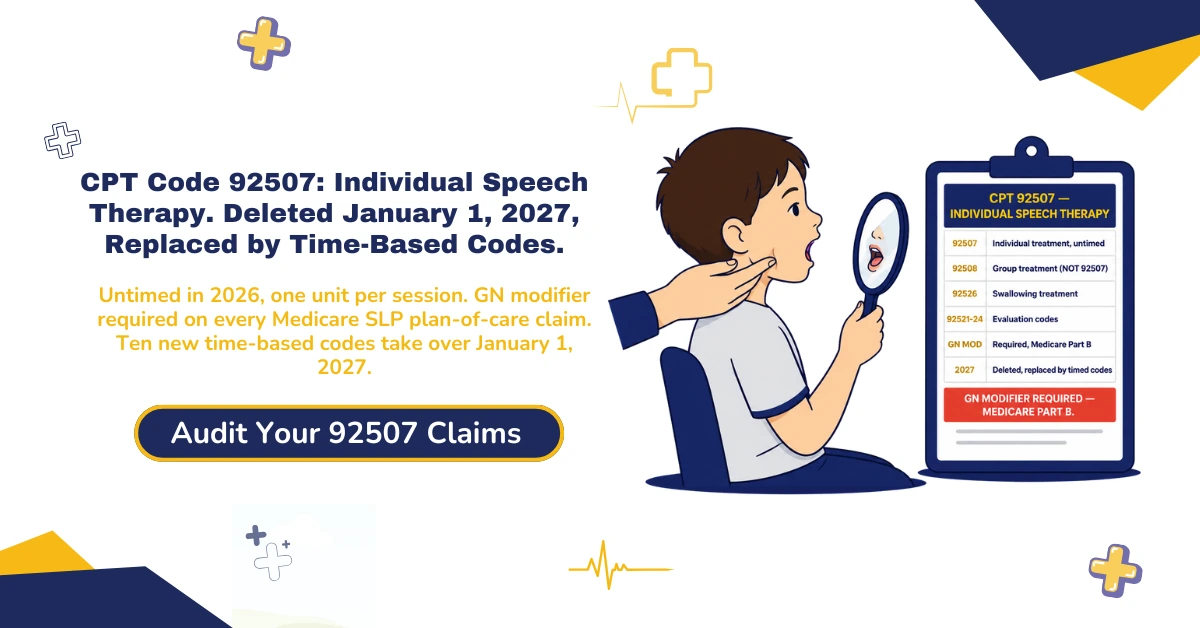
| Quick answerCPT code 92507 covers individual speech-language pathology treatment for speech, language, voice, communication, and auditory processing disorders. Speech-language pathologists bill it for one-on-one sessions. As of 2026, it’s an untimed code, generally reported once per session rather than in 15-minute units.ASHA reports that CPT code 92507 will be deleted effective January 1, 2027, and replaced by 10 new time-based codes. The code stays valid for 2026 dates of service, so providers should keep billing current claims correctly while preparing documentation and speech therapy billing workflows for the transition. |
Most speech therapy practices don’t lose money because they can’t define CPT code 92507. They lose money after the claim goes out.
The revenue leaks show up somewhere else: documentation that doesn’t prove medical necessity, a missing modifier, an authorization that expired mid-plan, a payer that underpays the allowed amount, or a claim that sits in AR while nobody follows up.
Each of those is a billing problem, not a coding trivia problem. Any one of them can turn a clean speech therapy service into a denial, an underpayment, or aging AR.
This guide walks through how to bill 92507 correctly in 2026, protect reimbursement, prevent claim denials, and prepare for the 2027 change without disrupting your speech therapy billing.
ClaimMax RCM works the full revenue cycle behind speech therapy claims, from eligibility to payment posting. Reach ClaimMax RCM and this guide shows where SLP billing on 92507 claims breaks before it becomes denials, underpayments, or aging AR.
What Is CPT Code 92507?
CPT code 92507 is used for individual treatment of speech, language, voice, communication, and auditory processing disorders, delivered one-on-one by a speech-language pathologist. It’s an untimed code, reported per session. It doesn’t cover group therapy, swallowing treatment, or evaluation services, each of which carries its own code.
CPT Code 92507 Description
The 92507 CPT code description centers on individual, skilled speech-language treatment. One clinician, one patient, one session focused on a communication disorder.
It belongs to the larger speech therapy CPT code family, which also includes group treatment, swallowing therapy, and a set of evaluation codes. Procedure code 92507 is the individual treatment member of that family, not a catch-all for every SLP service.
ASHA is the authority on this code’s current status and where it’s headed, including the 2027 change covered later in this guide.
What Providers Use 92507 For
SLPs bill CPT 92507 for a wide range of skilled work: articulation and speech-sound therapy, aphasia and dysarthria after a stroke, fluency treatment, and expressive or receptive language therapy.
Voice therapy and auditory processing treatment fall here too. If the service is individual, skilled, and aimed at a communication disorder, 92507 is usually the right treatment code.
Picking CPT code 92507 correctly is only the first layer of getting paid. Payment depends on whether the note, the diagnosis, the modifier, the authorization, and the payer’s rules all tell the same story.
Before a 92507 claim reaches the payer, the billing workflow should confirm that the service, diagnosis, modifier, and documentation all match.
What CPT 92507 Covers and What It Does Not Cover
CPT 92507 covers individual, skilled speech-language treatment. It doesn’t cover group therapy, swallowing work, evaluations, or AAC services, and mixing those up is a common denial trigger.
Services Commonly Billed With CPT 92507
Think of 92507 as the individual-treatment code. Articulation, language, voice, communication, and auditory processing therapy all belong here when they’re delivered one-on-one.
The table below sorts what belongs under 92507 from what needs a different code.
| Use CPT 92507 for | Use a different code for |
|---|---|
| Individual speech treatment | Group therapy, use 92508 |
| Language treatment | Swallowing treatment, use 92526 |
| Voice therapy | Evaluation, use 92521 to 92524 |
| Communication treatment | AAC evaluation or training, use 92607 or 92609 |
| Auditory processing treatment | Cognitive treatment codes where applicable |
Services That Need a Different CPT Code
Group therapy is the clearest split. CPT codes 92507 and 92508 look similar, but 92507 is individual and 92508 is group. Billing one for the other is a straightforward denial.
Swallowing treatment maps to 92526, and standardized evaluations map to 92521 through 92524. AAC work maps to 92607 or 92609. Each is a separate service with its own documentation.
Wrong code selection doesn’t just bounce back as a clean denial. It can trigger downcoding, appeal delays, or a payer request for medical records, all of which slow payment on speech therapy CPT codes.
None of this requires memorizing the whole family. It requires one habit: confirm the service actually matches 92507 before the claim goes out, and route anything else to its own code. Choosing the right CPT code for speech therapy up front avoids all of it.
Is CPT 92507 Timed or Untimed?
CPT 92507 is an untimed, per-session code, so it’s generally billed once for an individual treatment session rather than in 15-minute units.
That single detail answers the most common question about the code. Is 92507 a timed code? No. It isn’t billed in 15-minute increments the way many PT and OT codes are.
How Many Units of 92507 Can Be Billed?
In most cases, one unit per session. The 92507 units question trips people up because therapists assume a longer visit means more units. It usually doesn’t.
Session length still matters, just not for unit count. It matters for documentation, medical necessity, and meeting payer expectations for what a treatment session should contain.
ASHA describes 92507 as an untimed code, with payment historically built around a typical 60-minute session. Longer or shorter, the code is still generally reported once.
Why Timed vs Untimed Coding Matters for Revenue
Treating 92507 as a timed code is where practices get into trouble. Bill extra units the payer doesn’t recognize and you invite overbilling risk, audits, and claim-correction work.
The 92507 CPT code time rule is simple in practice: report the session, document the time and the skilled work, and don’t inflate units to match a long visit.
A structured speech therapy billing workflow confirms units, modifiers, diagnosis support, and payer rules before submission. That’s where ClaimMax RCM’s medical billing services support providers.
If your team isn’t sure a 92507 claim was billed correctly, check the units, modifier, diagnosis, and note before the payer does.
Is CPT Code 92507 Still Valid in 2026?
Yes. CPT code 92507 remains valid and billable in 2026. According to the ASHA CPT code update, there are no immediate changes to reporting or billing unless an individual payer makes its own change.
The deletion and replacement are real, but they’re dated. Any change from the review takes effect January 1, 2027, not before.
| 2026 billing status92507 remains valid in 2026.Use current payer rules for current dates of service.New codes apply January 1, 2027.Don’t change billing workflows before official payer adoption. |
What Providers Should Keep Doing in 2026
Keep billing current claims the way you do now: correct code, correct modifier, solid documentation, and clean claims for every 2026 date of service.
Watch the official channels too. ASHA, the AMA CPT Editorial Panel, CMS, and your individual payers will each signal when and how the transition applies to your claims.
What Providers Should Not Change Yet
Don’t jump ahead. Billing placeholder or new codes before their effective date and payer adoption is a fast way to trigger rejections.
The safe move for CPT code 92507 is patience with the codes and urgency with the prep. Report today’s claims under today’s rules, and use 2026 to get documentation and workflows ready.
Why CPT Code 92507 Was Flagged for Review
A code review doesn’t mean providers did something wrong. It means the numbers moved enough to get CMS and the AMA to take a closer look.
Medicare Utilization Growth
CPT code 92507 was flagged after Medicare utilization grew by more than 100% between 2017 and 2022. ASHA reports the code was identified through a high-volume growth screen requested by CMS.
Sharp growth is exactly what triggers a review. Through the AMA CPT code process, CMS and the AMA evaluate whether a code still matches how the service is delivered in current clinical practice.
- Medicare utilization increased sharply.
- CMS requested a high-volume review.
- Payers identified unusual billing patterns.
- The code structure may no longer reflect current clinical practice.
Payer Scrutiny and Audit Risk
Utilization isn’t the only thing payers watch on CPT code 92507. They also look at diagnosis mix, session frequency, unusual billing patterns, and documentation quality across a practice.
ASHA notes that overutilization concerns and unusual billing patterns prompted increased payer scrutiny. For providers, that scrutiny shows up as more record requests and closer claim review.
Why This Matters to Providers
The 92507 CPT code changes arriving in 2027 grab the headlines, but the nearer-term issue is tighter documentation scrutiny, more audits, and reimbursement controls on today’s claims.
When a code becomes a payer attention point, clean billing isn’t enough on its own. The documentation, diagnosis, modifier, authorization, and payment review all have to work together, which is the core of revenue cycle management services for CPT 92507.
Providers billing high-volume 92507 services should review denial trends, documentation quality, and payment patterns before scrutiny turns into revenue loss.
CPT 92507 and Medical Necessity Requirements
A 92507 claim lives or dies on the record behind it. The code can be perfect, but if the note doesn’t prove skilled, medically necessary treatment, the payer can still deny it.
What the Note Must Prove
Medical necessity for CPT code 92507 has to be visible to someone who never met the patient. The note should show skilled SLP intervention, not just an activity log.
Payers look for specific things: objective data, the treatment goal, the patient’s response, the cueing level used, measurable progress, and the clinical reasoning behind the session.
How ICD-10 Supports the CPT Code
The diagnosis has to match the service. CMS Article A54111 states that the medical record must support the selected ICD-10-CM code, and the CPT code billed must describe the service actually performed. For CPT code 92507, the diagnosis and the treatment have to line up.
That link between diagnosis and procedure code 92507 is where a lot of claims quietly fail. The service was skilled and appropriate, but the diagnosis on the claim didn’t support it.
The table below maps each documentation element to what it proves for the payer.
| Documentation element | Why the payer needs it |
|---|---|
| Diagnosis | Supports medical necessity |
| Treatment goal | Shows the purpose of care |
| Objective data | Shows measurable progress |
| Skilled intervention | Proves SLP-level service |
| Patient response | Supports continued treatment |
| Plan | Shows the next clinical step |
Common Medical Necessity Weak Spots
The weak spots are predictable. No measurable data, goals that never change, cueing levels left out, and progress described in vague words like improving with nothing to back it.
Skilled intervention is the piece most often missing. The note describes what the patient did, but not what the SLP did that required a licensed clinician, and that’s the speech therapy CPT code that gets questioned.
Denial prevention starts before submission. If the documentation doesn’t support the code, the denial team is stuck appealing a weak record instead of a strong one.
A quick documentation audit before submission can prevent days or weeks of denial work after it.
CPT 92507 Documentation Example: Weak Note vs Strong Note
The difference between a paid CPT code 92507 claim and a denied one is often a few lines in the note. Same service, different documentation, different outcome.
Below is a simplified, educational contrast. It’s not a full clinical note, just a comparison of weak versus strong documentation for the same session.
The 92507 CPT code description tells you what to bill. The note has to prove you actually delivered it, and that’s where weak and strong records split.
Weak 92507 Documentation
Weak version: Patient worked on speech sounds. Progress noted. That’s it. It describes an activity, but it proves nothing a payer can use.
Strong 92507 Documentation
The strong version names the target: the patient produced a target sound in the initial word position with measurable accuracy, at a stated cueing level, tied to a specific goal, with the response and next step recorded.
| Weak documentation | Strong documentation |
|---|---|
| Patient worked on speech sounds. Progress noted. | Patient produced target sound in initial word position with measurable accuracy, documented cueing level, goal connection, patient response, and continued skilled need. |
What Makes the Strong Note Billable
The strong note works because it connects the dots a payer checks: it ties to a treatment goal, includes measurable data, and shows skilled SLP intervention rather than generic practice.
It also documents the cueing level, supports medical necessity, and gives the billing team something defensible if the payer requests records. That’s the whole point of speech therapy billing done right.
A weak note may still describe real care, but it may not defend payment, and that’s the insight that matters. When 92507 claims deny because the record doesn’t support medical necessity, ClaimMax RCM’s denial management services focus on the denial reason, the documentation gap, and the appeal path.
If your 92507 denials mention documentation, medical necessity, or missing support, review a sample of recent notes before your next payer audit.
CPT 92507 Reimbursement in 2026
Reimbursement for 92507 depends on the payer, the contract, the locality, the place of service, and the plan’s rules. There’s no single national number, and any source that gives you one is oversimplifying.
The safer way to think about it: know the allowed amount for each payer, then compare every paid claim against that expected rate. 92507 reimbursement is a per-payer question, not a one-number answer.
Medicare Reimbursement
Medicare payment for 92507 is tied to the Medicare Physician Fee Schedule, which sets values by locality. ASHA’s 2026 Medicare fee schedule for SLPs is the right professional source for that context.
What Medicare pays for 92507 still varies by geographic locality, so two practices in different regions can see different allowed amounts for the identical code.
Commercial Payer Reimbursement
Commercial payers don’t use the Medicare number. They pay a contracted allowed amount that your practice negotiated, which can sit above or below the Medicare rate depending on the contract.
Medicaid Reimbursement
Medicaid is its own world. Rates vary by state and by plan, and some states handle speech therapy coverage differently, so the Medicaid allowed amount has to be checked state by state.
Why Paid Amounts Must Be Checked Against Contracts
A billed charge is not the allowed amount, and a paid claim is not always a correctly paid claim. The only way to know is to compare the ERA or EOB payment against the contract.
Auto-posting makes this worse if no one set variance rules. The payment lands, the claim closes, and a short payment never gets flagged because the system assumed the amount was right.
That comparison belongs in payment posting, not months later. ClaimMax RCM’s payment posting services flag underpayments as claims post, while the appeal and dispute windows are still open.
Providers billing high-volume speech therapy services should review a payer-by-payer sample of paid claims to confirm 92507 payments match the expected allowed amount.
CPT 92507 Modifier Rules
Modifiers decide whether a 92507 claim gets paid, denied, delayed, or sent back for records. On Medicare SLP claims especially, the wrong modifier or a missing one is a common, avoidable denial.
The table below shows how the main modifiers apply to 92507 and the risk when each is handled wrong.
| Modifier | When it may apply | Provider billing risk |
|---|---|---|
| GN | Medicare Part B SLP plan of care | Missing GN can cause denial |
| KX | Medicare therapy threshold exceeded | Requires medical necessity support |
| 95 | Synchronous telehealth when the payer allows | Payer policy must allow telehealth |
| GT | Some payer telehealth policies | Confirm payer preference |
| 59 | Distinct procedural service | Misuse can trigger audit risk |
| 52 | Reduced service | Must explain the reduced service |
| 22 | Unusually increased service | Requires strong documentation |
GN Modifier
GN is the one to never forget. ASHA’s Medicare coding rules state that CMS requires the GN modifier on every code rendered under a speech-language pathology plan of treatment.
So does 92507 need a modifier? On Medicare Part B SLP claims, yes, the GN modifier belongs on it. Leave it off and the claim can deny for a missing therapy-discipline indicator.
KX Modifier
KX comes in when the therapy threshold is exceeded and care is still medically necessary. It signals that you’re attesting to medical necessity above the threshold, so the documentation has to back it up.
Telehealth Modifiers 95 and GT
For telehealth, modifier 95 identifies synchronous audio-video treatment when the payer allows it. Some payers still prefer GT, so confirm which one the specific plan wants before you submit.
Modifier 59 for Distinct Services
Modifier 59 marks a distinct procedural service. It’s legitimate when two services are genuinely separate, but misuse is an audit magnet, so it needs clear documentation of why the services are distinct.
Modifiers 52 and 22
Modifier 52 flags a reduced service, and modifier 22 flags an unusually increased one. Both require an explanation in the record, because you’re telling the payer this session wasn’t typical.
ASHA also notes that SLPs may report 92507, 92508, or 92526, but shouldn’t unbundle certain other therapy codes that are already included in SLP treatment. That’s a 92507 CPT code modifier trap worth knowing.
The 92507 GN CPT code pairing is the one to build into your claim scrub, since it’s the most frequent Medicare miss. Confirm GN on every SLP plan-of-care claim.
If modifier errors are a recurring denial pattern on CPT 92507, review the payer, the code, the place of service, and the plan of care before submitting the next batch.
Can CPT 92507 Be Billed With Other Therapy Codes?
Same-day billing with 92507 is possible, but never automatic. Whether a second code can go on the claim depends on distinct services, separate diagnoses, separate goals, documentation, payer policy, and NCCI edits.
So what CPT codes can be billed with 92507? It depends on the pairing and the payer, and the common ones each have their own rule.
NCCI edits sit underneath all of this. They define which code combinations Medicare considers separately payable, and a pairing that fails an edit needs a valid modifier or it won’t go through.
| Code pairing | Possible? | Documentation requirement | ClaimMax billing note |
|---|---|---|---|
| 92507 + 92526 | Sometimes | Separate speech and swallowing goals | Verify payer and documentation |
| 92507 + 92609 | Sometimes | Separate AAC therapeutic service | Confirm distinct service |
| 92507 + 92508 | Usually not for the same service | Individual vs group must be separate | Avoid duplicate treatment logic |
| 92507 + 97530 | High risk | Check payer and ASHA/CMS guidance | Don’t assume PT/OT code logic applies |
Can 92507 and 92526 Be Billed on the Same Day?
Sometimes. Speech-language treatment and swallowing treatment are different services, so CPT 92507 and 92526 can be billable together when both are separately medically necessary and documented with their own goals.
Can 92507 and 92609 Be Billed Together?
Also sometimes. 92609 covers therapeutic services for a speech-generating device, so the AAC work has to be documented as distinct from the broader speech-language treatment under 92507.
Can you use CPT code 92609 with 92507? Yes, when the record clearly separates the device-related therapy from the rest of the session and the payer recognizes both.
Can 92507 and 92508 Be Billed Together?
Usually not for the same service. CPT codes 92507 and 92508 describe the same type of treatment delivered two different ways, individual versus group, so you don’t bill both for one session.
Can 92507 and 97530 Be Billed Together?
This one is high risk. 97530 is a physical medicine code, and ASHA’s Medicare coding rules caution against reporting certain PT-style codes as unbundled services already included in SLP treatment.
Don’t assume PT or OT code logic applies to speech therapy. Check the payer and current ASHA and CMS guidance before putting 97530 on a claim alongside 92507.
Before billing multiple services on one date, verify the payer rule, confirm separate documentation, and check whether the claim needs a distinct-service modifier. ClaimMax RCM’s insurance eligibility verification services confirm coverage and payer policy before the claim on CPT 92507 goes out.
When in doubt, treat same-day pairings as payer-specific until you’ve confirmed otherwise.
Common CPT 92507 Denials and How to Prevent Them
Most 92507 denials aren’t mysteries. They cluster into a handful of repeatable patterns, and almost all of them are preventable before the claim ever leaves the office.
The matrix below maps each common denial to why it happens, how to prevent it, and what follow-up it takes.
| Denial trigger | Why it happens | Prevention step | RCM follow-up |
|---|---|---|---|
| Missing GN modifier | Claim lacks the SLP plan-of-care indicator | Add the required modifier before submission | Correct and resubmit |
| Medical necessity gap | Note doesn’t support skilled care | Document goals, data, cueing, and rationale | Appeal with clinical support |
| ICD-10 mismatch | Diagnosis doesn’t support the service | Match diagnosis to the treatment performed | Coding review |
| Authorization expired | Visit limit or date range exceeded | Track authorization dates and units | Appeal or patient-responsibility review |
| Same-day code issue | Payer sees a bundled or duplicate service | Separate documentation and modifier review | Correct-coding appeal |
| Underpayment | Paid below contract | Compare ERA/EOB to the allowed amount | Payment dispute |
Modifier Denials
Modifier denials top the list. A missing GN on a Medicare SLP claim, or a misused 59, is enough to bounce a clean service. A claim scrub that checks modifiers before submission catches most of them.
Medical Necessity Denials
Medical necessity denials trace back to the note. If the record doesn’t show skilled intervention, goals, and measurable progress, the payer reads the service as routine and denies it.
Authorization Denials
Authorization denials are pure calendar math. The visit limit or date range got exceeded, or the auth lapsed mid-plan. Tracking auth dates and remaining units prevents the visit that quietly wasn’t covered.
Same-Day Billing Denials
Same-day denials happen when the payer sees a bundled or duplicate service. Separate documentation and the right distinct-service modifier keep two legitimate services from reading as one.
Underpayment and Contract Variance Issues
Underpayment isn’t technically a denial, but it drains revenue the same way. When a claim pays below contract, comparing the ERA or EOB to the allowed amount is the only way to catch it.
Repeated 92507 denials usually point to a pattern, not one bad claim. ClaimMax RCM’s accounts receivable services work the aging claims and the underlying denial trend, so the same 92507 units issue doesn’t keep repeating.
If your practice sees repeated 92507 denials, the issue is rarely one isolated claim. It usually points to a pattern in documentation, modifiers, authorizations, payer rules, or follow-up.
Payment Posting and Underpayment Recovery for 92507 Claims
A paid 92507 claim isn’t automatically a correctly paid one. Payers can pay below the contracted rate, and unless someone checks, that shortfall just becomes accepted revenue loss.
Why Paid Claims Still Need Review
How Underpayments Happen
Underpayments creep in through outdated fee schedules, contract changes, and plain payer error. The claim posts, the balance zeroes out, and the variance never gets flagged.
Auto-posting makes it worse. When ERAs post automatically without variance rules, a payment that’s 15% light looks identical to a correct one, and the system closes it either way.
What to Check in ERA and EOB Posting
Good posting compares five things: the paid amount, the allowed amount, the adjustment reason, the patient responsibility, and any denial codes. That comparison is where variance shows up.
Timing decides whether you recover it. ClaimMax RCM’s ERA payment review catches short payments while the appeal and dispute windows are still open, not months later when they’ve closed.
A monthly CPT and payer-level payment audit can reveal whether 92507 claims are being paid correctly or simply posted without review.
Is CPT 92507 Being Deleted in 2027?
Yes. CPT 92507 is expected to be deleted effective January 1, 2027. It stays valid for 2026 billing, so providers should keep using current payer rules until the new codes take effect.
What Changes on January 1, 2027
The change is dated and specific. ASHA states that any change resulting from the review is effective January 1, 2027, and that CPT code 92507 remains in effect during the review period.
So what happened to 92507 is less dramatic than the headlines suggest. It wasn’t pulled early or invalidated; it was flagged, reviewed, and scheduled for replacement on a specific future date.
Why the Replacement Codes Matter
The bigger shift is structural. The current model uses one broad, untimed treatment code, and the 92507 CPT code changes move toward a set of new, more specific time-based codes.
Ten new time-based codes replacing one untimed code is a real workflow change. It means documenting minutes, matching time to units, and training staff on a coding model speech therapy hasn’t used for this service.
That matters because time-based codes demand stronger time documentation. A practice that never tracked session minutes closely will feel the change more than one that already does.
What Providers Should Avoid Before 2027
Don’t bill new or placeholder codes before their effective date and payer adoption. Jumping the gun creates rejections and incorrect code use, and there’s no upside to switching early.
Also avoid treating this as a fire drill. The changes to 92507 are coming, but 2026 is preparation time, not panic time, and the current code still governs today’s claims.
The AMA CPT Editorial Panel and CMS drive this valuation and structure work, so their updates, alongside ASHA’s, are the ones to watch as the codes get finalized.
The real risk in the transition isn’t learning new codes. It’s weak time tracking, thin documentation, outdated fee schedules, and payer contract confusion carrying over into a new code structure.
2026 is the year to clean up documentation, payer rules, fee schedules, and billing workflows before the new code structure changes how speech therapy services get reported.
How Speech Therapy Practices Should Prepare for the 2027 Code Change
Preparing for the 2027 code change isn’t complicated, but it takes a head start. The practices that move calmly through 2026 will switch cleanly; the ones that wait will scramble.
The CPT code for speech therapy most SLPs rely on, 92507, changes in 2027, so preparation should start with the claims you file most often.
The checklist below covers the prep that actually protects revenue through the transition.
| Preparation step | Why it matters |
|---|---|
| Audit current 92507 notes | Reveals medical necessity gaps before the transition |
| Track session time | Timed codes will require stronger time documentation |
| Separate treatment focus | Future codes may require more specific disorder tracking |
| Update billing templates | Prevents old-code claim errors |
| Review fee schedules | Protects expected reimbursement |
| Train billing staff | Reduces transition denials |
| Monitor ASHA, AMA, CMS, and payer updates | Prevents acting on outdated guidance |
Audit Current Documentation
Start with the notes you’re writing now. A documentation audit on current 92507 claims reveals medical necessity gaps while there’s still time to fix the habit, not after new codes raise the stakes.
Track Treatment Time More Carefully
Time tracking is the big one. The new time-based codes will require stronger time documentation, so start recording session minutes precisely now, before it’s mandatory and unfamiliar at the same time.
Review Payer Contracts and Fee Schedules
Pull your payer contracts and fee schedules and actually read them. Knowing current allowed amounts protects expected reimbursement and gives you a baseline to compare against once the new codes carry new values.
Update Billing Templates and Claim Scrubs
Billing templates and claim scrub rules will need updating the moment the codes change. Mapping that speech therapy billing workflow now means fewer old-code errors when the switch happens.
Claim scrub rules are worth mapping early. The logic that catches errors on speech therapy CPT codes today will need new rules for the replacement codes, and building that once beats rebuilding under pressure.
Train Providers and Billing Staff
Train both sides of the house. Clinicians need to document time and specifics; the billing team needs the new code logic. Coordinated training reduces the transition denials that hit unprepared practices.
Keep watching the official channels. The AMA CPT Editorial Panel, CMS, ASHA, and your payers will each confirm timing and detail, so monitoring them prevents acting on outdated guidance.
ClaimMax RCM can review the billing workflow behind speech therapy claims before the 2027 transition creates preventable denials.
How ClaimMax RCM Helps Providers Bill 92507 Correctly
Every risk in this guide maps to a specific point in the revenue cycle, and that’s exactly where a billing partner helps. Getting CPT code 92507 paid isn’t one task; it’s a chain of them.
The table below connects each 92507 billing risk to the support that addresses it.
| 92507 billing risk | ClaimMax RCM support |
|---|---|
| Coverage not active | Eligibility verification |
| Authorization expired | Authorization tracking |
| Missing GN or KX modifier | Modifier review |
| Weak diagnosis support | Coding and documentation review |
| Claim denied | Denial management |
| Claim unpaid after submission | AR follow-up |
| Claim paid below contract | Payment posting and underpayment review |
| 2027 code change | Billing workflow transition support |
Eligibility and Authorization Review
It starts before the visit. Confirming active coverage and a valid authorization prevents the two denials that never should have happened: no coverage, and no auth for care already delivered.
Coding and Modifier Review
Next is the claim itself. Checking the code, the GN or KX modifier, and the diagnosis support before submission catches the errors that turn a clean service into a modifier or medical necessity denial.
Claim Submission and Denial Management
When denials happen anyway, denial management works them by reason, not one by one. That’s medical billing services done right: prevention first, recovery second, and speech therapy billing that improves as patterns get fixed.
Payment Posting and AR Follow-Up
After payment, the work isn’t done. Payment posting flags underpayments against contract, and AR follow-up chases the claims that stall, so paid-but-short and unpaid-and-aging both get caught.
2027 Transition Support
Through the transition, the billing workflow itself needs updating. New codes, new time documentation, and new scrub rules all have to be in place before the switch, not scrambled together after it.
The point isn’t to sell a service for every step. It’s that these steps are connected, and gaps between them are where speech therapy revenue leaks. Want to see where your 92507 claims are leaking? ClaimMax RCM can review denials, payment patterns, AR aging, and documentation trends through a free revenue cycle analysis.
CPT 92507 FAQs
What is CPT 92507 used for?
CPT 92507 is used for individual speech-language pathology treatment of speech, language, voice, communication, and auditory processing disorders. A speech-language pathologist delivers it one-on-one. It doesn’t cover group therapy, swallowing treatment, or evaluations, which each have their own code. In billing terms, it’s the individual-treatment member of the speech therapy code family.
Is 92507 timed or untimed?
92507 is an untimed code. It’s generally billed once per treatment session rather than in 15-minute units the way many PT and OT codes are. Session length still matters for documentation and medical necessity, but not for counting units. So if you’re wondering whether to bill it in increments, the answer is one unit per session in most cases.
How many units of 92507 can be billed?
In most cases, one unit per session. The 92507 units question confuses people because a longer visit doesn’t add units. Check the specific payer’s policy before billing anything unusual, since a few plans handle speech therapy differently. Assuming a longer session means more units is a common overbilling mistake that can trigger a payer audit.
Does 92507 require modifier GN?
On Medicare Part B claims, yes. ASHA states CMS requires the GN modifier on every code billed under a speech-language pathology plan of treatment. The 92507 modifier GN pairing is a frequent Medicare miss, so build it into your claim scrub. Leaving GN off is one of the most preventable Medicare denials on this code.
When does 92507 need modifier KX?
KX applies when the Medicare therapy threshold is exceeded and care remains medically necessary. It’s an attestation, so the documentation has to justify continued treatment. Without that support, a KX claim is exactly the kind a payer flags for review. Track your patients against the threshold so KX goes on at the right time with the right documentation.
Can 92507 and 92526 be billed on the same day?
They may be billable together when the speech-language treatment and the swallowing treatment are separate, medically necessary, and documented with their own goals. Payer policy has to allow it. Bill them as one blurred service and you invite a bundling denial. The deciding factor is documentation, not the codes, so separate goals and notes are what make both defensible.
Can 92507 and 92609 be billed together?
Sometimes. 92609 covers therapeutic services for a speech-generating device, so the AAC work must be documented as distinct from the broader treatment under 92507. Confirm the payer recognizes both codes on the same claim before billing them together. Keep the device programming and training on their own documented line to show the services were distinct.
Can 92507 and 92508 be billed together?
Usually not for the same service. CPT codes 92507 and 92508 describe individual versus group treatment, so billing both for one session reads as a duplicate. A rare exception would need clearly separate individual and group work, documented and payer-approved. For a single individual session, 92507 alone is the correct code.
Can 92507 and 97530 be billed together?
This pairing is high risk. 97530 is a physical medicine code, and ASHA cautions against reporting PT-style codes as unbundled services already included in SLP treatment. Don’t assume PT logic applies; check the payer and current CMS and ASHA guidance first. When in doubt, treat this pairing as needing specific payer approval before it goes on a claim.
How much does insurance reimburse for 92507?
There’s no single national rate. 92507 reimbursement depends on the payer, the contract, the locality, the place of service, and the plan. Medicare uses the fee schedule, commercial payers use contracted amounts, and Medicaid varies by state. Verify each payer’s allowed amount, then compare every paid claim against it so underpayments get caught, not absorbed.
Does Medicaid pay for speech therapy?
Often, but it varies by state and plan. Medicaid speech therapy coverage, rates, and authorization rules differ across states and managed care plans. Confirm the specific plan covers 92507, at what rate, and with what documentation before billing volume. Managed Medicaid plans can pay differently from the state baseline, so the plan’s own fee schedule governs.
Is 92507 being discontinued?
Not in 2026. 92507 remains valid for 2026 dates of service. ASHA reports the code is scheduled for deletion effective January 1, 2027, and replacement by new time-based codes. Keep billing current claims under current rules until then. The deleted headlines describe 2027, not your current claims, so there’s no reason to change billing now.
What will replace 92507 in 2027?
A set of new, more specific time-based codes. The current model uses one broad, untimed treatment code, and the 2027 structure moves toward timed codes that require stronger time documentation. The change is effective January 1, 2027. Watch ASHA, the AMA, and CMS for the finalized codes, and don’t bill them before their effective date.
What documentation is required for 92507?
The note must prove skilled, medically necessary treatment. That means a specific diagnosis, a treatment goal, objective data, the cueing level, the patient’s response, and a plan. A generic note repeated each visit is a common reason procedure code 92507 claims deny. Write it so a reviewer who never met the patient can see why skilled therapy was necessary.
How can a billing company help with 92507 denials?
A billing partner catches errors before submission and works denials by pattern after. That means checking the modifier, diagnosis, and documentation up front, then fixing the root cause behind recurring speech therapy CPT codes denials instead of resubmitting the same claim. The goal is fewer denials over time, not just faster appeals on the ones you already have.
Final Takeaway for Providers
CPT 92507 is still valid in 2026. It’s an untimed code, generally billed once per session, and it stays in effect until the 2027 transition.
Getting paid for it depends on more than the code. The documentation has to prove medical necessity, the modifier has to be right, the authorization has to be active, and the payer’s rules have to be met before the claim goes out.
Reimbursement is a per-payer question, so paid claims still need checking against contract. And the 2027 code change makes 2026 the right year to audit your speech therapy billing, tighten documentation, and prepare your workflows.
Do that now and the transition becomes routine. Wait, and it becomes a scramble that costs you denials and delays.
The practices that come through the 2027 change cleanly are the ones treating 2026 as preparation, not as business as usual.
If you want to know whether your speech therapy claims are being denied, delayed, or underpaid, request a free revenue cycle analysis from ClaimMax RCM.