
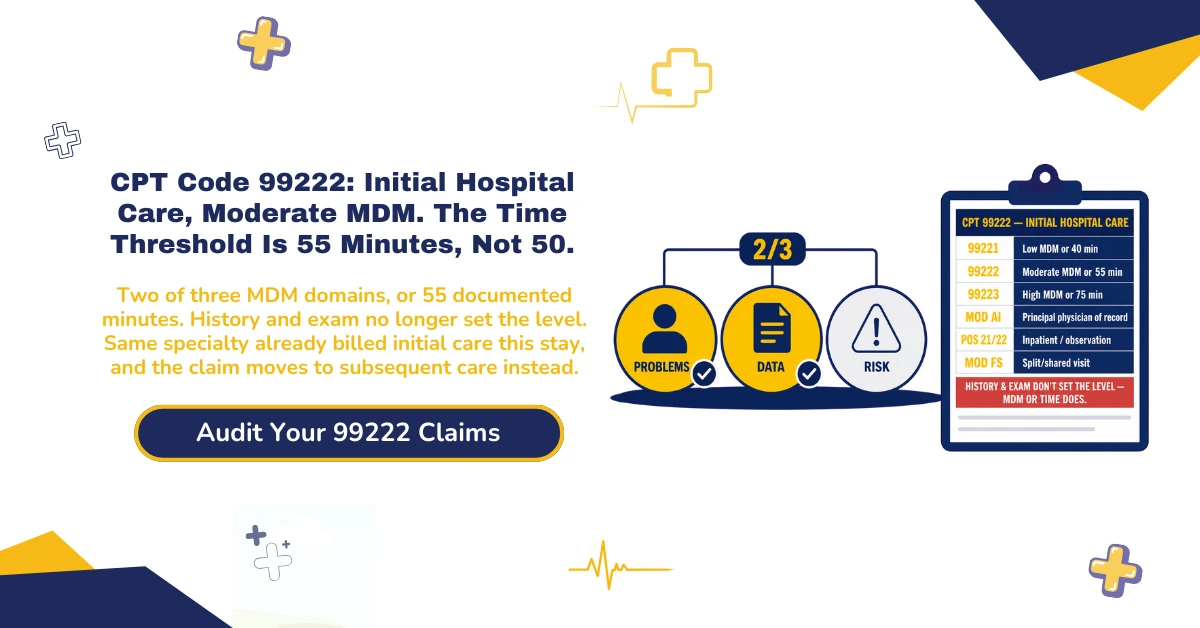
The 99222 CPT code reports initial hospital inpatient or observation care, billed once per day, for a patient who needs moderate medical decision making. Time can set the level instead: the encounter then needs at least 55 minutes of qualifying time on the date of service. A medically appropriate history and exam belong in the note, but neither one decides the code.
CPT code 99222 sits in the middle of the initial hospital care family, between 99221 and 99223. Most billing mistakes on CPT 99222 trace back to old habits: coders still checking for 50 minutes instead of 55, or scoring a history and exam that no longer count toward the level.
Mixing up inpatient status with observation status causes the rest of the trouble. Fix those three habits and most 99222 denials disappear.
This guide walks through MDM, time, place of service, modifiers, split/shared billing, denials, and 2026 Medicare rates, in that order, so a coder or provider can find the exact rule they need without reading past it.
Explore hospital billing support at ClaimMax RCM.
CPT 99222 at a Glance
Use this table to confirm the basics before diving into MDM or time rules. It covers the code’s setting, patient status, and the adjacent codes coders confuse it with.
| Code | 99222 |
| Service family | Initial hospital inpatient or observation care |
| Patient status | New or established |
| MDM level | Moderate |
| Time threshold | 55 minutes, met or exceeded |
| History and exam | Medically appropriate; doesn’t set the level |
| Inpatient POS | 21 |
| Observation POS | 22 |
| Lower adjacent code | 99221 |
| Higher adjacent code | 99223 |
| Subsequent-care family | 99231 to 99233 |
| Medicare principal-physician modifier | AI, when applicable |
Two habits cause more downcoding than anything else on this code. First, drop the old 50-minute threshold. The current rule is 55 minutes. Second, stop selecting the level by counting history or exam elements. Neither one drives 99222 anymore.
Hospital coding only pays off when the documentation, the claim, and the payer’s setting rules all agree. A hospital revenue cycle management team that checks all three before submission catches mismatches a solo coder tends to miss.
What Is the 99222 CPT Code?
Current CPT 99222 Definition
CPT 99222 covers initial hospital inpatient or observation evaluation and management, reported once per day, for a new or established patient. Moderate medical decision making sets the level, or 55 total minutes does when time is the basis instead. A medically appropriate history and exam belong in the note, but neither one determines which code applies.
99222 is the middle option in the 99221 to 99223 family. Picture the three codes as a ladder: 99221 for straightforward or low-complexity admissions, 99222 for moderate ones, and 99223 for the highest-acuity visits.
The American Medical Association maintains the full code family and descriptor language. Coders should check the current AMA CPT E/M guidelines directly instead of relying on a paraphrase from any billing site, including this one.
What Changed Under the 2023 Hospital E/M Rules
The 2023 AMA revisions merged what used to be two separate code families. Before that year, observation care had its own initial-visit codes, separate from inpatient care. Now, 99221 through 99223 cover both settings.
A patient on observation status and a patient with a full inpatient admission can land on the same code, as long as the MDM or time supports it. Code selection runs on two paths now: medical decision making or total time.
History and exam are still clinically necessary, but they stopped counting toward the level years ago. Plenty of practices are still training new coders on the old scoring method.
History and Examination No Longer Determine the Level
This trips up experienced coders more than new ones, because it contradicts what they learned first. The table below lines up the old rule against the current one.
| 99222 requires 50 minutes | 55 minutes must be met or exceeded |
| Observation care uses a separate initial-visit code family | 99221 to 99223 cover both inpatient and observation care |
| A comprehensive history sets the code level | History must be medically appropriate; it doesn’t set the level |
| A comprehensive exam sets the code level | Exam must be medically appropriate; it doesn’t set the level |
| All three MDM elements must reach moderate | Two of three MDM elements must meet or exceed moderate |
If your coders still fill out a 14-point review of systems to “support” 99222, retire that habit. It won’t hurt the patient’s care, but it won’t move the code level either.
When Is CPT 99222 Appropriate?
Eligible Hospital Encounters
CPT 99222 fits when four things line up: the visit is the first qualifying inpatient or observation encounter of the stay, the provider performs a medically appropriate evaluation, moderate MDM is supported (or the visit hits 55 minutes), and the service isn’t a pure emergency department (ED), office, or subsequent hospital visit. Miss any one, and a different family applies.
Encounters that typically qualify include an initial inpatient hospital evaluation, an initial observation-status evaluation, and the first qualifying service a hospitalist or specialist provides during that stay, as long as payer rules and provider-role requirements are met. Medicare consultation policy adds another layer here; Section 10 covers that in full.
Initial Care Does Not Simply Mean the Admission Date
Coders sometimes assume “initial” means the calendar date of admission and nothing more. It doesn’t. Initial status depends on whether the patient already received a qualifying professional service during the same stay, from the same physician or from another physician or qualified healthcare professional of the same specialty and subspecialty in the same group. Section 9 walks through this rule in detail.
Encounters That Do Not Qualify
| Office visit | The office E/M family applies instead |
| Pure emergency department service | The ED code family applies instead |
| Later hospital day | The subsequent hospital care family may apply |
| Same-day admission and discharge, 8+ hours | 99234 to 99236 may apply |
| Critical care | Critical-care requirements and codes apply instead |
| Below moderate MDM and below 55 minutes | 99221 may be the correct level |
Use 99222 when all of these are true:
- The encounter is the first qualifying inpatient or observation service of the stay
- MDM reaches moderate, or total time reaches 55 minutes
- The setting is inpatient hospital or hospital observation, not office or ED
- The provider role and specialty rules for that payer are met
Hospitalist billing codes like this one drive a large share of a hospital’s professional revenue, so a wrong-family selection here rarely stays a small error. Hospitalist coding teams that check setting and sequence before checking MDM tend to see fewer denials downstream, because they catch the family mismatch before it becomes a documentation argument.
How Moderate MDM Supports CPT 99222
The Two-of-Three MDM Rule
CPT 99222 requires moderate MDM when the code is chosen by decision making rather than time. Moderate MDM is met when at least two of three elements reach or exceed the moderate level: problems addressed, data reviewed and analyzed, and risk of patient management. All three elements don’t need to reach moderate, only two.
The weakest of the three elements doesn’t automatically drag the level down, as long as the other two clearly qualify. The note has to show real clinical work behind each element a coder counts, not a label like “moderate complexity” sitting alone in the assessment. Medical necessity still has to support the visit, regardless of how the MDM elements shake out.
Number and Complexity of Problems Addressed
Moderate-level problem patterns include one or more chronic illnesses with exacerbation, progression, or treatment side effects; two or more stable chronic illnesses actively addressed at the visit; one undiagnosed new problem with an uncertain prognosis; one acute illness with systemic symptoms; or one acute, complicated injury.
A diagnosis sitting on the problem list doesn’t count on its own. The physician has to evaluate, assess, or manage that condition during the encounter for it to count toward the level. Comorbidities count when they change how the physician manages the visit, not when they’re mentioned in passing.
Amount and Complexity of Data Reviewed and Analyzed
| Combination of qualifying data items | Reviewing external notes, reviewing unique test results, ordering unique tests, or using an independent historian |
| Independent interpretation | Interpreting a test personally when that test isn’t separately reported and billed |
| External discussion | Discussing management or test results with an external physician, QHP, or other appropriate source |
An independent historian counts as one item within the combination-of-data pathway above, not as an automatic separate category on its own. Listing labs in the note doesn’t show analysis; the note needs to show how that data changed or confirmed the management plan. A test that’s already billed and interpreted separately can’t be counted again here.
Risk of Patient Management
Moderate-risk examples include prescription drug management, a minor surgery decision with identified risk factors, an elective major surgery decision without identified risk factors, or a diagnosis or treatment significantly limited by social determinants of health.
A medication list by itself doesn’t prove prescription drug management. The note needs to name the decision: starting a drug, adjusting a dose, continuing a regimen, discontinuing a medication, or monitoring for a specific effect. A serious-sounding diagnosis doesn’t automatically establish the risk element either; the risk comes from the management decision, not the diagnosis label.
What Does Not Establish Moderate MDM by Itself
None of the following carry a claim on their own: copied-forward diagnoses, a long note, a comprehensive review of systems, a multisystem exam, a medication list with no management decision attached, labs listed without analysis, the phrase “moderate complexity” with no supporting work behind it, or inpatient status alone.
| Problems | An active moderate-level problem pattern | The assessment names the condition’s status and how it’s being managed |
| Data | A qualifying moderate data pathway | Tests, records, historian, interpretation, or discussion, documented specifically |
| Risk | A moderate patient-management decision | A medication, surgery, or SDOH limitation named directly |
When a claim gets reduced to 99221, the record usually does contain moderate-level work. It doesn’t show a second qualifying element clearly enough for a reviewer to count it. That’s a documentation gap, not a clinical one.
ClaimMax RCM reviews hospital E/M notes against the current MDM rules before a claim goes out the door, through the medical billing services built for hospitalist and specialty groups.
CPT 99222 Time Requirement: The 55-Minute Rule
What Time Counts Toward CPT 99222?
When CPT 99222 is selected by time, the visit needs at least 55 minutes of qualifying physician or qualified healthcare professional time on the date of the encounter. The threshold is 55 minutes, not 50, and not a range. Total time on the date of service can include face-to-face work and eligible non-face-to-face work performed by the billing provider.
| Preparing to see the patient | Clinical staff time |
| Reviewing relevant records and tests | Work performed on a different date |
| Obtaining or reviewing separately obtained history | Travel time |
| Performing the evaluation and exam | Time for a separately reported service |
| Counseling the patient or caregiver | Duplicated split/shared time |
| Ordering medications, tests, or procedures | General administrative work |
| Communicating with other professionals, when not separately reported | Unrelated activities |
| Documenting the encounter | Automatically populated EHR time |
| Care coordination, when not separately reported | Time the record can’t support |
How to Document Time
A defensible time entry states the exact total minutes, the date of service, a brief description of the qualifying activities, and the identity of the reporting professional, with no double counting of separately billed work.
A workable example reads: “Total qualifying time on the date of service was 61 minutes, including record review, patient evaluation, family counseling, order entry, care coordination, and documentation.” Skip the old “more than half the visit was counseling” language. That standard doesn’t apply to the current time rules.
When Time Should Not Be Used
Don’t select the level by time when the total falls below 55 minutes, when the time is estimated rather than tracked, when the work happened across different calendar dates, when separately reported service time got folded in, when staff time is included, or when the record can’t back up the total.
The CMS E/M Services Guide lays out the current federal guidance on time-based selection and confirms that history and exam still don’t factor into the level.
CPT 99221 vs 99222 vs 99223
Initial Hospital Care Comparison Table
99221 covers straightforward or low MDM, or 40 minutes. 99222 covers moderate MDM, or 55 minutes. 99223 covers high MDM, or 75 minutes. None of the three gets chosen by diagnosis count, admission status, note length, or how sick the patient looks on paper; the choice comes down to documented MDM or documented time.
| 99221 | Straightforward or low | 40 minutes | Overdocumented for the actual complexity |
| 99222 | Moderate | 55 minutes | Second MDM element implied but not written down |
| 99223 | High | 75 minutes | High MDM asserted without two domains shown in the note |
When 99222 Is Downcoded to 99221
A 99222 claim tends to get reduced when only one MDM element reaches moderate, when the second element is implied but never documented, when prescription management isn’t described as a decision, when data review is listed but not counted correctly, or when total time falls under 55 minutes or can’t be supported.
When 99223 Is More Appropriate
99223 needs high MDM or 75 minutes, not a longer problem list. A patient with five stable chronic conditions and no acute change usually stays at 99222. A patient with one condition threatening organ function usually reaches 99223.
For a full breakdown of high-MDM documentation and the 75-minute pathway, ClaimMax’s CPT 99223 billing guide covers that code in the same depth this guide covers 99222.
Is CPT 99222 Inpatient or Observation?
POS 21 for Inpatient Hospital Care
CPT 99222 can report either initial inpatient hospital care or initial hospital observation care. Observation is an outpatient status, but it isn’t an office visit; it’s still hospital-based care. Professional claims typically use POS 21 for inpatient hospital care.
POS 22 for Hospital Observation Care
Observation care under 99222 typically uses POS 22, for on-campus outpatient hospital services. The code descriptor and the MDM or time requirements stay identical between the two settings; only the POS code and the underlying facility status change.
| Inpatient hospital | 21 | Yes, when requirements are met |
| On-campus hospital observation | 22 | Yes, when requirements are met |
| Emergency department only | 23 | Use the ED family, unless the visit leads to admission |
| Office | 11 | No |
| Other outpatient clinic | Setting-specific | Not the standard use of 99222 |
Why POS 23 and POS 11 Do Not Represent the Standard Use
POS 23 belongs to a pure emergency department encounter, not to 99222, unless that ED visit converts into an admission or observation stay under the rules Section 13 covers. POS 11 is the office setting and doesn’t apply to this code family.
Confirm the current CMS Place of Service code set before submitting a claim with an unfamiliar POS.
Initial vs Subsequent Care for CPT 99222
Same Specialty, Same Subspecialty, and Same Group
“Initial” covers more than the admission date. A coder has to check whether the patient already received a professional service during the same stay from the same physician, or from another physician or qualified healthcare professional of the same specialty and subspecialty in the same group.
A second note from that group doesn’t automatically create a second initial visit. It usually moves to subsequent care instead.
Observation-to-Inpatient Conversion Does Not Create a New Stay
Converting a patient from observation to inpatient status doesn’t start a new stay for coding purposes. A later qualifying service after that conversion isn’t automatically a second initial code. If the next qualifying visit happens on a later date, the subsequent hospital care family applies, even though the patient’s status and POS code changed partway through.
When to Use 99231 to 99233 Instead
Once a later date brings another qualifying service from the same physician or group, the subsequent hospital care codes, 99231 through 99233, take over from the initial family.
A quick decision sequence settles most of these cases: Was this the first hospital service of the stay? Has the same specialty and group already billed for this stay? Did observation convert to inpatient without a gap? Is the service on a later date?
Each answer points toward the initial or the subsequent family. The Medicare Claims Processing Manual sets out the federal detail behind each one.
Who Can Bill CPT 99222?
Physicians and Qualified Healthcare Professionals
Physicians and qualified healthcare professionals can report initial hospital inpatient or observation care when the service meets the code descriptor, the payer’s rules, scope-of-practice limits, and documentation standards. Under Medicare fee-for-service, the principal physician of record gets identified with modifier AI. Other specialists can report qualifying initial hospital care without AI when Medicare’s requirements are met.
Eligible providers include physicians, nurse practitioners, physician assistants, and clinical nurse specialists where state and payer rules allow it. Billing eligibility depends on licensure, scope of practice, payer enrollment, supervision requirements, and whether the visit was performed independently or jointly with another provider.
Principal Physician of Record
Medicare identifies one MD or DO as the principal physician of record for a given stay, and that physician appends modifier AI to the initial hospital care code. AI marks responsibility for the patient’s overall hospital care; it doesn’t block another physician from performing a separate, medically necessary initial evaluation.
Physicians who aren’t the principal physician of record don’t append AI, even when their own visit qualifies for 99222 on its own.
Other Specialists During the Same Stay
A different-specialty physician can provide a medically necessary initial evaluation during the same stay without conflicting with the principal physician’s claim. Same-specialty, same-subspecialty, and same-group rules still apply, and a second claim from that exact combination usually needs to move to the subsequent hospital care family instead of billing another initial visit.
CPT Consultation Codes vs Medicare Billing
| Principal physician of record (Medicare) | Yes | Appends modifier AI |
| Other qualifying physician, different specialty (Medicare) | Yes | No AI, unless that physician becomes the principal physician of record |
| Physician billing a CPT consultation code (Medicare FFS) | No | Medicare doesn’t pay CPT consultation codes; bill the correct hospital care level instead |
| Physician billing a CPT consultation code (some commercial payers) | Possibly | Check the specific payer’s policy before billing |
CPT still maintains inpatient and observation consultation codes, and some commercial payers recognize them. Medicare fee-for-service does not pay consultation codes; for Medicare, the practitioner reports the correct initial or subsequent hospital care code when the requirements are met.
That distinction answers the recurring question of how 99252 compares to 99222: 99252 is a CPT consultation code, while 99222 is the initial hospital care code Medicare expects in its place.
Does CPT 99222 Need a Modifier?
No, a modifier is not automatically required on every 99222 claim. A modifier gets appended only when the provider’s role, a same-day procedure, a postoperative context, or a specific payer’s policy calls for extra information. Common examples: AI for the Medicare principal physician, 25 for a separately identifiable E/M service, and 57 for a decision involving major surgery.
| AI | Principal physician of record | Medicare initial hospital claim | Principal role and overall care responsibility |
| 25 | Significant, separately identifiable E/M | Same day as another service or minor procedure | Work beyond the normal pre- and post-service care for that procedure |
| 57 | Decision for major surgery | Day of, or day before, an applicable major surgery | The E/M produced the decision for surgery |
| 24 | Unrelated postoperative E/M | Inside a global period, for an unrelated condition | Clear clinical separation from the surgery |
| FS | Split/shared facility E/M | Physician and NPP jointly perform a qualifying visit | Substantive portion and participant documentation, covered in the next section |
Modifier AI
Modifier AI is Medicare-specific, and only the principal physician of record appends it. It doesn’t raise the MDM level, and it doesn’t fix an initial visit the documentation can’t otherwise support. Other qualifying physicians on the same stay don’t use it.
Modifier 25
The E/M service billed with modifier 25 has to be significant and separately identifiable from whatever procedure shares the claim. The diagnosis doesn’t need to differ from the procedure’s diagnosis, but the note has to show work beyond the usual pre- and post-procedure evaluation. Don’t attach 25 automatically because a procedure happens to appear on the same claim.
Modifier 57
Modifier 57 applies to the decision for major surgery, and it isn’t interchangeable with modifier 25. The note has to show that the E/M service itself produced the decision to operate, not that a procedure happened to occur around the same time.
Modifier 24
Modifier 24 covers an E/M service that’s unrelated to the procedure behind a global period. The unrelated problem and its management need to be clear in the note; care that’s related to routine postoperative recovery stays bundled into the surgical package.
Modifiers That Should Not Be Used as Shortcuts
Modifier 59 isn’t the standard way to force payment on a separately identifiable E/M service, and no modifier overrides a payer edit when the documentation doesn’t meet that modifier’s actual definition. Modifier 27 concerns institutional outpatient reporting for multiple encounters and isn’t the professional modifier this code family needs.
Split/Shared and Teaching Physician Rules
Medicare Split/Shared Facility Visits
CPT 99222 can be reported as a qualifying Medicare split/shared facility E/M visit when a physician and a nonphysician practitioner from the same group jointly perform the service, and the billing practitioner performs the substantive portion. Medicare identifies this claim with modifier FS.
Teaching physician claims follow a separate set of presence, participation, and documentation rules, covered later in this section.
A split/shared visit requires a facility setting, a physician and NPP from the same group practice, and joint participation in the same encounter on the same date. The service can’t be split across two unrelated groups, and it bills under whichever practitioner performed the substantive portion.
Determining the Substantive Portion
Under current CMS policy, the substantive portion means more than half of the total time spent by the physician or NPP on the visit, or the substantive part of the medical decision making. Either pathway works; the group doesn’t have to pick one in advance.
When MDM is the pathway, the billing practitioner has to have made or approved the management plan for the problems addressed and taken on responsibility for the associated risk, not only co-signed the note. The record should show who performed which piece of the work, and how the substantive portion was met.
Modifier FS and Documentation
Modifier FS identifies the split/shared service to Medicare. It’s a reporting flag, not a documentation substitute, and it shouldn’t get appended to a visit that doesn’t meet the split/shared definition. The record has to name both practitioners, and the billing practitioner has to sign and date it.
Teaching Physician and Resident Services
Teaching settings add resident participation, teaching physician presence, and a documented attestation to the mix. Modifier GC generally applies when a resident performs part of the service under a teaching physician’s direct supervision.
This isn’t a full resident-billing guide. Check your MAC and payer-specific academic billing rules for the complete picture. The CMS split/shared E/M guidance covers the substantive-portion standard and modifier FS in full detail.
Same-Day Hospital Billing Rules for CPT 99222
Same-day reporting depends on two things: the calendar date and how long the stay lasted. For Medicare, a same-day stay of less than eight hours generally uses the appropriate initial hospital or observation code alone. A same-day stay of at least eight hours but less than 24 generally moves to 99234 through 99236 instead.
| Admitted and discharged same date, under 8 hours | Report the appropriate 99221 to 99223 code only |
| Admitted and discharged same date, 8 to under 24 hours | Report 99234 to 99236 |
| Admission and discharge on different dates | Initial code, subsequent care as needed, and a discharge code on the discharge date |
| Observation converts to inpatient | One continuous stay, not a second initial encounter |
| Pure ED service, no admission or observation | Use the ED E/M family |
| ED service followed by admission or observation | Same-date payer rules and separate-service rules both apply |
Can 99222 and 99238 Be Billed Together?
Don’t report 99238 or 99239 alongside an initial hospital inpatient or observation code when admission and discharge both happen on the same calendar date. The correct family depends on how many hours the stay lasted, not on which codes happen to be in the system.
ED Service Followed by Admission or Observation
A pure ED encounter stays in the ED family. Payer rules decide whether that ED work folds into the admission or gets reported separately, once the same practitioner provides ED care and then admits the patient or places them in observation. Any separate E/M has to be significant, separately identifiable, and documented that way. Don’t bill both services by default.
Prolonged Hospital Care
Prolonged initial hospital or observation care attaches to the highest initial code level, 99223, not to 99222. Medicare reports this with HCPCS G0316, and the encounter has to already meet 99223’s time threshold before any prolonged time counts. There’s no prolonged-service add-on that pairs with 99222 itself.
CPT 99222 Documentation Requirements
CPT 99222 documentation has to support either moderate MDM or at least 55 minutes of qualifying time. The record should identify the problems addressed, the data reviewed and analyzed, the patient-management risk, an assessment and plan, the date of service, and the reporting practitioner’s signature. A detailed or comprehensive history and exam aren’t level-selection requirements.
MDM-Based Documentation
The note should show which conditions were addressed, their status or change since the last assessment, the physician’s clinical reasoning, and any unique tests ordered or reviewed. Add external notes reviewed, an independent historian if one was used, an independent interpretation if one occurred, and any external professional discussion tied to the visit.
Management decisions belong here too: prescription drug changes, surgery decisions, and any social determinants of health that limited care, along with an assessment and plan that matches the level billed.
Time-Based Documentation
A time-based note needs the exact total qualifying minutes, the date of the encounter, the qualifying activities performed, and the name of the reporting physician or QHP. Exclude staff time, exclude separately reported service time, and note the split/shared allocation when more than one practitioner was involved. A counseling-majority statement isn’t required under current rules.
Provider Identity, Signature, and Date
The record needs a signature, credentials, a date, and a teaching physician attestation where one applies. Split/shared claims should clearly identify both the physician and the NPP. Late signature additions shouldn’t alter the original clinical content, and payer-specific authentication rules still apply on top of these baseline requirements.
Audit-Ready Documentation Checklist
- Correct initial or subsequent status confirmed
- Correct inpatient or observation setting confirmed
- Moderate MDM or the 55-minute threshold clearly met
- Problems addressed, named specifically
- Data counted correctly, with no double counting
- Management risk documented as a decision, not a diagnosis
- Assessment and plan consistent with the billed level
- Provider role and modifier support confirmed
- POS validated against the actual setting
- Signature and date present
- Medical necessity supported throughout
When the clinical work supports moderate MDM but the note doesn’t make the second qualifying element visible, the claim can get reduced before it’s ever paid. A pre-bill hospital E/M review catches that gap while there’s still time to fix it.
Example of Documentation That Supports Moderate MDM
A hospitalist admits a patient with an acute illness carrying systemic symptoms, reviews outside records along with new labs, and starts a prescription drug regimen with a specific monitoring plan. The note names the problem’s status, describes what the data review changed about the plan, and states the medication decision directly.
Two moderate MDM elements are clearly identifiable here, which supports 99222. Treat this as an educational example, not an automatic diagnosis-to-code mapping. The clinical picture always drives the level.
Common CPT 99222 Denials and Downcoding Reasons
The most common CPT 99222 claim problems involve unsupported moderate MDM, an incorrect initial-code selection, missing qualifying time, duplicate same-specialty billing, modifier errors, POS conflicts, and improper same-day combinations. A useful denial review identifies the failed rule, locates the supporting evidence, and fixes the underlying workflow before resubmission or appeal.
| Reduced to 99221 | Only one moderate MDM element is visible in the note | Lower payment | Confirm whether a second element was performed, then document it |
| Level not supported | Diagnosis looks serious, but the work isn’t documented | Downcoding or a record request | Reconstruct problems, data, and risk from the actual note |
| Initial code conflict | Same-specialty group already billed initial care for this stay | Duplicate denial | Review specialty, subspecialty, group, and prior service history |
| Time unsupported | No exact qualifying total in the record | MDM review or denial | Remove the unsupported time basis, or submit valid documentation |
| Modifier AI conflict | Wrong physician identified as principal | Claim edit | Confirm the actual principal physician of record |
| Modifier 25 or 57 unsupported | Separate work or the surgery decision isn’t clear | Bundling | Appeal only when the original documentation meets the modifier’s definition |
| POS mismatch | Professional claim conflicts with the patient’s actual setting | Rejection or denial | Reconcile status and POS before resubmitting |
| Same-day code conflict | Initial and discharge families combined incorrectly | Denial or overpayment | Apply the calendar-date and stay-duration rules from Section 13 |
How to Correct or Appeal the Claim
Identify the payer’s exact reason or edit first. Determine whether the claim itself is wrong or underdocumented, then review the code family, level, POS, and modifiers against what happened at the visit.
Match the documentation to the applicable MDM or time rule, and correct any clerical data. Appeal only when the original record supports the service. Don’t alter the medical record after the fact to manufacture support that wasn’t there; track the root cause instead, so the same error doesn’t repeat on the next claim.
Repeated reductions on hospital E/M claims usually point to one recurring documentation, provider-role, or payer-edit problem. ClaimMax RCM’s denial management services trace that pattern back to its source and support the correction from the original record forward.
CPT 99222 RVUs and Medicare Reimbursement in 2026
Medicare may reimburse the 99222 CPT code when the service is medically necessary and the documentation supports moderate MDM or at least 55 minutes, along with Medicare’s other billing rules. The code carries a physician work RVU value, but work RVU isn’t the same figure as total RVU or final payment.
Actual reimbursement varies by locality and by other fee-schedule factors.
Work RVU vs Total RVU
Work RVU reflects the physician’s time, technical skill, and intensity on the visit. CMS has held the 99222 work RVU at approximately 2.60 for several years running, including into 2026.
Work RVU is only one input into total RVU, which also includes practice expense and malpractice components. Check the current CMS PFS files for the exact total RVU your locality applies.
How Medicare Calculates Payment
Medicare payment runs on a formula: the adjusted work RVU, plus the adjusted practice expense RVU, plus the adjusted malpractice RVU, multiplied by the conversion factor and any other relevant adjustment. Geographic Practice Cost Indices, facility setting, locality, conversion factor, and qualifying APM participant status all feed into that calculation.
| Work RVU | Physician time, skill, and intensity | Rarely changes year to year for this code |
| Practice expense RVU | Overhead tied to delivering the service | Shifts with facility versus non-facility setting |
| Malpractice RVU | Liability cost of the service | Adjusts with national malpractice trends |
| Conversion factor | Dollar value applied to total RVU | Set annually by CMS and by statute |
| GPCI | Local cost-of-living adjustment | Varies by Medicare locality |
Why the Allowed Amount Varies
For 2026, CMS finalized two separate conversion factors for the first time: $33.57 for qualifying APM participants and $33.40 for everyone else. Multiplying either figure by the work RVU alone doesn’t produce the final payment; practice expense, malpractice, and geographic adjustments all apply on top of it.
Medicare vs Commercial Payer Reimbursement
Commercial rates run on individual contracts, Medicare Advantage plans carry their own operational edits, and Medicaid policy varies by state. None of these reliably tracks as a fixed percentage of the Medicare rate, so don’t assume a commercial payer pays a set multiple of what Medicare allows for this code.
How to Identify Underpayments
Compare the expected allowed amount against the actual remittance, validate the payer contract and fee schedule, and recheck modifiers and POS on any claim that looks light.
Watch for a pattern of systematic downcoding rather than judging each claim in isolation; a single claim can be an error, but a pattern is a workflow problem. Confirm current locality-specific rates with the CMS Physician Fee Schedule Look-Up Tool before assuming a payment is wrong.
Code selection, payment posting, denial analysis, and AR follow-up all have to be evaluated together when a payer consistently allows less than expected. ClaimMax’s revenue cycle management services connect those payment variances back to their actual source instead of treating each one as a one-off.
What Changed for CPT 99222 in 2026?
The 2026 official Medicare materials don’t show a new descriptor-level change to this code. The framework still reflects the hospital E/M revisions the AMA introduced in 2023. The relevant 2026 developments involve Medicare payment updates, split/shared implementation details, and payer-specific operational policy, not a rewrite of the code itself.
Core Code Requirements Remain Stable
| 2023 | Inpatient and observation families merged; MDM or time became the level-selection basis |
| 2024 | Medicare’s split/shared substantive-portion framework updated to the current time-or-MDM standard |
| 2025 | HCPCS G0545 introduced as an infectious-disease-specific add-on to the hospital E/M family |
| 2026 | New dual Medicare conversion factors take effect; the underlying hospital E/M structure continues |
Surrounding Medicare Policies to Monitor
G0545 deserves a specific note: it’s an add-on code for infectious disease specialists only, reported alongside 99221 through 99223 or the subsequent-care family, and it doesn’t change how the base code itself gets selected. Most practices billing this code won’t ever touch G0545, but infectious disease groups should know it exists.
Annual Review Requirements
Recheck the current AMA CPT codebook, CMS E/M educational materials, the Medicare Physician Fee Schedule, NCCI guidance, your MAC’s local coverage decisions, and relevant commercial payer policies at least once a year. The 2026 Medicare Physician Fee Schedule final rule is the authoritative source for the current conversion factors and payment updates.
Frequently Asked Questions
Is CPT 99222 for new or established patients?
Either one. New-versus-established status doesn’t determine which family applies. The key question is whether this is the first qualifying inpatient or observation encounter for that provider relationship during the current stay.
Does a specific diagnosis automatically support 99222?
No. A diagnosis supports medical necessity, but the code level comes from MDM or time. The condition has to be actively addressed at the visit; a diagnosis sitting on a problem list doesn’t establish moderate MDM by itself.
Can a nurse practitioner or physician assistant report 99222?
Potentially, depending on state scope-of-practice rules, payer enrollment, and whether the visit is billed independently or as a split/shared service. Coverage isn’t universal across every payer, so confirm the specific plan’s rules before billing under an NP or PA.
Can multiple physicians bill an initial hospital care code?
Potentially, under Medicare, when each service is medically necessary and specialty or group requirements are met. Only the principal physician of record uses modifier AI. Same-specialty and same-group rules still need review before a second initial claim goes out.
What is the difference between 99252 and 99222?
99252 is a CPT inpatient or observation consultation code. Medicare fee-for-service doesn’t pay consultation codes, so Medicare practitioners use the appropriate initial or subsequent hospital care code instead, once the documentation supports it.
Can prolonged services be added to 99222?
Generally, no. Prolonged initial hospital or observation care attaches to 99223, the highest initial code level, not to the middle level. Medicare reports prolonged time with HCPCS G0316, and that code doesn’t pair with a 99222 base visit.
Does modifier 27 apply to a professional 99222 claim?
No. Modifier 27 is tied to institutional outpatient reporting for multiple outpatient E/M encounters on the same date. It isn’t the modifier that establishes separate physician E/M work on a professional claim.
Does documentation guarantee payment?
No. Documentation has to support the code, but payment also depends on coverage, medical necessity, payer enrollment, POS accuracy, modifiers, bundling edits, and contract terms. Strong documentation removes one obstacle; it doesn’t remove all of them.
Improve Hospital E/M Billing Accuracy With ClaimMax RCM
Getting 99222 right comes down to a chain: the right initial-care classification, moderate MDM or 55 minutes clearly documented, the correct provider role and modifier, accurate POS, a clean same-day determination, and a claim that goes out the door ready to be paid the first time.
Most practices lose revenue somewhere in that chain. The clinical care is rarely the problem; one link in the documentation or billing workflow usually is. ClaimMax RCM works hospital E/M coding, provider documentation, modifier use, and payer edits for hospitalist groups, orthopedic practices, and any specialty that bills initial hospital inpatient or observation care.
Medical billing runs at 3.49% of collections, with eligibility verification and prior authorization support included at no extra charge, alongside a free coding audit before you commit to anything.
For practices building out a hospital-based provider roster, credentialing and payer enrollment start at $120, handled by the same team that already knows your specialty and your payer mix. That combination is affordable, specialty-aware billing built to keep 99222 and every other hospital E/M code collecting what the documentation earns.
Request a hospital billing review to see where your own claims are leaking revenue, or ask about credentialing timelines for your next hire.