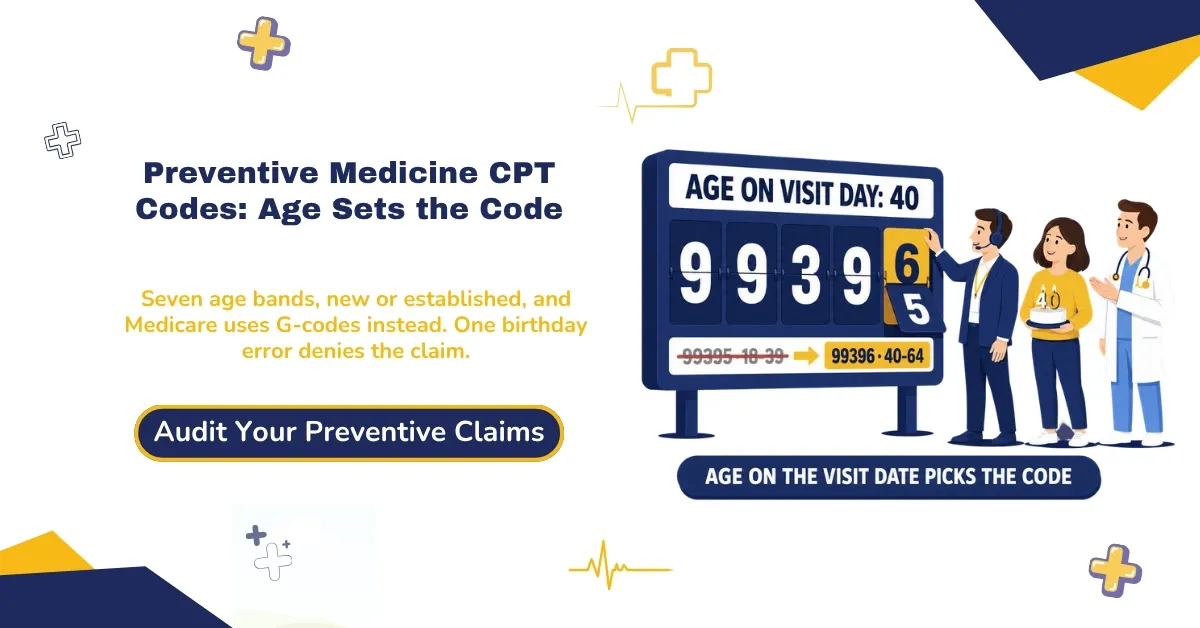
A patient comes in for her annual physical three days after her 40th birthday. The front desk scheduled the visit a month earlier, the encounter still says 99395, and the claim comes back denied for an age mismatch. Fixing it takes one digit, and the denial still costs a rework cycle and a resubmission.
Preventive medicine CPT codes (99381 to 99429) report routine wellness visits and risk-reduction counseling for patients with no active complaint. You select the visit code by the patient’s age on the date of service and by new or established status. Original Medicare uses HCPCS G-codes for wellness care instead.
We wrote this guide for coders, billers, and practice managers who handle commercial, Medicare, and Medicaid preventive claims. The team at ClaimMax RCM built it from CMS manuals, AMA and AAP guidance, and payer policy, and we’ll keep it current through the 2027 code year.
| Key takeawaysNew patients use 99381 to 99387 and established patients use 99391 to 99397, across seven age bands.Age on the date of service sets the code. A patient seen by the same specialty in your group within three years is established.Original Medicare excludes routine physicals, so Medicare wellness care bills as G0402, G0438, or G0439 instead of preventive medicine CPT codes.Modifier 25 goes on the problem-oriented E/M (such as 99213) billed with the preventive visit, unless the second service is a procedure.For 2027, the CPT 2027 code set takes effect January 1, 2027, and the Medicare fee schedule proposal would convert G2211 to a modifier and lower the conversion factor. |
What Are Preventive Medicine CPT Codes?
Preventive medicine CPT codes are evaluation and management codes for care aimed at keeping a patient healthy. They cover the annual physical or well-child exam (99381 to 99397), risk-reduction counseling (99401 to 99404, 99411, and 99412), behavior change intervention (99406 to 99409), and one unlisted code, 99429. The AMA maintains all of them.
| Code family | Codes | What it reports |
|---|---|---|
| Preventive E/M visits | 99381 to 99387 (new), 99391 to 99397 (established) | Comprehensive, age and gender appropriate history, exam, counseling, and ordering of screenings |
| Risk-reduction counseling | 99401 to 99404 (individual), 99411 to 99412 (group) | Counseling for patients without a specific illness tied to the counseling, billed by time |
| Behavior change and unlisted | 99406 to 99409, 99429 | Tobacco cessation (99406, 99407), alcohol or substance screening and brief intervention (99408, 99409), unlisted preventive service (99429) |
Preventive visit codes don’t use medical decision making or total time the way office codes 99202 to 99215 do. You choose them by age band and patient status alone. A 30-minute physical and a 60-minute physical for the same 52-year-old established patient both bill as 99396.
Original Medicare draws a firm line here. Federal law excludes routine physical exams from Part B, so Medicare wellness care runs on HCPCS Level II codes: G0402 for the Welcome to Medicare visit, and G0438 and G0439 for the initial and subsequent annual wellness visits. Our comparison of HCPCS vs CPT codes explains how the two code systems split the work.
CMS MLN Matters MM13548 tells providers not to bill 99381 to 99397 for those Medicare wellness services. You’ll also see this family called preventative CPT codes, preventive care codes, or preventive visit codes, and each name points to the same AMA code set.
Preventive Medicine CPT Codes by Age: New and Established Patient Tables
Preventive visit codes follow seven age bands, and each band has a new patient code and an established patient code. Infants under 1 year use 99381 or 99391. Adults 65 and older use 99387 or 99397. The table below lists all seven bands.
Preventive visit CPT codes by age, valid for 2026 dates of service
| Age on date of service | Age group | New patient | Established patient |
|---|---|---|---|
| Under 1 year | Infant | 99381 | 99391 |
| 1 to 4 years | Early childhood | 99382 | 99392 |
| 5 to 11 years | Late childhood | 99383 | 99393 |
| 12 to 17 years | Adolescent | 99384 | 99394 |
| 18 to 39 years | Adult | 99385 | 99395 |
| 40 to 64 years | Adult | 99386 | 99396 |
| 65 years and older | Adult | 99387 | 99397 |
How Age Limits Work on Preventive Codes
The patient’s age on the date of service decides the code. Scheduling dates and claim dates don’t count. A patient who is 39 on the visit date bills 99395, and the same patient seen on or after the 40th birthday bills 99396. The 99385 age limit ends the day before the 40th birthday.
Birthday weeks are the usual trap. A practice books an annual physical a month ahead while the patient is still in the lower band, then nobody updates the code after the birthday passes. The payer’s age edit catches it, and the remittance shows CARC 6, procedure inconsistent with the patient’s age.
Where Each Age Band Usually Breaks
Three birthdays deserve a scheduling flag. Turning 5 moves a child from 99382 or 99392 to 99383 or 99393. At 18, an adolescent moves to the adult codes 99385 or 99395, and most payers expect adult Z codes from that point. Turning 65 moves the patient to 99387 or 99397, and anyone on Original Medicare loses routine physical coverage.
New vs Established Patient: The Three-Year Rule for Preventive Visits
A patient is established if they received any professional service from the same physician, or from another physician of the exact same specialty and subspecialty in the same group practice, within the past three years. A patient outside that window takes the new patient codes 99381 to 99387.
CMS sets out the rule in the Medicare Claims Processing Manual, Chapter 12 (section 30.6.7), and the CPT definition that commercial payers follow uses the same three-year test. Three situations come up often on preventive claims:
- A sick visit counts. A patient seen 18 months ago for a sinus infection is established, so the physical bills in the 99391 to 99397 range.
- CPT limits professional services to face-to-face services for this purpose. Reading a patient’s EKG without seeing them doesn’t make that patient established.
- A different specialty in the same group can bill a new patient code, though payers that enroll every provider under one specialty may deny it.
When Both Visits Are New-Patient Codes
A new patient who needs a problem visit on the same day as the physical can receive two new patient codes: 99381 to 99387 for the preventive service and 99202 to 99205 for the problem, with modifier 25 on the problem code.
CPT Assistant supported this pairing in October 2006. Some payer edits still flag two new patient codes on one date, so check the plan’s policy first.
A three-year lookback at check-in catches most status errors before the visit. It’s one of the front-end checks built into small practice medical billing at ClaimMax RCM, alongside age and coverage checks.
How to Choose the Right Preventive Visit CPT Code in 3 Steps
To choose a preventive visit CPT code, confirm the patient’s age on the date of service, check new or established status under the three-year rule, and match the code to the payer. Commercial plans take 99381 to 99397, and Original Medicare takes G-codes.
- Calculate age on the date of service. Count from the date of birth to the visit date, then pick the band from the age table.
- Check patient status. Search three years of history for any face-to-face service by the same specialty and subspecialty in your group.
- Match the payer. Commercial and ACA plans use preventive medicine CPT codes 99381 to 99397. Original Medicare uses G0402, G0438, or G0439. Medicare Advantage follows the plan’s policy. Medicaid follows the state manual, with EPSDT rules for patients under 21.
A 47-year-old on a commercial PPO books an annual physical, and she saw a physician in the same group two years ago for bronchitis. Age 47 falls in the 40 to 64 band, the bronchitis visit makes her established, and her PPO covers routine physicals. The CPT code for her annual physical is 99396.
Search for the CPT code for a physical exam and you’ll often see one code quoted. The family holds 14 visit codes, and the three checks above narrow them to one.
Payer rules change by plan year, so the check belongs before the visit. Run insurance eligibility verification at scheduling to confirm active coverage and plan type. Then follow our benefit verification steps to confirm the preventive benefit, its frequency limit, and which labs carry no cost share.
What Each Preventive Code Covers: 99381 to 99397 Explained
Each pair of preventive medicine CPT codes shares one service description and differs only by patient status. The age bands below cover who each pair fits, what the visit usually includes, and the billing problem specific to that pair.
CPT 99381 and 99391: Infants Under 1 Year
CPT 99381 is the new patient preventive visit for an infant under 1 year, and the 99391 CPT code is the established patient version. Both cover the well-baby exam, growth and development review, feeding guidance, and anticipatory guidance.
Pair them with Z00.110 for a newborn under 8 days, Z00.111 for 8 to 28 days, and Z00.129 or Z00.121 after 28 days. A nurse-only weight check isn’t a preventive visit and shouldn’t carry 99391.
CPT 99382 and 99392: Ages 1 to 4
CPT 99382 (new) and 99392 (established) cover early childhood preventive visits from the first birthday through age 4. Visit timing follows the Bright Futures periodicity schedule, with well visits at 12, 15, 18, 24, and 30 months, then yearly at ages 3 and 4.
Developmental and autism screening instruments bill separately with 96110. The 99392 age limit ends at the fifth birthday, when the code becomes 99393.
CPT 99383 and 99393: Ages 5 to 11
CPT 99383 and 99393 report late childhood preventive visits for ages 5 through 11. Vision screening (99173) and hearing screening (92551) bill separately when performed and documented. Plans often exclude a standalone sports physical from the preventive benefit, so confirm coverage before the visit or complete the form during the annual well-child exam.
CPT 99384 and 99394: Ages 12 to 17
CPT 99384 and 99394 cover adolescent preventive visits from age 12 through 17. These visits typically include confidential time with the patient, and depression screening with a standardized instrument bills separately with 96127. An explanation of benefits can expose confidential services to a parent, so set up confidential billing workflows where state law allows.
CPT 99385 and 99395: Ages 18 to 39
CPT 99385 is the new patient preventive visit for adults 18 to 39, and 99395 is the established patient code. A well-woman visit in this band bills with these codes. If the provider performs and documents a pelvic exam, commercial payers that recognize the 99459 pelvic exam add-on pay it with the preventive code.
Pair the visit with Z00.00 or Z00.01, or with Z01.419 or Z01.411 for a gynecological exam.
CPT 99386 and 99396: Ages 40 to 64
CPT 99396 is a preventive medicine visit for an established patient aged 40 to 64, and 99386 is its new patient counterpart. Commercial and ACA-compliant plans usually cover CPT 99396 with no cost share when it’s paired with Z00.00 or Z00.01.
Screening mammograms ordered at this visit follow the USPSTF biennial recommendation for women 40 to 74. Patients under 65 who have Medicare through disability get annual wellness visit G-codes instead.
CPT 99387 and 99397: Age 65 and Older
The 99397 CPT code is the established patient preventive visit for patients 65 and older, and 99387 covers new patients in that band. Commercial plans and some Medicare Advantage plans pay for these visits.
Original Medicare doesn’t, so a beneficiary’s routine physical bills as an annual wellness visit or becomes patient responsibility. Definitive Healthcare’s analysis of 2023 all-payer claims put 99397 at 36.2% of preventive visit claims, so the Medicare boundary affects a large share of this revenue.
What’s Included in a Preventive Visit and What You Bill Separately
A visit billed with preventive medicine CPT codes includes the age and gender appropriate history, exam, counseling, anticipatory guidance, and ordering of labs and immunizations. Vaccines, vaccine administration, lab tests, screening instruments, and some procedures bill separately with their own codes when performed at the same visit.
Bundled Into 99381 to 99397
- A comprehensive history and exam. In preventive codes, comprehensive means age and gender appropriate, and the 1995 and 1997 exam guidelines don’t apply.
- Counseling, anticipatory guidance, and risk factor reduction discussed during the visit.
- Ordering of labs, imaging, and immunizations. The tests and vaccines themselves bill separately.
- Breast exam, pelvic exam, and Pap specimen collection done as part of the exam, except where 99459 or Medicare’s Q0091 and G0101 apply.
- Minor problems and stable chronic conditions that need no significant extra work.
Separately Reportable Services That Often Go Unbilled
| Code | Service | Billing note |
|---|---|---|
| 90460, +90461 | Immunization administration with counseling by a physician or QHP, through age 18 | 90460 for the first component of each vaccine, +90461 for each additional component |
| 90471 to 90474 | Immunization administration when 90460 criteria aren’t met | Injection (90471, +90472) or oral and intranasal (90473, +90474) |
| Vaccine product codes | The vaccine itself | Report with each administration code; VFC stock follows state VFC billing rules |
| 36415 | Venipuncture | Bill when the practice draws blood in the office |
| 96110 | Developmental screening with a standardized instrument | Per instrument |
| 96127 | Brief emotional or behavioral assessment, such as depression screening | Per instrument |
| 99173 | Visual acuity screening, quantitative, bilateral | Bill when performed and documented |
| 92551 | Screening test, pure tone, air only | Bill when performed and documented |
| 99188 | Topical fluoride varnish by a physician or QHP | Check the plan’s age limits |
| 99459 | Pelvic exam add-on | Payer acceptance varies |
| 90482 to 90484 | Standalone immunization counseling | Only when no vaccine is given that date |
Practices lose this revenue when the provider documents the service and nobody posts the charge. Medicare women’s exams carry the same gap, since Q0091 covers screening Pap specimen collection and G0101 covers the pelvic and breast exam. Our guide to the Pap smear CPT code shows which code each payer expects.
For pediatric visits, the AAP Bright Futures periodicity schedule lists the screenings due at each age. Billers can use it as a charge capture checklist, matching each screening on the schedule to a code on the claim.
If your charge report shows preventive visits with no screening or vaccine lines attached, the gap is worth a closer look. ClaimMax RCM reviews charge capture as part of billing for small practices, and preventive visits are a practical place to start that review.
Preventive Counseling CPT Codes: 99401 to 99429 and the New 90482 to 90484
Beyond the visit codes, preventive medicine CPT codes include 99401 to 99404 for individual risk-reduction counseling in 15-minute steps and 99411 to 99412 for group counseling. Tobacco cessation uses 99406 and 99407, alcohol and substance screening with brief intervention uses 99408 and 99409, and 99429 is unlisted.
| Code | Service | Time |
|---|---|---|
| 99401 | Individual preventive counseling and risk factor reduction | About 15 minutes |
| 99402 | Individual preventive counseling and risk factor reduction | About 30 minutes |
| 99403 | Individual preventive counseling and risk factor reduction | About 45 minutes |
| 99404 | Individual preventive counseling and risk factor reduction | About 60 minutes |
| 99411 | Group preventive counseling | About 30 minutes |
| 99412 | Group preventive counseling | About 60 minutes |
| 99406 | Smoking and tobacco cessation counseling, intermediate | More than 3 minutes up to 10 minutes |
| 99407 | Smoking and tobacco cessation counseling, intensive | More than 10 minutes |
| 99408 | Alcohol or substance structured screening and brief intervention | 15 to 30 minutes |
| 99409 | Alcohol or substance structured screening and brief intervention | More than 30 minutes |
| 99429 | Unlisted preventive medicine service | Not time-based |
Some online summaries group 99408 and 99409 with tobacco counseling. Both codes cover alcohol and drug screening with brief intervention, and Medicare uses G0396 and G0397 for that service. Our guide to smoking cessation codes 99406 and 99407 covers rates, modifiers, and denial fixes for tobacco counseling.
When 99401 Can and Can’t Be Billed
The 99401 CPT code reports about 15 minutes of risk-reduction counseling for a patient without a specific illness tied to that counseling. Counseling given during a preventive visit is already part of 99381 to 99397.
A same-day 99401 needs separate, significant counseling with its own documented time, and some payers bundle it anyway. Counseling about a diagnosed condition belongs in a problem-oriented E/M code.
99429: When to Use the Unlisted Preventive Code
CPT code 99429 is the unlisted preventive medicine service code. Use it only when no other preventive code describes the service, and send the visit note with the claim. Unlisted codes have no fixed value, so payers price them by report, and you should expect a manual review and slower payment.
New for 2026: Immunization Counseling Codes 90482 to 90484
CPT 2026 added time-based codes for immunization counseling when no vaccine is given that day: 90482 for 3 up to 10 minutes, 90483 for more than 10 up to 20 minutes, and 90484 for more than 20 minutes. Report one code per date of service based on total counseling time across all vaccines discussed.
If a preventive or problem visit happens on the same date, append modifier 25 to the E/M if it’s significant and separately identifiable from the counseling.
Medicare assigned these codes status indicator I for 2026, so they aren’t payable under the fee schedule, and Blue Cross Blue Shield of Massachusetts directs providers to 99401 to 99404 instead. Read the AAP immunization counseling guidance and your payer’s policy before you bill them.
Billing a Preventive Visit and a Problem Visit Same Day: Modifier 25 and Modifier 33
You can bill a preventive visit and a problem-oriented E/M on the same day when the problem needs significant, separately identifiable work beyond the preventive service. Report the E/M code for the preventive visit and the problem E/M, append modifier 25 to the problem E/M, and point the problem diagnosis to that line.
Sick visit CPT codes 99202 to 99215 and preventive medicine CPT codes can share one claim this way, as long as the note supports both services.
Where Modifier 25 Goes
Modifier 25 goes on the problem E/M, such as 99213 or 99214, when it’s billed with 99381 to 99397. The exception is a same-day minor procedure: if the provider removes a skin tag during the physical, modifier 25 goes on the preventive E/M, since the procedure is the second service.
A 52-year-old established patient comes in for an annual physical and mentions three days of cough and fever. The physician examines her, diagnoses acute bronchitis, and prescribes treatment.
The claim shows 99396 with Z00.01 and 99213-25 with J20.9 pointed to 99213. Level the problem visit on the work for bronchitis alone, using the CPT 99213 decision guide if the level is unclear. The problem visit can carry the patient’s normal copay or deductible, so tell her before checkout.
Documentation That Survives Review
Keep the problem portion of the note distinct, with its own history of present illness, assessment, and plan. A stable chronic condition refilled during the physical rarely supports a separate code. A new complaint worked up with an exam, test orders, or a prescription usually does.
Modifier 25 has a long history as an OIG review target, so private practice billing teams should sample these claims every quarter.
What Modifier 33 Means and When to Use It
Modifier 33 tells a commercial payer that a service is preventive under the Affordable Care Act, so the patient owes no cost share. It applies to services with a USPSTF A or B rating, ACIP-recommended immunizations, HRSA-supported women’s preventive services, and Bright Futures pediatric services.
Skip modifier 33 on codes that are preventive by definition, such as screening mammography (77067). Most payers treat 99381 to 99397 the same way and don’t require the modifier on them. Medicare uses modifier PT when a screening colonoscopy turns diagnostic, such as when the physician removes a polyp, so the Part B deductible doesn’t apply.
The AMA preventive services coding guides list the codes and modifiers for each USPSTF recommendation. A wrong modifier 33 decision either bills the patient for a covered service or invites a payer recoupment. Practices without a certified coder on staff can hand this review to a medical coding and billing team that checks modifiers before submission.
Preventive Visit CPT Codes for Medicare, Medicare Advantage, and Medicaid
Original Medicare doesn’t pay for routine physicals, so Medicare wellness visits bill with G0402 (the Welcome to Medicare visit, within 12 months of Part B enrollment), G0438 (the initial annual wellness visit), and G0439 (subsequent annual wellness visits). Our page on annual wellness visit codes covers the requirements for each one.
Searches for a Welcome to Medicare CPT code land on G0402, which is a HCPCS code. The CMS Medicare Preventive Services chart lists every covered preventive service with its codes, frequency, and patient cost share. Medicaid and Medicare Advantage follow their own rules, which the table below compares with the preventive medicine CPT codes commercial plans use.
| Payer | Preventive visit codes | What to check |
|---|---|---|
| Original Medicare | G0402, G0438, G0439 | 99381 to 99397 are excluded by statute; bill any non-covered physical with GY |
| Medicare Advantage | AWV G-codes; some plans cover 99381 to 99397 as a supplemental benefit | The plan’s provider manual and supplemental benefits |
| Medicaid, age 21 and older | Set by state policy, often 99385 to 99397 | State manual frequency rules |
| Medicaid, under 21 | 99381 to 99395 under EPSDT; some states require modifier EP | State EPSDT periodicity schedule and claim format |
| Commercial and ACA plans | 99381 to 99397 | Frequency: per plan year, calendar year, or 365 days |
When a Medicare Patient Wants a Full Physical
A Medicare patient can still receive a head-to-toe physical, though Original Medicare won’t pay for the parts outside the AWV. Bill G0438 or G0439 for the covered portion and the preventive code for the non-covered portion with modifier GY, which marks a statutorily excluded service. Our G0439 billing rules page covers its modifiers and denial fixes.
You don’t need an ABN for a statutory exclusion. A voluntary notice, billed with modifier GX, documents that you told the patient about the cost. Have that conversation before the exam starts.
Medicaid and EPSDT for Patients Under 21
Medicaid covers well-child care for enrollees under 21 through EPSDT, which requires screenings on a state periodicity schedule plus the diagnosis and treatment those screenings find. The Medicaid.gov EPSDT benefit page sets the federal baseline. Some states add a required modifier such as EP, and our Medicaid billing guide covers Medicaid claim rules in more depth.
Medicare Advantage plans vary the most here, and a plan-level check is the dependable way to know whether a routine physical is covered. ClaimMax RCM runs eligibility checks before visits so your front desk knows which code set applies before the patient arrives.
ICD-10 Codes for Preventive Visits: Pairing Z Codes With 99381 to 99397
Preventive medicine CPT codes pair with ICD-10-CM Z codes. Adults use Z00.00 (without abnormal findings) or Z00.01 (with abnormal findings). Children past 28 days use Z00.129 or Z00.121, and newborns use Z00.110 under 8 days or Z00.111 from 8 to 28 days. Gynecological exams use Z01.419 or Z01.411.
| Patient or encounter | Without abnormal findings | With abnormal findings |
|---|---|---|
| Adult, generally 18 and older | Z00.00 | Z00.01 |
| Child, over 28 days through 17 | Z00.129 | Z00.121 |
| Newborn under 8 days | Z00.110 | Single code |
| Newborn 8 to 28 days | Z00.111 | Single code |
| Gynecological exam | Z01.419 | Z01.411 |
| Immunization given | Z23 (add as a secondary code) | Z23 |
Two pairing errors show up often. Coders attach Z00.00 to a pediatric visit code, which fails payer age edits, or list a problem diagnosis first on the preventive line, which can move the visit out of the no-cost preventive benefit. The ICD-10 code for an annual physical in an adult is Z00.00 or Z00.01.
A routine exam that finds a new problem takes the abnormal findings code plus a code for the finding, per the guidelines. Pre-existing and chronic conditions can go on as additional codes, provided the exam isn’t focused on that condition. These codes remain valid under the FY 2027 ICD-10-CM guidelines, effective October 1, 2026, through September 30, 2027.
In 2026 pediatric preventive coding, pair Z00.129 or Z00.121 with 99381 to 99384 or 99391 to 99394 for children past 28 days, and add Z23 when the patient receives vaccines.
Which Labs Are $0 at a Preventive Visit (and Why 85025 Usually Isn’t)
Labs are $0 at a preventive visit only when they match an ACA preventive recommendation and the patient meets its criteria, such as HIV screening for ages 15 to 65 or hepatitis C screening for adults 18 to 79. A CBC (85025), CMP (80053), and TSH (84443) usually fall outside that list and carry cost sharing.
| Usually $0 when criteria are met | Usually subject to cost sharing |
|---|---|
| HIV screening, ages 15 to 65 (USPSTF A), with Z11.4 | Complete blood count, 85025 |
| Hepatitis C screening, adults 18 to 79 (USPSTF B), with Z11.59 | Comprehensive metabolic panel, 80053 |
| Prediabetes and type 2 diabetes screening, adults 35 to 70 with overweight or obesity (USPSTF B), such as A1c 83036 with Z13.1 | Thyroid stimulating hormone, 84443 |
| Lipid panel 80061, when the plan covers lipid screening as preventive | Lipid panel 80061, when the plan treats it as diagnostic |
One payer’s policy shows the pattern: Moda Health lists 80053, 84443, and 85025 outside its 100% preventive benefit. A CBC has no USPSTF A or B recommendation for routine adult screening, so most plans process 85025 as diagnostic. Our page on CBC code 85025 covers its NCCI edits and the 85027 mix-up.
CPT 80061 counts as preventive under some plans and diagnostic under others. The USPSTF recommends statins for adults 40 to 75 with risk factors and a 10-year cardiovascular risk of 10% or higher, and plans read that recommendation in different ways. For diabetes screening, our A1c CPT code 83036 guide covers when 83037 applies instead.
The diagnosis code for preventive lab work matters as much as the test code. Order each screening with its screening Z code, and tell patients before the draw which labs may hit their deductible. Use preventive benefit checks to confirm the plan’s lab list, and keep the USPSTF A and B list at the front desk for quick reference.
Why Preventive Visit Claims Get Denied (CARC Codes and Fixes)
The common denials on preventive medicine CPT codes most often trace to five errors: a code that doesn’t match the patient’s age, the wrong patient status, a plan that excludes routine exams, a frequency limit already met, or a missing or misplaced modifier 25. Each error shows up as a specific CARC on the remittance.
| CARC | Meaning | Usual cause | Fix |
|---|---|---|---|
| 6 | Procedure inconsistent with the patient’s age | Wrong age band, such as a 40-year-old billed past the 99385 age limit | Recode to the band for age on the date of service |
| 7 | Procedure inconsistent with the patient’s gender | A gender-specific diagnosis or service that doesn’t match registration | Verify registration data and the code, then correct |
| 49 | Non-covered routine exam or screening | Plan excludes routine physicals, or the patient has Original Medicare | Bill AWV codes for Medicare; collect with advance notice otherwise |
| 119 | Benefit maximum for this period reached | Second physical within the plan’s frequency limit | Check the last preventive date before scheduling |
| B16 | New patient qualifications not met | New patient code within three years of a visit | Recode to 99391 to 99397 |
| 97 | Included in another service already adjudicated | Counseling or a minor service bundled into the preventive visit | Remove the line or document a distinct service |
| 4 | Procedure code inconsistent with the modifier used | Modifier 25 on the wrong line | Move modifier 25 to the problem E/M |
B16 can appear when the payer’s records show a visit your system doesn’t, such as a visit with a same-specialty provider who joined your group from another practice. Your preventive visit coding guidelines should cover that check at onboarding.
Calendar Year vs. 365 Days
Commercial plans define the frequency of a yearly physical exam in different ways. Some allow one per calendar year, so visits on December 15 and January 10 both pay. Others require 365 days or a full year between visits. Medicare pays G0439 once 11 full months have passed since the last AWV.
Track Denials by Pattern
Fixing one CARC 6 denial recovers one claim. Sorting a quarter’s denials by CARC, provider, and payer shows whether the cause is a scheduling habit, a template default, or a payer rule change. A cluster of B16 denials from one location points to a registration workflow problem.
If the same preventive denials keep returning after rework, the cause sits upstream of the billing team. ClaimMax RCM’s denial management services trace each pattern to its source and fix it at the front end.
Preventive Medicine CPT Codes in 2026 and What Changes in 2027
| Last reviewed: October 30, 2026In effect for 2026 dates of serviceImmunization counseling codes 90482 to 90484 took effect January 1, 2026.Medicare allows G2211 with a modifier 25 E/M when the same-day service is an AWV, a vaccine administration, or a Medicare Part B preventive service.The FY 2027 ICD-10-CM code set and guidelines took effect October 1, 2026, and run through September 30, 2027.Coming in 2027The AMA released the CPT 2027 code set on September 9, 2026, with 453 editorial changes: 299 new codes, 74 revisions, and 80 deletions, effective January 1, 2027. The AMA’s announced highlights don’t include changes to 99381 to 99429.The CY 2027 Medicare fee schedule proposal, released July 14, 2026, sets a proposed conversion factor of $33.17 for qualifying APM participants (down 1.19%) and $32.84 for everyone else (down 1.68%).CMS proposes converting G2211 to a modifier that raises the base E/M payment by 16%, or 32% for Shared Savings Program ACO and LEAD Model participants.For an office E/M and a 0, 10, or 90-day global procedure on the same day in the same practice, CMS proposes paying the highest-valued service at 100% and the others at 50%. |
Sources: the AMA CPT 2027 announcement and the CMS 2027 fee schedule proposal. CMS usually publishes the final fee schedule rule in early November. We update this guide when the final rule posts and again on January 1, 2027.
Preventive Medicine CPT Codes: Frequently Asked Questions
Is CPT code 99396 preventive?
Yes. CPT 99396 is a preventive medicine evaluation and management code for an established patient aged 40 to 64. It reports a periodic wellness exam with age and gender appropriate history, examination, counseling, and ordering of screenings, and it isn’t used for problem-focused care.
Commercial and ACA plans usually cover 99396 with no cost share when it’s paired with Z00.00 or Z00.01. Original Medicare doesn’t cover it, so Medicare patients receive an annual wellness visit, G0438 or G0439, instead.
What are the CPT codes for preventive services?
The core preventive medicine CPT codes are 99381 to 99387 for new patients and 99391 to 99397 for established patients, split into seven age bands. Counseling codes 99401 to 99412, behavior change codes 99406 to 99409, and unlisted code 99429 complete the family.
Screenings, vaccines, and labs tied to a preventive visit use their own codes, such as 77067 for screening mammography or 90471 for vaccine administration. Medicare uses HCPCS codes G0402, G0438, and G0439 for its wellness visits.
What is the CPT code for preventive medicine counseling?
Preventive medicine counseling uses 99401 to 99404 for individual sessions of about 15, 30, 45, and 60 minutes, and 99411 or 99412 for group sessions. These codes cover risk factor reduction for patients without a specific illness tied to the counseling.
Tobacco cessation counseling has its own codes, 99406 and 99407. Alcohol or substance screening with brief intervention uses 99408 and 99409. Standalone vaccine counseling with no vaccine given that day uses 90482 to 90484, starting with 2026 dates of service.
Is CPT code 85025 preventive care?
Usually not. CPT 85025, a complete blood count with automated differential, has no USPSTF A or B recommendation for routine adult screening. Most plans process it as a diagnostic lab subject to deductible and coinsurance, even when it’s drawn at an annual physical.
A few plans include a CBC in their own wellness benefit, so check the plan’s preventive lab list. If the patient may owe for the test, tell them before the draw to avoid a billing complaint later.
What is a patient preventive code?
A patient preventive code reports care meant to prevent illness or catch it early. In billing, it usually means a preventive medicine CPT code from 99381 to 99397, or an ICD-10-CM Z code such as Z00.00 that marks the encounter as a routine exam.
Payers read the pairing of a preventive CPT code and a routine exam Z code to apply the no-cost preventive benefit. A problem diagnosis listed first on the preventive line can send the claim to regular cost sharing.
Can you bill 99213 with 99396 on the same day?
Yes, when the problem needs significant, separately identifiable work beyond the preventive exam. Bill 99396 for the physical and 99213 with modifier 25 for the problem visit, link the problem diagnosis to 99213, and document the problem’s history, assessment, and plan as a distinct part of the note.
Level the problem visit by medical decision making or by time spent on the problem alone, leaving out preventive work. The problem visit may carry a copay or deductible, so tell the patient before checkout.
Can a preventive visit be done by telehealth?
Medicare pays for the annual wellness visit, G0438 and G0439, by telehealth, since both codes appear on the Medicare telehealth services list. Telehealth coverage of 99381 to 99397 depends on the commercial plan, and a full physical exam can’t be done over video.
Check the plan’s telehealth policy for place of service and modifier rules, such as POS 02 or 10 and modifier 95. If the plan doesn’t cover a telehealth physical, schedule the visit in person to avoid a denial.
Getting Preventive Visit Billing Right in 2026 and 2027
Clean preventive claims come from three checks made before the visit: age on the date of service, three-year patient status, and the payer’s coverage rules. Practices that run those checks at scheduling turn preventive medicine CPT codes into one of their most predictable revenue lines. Watch for the CY 2027 final rule in November and the CPT update on January 1.
If you’d like a second set of eyes on your preventive claims, ClaimMax RCM offers preventive billing for practices that want fewer denials and complete charge capture.
Sources
- CMS: MLN Matters MM13548, HCPCS billing codes and ABN requirements
- CMS: Medicare Claims Processing Manual, Chapter 12
- CMS: Medicare Preventive Services (MLN006559)
- CMS: CY 2027 Physician Fee Schedule proposed rule fact sheet
- Medicaid.gov: Early and Periodic Screening, Diagnostic, and Treatment
- CDC NCHS: ICD-10-CM Official Guidelines for Coding and Reporting FY 2027
- USPSTF: A and B Recommendations
- AMA: Preventive services coding guides
- AMA: AMA releases CPT 2027 code set
- AAP: Bright Futures
- AAP: Standalone immunization counseling
CPT is a registered trademark of the American Medical Association.