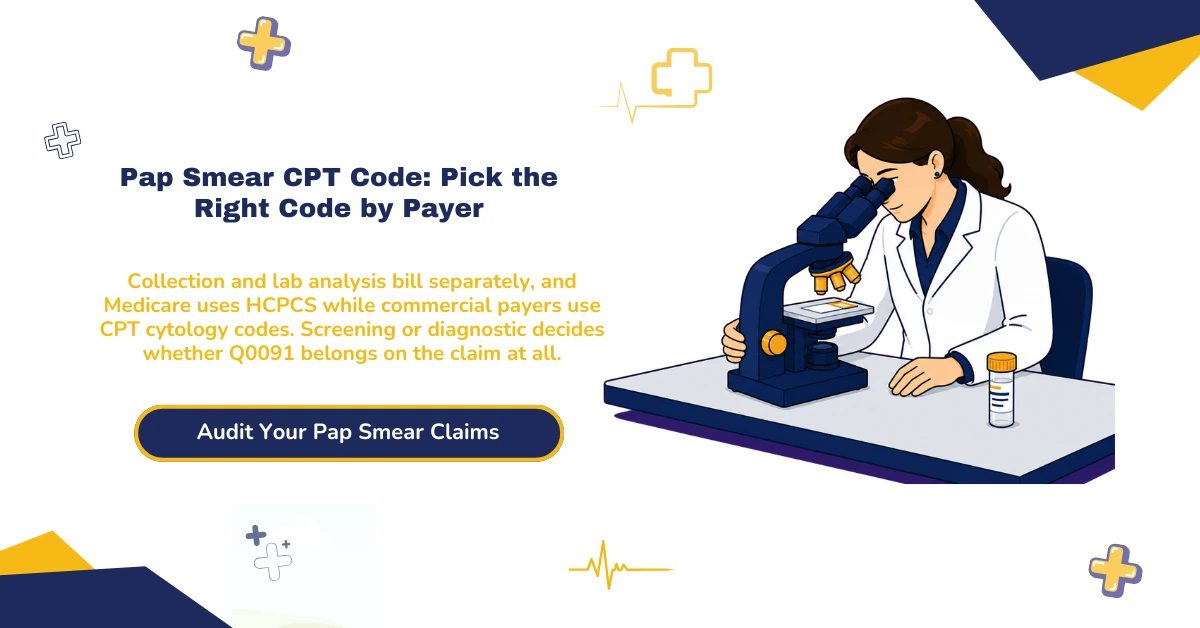
Bottom line: Billers lose money on Pap claims by hunting for one pap smear CPT code. There isn’t one. Two entities bill two claims, and the payer picks the code set.
- Collection and lab analysis bill separately, often under different tax IDs.
- Medicare screening: Q0091 for collection, G0101 for the exam, G-codes for the lab.
- Commercial: a preventive or problem E/M, plus Q0091 where the payer accepts it, with 88142 or 88175 on the lab claim.
- Diagnostic Pap carries no Q0091. Collection rolls into the E/M.
- Medicare HPV screening uses G0476, not 87624.
Pick the wrong pap smear CPT code and the claim denies on code-set mismatch, not medical necessity.
Start Here: Three Questions That Pick Your Code
Three questions settle almost every pap smear CPT code decision.
Who’s billing? The office collecting the specimen, or the lab reading the slide.
Which payer? Medicare runs on HCPCS. Commercial and Medicaid run on CPT cytology.
Screening or diagnostic? This one decides whether Q0091 belongs on the claim.
Question 3 causes most of the Pap denials that cross my desk.
Medicare screening uses G-codes and Q0091
Medicare screening runs on HCPCS Level II. No CPT cytology codes.
- Lab screening: G0123, G0143, G0144, G0145, G0147, G0148, P3000
- Physician interpretation: G0124, G0141, P3001
- Collection: Q0091
- Pelvic and clinical breast exam: G0101
- HPV screening with the Pap: G0476
Every code above comes from the CMS screening Pap booklet, and none appears in your CPT book. The HCPCS versus CPT code sets distinction decides this claim. For Medicare, the cpt code for pap smear in office is Q0091 plus G0101.
Medicare screening claims carrying 88142 or 88175 instead of the G-codes reject on code-set mismatch.
Commercial and Medicaid use CPT cytology codes
Commercial plans want the CPT side, so the cpt code for pap smear there is a lab code.
- Lab, liquid-based: 88142, 88143, 88174, 88175
- Lab, conventional: 88150 to 88155, 88164 to 88167
- Interpretation: 88141, an add-on
- Office: 99381 to 99397 preventive, or 99202 to 99215 problem
- Collection: Q0091 where the plan accepts it
Q0091 turns a cpt code for screening pap smear question into a payer question. Some plans pay it with a preventive visit. Others deny it as inherent.
Any medicaid pap smear cpt code answer depends on state fee schedules and frequency rules.
Diagnostic Paps carry no collection code
Symptoms, a prior abnormal result, or scheduled follow-up all mean the same thing. Collection bundles into the E/M.
Q0091 is a screening code. On a diagnostic claim it misrepresents the service, which makes it a compliance problem rather than an appealable denial.
Screening versus diagnostic is set by the ICD-10, not by the procedure code.
| Who bills | Medicare | Commercial | Medicaid |
|---|---|---|---|
| Office, collection | Q0091 + G0101 | 99381 to 99397 + Q0091 where accepted | Check state plan; many mirror Medicare |
| Lab, analysis | G0123, G0143 to G0148, P3000 | 88142, 88175, 88164 | Varies by state fee schedule |
Lab and Cytopathology Codes: 2026 Descriptor Table
Sixteen codes cover cervical and vaginal cytology. They differ on two variables: what prepared the slide, and what screened it. Descriptors follow the AMA CPT code set.
| Code | Descriptor | Method |
|---|---|---|
| 88141 | Cytopathology, cervical or vaginal (any reporting system); requiring interpretation by physician | Add-on, professional |
| 88142 | Cytopathology, cervical or vaginal (any reporting system), collected in preservative fluid, automated thin layer preparation; manual screening under physician supervision | Liquid-based, manual |
| 88143 | Cytopathology, cervical or vaginal (any reporting system), collected in preservative fluid, automated thin layer preparation; with manual screening and rescreening under physician supervision | Liquid-based, manual + rescreen |
| 88147 | Cytopathology smears, cervical or vaginal; screening by automated system under physician supervision | Smears, automated |
| 88148 | Cytopathology smears, cervical or vaginal; screening by automated system with manual rescreening under physician supervision | Smears, automated + rescreen |
| 88150 | Cytopathology, slides, cervical or vaginal; manual screening under physician supervision | Slides, manual |
| 88152 | Cytopathology, slides, cervical or vaginal; with manual screening and computer-assisted rescreening under physician supervision | Slides, computer rescreen |
| 88153 | Cytopathology, slides, cervical or vaginal; with manual screening and rescreening under physician supervision | Slides, manual rescreen |
| 88154 | Cytopathology, slides, cervical or vaginal; with manual screening and computer-assisted rescreening using cell selection and review under physician supervision | Slides, cell selection |
| 88155 | Cytopathology, slides, cervical or vaginal, definitive hormonal evaluation | Add-on, hormonal |
| 88164 | Cytopathology, slides, cervical or vaginal (the Bethesda System); manual screening under physician supervision | Bethesda, manual |
| 88165 | Cytopathology, slides, cervical or vaginal (the Bethesda System); with manual screening and rescreening under physician supervision | Bethesda, manual + rescreen |
| 88166 | Cytopathology, slides, cervical or vaginal (the Bethesda System); with manual screening and computer-assisted rescreening under physician supervision | Bethesda, computer rescreen |
| 88167 | Cytopathology, slides, cervical or vaginal (the Bethesda System); with manual screening and computer-assisted rescreening using cell selection and review under physician supervision | Bethesda, cell selection |
| 88174 | Cytopathology, cervical or vaginal (any reporting system), collected in preservative fluid, automated thin layer preparation; screening by automated system, under physician supervision | Liquid-based, automated |
| 88175 | Cytopathology, cervical or vaginal (any reporting system), collected in preservative fluid, automated thin layer preparation; with screening by automated system and manual rescreening or review, under physician supervision | Liquid-based, automated + rescreen |
Bill from the descriptor, not the lab’s shorthand. A requisition reading “ThinPrep with reflex” tells you nothing about which liquid-based code applies.
Labs running cytology alongside hematology should also check their peripheral blood smear codes, since 85007 and 85008 get miscoded into cytology claims.
Liquid-based: 88142, 88143, 88174, 88175
All four start with the same automated slide prep. They split on what happened next.
- 88142: manual screening
- 88143: manual screening plus manual rescreening
- 88174: automated screening, no manual rescreen
- 88175: automated screening plus manual rescreen or review
If a machine screened the slide, the code is 88174 or 88175. If a person screened it, the code is 88142 or 88143.
That line resolves the cpt code 88175 versus cpt code 88142 confusion behind most liquid-based denials, and the payer catches the reversal because the lab report names the screening method.
Conventional: 88150 to 88155, 88164 to 88167
Conventional codes split on reporting system rather than technique. Codes 88150 to 88155 use non-Bethesda reporting, 88164 to 88167 use the Bethesda System, and 88147 and 88148 cover smears rather than slides.
88150 and 88164 are the same manual screening service. The reporting system is the difference.
88141: interpretation only, no modifier 26 or TC
The cpt code 88141 line is an add-on. It never stands alone.
Bill cpt 88141 without split modifiers, since it represents a standalone professional interpretation. No modifier 26, no modifier TC. Apply it when physician interpretation supports a clinical diagnosis, not a routine quality-assurance reading.
88141 on a claim with no technical code attached denies as an orphaned add-on.
Provider-Side Codes: Q0091, G0101, and 99459
Three codes live on the office claim. Most practices haven’t loaded 99459, a missing line on every pelvic exam.
Q0091 covers screening collection only
Descriptor: screening Papanicolaou smear, obtaining, preparing, and conveyance of cervical or vaginal smear to laboratory.
Four rules generate the denials:
- Screening only. Never on a diagnostic Pap.
- HCPCS, not CPT. You won’t find cpt q0091 in your CPT book.
- Bundled the same day as G0101 or a preventive visit, unless a separately identifiable E/M was also performed.
- Put modifier 25 on that separate E/M line. Not on the collection line.
Q0091 pays for getting the specimen to the lab. It doesn’t pay for the exam and it doesn’t pay for reading the slide.
Those rules produce a steady stream of q0091 cpt code denials, and most are recoverable through bundling denial recovery.
G0101 needs the breast exam plus 7 elements
Descriptor: cervical or vaginal cancer screening; pelvic and clinical breast examination.
The g0101 cpt code fails audits on documentation. It requires the clinical breast exam plus 7 specified elements. Fewer than 7 leaves the service unsupported.
| G0101 documentation elements | Count |
|---|---|
| Breasts (clinical breast exam, required) | Required |
| Digital rectal examination | 1 of 7 |
| External genitalia | 1 of 7 |
| Urethral meatus | 1 of 7 |
| Urethra | 1 of 7 |
| Bladder | 1 of 7 |
| Vagina | 1 of 7 |
| Cervix | 1 of 7 |
| Uterus | 1 of 7 |
| Adnexa and parametria | 1 of 7 |
| Anus and perineum | 1 of 7 |
Billing it the same day as a CPT preventive visit reads as double billing. The preventive code already includes the age and gender appropriate exam.
There is no Medicare code for a breast exam alone.
99459 applies to preventive and problem visits
The cpt 99459 add-on covers the pelvic exam itself.
- Add-on to 99202 to 99205 and 99212 to 99215
- Add-on to consultation codes 99242 to 99245
- Add-on to preventive codes 99383 to 99387 and 99393 to 99397
Cpt code 99459 is a practice-expense code with no physician work RVUs assigned, covering staff time and the supply kit.
Pull your locality rate from the CMS physician fee schedule lookup. Published dollar figures go stale with every conversion factor update.
99459 is reportable on preventive visits and problem visits. It isn’t limited to diagnostic exams.
On 99459 documentation requirements: a chaperone isn’t required to report the code.
Scenario 1: Medicare Screening Pap and Pelvic Exam
| SCENARIO: Established Medicare patient. Asymptomatic. Annual well-woman visit. Pelvic exam, clinical breast exam, and screening Pap collected.THE FIX:1. Verify the frequency window before the visit.2. Bill G0101 for the pelvic and clinical breast exam.3. Bill Q0091 for the specimen collection.4. Pair with the correct risk-level ICD-10.5. Lab bills its screening G-code separately.TIME: 10 minutes to verify and build the claim. |
The frequency check in step 1 takes two minutes and prevents the most common denial on this claim. Low risk needs at least 23 months elapsed, high risk at least 11 months.
Run it at scheduling, where eligibility verification before visits catches the problem while you can still reschedule.
Step 4 is where these claims die. Low risk takes Z01.419 or Z12.4. High risk takes the appropriate Z72 or Z92 code.
The modifier 25 branch. Bill the E/M with modifier 25 and keep the collection line when the provider also handled a separate problem. Documentation has to show that E/M was significant and separately identifiable.
Cost sharing. Coinsurance, copayment, and the Part B deductible are waived when coverage conditions are met. Don’t collect at check-in on a covered screening.
| Line | Code | ICD-10 | Modifier |
|---|---|---|---|
| 1 | G0101 | Z01.419 | none |
| 2 | Q0091 | Z01.419 | none |
| 3, if separate problem | 99213 | problem dx | 25 |
Knowing how to bill a pap smear for medicare comes down to those five lines and the frequency check protecting them.
| Frequency edits stacking up on your Medicare preventive claims? ClaimMax RCM works these denials the same day they land. |
Scenario 2: Commercial Preventive Visit With a Pap
| SCENARIO: Commercial plan. Established patient, 45. Annual preventive visit. Pelvic exam performed, screening Pap collected.THE FIX:1. Bill the age-appropriate preventive code.2. Add 99459 for the pelvic exam.3. Check whether the plan pays Q0091 separately.4. Lab bills the CPT cytology code.TIME: 5 minutes, plus a one-time payer check. |
Step 1 takes 99396 for a 45-year-old established patient. Step 2 adds 99459, since the cpt 99459 add-on works on preventive visits, not only problem visits.
Step 3 is the payer split, and I’ll be straight about it: no universal rule exists. Some plans pay Q0091 alongside the preventive visit. Others treat collection as inherent and deny it.
Check once per payer and build the answer into your fee schedule setup. The UnitedHealthcare preventive care policy shows how one large payer handles collection and the age limits on cytology.
Don’t bill G0101 here. Same day as a CPT preventive visit, it reads as double billing.
Every does cpt 99396 include pap smear search wants the same answer, and it splits three ways: 99396 covers the visit and the exam, it doesn’t cover lab processing, and it may or may not cover specimen collection depending on the payer.
| Verify | Where | Why |
|---|---|---|
| Q0091 payable with preventive? | Preventive services policy | Determines line 2 |
| 99459 recognized? | Fee schedule | 2024 code, not all payers loaded it |
| Preventive frequency | Benefit summary | Calendar year versus rolling |
| Age limits on cytology | Preventive policy | Commonly 21 to 65 |
Scenario 3: Diagnostic Pap After an Abnormal Result
| SCENARIO: Patient returns after an ASC-US result. Repeat Pap ordered as follow-up. Pelvic exam performed.THE FIX:1. Bill the problem E/M by MDM or time.2. Add 99459 for the pelvic exam.3. Do not bill Q0091.4. Lead ICD-10 with the abnormality, not a screening code.TIME: 5 minutes. |
Step 1 selects the E/M by medical decision making or by total time on the date of the encounter. History and exam elements stopped driving E/M level in 2021, and teams working from older training still get this wrong.
Step 3 drops the collection code, because collection is part of the E/M on a diagnostic claim. Step 4 answers the abnormal pap smear icd 10 question. Lead with the reason for the visit. R87.610 covers ASC-US, and Z12.4 is wrong here.
The compliance angle. Billing screening collection on a diagnostic Pap does more than trigger a denial. It represents the service as preventive, which changes the benefit category and changes what the patient owes.
Cost sharing changes with intent. Screening often carries zero cost share. Diagnostic is subject to deductible and coinsurance. Tell the patient before the visit, not after the EOB lands.
The icd 10 code for abnormal pap smear does two jobs here. It supports medical necessity, and it tells the payer which benefit category to apply.
Scenario 4: Unsatisfactory Specimen, Patient Returns
| SCENARIO: Lab reports the screening Pap specimen was unsatisfactory. Patient returns for a recollection.THE FIX:1. Rebill Q0091 with modifier 76.2. Keep the original screening ICD-10.3. Do not bill a second E/M for the recollection visit.TIME: 3 minutes. |
Rebill Q0091 with modifier 76 when the lab can’t interpret the specimen and the patient returns.
Modifier 76 means repeat procedure by the same physician or qualified health care professional. Without it, the second collection line hits the frequency edit and denies as a duplicate.
The frequency question, answered. The recollection doesn’t consume a new frequency window. It completes the original screening, so the 23-month or 11-month clock still runs from the first collection date.
Scenario 5: Medicare HPV Co-Test
| SCENARIO: Medicare patient, age 52, asymptomatic. Screening Pap plus HPV co-test.THE FIX:1. Bill the screening Pap G-code.2. Bill G0476 for the HPV screening, not 87624.3. Lead ICD-10 with Z11.51.4. Add Z01.411 or Z01.419 as secondary.5. Confirm 59 months since the last HPV screen.TIME: 5 minutes. |
Medicare screening HPV uses G0476. CPT 87624 is incorrect for the Medicare screening benefit.
The dual-diagnosis rule. Two codes are required. Z11.51 primary, plus Z01.411 or Z01.419 secondary. One alone denies.
Coverage window. Asymptomatic patients aged 30 to 65, once every 5 years, performed with a screening Pap. The edit threshold is 59 months.
Where 87624 does apply. Commercial payers. The 87624 cpt code covers high-risk pooled testing, 87625 reports types 16 and 18, and cpt 87626 reports high-risk types with separate 16 and 18 reporting.
A medically unlikely edit on 87623, 87624, and 87625 for the same date of service limits units, so multiples on one date reject.
| Payer | HPV code | Primary dx | Secondary dx |
|---|---|---|---|
| Medicare | G0476 | Z11.51 | Z01.411 or Z01.419 |
| Commercial | 87624, 87625, or 87626 | Z11.51 | per plan policy |
The g0476 cpt code description is the Medicare answer to any cpt code for pap smear with hpv question, and the CMS cervical cancer screening billing article states it directly.
Medicare Frequency Edits: 23, 11, and 59 Months
Every source states Pap frequency in years. CMS states it in months, and the month thresholds fire the edit. A claim submitted at month 23 pays. A biller working from “every 24 months” holds it another month for nothing.
| Service | Risk level | Edit threshold | Common phrasing |
|---|---|---|---|
| Screening Pap and pelvic exam | Low risk | At least 23 months since last screening | Every 24 months |
| Screening Pap and pelvic exam | High risk | At least 11 months since last screening | Annually |
| HPV screening with Pap | Ages 30 to 65 | At least 59 months since last HPV screen | Every 5 years |
Rule 1. The clock runs from the date of the last covered screening, not the calendar year. A January patient and a December patient have different windows.
Rule 2. High risk requires a supporting diagnosis on the claim. Risk level isn’t assumed from the chart, so without the Z-code the claim holds to the 23-month window.
| Medicare high-risk factor | Detail |
|---|---|
| Early onset of sexual activity | Under age 16 |
| Multiple sexual partners | Five or more in a lifetime |
| History of sexually transmitted infection | Including HIV |
| Inadequate screening history | Fewer than three negative Pap tests, or none, in the previous 7 years |
| DES exposure | Daughter of a woman who took DES during pregnancy |
The childbearing-age pathway. A premenopausal patient of childbearing age also qualifies for annual coverage after a screening Pap or pelvic exam in the previous 3 years showed cervical or vaginal cancer or another abnormality.
The physician determines childbearing age from medical history or other findings. That pathway sits outside the five risk factors and answers how often will medicare pay for a pap smear in the cases billers get stuck on.
| Frequency denials hitting your preventive claims in batches? We clear aged AR backlog and rebill with the right risk-level diagnosis. |
ICD-10 Codes That Support the Claim
The procedure code tells the payer what you did. The pap smear cpt code pairing only works when the diagnosis supports it, and cervical cancer screening icd 10 selection is where most preventive claims fall apart.
Screening and low-risk codes
| Code | Descriptor | Use when |
|---|---|---|
| Z12.4 | Encounter for screening for malignant neoplasm of cervix | Cervical screening not part of a routine gyn exam |
| Z01.419 | Encounter for gynecological examination (general) (routine) without abnormal findings | Routine gyn exam, nothing abnormal |
| Z01.411 | Encounter for gynecological examination (general) (routine) with abnormal findings | Routine gyn exam, abnormality found |
| Z01.42 | Encounter for cervical smear to confirm findings of recent normal smear following initial abnormal smear | Confirmatory smear after abnormal then normal |
| Z11.51 | Encounter for screening for human papillomavirus (HPV) | HPV screening, primary code |
| Z12.72 | Encounter for screening for malignant neoplasm of vagina | Vaginal screening |
| Z12.79 | Encounter for screening for malignant neoplasm of other genitourinary organs | Other GU screening |
Z01.411 rule. Z01.411 requires a second code identifying the specific abnormality. Submitting it alone is a coding error and raises denial risk.
Z01.42 is the one nobody carries. It appears in payer policy and CMS-adjacent code sets, and billers substitute Z12.4 for it out of habit. Descriptors above follow the CDC ICD-10-CM code set.
Z01.419 covers the routine gyn exam encounter. Z12.4 covers cervical cancer screening specifically.
High-risk codes for the annual benefit
| Code | Descriptor |
|---|---|
| Z72.51 | High risk heterosexual behavior |
| Z72.52 | High risk homosexual behavior |
| Z72.53 | High risk bisexual behavior |
| Z77.29 | Contact with and (suspected) exposure to other hazardous substances |
| Z77.9 | Other contact with and (suspected) exposures hazardous to health |
| Z91.89 | Other specified personal risk factors, not elsewhere classified |
| Z92.850 | Personal history of Chimeric Antigen Receptor T-cell therapy |
| Z92.858 | Personal history of other cellular therapy |
| Z92.86 | Personal history of gene therapy |
| Z92.89 | Personal history of other medical treatment |
Most published high-risk lists stop at Z92.89. Z92.850, Z92.858, and Z92.86 sit on the current CMS list, and a screening pap icd 10 selection built from a stale list holds the claim to the 23-month window.
Diagnostic codes: R87.610 (ASC-US), R87.611 (ASC-H), R87.612 (LGSIL), R87.613 (HGSIL), R87.614 (cytologic evidence of malignancy), N87.0 (mild cervical dysplasia), N87.1 (moderate cervical dysplasia), Z85.41 (personal history of malignant neoplasm of cervix uteri).
What Changed for 2026
Pap CPT codes are unchanged. The pap smear cpt code 2026 set matches the pap smear cpt code 2025 set line for line across 88141 through 88175, so existing crosswalks still work.
Ages 30 to 65: primary hrHPV is now the default order. Clinician-collected primary high-risk HPV screening every 5 years is the preferred method for average-risk patients.
Cytology alone is the fallback, used when primary hrHPV or co-testing is unavailable or the patient chooses it after counseling. Current ACOG cervical cancer screening guidance carries the detail.
Check what was ordered before selecting the code. An hrHPV-only order produces no cytology code.
Ages 21 to 29 unchanged. Cytology alone every 3 years.
Self-collection is covered without cost sharing. The January 2026 HRSA women’s preventive services guidelines update requires most health plans to cover HPV self-collection and the additional testing done as part of the screening.
Note who collected the specimen and how. Payer coding policies for self-collected specimens vary and are still settling.
USPSTF status. The USPSTF cervical cancer screening final recommendation is still dated August 21, 2018, and the update has been in draft since December 10, 2024. Cite the 2018 final.
CLFS payment. Medicare pays the lab side under the Clinical Laboratory Fee Schedule, where the Part B deductible and coinsurance don’t apply.
Denial Triage: Fix It or Write It Off
Not every pap smear CPT code denial is worth an appeal. Sort them before you work them, which is the same triage our denial management services run on intake.
| Denial reason | Fixable? | The fix | Time |
|---|---|---|---|
| Q0091 denied as bundled with G0101 or preventive | Only if a separate E/M was performed and documented | Add modifier 25 to the E/M, rebill | 10 min |
| Frequency edit, too soon | Usually not | Verify the last screening date. If inside the window, write it off and reschedule | 5 min |
| Frequency edit, high risk not recognized | Yes | Add the supporting high-risk Z-code, rebill | 10 min |
| Z01.411 submitted without a second code | Yes | Add the abnormality code, rebill | 5 min |
| 87624 denied on a Medicare screening claim | Yes | Rebill with G0476, Z11.51 primary, Z01.411 or Z01.419 secondary | 10 min |
| Duplicate Q0091 after recollection | Yes | Rebill with modifier 76 | 5 min |
| 88141 denied as orphaned | Yes | Confirm the technical code is on the claim, rebill together | 10 min |
| Q0091 on a diagnostic Pap | No | Remove Q0091. Do not appeal. Correct the process | 5 min |
Escalation triggers. Four patterns mean the claim isn’t the problem:
- Frequency denials arriving in volume across multiple patients point at a broken front-end eligibility check.
- A payer consistently denying Q0091 with a preventive visit is stating policy. Stop appealing and get it in writing.
- Repeated bundling denials after correct modifier 25 use signal a payer edit needing provider relations escalation.
- Any denial citing a jurisdiction-specific LCD needs the actual LCD pulled first.
On LCDs. MAC local coverage determinations vary by jurisdiction and can add requirements beyond national policy. Pull yours from the Medicare Coverage Database before appealing, because coding to national policy alone generates denials where local rules add requirements.
Copy-Paste Templates
Four templates cover the situations that generate the most rework. Log every payer answer you get, with a reference number.
Template 1: Modifier 25 claim note
Use when a separately identifiable E/M is billed the same day as Q0091 or G0101.
| COPY-PASTE:Patient presented for screening cervical cancer services. A separate, significant evaluation and management service was performed for an unrelated problem documented in the encounter note. The E/M service is distinct from the screening pelvic exam and specimen collection. |
Template 2: Modifier 76 recollection note
Use when the lab reports an unsatisfactory specimen and the patient returns.
| COPY-PASTE:Original screening Papanicolaou specimen reported unsatisfactory by the laboratory. Specimen recollected on this date to complete the original screening service. Modifier 76 applied per repeat procedure guidance. |
Template 3: Payer call script for Q0091
Use once per commercial payer, then document the answer in your fee schedule setup.
| COPY-PASTE:I’m calling to confirm your policy on HCPCS Q0091, screening Pap smear collection, when billed on the same date as a preventive medicine visit in the 99381 to 99397 range. Do you reimburse Q0091 separately, or is specimen collection considered inherent to the preventive service? If separately payable, does it require a modifier? |
Template 4: Frequency appeal
Use when the payer applied the wrong risk category.
| COPY-PASTE:Claim denied for frequency. Patient meets high-risk criteria supported by the diagnosis submitted on this claim. The annual coverage interval applies rather than the 24-month interval. Prior covered screening date: [DATE]. Interval since prior screening: [MONTHS]. Requesting reprocessing. |
Pap Smear CPT Code FAQs
What is the diagnosis code for a Pap smear?
Z12.4 reports cervical cancer screening. Z01.419 reports a routine gynecological exam without abnormal findings, and Z01.411 reports one with abnormal findings plus a second code naming the abnormality. Z11.51 reports HPV screening. The R87.6 series reports diagnostic findings after an abnormal result.
What is the HCPCS code for a Pap smear?
Q0091 reports specimen collection and conveyance to the lab. G0101 reports the pelvic and clinical breast exam. Screening lab work uses G0123, G0143 through G0148, and P3000. Physician interpretation uses G0124, G0141, and P3001. HPV screening uses G0476. None of these codes appear in the CPT book.
Can I bill CPT codes 99396 and 99213 together?
Yes, when the problem service is significant and separately identifiable from the preventive visit. Append modifier 25 to the problem E/M, not to the preventive code. Many payers reduce payment on the problem E/M in this pairing, so check your contract before you expect full reimbursement on both lines.
What is the CPT code for pelvic exam without Pap smear?
99459 reports the pelvic exam as an add-on to an office, consultation, or preventive visit. For a Medicare screening pelvic and clinical breast exam performed without a Pap, G0101 applies instead. No standalone CPT code exists for a pelvic exam billed on its own.
What is the CPT code for a Pap smear with HPV testing?
For Medicare screening, G0476 applies and CPT 87624 does not. Medicare requires Z11.51 as the primary diagnosis with Z01.411 or Z01.419 secondary. Commercial payers use 87624 for high-risk pooled testing, 87625 for types 16 and 18, and 87626 for high-risk types with separate 16 and 18 reporting.
What is the description of CPT code 88141?
Cytopathology, cervical or vaginal (any reporting system); requiring interpretation by physician. It is an add-on reported alongside a technical cytology code, never on its own. Bill it without modifier 26 and without modifier TC, since the code already represents a standalone professional interpretation.
How often will Medicare pay for a Pap smear?
Every 24 months for average-risk patients, with the edit firing at 23 months elapsed. Annually for high-risk patients, with the edit firing at 11 months. HPV screening runs every 5 years for ages 30 to 65, with the edit firing at 59 months. The clock runs from the last covered screening date.
Is CPT 88175 a Pap smear?
Yes. 88175 reports liquid-based cervical or vaginal cytology using automated thin layer preparation, screening by automated system, and manual rescreening or review. When a person performed the screening rather than a machine, 88142 or 88143 applies instead of 88175. The screening method decides the code.
Does CPT 99396 include a Pap smear?
99396 covers the preventive visit and the age and gender appropriate exam for established patients aged 40 to 64. It does not cover lab processing of the specimen, which the lab bills separately. Medicare does not accept 99396 and uses G0101 with Q0091 instead.
What are the coding guidelines for pap smears?
Identify the biller, the payer, and the intent before selecting any pap smear CPT code. Medicare screening uses HCPCS. Commercial uses CPT cytology plus an E/M. A diagnostic Pap never carries a collection code. Frequency windows and diagnosis pairing drive the denials that follow.
| Preventive and lab claims sitting in AR while you sort out payer rules? talk to a specialist and we’ll work them with you. |