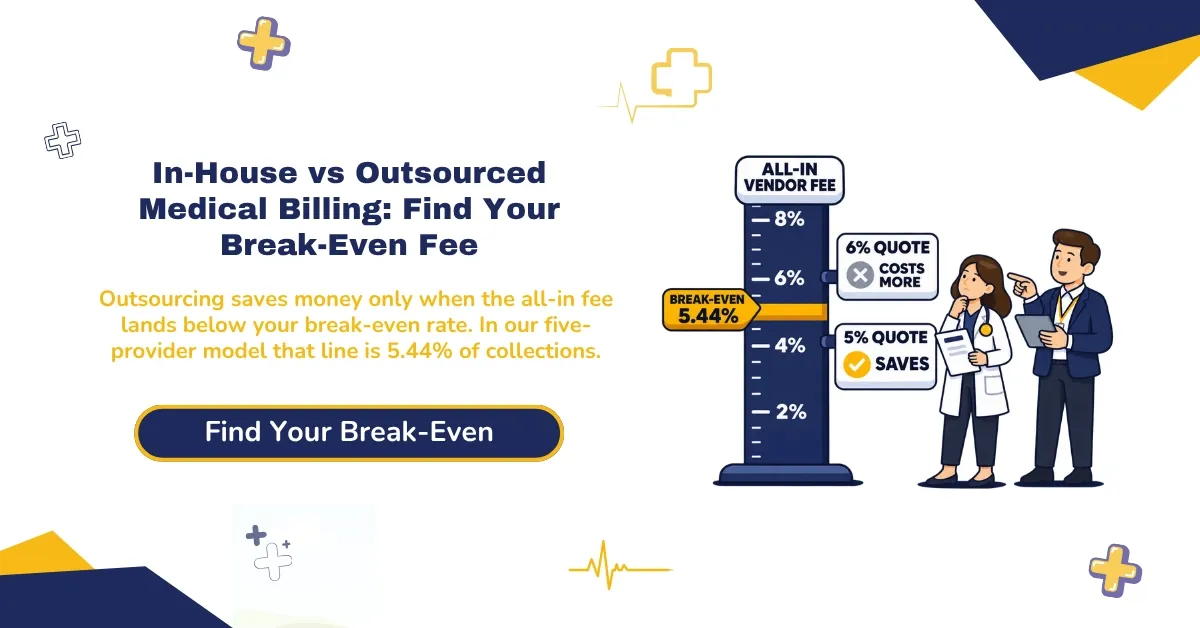
For a 3 to 10 provider practice, in-house vs outsourced medical billing comes down to one number: the break-even fee. Outsourcing costs less only when a vendor’s all-in fee lands below it. In our five-provider model, that line sits at 5.44% of collections once the switch is done, and 4.69% in year one.
You’ll find wage data for billers in physician offices from the Bureau of Labor Statistics (BLS), the employer costs stacked on top of each paycheck, a side-by-side model you can copy, and the 2027 Medicare changes that move collections under either model.
One disclosure before the math. ClaimMax RCM sells outsourced billing, so we built every table to show where keeping billing in-house wins too. Each number names its source in the same sentence, and each assumption carries a label so you can swap in your own figures.
| In shortA median biller in a physician office costs about $64,200 a year once employer costs are added.An outsourced quote is a fair comparison only when it covers the same work and the same collections.Whole hires move the math more than provider count does.2027 Medicare payment cuts change collections under either model. |
What in-house and outsourced medical billing mean
In-house medical billing is the setup where your own employees bill payers on software your practice pays for. Outsourced medical billing is a contract with a billing company to handle agreed parts of that work, most often for a percentage of collections. A hybrid model splits the job between the two.
Any in-house vs outsourced medical billing comparison has to price the same work on both sides. The Healthcare Financial Management Association (HFMA) measures cost to collect across the whole revenue cycle management (RCM) process, from patient access through collections. List the tasks first, then put a price on each one.
Billing work and who handles it in each model
| Task | In-house | Outsourced (typical contract) |
|---|---|---|
| Eligibility checks and prior authorizations | Your staff | Often stays with your practice |
| Charge entry and coding | Your staff | Charge entry included; coding varies by contract |
| Claim submission and edits | Your staff | Included |
| Payment posting | Your staff | Included |
| Denials and appeals | Your staff | Included |
| Patient statements and calls | Your staff | Varies by contract |
| A/R follow-up and bank reconciliation | Your staff | Follow-up included; reconciliation stays with you |
Before outsourcing medical billing, check that third column line by line. Work a contract leaves with your team still costs payroll hours. If you want the whole cycle covered, ask for quotes on full revenue cycle management services and hold each bidder to the same task list.
What in-house billing costs a 3 to 10 provider practice
A median billing and posting clerk in a U.S. physician office earned $47,570 in May 2025, according to BLS. Small employers add about 35% on top in benefits and payroll costs. That puts one biller near $64,200 a year before software, coverage, or turnover, and it’s the starting line for any in-house vs outsourced medical billing budget.
Medical biller salary in physician offices
Medical biller salary figures come from BLS wage estimates in the Occupational Employment and Wage Statistics (OEWS) program. BLS doesn’t track a “medical biller” title, so the closest matches are billing and posting clerks and medical records specialists. Use the offices of physicians figures, since that’s the market you hire from.
May 2025 annual wages in offices of physicians (NAICS 621100), BLS OEWS
| Occupation | 25th percentile | Median | 75th percentile | Median hourly |
|---|---|---|---|---|
| Billing and posting clerks (SOC 43-3021) | $42,620 | $47,570 | $55,830 | $22.87 |
| Medical records specialists (SOC 29-2072) | $39,160 | $47,120 | $58,230 | $22.66 |
Across all industries, the billing and posting clerk median runs higher, at $48,500. Pay also swings by state and metro area, so pull your own state’s OEWS table before you budget. A certified coder in a high-cost city won’t come in near the national median.
Employer costs on top of the wage
Wages cover only part of the bill. In June 2026, private employers with 1 to 49 workers paid $27.88 an hour in wages and $9.76 in benefits, for $37.64 in total compensation, according to BLS employer cost data. Benefits there add about 35% on top of wages.
Apply that to the median clerk and $47,570 becomes about $64,223 a year, or $16,653 in employer costs. One caution applies. If your payroll report already includes taxes, insurance, and retirement, don’t stack the BLS percentage on top, because salary already covers paid time off.
How many billers a 3 to 10 provider practice needs
No national survey publishes a reliable ratio of billers to providers. The closest published measure comes from a 2009 Health Affairs study of one large multispecialty group in California, using 2006 data. That group had 0.67 non-clinical staff on billing and insurance work for each full-time physician.
Only 0.25 of that staff per physician worked on collecting payment: building claims, posting payments, and following up. Front desk and clinical insurance tasks took the rest. MGMA warns against assuming a link between provider counts and staff counts in its benchmark tables, so treat any billing staff to provider ratio online with care.
Your real number depends on claims per month, payer mix, specialty, and prior authorization load. You also hire whole people. A three-provider office can’t hire 1.2 billers, and one biller leaves no one to cover a week of flu. That coverage gap is where medical billing for small practices often starts.
Costs that sit outside payroll
Payroll is the biggest line, but other costs follow it. In-house billing also carries practice management software, clearinghouse fees, patient statements and postage, coding updates, continuing education, temporary coverage, and recruiting. Pull 12 months of these from your books, since national averages won’t match your contracts.
Count a cost as a saving only when it leaves your bank statement. Say your office manager spends a quarter of her week on billing and keeps her salary after you outsource. Those freed hours only count in the in-house vs outsourced medical billing math if they replace a hire, overtime, or a paid service.
| Covering a billing vacancy right now? Before you post the job, we can price both options on your real payroll and collections, so you see the trade-off in dollars instead of guesses. |
What outsourced medical billing costs
Most billing companies charge a percentage of what they collect for you, and no independent national survey sets a standard rate. Two EHR vendors’ published price pages we checked in November 2026 list 2.9% of practice collections and a typical 4% to 8% range, before any charges outside the rate.
How billing companies set their fees
Owners who ask “how much does it cost to outsource medical billing” get one of four pricing models in reply. The percentage medical billing companies charge moves with specialty, claim volume, and the scope you buy, so compare models before you compare rates:
- A percentage of collections, the most common model
- A flat fee for each claim submitted
- A flat monthly fee
- Separate prices for single services, such as coding or A/R recovery
Next, pin down the fee base, meaning the money the percentage applies to. Does it cover patient payments, copays your front desk collects, refunds, drug receipts, or old A/R? At 5%, each $100,000 of drug receipts in the fee base adds $5,000 to your bill with the same claim count.
Charges outside the headline rate
Medical billing company fees can run past the headline percentage. Read each proposal for these items, and ask the bidder to price them in writing before you sign anything:
- Monthly minimum fees
- Setup or implementation charges
- Patient statements and postage
- Clearinghouse and EHR interface fees
- Credentialing and enrollment work
- Termination, A/R run-out, and data export
Monthly minimums deserve a second look. If a contract bills the greater of a minimum or the percentage, a slow month can trigger the minimum even when your yearly total looks fine. Ask each bidder for a sample invoice built on your last 12 months, month by month.
Work your team keeps after outsourcing
Prior authorization stays with most practices. In the AMA prior authorization survey of 1,000 physicians from December 2025, respondents reported 40 prior authorizations per physician each week and 13 hours of physician and staff time spent on them. Most billing contracts leave that load with your clinic.
Outsourcing medical billing also leaves these tasks with your team, and each one takes paid hours that belong in your cost model:
- Answering coder questions about documentation
- Eligibility checks and copays at check-in
- Reviewing the vendor’s monthly reports
- Reconciling bank deposits against remittances
Price those hours as a real cost on the outsourced side of your in-house vs outsourced medical billing comparison. Your practice also keeps legal responsibility for its claims. If you want a partner that handles the full claim cycle, compare full-service medical billing quotes against that list.
In-house vs outsourced medical billing cost for a five-provider practice
Run the in-house vs outsourced medical billing numbers for a five-provider practice collecting $2.4 million a year, and two billers plus their tools cost $202,446, or 8.44% of collections. A 5% fee totals $192,000 a year once running and $210,000 in year one. Break-even sits at 5.44%, or 4.69% in year one.
The side-by-side numbers
The model below is illustrative. It assumes the same patients, payer mix, and collections on both sides, no monthly minimum, and no collections boost from the vendor. Only the wage comes from BLS, so swap the other lines for figures from your own books.
Illustrative five-provider model, $2.4 million in annual collections
| Annual cost | In-house | Outsourced at 5% |
|---|---|---|
| Two billers at the BLS median wage plus employer costs | $128,446 | $0 |
| Billing tools, transactions, statements, and backup coverage you’d cancel | $26,000 | $0 |
| Vendor fee on $2.4 million in collections | $0 | $120,000 |
| Added oversight time and statement fees billed on top | $0 | $24,000 |
| Billing-related work that stays the same in both models | $48,000 | $48,000 |
| Total once running | $202,446 (8.44%) | $192,000 (8.0%) |
| One-time switch: implementation, parallel run, and A/R handoff | $0 | $18,000 |
| First-year total | $202,446 (8.44%) | $210,000 (8.75%) |
At a 5% fee, outsourced medical billing saves $10,446 a year once it’s running. Year one runs the other way: the $18,000 switch makes outsourcing $7,554 more expensive than staying put. At that pace, the yearly savings need about 21 months to cover the switching cost.
The break-even fee formula
The break-even fee equals the in-house costs you’d stop paying, minus the new costs outsourcing adds, divided by the collections the fee applies to. An all-in quote below that rate saves money at equal collections. A quote above it needs the vendor to collect more than your team does.
In the model above, the costs you’d stop paying total $154,446: two billers plus $26,000 in tools you’d cancel. Subtract the $24,000 outsourcing adds, divide by $2.4 million, and the break-even fee comes to 5.44%. Take out the $18,000 switch as well, and year one drops to 4.69%.
Contracts with minimums, volume tiers, or per-claim charges need that formula run for each month, using your real monthly collections. That monthly version is the medical billing break-even analysis worth bringing to any vendor meeting, because a single yearly figure hides your costliest months.
How the answer shifts from 3 to 10 providers
Is it cheaper to outsource medical billing at three providers than at ten? Provider count matters less than most owners expect. The table below holds collections steady at $480,000 per provider and changes only the number of whole billers each practice employs.
Illustrative break-even fee by practice size. Assumes $480,000 in collections, $5,200 in cancelable tools, and $4,800 in added oversight per provider.
| Providers | Billers employed | Collections | Break-even fee | Break-even if one more hire is needed |
|---|---|---|---|---|
| 3 | 1 | $1.44 million | 4.54% | 9.00% |
| 5 | 2 | $2.4 million | 5.44% | 8.11% |
| 7 | 3 | $3.36 million | 5.82% | 7.73% |
| 10 | 4 | $4.8 million | 5.44% | 6.77% |
Whole hires decide the math. A three-provider office with one biller and no backup breaks even at 4.54%. Add a second person for coverage and its break-even jumps to 9.00%, which explains why small-office owners so often start shopping for a billing company after one resignation.
That jump shrinks as a group grows, since one extra hire spreads across more collections. At 10 providers, the same added hire moves break-even from 5.44% to 6.77%. If you run a group in that range, our group practice billing team can model your own provider mix.
| Want this table built on your own numbers? We’ll build this table with your payroll, collections, and contract terms, so you see your break-even fee before you talk to any billing company, us included. |
When a higher fee can still pay for itself
A higher fee pays for itself only if the vendor brings in cash your team would lose. Divide the extra cost by one minus the fee rate to find that amount. At a 6% fee in the five-provider model, the vendor has to recover $14,419 a year that you’d otherwise miss.
How much more the vendor has to collect
At 6%, outsourcing medical billing costs $13,554 more than in-house once it’s running and $31,554 more in year one. The vendor keeps 6 cents of each recovered dollar, so it needs $14,419 a year in cash your team would otherwise lose, or $33,568 in year one, to break even.
Test that promise with your own data. Pull 12 months of remittances, deposits, adjustments, and payroll. Compare claims by date of service at the same age, such as 120 days, payer by payer. Count old A/R recovery on its own line, and check whether underpaid claims on the ERA explain part of the gap.
Faster cash is a one-time gain
Getting paid five days sooner on $2.4 million a year frees about $32,877 once. That’s working capital. It shows up a single time, so count it as a financing benefit only if your practice borrows less on its line of credit because of it.
Three percentages that get mixed up
A vendor’s fee and your cost to collect measure different things. HFMA MAP Keys define cost to collect as total revenue cycle cost divided by total patient service cash collected. A 5% invoice plus the staff time you keep can add up to a higher all-in rate.
A denial rate is a share of claims. MGMA benchmarking puts first-submission denials at 7% to 8% across the past four years, and many of those claims pay after a correction. Track your rate against that range, and check how many denials trace back to front-end eligibility failures.
A 2018 JAMA study put billing and insurance-related costs at 14.5% of professional revenue for primary care visits at one academic health system, physician time included. That figure measures total burden. Use it as context in any in-house vs outsourced medical billing comparison, since no vendor can remove all of it.
Numbers you’ll see quoted that don’t hold up
Three figures show up across outsourcing pages, and none of them traces back to a primary source you can check. Check where a number comes from before it shapes a staffing decision worth six figures a year, and ask who measured it, on which practices, and in what year.
Common claims, what the source shows, and how to use them
| Claim you’ll see | What the source shows | How to use it |
|---|---|---|
| “MGMA says in-house billing costs 13.7% of collections and outsourcing 5.4%.” | We couldn’t find the original MGMA table, sample, or definitions behind this pair. The earliest dated repetition we traced was a 2025 article citing a 2021 survey. | Don’t attribute it to MGMA without the source table. |
| “Outsourcing lifts a three-physician practice from 60% to 70% collections.” | This comes from a hypothetical model published in 2010 and copied across many sites since. The 10-point gain is an assumption built into the model, and its author measured no real practices. | Treat it as an example of an assumption, not as evidence. |
| “The national in-house denial rate is 12.4%.” | Pages repeating it name no source, and the page AI search tools cite labels 12.4% a national rate, with no in-house breakdown. | Use MGMA’s measured 7% to 8% first-submission rate instead. |
Two questions test any in-house vs outsourced medical billing statistic. Who measured it, and on which practices? Did the author compare real practices, or assume the result inside a model? A number that fails both questions shouldn’t drive a hiring decision or a contract signature.
Clean claim rates near 98% on sales pages come from vendors’ own reporting. HFMA defines the clean claim rate as claims that pass edits without manual intervention, divided by claims accepted into the billing system. Ask each bidder to calculate it that way on your own claims, then compare.
What stays with your practice after outsourcing
Outsourcing medical billing moves the work, and your practice keeps the responsibility. Medicare holds you accountable for claims a billing agency files for you, and HIPAA requires a signed business associate agreement before a vendor touches patient data. Those two rules shape every contract you’ll review.
Responsibility for every claim
The CMS-855B enrollment form puts it in one line: “Even if you use a billing agency/agent, you remain responsible for the accuracy of the claims submitted on your behalf.” In practice, someone on your team reviews denials by reason, approves write-offs and refunds, and reconciles deposits each month.
That responsibility stays put on both sides of the in-house vs outsourced medical billing decision. The HHS Office of Inspector General (OIG) also published voluntary compliance guidance for third-party billing companies in 1998, so ask each vendor how its compliance program follows it.
Business associate agreement and data access
A billing company that handles patient information is a HIPAA business associate, so you need a signed business associate agreement before work starts. The HHS sample BAA provisions give you optional model clauses. They aren’t required wording, and they don’t replace a healthcare attorney’s review.
One of the real disadvantages of outsourcing medical billing is losing sight of your own data. Write these four protections into the contract, and test each one during the first month:
- Your access to raw claim, remittance, and adjustment data
- Your approval before write-offs and refunds
- A monthly bank-to-remittance reconciliation
- A priced exit that covers data export and A/R run-out
How Medicare money can flow
Medicare can pay a billing agent only under strict conditions. Under 42 CFR 424.73, the agent’s pay can’t relate in any way to the dollar amounts billed or collected, and it can’t depend on actual collection. Payment still goes out in the provider’s name, and 42 CFR 424.80 applies those conditions to physician practices.
That rule governs arrangements where Medicare pays the agent. It doesn’t ban percentage fees when Medicare deposits into your own account. Keep EFT and ERA enrollment in your practice’s name, and have a healthcare attorney check state fee-splitting rules and payer terms. This section is general information and isn’t legal advice.
| Comparing contracts right now? Send us the fee and exit sections and we’ll show you what each one leaves out, ours included. |
2027 changes to price into either model
Medicare’s 2027 conversion factor drops 2.31%, to $32.63, for most clinicians, and 1.83%, to $32.95, for qualifying APM participants. Reprice your top codes under the 2027 Medicare physician fee schedule before you judge any billing team. Your collections can fall while billing performance holds steady.
Medicare physician fee schedule changes
The CMS 2027 fee schedule fact sheet, released November 4, 2026, sets two conversion factors starting January 1, 2027. Qualifying APM participants get $32.95, down from $33.57. All other clinicians get $32.63, down from $33.40, and most 3 to 10 provider practices fall in that group.
Same-day visits change too. If you bill a separate office or outpatient E/M visit on the same day as a 0-day global procedure, Medicare pays the most expensive service at 100% and the other at 80%. CMS had proposed 50%, and it dropped 10-day and 90-day globals from the final policy.
The G2211 add-on code becomes modifier B1, which raises payment for the attached E/M code by 16%. Modifier B2 pays 32% more for clinicians in a Shared Savings Program ACO or the LEAD Model. Billing teams need new charge rules for both before January claims go out, and denial management services should watch early remittances.
Reprice your own frequent codes, locality, and modifier mix with the final 2027 Medicare physician fee schedule files. A 2.31% cut to the conversion factor won’t equal a 2.31% cut to total revenue, because your code and payer mix sets the real number.
Prior authorization and claims attachments
Under CMS-0057-F, Medicare Advantage plans, state Medicaid and CHIP programs, their managed care plans, and qualified health plans on the federal exchanges must run a prior authorization API by January 1, 2027. Managed care plans follow the rating period starting on or after that date.
Those payers have had to decide standard prior authorization requests within seven calendar days and urgent ones within 72 hours since 2026. Faster answers help either billing model, but only if your EHR and clearinghouse can send requests through the new connections.
Most employer-sponsored commercial plans fall outside this rule. On the clinician side, the CY 2027 fee schedule final rule makes the MIPS electronic prior authorization measure optional for 2027, worth 10 bonus points, and required starting with the 2028 performance period.
Electronic claims attachments follow a separate rule. CMS-0053-F took effect May 26, 2026, and covered entities must comply by May 26, 2028. Ask your EHR vendor, clearinghouse, and any billing bidder for their testing dates and who handles rejected attachments.
The question to ask your billing lead or any bidder
Ask your in-house lead and each bidder the same thing: “Show us how our most common same-day visits and procedures will pay in 2027, and tell us who updates the claim edits and reconciles the first January remittances.” Vague answers show you who isn’t ready, on either side of the in-house vs outsourced medical billing decision.
How to choose the right billing model for your practice
Should you outsource medical billing? Keep billing in-house when your own numbers beat a matched quote and you have backup coverage. Outsource when one vacancy would stall claims or a quote lands below your break-even fee. A hybrid fits when a single bottleneck explains the gap.
The table below sets the in-house vs outsourced medical billing trade-offs side by side, using the same six factors owners ask about most in vendor meetings and in our free billing reviews.
Pros and cons of outsourcing medical billing vs keeping it in-house
| Factor | In-house | Outsourced |
|---|---|---|
| Cost structure | Fixed payroll, whatever the claim volume | A percentage of collections plus any extras |
| Control | Direct daily supervision | Vendor reports and service-level terms |
| Staffing risk | A vacancy can stall claims | The vendor covers absences |
| Expertise | Depends on who you hire | Teams that may cover more specialties |
| Data access | Inside your own system | Set by the contract |
| Best fit | A stable team with strong numbers | No backup coverage, or rising denials |
Keep billing in-house when your numbers already hold up
In-house billing wins when your measured results are already strong: denial rate, days in A/R, and cost to collect, each checked against HFMA definitions. You also need staff with specialty knowledge and a trained backup who can step in during a vacancy without claims piling up.
The advantages of in-house medical billing are real. Your coders answer documentation questions down the hall, and your data sits in your own system. Before you decide, score your current team with our medical billing audit checklist so the comparison starts from facts.
When to outsource medical billing
Outsourcing medical billing tends to make sense when one or more of these conditions describes your practice today, based on the numbers above:
- One biller handles everything, with no trained backup
- A billing job is open right now
- Denials pile up faster than your team can work them
- A quote priced on your last 12 months lands below your break-even fee
Groups in the 5 to 10 provider range can compare our billing for group practices approach against their own numbers. Smaller offices can see how we outsource medical billing end to end, from charge entry through A/R follow-up and monthly reporting.
Use a hybrid model to fix one bottleneck
A hybrid medical billing model buys only the piece that’s failing, such as coding review, appeals, credentialing, or old A/R recovery. Your team keeps routine posting, and you avoid paying a percentage on each routine payment that your staff already handles well.
Picture a clinic with clean front-end work and a backlog of claims past 120 days. That clinic doesn’t need a full outsourcing contract. A hybrid medical billing model hands the aged A/R to a specialist team, then returns the desk to normal once the backlog clears.
Questions to ask every bidder
Bring these seven questions to each vendor meeting, and get the answers in writing before you compare prices or sign anything:
- Will you price our last 12 months, month by month?
- Which money counts in the fee base?
- What’s charged outside the rate?
- Who does each task on our list?
- Do we keep our raw claim and remittance data?
- Which KPIs do you report, and by whose definitions?
- What do exit and A/R run-out cost?
Once you pick a partner, the handoff matters as much as the price. Our guide on how to switch billing companies covers the cutover date, open claims, and deposit rerouting, so cash keeps moving during the change.
| Want an outside read before you decide? We’ll run your numbers through this framework and tell you if keeping billing in-house is the better call for your practice. |
Questions practices ask about in-house and outsourced billing
Is outsourcing medical billing a good idea?
Outsourcing medical billing is a good idea when a vendor’s all-in fee falls below your break-even fee and your practice lacks backup coverage. It’s a weaker choice when your measured denial rate, days in A/R, and cost to collect already beat a matched quote.
In our five-provider model, break-even sits at 5.44% of collections. A three-provider office with one biller often reaches that point after its first resignation, when replacing the biller means paying for two people during training.
What percentage do medical billing companies charge?
No independent national survey sets a standard rate. Published EHR-vendor price pages we checked in November 2026 list 2.9% of practice collections and a typical 4% to 8% range, and ClaimMax’s posted RCM pricing starts at 2.44%, with terms.
Compare quotes only after each bidder defines the fee base in writing. A low headline rate on a broad fee base can cost more than a higher rate charged on insurance payments alone.
How many billers does a medical practice need?
No national ratio tells you how many billers a medical practice needs. One large multispecialty group studied in 2006 used 0.25 full-time staff per physician on claims and payment work. Your own count depends on claim volume, payer mix, specialty, and prior authorization load.
A useful check: divide your monthly claims by what one experienced biller clears in a month on your payer mix. Then add a trained backup, because a single absence shouldn’t stall a week of claims.
Is it cheaper to outsource medical billing?
It’s cheaper only when the vendor’s all-in fee lands below the in-house costs you’d stop paying, after subtracting the costs outsourcing adds. Year one is harder, since implementation, a parallel run, and the A/R handoff add one-time costs.
In our five-provider model, the in-house vs outsourced medical billing break-even drops from 5.44% to 4.69% in year one. At a 5% fee, the yearly savings need about 21 months to pay back the switch.
How long does it take to switch to outsourced billing?
Timing depends on payer enrollment changes, rerouting EFT and ERA, clearinghouse setup, and how long you run both systems side by side. Set the cutover date in writing, and name an owner for each open claim on that date. A medical billing outsourcing contract should state both.
ClaimMax tracks claims, remittances, and deposits weekly for the first 90 days after a switch. Our guide to switching without a cash gap lays out each step, from the cutover letter to the first month-end reconciliation.
Can a practice outsource only part of its billing?
Yes. A practice can keep front desk work and payment posting in-house and outsource one function, such as coding review, appeals, credentialing, or aged A/R. That hybrid setup works best when one bottleneck explains most of your lost revenue.
It also lets you test a vendor on contained work before you settle the full in-house vs outsourced RCM question. Price each piece on its own, so you don’t pay a percentage on payments your team already handles well.
Have each bidder price your last 12 months, month by month. If a quote only works by assuming higher collections, ask which unpaid claims will cover the difference. That’s the fair version of the in-house vs outsourced medical billing comparison, and we’ll run it for you whether or not you hire us.
| Ready to see your own break-even fee? We’ll price your last 12 months both ways and walk you through the result on a short call. |