CPT 99406 covers 3 to 10 minutes of face-to-face smoking and tobacco cessation counseling. CPT 99407 covers counseling that runs longer than 10 minutes. Both codes are time-based, so the counseling minutes have to appear in the note. Medicare pays $15.36 for 99406 in a non-facility setting in 2026.
These two codes get billed less than almost any preventive service in outpatient care. Most of the loss traces back to the note. Providers skip the minutes, or the diagnosis pairing sits outside Medicare’s covered list. A smaller share comes down to modifier placement.
This guide covers the 2026 rates, the modifier decision matrix, the ICD-10 codes Medicare covers, and the denial codes that show up when one of those goes wrong. If your team bills smoking cessation CPT codes and the payments look thin, the answer is somewhere in here.
What CPT 99406 and 99407 cover
The two smoking cessation CPT codes split on one variable, and that variable is time. Documentation rules, diagnosis pairing, and provider eligibility stay identical across both.
CPT 99406: intermediate counseling, 3 to 10 minutes
The AMA 99406 CPT code description reads: smoking and tobacco use cessation counseling visit, intermediate, greater than 3 minutes up to 10 minutes. The code sits under Behavior Change Interventions, Individual. It applies to all tobacco products, including cigarettes, cigars, pipe tobacco, and chewing tobacco.
In a real visit, those minutes cover the quit conversation itself. You assess where the patient stands, walk through the health risks tied to their own chart, and review cessation options. Setting a quit date and discussing medication both count toward the time.
CPT 99407: intensive counseling, more than 10 minutes
The 99407 CPT code description covers cessation counseling that runs longer than 10 minutes. The code isn’t an add-on. One of the two codes goes on the claim, never both. If the session crosses 10 minutes, bill 99407 by itself.
Sessions cross into 99407 territory when the patient wants a real plan. Withdrawal management, medication selection, trigger mapping, and a follow-up schedule take longer than 10 minutes to work through properly. Behavioral health visits hit that threshold more often than primary care visits do.
99406 vs 99407: side-by-side comparison
| Code | Time | Service level | Typical scenario | Both same day? |
|---|---|---|---|---|
| 99406 | 3 to 10 minutes | Intermediate | Brief quit conversation during an office visit | No. One code per session. |
| 99407 | More than 10 minutes | Intensive | Structured quit plan with medication discussion | No. One code per session. |
Descriptors per AMA CPT. Time is the only variable that separates the two codes.
How much counseling time is required to bill 99406
Time drives everything in smoking cessation coding. Both smoking cessation CPT codes are time-based, which makes the minutes in your note the most important line on the claim.
The 3-minute threshold, and why some sources say 4 minutes
The CPT descriptor sets the billing threshold at greater than 3 minutes. Counseling that runs 3 minutes or less rolls into the E/M service. Some payers publish a 4-minute minimum in their own rate schedules. Nevada Medicaid lists 99406 as 4 to 10 minutes on its published behavioral health rates.
That gap causes arguments in coding meetings. The CPT book says greater than 3. A state Medicaid rate sheet says 4. Both can be correct at once, because a payer can set a standard stricter than CPT. Check your own payer documentation before you write internal policy.
The practical fix has nothing to do with the debate. Document the actual number of minutes. A note that says 7 minutes survives either standard. A note that says brief counseling survives neither one.
Counseling under 3 minutes is not separately billable
CMS treats minimal cessation counseling of 3 minutes or less as part of the E/M service. You can’t bill 99406 for it. That instruction sits in the Medicare Claims Processing Manual, Chapter 32, Section 12.1.
This shows up constantly in charts where the provider mentioned smoking in passing. A 90-second exchange isn’t a billable cessation service. Train providers to either do the counseling and time it, or leave it inside the E/M where it belongs.
Carving cessation time out of a time-based E/M
Selecting the E/M level by total time means the cessation counseling minutes have to come out of that total. Counting the same block of time twice supports two codes off one set of minutes, and auditors look for exactly that pattern.
A 40-minute visit with 12 minutes of cessation counseling leaves you 28 minutes for the E/M, not 40. That drops some visits a level. Put both numbers in the note so a reviewer can follow the math without calling you.
2026 Medicare reimbursement for CPT 99406 and 99407
2026 Medicare Payment Rates for CPT 99406 and 99407
Medicare pays $15.36 for CPT 99406 in a non-facility setting and $10.69 in a facility setting in 2026. CPT 99407 pays approximately $29 in a non-facility setting. The work RVU is 0.24 for 99406 and 0.50 for 99407.
| Code | Work RVU | Total RVU (non-facility) | Non-facility payment | Facility payment |
|---|---|---|---|---|
| 99406 | 0.24 | 0.46 | $15.36 | $10.69 |
| 99407 | 0.50 | 0.83 (verify) | Approximately $29 | Verify with MAC |
Source: CMS Physician Fee Schedule, 2026 national averages effective January 1, 2026. Rates vary by locality. Verify your exact rate with the CMS Physician Fee Schedule Look-Up Tool before contract benchmarking.
The $4.67 gap between the non-facility and facility rate comes from practice expense RVUs. Office-based providers carry staff and overhead costs directly, so CMS assigns them a higher practice expense value. Hospital-based clinics bill the facility rate because the facility bills separately for those costs.
The same setting split drives a much larger gap on higher-level E/M codes. Our 99214 Medicare reimbursement breakdown walks through the full calculation if you want to see how the components stack up.
Why there are two conversion factors in 2026
2026 is the first year Medicare has run two conversion factors. Qualifying APM Participants get $33.5675. Everyone else gets $33.4009. Both took effect January 1, 2026. The 2025 conversion factor was $32.35 for all providers.
Most practices bill under the non-QP factor. On a single 99406 claim, the difference is pennies. Across a health system running thousands of cessation visits a year, it stops being pennies. Verify your QPP participation status if nobody has checked it against 2026 enrollment records.
What the 2026 efficiency adjustment means for these codes
CMS finalized a 2.5% efficiency adjustment for 2026 that cuts work RVUs on non-time-based codes. CPT 99406 and 99407 are time-based, so the reduction doesn’t touch them.
That puts smoking cessation CPT codes in an unusual position this year. These codes picked up the full conversion factor increase while many procedure codes absorbed a work RVU cut on top of it. Practices that dropped these codes years ago because the payment looked small should rerun the math.
If you aren’t sure which conversion factor applies to your providers, that’s worth confirming before your next quarterly review. The locality adjustment and APM status together move the national average more than most teams expect.
Which providers can bill smoking cessation counseling
Provider eligibility on smoking cessation CPT codes runs broader than most billing teams assume, and two exceptions catch people out.
Qualified provider types
Medicare covers cessation counseling when a qualified physician or other Medicare-recognized practitioner furnishes it and the patient is competent and alert at the time of service. Scope of practice and state licensure govern who qualifies inside that definition.
| Provider type | Can bill directly | Notes |
|---|---|---|
| Physician | Yes | No supervision requirement |
| Nurse practitioner | Yes | Within state scope of practice |
| Physician assistant | Yes | Within state scope of practice |
| Clinical psychologist | Yes | NCCI edits permit psychotherapy pairing |
| Clinical social worker | Yes | Verify plan participation |
| Clinical nurse specialist | Yes, with an exception | Incident-to only in RHC and FQHC settings |
| Registered nurse | Incident-to only | Requires physician supervision |
| Medical assistant | Incident-to only | Requires physician supervision |
Scope of practice varies by state. Confirm licensure rules and plan participation before adding a provider type to your billing workflow.
The RHC and FQHC exception most billing teams miss
A clinical nurse specialist furnishing cessation counseling in an RHC or FQHC falls under incident-to rules. That visit doesn’t count as separately billable. CMS does list 99406 and 99407 as qualifying visit codes for G0466, G0467, and G0468 under the FQHC prospective payment system.
Two rules sit close together there, and billing teams collapse them into one. The codes qualify a visit for FQHC payment. That isn’t the same thing as the codes generating their own payment.
Can a social worker or psychologist bill 99406?
Yes. Clinical psychologists and clinical social workers can report 99406 and 99407. Revised NCCI edits permit reporting these codes at the same encounter as individual psychotherapy codes 90832, 90834, and 90837 when the appropriate modifier is appended.
Behavioral health carries the highest tobacco use rates of any patient population. These codes sat unused in that setting for years because an NCCI edit blocked the pairing outright. The edit changed. Plenty of billing teams still code as though it didn’t, and the modifier section below covers which one applies.
Medicare coverage rules and session limits for tobacco cessation counseling
Coverage criteria under NCD 210.4.1
NCD 210.4.1 covers cessation counseling for outpatient and hospitalized Medicare beneficiaries who meet all three conditions below.
- The patient uses tobacco, whether or not signs or symptoms of tobacco-related disease are present.
- The patient is competent and alert at the time counseling is provided.
- A qualified physician or other Medicare-recognized practitioner furnishes the counseling.
Inpatient coverage surprises people. A hospitalized patient who smokes can receive billable cessation counseling. Most published guidance treats these as outpatient-only codes and leaves that revenue on the floor.
How many sessions Medicare covers per year
Medicare covers 2 cessation attempts per 12-month period, with up to 4 sessions per attempt, for a maximum of 8 sessions in 12 months. Both smoking cessation CPT codes count against the same limit.
The clock runs from the first covered session, not from January. After 11 full months elapse, the beneficiary becomes eligible for another 8 sessions in the following year. Practices that reset counts on the calendar year get this wrong in both directions.
The frequency limit trap: sessions billed by other providers
Frequency limits are beneficiary-specific, not provider-specific. Sessions another provider furnished count against the same 8-session annual maximum. Your practice can track its own counts perfectly and still take a frequency denial.
A patient sees a pulmonologist in March and uses 4 sessions. They come to you in July. You have 4 left, not 8, and nothing in your system tells you that. Checking prior utilization before the visit costs a few minutes. Working the denial afterward costs more.
When Medicare will not cover cessation counseling
Medicare doesn’t cover cessation counseling when tobacco cessation is the primary reason for the hospital stay. If tobacco use disorder is the principal diagnosis on an inpatient admission, the counseling isn’t separately payable.
Patient cost sharing
Copayment, coinsurance, and the Part B deductible are waived for 99406 and 99407. The Affordable Care Act established that waiver effective January 1, 2011. Patients pay nothing when the provider accepts assignment.
Tell patients this at the point of service. Cost is a common reason people decline the conversation, and this particular service is free to them.
Which ICD-10 codes support a 99406 or 99407 claim
Medicare’s covered diagnosis list
CMS publishes a specific list of applicable diagnosis codes for tobacco cessation counseling in the Medicare Claims Processing Manual, Chapter 32, Section 12.1. Claims carrying a diagnosis outside that list are at risk of denial for medical necessity.
| Category | ICD-10-CM codes |
|---|---|
| Nicotine dependence, cigarettes | F17.210, F17.211, F17.213, F17.218, F17.219 |
| Nicotine dependence, chewing tobacco | F17.220, F17.221, F17.223, F17.228, F17.229 |
| Nicotine dependence, other tobacco product | F17.290, F17.291, F17.293, F17.298, F17.299 |
| Tobacco use, non-dependent | Z72.0 |
| Personal history of nicotine dependence | Z87.891 |
| Toxic effect, chewing tobacco | T65.211A, T65.212A, T65.213A, T65.214A |
| Toxic effect, cigarettes | T65.221A, T65.222A, T65.223A, T65.224A |
| Toxic effect, other tobacco and nicotine | T65.291A, T65.292A, T65.293A, T65.294A |
Source: CMS Medicare Claims Processing Manual, Chapter 32, Section 12.1. Jurisdictional lists can differ. Verify against your own MAC before updating your charge master.
Why Z71.6 is not on Medicare’s covered list
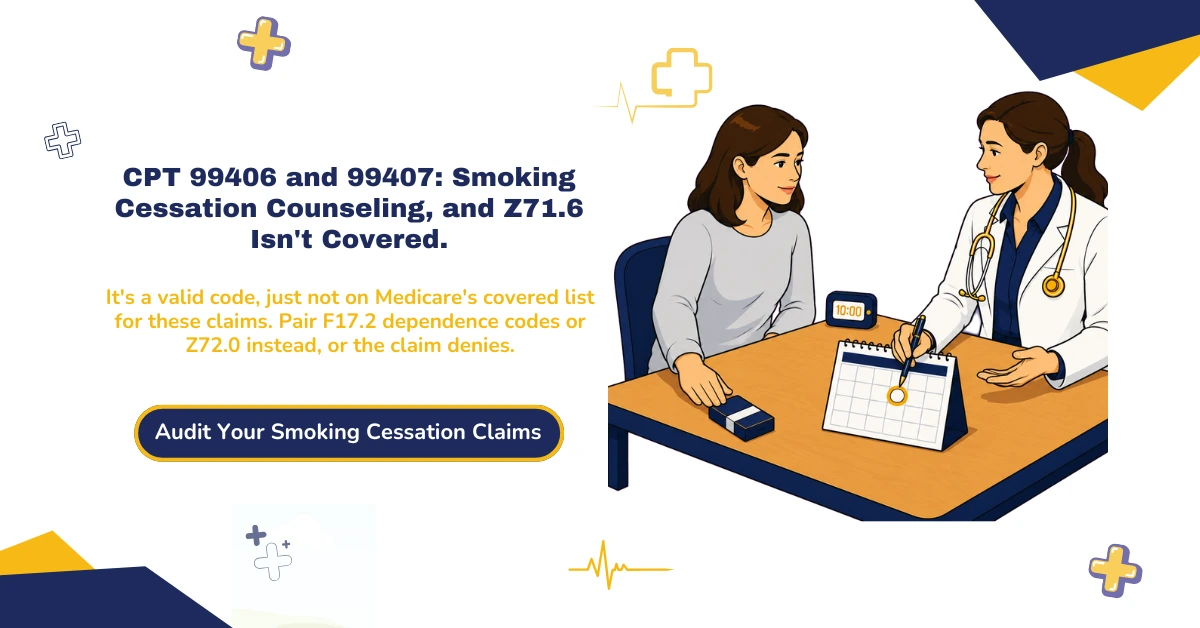
Z71.6 is a valid, billable ICD-10-CM code for tobacco abuse counseling, and the 2026 edition took effect October 1, 2025. Z71.6 does not appear on Medicare’s applicable diagnosis list for 99406 and 99407. Pair the F17.2 code matching the product and clinical status instead, or use Z72.0 when the record doesn’t document dependence.
A lot of published guidance recommends Z71.6, and code lookup sites return it as the counseling code. Those sites aren’t wrong about the code. A code being valid and a code being covered for a specific CPT are two separate questions, and the second one is what gets your claim paid.
Z72.0 was added effective October 1, 2024
CMS added Z72.0, tobacco use, to the applicable diagnosis list effective October 1, 2024. Practices working from older reference material may still be avoiding it.
Before that change, non-dependent tobacco users created a coding problem. F17 requires documented dependence, and plenty of patients smoke without a dependence diagnosis in the chart. Z72.0 fills that gap and Medicare covers it now.
Choosing between F17 dependence codes and Z72.0
| Clinical situation | Correct code | Documentation needed |
|---|---|---|
| Provider documents nicotine dependence | F17.2 code matching the product | Dependence stated in the record |
| Current tobacco user, no dependence documented | Z72.0 | Tobacco use status and product |
| Former user, quit and no current use | Z87.891 | History of use, current non-use |
| Patient in remission from dependence | F17.211, F17.221, or F17.291 | Remission stated in the record |
Use category F17 only when the provider documents nicotine dependence. Defaulting to F17 for simple tobacco use creates audit exposure.
Does CPT 99406 need a modifier
Modifier questions on smoking cessation CPT codes drive more coder forum traffic than any other issue tied to 99406 and 99407. The rule below resolves most of it.
The short answer: the modifier goes on the other service
CPT 99406 doesn’t carry a modifier on its own. The modifier attaches to the service you pair it with, and which modifier applies depends on that pairing. With a same-day office visit, modifier 25 goes on the E/M code. With individual psychotherapy, modifier 59 goes on the cessation code.
That inversion trips up more billing teams than anything else on these two codes. The modifier doesn’t belong to 99406. It belongs to the relationship between 99406 and whatever else you billed that day.
Modifier Requirements for CPT 99406 and 99407 by Paired Service
| Paired service | Modifier | Applied to | Note |
|---|---|---|---|
| Office or outpatient E/M (99202 to 99215) | 25 | The E/M code | Counseling must be distinct and separately documented |
| Individual psychotherapy (90832, 90834, 90837) | 59 | The cessation code | Per revised NCCI edits |
| Preventive medicine visit (99381 to 99397) | 25 | The preventive E/M code | Document counseling time separately |
| Telehealth delivery | 95 | The cessation code | Plus the correct place of service code |
| Preventive cost-share waiver | 33 | The cessation code | Payer-specific requirement |
| Certain Medicaid programs | SC | The cessation code | Verify plan policy |
| Group session (New York Medicaid) | HQ | The cessation code | Program-specific, not a Medicare rule |
| 99406 billed alone | None | Not applicable | No modifier required |
Modifier requirements vary by payer. Confirm the policy for each plan before building the rule into your claim scrubber.
Modifier 25 vs modifier 59: when each applies
Modifier 25 signals that a significant, separately identifiable E/M service happened alongside the counseling. Modifier 59 signals that two procedures an NCCI edit would otherwise bundle were distinct services. Different problems, different fixes.
Two failure patterns account for most rejections. Some teams put modifier 25 on 99406 instead of the E/M, and the E/M bundles. Others put it on both lines, and the payer rejects the claim outright.
The psychotherapy pairing runs on a different rule. NCCI edits used to block 99406 with 90837 completely. That changed, but the edit still requires a modifier, and it’s 59, not 25. Teams that learned the old rule keep submitting these wrong.
Vaccine administration deserves a separate flag. At least one plan has denied 99406 billed with 90471 and 90472 for a missing modifier. That’s payer-specific behavior, so check the policy before you assume it applies to your contracts.
Modifier 33, modifier SC, and modifier HQ
Modifier 33 identifies a preventive service, and some payers require it to trigger the cost-sharing waiver. Modifier SC appears in certain Medicaid programs. New York uses modifier HQ to indicate a group cessation session.
The HQ modifier answers a question that comes up often and rarely gets a straight answer. Group cessation counseling is billable in some Medicaid programs, and New York publishes the modifier for it. The Medicare codes describe individual counseling, so group delivery follows program-specific rules rather than the Medicare rule set.
Billing 99406 with E/M visits, preventive visits, and psychotherapy
Can you bill 99214 with 99406?
Yes. You can bill 99214 and 99406 on the same date when the cessation counseling is a distinct service. Append modifier 25 to 99214. If you selected the 99214 level by time, the cessation minutes can’t count toward that total.
This pairing generates more coder questions than almost any other combination involving these codes. Our 99214 Medicare reimbursement guide covers the time thresholds on the E/M side, which is where the carve-out math starts.
Can 99406 be billed with 99396 or another preventive visit?
Yes. You can report 99406 with preventive medicine visits 99381 through 99397, including 99396. CPT recognizes behavior change interventions as separate from the preventive E/M. Append modifier 25 to the preventive code and document the counseling time on its own.
Annual physicals are where cessation counseling gets performed and never billed. The provider covers smoking as part of the review, writes one line about it, and moves on. Without minutes in the note, there’s nothing to submit.
Billing 99406 with psychotherapy sessions
Report 99406 or 99407 alongside 90832, 90834, or 90837 with modifier 59 appended to the cessation code. Document the total face-to-face time and the start and stop times for the cessation segment.
The note has to show two services happened inside one encounter. A 60-minute session with 6 minutes of cessation counseling means 54 minutes supported the psychotherapy code, and the record should say so.
What separately identifiable means in the note
Two elements have to be visible in the record. A problem-oriented or preventive service with its own history, exam, or medical decision making. A cessation counseling segment with its own minutes and its own content.
Auditors read for that phrase and billers rarely define it. If a reviewer can’t point at two separate services in the note, modifier 25 won’t hold up on appeal.
Same-day pairing is where most cessation revenue leaks, and the fix is usually a note template rather than an appeal. If the same bundling rejection keeps repeating across providers, our denial management services team traces it back to the workflow that caused it.
Can smoking cessation counseling be billed via telehealth
Telehealth coverage status
Cessation counseling appears on the Medicare Telehealth Services list, which makes 99406 and 99407 billable for synchronous telehealth delivery. Medicare telehealth authority has moved through several statutory extensions, so confirm the current list and any active extension before you submit.
Some published guidance still states these codes require an in-person visit. That was accurate at one point. Telehealth policy on this category has changed more than once, which is why the guidance in circulation contradicts itself.
Place of service and modifier requirements
Append modifier 95 for synchronous audio-video delivery. Use POS 02 when the patient is somewhere other than home, and POS 10 when the patient is at home. Commercial payers sometimes require a different combination.
Place of service errors on telehealth claims produce silent underpayments instead of denials, which makes them hard to catch. Our revenue cycle management team audits POS assignment and modifier 95 application at the code level.
Documentation requirements for CPT 99406 and 99407
Documentation carries more weight on smoking cessation CPT codes than on most preventive services, because time is the only thing separating the two codes from each other.
Documentation Checklist for CPT 99406 and 99407
| Element | What to record | Why it matters |
|---|---|---|
| Tobacco use status | Product type, quantity, and duration | Establishes medical necessity |
| Counseling minutes | Exact number, or start and stop times | Determines 99406 vs 99407 |
| Advice to quit | Risks discussed with this patient | Shows counseling occurred |
| Methods reviewed | Behavioral techniques and medication options | Separates counseling from a mention |
| Willingness to quit | Readiness assessed, quit date if set | Supports the service level |
| Follow-up | Next contact or referral arranged | Completes the intervention |
Six elements support a clean 99406 or 99407 claim. Missing counseling minutes is the single most common reason these claims fail review.
Additional documentation for 99407
Intensive sessions need more in the note than intermediate ones. Add the pharmacotherapy options you offered, the resources you provided, the quit date if the patient set one, and the follow-up arrangements you made.
A 99407 claim carrying the same four-line note as a 99406 claim invites a downcode. The extra time has to show up as extra content, and reviewers check for that.
A note that will not survive an audit
This note fails: I spent 11 minutes counseling the patient on tobacco use. Time by itself doesn’t establish the product, the content of the counseling, or the patient’s engagement.
The fix takes one more sentence. Patient smokes one pack daily for 12 years. Spent 11 minutes reviewing withdrawal symptoms, comparing varenicline to nicotine patches, and setting a quit date of September 3. Follow-up in 4 weeks. That version pays.
Build the time field into your EHR template. Providers won’t remember to add minutes on their own, and a required field costs them 2 seconds.
Why 99406 claims get denied and how to fix them
Denials on smoking cessation CPT codes cluster around five specific failures, and each one carries a recognizable reason code on the remittance.
Common Denial Reason Codes for CPT 99406 and 99407
| Reason code | What it means | Usual cause | Corrective action |
|---|---|---|---|
| CO-97 | Service bundled into another payment | Modifier missing on the paired service | Verify modifier placement, submit corrected claim |
| CO-151 | Frequency limit exceeded | Sessions billed by another provider count toward the same maximum | Verify prior utilization, appeal with documentation if within limit |
| CO-50 | Not deemed medically necessary | Diagnosis outside the covered list, often Z71.6 | Recode with the correct F17.2 or Z72.0 diagnosis |
| CO-16 | Claim lacks information | Counseling time absent from the record | Amend documentation, resubmit |
| CO-4 | Modifier missing or inconsistent | Wrong modifier, or right modifier on the wrong line | Correct per the modifier matrix above |
Reason code behavior varies by payer. These are the patterns that repeat most often on cessation counseling claims.
Seeing the same reason code repeat across multiple providers points to a workflow pattern rather than a coding accident. Our denial management services team maps recurring denials back to their source and fixes the process that created them.
The five errors behind most cessation denials
Missing or vague counseling time causes the most rejections. Providers write discussed smoking cessation with no minutes attached, and the claim has nothing to stand on.
Wrong diagnosis pairing runs a close second. Z71.6 looks right to anyone reading a code lookup site, and it produces a medical necessity denial on Medicare claims.
Counseling under the 3-minute threshold gets billed anyway. Sometimes the provider counseled longer and didn’t record it. Sometimes the conversation ran 90 seconds and nothing more.
Modifier placement on the wrong claim line bundles the E/M. Teams catch this one after the fact because the denial looks like a documentation problem rather than a modifier error.
Frequency limits already exhausted elsewhere generate CO-151 with no warning. The patient received counseling somewhere else, and your system had no way to know.
How to correct and resubmit
Submit a corrected claim if the documentation supports the service and only the claim was wrong. Modifier placement, diagnosis selection, and place of service all fall in that category.
File an appeal when the payer applied a limit incorrectly. Pull the utilization record, show the session count, and cite the frequency rule. Track your timely filing window because these claims sit at low dollar values and get deprioritized.
How smoking cessation CPT codes are covered outside Medicare
State Medicaid rates and session limits
Medicaid programs set their own rates and frequency limits for 99406 and 99407. Nevada Medicaid pays $12.46 for 99406 and $24.32 for 99407 in behavioral health specialties, and allows up to 24 encounters per year rather than 8.
| Payer | 99406 | 99407 | Frequency | Notes |
|---|---|---|---|---|
| Medicare | $15.36 non-facility | Approximately $29 | 8 per 12 months | Cost sharing waived |
| Nevada Medicaid | $12.46 | $24.32 | 24 per year | Behavioral health specialties |
| New York Medicaid | Varies by program | $22 to $25 | Program-specific | HQ modifier for group sessions |
| Commercial (New York reference) | Varies by contract | $15 to $32 | Plan-specific | Verify contracted rate |
Sources: Nevada Medicaid published rate corrections effective July 1, 2024; New York State tobacco counseling billing code reference. Rates change. Verify against your current fee schedule.
The 8-session limit gets quoted as though it applies everywhere. It’s a Medicare rule. Nevada allows 24 and permits providers to exceed that when medical necessity supports it. A practice capping at 8 across all payers leaves covered visits unbilled.
Nevada also restricted these codes to pregnant recipients until December 1, 2021. Reference material written before that date still carries the old rule, which is one reason state Medicaid guidance in circulation contradicts itself.
Commercial and Marketplace coverage
Most commercial plans cover tobacco cessation counseling as a preventive service without cost sharing under the Affordable Care Act. Rates and documentation requirements vary by contract.
Verify your own contract terms. A preventive coverage mandate says the service has to be covered. It doesn’t say what the plan pays, which modifier it wants, or how many sessions it allows in a year.
Codes commonly confused with 99406 and 99407
G0436 and G0437 were deleted in 2017
CMS deleted G0436 and G0437 effective January 1, 2017. Those codes separated asymptomatic patients from symptomatic ones. CPT 99406 and 99407 now apply to both, whether or not the patient shows signs of tobacco-related disease.
Reference material published before 2017 still lists the G codes, and some of it ranks well in search results. If your internal coding guide mentions G0436, it needs updating.
99403 and the preventive counseling codes
CPT 99401 through 99404 cover preventive medicine counseling for risk factor reduction in general. They aren’t tobacco-specific. Counseling that addresses tobacco cessation belongs on 99406 or 99407 instead.
1036F and G9903: quality reporting, not payment
CPT 1036F is a Category II quality reporting code. It pays $0. G9903 is a quality measure code. Neither one substitutes for 99406 or 99407 on a claim.
Practices that report 1036F and expect payment are submitting quality data and billing nothing for the service. Report the quality code if your program requires it, and bill the CPT code separately.
99408 and 99409 for alcohol and substance screening
CPT 99408 and 99409 cover alcohol and substance abuse structured screening and brief intervention, known as SBIRT. Different service, different codes, different documentation requirements.
| Code | What it covers | Pays | Use instead of 99406 when |
|---|---|---|---|
| 99403 | General preventive risk factor counseling | Yes | Counseling isn’t tobacco-specific |
| 1036F | Tobacco use quality measure | No, $0 | Never. Report alongside, not instead. |
| G9903 | Quality measure code | No | Never. Report alongside, not instead. |
| 99408 | Alcohol or substance SBIRT, 15 to 30 min | Yes | The service addresses alcohol or drugs |
| G0436 | Deleted January 1, 2017 | No longer valid | Never. Use 99406. |
Category II codes carry no payment. They satisfy quality reporting requirements and sit alongside the billable CPT code.
What changed for smoking cessation billing in 2026
CMS refreshed its billing instructions effective January 2026
CMS revised Chapter 32, Section 12.1 of the Medicare Claims Processing Manual on December 18, 2025, with an effective date of January 20, 2026. The revision reaffirms 99406 and 99407 as the correct codes and carries the current applicable diagnosis list.
The code descriptors themselves haven’t changed since 2008. Payment, payer policy, and the NCCI edits around these codes shift every year, and that’s where your review time belongs.
Proposed reimbursement increase in the CY 2027 rule
CMS has proposed increasing the valuation of behavior change intervention services in the CY 2027 Physician Fee Schedule proposed rule. The proposal isn’t final. Proposed valuations change between the proposed rule and the final rule on a regular basis.
Nothing changes for your 2026 claims. Watch the final rule, expected late in 2026, and update your fee schedule once the numbers are settled.
Change log: CPT 99406 and 99407
| Date | Change |
|---|---|
| January 1, 2011 | ACA waived coinsurance and the Part B deductible for this service |
| January 1, 2017 | G0436 and G0437 deleted. 99406 and 99407 apply to all patients. |
| September 2024 | AMA CPT Assistant published refreshed guidance. Descriptors unchanged since 2008. |
| October 1, 2024 | Z72.0 added to Medicare’s applicable diagnosis list |
| January 1, 2026 | Dual conversion factors take effect: $33.5675 QP, $33.4009 non-QP |
| January 20, 2026 | CMS Claims Processing Manual Chapter 32 revision effective |
Dated changes only. Proposed rules are excluded from this table until CMS finalizes them.
Frequently asked questions about CPT 99406 and 99407
What is CPT code 99406?
CPT 99406 reports smoking and tobacco use cessation counseling delivered face-to-face for 3 to 10 minutes. Any qualified healthcare provider can bill it within their scope of practice. The code is time-based, so the counseling minutes must appear in the documentation for the claim to hold up.
How many tobacco cessation sessions does Medicare cover per year?
Medicare covers 2 cessation attempts per 12-month period, with up to 4 sessions per attempt, for a maximum of 8 sessions in 12 months. Both 99406 and 99407 count toward that limit. The patient doesn’t need a tobacco-related illness to qualify for coverage.
Does CPT 99406 need a modifier?
Not on its own. Billed with a same-day E/M visit, modifier 25 goes on the E/M code rather than on 99406. Paired with individual psychotherapy, modifier 59 goes on the cessation code instead. Telehealth delivery adds modifier 95 plus the correct place of service.
Can 99406 and 99407 be billed on the same day?
No. Report one code per session based on total counseling time. Under 10 minutes takes 99406. Over 10 minutes takes 99407. CPT 99407 isn’t an add-on code, so billing both for a single session produces a denial.
What is the ICD-10 code for someone who recently quit smoking?
Z87.891 reports a personal history of nicotine dependence for a patient who has quit and no longer uses tobacco. If the patient still uses tobacco, Z87.891 is the wrong code. Use an F17.2 code when dependence is documented, or Z72.0 for current use without documented dependence.
What is the RVU for CPT 99406?
The work RVU for CPT 99406 is 0.24 in 2026, with total RVUs of approximately 0.46 in a non-facility setting. Multiplying total RVUs by the applicable conversion factor and adjusting for your GPCI locality produces the allowed amount. The national average is $15.36.
Can 99406 be billed if the patient does not want to quit?
Yes. Medicare’s coverage criteria require that the patient uses tobacco, is competent and alert, and receives counseling from a qualified practitioner. Willingness to quit isn’t a coverage condition. Document the counseling you delivered and the patient’s stated readiness, even when that readiness is low.
What is the ICD-9 code for smoking cessation counseling?
ICD-9 was retired for US claims on October 1, 2015. Any claim you submit today uses ICD-10-CM. For tobacco cessation counseling, pair 99406 or 99407 with an F17.2 dependence code, Z72.0 for non-dependent tobacco use, or Z87.891 for a former user.
Getting paid for the counseling you already deliver
Smoking cessation CPT codes reward practices that document minutes and punish practices that don’t. The counseling happens in thousands of visits every week and never reaches a claim, because nobody wrote down how long it took.
Fix the note template first, then check your diagnosis pairing against Medicare’s covered list. If the claims still come back, the problem sits in modifier placement or frequency tracking. Our medical billing service team works both sides of that for practices across all 50 states.