
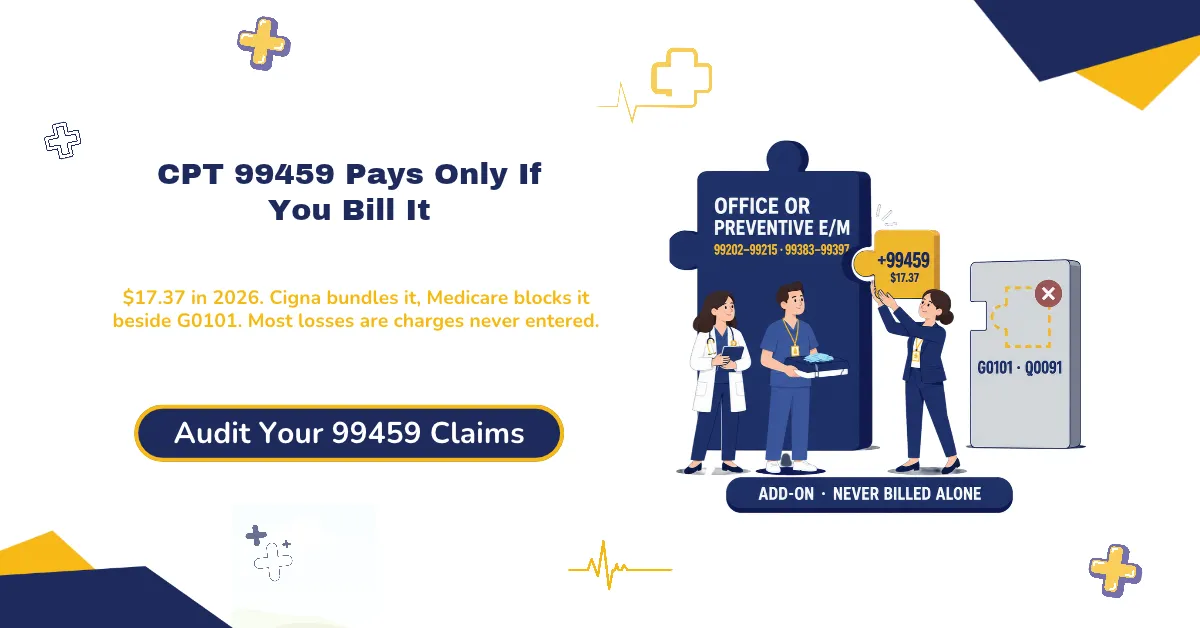
The 99459 CPT code is an add-on code for the practice expense of a pelvic examination performed during an office visit, office consultation, or preventive visit. It carries zero work RVUs, can’t be billed alone, and pays $17.37 nationally under the 2026 Medicare Physician Fee Schedule.
Payment on 99459 comes down to three checks. Your primary code has to be on CPT’s eligible list. The payer’s policy has to allow it: Cigna bundles it into problem visits, EmblemHealth never pays it on its own, and Medicare won’t pay it beside G0101 or Q0091. Your note has to prove the exam happened.
We wrote this for practice managers, billers, and the OB/GYN and primary care providers who perform these exams. The AAPC-certified coders at ClaimMax RCM checked each rule below against CMS rules, Medicare contractor guidance, and the payers’ own policy documents.
99459 Key Facts
| Item | Detail |
|---|---|
| Code type | Add-on (+), practice expense only |
| Official descriptor | Pelvic examination (List separately in addition to code for primary procedure) |
| Work RVUs | 0.00 |
| 2026 Medicare national rate | $17.37 (0.52 total RVUs x $33.4009) |
| Billable since | January 1, 2024 |
| Primary codes | 99202 to 99205, 99212 to 99215, 99242 to 99245, 99383 to 99387, 99393 to 99397 |
| Frequency | Once per patient per day |
| Modifier on 99459 | None |
| Chaperone required to bill | No, but document one as best practice |
| Medicare with G0101 or Q0091 | Not separately payable (Noridian) |
In This Guide
- What Is the 99459 CPT Code?
- Which Codes Can You Bill With 99459?
- How Much Does 99459 Pay in 2026?
- Does Medicare Cover 99459?
- Which Payers Pay 99459 and Which Bundle It?
- Does 99459 Require a Chaperone?
- 99459 Documentation Requirements
- How to Bill 99459 Step by Step
- Common 99459 Denials and How to Fix Them
- 99459 CPT Code FAQs
- Getting 99459 Paid Consistently
What Is the 99459 CPT Code?
CPT 99459 is a practice-expense-only add-on code for a pelvic examination done during an office visit, consultation, or preventive visit. It pays for clinical staff time and the exam supply pack. The provider’s own exam work stays inside the E/M code.
The CPT 99459 description reads “Pelvic examination (List separately in addition to code for primary procedure).” You’ll often see it written as +99459. That plus sign is what makes CPT 99459 an add-on code, and it means the line can’t stand on a claim by itself.
What CPT 99459 Pays For
The Society of Gynecologic Oncology lists what the payment covers: four minutes of chaperone time, the exam table and light, the speculum, lubricant, and swabs. At launch in 2024, the AMA’s RUC recommended 0.68 practice expense RVUs for that package.
Physician work isn’t part of 99459, and its work RVU is 0.00. The exam itself counts toward the E/M visit: the external genitalia inspection, the speculum exam, the bimanual exam, and a rectovaginal exam when the provider does one. Your E/M level carries the thinking, and 99459 covers the room, the staff, and the supplies.
When Did 99459 Take Effect?
The AMA CPT Editorial Panel approved the code in September 2022, and CMS valued it in the CY 2024 Medicare fee schedule. That makes the CPT code 99459 effective date January 1, 2024. You’ll still see it called the CPT 2024 new code 99459 for pelvic examination, though practices have billed it for almost three years.
Is There a Standalone Pelvic Exam CPT Code?
No. CPT doesn’t have a standalone pelvic exam CPT code for office visits. Anyone searching for a pelvic examination CPT code ends up at the same answer: the exam belongs to the E/M visit, and 99459 adds the practice expense on top. Three related codes cause most of the mix-ups:
- Medicare screening pelvic and breast exam: G0101, with Q0091 for Pap collection (see our Medicare screening pelvic codes)
- Pelvic exam under anesthesia: CPT 57410
- Vaginal exam: no separate CPT code; vaginal exam work follows the same E/M plus 99459 rule
Male patients don’t qualify for the add-on. CPT Assistant (July 2025) says reporting 99459 isn’t appropriate for a male external genital and digital rectal exam.
[IMAGE 1 | File: 99459-cpt-code-what-it-covers.webp | Three-box diagram: E/M code = provider work; 99459 = staff time + supplies; G0101 = Medicare screening exam | Alt text: What the 99459 CPT code covers compared with the E/M visit and G0101]
Which Codes Can You Bill With 99459?
You can report CPT 99459 only with 99202 to 99205, 99212 to 99215, 99242 to 99245, 99383 to 99387, or 99393 to 99397 on the same date. Bill it once per patient per day, on its own claim line, with no modifier attached to it.
Eligible Primary Codes for 99459
Every 99459 line needs a primary code from this table on the same claim and date of service. Coders who ask about the prerequisite code for 99459 are asking about this list, and payers check it before they look at anything else.
| Primary service | Codes | Note |
|---|---|---|
| New patient office visit | 99202 to 99205 | |
| Established patient office visit | 99212 to 99215 | 99211 isn’t on the list |
| Office consultation | 99242 to 99245 | Medicare doesn’t pay consult codes |
| Preventive visit, new patient | 99383 to 99387 | Ages 5 and older |
| Preventive visit, established patient | 99393 to 99397 | Ages 5 and older |
Commercial plans bill the well-woman visit with those preventive codes. That makes the CPT code for well woman exam and the annual gynecological exam CPT code a payer expects the same thing: a 99383 to 99387 or 99393 to 99397 visit. The infant and young-child codes 99381, 99382, 99391, and 99392 aren’t eligible.
On a problem visit, pick the E/M level first and add 99459 second. Our 99213 office visit guide covers level selection for established patients. AAPC’s Ob-Gyn Coding Alert confirms the primary-code list and the once-per-day limit, and both match CPT’s guidelines for 99459.
When 99459 Doesn’t Belong on the Claim
Six situations block 99459 even after a pelvic exam happens:
- A postoperative visit billed as 99024, since the surgical global package covers it
- A Medicare screening exam billed with G0101 or Q0091
- An IUD insertion (58300) at the same encounter, because the pelvic pack sits inside that procedure’s practice expense, per AAPC
- Other same-encounter procedures that include a pelvic exam, such as endometrial biopsy (58100) or colposcopy (57452); the same logic applies, so confirm with the payer
- A routine prenatal visit inside the global obstetric package, though a separately billable problem visit during pregnancy may qualify
- A visit where the patient declined the exam
A common 99459 loss never shows up as a denial, because nobody enters the charge in the first place. If the EHR template doesn’t prompt for the add-on, the 99459 CPT code never makes it onto the claim, and the money disappears without a trace on any report.
If your E/M claims keep going out without 99459, start with the charge template. Our medical coding and charge capture team can count how many exams went unbilled last quarter and fix the prompt that missed them.
How Much Does 99459 Pay in 2026?
CPT 99459 pays $17.37 nationally under the 2026 Medicare Physician Fee Schedule. That’s 0.52 total RVUs, all practice expense, multiplied by the $33.4009 conversion factor. The code paid about $22 in 2025, so 2026 brought a drop of about 21%. Your local rate moves with your geographic adjustment.
| Year | Total RVUs | Conversion factor | National non-facility rate | Basis |
|---|---|---|---|---|
| 2024 | 0.68 | $33.2875 (from March 9, 2024) | $22.64 | AMA RUC value; CMS conversion factor |
| 2025 | 0.68 | $32.3465 | About $22.00 | 2025 factor cited in the CY 2026 final rule |
| 2026 | 0.52 | $33.4009 (non-QP); $33.5675 (QP) | $17.37 non-QP; $17.46 QP | CMS 2026 relative value file |
| 2027 (proposed) | Lower; not final | $32.8409 (non-QP, proposed) | Below $17.08 | CMS-1848-P |
CPT code 99459 reimbursement rate by year. National amounts before geographic adjustment. QP means a qualifying APM participant.
Why the 99459 Rate Dropped in 2026
CMS found that it had overpriced several clinical supply packs, including SA051, the pelvic exam pack. ACOG’s fee schedule summary ties that overvaluation to CPT code 99459. CMS chose to phase the correction in over several years instead of cutting the pack price in one step.
The CY 2026 PFS final rule sets the SA051 price path: $20.16 before the fix, $14.38 for 2026, $8.59 for 2027, and $2.81 when the transition ends in 2028. That’s an 86% cut to the pack. CMS treats it as a price correction, and 99459 stays an active, payable code.
What 99459 Will Likely Pay in 2027
CMS proposed a 2027 non-QP conversion factor of $32.8409 in the CY 2027 proposed rule. That’s 1.68% lower, because the one-year 2.5% statutory bump expires. Hold 99459 at 0.52 RVUs and that factor alone pays about $17.08.
The 2027 SA051 step to $8.59 should pull the RVUs down as well, so plan for less than $17.08. CMS posts its final fee schedule rule each fall, and we’ll update the rate table on this page the week the 2027 numbers come out.
What 99459 Is Worth to Your Practice
Run the 99459 CPT code reimbursement math on your own volume. A practice doing 20 qualifying pelvic exams a week for 48 weeks bills 960 exams. At $17.37 each, that’s about $16,675 a year at the national Medicare rate, before bundling payers and geographic adjustment change the total.
That $17.37 assumes the office setting. Medicare pays the non-facility rate when the place of service is the office, and our guide to POS 11 non-facility rates shows how a wrong place-of-service code pulls practice expense payment down.
[IMAGE 2 | File: 99459-cpt-code-reimbursement-2024-2027.webp | Line chart of the 99459 national rate, 2024 to 2027, with 2027 dashed and labeled “proposed, not final” | Alt text: 99459 CPT code Medicare national reimbursement from 2024 to 2027]
Does Medicare Cover 99459?
Yes. Medicare pays 99459 when you bill it with an eligible office or outpatient E/M visit on the same date. Payment stops when the add-on sits beside G0101 or Q0091, and it doesn’t pay the consultation codes that commercial plans accept as primary codes.
Medicare stopped paying consultation codes in 2010, so the 99242 to 99245 pairing works only with commercial plans. Each Medicare Advantage plan sets its own claim edits, so check the plan’s policy. On a problem visit, the Part B deductible and 20% coinsurance apply to 99459 the same way they apply to the E/M.
Can 99459 Be Billed With G0101 or Q0091?
Not under Medicare. Noridian’s November 2024 Q&A says CPT 99459 isn’t allowed on its own with Q0091 or G0101, because those services are bundled. The same answer adds that 99459 belongs with office E/M visits.
That guidance comes from the Medicare Administrative Contractor for Jurisdiction F. It isn’t a national NCCI edit, so check your own MAC’s 99459 CMS guidelines before you build a scrubber rule around it. Commercial plans handle the pairing their own way.
Can 99459 Be Billed With a Medicare Wellness Visit?
Original Medicare doesn’t cover the CPT preventive codes 99383 to 99397. It uses G0402, G0438, and G0439 instead, and AAPC reports that CMS hasn’t issued guidance on adding 99459 to them. Treat that pairing as unpaid until your MAC says otherwise. Our guide to Medicare wellness visit codes covers the G-code rules.
If Medicare keeps bundling your 99459 lines, fix the claim edit before you file another appeal. Our bundling denial recovery team traces the pattern back to the edit that’s missing from your scrubber.
Which Payers Pay 99459 and Which Bundle It?
Payer rules for 99459 split three ways in 2026. Medicare pays it with office E/M visits. EmblemHealth and BCBS Kansas never pay it on its own. Cigna may cover it as a preventive benefit beside a preventive visit, but it bundles the code into problem-oriented office visits.
| Payer | 99459 policy | Effective | Source |
|---|---|---|---|
| Medicare (Noridian JF) | Paid with office E/M visits. Not paid on its own with G0101 or Q0091. | November 6, 2024 Q&A | Noridian Q&A (linked above) |
| Cigna | Bundled into office E/M codes 99202 to 99205 and 99212 to 99215 | June 1, 2025 (policy R30) | AAFP on Cigna R30 |
| Cigna | Preventive benefits may apply when a preventive medicine E/M is the primary service | October 1, 2026 (policy A004) | Cigna policy A004 |
| EmblemHealth (commercial) | Included in both preventive and illness-related E/M; not paid on its own | January 1, 2024 (revised September 15, 2026) | EmblemHealth policy |
| BCBS Kansas | Content of service, meaning bundled into the exam | Dates of service from October 1, 2024 | BCBS Kansas provider notice |
| Kansas Medicaid (KMAP) | Paid at $17.14 with listed E/M and preventive codes, for female members | April 1, 2025 | KMAP Bulletin 25014 |
One plan can treat the same code two ways. Cigna’s R30 policy bundles 99459 into office E/M visits, while its A004 policy lets preventive benefits apply when a preventive visit is primary. That’s why you load each payer’s 99459 CPT code rule into your claim scrubber on its own instead of writing one blanket rule.
Medicaid programs set their own rules state by state. Kansas Medicaid pays 99459 at $17.14 for female members, starting with April 1, 2025 dates of service. Your state’s rule may not match Kansas, and our guide to Medicaid billing rules covers the state-level differences.
Why Patients Get Billed for 99459 After a Preventive Visit
Is CPT 99459 considered preventive care? It depends on the plan. Patients expect a well-woman visit to cost nothing, but some plans process 99459 outside the preventive benefit, and a problem visit as the primary code makes that more likely. The patient gets a small balance, and your front desk gets the phone call.
Check how each plan treats 99459 before the visit. Our preventive benefit verification team confirms that detail ahead of the appointment. Then tell the patient at check-in, so the balance doesn’t surprise anyone. If you run verification in-house, our guide to benefit verification steps lists what to ask the payer.
| Front-desk script: “Your plan may process the pelvic exam supply and staff charge apart from your annual visit. If it does, you could see a small balance, and we’ll tell you before your visit if we can confirm it.” |
Does 99459 Require a Chaperone?
No. A chaperone isn’t required to report CPT 99459. The AMA answered this at its 2024 CPT Symposium: the code’s value assumes chaperone time and an exam supply pack, but billing the code doesn’t depend on a chaperone being in the room.
ASRM’s coding chair calls 99459 a “chaperone code,” and AAPC’s Ob-Gyn Coding Alert notes that its value assumes both a chaperone and an exam pack. Those statements describe how the RUC priced the code. Neither one turns the chaperone into a condition for getting paid.
Documenting the chaperone is still smart. SGO recommends noting that a chaperone was present, or that the patient was offered one and declined. No published rule requires the chaperone’s name, according to coding consultant Melanie Witt in AAPC’s coverage, but a “chaperone present: yes/no” field makes the note audit-ready.
Billing rules are only one layer here. State law, practice policy, and patient preference can still require a chaperone in the room, and those rules apply whatever the code allows.
99459 Documentation Requirements
The CPT code 99459 documentation requirements come down to one test: the note has to prove a pelvic exam happened during an eligible visit, and why. Record the indication, the exam components, the chaperone status, and the primary E/M’s own medical decision making or time.
Build these five items into every pelvic exam note:
- The clinical reason: symptoms, history, screening, or shared decision making
- The components performed: external genitalia, speculum, bimanual, and rectovaginal when done
- Chaperone status: present, or offered and declined
- The primary E/M, supported on its own by MDM or time
- A refusal note if the patient declined the exam, which also means no 99459
Auditors reviewing a 99459 CPT code read the E/M note and the exam documentation together. A note that says “pelvic exam performed” and nothing more fails the first item, because nobody reading it can tell why the exam happened.
Set those five items as required fields in the EHR template. A required field costs your providers a few seconds per visit. Leave one out, and your billing team pays for it with an appeal, a resubmission, and weeks of waiting on the payer.
| Copy-ready pelvic exam templatePELVIC EXAM: Indication: [symptom / history / screening / shared decision].Components: external genitalia [ ], speculum exam of vagina and cervix [ ], bimanual [ ], rectovaginal [ ].Findings: [ ].Chaperone: present [name/role optional] / offered and declined by patient. |
A good template fixes the note, and claim edits catch the rest. If your 99459 lines go out without a primary code or the right payer rule, our clean claim submission workflow catches the gap before the payer sees it.
How to Bill 99459 Step by Step
To bill the 99459 CPT code, confirm the exam was documented, confirm an eligible primary code, and check the payer’s rule. Then put 99459 on its own line under the E/M with one unit and the same date of service.
- Confirm the exam. Check that the note documents the indication and the components from the list above.
- Confirm the primary code. It has to be on the eligible list, with no same-encounter procedure that already includes a pelvic exam.
- Check the payer rule. Medicare with G0101 or Q0091, Cigna problem visits, EmblemHealth, and your state Medicaid program each treat 99459 their own way.
- Build the claim. Put the E/M on line 1 and 99459 on the next line with 1 unit, no modifier, the same date and place of service, and the visit’s diagnosis pointed to it.
- Check the expected payment. Pull your locality rate from the CMS fee schedule lookup and confirm each payer’s fee schedule has 99459 loaded.
| Scenario | Line 1 | Line 2 | Line 3 | Note |
|---|---|---|---|---|
| Commercial annual visit, established patient, age 45, pelvic exam, screening Pap | 99396 | 99459 | Q0091 if the payer accepts it | Some plans include Pap collection in the preventive visit |
| Medicare problem visit for postmenopausal bleeding, pelvic exam | 99214 | 99459 | Point diagnosis N95.0 to both lines | |
| Medicare screening pelvic and breast exam with Pap, no separate problem | G0101 | Q0091 | No 99459 (Noridian) | |
| Same-day IUD insertion with pelvic exam | E/M with modifier 25, only if separately identifiable | 58300 | No 99459; the pelvic pack is part of 58300 |
Examples only. Confirm each line with the payer’s current policy.
A frequent setup error is modifier 25 on the 99459 line. Add-on codes don’t take it. Modifier 25 goes on the E/M, and only when a significant, separately identifiable service happens alongside a procedure or a preventive visit.
Common 99459 Denials and How to Fix Them
A 99459 CPT code not covered by insurance on your remittance traces back to one of three causes: a missing primary code, a payer bundling policy, or a pairing the payer won’t accept. The CARC on the 835 tells you which one, and whether an appeal is worth filing.
| CARC | What it means for 99459 | Fix | Appeal? |
|---|---|---|---|
| B15 | Qualifying primary service not received or not paid | Bill or correct the primary E/M on the same claim and date | Corrected claim, not an appeal |
| 97 | Included in another service’s payment (bundled) | Check the payer policy; write off a written policy bundle (Cigna problem visit, EmblemHealth) | Only if the payer’s own policy allows 99459 |
| 236 | Not compatible with another code on the same day | Look for G0101, Q0091, or a pelvic-exam procedure on the claim | No, in most cases |
| 151 | Units or frequency not supported | Correct to 1 unit per day | Corrected claim |
| 4 | Modifier inconsistent with the code | Remove the modifier from 99459; check modifier 25 on the E/M | Corrected claim |
| 204 | Not covered under the patient’s plan | Verify benefits; give patient notice where required | No, in most cases |
Typical CARCs; payers vary. Read the CARC and RARC together on the 835, and note that the group code (CO or PR) depends on the payer.
If EmblemHealth or Cigna bundles 99459 into a problem visit under its own written policy, an appeal costs staff time without changing the outcome. Write the line off, then fix the scrubber rule so the next claim to that payer goes out right.
Track 99459 denials by payer every month. One CARC that keeps repeating under the same payer points to a rule your scrubber doesn’t have yet, and one rule fixes every future claim.
If the same payer keeps denying 99459, you’re looking at a rule gap. Our denial management services sort every denial by CARC and fix the edit that caused it.
99459 CPT Code FAQs
Does the 99459 CPT code need a modifier?
No. The 99459 CPT code modifier field stays empty. As an add-on, 99459 goes on its own line without modifier 25. Put modifier 25 on the E/M only when the visit includes a significant, separately identifiable service alongside a procedure or a preventive visit. The modifier 25 vs 59 comparison in our modifier guide shows where each one belongs.
Can CPT 99459 be billed alone?
No. Payers deny 99459 when no eligible primary code appears on the same claim, and the remittance will often show CARC B15. The primary has to be an office visit, an office consultation, or a preventive visit for a patient age 5 or older. If the E/M denies, the add-on falls with it, so fix the primary line first.
Can 99459 be billed with a procedure?
Not when the procedure’s own practice expense already includes a pelvic exam pack. AAPC names IUD insertion, 58300, as the clear case. Endometrial biopsy and colposcopy follow the same logic, so confirm each payer’s position first. The rule covers the same encounter. A problem visit with a pelvic exam on a different date can still carry 99459.
Can 99459 be billed for male patients?
No. CPT Assistant (July 2025) says reporting 99459 isn’t appropriate for a male external genital and digital rectal exam. The code captures the resources of a female pelvic exam, and Kansas Medicaid also limits its payment to female members. Bill the male exam inside the E/M level, with no add-on line.
What ICD-10 codes support 99459?
You don’t need a special diagnosis. Neither CPT nor CMS publishes a CPT code 99459 ICD code list, so point 99459 to the same diagnosis as the visit. Common examples are Z01.419 or Z01.411 for a routine gynecological exam without or with abnormal findings, and N93.9, N95.0, or N89.8 for problem visits.
For pelvic pain, use R10.20 or a side-specific R10.2 code. R10.2 by itself hasn’t been billable since October 1, 2025, when the code set split it by side.
What is the CPT code for a pelvic exam?
There’s no standalone CPT code for a pelvic exam in the office. The exam work sits in the E/M visit, and 99459 adds the practice expense. Medicare’s screening pelvic and breast exam uses G0101, and a pelvic exam under anesthesia uses 57410.
The same answer covers anyone looking for a gynecological exam CPT code or a CPT code for pelvic examination. Bill the E/M first, then add 99459 on its own line for the practice expense.
Can 99459 be billed with a Pap smear?
Under commercial plans, yes. Bill the E/M, add 99459, and add Q0091 for a screening Pap where the plan accepts it. Medicare won’t pay 99459 beside Q0091 or G0101. A diagnostic Pap during a problem visit gets the E/M plus 99459 and no Q0091. Our pap smear billing guide covers each payer’s Pap codes.
Is 99459 billable in a hospital outpatient clinic?
In most cases, no. CMS valued 99459 for the direct practice expenses of a pelvic exam in the non-facility setting, and a hospital-owned clinic’s costs flow through its facility fee instead. Before you bill it from a provider-based department, check the facility RVU column for 99459 in the current CMS relative value file and your payer’s place-of-service rules.
Getting 99459 Paid Consistently
You can keep 99459 paid with three habits. Build the 99459 CPT code into the E/M charge template. Load each payer’s rule into the scrubber. Document the indication, the exam components, and the chaperone status at every visit. We’ll update the rate table when CMS publishes the CY 2027 final rule.
If you’d like to see the numbers first, start with a free billing analysis of your last 90 days of E/M claims. It shows how many pelvic exams went out without 99459. For gaps beyond one add-on code, our revenue cycle management team covers charge capture, payer rules, and denials under one account manager.