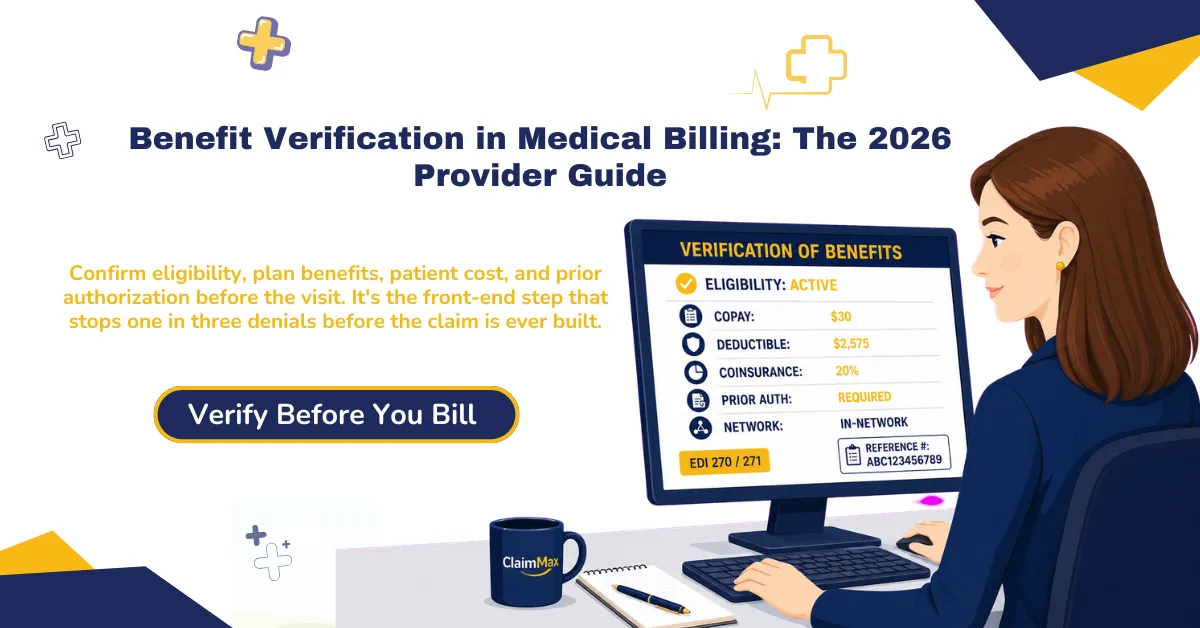
Benefit verification in medical billing, also called VOB (Verification of Benefits), is the proactive, compliance-driven process of confirming a patient’s insurance eligibility, plan-specific benefit details, financial responsibility, and prior authorization requirements before a single service is rendered.
Key Aspects of Benefit Verification
- Eligibility Check: Confirms the patient’s insurance plan is active on the date of service.
- Benefit Details: Verifies coverage for specific services, including remaining deductible, coinsurance, copay amounts, and out-of-pocket maximums.
- Authorization Check: Determines whether prior authorization or a referral is required before the procedure.
- Network Status: Identifies whether the provider is in-network or out-of-network to produce an accurate patient cost estimate.
Why Verification Is Non-Negotiable
- Reduces Denials: Prevents the most common claim rejections caused by inactive policies, uncovered services, and missing authorizations.
- Improves Cash Flow: Ensures higher clean claim rates, faster payment processing, and predictable revenue.
- Improves Patient Experience: Eliminates billing surprises and lets providers communicate out-of-pocket costs before the appointment.
The Four-Step VOB Process
- Collection: Obtain member ID, group number, DOB, plan type, and payer ID at scheduling.
- Verification: Contact the payer via the 270/271 EDI transaction, online portal, or phone to confirm active coverage and specific benefits.
- Authorization: Secure pre-authorization for any services that require it before the appointment is confirmed.
- Documentation: Record all verified details, including reference numbers, representative name, date, and time, in the practice management system.
This guide is verified against the FY2026 ICD-10-CM Official Guidelines, the CMS Interoperability and Prior Authorization Final Rule CMS-0057-F (effective January 1, 2026), and the CMS HETS Medicare eligibility attestation requirements updated May 11, 2026. Every workflow recommendation reflects current payer rules, not 2024 or 2025 standards.
What Is Benefit Verification in Medical Billing?
Benefit verification in medical billing is the process of confirming what a patient’s insurance plan actually covers: the specific services, the amounts the patient owes out of pocket, and whether prior authorization is needed before the provider renders care.
What does VOB stand for, and how is it different from VOE? VOE (Verification of Eligibility) answers one question: is the patient’s insurance active on the date of service? It’s a binary check.
VOB (Verification of Benefits) goes further and answers what that active insurance actually pays for. Verification of benefits in medical billing is the step that surfaces the dollar amounts.
That means copays, remaining deductibles, coinsurance rates, service-specific coverage limits, prior authorization requirements, referral requirements, and in-network status for both the provider and the facility. The eligibility verification in medical billing step alone can’t surface any of that.
Missing the VOB step and only completing VOE is the billing team’s most expensive routine error. A patient can walk in with a fully active Blue Cross card and still generate a denied claim if the specific service wasn’t covered, the provider was out-of-network, or a required prior authorization wasn’t obtained.
ClaimMax RCM’s eligibility verification and prior authorization service handles both VOE and VOB for practices across all specialties. It confirms active coverage, verifies plan-specific benefits, and flags prior authorization requirements before the first patient walks through the door.
Eligibility Check, Benefit Verification, and VOB: What Each One Actually Covers
Three terms get used interchangeably in billing offices, but they represent three distinct steps with different data outputs and different consequences when skipped.
| Eligibility Check | Benefit Verification | VOB | |
|---|---|---|---|
| What It Confirms | Active insurance status on date of service | What the active insurance covers | All coverage details plus patient financial responsibility |
| When It Happens | At scheduling, and again day-of-service | 48 to 72 hours before appointment | Before scheduling high-cost or specialized services |
| Primary Tool | EDI 270/271 transaction or portal | Payer portal, phone, EDI 271 response | Direct payer contact or specialized VOB platform |
| Risk if Skipped | Claims denied for inactive coverage | Claims denied for non-covered services or missing PA | Surprise patient bills, bad debt, and coordination of benefits errors |
The eligibility check is the fastest of the three, often automated through a clearinghouse 270/271 transaction in under 60 seconds. Benefit verification takes longer because it requires reading the 271 response for benefit-level details, and sometimes calling the payer to confirm service-specific coverage or PA requirements. This is the eligibility in medical billing distinction most front desks blur.
VOB is the most comprehensive check, and it’s standard practice for behavioral health, DME, and high-cost specialty procedures. It captures everything the eligibility check and benefit verification cover, plus coordination of benefits status, secondary payer information, and session or visit limits. Eligibility and benefits verification at the VOB tier is where surprise bills get prevented.
Why Benefit Verification Matters: The Numbers Every Provider Needs to See
Accurate benefit verification in medical billing isn’t just good practice. The data shows it’s the single most financially leveraged step in the front-end revenue cycle.
For Providers: What Skipping Verification Actually Costs
MGMA data shows 25 to 36% of all denied claims trace back to eligibility and missing information errors. That’s not a coding problem or a documentation problem. It’s a front-end verification failure that a thorough VOB process catches before the claim is ever built.
Prior authorization failures account for 19% of all claim denials, per MGMA. Benefit verification is the step that identifies whether a service requires PA. That makes the PA failure rate a direct function of verification quality, not just authorization team performance.
Experian Health’s research puts manual data entry error rates at up to 30% for practices relying on manual verification. The CAQH Index quantifies what automation fixes: electronic verification saves an average of 14 minutes per transaction and represents a potential industry-wide savings of $12.8 billion annually when practices shift from manual to electronic workflows.
Practices that skip verification create a downstream denial problem that ClaimMax RCM’s denial management services team resolves daily. The denial was preventable at the front end. The MGMA denial research backs every one of these figures.
For Patients: Why Verification Builds Trust and Speeds Up Collections
The average individual high-deductible health plan carries a $2,575 deductible, per Kaiser Family Foundation data. Patients who don’t know their deductible status before a visit are blindsided by bills they didn’t budget for. That surprise doesn’t just damage the patient relationship. It directly reduces collection rates.
When benefit verification communicates patient financial responsibility before the appointment, practices collect more upfront and reduce outstanding patient balances. Informed patients are more likely to arrive prepared to pay, set up payment plans, or ask questions that front-desk staff can answer at scheduling rather than during a billing dispute weeks later.
Roughly 18% of patients provide incorrect insurance information at intake, according to Experian Health. Verification catches those errors before service, not after a claim denial that requires resubmission, patient outreach, and billing staff time to correct.
Benefit Verification in 2026: The Regulatory Changes That Change Your Workflow
Three federal rules that took effect in 2026 directly change how benefit verification in medical billing is performed, documented, and timed. Most billing guides published before June 2026 don’t cover any of them.
CMS-0057-F: Prior Authorization Timelines Now Apply to Your VOB Workflow
CMS Interoperability and Prior Authorization Final Rule CMS-0057-F took operational effect January 1, 2026. Impacted payers must now respond to standard prior authorization requests within 7 calendar days and expedited requests within 72 hours, regardless of how the request was submitted.
For benefit verification teams, this changes one specific workflow element. When you flag a PA requirement during VOB, document the PA request submission timestamp. If the payer exceeds the 7-day window, that documented timestamp supports an expedited appeal citing CMS-0057-F payer non-compliance.
ClaimMax RCM’s prior authorization team tracks submission timestamps, payer response windows, and expedited appeal triggers for every PA-required service. That’s the exact workflow CMS-0057-F now requires practices to have documented.
CMS HETS Attestation: Medicare Eligibility Verification Requires a New Authorization Step
On May 11, 2026, CMS transitioned to a new HETS (HIPAA Eligibility Transaction System) trading partner management system. Any practice using a third-party vendor or clearinghouse to perform Medicare eligibility verification must now complete a formal provider attestation authorizing that trading partner to query Medicare data.
If your practice hasn’t completed the HETS attestation for every NPI in use, your Medicare eligibility queries may be blocked or delayed. Contact your clearinghouse or RCM vendor to confirm attestation status before your next Medicare verification batch runs. This eligibility verification process in medical billing step is new for 2026.
CMS-0053-F: Electronic Claims Attachments Now Require Documented Verification Records
The CMS Electronic Claims Attachments and Electronic Signatures Final Rule (CMS-0053-F) took effect May 26, 2026, with a compliance deadline of May 26, 2028. It adopts national standards for electronic documentation attached to claims, including X12N 275 and 277 transactions.
For benefit verification, this means the verification record, what was confirmed, by whom, with what reference number, and on what date, is increasingly expected as a structured electronic document, not a handwritten note or a screenshot.
2025 Marketplace Integrity Rule: ACA Patients Now Require Stricter Pre-Enrollment Verification
The 2025 Marketplace Integrity and Affordability Final Rule reinstates pre-enrollment verification for Special Enrollment Periods and adds income documentation requirements for certain auto-renewed plans.
Practices with ACA marketplace patients should re-verify eligibility for all marketplace enrollees who came in through a Special Enrollment Period since January 1, 2026. The CMS HETS Medicare eligibility system governs the Medicare side of these checks.
How to Verify Insurance Benefits as a Provider: The 2026 Seven-Step Process
Here’s the complete benefit verification in medical billing process that a 2026-compliant billing team runs for every patient, every visit, regardless of whether the patient is new or established. This is how to do insurance verification correctly.
- Collect Insurance Information at Scheduling. Gather the patient’s full legal name, date of birth, member ID, group number, plan type, insurance carrier, policyholder name (if different), and secondary insurance details. Collect this at scheduling, not at check-in when time pressure causes transcription errors.
- Confirm the Correct Payer and Plan Type. Before running any verification, identify whether the patient is on a Medicare FFS plan, a Medicare Advantage plan, Medicaid FFS, a Medicaid MCO, a commercial PPO or HMO, an ACA marketplace plan, TRICARE, or a self-funded employer plan. Each type has different verification channels, rules, and timelines.
- Run the EDI 270 Eligibility Inquiry Through Your Clearinghouse. Submit the X12 270 eligibility inquiry through your clearinghouse to the payer. The payer returns a 271 eligibility response, the structured electronic reply that confirms active coverage and benefit-level details. Ninety percent of all eligibility verifications in the U.S. now run through this electronic standard.
- Interpret the 271 Response for Benefit-Level Details. Read the 271 response for copay amounts, coinsurance rates, remaining deductible, out-of-pocket maximum, and service-specific coverage limits. When the 271 response is ambiguous, especially for behavioral health carve-outs or specialty services, call the payer’s provider services line to confirm.
- Verify Prior Authorization Requirements. Check whether the planned service requires PA. If yes, confirm the PA submission channel, required clinical documentation, medical necessity criteria, and the expected decision timeline under CMS-0057-F’s 7-day standard. Initiate the PA request immediately. Don’t wait until the day before the appointment. For practices using clearinghouses to run 270/271 transactions, ClaimMax RCM’s clearinghouses in medical billing guide covers the ten largest clearinghouses and their payer connectivity for specialty-specific verification.
- Communicate Patient Financial Responsibility Before the Visit. Contact the patient at least 48 hours before the appointment with their copay amount, estimated coinsurance, and remaining deductible. Patients who know what they’ll owe before the visit are far more likely to arrive prepared to pay or to proactively discuss payment arrangements.
- Document Everything in the Practice Management System. Record the 271 response file or portal screenshot, the payer representative’s name if you called, the reference number, the date and time of verification, and any PA reference numbers obtained. This documentation serves as your audit trail if the payer later disputes the coverage status.
The X12 270 eligibility inquiry is the electronic standard for benefit verification in the U.S., submitted through a clearinghouse to the payer via the HIPAA eligibility transactions (270/271) standard. It generates over 20 billion transactions annually.
Every step in this process is part of what ClaimMax RCM’s revenue cycle management team executes for practices that outsource front-end verification to reduce denial rates and protect clean claim performance.
The Complete VOB Verification Checklist for 2026: Every Item Your Team Must Confirm
A benefit verification in medical billing process is only as consistent as its documentation. This benefit verification in medical billing checklist covers every item your team must confirm before any patient appointment. Use it as a benefit verification in medical billing template you can print, and save a benefit verification in medical billing pdf version in your intake SOP.
Group 1: Patient and Insurance Data (Collect at Scheduling)
- Patient’s full legal name exactly as it appears on the insurance card
- Date of birth
- Member ID or subscriber ID
- Group number
- Insurance carrier name and payer ID
- Plan type (HMO, PPO, EPO, POS, Medicare Advantage, Medicaid MCO, ACA marketplace)
- Policyholder name and relationship to patient (if different from patient)
- Secondary insurance carrier, member ID, and group number (if applicable)
- Primary Care Provider name (for HMO and gatekeeper plans requiring referrals)
- Effective date of current coverage
Group 2: Benefit and Coverage Details (Confirm 48 to 72 Hours Before Appointment)
- Policy status (active or inactive on the scheduled date of service)
- Network status of the treating provider (in-network or out-of-network)
- Network status of the treating facility (if applicable)
- Copay amount for the specific service type being rendered
- Coinsurance percentage
- Individual deductible (total amount and amount remaining)
- Family deductible (total amount and amount remaining, if applicable)
- Out-of-pocket maximum (total amount and amount remaining)
- Service-specific coverage (does the plan cover the exact procedure being scheduled)
- Visit or session limits (annual maximum, remaining visits)
- Prior authorization required (yes or no for the specific CPT code planned)
- Referral required (yes or no)
- Coordination of benefits (primary payer confirmed, secondary payer noted if applicable)
- Verification reference number and representative name (if phone verification)
- Date and time of verification completed
The CAQH operating rules for eligibility and benefits transactions define the minimum data elements payers must include in 271 responses, which is why every item in Group 2 above is systematically extractable through a compliant EDI 270/271 workflow. Knowing how to verify insurance eligibility and benefits at this level of detail is what separates clean claims from rework.
This checklist maps directly to Step 2 of the 13 steps of revenue cycle management, the insurance eligibility and benefit verification step that determines whether every downstream billing function succeeds or starts from a correctable error.
Practices that struggle to execute this consistently often find the root issue isn’t verification knowledge, it’s workflow scope. Medical billing vs revenue cycle management breaks down how benefit verification fits within a full RCM operation versus a standalone billing function.
Benefit Verification Rules by Insurance Type: Medicare, Medicaid, Commercial, and More
The verification method, the verification timing, and the specific benefit items to confirm all change depending on which type of insurance the patient carries. Medical insurance verification isn’t one process. It’s several, by payer.
Medicare Fee-for-Service Verification
Use the CMS HETS system for real-time 270/271 eligibility queries. Verify that the patient is on Medicare FFS and not enrolled in a Medicare Advantage plan. Many patients carry their original Medicare card while having switched to an MA plan without realizing it. Always check enrollment status before assuming FFS billing applies.
Medicare Advantage Verification
Medicare Advantage plans have plan-specific benefits, networks, copays, and prior authorization requirements that differ completely from Medicare FFS. Verify through the MA plan’s payer portal or call the plan’s provider services line directly. A Medicare card doesn’t confirm FFS coverage. Always check for MA enrollment through HETS or the specific MA plan portal.
Medicaid Verification
Medicaid eligibility changes more frequently than any other payer type. Verify Medicaid status on the day of service, not just 48 to 72 hours before. After the pandemic-era Medicaid unwinding, 8.2 million enrollees lost Medicaid eligibility, per HHS data.
Practices serving Medicaid patients should re-verify monthly for recurring patients. ClaimMax RCM’s billing for Medicaid guide covers state-specific Medicaid verification channels, MCO-specific rules, and the X12 270 transaction requirements for each state MMIS.
Commercial PPO and HMO Verification
Commercial plans require verifying in-network status for both the provider and the facility, separately. A provider can be in-network while the facility they practice at is out-of-network, creating unexpected patient liability. For HMO plans, confirm whether a referral from the PCP is required before the specialist appointment. Without a referral, the claim denies regardless of medical necessity.
If your providers aren’t yet enrolled with all active commercial payers, ClaimMax RCM’s credentialing services team manages payer enrollment before the first claim submission. That prevents the in-network status verification from returning an incorrect out-of-network designation for a provider who isn’t yet credentialed.
ACA Marketplace Plans Verification
The 2025 Marketplace Integrity and Affordability Final Rule has tightened pre-enrollment verification for Special Enrollment Period enrollees. Verify ACA marketplace coverage through Healthcare.gov’s Verify Eligibility portal or the plan’s payer portal directly. ACA plans with premium tax credit subsidies can have coverage lapses if subsidy reconciliation creates retroactive plan terminations.
TRICARE Verification
TRICARE has strict network and referral requirements that vary by TRICARE plan type (TRICARE Prime, Select, For Life). Verify through the TRICARE portals (Humana Military or TriWest) and confirm the specific TRICARE plan, not just that the patient has military coverage. Billing TRICARE Select rates for a TRICARE Prime patient generates an immediate denial.
Getting payer-specific verification right is what converts into a what is a clean claim in medical billing. A claim built on verified, payer-specific benefit data has no front-end failure points, and front-end accuracy is where 95% clean claim rates are built or lost.
Coordination of Benefits Verification: When Your Patient Has Primary and Secondary Insurance
Coordination of Benefits (COB) verification is the process of identifying which insurance plan is primary and which is secondary when a patient has two active insurance policies.
When a patient has two insurance plans, billing the wrong one first triggers an immediate denial. The primary plan processes the claim first and pays its share. The secondary plan then processes the remaining balance. Reversing that order generates a denial from the secondary payer, because secondary claims require a primary EOB before processing.
COB verification is one of the most time-consuming verification steps, because payer portals don’t always surface secondary insurance data automatically. The biller has to confirm which plan is primary, what the primary plan covers, what the patient’s responsibility is after primary payment, and whether the secondary plan has coordination of benefits rules that reduce or eliminate secondary payment.
Here’s the COB verification mini-process:
- Identify all active insurance policies during scheduling using the patient intake form.
- Determine the primary payer based on plan rules (birthday rule for dependents, employment-based plan rules for patients with two employer plans).
- Run the 270 inquiry to the primary payer first and document the 271 response.
- Confirm secondary payer coverage and COB policy rules through the secondary payer’s portal or provider services line.
- Document both verifications with separate reference numbers in the practice management system.
COB verification is one of the most error-prone steps in benefit verification in medical billing workflows, and one of the most common drivers of secondary payer denials. ClaimMax RCM’s benefits of outsourcing revenue cycle management analysis shows why high-volume practices save 49% on verification costs by outsourcing COB-heavy workflows to specialized RCM teams rather than adding front-desk staff.
What Skipping Benefit Verification Actually Costs: Denial Codes, Rework Time, and Revenue Loss
Every verification failure generates one of five denial types. Each type has a specific CARC code, a specific cause, and a specific fix, but the cheapest fix is the one you run before the claim is ever built.
| Verification Failure | Resulting Denial | CARC Code | Fix Cost vs Prevention Cost |
|---|---|---|---|
| Policy inactive on date of service | Claim denied for ineligible patient | CARC 27 | Rework: 45 to 90 minutes per claim. Prevention: 60-second EDI check |
| Wrong payer billed (MA patient billed to FFS) | Claim denied for wrong payer | CARC 109 | Rework: resubmission plus patient contact. Prevention: plan type confirmed at scheduling |
| Service not covered under the plan | Medical necessity denial | CARC 50 | Rework: appeal with clinical notes. Prevention: service-specific coverage confirmed at VOB |
| Missing prior authorization | Authorization-related denial | CARC 15 | Rework: retroactive PA request (often denied). Prevention: PA flag at VOB step |
| COB order reversed | Secondary payer denial | CARC 22 | Rework: obtain primary EOB and resubmit. Prevention: COB confirmed at verification |
The rework cost for a single denied claim averages $25 to $118 in labor, depending on claim complexity and appeal depth. At a denial rate of 5% of claims, already below the MGMA-cited industry average, a practice submitting 500 claims per month faces 25 denied claims and significant monthly rework expense from preventable errors.
Front-end benefit verification prevents every denial type in the table above. The same claim that costs $118 to rework after denial costs a fraction of that to prevent through an automated EDI 270/271 verification workflow. That ROI is why CAQH’s 2024 data shows $12.8 billion in annual savings opportunity still sitting uncaptured in manual verification workflows across the industry.
The math on benefit verification investment versus denial rework cost is unambiguous. Every dollar spent on systematic front-end verification returns three to ten dollars in recovered revenue and avoided rework, according to HFMA revenue cycle benchmark data.
Verification Technology in 2026: Real-Time EDI, Automated Workflows, and What the FHIR API Means for Providers
Real-time eligibility verification technology is no longer optional for practices running more than 50 appointments per week. CMS is accelerating the move toward API-based data exchange that will change how verification integrates with EHR and billing workflows by 2027.
What Real-Time EDI Verification Does, and What It Cannot Do
Real-time eligibility verification submits an X12 270 inquiry and receives the 271 response in under 60 seconds through a clearinghouse connection. It confirms active coverage, plan type, and basic financial responsibility data.
Ninety percent of practices that run real-time verification catch inactive coverage before the appointment rather than after the denial. Electronic benefits verification at this speed is the new baseline.
But a real-time 270/271 check doesn’t catch everything. It can miss behavioral health carve-outs, confirm a plan that has a service limitation the 271 doesn’t surface, or return an incomplete response that requires a phone call to the payer’s provider line.
Automated verification is the floor, not the ceiling, of a complete benefit verification workflow. The fastest benefit verification in medical billing platforms still need human review for these edge cases.
What EHR-Integrated Verification Actually Changes
EHR-integrated eligibility verification removes the manual transcription step. The EHR sends the 270 inquiry automatically and writes the 271 response back to the patient record, with no tab-switching, no manual ID entry, and no copy-paste. Per Innobot Health research, this real-time insurance eligibility verification integration saves 7 to 15 minutes per patient compared to portal-based manual verification.
At 50 appointments per week, that’s 350 to 750 minutes returned to billing staff every week. At 200 appointments per week, it’s over 50 hours.
The time savings don’t just reduce labor cost. They reduce verification errors caused by time pressure, which is where most transcription mistakes originate.
The top AI solutions for benefit verification in medical billing automate this entire write-back loop, and the move to automate verification of benefits in medical billing frees billing staff from manual portal checks. This is the medical insurance eligibility verification software category that practices ask about most.
The FHIR API Transition: What Providers Should Prepare for in 2027
CMS-0057-F’s FHIR API requirements take effect for most impacted payers beginning January 1, 2027. These APIs will let providers query prior authorization status, patient access data, and payer-to-payer data transfer in a standardized digital format. For benefit verification teams, this means real-time PA status will become queryable through EHR systems without a separate portal login or phone call.
Practices that design their verification workflow now to accommodate API-based data retrieval, rather than rebuilding after 2027, are positioning their billing operations ahead of the payer infrastructure transition. This means choosing EHR and practice management systems with confirmed FHIR readiness, not just current clearinghouse connectivity.
Frequently Asked Questions: Benefit Verification in Medical Billing
What is benefit verification in medical billing?
Benefit verification in medical billing, also called VOB or Verification of Benefits, is the process of confirming a patient’s active insurance coverage, plan-specific benefits, financial responsibility, and prior authorization requirements before any service is rendered. It goes beyond a basic eligibility check by confirming what the active insurance actually covers: copay amounts, remaining deductible, coinsurance rates, out-of-pocket maximum, service-specific coverage limits, and PA requirements. A complete VOB process is verified 48 to 72 hours before the appointment, and the results are documented in the practice management system with reference numbers, timestamps, and representative names for audit trail purposes.
What is the purpose of benefit verification?
The purpose of benefit verification is to prevent claim denials, eliminate surprise patient bills, and establish accurate patient financial responsibility before care is delivered. Benefit verification identifies inactive coverage before service, catches missing prior authorization requirements before appointment confirmation, confirms in-network status for both provider and facility, and surfaces COB order for patients with two insurance plans. According to MGMA, 25 to 36% of all claim denials trace back to eligibility and missing information errors, all of which a complete benefit verification process catches at the front end of the revenue cycle.
How do you verify insurance benefits as a provider?
To verify insurance benefits as a provider, run seven steps: collect insurance data at scheduling, confirm the correct payer type and plan, run the EDI 270 inquiry through your clearinghouse, interpret the 271 response for benefit details, flag any prior authorization requirements, communicate patient financial responsibility before the visit, and document all verified information with reference numbers in the practice management system. For Medicare patients, use the CMS HETS system for real-time 270/271 queries. For Medicaid patients, re-verify on the day of service. For patients with two plans, confirm COB order before billing either payer.
How do you obtain a benefit verification letter?
A benefit verification letter is a written confirmation from the insurance carrier documenting the patient’s active coverage, covered services, financial responsibility amounts, and prior authorization status as of a specific date of service. To obtain one, contact the payer’s provider services line and request written confirmation of the benefits verbally verified during the eligibility check. Ask for the verification reference number, the representative’s name, and the specific benefit details confirmed in writing. Document this in the patient record alongside the EDI 271 response. The letter serves as audit trail evidence if the payer later disputes the coverage status communicated during verbal verification.
What is the difference between eligibility verification and benefit verification?
Eligibility verification (VOE) confirms that a patient’s insurance policy is active on the date of service. It’s a binary check that takes under 60 seconds through an EDI 270/271 transaction. Benefit verification (VOB), the verification of benefits in medical billing step, goes further and confirms what that active policy covers: copay amounts, remaining deductible, coinsurance rates, out-of-pocket maximum, service-specific coverage limits, prior authorization requirements, and referral requirements. Treating VOE as a substitute for VOB is the most common front-end billing mistake in the industry. Claims pass basic eligibility edits and then deny on coverage grounds.
What is coordination of benefits in insurance verification?
Coordination of Benefits (COB) verification identifies which insurance plan is primary and which is secondary when a patient carries two active insurance policies. The primary plan processes the claim first. The secondary plan processes the remaining balance using the primary EOB. Billing the secondary payer before the primary generates an automatic denial (CARC 22), because secondary claims require a primary EOB as a prerequisite. The birthday rule governs primary payer determination for dependents covered under two parents’ employer plans.
What are the benefits of insurance verification for a practice?
The benefits of insurance verification for a medical practice are fewer claim denials, higher clean claim rates, faster payment cycles, more accurate patient estimates, reduced bad debt from uncollected patient balances, and lower rework costs. The CAQH Index shows electronic verification saves 14 minutes per transaction and represents $12.8 billion in annual industry savings. Practices that run real-time eligibility verification before every encounter typically report denial rates 40% lower than practices that rely on manual spot-checks. Verification is the highest-ROI step in the front-end revenue cycle.
How often should insurance eligibility be verified for returning patients?
Insurance eligibility for returning patients should be verified at every visit, not just at first intake. Coverage changes throughout the year: patients switch jobs, employers change plan designs, open enrollment periods alter deductibles and networks, and Medicaid eligibility terminates without notification to providers. As a minimum standard, re-verify all returning patients 48 hours before each appointment. For Medicaid patients specifically, re-verify on the day of service and run a monthly batch verification for high-volume Medicaid patient panels. Coverage changes affect 5 to 10% of patients annually, per Office Ally research.
Stop Losing Revenue to Preventable Verification Errors
Benefit verification failures are responsible for 25 to 36% of all claim denials, and every one of those failures is preventable with a systematic, 2026-compliant verification workflow run before the appointment, not after the denial.
ClaimMax RCM handles complete eligibility verification and prior authorization for practices across all specialties. Our team runs real-time EDI 270/271 verification, confirms service-specific benefits, flags and submits prior authorization requests, verifies COB order, and documents everything with audit trail records that protect your claims from payer disputes.
Our medical billing service includes benefit verification as a standard front-end function, not an add-on. Contact ClaimMax RCM to run a free verification audit on your current workflow and see exactly where your denial rate can be reduced.