CPT code 99349 is the evaluation and management (E/M) code for a home or residence visit with an established patient. The visit needs moderate medical decision making (MDM) or at least 40 minutes of total time on the date of the encounter. Either one qualifies.
Two things changed for this code heading into 2026. Medicare started paying the G2211 add-on with home and residence visit codes on January 1, 2026. Noridian’s Jurisdiction F medical review team published Targeted Probe and Educate results on 99349 for claims from October 1 to December 31, 2025.
CPT 99349 quick facts for 2026
Checked against CMS and AMA sources on September 28, 2026
| Fact | 2026 answer |
|---|---|
| Code family | Home or residence services, established patient (99347 to 99350) |
| Level selection | Moderate medical decision making, or 40 minutes or more of total time on the date of the encounter |
| Time ceiling | None in the descriptor; 60 minutes meets the 99350 threshold |
| Medicare place of service codes | 12, 13, 14, 33, and 55 |
| Status | Active for 2026 dates of service; the AMA revised it in 2023 |
| Global period | XXX, so global surgery rules don’t apply |
| 2026 national Medicare payment | $132.27 (non-QP) or $132.93 (QP), from 3.96 RVUs, before locality adjustment |
| G2211 add-on | Payable with 99349 for Medicare since January 1, 2026 |
| Prolonged service add-on | None at this level; prolonged codes attach to 99350 |
| Homebound requirement | None |
| Medicare telehealth | Listed on the CY 2026 Medicare telehealth services list |
What is CPT code 99349? The official AMA descriptor
99349 is the established patient CPT code for a moderate-complexity home or residence E/M visit. It sits one level below 99350, the top code in the established patient home series. Picture a patient whose heart failure is getting worse. The provider changes the medication during the home visit.
The 99349 CPT code description, word for word
The CPT code 99349 description comes from the AMA’s 2023 E/M revision, and claims for 2026 dates of service use the same wording. It reads in full:
Home or residence visit for the evaluation and management of an established patient, which requires a medically appropriate history and/or examination and moderate level of medical decision making. When using total time on the date of the encounter for code selection, 40 minutes must be met or exceeded.
Source: AMA’s 2023 E/M guidelines. The AMA marks 99349 in that document with a triangle, its symbol for a revised code.
What each part of the descriptor means on a claim
Each phrase in the descriptor controls a different part of the claim, and auditors read the note against each one.
| Descriptor phrase | What it means for billing |
|---|---|
| “Home or residence” | The patient’s private home plus four other residential settings Medicare recognizes: POS 13, 14, 33, and 55 |
| “Established patient” | Professional services from the same physician or qualified health care professional (QHP), or one of the exact same specialty and subspecialty in the same group, within the past three years. NPs and PAs who work with physicians count as the same specialty. |
| “Medically appropriate history and/or examination” | Required in the note at the provider’s judgment; it doesn’t set the level |
| “Moderate level of medical decision making” | Two of the three MDM elements meet or exceed moderate |
| “40 minutes must be met or exceeded” | A minimum, with no upper limit written into the descriptor |
Some references still describe 99349 as moderate to high complexity. That wording traces to the pre-2023 descriptor, which called the usual presenting problems moderate to high severity. The current descriptor says moderate. A visit with high MDM belongs at 99350.
If you’re searching for the CPT code for a home visit with an established patient, 99349 covers the moderate level and three other codes cover the rest. Our home health CPT codes guide maps the full home or residence family next to the G-codes that home health agencies bill.
Is CPT code 99349 still active in 2026?
Yes. CPT 99349 is active for 2026 dates of service. The AMA revised it in 2023 when it merged the home and domiciliary code families, and CMS pays it under the CY 2026 Physician Fee Schedule. Its neighbors in the established patient series, 99347, 99348, and 99350, are active too.
Some older reference PDFs still carry the pre-2023 wording, which required “at least 2 of these 3 key components.” If a 99349 description lists history and exam as components, it predates the 2023 revision. Coders trained on that version may still level home visits by counting exam bullets. Retrain them on MDM and time.
Deleted home visit codes that still cause denials
The 2023 merger deleted a group of codes that some charge masters still carry. People still search the 99343 CPT code description three years later. Payers deny CPT code 99343 on any date of service from 2023 on. The 99334 CPT code gets the same treatment.
| Deleted code | What it was | What to bill now |
|---|---|---|
| 99343 | New patient home visit | 99342, 99344, or 99345, based on MDM or time |
| 99324 to 99328 | Domiciliary or rest home visit, new patient | 99341 to 99345 |
| 99334 to 99337 | Domiciliary or rest home visit, established patient | 99347 to 99350 |
| 99339 and 99340 | Domiciliary or home care plan oversight | No one-to-one replacement; Medicare home health plan oversight uses G0181 |
| 99346 | Not a valid home visit code | Nothing; payers reject it as an invalid code |
Pull these codes from your charge master and from any provider pick lists. A new provider in a hurry will pick a deleted code sooner or later if it’s still in a dropdown. You won’t see the denial for weeks.
How a visit qualifies for 99349: Moderate MDM or 40 minutes
A home visit qualifies for 99349 when the note supports moderate MDM or at least 40 minutes of total time on the date of the encounter. One pathway is enough. Since 2023, history and exam don’t set the level, although the provider still documents a “medically appropriate” version of each.
For CPT code 99349, the provider picks whichever pathway the note supports better, and the choice can change from visit to visit. A long visit with a stable patient may qualify on time. Short visits often qualify on MDM.
Pathway 1: Moderate medical decision making
MDM has three elements: the problems addressed, the data reviewed and analyzed, and the risk of patient management. Two of the three must meet or exceed moderate. The AMA’s E/M table for MDM defines each level, and auditors score your note against that table one element at a time.
AMA requirements for moderate medical decision making (two of three elements must meet or exceed moderate)
| Element | What counts as moderate |
|---|---|
| Problems addressed | One or more chronic illnesses with exacerbation, progression, or side effects of treatment; two or more stable chronic illnesses; one undiagnosed new problem with uncertain prognosis; one acute illness with systemic symptoms; or one acute complicated injury |
| Data reviewed and analyzed | One of three categories: (1) any combination of three from review of prior external notes from each unique source, review of the result of each unique test, ordering of each unique test, or assessment requiring an independent historian; (2) independent interpretation of a test performed by another physician or QHP, not billed on its own; (3) discussion of management or test interpretation with an external physician, QHP, or appropriate source, not billed on its own |
| Risk of patient management | Prescription drug management; decision regarding minor surgery with identified patient or procedure risk factors; decision regarding elective major surgery without identified patient or procedure risk factors; or diagnosis or treatment “significantly limited by social determinants of health” |
Take an 82-year-old patient with heart failure whose weight is up four pounds since last week. The provider increases the diuretic and orders a weight recheck in three days. That’s a chronic illness with exacerbation plus prescription drug management. Two elements reach moderate, and a thin data element can’t pull the level down.
One common scoring mistake involves data. Reviewing a single outside record doesn’t meet the moderate data element by itself. Category 1 needs three items in any combination, such as one external note, one lab result, and one test order.
Pathway 2: 40 minutes of total time
The time requirement for 99349 is 40 minutes or more of total practitioner time on the date of the encounter. Per the 99349 CPT code description time rule, 40 minutes “must be met or exceeded.” That makes 40 a floor. Time-based E/M coding for home visits counts the practitioner’s own work that day, with or without the patient present.
The AMA counts these activities toward total time:
- Preparing for the visit, including reviewing records and tests
- Obtaining or reviewing history gathered by someone else
- Performing the exam
- Counseling the patient, family, or caregiver
- Ordering medications, tests, or procedures
- Referring and talking with other professionals, when those calls aren’t billed on their own
- Documenting the visit in the record
Travel time doesn’t count. The AMA’s guideline reads: “When selecting code level using time, do not count any travel time.” Clinical staff time doesn’t count either, and neither does time spent on another billed service or on another date.
In practice, 99349 covers 40 to 59 minutes, because 60 minutes meets the 99350 threshold. No upper limit appears in the descriptor. A 57-minute visit that stays at moderate complexity still bills as CPT code 99349. Some guides present 40 to 59 minutes as the descriptor’s range; that ceiling comes from the next code’s floor.
Document both pathways when you can
Record the time even when the MDM carries the visit. If an auditor scores the MDM one level lower than your provider did, a documented total time can still support 99349. The reverse works too, when a short visit shows clear moderate complexity. A single line at the end of the note covers it:
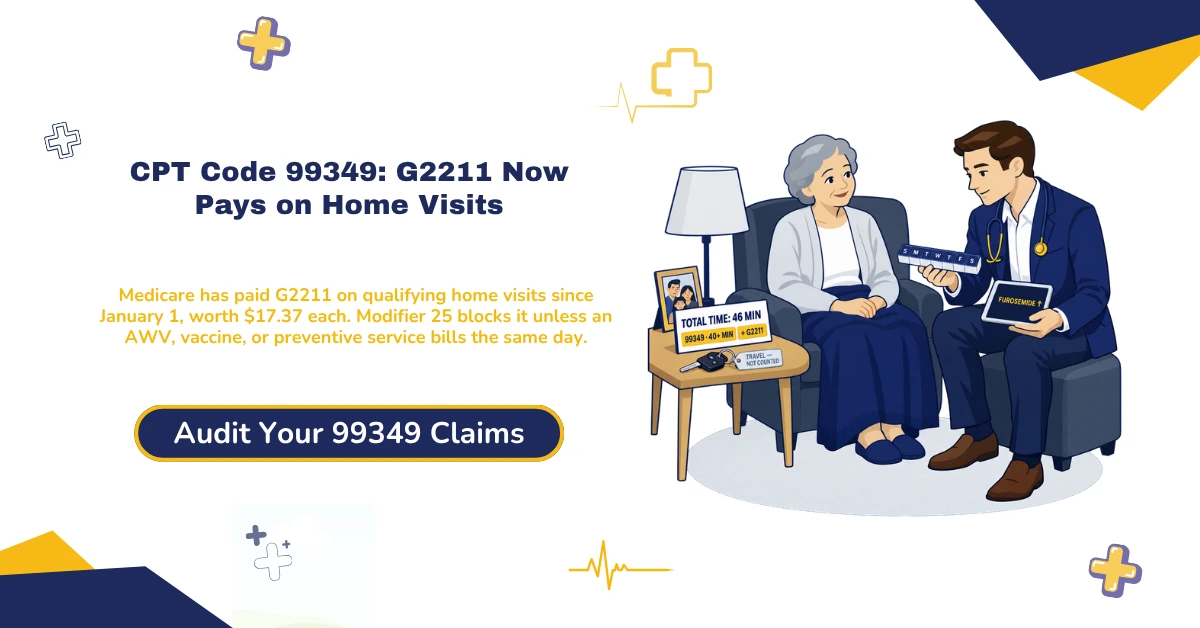
Total time on the date of service: 46 minutes, including record review, face-to-face evaluation, medication reconciliation with the caregiver, and documentation. Travel time is not included.
Coding 99349-level work as 99348 leaves about $53 per visit behind at the 2026 national Medicare rate. If you’d like a second set of eyes on home visit notes before claims go out, our medical billing services team checks them against the AMA’s MDM table.
99348 vs. 99349 vs. 99350: Choosing the right established patient level
The difference between 99348, 99349, and 99350 comes down to MDM level and minimum time. In order, that’s low MDM or 30 minutes, moderate MDM or 40 minutes, and high MDM or 60 minutes. CPT 99349 sits in the middle. Your note has to rule out both neighbors.
Established patient home or residence codes, 2026
| Code | MDM level | Minimum total time | 2026 national Medicare rate (non-QP) | Prolonged add-on |
|---|---|---|---|---|
| 99347 | Straightforward | 20 minutes | $46.09 | None |
| 99348 | Low | 30 minutes | $78.83 | None |
| 99349 | Moderate | 40 minutes | $132.27 | None |
| 99350 | High | 60 minutes | $193.06 | 99417 at 75 minutes or more (CPT payers); G0318 at 110 minutes or more (Medicare) |
E/M times for home codes are minimums, so time alone moves an established visit up a level at each threshold. At the bottom of the series, the 99347 CPT code description covers straightforward MDM or 20 minutes. Prolonged service codes attach to the top level. Our guide to CPT 99417 prolonged services covers the CPT rule.
When a visit moves up to 99350
The 99350 CPT code description matches 99349 except for two points: high MDM and a 60-minute time threshold. High MDM needs two of three elements at high. Examples include a chronic illness with severe exacerbation or a decision about hospitalization.
A patient with a severe COPD exacerbation whose provider weighs hospital admission against treatment at home belongs at CPT code 99350, even at 45 minutes. Time isn’t the deciding factor there. Pick 99350 when the provider’s note documents that level of risk in plain terms.
When a visit stays at 99348
Low MDM often looks like one stable chronic illness managed at low risk. On time, the range is 30 to 39 minutes. The 99348 CPT code description time rule works the same way as 99349’s, with 30 minutes met or exceeded. A visit under 40 minutes with low MDM stays at CPT code 99348.
Refill visits trip up a lot of coders. Consider a stable hypertensive patient seen for a refill with no dose change. Prescription drug management puts risk at moderate, but the single stable illness keeps problems at low. With one element at moderate, the visit lands at low MDM and bills as 99348.
New patient home visit codes for comparison
A patient who hasn’t received services from anyone of the same specialty in your group within three years is a new patient, even at home. New patients use a separate set of home visit CPT codes with longer time thresholds, and 99343 no longer exists in that set.
| Code | MDM level | Minimum total time |
|---|---|---|
| 99341 | Straightforward | 15 minutes |
| 99342 | Low | 30 minutes |
| 99343 | Deleted in 2023 | Not applicable |
| 99344 | Moderate | 60 minutes |
| 99345 | High | 75 minutes |
CPT 99349 place of service rules: POS 12, 13, 14, 33, and 55
Medicare accepts 99349 with five place of service codes: 12, 13, 14, 33, and 55, according to Noridian’s home visit guidance. The POS on the claim has to match where the patient lives. Your office address doesn’t matter.
Getting the 99349 CPT code place of service right matters more for audits than for payment. All five settings pay the non-facility rate. A wrong POS inside this group usually doesn’t change the allowed amount, but it does break the match between the claim and the chart.
| POS | Setting | Billing note |
|---|---|---|
| 12 | Home (private residence) | The practitioner has to be in the home for an in-person visit |
| 13 | Assisted living facility | Report the facility address as the service location (Item 32, Loop 2310C) |
| 14 | Group home not licensed as an intermediate care facility for individuals with intellectual disabilities (ICF/IID) | Confirm the home’s licensure |
| 33 | Custodial care facility | A different setting from a nursing facility |
| 55 | Residential substance abuse treatment facility | Often missing from charge templates |
CPT’s definition of home includes temporary lodging such as a hotel or shelter. Medicare’s POS list for this code family doesn’t include POS 16, so check the payer’s policy before you bill a hotel or shelter visit. CPT code 99349 doesn’t cover nursing facility or skilled nursing facility residents.
The CPT code for assisted living visits after the 2023 merger
Before 2023, assisted living visits used the domiciliary and rest home codes, 99324 to 99337. Since January 1, 2023, those visits use 99341 to 99350 with POS 13. Residents of a nursing facility or skilled nursing facility take 99304 to 99310 instead, and our nursing facility code 99306 guide covers that family.
Place of service mistakes that put home visit claims at risk
POS errors on home visit claims often start in the practice management system, which fills in POS from the practice location by default. Our POS 12 billing rules guide covers the private home setting in more depth. Watch for these five errors:
- POS 11 on a home visit
- POS 12 for a patient who lives in assisted living
- A home code for a nursing facility resident
- POS 10 or 02 on an in-person visit
- No service facility address on a POS 13, 14, 33, or 55 claim
Who can bill 99349: Physicians, NPPs, and the in-person rule
Physicians and qualified nonphysician practitioners (NPPs), including nurse practitioners, physician assistants, and clinical nurse specialists, can bill CPT 99349 under their own NPI. The practitioner has to perform the visit in the patient’s residence. For an in-person visit, Noridian’s guidance says the “physician must be physically present in beneficiary’s home.”
NPP billing and the rendering NPI
NPPs who bill under their own NPI receive 85% of the Medicare Physician Fee Schedule amount, which puts 99349 at $112.43 before locality adjustment in 2026. State scope of practice and payer credentialing still apply. The rendering NPI on the claim has to belong to the person who did the visit.
Noridian’s Q4 2025 review of 99349 listed “the performing and billing providers are different” among its top three denial reasons. A common cause is a claim billed under the supervising physician’s NPI for a visit an NP did alone. Split or shared billing won’t fix it. CMS limits split or shared visits to facility settings.
Incident-to billing in a patient’s home
Incident-to billing needs direct supervision. In a private residence, that has meant the physician is in the home during the service. CMS’s CY 2026 final rule made virtual direct supervision through live audio and video permanent. The change covers services that require direct supervision, except those with a 010 or 090 global surgery period.
Ask your MAC how it applies that change to incident-to services in a residence. Don’t assume. The Medicare Benefit Policy Manual, Chapter 15, has a narrow general supervision exception for homebound patients in areas with no available home health agency. Noridian’s review flagged claims that “did not support incident-to criteria were met.”
Homebound status isn’t required
Medicare doesn’t require a patient to be homebound for 99341 to 99350. Noridian’s guidance states: “There is no requirement that patient must be homebound.” Homebound status is a home health benefit rule. For 99349, the note still has to show why the visit happened at home instead of the office.
NPs and PAs who start home visits before their Medicare enrollment or group reassignment clears are a common source of rendering NPI denials. Our credentialing and contracting services team tracks enrollment status so the first home visit claim goes out under an active NPI.
CPT code 99349 documentation requirements: What auditors look for
A defensible note for CPT code 99349 answers two questions for an auditor: why the provider saw the patient at home, and what supports the level. It also has to show who did the visit. Miss any of that and an auditor can take the payment back, whatever the quality of the care.
According to CMS E/M compliance tips, incorrect coding caused 49.1% of improper payments for E/M codes in the 2024 reporting period. Insufficient documentation caused 34.1%, and no documentation caused 13.1%. Together, those three causes account for 96.3%.
Medical necessity for a visit at home
Noridian’s education for its 99349 review sets out five expectations for medical necessity. Auditors look for each one in the note:
- A chief complaint or specific need for each visit, plus how the visit changed care
- A reason beyond inactive or chronic conditions alone
- A service that a visiting nurse or home health agency couldn’t provide
- A visit frequency close to what the patient would have in an office
- A documented reason for seeing the patient at home instead of the office
The last item needs a specific reason. A line like “patient uses a walker, can’t manage the clinic stairs, and has no ride” explains the home setting in one sentence. Noridian treats a visit without documented necessity as a social visit, and Medicare doesn’t pay for those.
What a 99349 note should contain
The 99349 documentation requirements come down to seven items. A coder should find each one without asking the provider a question:
- Date of service and exact location (address or facility name)
- Established patient status
- Chief complaint and interval history
- History and exam at the level the provider judged appropriate
- MDM elements at moderate, or total time in minutes
- Assessment and plan for each problem addressed
- Performing provider’s signature and credentials, matching the rendering NPI
Sample 99349 note excerpt (MDM pathway)
Illustrative example only. It shows how the MDM elements read in a note, and it doesn’t describe a real patient.
CC: Leg swelling and a 2.3 kg (5 lb) weight gain over four days, per the facility weight log.
HPI: 84-year-old with chronic systolic heart failure and CKD stage 3b, seen at her assisted living facility (POS 13). Mild shortness of breath on exertion.
Data: Reviewed facility nursing notes and weight log. Reviewed basic metabolic panel dated September 10, 2026. Ordered repeat BMP.
Assessment: Acute on chronic systolic heart failure with volume overload.
Plan: Increase furosemide from 40 mg daily to 40 mg twice daily. Daily weights. Repeat BMP in five days. Caregiver taught fluid limits.
MDM: Moderate. Chronic illness with exacerbation, three Category 1 data items, prescription drug management.
The visit stays at 99349 because nothing in the note reaches high MDM. If the provider had documented a decision about hospital admission, risk would move to high, and the provider could bill 99350 instead.
Diagnosis codes that often support a moderate home visit
Code the condition that drove the MDM first, then the conditions that explain the home setting. These ICD-10-CM codes are valid for FY2026. Confirm each one against the FY2027 code set, which takes effect October 1, 2026.
| ICD-10-CM | Description | Why it fits a 99349 visit |
|---|---|---|
| I50.23 | Acute on chronic systolic (congestive) heart failure | Exacerbation plus drug management |
| J44.1 | Chronic obstructive pulmonary disease with (acute) exacerbation | Exacerbation plus drug management |
| E11.65 | Type 2 diabetes mellitus with hyperglycemia | Therapy adjustment at moderate risk |
| N18.32 | Chronic kidney disease, stage 3b | Drives dosing decisions across the medication list |
| Z74.09 | Other reduced mobility | Supports the reason for a home visit |
| Z59.82 | Transportation insecurity | Supports the home setting and the social determinants risk element |
CPT 99349 reimbursement in 2026: RVUs, rates, and why sources disagree
The 2026 national Medicare payment for CPT code 99349 is $132.27 for clinicians paid at the non-QP conversion factor and $132.93 for qualifying APM participants, before locality adjustment. CMS set two conversion factors for 2026, $33.4009 and $33.5675, and the CMS CY 2026 fact sheet explains the split.
CPT code 99349 RVU breakdown, CY 2026
| Component | Value |
|---|---|
| Work RVU | 2.44 |
| Practice expense RVU (non-facility) | 1.36 |
| Malpractice RVU | 0.16 |
| Total RVU | 3.96 |
| Non-QP payment | 3.96 × $33.4009 = $132.27 |
| QP payment | 3.96 × $33.5675 = $132.93 |
You can confirm these values, and your own locality’s amount, in the CMS PFS Look-up Tool. Our figures come from the April 2026 national relative value file, and CMS updates that file each quarter.
Why sources show $103, $122, and $132 for 99349
Search results show three national figures for 99349. The $103.21 figure uses 3.09 total RVUs built on a 1.7 work RVU; CMS lists 2.44. A second figure, $122.59, multiplies 3.79 RVUs by $32.3465, which was the 2025 conversion factor. Only $132.27 uses the 2026 values. Check the year and the RVU inputs whenever two published numbers disagree.
Some guides claim home visits pay 60 to 70% more than office visits. That comparison dates to pandemic-era rules and deleted office codes. In 2026, office code 99214 pays $135.61 at the national rate (4.06 RVUs). That’s $3.34 more than 99349, as our 99214 Medicare reimbursement breakdown shows.
What your practice collects
Your MAC locality moves the national figure up or down through geographic practice cost indices (GPCIs). Pull your own number from the CMS tool, then apply the NPP reduction when an NP or PA billed the visit. Medicare pays 80% after the Part B deductible, and the patient owes 20% coinsurance.
Medicare Advantage and commercial plans set their own rates, and state Medicaid programs set theirs. The 99349 CPT code reimbursement in those contracts often tracks a percentage of the Medicare rate. Prior authorization and add-on rules differ too. Confirm the plan type before the visit; our insurance eligibility verification team runs that check at scheduling.
G2211 with CPT code 99349: The 2026 add-on rules
Starting January 1, 2026, Medicare pays add-on code G2211 with 99349. The practitioner has to be the continuing focal point for the patient’s care or manage a single serious or complex condition over time. G2211 carries 0.52 RVUs, or $17.37 at the 2026 national non-QP rate.
Paired with 99349, that’s $149.64 per visit before locality adjustment, or $150.39 at the QP rate. The usual Part B deductible and coinsurance apply to G2211. Patients see a small added balance.
When G2211 qualifies on a home visit
CMS describes two situations. In the first, the practitioner is the continuing focal point for all needed services, the way a primary care practice is. The second covers ongoing care for a single serious or complex condition. Home-based primary care fits the first one in most cases.
The CMS G2211 FAQ lists what the record should support: the history of the patient and practitioner relationship, the diagnoses, the assessment and plan, and the other services billed. RHCs and FQHCs don’t get separate payment for G2211. Medicare Advantage plans set their own policies.
The modifier 25 rule for G2211 on home visits
Medicare denies G2211 when the base E/M visit carries modifier 25. There’s one exception. If the same practitioner bills an annual wellness visit, a vaccine administration, or any Part B preventive service that day, G2211 still pays. CMS extended that exception to home or residence codes starting January 1, 2026.
| Claim lines | G2211 result |
|---|---|
| 99349-25 + G0439 + G2211 | Payable |
| 99349-25 + minor procedure + G2211 | Denied |
A missing G2211 on an eligible home visit leaves $17.37 behind at the national rate, and it’s easy to miss when providers bill from a home visit template. If you’d like that check built into charge review, our revenue cycle management team adds it as a standing edit.
Billing 99349 with other services: Modifiers, add-ons, and same-day rules
You can bill 99349 on the same day as an annual wellness visit, advance care planning, vaccines, or a procedure when the note supports a “significant, separately identifiable” visit. In our experience, most same-day problems with CPT code 99349 come from the modifier. Fewer come from the visit itself.
99349 CPT code modifier rules: 25, 95, GV, and GW
| Modifier | When it belongs on 99349 |
|---|---|
| 25 | A “significant, separately identifiable” visit on the same day as a procedure, AWV, or preventive service, written as 99349-25. It also decides whether G2211 pays. |
| 95 | A visit delivered by telehealth, when the payer requires the modifier. It doesn’t belong on an in-person visit. |
| GV | Hospice patient; the attending physician isn’t employed or paid by the hospice |
| GW | Hospice patient; the service isn’t related to the terminal condition |
Two other modifiers don’t belong on 99349. CMS’s NCCI guidance says not to use modifier 59 on E/M services, since modifier 25 covers a separate E/M visit. Modifier AI applies to initial hospital and nursing facility care, so a home visit doesn’t qualify. Our modifier 59 rules guide explains where 59 does fit.
AWV, advance care planning, and vaccines on the same day
A home visit that includes an annual wellness visit bills as 99349-25 plus the AWV code when the provider addresses a separate problem. Advance care planning (99497) done during the AWV takes modifier 33, which waives the patient’s cost sharing. Vaccine administration qualifies for the G2211 exception. Our G0439 wellness visit billing guide covers the AWV side.
Care management, TCM, and home health certification
Chronic care management (99490) can go on a claim in the same month as 99349, as long as the CCM time doesn’t include time spent on the visit. Our chronic care management codes guide covers the monthly time rules.
Transitional care management follows a different rule. The required face-to-face visit is part of 99495 or 99496, so a home visit that counts as that visit doesn’t get its own 99349 line. Later visits in the 30-day period can bill on their own, and our guide to TCM code 99496 covers the timing.
Home health certification (G0180) and recertification (G0179) cover work done without the patient present. Billers on AAPC’s forum report modifier denials when 99349 goes out with G0179. Check the current quarter’s NCCI procedure-to-procedure edit for your date of service before you add a modifier.
Why 99417 and G0318 don’t attach to 99349
Prolonged service codes attach to the highest level in each home series: 99345 for new patients and 99350 for established patients. Some guides say you can add a prolonged code once a 99349 visit runs 15 minutes past 40. Payers won’t pay it. A long visit moves up to 99350 once total time reaches 60 minutes.
Medicare uses its own HCPCS code instead of 99417. The G0318 CPT code description time rule requires 110 minutes with 99350 or 140 minutes with 99345. Medicare counts that time from three days before the visit through seven days after, per the CMS E/M services booklet.
Can CPT code 99349 be billed via telehealth in 2026?
Yes, for Medicare. The CMS telehealth services list for CY 2026 includes 99349 with the action “Maintain.” Medicare patients can receive non-behavioral telehealth at home through December 31, 2027, per HHS telehealth policy updates.
CMS dropped the provisional and permanent labels on the telehealth list for CY 2026, as the CMS CY 2026 rule summary explains. All eight active home or residence codes, 99341 to 99350, appear on that list.
An in-person CPT code 99349 visit still requires the practitioner in the home. A telehealth 99349 follows telehealth billing rules: POS 10 when the patient is at home and POS 02 for other locations, with modifier requirements that vary by payer. Our modifier 95 telehealth rules guide covers the modifier side.
Some billing references say 99349 isn’t on Medicare’s telehealth list; CMS’s own CY 2026 file lists it. Older guides mention the GQ modifier, which applies to asynchronous services in the Alaska and Hawaii federal demonstration programs. Medicaid and commercial plans keep their own telehealth code lists.
CPT code 99349 audit risk: Noridian’s TPE review and RAC topic 0011
99349 draws two kinds of Medicare scrutiny in 2026. Noridian runs a Targeted Probe and Educate (TPE) review of the code in Jurisdiction F, and Recovery Audit Contractor (RAC) reviews flag home visits billed during inpatient stays.
What Noridian’s 2025 review found
Noridian’s 99349 review results for October 1 to December 31, 2025, listed three top denial reasons. Jurisdiction F covers Alaska, Arizona, Idaho, Montana, North Dakota, Oregon, South Dakota, Utah, Washington, and Wyoming.
| Denial reason | What fixes it |
|---|---|
| Failure to return records | Track each additional documentation request (ADR) and answer by the deadline on the letter, often 45 days |
| Performing and billing providers are different | Bill under the NPI of the person who did the visit, with group reassignment in place |
| Documentation didn’t support incident-to criteria | Confirm supervision rules before billing incident-to in a residence |
The first reason is the easiest to prevent. Noridian denies the claim when the practice misses the ADR deadline, however good the note was. The second is a group practice billing problem at its root: the claim names one provider while the chart shows another.
How a TPE review escalates
A TPE round reviews 20 to 40 claims, and a provider can go through up to three rounds with education between each one. CMS gives the provider at least 45 days to improve before the next round, according to the CMS TPE program page.
Noridian refers providers who don’t improve after three rounds to CMS. CMS can then move to 100% prepayment review, extrapolation, a referral to a Recovery Auditor, or other action. Extrapolation applies the error rate from the sample to a larger set of past claims, and CMS recovers the overpayment across that whole set.
RAC topic 0011: Home visits during inpatient stays
RAC topic 0011 is an automated review, approved February 1, 2017, for all A/B MACs, and it lists 99349 as an affected code, per CMS approved RAC topics. Its description reads: “Home Services CPT Codes may not be used for billing services provided in settings other than in the private residence of a beneficiary.”
Under a related topic, 0115, Medicare denies professional claims with a home place of service that overlap an inpatient stay. Some guides say CMS bundles the home visit into the inpatient DRG. The DRG pays the hospital under Part A.
A practitioner who sees an admitted patient bills hospital codes, 99221 to 99223 or 99231 to 99233, with POS 21; our guide to subsequent hospital care codes covers that side. The edits compare dates, so a home visit in the morning and an admission that evening can still trigger a denial. Document both times in the note.
Common 99349 denials and how to fix them
Most 99349 denials we work trace to five causes: wrong POS, modifier errors, NCCI pair edits, missing home-setting necessity, or rendering provider problems. A CPT 99349 denial with CO-58 points to a POS that doesn’t match the setting in most cases.
| Denial code | What it usually means on 99349 | Fix |
|---|---|---|
| CO-58 or RARC M77 | POS doesn’t fit the service | Correct the POS (12, 13, 14, 33, or 55) and resubmit under the payer’s corrected claim process |
| CO-5 | Code doesn’t match the POS, such as POS 11 or 31 | Fix the POS or switch code families |
| CO-4 | Modifier conflict, such as 25 on the wrong line, 59 on an E/M, or 95 on an in-person visit | Correct the modifier |
| CO-236 | NCCI pair edit with a same-day service | Check the edit’s modifier indicator; add 25 only when the visit stands on its own |
| CO-97 | Bundled service, such as a TCM face-to-face visit billed as 99349 | Remove the line or rebill under the right code |
| CO-50 | No documented medical reason for the home visit | Appeal with records, then fix the note template |
| CO-16 with RARC N290 | Rendering provider NPI missing or invalid | Correct the rendering provider |
| CO-B7 | NPP not enrolled for the date of service | Finish enrollment and request a retroactive effective date where the payer allows it |
Fix the root cause before you resubmit. Medicare Part B handles clerical fixes through reopenings. For a Medicare redetermination, the first level of appeal, you have 120 days from the day you receive the initial determination.
Track these denials by code and by rendering provider each month. A pattern that repeats needs a workflow fix, and rebilling alone won’t stop it. That monthly trending is the core of our denial management services work for practices that bill home visits.
CPT 99349 billing guidelines: A pre-bill checklist
Run these seven checks before a 99349 claim leaves the practice. Each one stops a denial reason that shows up on home visit claims.
- Confirm established status: the patient saw someone of the same specialty in your group within three years.
- Match the POS to the residence, add the facility address for POS 13, 14, 33, or 55, and rule out an inpatient stay that day.
- Check the note against the CPT 99349 description: moderate complexity or 40 minutes or more, with travel excluded.
- Confirm a chief complaint and a documented reason for seeing the patient at home.
- Bill under the NPI of the person who did the visit, enrolled and reassigned to your group.
- Add G2211 where it qualifies, drop it from modifier 25 claims without an AWV, vaccine, or preventive service, and add GV or GW for hospice patients.
- Run the current quarter’s NCCI edits for same-day services and look for a second home visit on the same date.
Print this list as a one-page CPT code 99349 PDF checklist and keep it at the charge review desk. A printed list helps coders who work home visit claims in batches, because the checks are easy to skip when volume spikes.
Once home visit volume outgrows a manual check, our outsourced medical billing team runs these seven checks as claim edits before submission. Misses land in a work queue, where a coder fixes them before the payer sees the claim.
CPT code 99349 FAQs: Quick answers for billing teams
What is CPT code 99349 used for?
Practices bill 99349 for a moderate-complexity home or residence visit with an established patient. Under the CPT code 99349 description, the visit needs moderate medical decision making or at least 40 minutes of total time on the date of the encounter.
The code covers private homes and four other residential settings: assisted living facilities, group homes, custodial care facilities, and residential substance abuse treatment facilities. Nursing facility residents fall outside it and take 99304 to 99310.
What is the 99349 CPT code time requirement?
You need 40 minutes or more of total practitioner time on the date of the encounter. The 99349 CPT code description says 40 minutes “must be met or exceeded,” so the descriptor sets a floor with no ceiling. At 60 minutes, time alone supports 99350.
Total time includes record review, the visit, counseling, orders, care coordination, and documentation on that date. Travel time doesn’t count, and neither does clinical staff time or time spent on a service billed on its own.
How much does Medicare pay for 99349 in 2026?
The 2026 national Medicare amount is $132.27 at the non-QP conversion factor and $132.93 for qualifying APM participants, before locality adjustment. Adding G2211 brings the non-QP total to $149.64. Your MAC locality moves the figure up or down through GPCIs.
NPs and PAs billing under their own NPI get 85% of the fee schedule amount. Once the patient meets the Part B deductible, Medicare pays 80% and the patient owes the other 20%. Commercial and Medicare Advantage rates depend on each contract.
Can you bill 99349 on the same day as another service?
Yes, when the note supports a separate, identifiable visit. Modifier 25 goes on 99349 when you bill it with a procedure or a preventive service such as an annual wellness visit, and NCCI edits decide which pairs Medicare accepts.
G2211 still pays with 99349-25 when the other service is an AWV, a vaccine administration, or a Part B preventive service. Two home visits by the same provider on the same date don’t bill as two codes; combine the work into one visit and level it on the total.
Does 99349 have a global period?
No. 99349 carries a global indicator of XXX in the Medicare Physician Fee Schedule, so global surgery rules don’t apply to it. The visit doesn’t start a postoperative period of its own.
A procedure can still affect the claim. If your provider did a procedure with a 10-day or 90-day global period, a later home visit in that window for an unrelated problem takes modifier 24. Visits for the surgical problem itself stay inside the global package, and the payer won’t pay them as 99349.
Can a nurse practitioner bill 99349?
Yes. Nurse practitioners can bill 99349 under their own NPI when they perform the visit in the patient’s residence, and the same rule covers physician assistants and clinical nurse specialists. State scope of practice and payer enrollment still apply. Medicare pays them 85% of the fee schedule amount.
The rendering NPI has to match the person who did the visit; Noridian’s 2025 review of 99349 found claims where the performing and billing providers differed. Incident-to billing in a home usually needs direct supervision, so confirm your MAC’s rules first.
Does a patient have to be homebound for 99349?
No. Medicare doesn’t require homebound status for home or residence visits, and Noridian’s guidance says so in writing. Homebound status belongs to the home health benefit, which pays home health agencies.
For 99349, the note has to show why the provider saw the patient at home instead of the office, such as limited mobility or no reliable transportation. Without that reason in the note, Noridian can deny the claim as a social visit, and a visit for the provider’s convenience doesn’t qualify.
Can 99349 be billed for an assisted living resident?
Yes. Since January 1, 2023, assisted living visits use the home or residence codes, 99341 to 99350, with POS 13. The old domiciliary codes, 99324 to 99337, no longer exist, and payers deny claims that still carry them.
Report the facility’s address as the service location in Item 32 of the CMS-1500, which is Loop 2310C on the 837P. If the patient lives in the nursing facility section of a continuing care community, use 99304 to 99310 instead.
What to fix first if you bill 99349
Three fixes recover the most money on the home visit claims we review:
- Capture G2211 on qualifying visits, including the modifier 25 exception.
- Match the POS and rendering NPI to the visit before the claim goes out.
- Document MDM and total time together in each note.
A missed G2211 costs $17.37 per visit at the 2026 national rate. Across 200 CPT 99349 visits a month, that’s $3,474 your providers earned and didn’t collect.
If home visits make up a real share of your revenue, ClaimMax RCM can review last quarter’s 99349 claims with your team and show you which ones left money unpaid.