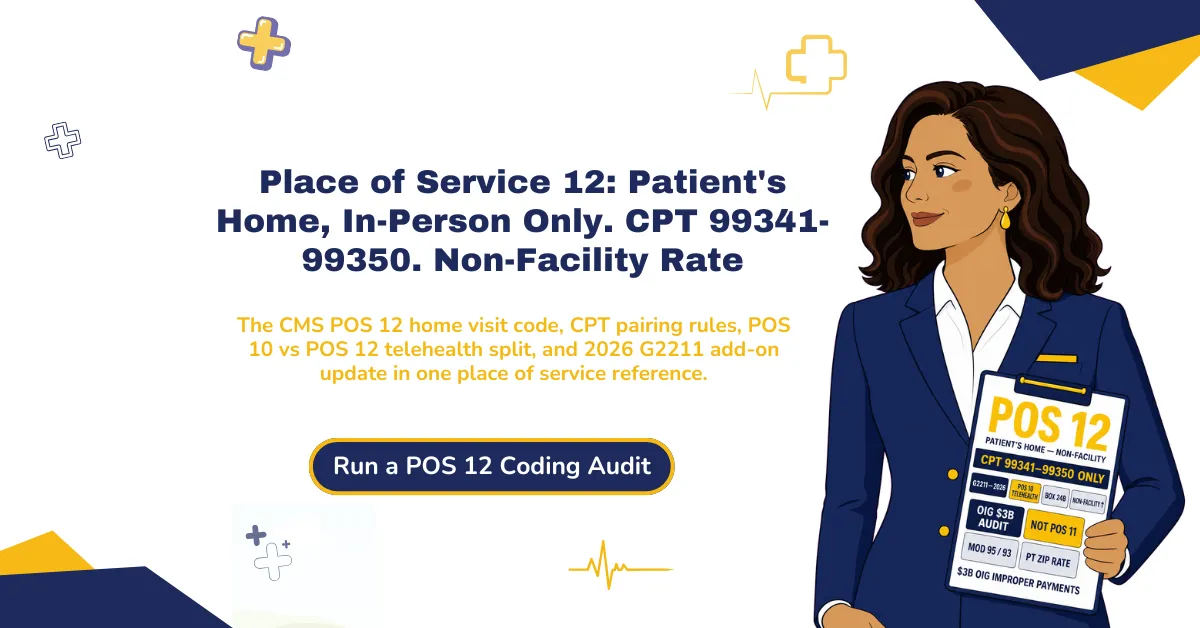
Place of Service 12 (POS 12) designates the patient’s home.
It’s used in medical billing to indicate that a healthcare service, such as a home visit, chronic care management, wound care, or palliative care, was rendered in the patient’s private residence, not in a clinical or facility setting.
Selecting the right pos 12 in medical billing code determines how your claim gets paid, whether it processes cleanly, and whether it survives audit.
12 pos in medical billing decisions start before the claim is coded. POS codes aren’t administrative formalities. They determine reimbursement rates, trigger different payer coverage rules, and create audit exposure when they’re wrong.
The OIG 2023 report documented over $3 billion in improper Medicare payments linked to pos 12 medical billing misrepresentation and other POS code errors. A wrong two-digit code entry costs more than a resubmission, it costs reimbursement.
Three Key Guidelines for Place of Service 12
Guideline 1: Private Residence Only. POS 12 is strictly for in-person clinical care provided in a private home, apartment, or townhome. It must not be used for assisted living facilities (POS 13), group homes (POS 14), or any other licensed care setting. Each excluded setting has its own dedicated CMS POS code.
Guideline 2: No Telehealth. POS 12 is for in-person visits only. When telehealth is provided to a patient at home, the correct code is POS 10, not POS 12. This is the pos 12 vs pos 10 distinction that generates the most preventable denials in home-based care billing. When telehealth is provided outside the patient’s home, the correct code is POS 02. Using POS 12 for a telehealth visit creates a documentation conflict.
Guideline 3: Specific E/M Codes Required. Providers must use home-visit Evaluation and Management codes (CPT 99341 through 99350) with POS 12, not standard office visit codes (CPT 99202 through 99215) used with pos 11 in medical billing. CGS Medicare identified this as a specific denial trigger in their Kentucky Part B region: office E/M codes were being incorrectly processed when submitted with POS 12. That is an automatic denial.
Wound Care CPT Code Quick Reference: 2026 Complete POS Code Reference for Healthcare Providers
| POS Code | Setting | Service Type | Rate Category | Key Rule |
|---|---|---|---|---|
| 12 | Patient’s Home | In-person home visits, chronic care, wound care | Non-facility (higher rate) | For private residence only, not assisted living or telehealth |
| 11 | Physician’s Office | Standard office visits | Non-facility (higher rate) | Most common code, do not use for home visits |
| 10 | Patient’s Home (Telehealth) | Telehealth when patient is at home | Non-facility (higher rate) | New since 2022, use instead of POS 12 for virtual visits |
| 02 | Non-Patient Home (Telehealth) | Telehealth outside patient’s home | Facility (lower rate) | Pays at lower facility rate, location matters |
| 13 | Assisted Living Facility | Services in ALF | Non-facility | Often confused with POS 12, use 13 for ALF, not 12 |
| 21 | Inpatient Hospital | Hospital inpatient services | Facility | Home visit codes invalid when patient is a hospital inpatient |
Source: CMS Place of Service Code Set, updated February 17, 2026. Verify current code requirements with your Medicare Administrative Contractor (MAC).
The complete list of all valid Place of Service codes is maintained by the Centers for Medicare and Medicaid Services.
Review the CMS Place of Service Code Set for the current definitions and effective dates for every 12 place of service code in the series.
Google’s AI Overview for POS code queries directs providers to this exact resource as its closing directive.
What Is Place of Service 12? The Official CMS Definition and What It Covers
Place of Service 12 in medical billing is a two-digit code defined by CMS that indicates a healthcare service was provided in the patient’s private residence.
The code is entered in Box 24B of the CMS-1500 form and the corresponding field of the electronic 837P transaction. That’s the first question billing teams need answered when they encounter it: Box 24B, private residence, in-person only.
What It Covers: In-person medical care provided at the patient’s house, apartment, or townhome. This includes in-home E/M visits, wound care, chronic care management, post-discharge follow-up, physical therapy, palliative care, and mobile healthcare services. The 12 pos designation applies when the clinician travels to the patient.
Who Uses It: Visiting physicians, home health agencies, visiting nurse practitioners, physical and occupational therapists, behavioral health clinicians, wound care specialists, hospice workers, and mobile podiatry providers. Durable medical equipment suppliers also report POS 12 when equipment is used at the patient’s home. Hospital inpatients (pos 21 in medical billing) cannot have home visit codes billed on the same date.
What It Excludes: Assisted living facilities (use POS 13), group homes (use POS 14), skilled nursing facilities (use POS 31), custodial care facilities (use POS 33), and telehealth or virtual appointments (use POS 10 for home telehealth). Each excluded setting has its own specific POS place of service code. Pos 13 in medical billing is the correct code for ALF, not POS 12.
What does pos 12 mean for your reimbursement? Insurance companies use place of service codes to determine reimbursement rates, apply coverage rules, and validate claims.
The pos 12 meaning for your practice is that a correct code ensures your home visit claim processes accurately and prevents denials or payment delays.
A wrong two-digit entry can reduce reimbursement by hundreds of dollars per visit or trigger a payer audit.
Wound care is one of the most commonly delivered home visit services billed under POS 12. ClaimMax RCM’s guide to wound care CPT codes covers every code family for home wound care procedures including debridement, negative pressure wound therapy, and wound repair with the documentation requirements that prevent claim denials.
Three Key Guidelines for Place of Service 12: The Rules That Prevent the Most Costly Billing Errors
These three guidelines are the source of the most preventable denials in home-based billing. Each one corresponds to a specific, named error type that CMS, CGS Medicare, and payer auditors have identified in claims review.
If your billing team can recite all three from memory, your POS 12 denial rate will be lower than your competitors.
Guideline 1: POS 12 Is Strictly for Private Residences, Not Facilities
Place of service code 12 applies only to services delivered in a patient’s private home, apartment, or townhome. It does not apply to any licensed care facility.
When providers use POS 12 for a patient in an assisted living facility, skilled nursing facility, or group home, the claim denies because the setting has its own dedicated code.
CMS assigns a separate POS code to every care setting for exactly this reason.
The complete exclusion list with the correct alternative codes:
- Assisted Living Facility: Use POS 13. Pos 13 in medical billing is the only correct code for ALF. Don’t use POS 12.
- Group Home: Use POS 14
- Skilled Nursing Facility: Use POS 31 or POS 32 depending on type of care
- Custodial Care Facility: Use POS 33
- Hospice Inpatient Unit: Use POS 34
Guideline 2: POS 12 Is In-Person Only, Use POS 10 for Home Telehealth
POS 12 is strictly for in-person visits where the clinician is physically present in the patient’s home. It is not used for telehealth. When the patient is at home and the visit is conducted by video or audio, CMS directs providers to use POS 10, not POS 12.
The POS 10 vs POS 12 Decision Rule: In-person at home equals POS 12. Telehealth while patient is at home equals POS 10. Telehealth while patient is not at home equals POS 02.
The CMS Telehealth FAQ Updated February 26, 2026 reconfirms this distinction: POS 10 for telehealth in patient’s home, pos 02 in medical billing for telehealth outside the patient’s home. Providers delivering both in-person home visits and telehealth services to the same patient population need both codes correct on every claim.
ClaimMax RCM’s telehealth medical billing services team manages the complete billing workflow for both encounter types.
Guideline 3: Use CPT 99341 Through 99350 With POS 12, Not Office Visit Codes
Providers must use home-visit E/M codes (CPT 99341 through 99350) with 12 pos in medical billing claims, not standard office visit codes (CPT 99202 through 99215).
CGS Medicare identified this as a specific denial trigger: CPT codes 99201 through 99215 were being incorrectly processed when submitted with Place of Service 12 in their Kentucky Part B region. That is an automatic denial.
The CPT Pairing Rule: POS 12 requires CPT 99341 through 99350. If you’re submitting CPT 99213, 99214, or any other office E/M code with POS 12, expect a denial.
The full CGS Medicare guidance on this error is available in the CGS Medicare Improper Use of Place of Service Code 12 (Home) compliance article. ClaimMax RCM includes this check in every POS 12 claim review.
Is Place of Service 12 a Facility or Non-Facility Code? How It Affects Your Payment Rate
POS 12 is a non-facility code. The patient’s home is not a healthcare facility. CMS classifies it as non-facility because care is provided in the patient’s private residence rather than a formal hospital or clinical setting. That’s the direct answer, and it’s the most consequential billing classification in home-based care.
CMS divides all POS codes into two payment categories: facility and non-facility. Facility codes include POS 21 in medical billing (inpatient hospital), POS 22 (outpatient hospital), and POS 31 (skilled nursing facility).
Non-facility codes include POS 11 (office), POS 12 (home), and POS 10 (home telehealth). The payment category determines how much Medicare pays for the same procedure across different settings.
The Non-Facility Rate Advantage: Because 12 place of service is classified as non-facility, Medicare pays higher practice expense RVUs for home visits than for the same service performed in a hospital outpatient setting (POS 22). The clinician absorbs the practice overhead, including travel, portable equipment, and supplies, so Medicare compensates at the non-facility rate. A home visit using POS 12 for the same procedure often pays more than a hospital outpatient department visit billed with POS 22.
For Medicare pos 12 medical billing claims, CMS uses the beneficiary’s home address to determine the pricing locality rather than the provider’s office location.
Your patient’s ZIP code, not your practice ZIP code, determines the geographic Physician Fee Schedule payment adjustment. This RVU calculation is specific to POS 12 and applies to non-facility claims under CMS Publication 100-04 Chapter 1.
Most billing teams don’t know this distinction until they see a geographic payment discrepancy on an EOB.
What Services Qualify for Place of Service 12? Who Uses It and When
Place of service 12 applies to a wide range of in-person services delivered directly in a patient’s private residence. The key requirement is that the clinician travels to the patient, the patient doesn’t travel to the provider.
Documentation must confirm the service occurred in the patient’s home, and the pos 12 place of service code must appear in Box 24B of the claim.
These services commonly qualify for POS 12 home visit billing when delivered in a patient’s private residence:
Evaluation and Management Home Visits: Billed using CPT 99341 through 99350 for new and established patients. These are the primary E/M codes paired with POS 12. Do not substitute office E/M codes from the 99202 through 99215 range.
Chronic Care Management: Coordination services for patients with two or more chronic conditions. POS 12 applies when care coordination occurs with the patient at home or when the care manager visits in person.
Wound Care: In-home wound care including debridement, dressing changes, and negative pressure wound therapy qualifies for POS 12 when the clinician visits the patient’s residence. Medical necessity for the home setting must be documented in the clinical note.
Post-Discharge Follow-Up: Home visits following a hospital discharge, rehabilitation, or surgical procedure. These visits qualify as long as the service is in-person at the private residence, not in a home health facility or skilled nursing facility.
Physical and Occupational Therapy: In-home therapy sessions for mobility-limited patients qualify for POS 12 when the therapist visits the patient’s home under a physician-certified plan of care.
Palliative and Hospice Care: Non-facility hospice visits in the patient’s private home qualify for POS 12. When the patient is in a hospice inpatient unit, use POS 34.
Mental and Behavioral Health: In-person behavioral health counseling delivered at the patient’s home qualifies for POS 12 with appropriate documentation of medical necessity for the home setting.
Mobile Services: Blood draws, vaccinations, EKGs, and mobile diagnostic services performed at the patient’s private residence qualify for POS 12 when delivered in-person.
Before scheduling a POS 12 home visit, eligibility verification confirms that the patient’s coverage includes home-based services. ClaimMax RCM’s eligibility verification and prior authorization process runs eligibility checks and manages prior authorization requests before the clinician travels to the patient’s home.
POS 12 vs POS 11 vs POS 10 vs POS 02: How to Choose the Right Code Every Time
The most expensive billing mistake in home-based care is using the wrong POS code when the right one was one number away.
POS 12, POS 11, POS 10, and POS 02 all involve the same patients in similar settings, but the pos 12 in medical billing designation produces different reimbursement rates and different claim outcomes from all three alternatives.
Wrong code, wrong outcome, every time. This is where the code selection gets made correctly or expensively.
Master POS Code Comparison:
| Feature | POS 11 (Office) | POS 12 (Home) | POS 10 (Home Telehealth) | POS 02 (Non-Home Telehealth) |
|---|---|---|---|---|
| Location | Provider’s office | Patient’s private residence | Patient’s home, virtual visit | Anywhere other than patient’s home, virtual |
| Visit Type | In-person | In-person | Telehealth by video or audio | Telehealth by video or audio |
| Rate Category | Non-facility | Non-facility | Non-facility (since Jan 1, 2024) | Facility (lower rate) |
| Common E/M Codes | 99202 through 99215 | 99341 through 99350 | 99202 through 99215 | 99202 through 99215 |
| Modifier Required? | None for standard visit | None for standard visit | Modifier 95 (video) or Modifier 93 (audio-only) | Modifier 95 (video) or Modifier 93 (audio-only) |
| Most Common Error | Using for home visits | Using for telehealth visits | Using POS 12 instead when patient is at home | Using POS 10 when patient is not at home |
POS 12 vs POS 11: When the Provider Goes to the Patient vs When the Patient Comes to the Provider
The rule for choosing between POS 12 and POS 11 is location-based. Pos 11 in medical billing is the office code, the patient travels to the provider’s practice.
POS 12 is the patient’s home code, the provider travels to the patient.
Both are non-facility codes with similar payment rates, but using POS 11 for a visit that occurred in the patient’s home is billing fraud if the documentation reflects a home visit.
This pos 12 vs pos 11 distinction matters for audit exposure. Billing POS 11 for a home visit when documentation shows the visit occurred at the patient’s residence is a site-of-service misrepresentation that the OIG actively audits.
The pos 12 description in the medical record and the POS code on the claim must match.
POS 12 vs POS 10: The Most Important Distinction in Home-Based Care Billing for 2026
POS 12 and POS 10 both involve a patient who is at home. The difference is whether the clinician is physically there.
If the clinician travels to the patient’s residence and sees the patient in person, that’s POS 12. If the clinician sees the patient by video or audio while the patient is at home, that’s POS 10.
Both codes pay at the non-facility rate. The code selection comes down to one question: is the clinician physically in the room?
The In-Person Test: If you’re in the same room as your patient, use 12 place of service. If there’s a screen between you and your patient who is at home, use POS 10.
CPT Codes for Place of Service 12: Home Visit E/M Codes, G-Codes, and 2026 Updates
Using the right CPT code with POS 12 is not optional, it’s a billing requirement. What is pos 12 for CPT pairing? The answer is CPT 99341 through 99350 for home visits, not office E/M codes.
CGS Medicare identified office E/M codes (99202 through 99215) being incorrectly submitted with POS 12 as a specific denial trigger. When billers ask what is pos 12 for home visits, the CPT pairing answer is the most operationally critical one.
The correct CPT family for home visits is CPT 99341 through 99350. If you’re billing home visit claims with office codes, you’re generating avoidable denials on every submission.
Home Visit E/M Codes with POS 12:
| CPT Code | Patient Type | MDM Level | Time Threshold | 2026 Note |
|---|---|---|---|---|
| 99341 | New Patient | Minimal complexity | 15+ minutes | Standard new patient home visit |
| 99342 | New Patient | Low complexity | 30+ minutes | Standard new patient home visit |
| 99344 | New Patient | Moderate complexity | 60+ minutes | CPT 99343 deleted effective Jan 1, 2023 |
| 99345 | New Patient | High complexity | 75+ minutes | Standard new patient home visit |
| 99347 | Established Patient | Minimal complexity | 20+ minutes | Standard established home visit |
| 99348 | Established Patient | Low complexity | 30+ minutes | Standard established home visit |
| 99349 | Established Patient | Moderate complexity | 40+ minutes | Standard established home visit |
| 99350 | Established Patient | High complexity | 60+ minutes | Standard established home visit |
| G2211 | New or Established | Complex/Longitudinal | Add-on to E/M | NEW in 2026: Now applicable at POS 12 |
Note: CPT 99343 was deleted effective January 1, 2023 as part of the AMA home visit E/M code revision. Do not use 99343 on any claim submitted after that date.
New for 2026 at POS 12: G2211 Is Now Applicable at Home. Effective January 1, 2026, G2211 (visit complexity add-on) can be appended to home or residence E/M visits (POS 12) for complex or longitudinal care cases. Previously limited to outpatient office settings, this add-on code now recognizes the complexity of ongoing care delivered in the home setting. If you’re providing ongoing complex care to homebound patients with chronic conditions and not appending G2211, you’re leaving revenue on the table that has been available since January 1, 2026. No competitor billing resource currently covers G2211 at POS 12. ClaimMax does.
Accurate CPT code selection alongside correct POS 12 coding is the foundation of every clean claim for home visits.
ClaimMax RCM’s complete guide to what is a clean claim in medical billing covers all seven documentation requirements that determine whether your home visit claim processes on the first submission.
The CMS-1500 form requires both fields to be correct, Box 24B for the POS code and the CPT code field, before adjudication can begin.
Provider Credentialing Requirements for Place of Service 12: What Every Home Visit Biller Must Verify
Billing place of service 12 without active credentialing with the payer produces an automatic denial. Providers must be enrolled and approved with Medicare, Medicaid, and every commercial payer before submitting home visit claims.
Credentialing is not a one-time event, it requires active maintenance and periodic renewal tracking. Medicare Part B home visit billing requires enrollment specifically for this service type.
These credentialing requirements apply to every provider billing POS 12 home visits:
Medicare Enrollment: The clinician must be actively enrolled in Medicare and hold a valid NPI before billing any pos 12 home visit to a Medicare beneficiary. Enrollment gaps produce immediate claim denials that cannot be retroactively corrected.
Medicaid State Enrollment: Medicaid credentialing requirements vary by state. Most state Medicaid programs require separate enrollment for home-based services. Always check the state Medicaid provider manual before scheduling the first home visit.
Commercial Payer Credentialing: Each commercial payer has its own credentialing process for home visit billing. A provider credentialed for office visits with a payer is not automatically approved for home visits under POS 12 with the same payer.
Specialty-Specific Authorization: Some payers require specific authorization for home visits by specialty type. Physical therapists, occupational therapists, and behavioral health clinicians may face different credentialing requirements than primary care physicians for POS 12 billing.
Active Credentialing Maintenance: CMS amended its regulations in 2026 to deactivate billing privileges for physicians and practitioners who have not ordered or certified home health services for 12 consecutive months. Audit your provider roster now for inactive home health billers before a MAC audit does it for you.
A single credentialing gap produces an automatic denial for every POS 12 claim submitted under that provider’s NPI, regardless of how accurately the claim is coded.
ClaimMax RCM’s credentialing services verify that every provider in your practice is enrolled for home visit billing with every active payer before the first POS 12 claim is submitted.
The complete CMS billing requirements for POS codes on professional claims, including the Box 24B requirement and the unprocessable claim rules, are documented in the CMS Medicare Claims Processing Manual Publication 100-04 Chapter 26.
The pos 12 entry in the 837P electronic transaction and the corresponding Box 24B on the CMS-1500 must match.
The Box 24B Rule: POS 12 is entered in Item 24B of the CMS-1500 form and in the corresponding field of the electronic 837P transaction. CMS instructs Medicare Administrative Contractors (MACs) to return claims as unprocessable when POS is missing, invalid, or incompatible with the procedure code billed. POS is a required field, not an optional one. A missing POS code in Box 24B creates an unprocessable claim that your MAC returns without processing.
Documentation Requirements for Place of Service 12: What Every Home Visit Note Must Include
Documentation for POS 12 home visit claims must clearly confirm that the service occurred in the patient’s private residence. Payer auditors specifically look for home setting documentation when reviewing pos 12 in medical billing claims.
A note that reads “patient evaluated and treated” without specifying the home setting is insufficient and audit-vulnerable. Medical necessity for the home setting must be part of every home visit record.
Every POS 12 home visit note must contain these specific elements to support billing and survive payer audit:
- Patient’s Confirmed Home Address: The patient’s residential address, not a facility or clinic, must appear in the documentation as the confirmed service location. Address confirmation protects against denials when the payer’s eligibility file shows a different address.
- Confirmation That the Service Is In-Person at the Home: The note must state explicitly that the clinician was physically present in the patient’s home. “Telehealth” or “phone call” language in the same note as POS 12 creates an audit red flag that triggers immediate payer review.
- Medical Necessity for the Home Setting: Documentation must explain why the home setting was required. Mobility limitations, homebound status, post-discharge recovery, and patient safety concerns are acceptable clinical reasons. Generic notation of “patient prefers home visits” is insufficient.
- Provider Credentials: The clinician’s NPI and credentials must appear in the documentation. When supervision applies, the supervising provider’s credentials must also be documented alongside the visiting clinician’s. The E/M note must reflect the credentialing status of the provider who rendered the service.
- Service Details: Chief complaint, clinical findings, treatment provided, time spent (if billing on time rather than medical decision-making), and plan of care must all appear in the home visit note. Documentation must support the E/M level selected.
- Homebound Status Documentation (if applicable): For Medicare home health benefit claims, homebound status must be documented. Note that physician home visits under Medicare Part B do not require the patient to be homebound. Homebound documentation is specific to the home health benefit, not to Part B physician visits billed with POS 12.
2026 Regulatory Updates That Affect Place of Service 12 Billing: What Every Home-Based Provider Must Know Now
2026 brought seven regulatory changes that directly affect how POS 12 claims are billed, documented, and reimbursed. Understanding what is place of service 12 and how its rules may change is essential for long-term home-based care planning.
Providers who haven’t updated their billing workflows for these changes are leaving money on the table or submitting claims that create audit exposure. The pos 12 medical billing environment changed significantly this year.
Update 1: G2211 Add-On Code Now Applicable at POS 12 (Effective January 1, 2026). G2211 (visit complexity inherent to E/M for complex or longitudinal care) was previously limited to outpatient office settings. Effective January 1, 2026, G2211 can be appended to home or residence E/M visits at POS 12. Providers delivering ongoing complex care to homebound patients who are not appending G2211 to eligible claims have been losing revenue since January 1, 2026. This is the most important POS 12 revenue update of the year.
Update 2: Consolidated Appropriations Act, 2026, Telehealth Extended Through December 31, 2027. President Trump signed the Consolidated Appropriations Act, 2026 on February 3, 2026, extending Medicare telehealth flexibilities through December 31, 2027. Home as an originating site for telehealth is preserved through 2027. Providers building home-based care programs that include telehealth components have confirmed runway through the end of 2027. The Physician Fee Schedule implications for POS 10 remain stable through this extension.
Update 3: The 2028 Cliff, What Every Home-Based Provider Must Plan For Now. Unless Congress acts again, nonbehavioral Medicare telehealth services revert to pre-pandemic rural-only rules on January 1, 2028. Home would no longer count as an originating site for most nonbehavioral telehealth. The 2026-2027 window is the time to diversify care delivery models. The RVU impact of losing home telehealth eligibility would be significant for practices that have built their model around POS 10.
Update 4: Direct Supervision Can Now Be Virtual (Effective January 1, 2026). CMS permanently changed the definition of direct supervision effective January 1, 2026 to allow the supervising practitioner to be virtually present through real-time audio and video. Physical presence in the office is no longer required for supervision of many home-based services. This change directly benefits home-based care models where in-person supervision was previously a barrier.
Update 5: CY 2026 Home Health PPS Final Rule, 1.3% Payment Decrease. CMS estimated a 1.3% decrease in aggregate Medicare payments to Home Health Agencies in CY 2026, totaling approximately $220 million less than CY 2025. The 2.4% home health payment update is offset by permanent and temporary adjustments. Precise POS coding is more financially critical in 2026 than in prior years because payment margins have narrowed. Prior authorization accuracy also becomes more important when margins compress.
Update 6: New RPM Codes (CPT 99470), 10-Minute Threshold Now Applies. New remote physiologic monitoring codes effective January 1, 2026 allow billing for as little as 10 minutes of clinical monitoring per calendar month under CPT 99470, down from the prior 20-minute minimum. Home-based patients receiving remote monitoring qualify for these expanded billing opportunities. The homebound patient population is the primary beneficiary of this threshold reduction.
Update 7: CMS Telehealth FAQ Updated February 26, 2026, POS 10 vs POS 02 Clarification. CMS updated its Telehealth FAQ on February 26, 2026, reconfirming that Medicare telehealth services provided to patients in their homes are paid at the non-facility rate as of January 1, 2024. This update affects every provider who delivers telehealth services to home-based patients and correctly distinguishes pos 02 in medical billing from pos 12. Providers still billing POS 12 for home telehealth, instead of POS 10, are using the wrong code and losing the non-facility rate protection that POS 10 now carries.
The complete CY 2026 home health payment rate changes and policy updates are documented in the CMS CY 2026 Home Health PPS Final Rule.
Common Place of Service 12 Billing Mistakes and Denial Triggers: The 2026 Prevention Guide
The OIG 2023 report documented over $3 billion in improper Medicare payments linked partly to 12 place of service misrepresentation. Most POS 12 denials repeat the same seven root causes.
Knowing them prevents nearly all of them before the claim is submitted. If any of these triggers match what’s happening in your accounts receivable queue right now, don’t wait to fix it.
| Denial Trigger | Root Cause | 2026 Prevention Fix |
|---|---|---|
| Office E/M codes (99202-99215) submitted with POS 12 | CGS Medicare-identified error: office codes incompatible with home POS | Use CPT 99341 through 99350 exclusively with POS 12, never substitute office codes |
| POS 12 used for assisted living facility visits | ALF is POS 13, not POS 12, setting mismatch produces automatic denial | Verify patient residence type before every visit, ALF residents require POS 13 |
| POS 12 used for telehealth visit | POS 12 is in-person only, telehealth at home requires POS 10 | Build EHR workflow that routes telehealth home encounters to POS 10 automatically |
| Provider not credentialed for home visit billing | Payer enrollment does not automatically cover home visit services | Verify credentialing for POS 12 with every active payer before first claim |
| Missing medical necessity documentation for home setting | Note does not explain why home setting was required | Train clinicians to document homebound status or mobility limitation in every home visit note |
| Home visit coded during inpatient stay | Patient was admitted to hospital (POS 21) on same date, RAC Topic 0011 audit target | Build a claim edit that prevents POS 12 codes on dates where POS 21 is also billed |
| POS 12 without patient address confirmation | Patient’s address does not match payer eligibility file | Confirm patient home address at every encounter, not just at registration |
Ensuring HIPAA-compliant claim submission with the correct POS code requires systematic workflow controls that catch these errors before the claim leaves the practice. Every denial trigger in this table is preventable before adjudication begins, and every one of them is recoverable before timely filing windows close.
Every denial trigger in this table is preventable with the right billing workflow before the claim leaves the practice.
When POS 12 denials are already aging in your accounts receivable, ClaimMax RCM’s denial management services team identifies the root cause of every home visit denial pattern and builds the prevention workflow that stops the same coding error from hitting the next claim cycle.
POS 12 denials are time-sensitive. A home visit claim denied for a wrong POS code or a credentialing gap needs immediate action before the timely filing window closes.
ClaimMax RCM’s AR follow-up team works every POS 12 denial systematically, contacts payers before claims age past the recovery window, and tracks appeal deadlines so preventable denials don’t become permanent revenue losses.
Our accounts receivable recovery workflow treats every POS 12 denial as a revenue recovery opportunity until adjudication is final.
Frequently Asked Questions: Place of Service 12 in Medical Billing
What Does Place of Service 12 Indicate?
Place of service 12 indicates that a healthcare service was delivered in the patient’s private residence.
It differentiates home care from clinical or hospital settings and requires specific documentation, the correct E/M codes (CPT 99341 through 99350), and active provider credentialing with the payer.
It is reported in Box 24B as the place of service code on professional claims.
What Is 12 POS in Medical Billing?
12 POS stands for the two-digit code 12 that designates the patient’s home.
It is a two-digit code defined by CMS, used on professional claims to indicate that in-person care was delivered in a private residence rather than a facility or clinical setting.
HIPAA mandates the use of CMS POS codes on all electronic professional claims, making pos 12 a required field on every home visit claim submission.
Is Place of Service 12 a Facility or Non-Facility Code?
POS 12 is a non-facility code. The patient’s home is not a healthcare facility. CMS classifies it as non-facility, which means Medicare pays practice expense RVUs at the higher non-facility rate for home visit services.
Does Place of Service 12 Require a Modifier?
Standard in-person home visits billed with POS 12 do not require a modifier. Modifier 25 is needed when a separately identifiable E/M service is billed alongside a procedure on the same date.
When telehealth is delivered to a patient at home, the correct code is POS 10 (not POS 12), and POS 10 requires Modifier 95 for video or Modifier 93 for audio-only visits.
What Is the Difference Between POS 10 and POS 12?
POS 12 is for in-person care delivered at the patient’s home, the clinician is physically present. POS 10 is for telehealth provided while the patient is at home, the visit is delivered by video or audio.
Both codes trigger the non-facility payment rate under Medicare. Some payers require prior authorization for POS 12 home visits, verify before scheduling.
What Is the Difference Between POS 11 and POS 12 in Medical Billing?
POS 11 (Office) is used when the patient travels to the provider’s office. POS 12 (Home) is used when the provider travels to the patient’s private residence. Both are non-facility codes.
Using POS 11 for a visit that occurred at the patient’s home is a site-of-service misrepresentation that triggers OIG audit exposure and potential recoupment.
What Is the Difference Between POS 12 and POS 13 in Medical Billing?
POS 12 is for services in a patient’s private home, apartment, or townhome. POS 13 is for services in an assisted living facility. These two codes are the most commonly confused POS codes in home-based care billing.
Using POS 12 for an ALF visit produces a denial. Home health agencies serving both settings need separate billing workflows for each POS code.
What Is a Place of Service Code in Medical Billing?
A place of service code is a two-digit code defined by CMS that identifies where a healthcare service was performed. POS codes are required in Box 24B of the CMS-1500 form and the electronic 837P transaction.
They determine reimbursement rates, payer coverage rules, and claim processing logic. Modifier 25 rules, prior authorization requirements, and credentialing requirements all vary by POS code.
Get Every Place of Service 12 Claim Right on the First Submission: How ClaimMax RCM Does It
You’ve seen the CMS definition. You’ve seen the three rules that prevent the most common denials. You’ve seen the G2211 revenue opportunity that’s been available since January 1, 2026.
You’ve seen the 2028 cliff that every home-based provider needs a plan for now. The question isn’t whether your POS 12 billing needs to be more precise.
It’s how much revenue the current gaps are costing you every month.
ClaimMax RCM builds the POS 12 billing workflow your practice needs: correct code selection for every home visit encounter, non-facility rate compliance across all POS 12 claims, credentialing verification before every first claim, and documentation checklists per visit type.
The workflow also includes CPT code pairing compliance across the 99341 through 99350 range, G2211 add-on identification, Modifier 93 for audio-only telehealth, and systematic denial tracking with root cause identification.
ClaimMax RCM’s medical billing service is built for providers who deliver care in the patient’s home and need every POS 12 claim going out correctly coded, fully documented, and audit-ready on the first submission.
Get your free home visit billing audit today. We’ll show you exactly where your POS 12 claims are losing money and what it takes to stop it.
All Place of Service code information in this article is sourced from the Centers for Medicare and Medicaid Services (CMS) Place of Service Code Set (updated February 17, 2026), the CMS Telehealth FAQ (updated February 26, 2026), the CGS Medicare compliance article on Improper Use of POS Code 12 (Home), CMS Medicare Claims Processing Manual Publication 100-04 Chapter 26, the CY 2026 Home Health Prospective Payment System Final Rule (effective January 1, 2026), and Premera Blue Cross Policy CP.PP.422 (published May 12, 2026). Billing rules are subject to change with each annual CMS policy cycle and quarterly NCCI update. Verify all current POS code requirements with your Medicare Administrative Contractor (MAC) and applicable payer-specific guidelines before submitting claims.