The Short Answer on Home Health CPT Codes
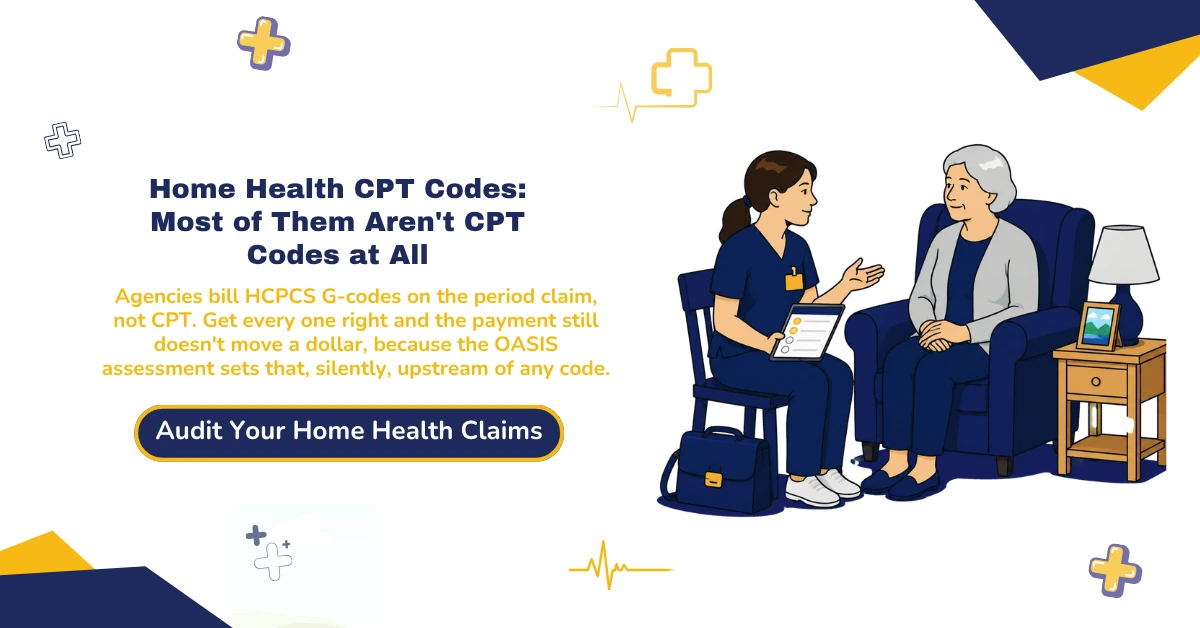
Certified home health agencies don’t bill CPT visit codes. They report HCPCS G-codes on a bundled 30-day period claim under the Patient-Driven Groupings Model, or PDGM. True CPT codes sit on the physician side: home visit E/M and care plan oversight.
A search for home health CPT codes returns two different code sets because two organizations bill the same episode of care on two different claim forms.
- Agencies report G-codes on a Type of Bill 32x institutional claim, not CPT
- G0299 covers skilled nursing by an RN, and G0300 covers the same visit by an LPN
- G0151, G0152, and G0153 cover physical, occupational, and speech therapy
- G0155 covers medical social work, and G0156 covers the home health aide
- Physicians bill home E/M 99341-99350 and certify the plan of care with G0180 or G0179
- The OASIS assessment sets the payment amount, not the visit codes
A wrong home health CPT code gets one line rejected. Pulling from the wrong code set gets the whole claim returned.
Are Home Health Codes CPT or HCPCS?
Why Everyone Calls Them CPT Codes
G0151, G0299, and G0156 get called CPT codes in search queries, job postings, and payer phone calls. They aren’t CPT codes. They’re HCPCS Level II codes, and CMS maintains them, not the AMA.
The search data shows how common the mix-up is. The term g0299 cpt code pulls 590 searches a month. So does g0151 cpt code description. Billers type what they’ve always called it.
That habit costs time at the claim level. A biller who goes looking for a CPT crosswalk for G0299 won’t find one, decides the code must be wrong, and holds the claim while the filing window runs.
What HCPCS Level II Covers
CPT is HCPCS Level I. Five numeric digits, maintained by the American Medical Association, covering physician work. HCPCS Level II runs one letter plus four digits, and CMS HCPCS Level II covers supplies, drugs, equipment, and the non-physician professional services CPT never described. Home health agency visits fall in that second bucket.
One difference matters more than the definitions. CMS updates HCPCS Level II four times a year, in January, April, July, and October. The AMA updates CPT once, on January 1, plus Category II and III releases through the year.
Anyone searching home health CPT codes for a Medicare agency claim needs the HCPCS Level II file, not the CPT book. Both systems appear on the same claim in other settings. In home health, the claim form decides which one applies.
So the home health code set can shift in April while your CPT book stays accurate. Our HCPCS vs CPT code systems guide walks through both update calendars. Agencies that load HCPCS files once a year carry three quarters of stale codes.
CPT and HCPCS Level II at a Glance
| Attribute | CPT (HCPCS Level I) | HCPCS Level II |
|---|---|---|
| Format | Five numeric digits | One letter plus four digits |
| Maintained by | American Medical Association | Centers for Medicare and Medicaid Services |
| Update cadence | Annual, January 1 | Quarterly |
| Who bills it in home health | Physicians and NPPs | Home health agencies |
| Copyright status | AMA copyrighted | Public domain |
Two Billing Worlds: Agency Claims and Physician Claims
Two organizations bill for the same episode of care, on two claim forms, using two code sets. Most home health coding errors trace back to someone mixing them up.
What the Home Health Agency Bills
A Medicare-certified agency gets paid under PDGM as a bundled 30-day period payment. The claim goes out institutional, on a UB-04 or an 837I institutional claim transaction, carrying Type of Bill 32x.
The G-codes on that claim track visits. They don’t each trigger a separate fee-for-service payment. The dollar amount comes from the case-mix group built off the OASIS assessment, which the clinician completes at start of care.
A perfectly coded G-code line won’t raise the period payment by a dollar. An under-scored OASIS functional item will lower it by hundreds. Agencies that audit coding but never audit OASIS are auditing the wrong document.
What the Physician or NPP Bills
A physician, NP, PA, or CNS who visits the patient at home bills a professional claim. CMS-1500 or 837P, true CPT codes, plus the HCPCS certification codes. These pay fee-for-service under the Physician Fee Schedule, separate from the agency’s period payment.
Physician practices sign home health plans of care constantly and never bill G0180, G0179, or G0181 for the work. That’s separately payable revenue nobody claims, and the Medicare Claims Processing Manual Chapter 10 spells out the claim routing for it.
The split explains why a search for home health CPT codes surfaces G-codes and E/M codes on the same results page. Both answers are correct. They answer different questions, and the searcher has to know which one they’re asking.
Who Bills What in Home Health
| Who’s billing | Code set | Claim form | Payment basis |
|---|---|---|---|
| Home health agency | HCPCS G-codes | UB-04 institutional claim, TOB 32x | Bundled PDGM 30-day period |
| Physician or NPP visiting the home | CPT 99341-99350 | CMS-1500 professional claim | Physician Fee Schedule, per visit |
| Physician certifying the plan of care | HCPCS G0180, G0179 | CMS-1500 professional claim | Physician Fee Schedule, per certification |
| Physician providing monthly oversight | HCPCS G0181, CPT 99339-99340 | CMS-1500 professional claim | Physician Fee Schedule, per month |
Home Health HCPCS G-Codes by Discipline
Every skilled visit gets one G-code. Not two. When a nurse changes a dressing and teaches the caregiver in the same visit, you report the code matching the discipline that consumed the most clinician time. That rule causes more duplicate-line rejections than any other.
Home health CPT codes get searched as a single list. The agency set splits four ways: nursing, therapy, aide, and medical social work. Organizing by discipline matches how the plan of care assigns visits, and how payers audit them.
Every code below bills in 15-minute units, so the visit note has to carry start and stop times. A 50-minute nursing visit is three units, not four. Rounding up is the easiest error for a reviewer to disprove, because the note contradicts the claim.
Skilled Nursing Codes: G0299, G0300, G0162, G0493, and G0494
G0299 reports direct skilled nursing delivered by a registered nurse in the home, in 15-minute increments. G0300 reports the same service when a licensed practical nurse delivers it. The credential in the home picks the code, not the task performed.
G0162 covers RN management and evaluation of the plan of care. Use it when skilled oversight is the service, not a task performed alongside it. G0493 covers RN observation and assessment, and G0494 covers the LPN version of that visit.
G0162 and G0493 aren’t spare nursing codes for slow weeks. They describe visits where clinical judgment is the skilled need. Billing G0299 for a pure management and evaluation visit holds up only when the note documents a direct hands-on service.
None of these codes moves the payment. That’s worth repeating because agencies spend audit hours on G-code selection and none on the assessment that prices the claim. Our home health revenue cycle management team works the OASIS-to-payment chain, not the code list.
Therapy Codes: G0151 to G0153, G0157 to G0161, G2168, and G2169
G0151 reports physical therapy delivered by a licensed physical therapist. G0157 reports the same visit delivered by a physical therapist assistant. G0152 covers occupational therapy by an OT, and G0158 covers the certified occupational therapy assistant.
G0153 reports speech-language pathology in the home. Our occupational therapy code set guide covers where outpatient OT coding diverges from the home health G-code, which trips up agencies running both lines of business.
Maintenance therapy has its own five codes. G0159 covers a PT establishing or delivering a maintenance program, G0160 covers the OT version, and G0161 covers the SLP version. G2168 covers a PTA delivering maintenance therapy, and G2169 covers a COTA.
G2168 and G2169 sit in almost no billing system. Assistant-delivered maintenance therapy happens constantly, the codes are newer than most chargemasters, and agencies default to the therapist-level code. That’s a credential mismatch waiting for a medical review.
A PTA can’t perform an initial evaluation. That work belongs to the physical therapist under G0151. An evaluation visit coded G0157 creates a documentation mismatch no matter who the scheduler assigned, and our PT evaluation documentation rules guide covers what the note has to show.
Aide and Medical Social Work: G0155 and G0156
G0156 reports home health aide services in 15-minute units. G0155 reports a clinical social worker visit. Both attach to the plan of care, and both need the plan of care to authorize the time before the visit happens.
Aide visits draw the heaviest unit-count scrutiny of any home health code. The recurring error isn’t fraud. Someone reports the time the aide spent, the plan of care authorized less, and the units deny even though the service happened.
No daily unit cap exists in the home health CPT codes set. The plan of care sets the ceiling, and the aide’s visit record has to land under it. Check the authorized frequency before the claim goes out, not after the denial arrives.
Patient and Family Training: G0495 and G0496
G0495 covers RN training and education of the patient, family, or caregiver. G0496 covers the LPN version. Teaching counts as a skilled service when teaching is the reason for the visit, and almost nobody bills these two.
Home Health G-Codes by Discipline and Credential
| Code | Discipline | Who delivers it | Billing unit |
|---|---|---|---|
| G0299 | Skilled nursing | Registered nurse | 15 minutes |
| G0300 | Skilled nursing | Licensed practical nurse | 15 minutes |
| G0162 | Management and evaluation of plan of care | Registered nurse | 15 minutes |
| G0493 | Observation and assessment | Registered nurse | 15 minutes |
| G0494 | Observation and assessment | Licensed practical nurse | 15 minutes |
| G0495 | Training and education | Registered nurse | 15 minutes |
| G0496 | Training and education | Licensed practical nurse | 15 minutes |
| G0151 | Physical therapy | Physical therapist | 15 minutes |
| G0157 | Physical therapy | Physical therapist assistant | 15 minutes |
| G0159 | PT maintenance program | Physical therapist | 15 minutes |
| G2168 | PT maintenance program | Physical therapist assistant | 15 minutes |
| G0152 | Occupational therapy | Occupational therapist | 15 minutes |
| G0158 | Occupational therapy | Certified OT assistant | 15 minutes |
| G0160 | OT maintenance program | Occupational therapist | 15 minutes |
| G2169 | OT maintenance program | Certified OT assistant | 15 minutes |
| G0153 | Speech-language pathology | Speech-language pathologist | 15 minutes |
| G0161 | SLP maintenance program | Speech-language pathologist | 15 minutes |
| G0155 | Medical social services | Clinical social worker | 15 minutes |
| G0156 | Home health aide | Home health aide | 15 minutes |
The full Medicare inventory, including the revenue code each one pairs with, sits on the CGS Medicare home health billing codes page. Check it against your chargemaster once a quarter, because the HCPCS file updates on that schedule.
G-Code and Revenue Code Pairings on the Home Health Claim
The Revenue Code Each Discipline Requires
Every G-code on the institutional claim has to sit on a line carrying the matching revenue code. Mismatch the pair and the line rejects before a human reviewer ever opens the claim.
Physical therapy visits pair with revenue code 042X. Occupational therapy visits pair with 043X. Speech-language pathology pairs with 044X. Skilled nursing pairs with 055X, medical social services with 056X, and the home health aide with 057X.
Home Health Revenue Code to G-Code Crosswalk
| Revenue code | Discipline | G-codes |
|---|---|---|
| 042X | Physical therapy | G0151, G0157, G0159, G2168 |
| 043X | Occupational therapy | G0152, G0158, G0160, G2169 |
| 044X | Speech-language pathology | G0153, G0161 |
| 055X | Skilled nursing | G0299, G0300, G0162, G0493, G0494, G0495, G0496 |
| 056X | Medical social services | G0155 |
| 057X | Home health aide | G0156 |
Where the Pairing Goes Wrong
Billers transpose 043X and 044X constantly. The codes sit next to each other, both cover therapy that isn’t physical therapy, and published billing guides have printed the pair backward. Occupational therapy is 043X. Speech-language pathology is 044X.
Revenue codes 055X, 056X, and 057X are invalid on a Type of Bill 034X claim. Agencies running home health and outpatient therapy under one NPI hit that edit regularly, and the Medicare Claims Processing Manual Chapter 10 documents the restriction.
Sub-digits matter more than most teams assume. Revenue codes 0550, 0551, and 0559 all sit under skilled nursing, and they carry different meanings. Payer edits differ on which of the three they’ll accept, so check the payer’s companion guide rather than defaulting to one.
Nothing in the home health CPT codes conversation matters more than this crosswalk, because it’s the one mapping a coder can’t fix at the claim level. The pairing lives in the chargemaster. When it’s wrong, it’s wrong on every claim until somebody changes the build.
Line rejections from a bad pairing don’t show up as denials. They bounce at the clearinghouse or the front-end edit, which means they never reach the denial report your team reviews on Monday. That’s how a mapping error survives for six months.
If your revenue code pairings are producing line rejections you can’t trace, the problem usually sits in chargemaster mapping rather than coder judgment. ClaimMax RCM audits the full G-code to revenue code map as part of a free revenue cycle review, and our clean claim submission service holds the map current as HCPCS files update each quarter.
Home Health Telehealth Codes G0320, G0321, and G0322
What Each Telehealth G-Code Reports
G0320 reports home health services delivered by real-time two-way audio and video telemedicine. G0321 reports the same service delivered audio-only. G0322 reports remote patient monitoring, meaning the transmission of physiologic data from the patient’s home.
All three describe encounters written into the plan of care and delivered remotely. They belong on the period claim as line items alongside the in-person visit codes, and CMS MLN telehealth G-code guidance sets the reporting conditions.
Why These Pay Nothing and Still Matter
These codes pay $0.00. They’re informational reporting, and CMS added them to measure how much remote care happens inside the home health benefit. No agency has ever collected a dollar on G0320.
So billers skip them. The visit produces no revenue, the claim goes out without the line, and the clinical record ends up documenting remote encounters the claim never reported.
That gap is what a medical reviewer flags. Not the missing payment, which nobody owed. The mismatch between what the chart says happened and what the agency told Medicare happened during the same 30-day period.
Agencies running remote monitoring alongside in-person visits carry the largest exposure. Our telehealth place of service codes guide covers the physician-side rules, which work differently: the physician’s telehealth visit pays, and the place of service drives the rate.
Home Health Telehealth Reporting Codes
| Code | What it reports | Payment |
|---|---|---|
| G0320 | Home health service via real-time audio and video telemedicine | $0.00, reporting only |
| G0321 | Home health service via audio-only telemedicine | $0.00, reporting only |
| G0322 | Remote patient monitoring, transmission of physiologic data | $0.00, reporting only |
Load all three into the billing system even though the fee schedule reads zero. Home health CPT codes that pay nothing still have to appear on the claim when the service happened.
How the Home Health Claim Gets Built
The Notice of Admission and the Five-Day Rule
One Notice of Admission per admission, filed within five calendar days of the start of care, on Type of Bill 32A. The NOA replaced the old Request for Anticipated Payment. File it late and Medicare reduces the period payment for every day of delay.
Run the numbers on that. The CMS CY 2026 HH PPS final rule sets the CY 2026 30-day base rate at $2,038.22. A one-thirtieth daily reduction works out to roughly $67.94 per day.
Nine days late costs about $611.46 on one period. An agency admitting 40 patients a month with a recurring five-day NOA lag gives back more than $13,000 a month. Nobody appeals it, because the reduction is correct.
Type of Bill 32x Across the Period
The NOA goes out on 32A. Period claims carry 32x. A final claim closes each period, and adjustment or cancel bill types handle corrections when dates or diagnoses need to change after submission.
The second 30-day period inside a 60-day certification is its own claim, grouped on its own. Agencies that moved over from the old 60-day episode model keep treating the second period as a continuation. It isn’t. It groups and prices separately.
Home Health Claim Types Across a Period of Care
| Bill type | When it’s filed | What it does |
|---|---|---|
| 32A | Within 5 days of start of care | Notice of Admission, establishes the period |
| 32x | After each 30-day period closes | Period claim, carries G-codes and HIPPS |
| 327 | When a filed claim needs correction | Adjustment to a previously paid period |
| 328 | When a filed claim must be voided | Cancels the period claim |
Where HIPPS Fits
The Health Insurance Prospective Payment System code on the claim is what the Medicare Administrative Contractor prices. The OASIS generates it. The biller doesn’t pick it.
That single fact reorganizes where an agency should spend its audit hours. A biller can’t fix a low HIPPS code at the claim level. Correcting it means going back to the assessment, which means the clinician, not the billing office.
Home health CPT codes appear on the claim as evidence the plan of care got delivered. The HIPPS code appears as the price. Two different jobs on one claim, and teams that confuse them audit the wrong document for years.
CPT Codes 99500-99602 for Home Health Procedures and Services
CPT 99500-99602 is the code family the AMA named Home Health Procedures and Services. These are non-physician home visit services covering prenatal monitoring, newborn care, stoma care, hemodialysis, and home infusion. Place of service is 12.
Home Visit Service Codes 99500 to 99600
The family runs wider than most published lists show. 99500 covers a prenatal monitoring visit. 99501 covers postnatal assessment. 99502 covers newborn care, and 99503 covers respiratory therapy delivered in the home.
99504 covers mechanical ventilation care, a code that drops off most home health CPT codes lists entirely. 99505 covers stoma care and maintenance. 99506 covers an intramuscular injection administered in the home.
99507 covers catheter care, another frequent omission. 99509 covers assistance with activities of daily living and personal care. 99510 covers individual, family, or couples counseling delivered at the residence.
99511 covers fecal impaction management with enema administration. 99512 covers hemodialysis in the home. 99600 is the unlisted home visit code, which is where a doula visit or any unlisted home service lands.
Searchers get stuck at coverage. Medicare generally won’t pay this family for a patient under a certified home health plan of care, because the period payment already covers the service. These codes show up on commercial claims and some Medicaid claims instead.
Home Infusion Codes 99601 and 99602
99601 covers home infusion or specialty drug administration for the first 2 hours. 99602 is the add-on for each additional hour, and it can’t stand alone on a claim.
The 99601 cpt code description gets searched 260 times a month and 99601 itself pulls 390, which tells you home infusion billing teams are working without a reference. The AMA CPT 2026 code set carries the current descriptors.
CPT Home Health Procedures and Services 99500-99602
| Code | Service | Typical payer |
|---|---|---|
| 99500 | Prenatal monitoring and assessment | Commercial, Medicaid |
| 99501 | Postnatal assessment | Commercial, Medicaid |
| 99502 | Newborn care and assessment | Commercial, Medicaid |
| 99503 | Respiratory therapy | Commercial, Medicaid |
| 99504 | Mechanical ventilation care | Commercial, Medicaid |
| 99505 | Stoma care and maintenance | Commercial, Medicaid |
| 99506 | Intramuscular injection | Commercial, Medicaid |
| 99507 | Catheter care and maintenance | Commercial, Medicaid |
| 99509 | Assistance with activities of daily living | Commercial, Medicaid |
| 99510 | Individual, family, or couples counseling | Commercial, Medicaid |
| 99511 | Fecal impaction management | Commercial, Medicaid |
| 99512 | Hemodialysis in the home | Commercial, Medicaid |
| 99600 | Unlisted home visit or procedure | Commercial, Medicaid |
| 99601 | Home infusion, first 2 hours | Commercial, some Medicare Part B |
| 99602 | Home infusion, each additional hour | Commercial, some Medicare Part B |
Physician Home Visit E/M Codes 99341-99350
New Patient Visits 99341 to 99345
99341 reports a new patient home or residence visit with straightforward medical decision making, running about 15 minutes. 99342 reports low MDM at about 30 minutes. 99344 reports moderate MDM at about 60 minutes, and 99345 reports high MDM at about 75 minutes.
Notice what’s missing from that sequence. CPT deleted 99343 in 2023, and the new patient series now runs 99341, 99342, 99344, and 99345. The AAFP home visit coding update documents the change.
People still search for it. The term 99343 cpt code description pulls 170 searches a month three years after deletion, which means legacy dropdowns are still offering the code and somebody is still picking it.
Level selection follows medical decision making or total time on the date of the encounter. Pick one method and document what that method requires, which our new patient MDM selection guide breaks down for the office equivalents.
Established Patient Visits 99347 to 99350
99347 reports an established patient home visit with straightforward MDM at about 20 minutes. 99348 reports low MDM at about 30 minutes. 99349 reports moderate MDM at about 40 minutes, and 99350 reports high MDM at about 60 minutes.
These two carry the heaviest search volume in the whole cluster. The 99349 cpt code description pulls 880 searches a month and 99348 cpt code description pulls 720, more than any agency G-code.
New versus established runs on the three-year rule, same as the office. If no provider of the same specialty in the group has seen the patient in three years, the visit is new. Our established patient E/M rules guide covers the professional services test that decides it.
Home or Residence E/M Codes by MDM Level and Time
| Code | Patient type | MDM level | Typical total time |
|---|---|---|---|
| 99341 | New patient | Straightforward | About 15 minutes |
| 99342 | New patient | Low | About 30 minutes |
| 99344 | New patient | Moderate | About 60 minutes |
| 99345 | New patient | High | About 75 minutes |
| 99347 | Established patient | Straightforward | About 20 minutes |
| 99348 | Established patient | Low | About 30 minutes |
| 99349 | Established patient | Moderate | About 40 minutes |
| 99350 | Established patient | High | About 60 minutes |
Place of Service for Home and Residence Visits
Most published guides list three place of service codes for this family. Medicare allows five. POS 12 for the home, POS 13 for assisted living, POS 14 for a group home, POS 33 for a custodial care facility, and POS 55 for residential substance abuse treatment.
A physician seeing a patient inside a skilled nursing facility doesn’t use this family. SNF visits carry their own E/M codes. The home and residence set covers private residences and residential settings, and a skilled facility is neither. CMS sets the allowed pairings in its place of service guidance.
One Medicare rule almost nobody publishes: prolonged time on a home or residence visit gets reported with HCPCS G0318, not the CPT prolonged services code. Commercial guidance points at the CPT route. For Medicare, that route denies.
Place of Service Codes Allowed with 99341-99350
| POS code | Setting |
|---|---|
| 12 | Home |
| 13 | Assisted living facility |
| 14 | Group home |
| 33 | Custodial care facility |
| 55 | Residential substance abuse treatment facility |
Home health CPT codes on the physician side live or die on place of service. Pick the wrong one and the claim pays at the facility rate or denies outright, depending on the payer.
Home Health Certification, Recertification, and Care Plan Oversight
G0180 and G0179: Certifying the Plan of Care
G0180 certifies a brand new Medicare home health plan of care. G0179 recertifies the plan for each continuing period after the first. Bill the wrong one for the point in the episode and the claim denies.
One nuance gets blurred in nearly every published guide. Payment periods run 30 days under PDGM. Certification periods still run 60 days. Two clocks, two different lengths, and guides that say the whole benefit moved to 30 days leave readers wrong.
The physician’s payment depends on the agency’s paperwork. Per the Medicare Benefit Policy Manual Chapter 7, when the agency’s claim is non-covered because certification is incomplete, the physician’s G0180 or G0179 claim is non-covered too.
Billing certification also requires the physician to be enrolled and active with the payer for that date of service. Our provider enrollment and credentialing team catches the enrollment gaps that turn a signed plan of care into an unbillable one.
G0181 and CPT 99339, 99340: Monthly Oversight
G0181 covers home health care plan oversight, once per calendar month, requiring 30 or more minutes of documented physician time. G0182 covers the hospice equivalent.
CPT 99339 covers 15 to 29 minutes of oversight and 99340 covers 30 or more, but only for a patient in a home, domiciliary, or rest home who isn’t under the home health or hospice oversight benefit. Don’t bill both for the same patient-month.
Three mechanics from the manuals rarely make it into billing guides. Oversight gets billed after the month ends, never during. It can’t span two calendar months. And it’s submitted and paid as one unit of service, regardless of how many minutes accumulated.
The Face-to-Face Encounter Requirement
The face-to-face encounter must occur within 90 days before or 30 days after the start of care. It has to relate to the primary reason for home health, and the certifying physician or an allowed practitioner has to perform it.
One detail almost every competitor misses: 42 CFR 424.22 certification rules permits the face-to-face encounter to happen through telehealth. For rural practices, that changes the scheduling problem completely.
More certification denials trace to face-to-face documentation than to any other cause. The encounter happened. Somebody forgot to date it, or tie it to the home health reason, or get the certifying provider’s signature on it.
Certification-side home health CPT codes represent the most reliably unclaimed revenue in the benefit. A practice signing 30 plans of care a month and billing none of them gives up a recurring line item that requires no additional clinical work.
Oversight minutes have to be logged as they happen. Phone calls with the agency, report reviews, order adjustments, and care coordination all count toward the 30-minute threshold. Reconstructing them at month end doesn’t survive a records request.
Home Health Certification and Oversight Codes
| Code | What it covers | Frequency rule | Who bills it |
|---|---|---|---|
| G0180 | Initial certification of the plan of care | Once at start of a new episode | Physician or allowed NPP |
| G0179 | Recertification of the plan of care | Once per continuing 60-day period | Physician or allowed NPP |
| G0181 | Home health care plan oversight | Once per calendar month, 30+ minutes | Physician |
| G0182 | Hospice care plan oversight | Once per calendar month, 30+ minutes | Physician |
| 99339 | Care plan oversight, 15 to 29 minutes | Once per calendar month | Physician |
| 99340 | Care plan oversight, 30 or more minutes | Once per calendar month | Physician |
Home Health Codes by Payer: Medicare, Medicaid, and Commercial
The letter tells you the payer. G-codes are Medicare. T-codes are Medicaid. S-codes are commercial. No regulation states it that cleanly, but it holds often enough that when a code rejects, the letter is the first thing worth checking.
Medicare Uses G-Codes
Medicare home health CPT codes are the G-code set covered above, reported on the institutional claim under PDGM. That part is settled.
Medicare Advantage complicates it. MA plans are Medicare, and many of them set their own prior authorization requirements and code preferences that don’t track traditional Medicare’s G-code reporting. Verify plan by plan, because our eligibility and prior authorization team sees the same MA plan change rules mid-year.
Medicaid Uses T-Codes
T-codes cover personal care and aide services Medicare won’t pay separately. T1019 covers personal care services per 15 minutes. T1020 covers the same care per diem. T1021 covers a home health aide or certified nurse assistant per visit.
T1022 covers contracted home health agency services per day. T1030 and T1031 cover RN and LPN home visits under state Medicaid programs.
T1019 excludes services delivered by a certified nurse assistant or home health aide. That’s what T1021 exists for. Billing T1019 for aide time is a routine Medicaid denial, and the descriptor exclusion is the reason.
T-codes are state codes. Coverage, unit definitions, and required modifiers change by state and by managed care organization, so check the state plan rather than a national list. Our state Medicaid billing requirements guide covers the MCO variability that catches multi-state agencies. State programs also apply Medicaid NCCI policy edits on top of their own coverage rules.
Commercial Payers Often Want S-Codes or CPT
S-codes are temporary non-Medicare codes. S9122 covers a home health aide per hour. S9123 covers RN nursing care in the home per hour, and S9124 covers the LPN version. S9131 covers physical therapy in the home per diem.
Some commercial payers reject S-codes outright and want CPT therapy evaluation codes 97161 through 97163 instead of Medicare’s G-codes. That single payer preference resolves a confusion that sends billers in circles.
S9123 covers general nursing care in the home. Don’t use it when a specific code in the 99500-99602 range describes the service performed. The specific code wins.
Sorting home health CPT codes by payer before sorting them by service saves rework. The clinical description barely shifts between a G-code, a T-code, and an S-code for the same nursing hour. The payer decides which letter the claim carries.
Home Health Code Sets by Payer Type
| Payer | Code family | Example codes | Claim form |
|---|---|---|---|
| Medicare | HCPCS G-codes | G0299, G0151, G0156 | UB-04 institutional, TOB 32x |
| Medicaid | HCPCS T-codes | T1019, T1020, T1021 | Varies by state, often CMS-1500 |
| Commercial | HCPCS S-codes or CPT | S9122, S9123, 97161-97163 | CMS-1500 professional |
Wound Care Coding in Home Health
Which Code Covers Wound Care at Home
No separate wound care G-code exists in home health. Under a Part A episode, wound care delivered by the nurse gets reported with G0299 or G0300, the skilled nursing codes. The service sits inside the discipline code.
Wound is one of the 12 PDGM clinical groups. When the principal diagnosis maps to wound, the period groups differently and pays differently, which means the ICD-10 code drives more wound care revenue than any procedure code on the claim.
Part B works differently. CPT 97597 and 97598 carry a sometimes-therapy classification and can be billed in home health settings under Part B when a qualified therapist performs the service under a physician-certified plan of care. Our wound care CPT code set guide covers the modifier requirements.
Part A episodes bundle wound care into the period payment. Billing it separately during an open period produces a bundling denial, not a payment.
Wound care sits outside the home health CPT codes most agencies memorize, because no wound code exists to memorize. The revenue comes from diagnosis sequencing into the wound clinical group and from consolidated billing discipline on supplies.
Disposable negative pressure wound therapy runs on A9272, which CMS treats as all-inclusive. Supplies used with a disposable wound suction system aren’t separately billable, so adding supply lines alongside A9272 produces a bundling denial.
What Consolidated Billing Absorbs
Wound care supplies furnished during a home health period route to the primary agency, not to Medicare separately. Outside vendors bill the agency. The agency absorbs the cost inside the period payment.
That list is growing. Effective October 1, 2026, CMS added 19 HCPCS codes to the Home Health Consolidated Billing non-routine supply list, covering syringes, catheters, ostomy irrigating equipment and supplies, incontinence inserts, and wound care tape. MAC systems apply the change October 5, 2026.
Audit the chargemaster in September against the CMS home health coding and billing master code list. Agencies that skip it will watch those supply lines start rejecting in the first week of October.
Choosing Between Similar Home Health Codes
Most home health coding errors land in the right family and the wrong member. Ten pairs cause the bulk of them, and each pair turns on one variable: who delivered the service, what the skilled need was, or which payer is paying.
Write the deciding variable next to each pair in your coding policy. Home health CPT codes stop generating audit findings once the person coding knows whether credential, skilled need, or payer settles the choice in front of them.
G0299 vs G0300, what’s the difference?
Credential. G0299 covers the registered nurse and G0300 covers the licensed practical nurse. Same service, same 15-minute unit, different license in the home. Payers audit this by matching the visit note signature against the code billed.
When do you use G0162 instead of G0299?
G0162 applies when management and evaluation of the plan of care is the skilled service. If the nurse performed a hands-on skilled task, G0299 applies. If the skilled need was clinical judgment and oversight, G0162 does.
G0493 vs G0299, which one applies?
G0493 covers RN observation and assessment, used when the patient’s condition is unstable and skilled monitoring is the reason for the visit. G0299 covers direct skilled nursing service delivery. The chart has to show which one the nurse went there to do.
G0151 vs G0157, why does it matter?
G0151 covers the physical therapist and G0157 covers the physical therapist assistant. A PTA can’t perform the initial evaluation, so an evaluation visit coded G0157 creates a documentation mismatch regardless of who the scheduler sent.
G0180 vs G0179, which do I bill?
G0180 certifies a new home health episode. G0179 recertifies each continuing period after the first. Billing certification when a recertification was due ranks among the most common physician-side denials in the benefit.
G0181 vs CPT 99339 and 99340, what’s the split?
G0181 covers oversight for a patient under a certified home health plan of care, 30 or more minutes per calendar month. CPT 99339 and 99340 cover oversight for a patient in a home or rest home who isn’t under that benefit. Never bill both for the same patient-month, and the Medicare care plan oversight policy sets the conditions.
T1019 vs G0156, when does each apply?
Payer. G0156 is the Medicare home health aide code inside a PDGM period. T1019 is a Medicaid personal care code, and its descriptor excludes services delivered by an aide or CNA, which is what T1021 covers.
99349 vs G0299, which code for a home visit?
Who visited. 99349 covers a physician or NPP performing an established patient E/M in the residence, billed on the professional claim. G0299 covers the agency’s nurse, billed on the institutional period claim. Both can happen in the same episode.
99445 vs 99454, can I bill both?
No. 99445 covers 2 to 15 days of transmitted remote monitoring data inside a 30-day period. 99454 covers 16 days or more. The two are mutually exclusive, and one per month of monitoring is the limit.
99470 vs 99457, which one?
99470 captures shorter-duration remote monitoring treatment management. 99457 applies once the provider crosses the 20-minute threshold. Current guidance treats 99470 as an alternative to 99457, not a companion code that rides alongside it.
Home Health Code Pairs and the Deciding Variable
| Code pair | Deciding variable | Rule in one line |
|---|---|---|
| G0299 vs G0300 | Credential | RN takes G0299, LPN takes G0300 |
| G0162 vs G0299 | Nature of the skilled need | Oversight takes G0162, hands-on care takes G0299 |
| G0493 vs G0299 | Reason for the visit | Assessment takes G0493, service delivery takes G0299 |
| G0151 vs G0157 | Credential | PT takes G0151, PTA takes G0157, evaluations take G0151 |
| G0180 vs G0179 | Point in the episode | New certification takes G0180, recertification takes G0179 |
| G0181 vs 99339, 99340 | Whether the patient is under the HH benefit | Certified home health takes G0181 |
| T1019 vs G0156 | Payer | Medicaid personal care takes T1019, Medicare aide takes G0156 |
| 99349 vs G0299 | Who performed the visit | Physician takes 99349, agency nurse takes G0299 |
| 99445 vs 99454 | Days of data transmitted | 2 to 15 days takes 99445, 16 or more takes 99454 |
| 99470 vs 99457 | Duration of treatment management | Shorter duration takes 99470, 20+ minutes takes 99457 |
Print that table and pin it near the coding queue. Home health CPT codes rarely fail because someone reached for a random code. They fail because two codes in the same family looked interchangeable and nobody documented which variable decided it.
What Changed for Home Health Billing in 2026
G2211 Now Applies to Home and Residence E/M
Effective January 1, 2026, HCPCS G2211 can be reported as an add-on with home or residence E/M base codes: 99341, 99342, 99344, 99345, and 99347 through 99350. Before this year it worked only with office and outpatient visits.
For home-based primary care, that’s a real revenue change on visits the practice already performs. The CMS Physician Fee Schedule G2211 guidance carries the payment policy, and CMS published a dedicated FAQ on July 7, 2026 covering the edge cases.
Two operational rules come out of that FAQ. Medicare generally denies G2211 when the base E/M line carries modifier 25. A preventive-service exception exists, and starting January 1, 2026 that exception extends to home and residence E/M.
Systems that auto-append G2211 to every E/M will generate denials at volume. The code describes an ongoing, longitudinal care relationship with the patient. Build the rule to require that flag before the code gets suggested, not after.
New Remote Monitoring Codes 99445 and 99470
CPT 2026 introduced 99445 for 2 to 15 days of transmitted physiologic data and 99470 for shorter-duration remote monitoring treatment management. The AMA also revised 99453, 99454, 99457, and 99458 to fit around the new thresholds.
Monitoring episodes that ran under 16 days used to be unbillable. Now they carry a code, which matters for post-acute patients monitored for a week after discharge and then stepped down.
Connect this to the agency side, because no published guide does. G0322 is the agency’s remote patient monitoring reporting code, paying nothing. 99445 and 99470 are the physician’s, and they pay. Same patient, same device, two claims, two code sets.
Nineteen New Consolidated Billing Codes, October 1
CMS Change Request 14510 adds 19 HCPCS codes to the Home Health Consolidated Billing non-routine supply list effective October 1, 2026. MAC systems begin applying the change October 5.
Audit the chargemaster in September. Supply codes that billed separately in August will route to the primary agency in October, and agencies that miss the update will see those lines reject during the first billing cycle of the quarter.
What Changed in the CY 2026 Payment Rule
CMS issued the CY 2026 home health final rule, CMS-1828-F, on November 28, 2025. It recalibrated PDGM case-mix weights, updated LUPA thresholds using CY 2024 claims data, and revised functional impairment levels and comorbidity subgroups.
Two program changes get almost no coverage. The HHCAHPS survey revision starts with the April 2026 sample month. And CMS removed the COVID-19 vaccine measure from the Home Health Quality Reporting Program beginning CY 2026.
Anyone still working from a home health CPT codes 2025 reference is carrying stale LUPA thresholds and stale case-mix weights. The codes themselves changed less than the math around them did.
2026 Changes Affecting Home Health Billing
| What changed | Effective date | Who it affects | Action required |
|---|---|---|---|
| G2211 allowed with home and residence E/M | January 1, 2026 | Physicians and NPPs | Add longitudinal-care flag before auto-suggesting |
| New RPM codes 99445 and 99470 | January 1, 2026 | Physicians and NPPs | Load new codes, retire 16-day-only logic |
| 19 codes added to consolidated billing list | October 1, 2026 | Home health agencies | Audit chargemaster in September |
| PDGM weights and LUPA thresholds recalibrated | January 1, 2026 | Home health agencies | Update visit-planning thresholds by clinical group |
| HHCAHPS survey revision | April 2026 sample month | Home health agencies | Confirm vendor is on the revised instrument |
| COVID-19 vaccine measure removed from HH QRP | CY 2026 | Home health agencies | Stop collecting the retired measure |
Every home health CPT codes reference published before December 2025 predates this rule. Check the publication date on whatever your team is working from.
What Home Health Codes Pay in 2026
The CY 2026 Period Payment Rate
The CY 2026 national standardized 30-day period payment rate is $2,038.22. That’s down from $2,057.35 in CY 2025.
Three components produce it. A 2.4% market basket update, a permanent behavior adjustment of negative 1.023%, and a temporary reduction of negative 3.0%. Aggregate effect across the industry is a 1.3% decrease, or roughly $220 million.
Agencies that fail to submit required quality data take an additional two percentage point reduction on top of that. The CMS Home Health PPS page carries the current rate files.
CY 2026 Home Health Payment Components
| Component | Value | Effect on the base rate |
|---|---|---|
| Market basket update | 2.4% | Increase |
| Permanent behavior adjustment | -1.023% | Decrease |
| Temporary adjustment | -3.0% | Decrease |
| CY 2026 30-day base rate | $2,038.22 | Net result |
| Quality data reporting penalty | -2 percentage points | Applied to non-compliant agencies |
Why the G-Code Doesn’t Set the Payment
Adding a G0299 line doesn’t add payment. The period amount comes from the PDGM case-mix group, which is built from the OASIS assessment, the timing of the period, the admission source, the clinical grouping from the principal diagnosis, the functional impairment level, and the comorbidity adjustment.
A biller can’t code their way to a higher period payment. An under-scored OASIS functional item costs more than any coding error in the same period will, and it costs it quietly, because nothing denies.
Agencies chase home health CPT codes accuracy because coding is the part of the claim a billing team controls. The variables that set the payment sit upstream with the clinician, which makes coding accuracy necessary and insufficient at the same time.
What a LUPA Costs
When skilled visits in a 30-day period fall below the threshold for that clinical group, the period pays per visit instead of paying the bundle. That’s a Low Utilization Payment Adjustment.
Take a clinical group with a 5-visit threshold. The agency delivers 4. The period drops from $2,038.22 to a per-visit total that lands in the several-hundred-dollar range depending on discipline mix. One missed visit moves more than $1,000.
A LUPA isn’t a denial. It’s the correct payment for low utilization, which means it can’t be appealed. The protection is operational: track visit counts against the clinical group threshold mid-period, while there’s still time to deliver a planned visit.
Late NOA reductions and LUPA shortfalls both surface in the AR report, not the denial report. Our aged claim recovery workflow separates underpayments from denials so agencies stop treating a priced-correctly period as a recoverable claim.
Home Health Denials by Code
The Denial Codes You’ll See
Home health denials cluster around six CARC codes, and each one means something specific on an institutional period claim that it doesn’t mean elsewhere. Our CARC-based denial resolution team categorizes by root cause rather than by code alone.
CO-16 means the claim lacks information. On home health that’s usually a missing HIPPS or OASIS element, a missing face-to-face date, or a structural 837I error. Read the paired RARC, complete the named element, resubmit corrected.
CO-29 means timely filing exceeded, and it shows up when a late NOA or a return-to-provider loop eats the filing window. CO-50 means the record doesn’t support homebound status or skilled need.
CO-97 means the service was already covered inside the period bundle. CO-197 means prior authorization was absent, which applies to Medicare Advantage and Medicaid managed care rather than traditional Medicare. CO-4 flags a missing or incorrect modifier on the professional side. Definitions for all six come from the X12 claim adjustment reason codes list.
Home Health Denial Codes and Their Root Causes
| Denial code | What it means on a home health claim | Fix |
|---|---|---|
| CO-16 | Missing HIPPS or OASIS element, missing F2F date, or 837I structural error | Read paired RARC, complete the element, resubmit corrected claim |
| CO-29 | Timely filing lost to a late NOA or an RTP loop | File NOA within 5 days, document original submission, appeal with proof |
| CO-50 | Homebound status or skilled need not supported in the record | Document homebound criteria and skilled need in the plan of care |
| CO-97 | Service already covered inside the period bundle | Confirm the service isn’t separately payable during an open period |
| CO-197 | Prior authorization absent on MA or managed Medicaid | Obtain auth before start of care, appeal with the auth number |
| CO-4 | Missing or incorrect modifier on the professional claim | Apply the correct discipline modifier before submission |
Three code-specific patterns show up repeatedly and appear in no published guide. G0156 unit counts that exceed what the plan of care authorized. G0151 billed for a visit a PTA delivered. And revenue code mismatches that produce a line-level rejection instead of a claim denial.
The third one is the dangerous pattern, because a line rejection never enters the denial queue. Our therapy denial taxonomy covers the CO-50 appeal language that works for therapy medical necessity, which transfers directly to home health therapy visits.
Home health CPT codes contribute to some of these denials. Most trace back to documentation, authorization, or timing instead, which is why categorizing denials by code alone hides the pattern costing the agency money.
Why G0180 Denials Are Almost Always Documentation
More G0180 denials trace to face-to-face documentation than to any other cause. The encounter took place. Somebody left it undated, or failed to tie it to the primary reason for home health, or never got the certifying provider’s signature on the note.
The consequence runs both directions. When the agency’s claim is non-covered for incomplete certification, the physician’s G0180 is non-covered too. Two organizations, two claims, one documentation failure.
Build a face-to-face checklist into the certification workflow rather than the appeal workflow. Checking for a date and a signature takes seconds before submission and takes weeks after a denial.
Return to Provider Is Not a Denial
An RTP means the period claim can’t group. Usually the principal diagnosis is non-specific or unacceptable for PDGM, or the NOA and claim dates don’t align. The claim comes back rather than denying.
RTP claims don’t appear on denial reports. They sit in a separate queue while the filing window runs, and nobody owns that queue in most agencies.
An agency with a clean denial rate and terrible cash flow is usually sitting on an RTP backlog. Home health CPT codes get audited constantly in that situation, and the codes were never the problem.
Most agencies can quote their denial rate on request. Very few can quote their RTP volume, because it lands in a different report. If that gap sounds like your operation, ClaimMax RCM will pull 90 days of your period claims and show you what’s sitting in the RTP queue and what the filing clock looks like on each one.
Retired Home Health Codes and What Replaced Them
Deleted codes keep pulling search traffic, which means they keep pulling claims. Four retirements matter for home health CPT codes, and legacy dropdowns are the reason they still get billed.
CPT deleted 99343 effective 2023. The new patient home and residence series now runs 99341, 99342, 99344, and 99345 with nothing in the third position.
The domiciliary, rest home, and custodial care E/M family, 99324 through 99337, was deleted and merged into 99341-99350 effective January 1, 2023. Systems built before that year still carry both families.
G0154 split into G0299 for the RN and G0300 for the LPN. It doesn’t appear on the current Medicare home health code list, though it still shows up in older billing references and training materials.
The Request for Anticipated Payment gave way to the Notice of Admission. One NOA per admission replaced a RAP per episode, and the filing consequence changed with it.
Retired Home Health Codes and Their Replacements
| Retired code | What replaced it | When it changed |
|---|---|---|
| 99343 | 99341, 99342, 99344, 99345 remain in the new patient series | 2023 |
| 99324 through 99337 | Merged into home or residence series 99341-99350 | January 1, 2023 |
| G0154 | G0299 for RN, G0300 for LPN | Not on the current Medicare home health code list |
| Request for Anticipated Payment | Notice of Admission, one per admission | Under PDGM |
If your billing system still offers any of these in a dropdown, somebody will pick one. Remove them from the pick list rather than relying on training to prevent it.
Pre-Submission Checklist for Home Health Claims
Two checklists, matching the two billing worlds. Run them before submission, because every item below is cheaper to verify than to appeal.
Agency Checklist
- OASIS complete, with functional items scored to reflect the patient’s actual status
- Principal diagnosis specific enough to map to a PDGM clinical group
- Comorbidities captured on the claim, not just in the chart
- Notice of Admission filed within 5 days of start of care
- Plan of care signed, with orders matching the visits delivered
- Visit count tracked against the LUPA threshold for the clinical group
- Each G-code sitting on its correct revenue code line
Physician and NPP Checklist
- Face-to-face encounter documented, dated, and tied to the home health reason
- Correct certification code, G0180 for new and G0179 for recertification
- Home E/M level supported by MDM or time, with the right place of service
- Care plan oversight minutes totaled and logged with the specific activities
- G2211 applied only where an ongoing care relationship appears in the record
- Modifier 25 interaction checked before appending G2211
- No service billed on both the professional and the institutional claim
Fourteen checks, and a team can run both lists in under 10 minutes per admission. Home health CPT codes selection is one line item on that list, which is roughly the weight it deserves against the OASIS and face-to-face items above it.
Running these consistently across every admission is where most agencies struggle, because the checks span clinical, billing, and physician offices. Our end-to-end billing workflow holds all 14 as pre-bill gates rather than post-denial cleanup.
Home Health CPT Codes: Frequently Asked Questions
These questions come up most often on home health CPT codes calls with agency billing teams and physician practices.
Are CPT codes used in home health?
Rarely for agency billing. Certified home health agencies report HCPCS G-codes on an institutional period claim, not CPT visit codes. CPT enters on the physician side through home and residence E/M 99341-99350 and care plan oversight 99339 and 99340. Some commercial payers want CPT therapy evaluation codes 97161 through 97163 instead of Medicare’s G-codes. The 99500-99602 family also carries the CPT label for home health procedures.
What are the CPT codes for home visits in 2026?
99341, 99342, 99344, and 99345 cover new patients, and 99347 through 99350 cover established patients. CPT deleted 99343 in 2023. Level selection follows medical decision making or total time on the date of the encounter. Place of service may be 12, 13, 14, 33, or 55 depending on the residence type. Medicare reports prolonged time on these visits with HCPCS G0318 rather than the CPT prolonged services code.
What are the CPT codes for home care services?
Home care services delivered by an agency use HCPCS G-codes in 15-minute units, not CPT. Therapy runs G0151, G0152, G0153, G0157, and G0158. Nursing runs G0299, G0300, G0162, and G0493. G0156 covers the home health aide and G0155 covers medical social work. Medicaid personal care uses T-codes such as T1019. Commercial payers often use S-codes such as S9123.
What are the ICD-10 codes for home health care?
No fixed list exists. Home health uses standard ICD-10-CM codes, but the principal diagnosis carries more weight than in most settings because it maps the 30-day period into one of 12 PDGM clinical groups. A non-specific or unacceptable principal diagnosis triggers a return to provider, which stops the claim from grouping at all. Secondary diagnoses drive the comorbidity adjustment and the payment tier that comes with it.
Is G0299 a CPT or HCPCS code?
G0299 is a HCPCS Level II code maintained by CMS, not a CPT code maintained by the AMA. Billers call it a CPT code because most people use CPT as shorthand for any procedure code. The letter prefix settles it: any code starting with a letter is HCPCS Level II. The same applies to G0151, G0156, and every other G-code on a home health claim.
What is the difference between G0180 and G0179?
G0180 certifies a new Medicare home health plan of care at the start of an episode. G0179 recertifies the plan for each continuing 60-day period after the first. Billing certification when a recertification was due ranks among the most common physician-side denials. G0180 also requires a documented face-to-face encounter within 90 days before or 30 days after the start of care, performed by the certifying provider or an allowed practitioner.
How many units of G0156 can be billed per day?
No universal daily cap applies. G0156 reports home health aide services in 15-minute units, and the billable amount is whatever the physician-certified plan of care authorized and the visit record documents. Units exceeding the authorized plan deny even when the aide delivered the time. Check the plan of care before the claim goes out, and our home health denial management team works these as an authorization problem rather than a coding one.
What is a LUPA in home health billing?
A Low Utilization Payment Adjustment applies when skilled visits in a 30-day period fall below the threshold set for that period’s clinical group. The period then pays per visit instead of paying the full bundled amount, which costs the agency the difference. A LUPA isn’t a denial and can’t be appealed away. The only protection is operational: track the visit count against the threshold before the period closes.
What is the home health eval CPT code?
It depends who performs the evaluation. An agency therapist’s evaluation visit gets reported with the discipline G-code, G0151 for physical therapy or G0152 for occupational therapy. A physician evaluating the patient in the home bills a home E/M code from 99341-99350. Some commercial payers want CPT therapy evaluation codes 97161 through 97163 for PT or 97165 through 97167 for OT instead of the Medicare G-code.
What is the home health referral CPT code?
None exists. A referral to home health isn’t separately billable as a procedure. The billable physician work is certification, G0180 for a new plan of care or G0179 for recertification, plus the face-to-face encounter, which gets billed as a normal E/M visit at whatever place of service applies. Practices looking for a referral code are usually looking for G0180 without knowing the code number.
What is the home health PT CPT code?
G0151 covers the licensed physical therapist and G0157 covers the physical therapist assistant, both in 15-minute units on the agency’s period claim. Maintenance program visits use G0159 for the PT and G2168 for the PTA. All four pair with revenue code 042X on the institutional claim. A PTA can’t perform the initial evaluation, so evaluation visits belong under G0151 regardless of who the scheduler assigned.
Do home health agencies bill CPT or HCPCS codes?
HCPCS. Certified agencies report HCPCS G-codes as line items on a bundled 30-day period claim submitted with Type of Bill 32x. The payment comes from the PDGM case-mix group built from the OASIS assessment, not from the visit codes on the claim. CPT belongs to the physician claim, filed separately for the same episode of care. One episode can generate both a HCPCS-coded agency claim and a CPT-coded physician claim.
Getting Home Health Claims Paid the First Time
Home health payment gets decided before the claim exists. The OASIS scores it, the certification qualifies it, and the visit plan protects it. Getting the home health CPT codes right on the claim protects an amount that three earlier steps already determined.
Agencies that collect consistently do three things the rest don’t. They score OASIS functional items accurately, they sequence a specific principal diagnosis into the right clinical group, and they watch visit counts against the LUPA threshold while the period is still open.
If the patterns in this guide look like your last 90 days, the gap usually sits in workflow rather than coding. ClaimMax RCM reviews the full home health cycle, from OASIS through the period claim to the physician’s certification revenue, and shows you where the money leaves. Nothing to prepare, and no obligation on the other side of it.