CPT 49650 is the code for the laparoscopic repair of an initial inguinal hernia on one side. It includes mesh when the surgeon places it. In 2026, the surgeon’s national Medicare rate is $424.19, and the code carries a 90-day global period.
Billing teams tend to trip on four calls with the 49650 CPT code. Coders mix up initial and recurrent repairs, and billers send bilateral cases in a line format the payer rejects. Staff also add a robotic code Medicare won’t pay. Others copy age language from another code.
These calls come up in ASCs, hospital outpatient departments, and surgical practices alike. The correct inguinal hernia repair CPT code comes first below. Payment and modifier rules come next. At ClaimMax RCM, these are the checks our coders run on hernia claims.
Coders check these 2026 facts first on a 49650 case.
| Item | 49650 detail |
|---|---|
| Descriptor | Laparoscopy, surgical; repair initial inguinal hernia |
| Approach | Laparoscopic, including TEP, TAPP, and robotic-assisted repair |
| Laterality | Unilateral; modifier 50 for a bilateral repair |
| Mesh | Included when the surgeon places it |
| Global period | 090 (major surgery) |
| 2026 work RVU | 6.20 |
| 2026 national surgeon rate | $424.19 non-APM, $426.31 APM (facility setting only) |
| Recurrent hernia | 49651 |
| Open initial repair | 49505 or 49507 (age 5 or older) |
| Robotic code | None in CPT; HCPCS S2900 has status I for Medicare |
49650 at a glance, 2026 Medicare data. Sources: AMA CPT descriptor and the CMS RVU26D relative value file.
What is CPT code 49650?
CPT code 49650 covers one side of a laparoscopic inguinal repair when the hernia is initial, meaning no surgeon has repaired that site before. TEP, TAPP, and robotic approaches all fall under it at the same payment. Recurrent and open repairs use other codes.
The 49650 CPT code description, word for word
The AMA descriptor for 49650 reads, “Laparoscopy, surgical; repair initial inguinal hernia.” That’s the whole descriptor. CMS shortens it to “Lap ing hernia repair init,” and that’s the text you’ll see on a Medicare remit.
Open inguinal codes split by the patient’s age and by whether the hernia is reducible or incarcerated. Laparoscopic coding has no such split. The CPT line reads 49650 for a 30-year-old with a reducible hernia and for a 70-year-old with an incarcerated one. Only the diagnosis changes.
Common mistake: some code lookup tools attach an age limit and a reducible requirement to 49650. Both belong to 49505, the open repair code.
What the surgeon does in a TEP or TAPP repair
The surgeon works through small ports with a camera, reduces the hernia contents, and places mesh in the preperitoneal space. In a TAPP (transabdominal preperitoneal) repair, the surgeon enters the peritoneal cavity first. With a TEP (totally extraperitoneal) repair, the surgeon stays outside it. A robot can assist with either.
Each version shares one CPT code for laparoscopic inguinal hernia repair, so the claim doesn’t show which one the surgeon used. The op note has to. It should say “laparoscopic” or “robotic,” because a note that only reads “hernia repair with mesh” won’t support 49650.
Some dictation templates still say “laparoscopic herniorrhaphy.” That describes the same procedure. There’s no separate herniorrhaphy CPT code, so an initial inguinal case still goes on the claim as 49650.
Does CPT 49650 include mesh?
Yes. Mesh placement is part of CPT 49650, so there’s no separate CPT code for inguinal hernia repair with mesh. The old add-on code +49568 never applied to inguinal repairs, and the AMA deleted it on January 1, 2023.
NCCI policy bars mesh codes with a hernia repair unless a CPT instruction allows them. No instruction allows one with 49650, and the NCCI section below gives the exact rule.
Hospitals may report the mesh on the facility claim, such as with HCPCS C1781, for cost tracking. Medicare packages it into the facility payment. Tacks and glue used to fix the mesh don’t earn separate payment on either claim.
CPT 49650 vs. 49651, 49505, and 49659: choosing the right code
Coders pick the CPT code for inguinal hernia repair from four facts in the op note. No single hernia repair CPT code covers every case, so check the four facts in this order:
- Laparoscopic (including robotic) or open approach
- Initial or recurrent status at that site
- Inguinal, femoral, or other hernia type
- Patient age and reducibility, for open repairs only
CPT 49650 is the right code when the repair is laparoscopic, the hernia is inguinal, and that site has no prior repair. If any one differs, the code changes.
Initial or recurrent: when 49651 applies
CPT 49651 is the laparoscopic code for a hernia that comes back at a site a surgeon repaired before. Medicare pays more for it. In 2026, 49651 has a work RVU of 8.17 and a national rate of $550.11, about $126 above 49650.
Check that the op note documents the recurrence. A prior repair on the left side doesn’t make a new right-side hernia recurrent. Match the diagnosis as well: K40 codes with a fifth character of 1 mean recurrent, and the diagnosis section below lists all 12.
Don’t use 49656 for a recurrent inguinal repair. It was a laparoscopic incisional hernia code, and the AMA deleted it on January 1, 2023.
Laparoscopic or open: when 49505 or 49507 applies
CPT code 49505 is the open repair of an initial, reducible inguinal hernia in a patient age 5 or older. An incarcerated or strangulated hernia takes 49507. Open pediatric repairs under age 5 use 49491 through 49501.
Recurrent open repairs go to 49520, or 49521 when the hernia is incarcerated or strangulated. A sliding hernia takes 49525. Take the open inguinal hernia repair CPT code from the op note’s findings, since the booked procedure and the actual findings can differ.
If the surgeon converts a laparoscopic case to open, report only the open code that matches the documented findings. Leave 49650 off the claim. The note should give the reason for the conversion, such as dense adhesions or bowel that won’t reduce through the ports.
Is robotic inguinal hernia repair coded as 49650?
Yes. A robotic-assisted repair of an initial inguinal hernia goes on the claim as 49650, or 49651 if recurrent. There’s no separate robotic inguinal hernia repair CPT code and no robotic modifier. The lap inguinal hernia repair CPT code covers the surgeon’s work with or without the robot.
HCPCS code S2900 describes robotic assistance. CMS gives it status I in the 2026 relative value file, so Medicare won’t pay it. Bill it only when a commercial contract names it. Our HCPCS vs. CPT code guide explains how Level II codes work next to CPT codes.
Inpatient facility claims use ICD-10-PCS. For a repair with mesh, hospitals report 0YU54JZ for the right side, 0YU64JZ for the left, or 0YUA4JZ for both. They add 8E0W4CZ for robotic assistance. None of these codes appear on the surgeon’s claim.
Incarcerated hernias, femoral findings, and retired codes
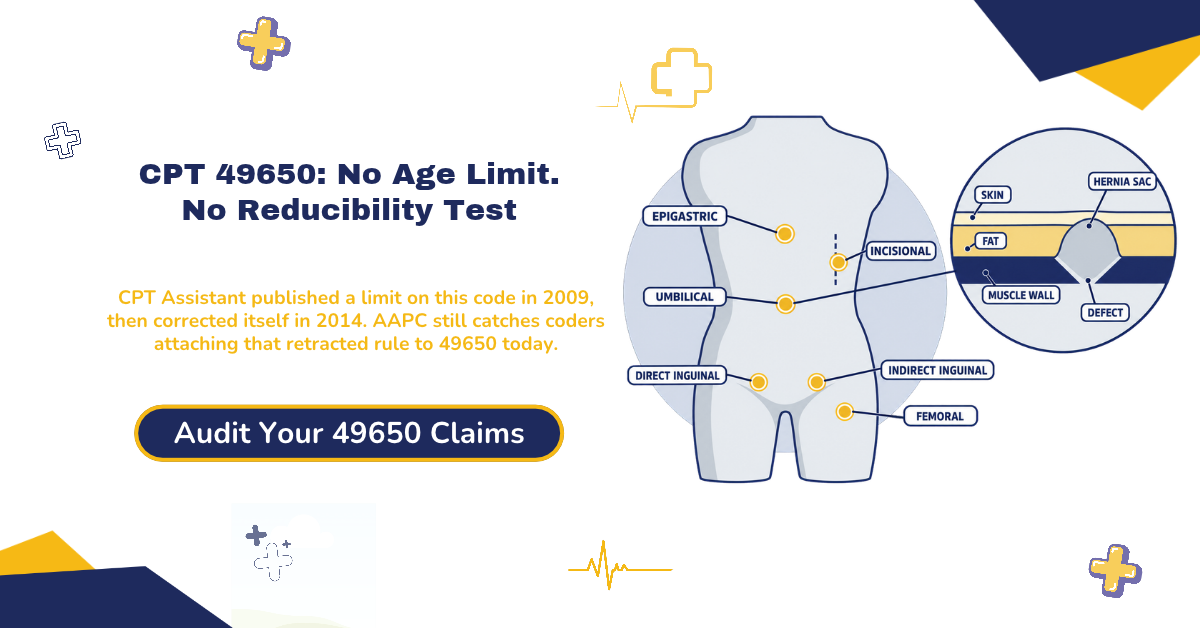
The 49650 CPT code still applies when the surgeon repairs an incarcerated initial hernia through the laparoscope. CPT Assistant corrected a January 2009 answer in July 2014: 49650 doesn’t separate reducible from incarcerated hernias, so 49659 doesn’t apply. Documented extra work may support modifier 22.
Femoral hernias are different. A laparoscopic femoral hernia repair CPT code doesn’t exist, so AAPC guidance from September 2025 points those repairs to unlisted 49659. The 49659 CPT code is carrier priced, so send the op note and a comparison code that helps the payer value it.
If the surgeon repairs an inguinal and a femoral hernia in the same session, ask the payer how it wants the pair reported. Payer policies differ here.
CPT 49652 through 49657 covered laparoscopic ventral, umbilical, and incisional repairs until the AMA deleted them on January 1, 2023. Those repairs now use 49591 through 49618 for any approach, sized by the total defect. Open umbilical codes such as 49585 went too.
Inguinal hernia repair CPT code selection table
The last column shows the op note finding that decides each code.
| Scenario | Code | What decides it |
|---|---|---|
| Initial, laparoscopic or robotic | 49650 | No prior repair at that site |
| Recurrent, laparoscopic or robotic | 49651 | Prior repair documented at that site |
| Initial, open, age 5 or older, reducible | 49505 | Hernia reduces |
| Initial, open, age 5 or older, incarcerated or strangulated | 49507 | Hernia doesn’t reduce |
| Recurrent, open, reducible | 49520 | Prior repair, hernia reduces |
| Recurrent, open, incarcerated or strangulated | 49521 | Prior repair, hernia doesn’t reduce |
| Sliding hernia, open | 49525 | Sliding hernia documented |
| Laparoscopic femoral, or another hernia with no laparoscopic code | 49659 | Unlisted; send the op note |
| Ventral, umbilical, incisional, epigastric, or spigelian | 49591 through 49618 | Any approach; never 49650 |
Inguinal hernia repair code selection, 2026 CPT code set.
If initial-versus-recurrent calls or robotic claims keep getting denied, the fix starts with the op note. Our surgical billing service reviews it on hernia claims before your team submits them.
2026 Medicare payment for CPT 49650: surgeon, ASC, and hospital
In 2026, Medicare’s national rate for the surgeon on 49650 is $424.19 in a facility setting. The facility bills its own claim: $3,030 at an ambulatory surgery center and $6,176 at a hospital outpatient department, before local adjustment. Setting doesn’t change the surgeon’s rate.
2026 RVUs and the national surgeon rate
In 2026, CPT code 49650 has 12.70 RVUs. The CMS 2026 relative value files split that total into three parts. Multiply the total by the conversion factor to get the national rate. Your Medicare contractor then applies three GPCIs, one for each RVU component, for your locality.
| RVU component | 2026 value |
|---|---|
| Work | 6.20 |
| Practice expense, facility | 4.87 |
| Malpractice | 1.63 |
| Total | 12.70 |
2026 facility RVUs for 49650. Source: CMS RVU26D.
At the non-APM conversion factor of $33.4009, the 49650 allowed amount works out to $424.19 before GPCI. Qualifying APM participants get $426.31 at $33.5675. CMS lists the code with status A and a 090 global, so Medicare pays it under the fee schedule as major surgery.
There’s no office rate. CMS marks the non-facility practice expense for 49650 as NA because surgeons don’t perform this repair in an office. Any $424.19 figure labeled non-facility is the facility rate under the wrong name.
Why 49650 pays less in 2026 despite a higher conversion factor
CPT 49650 reimbursement fell $3.43 in 2026, even though the conversion factor rose 3.26%. Medicare’s 2025 national rate was $427.62, from 13.22 RVUs at $32.3465.
CMS made two changes. In the CY 2026 Physician Fee Schedule final rule, CMS cut work RVUs for non-time-based services by 2.5%. The 49650 work RVU dropped from 6.36 to 6.20. Facility practice expense fell from 5.27 to 4.87 after CMS gave office settings a larger share of indirect costs.
Other facility-based surgical codes took the same hit. The laparoscopic cholecystectomy CPT codes guide shows the same efficiency adjustment on 47562.
Facility payment: ambulatory surgery center vs. hospital outpatient
One 49650 case produces three claims: the surgeon’s, the facility’s, and the anesthesia provider’s. The facility claim is the largest. For 2026 national averages by setting, check the Medicare Procedure Price Lookup.
| Setting (2026 national) | Facility fee | Total approved with surgeon’s fee | Medicare pays | Patient pays |
|---|---|---|---|---|
| Ambulatory surgery center (POS 24) | $3,030 | $3,454 | $2,763 | $690 |
| Hospital outpatient department (POS 22) | $6,176 | $6,600 | $5,280 | $1,319 |
Medicare-approved amounts for 49650 by setting, 2026 national averages. Source: Medicare Procedure Price Lookup.
Medicare covers 49650 in both outpatient settings. The surgeon’s place of service follows the facility: POS 24 for an ASC and POS 22 for an on-campus hospital outpatient department. An off-campus department takes POS 19. The POS 22 billing rules guide covers the on-campus hospital case.
The laparoscopic vs. open payment gap
Put 49650 next to CPT code 49505, the open initial repair, and the split is clear: Medicare pays the surgeon less and the facility more.
| Code | Surgeon rate (2026 national) | ASC facility fee | HOPD facility fee |
|---|---|---|---|
| 49650, laparoscopic initial | $424.19 | $3,030 | $6,176 |
| 49651, laparoscopic recurrent | $550.11 | $3,030 | $6,176 |
| 49505, open initial | $508.03 | $1,744 | $3,657 |
2026 national Medicare rates. Sources: CMS RVU26D and Medicare Procedure Price Lookup.
The surgeon earns about $84 less for the laparoscopic repair than for the open one. Facility payment is about 1.7 times as much. Both claims have to report the same approach from the same op note, because a payer that compares them can spot a mismatch.
Commercial rates depend on each contract. If your 49650 remits don’t match what you signed, you’ll catch the gap in payment posting. Our surgical revenue cycle management team checks allowed amounts on surgical remits against each contract.
Modifiers for 49650: bilateral repairs and same-day procedures
CPT code 49650 usually needs a modifier. Most payers want RT or LT on a one-sided repair, and a repair of both sides takes modifier 50. A second procedure in the same session may need 51, 59, or XS. Team and global period rules add a few more.
Is CPT 49650 a bilateral procedure?
No. CPT treats 49650 as a unilateral procedure, and AAPC hernia coding guidance lists the whole inguinal range from 49491 through 49651 as unilateral. If the surgeon repairs both sides in one session, report 49650 once with modifier 50.
Medicare wants a single line: 49650-50, one unit. CMS gives 49650 a bilateral surgery indicator of 1, so Medicare allows 150% of the fee schedule amount, a $636.29 national rate at non-APM. The Medicare Claims Processing Manual, Chapter 12 sets out that 150% rule.
Commercial payers don’t all agree. Some want two separate lines, 49650-RT and 49650-LT, each with its own charge. Others want modifier 50 with two units. Follow the payer’s written policy and keep a copy of it. In each format, the diagnosis is a bilateral K40 code such as K40.20.
A payer that wants two lines will often deny a single-line 49650-50 with CARC 4, the modifier mismatch code. Log each payer’s format in your system. If CARC 4 keeps showing up anyway, a denial management team can trace which payer rule changed.
RT and LT on one-sided repairs
The left inguinal hernia repair CPT code is 49650 with modifier LT, and a right-side repair takes RT. ICD-10-CM inguinal codes only say unilateral or bilateral, so the side shows up on the claim only through the modifier. Check the modifier on every line.
Laterality matters most when the surgeon repairs the other side later in the 90-day global period. That second claim needs the opposite-side modifier plus a global modifier such as 58 or 79. Without both, payers see a duplicate claim.
Modifiers 51, 59, and XS when other procedures happen the same day
CMS assigns multiple procedure indicator 2. Medicare allows 100% for the highest-valued procedure in the session and 50% for each additional one. It applies that reduction itself, while some commercial payers want modifier 51 on the lower-valued line.
With an anterior abdominal repair in the same session, American College of Surgeons coding guidance allows a separate inguinal line with modifier 59, as appropriate. CMS prefers XS (separate structure) when it fits. For the XS-versus-59 decision, see modifier 59 and X modifiers.
You can bill 49592 and 49650 together when the surgeon repairs the two hernias at separate sites. Check the NCCI edit first. Its modifier indicator shows whether 59 or XS can bypass it.
Modifier 22 for unusual work
Modifier 22 fits only when the op note shows significant extra work beyond a typical 49650. Dense adhesions from prior pelvic surgery or a large incarcerated hernia can qualify. The surgeon’s note should record the extra time and the reason. Send the op note with the claim.
Surgical team and split-care modifiers
CMS sets an indicator for each surgical team modifier on 49650 in the 2026 file, and Medicare pays by those indicators:
- Assistant at surgery by a physician (80 or 82) pays 16% of the fee schedule, $67.87 national.
- A PA, NP, or CNS assistant (AS) gets 85% of that 16%, or $57.69.
- Co-surgeons (62) each get 62.5% when both notes support distinct work.
- Team surgery (66) doesn’t pay, because CMS sets the team indicator at 0.
- Surgical care only (54) covers the pre-op and intra-op share, 90% combined.
- Postoperative management only (55) covers the remaining 10%.
- Modifiers 26 and TC don’t apply, since the PC/TC indicator is 0.
49650 modifier quick reference
The table also lists the three modifiers that never apply to 49650.
| Modifier | Use it when | 49650 note |
|---|---|---|
| RT or LT | One side repaired | Shows the side on the claim |
| 50 | Both sides repaired in one session | Medicare allows 150% on one line |
| 51 | Another procedure in the same session | Lower-valued line, if the payer asks |
| 59 or XS | A separate site or structure | Check the NCCI edit first |
| 22 | Documented work well beyond typical | Send the op note |
| 80, 82, or AS | An assistant at surgery | 16%; AS gets 85% of that |
| 62 | Two co-surgeons | 62.5% each, with both notes |
| 54 or 55 | Split surgical and post-op care | 90% and 10% shares |
| 24, 57, 58, 78, or 79 | Services during the global period | See the global period section |
| 52 or 53 | Reduced or discontinued procedure | Payer policy varies |
| 26, TC, or 66 | Never on 49650 | CMS indicators rule them out |
Modifiers for 49650, 2026. Indicators from the CMS RVU26D file.
49650 CPT code global period: what the 90 days cover
CPT 49650 is major surgery with a 90-day global period. Medicare counts 92 days: the day before surgery, the day of surgery, and the 90 days after. The surgical fee covers routine follow-up in that window. Don’t bill those visits.
What the global package covers
The CMS Global Surgery Booklet spells out what the surgical fee pays for. On a 49650 case, the package includes these services, and none of them gets its own claim line:
- Pre-op visits after the decision for surgery, starting the day before
- The repair itself
- Complications that don’t need a return to the operating room
- Follow-up visits during the 90 days
- Pain management by the surgeon
- Dressing changes and removal of sutures, staples, or drains
Diagnostic tests and visits for unrelated problems stay outside the package, along with distinct procedures that aren’t re-operations. The decision-for-surgery visit is outside it as well. You can bill a return to the operating room for a complication with modifier 78.
Practices with 10 or more practitioners in nine states must report post-op visits with 99024, a $0 tracking code, for the procedures on CMS’s list. The states are Florida, Kentucky, Louisiana, Nevada, New Jersey, North Dakota, Ohio, Oregon, and Rhode Island. CMS proposed pausing that reporting for 2027.
In the same proposal, CMS said its data shows post-op visits in the global period often aren’t happening. It asked for comments on how it should value global surgery.
Billing during the global period: 24, 57, 58, 78, and 79
Five modifiers cover billable work that falls around or inside the 92 days. Each one needs a note that shows why the service is outside the package.
| Modifier | When it applies | 49650 example |
|---|---|---|
| 57 | An E/M visit the day before or day of surgery that produced the decision for surgery | The visit where the surgeon decides to repair the hernia; see our modifier 57 decision for surgery guide |
| 24 | An unrelated E/M visit during the 90 days | An evaluation of a new breast lump, with a note that shows it isn’t about the hernia |
| 58 | A planned or staged procedure | A second-side repair planned at the first surgery; a new global period starts |
| 78 | An unplanned return to the OR for a related complication | A hematoma or mesh infection that needs surgery |
| 79 | An unrelated procedure during the global period | A new hernia on the other side that the surgeon didn’t plan; a new global period starts |
Global period modifiers for 49650. Source: CMS Global Surgery Booklet.
When an inguinal repair shares a session with a 0-day ventral repair
The anterior abdominal codes, 49591 through 49618, carry a 000 global. Inguinal codes carry 090. A follow-up visit for the anterior abdominal repair can be billable. Payer handling varies, and some payers apply the 90-day global to every procedure in the session.
AAPC’s advice in its Ask and Learn column on November 1, 2023, is to document that the visit was for the anterior abdominal repair. List that diagnosis first on the visit’s claim. Appeal with the note if the payer denies it.
NCCI edits and same-session scenarios for 49650
NCCI bundles diagnostic laparoscopy and mesh into the repair. It also bundles any hernia repair done at the incision of another open or laparoscopic abdominal procedure. A second hernia repair CPT code is billable when that hernia sits at a separate site and has its own medical reason.
Incidental vs. separately reportable hernia repairs
The 2026 NCCI Policy Manual, Chapter 6 sets the rules. Section E.4 says a hernia repair at the site of an incision for an open or laparoscopic abdominal procedure isn’t separately reportable. A repair at a different site, with its own medical need, is.
The mesh rule comes from Section E.7. Under Section F.1, surgical laparoscopy includes diagnostic laparoscopy, so 49320 doesn’t go on a 49650 claim.
Watch the umbilical port. Surgeons often place the camera port at the umbilicus. E.4 bundles an umbilical hernia repaired through that port incision, even if the patient had it before surgery. A separate 49591 needs a repair site other than a port incision.
CPT 49650 with laparoscopic cholecystectomy or other abdominal procedures
Surgeons sometimes repair an inguinal hernia during a lap chole (47562). The gallbladder and the groin are separate sites. Report 49650 when the op note supports the hernia’s own medical need, such as symptoms found on the pre-op exam.
Before adding 59 or XS, check the pair in the current CMS NCCI PTP edit tables. The release effective October 1, 2026, is version 323r0. A modifier only helps when that edit’s modifier indicator is 1.
Cord lipoma, hydrocele, and “no hernia found”
Report a spermatic cord lipoma excision with 55520 alongside the hernia repair. AHA Coding Clinic for HCPCS, which hospital outpatient coders follow, backed that in the fourth quarter of 2023. Reduction alone doesn’t count. The note has to describe an excision.
Coding Clinic revisited the topic in the third quarter of 2024. Check the current guidance before you add 55520, and confirm the surgeon’s payer accepts it on the professional claim. Don’t treat it as automatic.
For a patient age 5 or older, report hydrocelectomy (55040) on its own line with an open inguinal repair. Open pediatric codes 49491 through 49501 include it. AAPC’s guidance on sorting inguinal codes draws the same line for open cases. With 49650, check the NCCI edit for 55040 first.
If the surgeon scopes the groin and finds no hernia to repair, report diagnostic laparoscopy (49320) with the symptom diagnosis, such as groin pain.
Open groin exploration with no repair is harder. No dedicated groin exploration CPT code exists. Some payers accept the repair code with modifier 52, and others want an unlisted code. Ask the payer which CPT code for inguinal exploration it accepts, and get the answer in writing.
ICD-10-CM codes that support CPT 49650 (FY 2027)
A 49650 claim needs a K40 code whose fifth character is 0, meaning “not specified as recurrent.” If the fifth character is 1, the hernia is recurrent and belongs with 49651. The FY 2027 code set takes effect October 1, 2026. Its 12 K40 codes don’t change.
Each row pairs a K40 code with the CPT line it supports.
| Code | CMS description | Pairs with |
|---|---|---|
| K40.90 | Unilateral inguinal hernia, without obstruction or gangrene, not specified as recurrent | 49650-RT or 49650-LT |
| K40.91 | Unilateral inguinal hernia, without obstruction or gangrene, recurrent | 49651-RT or 49651-LT |
| K40.30 | Unilateral inguinal hernia, with obstruction, without gangrene, not specified as recurrent | 49650, or 49507 if converted to open |
| K40.31 | Unilateral inguinal hernia, with obstruction, without gangrene, recurrent | 49651, or 49521 if converted to open |
| K40.40 | Unilateral inguinal hernia, with gangrene, not specified as recurrent | 49650, or 49507 if converted to open |
| K40.41 | Unilateral inguinal hernia, with gangrene, recurrent | 49651, or 49521 if converted to open |
| K40.20 | Bilateral inguinal hernia, without obstruction or gangrene, not specified as recurrent | 49650-50 |
| K40.21 | Bilateral inguinal hernia, without obstruction or gangrene, recurrent | 49651-50 |
| K40.00 | Bilateral inguinal hernia, with obstruction, without gangrene, not specified as recurrent | 49650-50 |
| K40.01 | Bilateral inguinal hernia, with obstruction, without gangrene, recurrent | 49651-50 |
| K40.10 | Bilateral inguinal hernia, with gangrene, not specified as recurrent | 49650-50 |
| K40.11 | Bilateral inguinal hernia, with gangrene, recurrent | 49651-50 |
FY 2027 ICD-10-CM, effective October 1, 2026. Source: CMS FY 2027 ICD-10-CM code files.
When the two sides differ
A recurrent hernia on one side and an initial hernia on the other don’t fit a single modifier 50 line. Split the claim. Bill each side on its own line with its own diagnosis, such as 49651-RT with K40.91 and 49650-LT with K40.90.
History of hernia repair ICD-10 codes
The right history code depends on the index path. In the FY 2027 index, “history, personal, surgery NEC” leads to Z98.890, and a personal history of digestive disease points to Z87.19.
Use either one only as a secondary code, such as when the surgeon repaired the opposite side years ago. A hernia that came back at the same repaired site gets a recurrent K40 code instead.
Operative note documentation that holds up on review
In a CMS CERT review of laparoscopic hernia repair claims from July to September 2014, reviewers tied most improper payments to missing documentation. Coding errors came second. They found unsigned op notes, wrong dates of service, and missing signature attestations. One urologist billed 49650-51 for a general surgeon’s repair.
Before you submit a CPT 49650 claim, check that the op note states each of these in plain language:
- The approach and any conversion, with the reason
- The side or sides repaired, matching RT, LT, or 50
- Initial or recurrent status at that site, naming any prior repair
- The hernia type, its contents, whether it reduced, and the mesh used
- Any other procedure, with its own site and reason
- Symptoms and exam findings that show medical necessity
- The surgeon’s signature and date, or a signature attestation
The review appeared in the CMS compliance newsletter on CERT findings, Volume 6, Issue 2, January 2016. Its examples use retired codes such as 49652. Payers still check a CPT code 49650 claim against the note behind it.
Coders who read the note before billing catch gaps in the first four items, the ones that change the code. We build that pre-bill review into our medical billing for surgical practices. A signed, complete note is also part of what makes a clean claim.
Common 49650 denials and how to fix them
CPT 49650 denials tend to fall into four groups. Coding calls come first: the wrong code for the hernia’s history, the wrong side, or the wrong modifier format. The other three groups are bundled services, missing authorizations, and notes that don’t support the claim.
The table maps each group to X12’s claim adjustment reason codes (CARCs), with the X12 wording shortened.
| CARC | Meaning | Typical 49650 cause | Fix |
|---|---|---|---|
| 4 | Procedure code inconsistent with the modifier | Single-line 50 sent to a payer that wants RT and LT lines | Corrected claim in that payer’s format |
| 11 | Diagnosis inconsistent with the procedure | Recurrent K40 code on 49650, or an initial one on 49651 | Match the code to the history in the note |
| 16 | Missing information or billing error | No laterality, or an unlisted 49659 claim sent without the op note | Add the missing item and resubmit |
| 18 | Exact duplicate claim or service | Second-side repair billed without RT, LT, 58, or 79 | Add the side and the global modifier |
| 50 | Not a medical necessity per the payer | No documented symptoms, or missing required conservative care | Appeal with records, or fix intake |
| 97 | Included in another service | 49320 or a mesh line billed with 49650, or a port-site hernia repair | Write it off, or appeal if the note shows a separate site |
| 197 | Authorization absent | A Medicare Advantage or commercial plan required prior authorization | Ask for a retro authorization or appeal, then fix scheduling |
| 236 | Pair not allowed together under NCCI | A PTP edit between 49650 and a same-day code | Add XS or 59 only if the modifier indicator is 1 |
Common CARC denials on 49650 claims. Source: X12 claim adjustment reason codes.
For CARC 197, the fix belongs at scheduling. Check each plan’s rule before the surgery date; the eligibility and prior authorization guide shows how.
Some underpayments never show up as denials. A bilateral claim paid at 100% instead of 150% posts like a normal payment. You’ll only catch it in a payment posting review that compares each line to the fee schedule. Then recover the difference through accounts receivable follow-up with the payer.
If the same 49650 denial comes back from one payer month after month, the cause sits upstream of the claim. Our denial management services team traces each denial to the payer rule behind it. Then we change the setup that triggers it.
Worked claim examples
These four claims show how the inguinal hernia repair CPT code, the modifier, and the diagnosis fit together on the CMS-1500. Medicare amounts are 2026 national allowed amounts for non-APM clinicians, before local adjustment. For box-level errors, see our list of CMS-1500 claim form mistakes.
How do you bill a bilateral laparoscopic inguinal hernia repair to Medicare?
Report 49650-50, one unit, with K40.20 and POS 22 for an on-campus hospital outpatient case. Medicare allows $636.29, or 150% of $424.19. That’s Medicare’s format for the bilateral inguinal hernia repair CPT code.
How do you bill a robotic repair of a recurrent left inguinal hernia?
Use 49651-LT with K40.91 for a commercial PPO patient. CPT has no robotic code to add. Skip S2900 unless the PPO contract lists it, and check what the contract pays for it.
How do you bill a laparoscopic inguinal repair with an umbilical hernia repair?
Bill 49650-RT-59 (or XS) and 49591, with diagnoses K40.90 and K42.9. In this case, the umbilical hernia is 2.5 cm and reducible, and the surgeon repaired it at a site other than a port incision.
Medicare applies the 50% cut itself. The allowed amount is $582.01: $424.19 plus 50% of $315.64. Add modifier 51 to 49591 only for payers that ask for it.
How do you bill a laparoscopic case that converts to open for an incarcerated hernia?
Code it as CPT code 49507 with LT and K40.30, and leave 49650 and 49320 off the claim. Medicare’s 2026 national rate is $568.15. The op note should explain why the surgeon converted.
What changes for CPT 49650 in 2027
The AMA’s CPT 2027 announcement lists no change to the CPT code for laparoscopic inguinal hernia repair, so the code stays 49650. CMS proposed two payment changes: a lower 2027 conversion factor and a 50% payment for some same-day E/M visits billed with global procedures.
CPT 2027 code changes
The AMA released CPT 2027 on September 9, 2026. Its 453 changes take effect January 1, 2027, and include 299 new codes, 74 revisions, and 80 deletions. Hernia coding gets nine new codes, all for diaphragmatic hernia repair. Recheck 49650 when the codebook ships.
Proposed 2027 Medicare payment changes
In the CY 2027 fee schedule proposed rule, released July 14, 2026, CMS proposed a non-APM conversion factor of $32.84, down from $33.40. The APM factor would drop from $33.57 to $33.17. Congress passed a one-year 2.5% increase for 2026. That bump ends in 2027.
If the 2026 RVUs held at 12.70, the proposed $32.84 factor would put 49650 at a $417.07 national rate. The final 2027 RVUs can change. Treat the figure as math on a proposal.
Same-day E/M visits with a global procedure
CMS also proposed a same-day cut. It would apply to office and outpatient E/M visits on the same day as a 0-, 10-, or 90-day global procedure. Medicare would pay the lower-valued service at 50%.
A decision-for-surgery office visit billed with modifier 57 on the day of a 49650 case fits that description. Check the final rule for how CMS treats that visit. CMS usually publishes it around November 1.
CPT 49650 FAQs
What is the difference between CPT 49505 and 49650?
The main difference is the approach. CPT code 49505 is an open code for initial hernias. It adds two limits: the hernia must reduce, and the patient must be 5 or older. Code 49650 covers a laparoscopic or robotic initial repair at any age, reducible or not.
In 2026, the surgeon’s national Medicare rate is $508.03 for 49505 and $424.19 for 49650. Medicare pays the facility more for the laparoscopic case in both settings. Both codes carry a 90-day global period.
Is CPT 49650 inpatient or outpatient?
It’s usually outpatient. Medicare covers the facility side of a 49650 case in an ambulatory surgery center or a hospital outpatient department. Patients go home the same day in most cases, after a few hours in recovery.
An inpatient admission needs documented medical necessity, and Medicare expects an inpatient stay to span two midnights. If the hospital admits the patient, its claim groups to the inguinal and femoral hernia MS-DRGs, 350 through 352. The surgeon still bills 49650.
Can CPT 49650 and 49591 be billed together?
Yes, when the surgeon repairs the two hernias separately, at separate sites. The American College of Surgeons lets you report the inguinal repair on its own line with modifier 59. CMS would rather see XS when it fits.
Check the pair’s NCCI edit before you submit. If the surgeon repaired the umbilical hernia through a laparoscopic port incision, NCCI bundles it. Ask the surgeon to document each hernia’s size and the reason for its repair.
What is the 49651 CPT code description?
The AMA descriptor reads, “Laparoscopy, surgical; repair recurrent inguinal hernia.” Use CPT 49651 when the patient had a prior repair at the same site. In 2026, it has a work RVU of 8.17. Its national surgeon rate is $550.11.
Robotic recurrent repairs use the same code. Pair it with a K40 code whose fifth character is 1, and confirm the op note names the prior repair. A prior repair on the other side doesn’t count.
Does Medicare require prior authorization for 49650?
Original Medicare doesn’t. Hernia repair isn’t on CMS’s hospital outpatient prior authorization list, so a 49650 case can go ahead without one. Medicare Advantage and commercial plans often require it for elective hernia surgery, and a missing authorization comes back as CARC 197.
Run eligibility and authorization checks when the office schedules the case. Enter the authorization number in Box 23 of the CMS-1500, because payers compare it with the date of service and the approved code.
What anesthesia is billed with a laparoscopic hernia repair?
The anesthesia provider bills general anesthesia on a separate claim. Its code comes from the lower abdomen range, 00800 through 00882, chosen through the ASA crosswalk for the surgical code. The surgeon’s claim has no anesthesia line.
Payment uses base units plus time units, multiplied by the anesthesia conversion factor. Anesthesia claims use their own modifiers. AA means the anesthesiologist performed the case, and QK means medical direction. For the crosswalk and the 2026 math, see the anesthesia CPT code guide.
Is CPT 49585 still valid?
No. The AMA deleted 49585 on January 1, 2023, along with the other open umbilical and ventral hernia codes. Umbilical repairs now use 49591 through 49596 for an initial hernia or 49613 through 49618 for a recurrent one, by any approach.
Coders pick the exact code by the total defect size and whether the hernia reduces. One code covers every defect in the session. These codes carry a 000 global period, while inguinal repair codes carry a 090 global.
Is 49650 still a valid code in 2026?
Yes. CPT 49650 is active in 2026. CMS lists it with status A in the 2026 relative value file, and the 49650 CPT code description hasn’t changed. The 2026 national surgeon rate is $424.19.
The K40 diagnosis codes don’t change either. FY 2027 ICD-10-CM takes effect October 1, 2026, with all 12 K40 codes intact and none added. For 2027, the AMA’s CPT announcement lists no change to 49650, though CMS has proposed a lower conversion factor.
Getting 49650 claims paid the first time
Before a CPT code 49650 claim goes out, confirm five points on the claim itself:
- A code that matches the hernia’s history, 49650 or 49651
- An approach that matches the op note and the facility claim
- A side modifier in the format this payer wants
- A K40 fifth character that matches the code
- An authorization on file for plans that require one
If your surgical claims keep stalling on these points, our surgical coding and billing team can review a sample. You can request a claim review through our contact page.