| Quick Answer: CPT Code 99306CPT 99306 reports initial nursing facility care, per day, for a new or established patient.Level selection requires high-level medical decision making, or 50 minutes or more of total time on the date of the encounter.The code is billed once per admission, per physician, per specialty.The principal physician of record appends modifier AI.Valid place of service codes are 31, 32, 54, and 56.The 2026 national Medicare rate is $193.06 non-facility and $163.33 facility. |
A physician rounds at the nursing facility on Tuesday, documents a full high-complexity admission, and the coder picks 99306 without hesitation. Three weeks later the claim comes back downcoded. Nobody miscoded anything. The place of service field carried the wrong number, and that one field repriced the claim.
This guide covers what the 99306 cpt code requires in 2026, who can bill it, which place of service code belongs on the claim, and the denial codes that fire when one of those pieces is off.
It also settles the time threshold, because two numbers are circulating and only one of them is current. ClaimMax RCM built this guide from CMS manual language, Medicare Administrative Contractor guidance, and the AMA descriptor revision history.
What Is CPT Code 99306?
CPT code 99306 reports initial nursing facility care, per day, for the evaluation and management of a patient. The encounter needs a medically appropriate history and examination, plus a high level of medical decision making. Select the level using time instead and the encounter has to meet or exceed 50 minutes of total time on the date of service.
That descriptor is the entire 99306 cpt code definition. Everything after it in this guide covers what defending the code on a claim takes. The CMS MLN Evaluation and Management Services booklet sets out how Medicare treats this family as a per-day service.
The American Medical Association files 99306 under Nursing Facility Services within the Evaluation and Management section. It covers new and established patients alike. Anyone pulling the 99306 cpt description from a lookup tool sees that same classification.
Setting decides whether you can use the code. A resident the physician has treated for three years still gets an initial code on a new admission.
Where 99306 Sits in the Nursing Facility Code Family
Billers searching for nursing home cpt codes and billers searching for skilled nursing facility cpt codes land on the same range. Here is how that range breaks down.
| Code range | Category | How the level gets selected |
|---|---|---|
| 99304 to 99306 | Initial nursing facility care, per day | Three codes by MDM level or total time |
| 99307 to 99310 | Subsequent nursing facility care, per day | Four codes by MDM level or total time |
| 99315 to 99316 | Nursing facility discharge day management | Two codes by time alone |
| 99318 | Annual nursing facility assessment | Deleted January 1, 2023 |
One distinction costs billing teams more money than the code selection itself. A skilled nursing facility delivers short-term post-acute care under Medicare Part A. Nursing facilities deliver long-term custodial care. The nursing facility cpt codes run identically across both settings. Place of service and payment rate carry the difference, and Section 10 covers it in full.
Is CPT 99306 45 Minutes or 50 Minutes?
The 99306 cpt code requires 50 minutes or more of total time on the date of the encounter when you use time to select the level. That threshold took effect January 1, 2024, when the AMA revised the descriptor. Before that date, the figure was 45 minutes. The AAFP E/M time and MDM levels reference carries the current number.
Both figures still circulate. Each one was correct at some point, which is the reason the outdated number refuses to die. Teams searching 99306 cpt code description time find both numbers and no explanation of which one applies today.
Why You Still See 45 Minutes Everywhere
Three separate 45-minute artifacts float around the coding world, and each one had a defensible basis when someone published it. The AMA 2023 E/M descriptors and guidelines document is the source of the second one, and it stays useful as a historical record rather than a current rule.
| Where the 45 came from | What it meant at the time | Status in 2026 |
|---|---|---|
| CPT 2021 and earlier | 45 minutes of face-to-face time under the three key component framework | Retired January 1, 2023 |
| CPT 2023 | 45 minutes of total time under the MDM and time framework | Superseded January 1, 2024 |
| Articles published during 2023 | Correct on the publication date, never updated since | Stale |
The same revision moved CPT 99308 from 15 minutes to 20 minutes. A source still printing 15 for the 99308 cpt code is running the pre-2024 cycle, and every other number on that page deserves a second look before your team trusts it.
Open your charge capture template and find the nursing facility codes. Confirm that 99306 reads 50 and 99308 reads 20. A wrong threshold in a template gives no warning. It downcodes one visit at a time until somebody runs an audit two quarters later and finds the pattern.
The Structural Rule Behind Most Time Errors
Nursing facility codes work as meet-or-exceed thresholds. Office visit codes work as ranges. Treat a nursing facility threshold like a range and a 35-minute subsequent visit turns into a 99310, which reviewers flag as the most overused code in the family.
How to Select CPT 99306: MDM or Total Time
Since January 1, 2023, you select the level of a nursing facility visit by medical decision making or by total time on the date of the encounter. The 99306 cpt code follows that framework alongside the rest of the family.
Your physicians still perform a medically appropriate history and examination. Those two elements stopped setting the code level three years ago.
Any source describing cpt code 99306 with comprehensive history, detailed examination, or all three key components is teaching a retired framework. Two pages ranking on the first page of Google for this code still use that language, and a coder who follows them will document the wrong things and lose the level.
What Counts Toward Total Time
When time drives the selection, the clock covers more than the bedside visit. It also excludes work that billers assume they can count.
| Counts toward total time | Does not count |
|---|---|
| Preparing to see the patient, including record review | Services you report separately |
| Obtaining and reviewing separately obtained history | Travel to and from the facility |
| Performing the examination or evaluation | General teaching not tied to this patient |
| Counseling the patient, family, or caregiver | |
| Ordering medications, tests, or procedures | |
| Communicating with other health care professionals | |
| Documenting in the health record | |
| Independently interpreting results | |
| Coordinating care |
Nursing home e&m codes share this framework with the rest of the 2023 revision. A coder who can level a high-complexity office visit already knows how to level this one.
What Qualifies as High MDM for CPT 99306?
High MDM requires at least two of the three elements at the high level: problems, data, and risk. The AAFP nursing home E/M coding changes article maps the grid against the office visit family a coder already knows.
| MDM element | High level requires | What the note has to show |
|---|---|---|
| Number and complexity of problems | One or more chronic illnesses with severe exacerbation or progression, or an acute illness that threatens life or bodily function | Name the problems addressed and their status on that date |
| Amount and complexity of data | Extensive data, including independent interpretation of a test another physician performed, or discussion of management with an external professional | Identify each unique source the physician reviewed |
| Risk of complications | Drug therapy requiring intensive monitoring for toxicity, a decision about hospitalization, or a decision not to resuscitate | State the management risk, not the treatment alone |
The High MDM Element Almost Nobody Documents
The 2023 E/M revision added a high-level element that exists only for initial nursing facility care: multiple morbidities requiring intensive management. It describes conditions, syndromes, or functional impairments likely to require frequent medication changes, treatment changes, or re-evaluations, where the patient carries real risk of worsening status and real risk of hospital readmission.
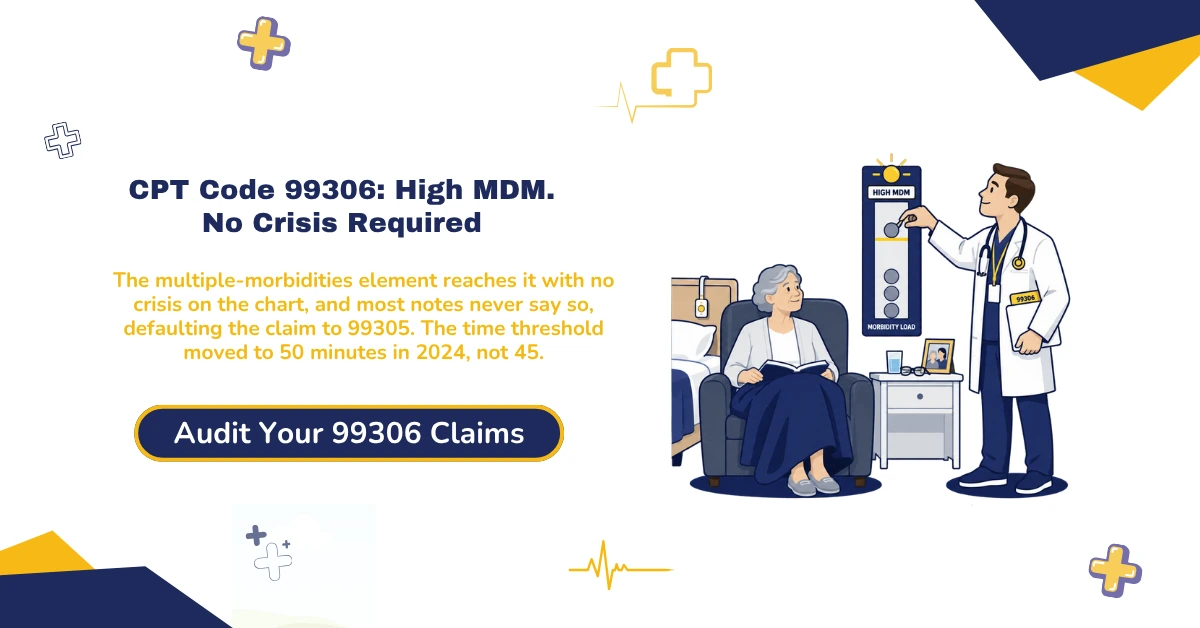
A physician reaches high MDM on the 99306 cpt code through that element with no acute crisis anywhere on the chart. The frail multi-morbid admission that reads as routine on paper qualifies more often than coders expect. Most notes never name it, so the claim drops to 99305 by default and the practice absorbs the difference.
Your physicians don’t need to copy that phrase into the chart. The note has to show the morbidity burden, the expected frequency of change, and the readmission risk. Three sentences cover it. The 99306 cpt code description gives you the room; the documentation has to use it.
When Does CPT 99306 Apply? Four Clinical Scenarios
Coding rules make more sense against real admissions. Three of the scenarios below support 99306. The fourth looks like it should and doesn’t, which is the call that costs practices the most on audit.
Complex Comorbidities Reaching High MDM
A 78-year-old arrives from the hospital with chronic kidney disease, heart failure, and poorly controlled diabetes. The physician stabilizes fluid overload, manages new-onset atrial fibrillation, and rebuilds a medication list carrying serious interaction risk under renal impairment. She reviews nephrology and cardiology notes, then orders new labs and an EKG. This one lands at high MDM on problems and risk.
Acute Unstable Condition on Admission
A 72-year-old with end-stage dementia and aspiration pneumonia arrives nonverbal with a poor prognosis. The physician weighs aggressive treatment against comfort-focused care, discusses goals of care with the healthcare proxy, and reviews a recent chest film and labs.
The escalation decision carries the level here, so it qualifies on risk. That same standard governs high MDM inpatient coding when the patient sits in an acute bed instead.
Extensive Counseling Reaching the Time Threshold
A 69-year-old arrives after a severe stroke with right hemiplegia and aphasia. The physician logs 55 minutes of total time on the date of service: record review across two hospitals, the examination, coordination with speech-language pathology and physical therapy, and a long prognosis conversation with the family.
Time carries this one rather than MDM, and the note states the total.
The Case That Looks Like 99306 and Is Not
A 74-year-old arrives to finish a course of IV antibiotics with stable hypertension and controlled diabetes. Long problem list, long note, thirty minutes of work. No condition was unstable, no data needed independent interpretation, and no management decision carried high risk.
This one is a 99305. Billing the 99306 cpt code here is the most common upcoding pattern on initial nursing facility claims, and it draws a CARC 50 on post-payment review.
The line between 99305 and 99306 is the hardest call in this family, and it moves roughly thirty dollars a claim. Across a full facility census that gap compounds inside a single month. If your coders are guessing on that call more than once a week, a code-level review before submission is worth the hour it takes.
CPT 99304 vs 99305 vs 99306: Choosing the Right Initial Code
All three codes report the first comprehensive evaluation after a patient arrives at the facility. The MDM level and the time threshold separate them.
| Code | MDM level | Time threshold | Typical admission |
|---|---|---|---|
| 99304 | Straightforward or low | 25 minutes | Stable post-surgical patient, clean care plan, no high-risk decisions |
| 99305 | Moderate | 35 minutes | Several active diagnoses that need care plan decisions |
| 99306 | High | 50 minutes | High-risk treatment decisions or intensive multi-morbidity management |
On 99304, a line reading “patient admitted to SNF for skilled care” won’t survive a post-payment review. The 99304 cpt code description still asks the physician to name the problems addressed, the data reviewed, and the reason risk stayed low. Teams weighing cpt code 99304 against the other two find the answer sitting in the risk column.
The 99305 cpt code description covers moderate MDM or 35 minutes, and it marks the most undercoded initial code in the family. Physicians write “patient evaluated, care plan established” without naming the diagnoses they weighed or the risk level they reached. The coder opens that note and has nothing to work with, so the claim drops a level.
On the cpt code 99305 and cpt 99306 decision, the widest gap sits between what physicians do and what they write down. The work reaches high MDM. Their note stays silent about it.
One more clarifier: initial nursing facility codes and outpatient new patient codes aren’t interchangeable, and outpatient new patient coding belongs on a claim carrying POS 11, never POS 31 or 32.
When the documentation supports either 99305 or 99306, take 99305. It’s the defensible choice, and the fix for the revenue gap is documentation quality rather than code selection. Teams searching cpt 99304 and cpt 99305 for a shortcut here won’t find one.
Who Can Bill CPT 99306?
In a skilled nursing facility, the admitting physician performs the initial comprehensive visit. Inside a nursing facility, a qualified non-physician practitioner who isn’t employed by the facility may perform that initial visit where state law permits.
Qualified NPPs may perform subsequent visits in both settings. First Coast Service Options nursing facility E/M guidance sets out the once-per-admission limit that governs all of it.
| Setting | Initial visit (99304 to 99306) | Subsequent visits (99307 to 99310) |
|---|---|---|
| Skilled nursing facility | Admitting physician | Physician or qualified NPP |
| Nursing facility | Physician, or a non-facility-employed qualified NPP where state law permits | Physician or qualified NPP |
Qualified NPP covers nurse practitioners, physician assistants, and clinical nurse specialists working inside their state scope of practice. The facility-employment test is the piece teams miss, and it only applies to the initial visit in a nursing facility.
Searches for the cpt code for skilled nursing facility admission and searches for a nursing visit cpt code both land on this same range.
The Enrollment Prerequisite Nobody Checks
A claim from a provider whose Medicare enrollment lapsed denies no matter how well the visit was coded. Your biller reworks it, resubmits, and gets the same denial back, because the fix lives in an enrollment file the billing department can’t see. Provider enrollment and credentialing and claim submission belong in the same file rather than two departments.
Pull your facility roster and confirm every rendering provider on it holds active enrollment and current revalidation before this month’s claims go out. That check takes an afternoon. It catches the denials that never trace back to coding, and those are the ones that sit in AR the longest.
Modifier AI on CPT 99306: Who Appends It and What Denies Without It
The principal physician of record appends modifier AI to the initial nursing facility care code, 99304 through 99306. Every other physician who performs an initial evaluation on that patient during the same admission bills without modifier AI, which is how the claim identifies specialty care instead of attending care. CMS Transmittal R808CP carries the instruction.
A 99306 cpt code claim from the attending that arrives without AI drives CARC 16, and the problem compounds when several specialties see the same patient during one stay. Two physicians submit 99306 for the same admission, neither claim carries AI, and the payer can’t tell which one is the attending. Both claims sit.
The Reverse Error
Consultants who append AI when they aren’t the principal physician of record create the same confusion from the other direction. The nursing facility modifier isn’t a formality on the code. It’s a role declaration, and two providers can’t both declare the same role on one admission.
Build a scrubber rule that verifies 99304 through 99306 from the attending carries AI, and that consultant claims for the same patient and admission don’t. The same modifier discipline on claims that keeps NCCI edits clean applies here, and a scrubber catches this one before the clearinghouse does.
Place of Service for CPT 99306: POS 31 vs POS 32
Use POS 31 when the patient has an active Medicare Part A skilled nursing facility benefit on the date of service. Switch to POS 32 when Part A benefits have exhausted, when no qualifying three-day hospital stay preceded the admission, or when the resident receives long-term custodial care. POS 11 is never valid on a nursing facility visit.
Most published guidance frames POS 31 and 32 as facility versus non-facility. That describes the payment mechanic. Part A status drives the selection, and the two aren’t the same question. Place of service drives payment across every setting, and the POS 22 billing rules guide shows the same mechanic working in the hospital outpatient setting.
Billers look this field up under several names. The 31 place of service code and the skilled nursing facility pos describe the same two-digit box on the CMS-1500, and so does the longer place of service code for skilled nursing facility phrasing some EHR templates use.
Picking the pos for skilled nursing facility claims comes down to one question: was Part A active on that date?
The Benefit-Exhaustion Trap
A patient admitted under Part A moves to custodial care once the hundred-day benefit period runs out. The place of service has to move with them. Practices that set POS once at admission generate a claim-level error from the day benefits exhaust forward, and nobody catches it until the remittances arrive.
In a building housing both Part A residents and long-term residents, defaulting to one POS code for the whole census produces that same error at scale. Verify Part A status per patient, per visit. It’s a field check, and it takes seconds.
POS 54 and POS 56, the Two Codes Almost Nobody Uses
The CPT definition of nursing facility takes in intermediate care facilities for individuals with intellectual disabilities under POS 54, and psychiatric residential treatment centers under POS 56. Physicians rounding in those settings reach for an office or inpatient code because they don’t realize this code family already covers them. The CMS Place of Service Code Set carries the official definitions.
| POS | Setting | When it applies to CPT 99306 |
|---|---|---|
| 31 | Skilled Nursing Facility | Active Medicare Part A SNF benefit on the date of service |
| 32 | Nursing Facility | Part A exhausted, no qualifying three-day stay, or long-term custodial care |
| 54 | Intermediate Care Facility for Individuals with Intellectual Disabilities | Resident of an ICF/IID |
| 56 | Psychiatric Residential Treatment Center | Resident of a PRTC |
| 11 | Office | Never valid on a nursing facility visit |
| 02 or 10 | Telehealth | Replaces 31 or 32 when the visit runs by telehealth |
A place of service mismatch on a 99306 claim returns CARC 5, procedure code inconsistent with the place of service. That’s a field check a pre-submission scrubber catches in a second, and Section 15 covers the correction path. For the telehealth rows, telehealth place of service rules replace the facility codes rather than sitting alongside them.
How Often Can CPT 99306 Be Billed?
Five rules govern frequency on this code. Each one denies claims on its own when a team misses it.
Per admission limit. CPT 99306 is billed once per admission, per physician, per specialty, no matter how long the stay runs.
The specialty nuance. That limit runs per specialty, not per group. Two physicians in the same group practice but different specialties may each report an initial nursing facility code for the same admission. Only the principal physician of record appends modifier AI.
Readmissions. If the patient discharges and returns for a new stay, the initial codes apply again for that readmission, whether or not the same physician has seen the patient before. Medicare treats a readmission as a new admission for billing purposes, and Palmetto GBA Medicare guidance states the policy.
Subsequent care. Routine and follow-up visits during the same stay use 99307 through 99310, selected by MDM or total time like any other subsequent visit. The 99307 cpt code sits at the floor of that range, and the 99309 cpt code carries the most volume inside it.
Same-day restriction. Medicare won’t pay for an initial nursing facility visit and an office, outpatient, or emergency department E/M on the same date for the same patient by the same practitioner. CPT guidelines allow reporting the other site with modifier 25, so the CPT rule and the Medicare payment rule split here. Follow the Medicare rule on a Medicare claim.
The Exception Most Practices Never Capture
Time a physician spends in another setting can count toward reporting prolonged nursing facility services when the prolonged requirements are met. That rule reads as a restriction and functions as a revenue opportunity. Almost nobody publishes it, and Section 12 covers how the counting works.
The Volume Rule That Triggers Review
Medicare pays no more than one nursing facility E/M per practitioner, per patient, per date of service. An unreasonable number of daily E/M visits by the same physician across multiple patients in one facility within 24 hours can send the whole batch to medical review.
Annual nursing facility visits fall under the subsequent codes now, so a cpt code for annual nursing facility visit search points back to 99307 through 99310.
Prolonged Services With CPT 99306: G0317 and CPT 99418
CPT 99418 is the prolonged services add-on for nursing facility care. Medicare doesn’t pay 99418 in this setting and requires HCPCS G0317 instead. Two coding systems, two thresholds, identical clinical work.
The 50-minute CPT threshold and the 95-minute Medicare threshold measure different things and don’t derive from each other.
Anyone reading the g0317 cpt code description sees a 15-minute increment, while CMS sets the reporting threshold from its own physician time file rather than from the CPT descriptor. A claim billed at 65 minutes gets rejected for missing 95. Novitas prolonged nursing facility services publishes the full policy.
| Base code | CPT reporting | Medicare reporting | Medicare threshold |
|---|---|---|---|
| 99306 | Add 99418 at 65 minutes | G0317 | 95 minutes |
| 99310 | Add 99418 at 60 minutes | G0317 | 85 minutes |
The Counting Window
Medicare counts qualifying time across one day before the encounter, the date of the encounter, and the three calendar days after. Every activity inside that window needs its own date and duration in the record. A total minute count with no itemization behind it won’t survive review, and reviewers ask for the itemization first.
Three Restrictions That Appear in Almost No Published Guide
- G0317 can’t be reported with nursing facility discharge day management, 99315 or 99316.
- G0317 can’t be reported on the same date as 99358, 99359, or 99418.
- G0317 can’t be reported for any time unit under 15 minutes.
G0317 pairs only with 99306 for initial care and 99310 for subsequent care, and only when the base code was selected using time rather than MDM.
One correction worth making: several guides name CPT 99417 as the code Medicare replaced with G0317. That mixes up two code families. Outpatient prolonged services run on 99417, which was never applicable in a nursing facility. The nursing facility counterpart is 99418, and prolonged care cpt codes behave differently in each setting.
CPT 99306 Reimbursement in 2026: RVUs, Rates, and What Changed
The 2026 national Medicare estimate for the 99306 cpt code is $193.06 non-facility and $163.33 facility, before geographic adjustment, calculated from the CMS 2026 Physician Fee Schedule relative value file. Global period XXX. Status code A, active and priced by CMS.
| RVU component | Non-facility | Facility |
|---|---|---|
| Work RVU | 3.50 | 3.50 |
| Practice expense RVU | 2.05 | 1.16 |
| Malpractice RVU | 0.23 | 0.23 |
| Total RVU | 5.78 | 4.89 |
| Estimated payment | $193.06 | $163.33 |
Practice expense carries the gap between those two columns. A claim that drops from 99306 to 99305 on thin documentation gives up roughly thirty dollars, and a claim carrying the wrong POS gives up thirty more.
Code-level review before submission protects both of those, and outsourced medical billing that runs the review inside your existing EHR catches them before the clearinghouse ever sees the claim.
The Two Conversion Factors Nobody Mentions
Starting in CY 2026, the Physician Fee Schedule carries two conversion factors instead of one: roughly $33.5675 for qualifying APM participants and $33.4009 for clinicians who aren’t qualifying participants. Whichever applies to your practice changes the payment on every 99306 claim you submit.
Most published rate figures quote the non-QP factor without saying so. Verify your own status against the CMS Physician Fee Schedule before you build the number into a budget.
Why Your Local Rate Differs From $193.06
That national figure sits before geographic adjustment. Geographic practice cost indices adjust work, practice expense, and malpractice separately by locality, so the same code pays one amount in Los Angeles and another in rural Georgia. Practices in California and other high-cost localities should pull their own locality rate from the CMS look-up tool rather than budgeting from a national average.
Commercial Rates Are Not the Medicare Rate
Commercial and managed care reimbursement for skilled nursing facility billing varies by contract, and the spread between two payers in the same market runs wider than most practices expect.
A range circulating online as the commercial rate for this code traces back to an unsourced estimate rather than published data. Pull your own contracted rates from your fee schedules instead.
Can CPT 99306 Be Billed as Telehealth?
Nursing facility E/M services are telehealth-eligible under Medicare. The CY 2026 Physician Fee Schedule permanently removed the frequency limitation on subsequent nursing facility telehealth visits, effective January 1, 2026.
Before that date, the rule allowed one subsequent nursing facility telehealth visit every 14 days. That cap dated to the CY 2011 fee schedule and stood for 15 years. Medical necessity governs frequency now.
Several guides still answer this question with a flat no. That answer was outdated before 2026 and it costs practices billable visits.
Three Claim Mechanics That Change
Modifier. Append modifier 95 for a synchronous audio-video encounter, or modifier 93 for synchronous audio-only where the service permits it. Our modifier 95 telehealth rules guide covers the payer-by-payer variation.
Place of service. Use POS 02 or POS 10 rather than POS 31 or POS 32. The nursing facility codes describe where the service would have happened in person, and the telehealth POS codes describe where it happened instead.
Originating site. The CY 2026 originating site facility fee, HCPCS Q3014, pays $31.85.
Practices that dropped nursing facility telehealth follow-ups because of the 14-day cap can restart them. The cap is gone, the documentation standard didn’t move, and the E/M selection rules run the same whether the physician sat in the room or on screen.
Why CPT 99306 Claims Get Denied: CARC Codes and Fixes
Most 99306 denials start somewhere other than the code. A place of service field, a missing modifier, or a thin note carries the failure while the code on the claim was right all along. That mismatch is why reworking the same claim four times changes nothing.
| Denial pattern | CARC | What triggers it | First correction step |
|---|---|---|---|
| POS mismatch during an active Part A stay | CARC 5 | POS 32 submitted while the Part A benefit is active | Resubmit with POS 31 |
| Office POS on a facility visit | CARC 5 | POS 11 on a nursing facility claim | Resubmit with POS 31 or POS 32 |
| Missing modifier AI | CARC 16 | Principal physician omitted AI on 99304 through 99306 | Resubmit with modifier AI appended |
| Documentation doesn’t support high MDM | CARC 50 | Post-payment medical necessity review | Addend with the specific MDM elements, then appeal |
| Duplicate initial code, same admission | CARC 18 | Second provider, same specialty, same stay | Verify specialty and AI status, then correct |
| Diagnosis doesn’t support the service | CARC 11 | Primary diagnosis mismatched to the encounter | Correct the diagnosis sequencing |
| Bundled service billed during a Part A stay | CARC 97 | Consolidated billing violation | Bill the facility rather than Medicare |
| Medicare Advantage authorization missing | CARC 197 | Prior authorization not obtained at the date of service | Request retroactive authorization or appeal |
CARC 5 and CARC 50 Account for Most of the Preventable Ones
CARC 5 is a field check, and a pre-submission scrubber catches it in a second. A CARC 50 denial works differently: it needs a clinical addendum and a formal appeal.
An addendum your physician writes six months later carries less weight than the note written that day. CARC-based denial management separates the two on the first pass instead of the fourth.
The Appeal That Works on CARC 50
Pull the note, then map each documented element to the high-MDM criterion it satisfies. State the connection in plain language instead of asking the reviewer to infer it.
Reviewers don’t reconstruct clinical reasoning; they look for it and move on when it isn’t there. Our CO-50 appeal workflow walks through the same structure on therapy claims, and the appeal architecture transfers.
Working one denial fixes one claim. Finding the pattern behind it stops the next ten. A denial nobody root-causes comes back the same way next month, from the same payer, on the same code.
If your team appeals 99306 denials without categorizing them by CARC first, a root-cause review across one reporting cycle surfaces the pattern faster than another round of appeals. Most snf billing guidelines stop at code selection and never reach the CARC layer, which is where the recoverable money sits.
Is CPT 99306 Included in SNF Consolidated Billing?
Physician and qualified non-physician practitioner professional services are excluded from SNF consolidated billing and stay separately payable to Medicare Part B during a covered Part A stay. That exclusion is what keeps 99306 billable at all.
The split catches teams on services carrying both a professional and a technical component. Professional components are excluded and bill to Part B. Technical components fall under consolidated billing and route through the facility. Bill both to Medicare and the technical line comes back as a bundling denial under CARC 97.
Two Claims, Two Forms, Same Patient, Same Day
The physician’s visit bills on the CMS-1500 under Part B. A facility’s Part A stay bills on the UB-04 under a per diem rate set by the Patient-Driven Payment Model. Both claims run at the same time for the same dates of service.
When the two billing offices don’t talk, the physician’s claim gets routed to the SNF and comes back unpaid.
When Consolidated Billing Switches Off
Three conditions pull a claim out of consolidated billing: exhausted Part A benefits, no qualifying three-day inpatient hospital stay, or an unmet level-of-care requirement. Any one of them ends the arrangement for that stay.
Teams researching cpt codes for snf and the snf consolidated billing exclusions list end up back at this rule, because it decides which claims you send and which ones the facility sends.
Audit Exposure on CPT 99306 in 2026
Recoupments under the one-E/M-per-day rule don’t arrive as denials. They surface months later inside an aging report, where nobody connects them back to a coding pattern. By the time a biller traces the thread, the pattern has run for two quarters. Aged AR recovery that works by aging bucket and payer queue finds these before the trail goes cold.
Three oversight programs touch this code right now. Medicare’s Recovery Audit program lists excessive units of nursing facility services as an approved review issue.
CMS launched the SNF Value-Based Purchasing Data Validation Process on January 1, 2026, after announcing it on December 23, 2025. Selected facilities receive notices through iQIES.
The HHS Office of Inspector General runs active audit work on SNF reimbursement, PDPM upcoding, medical necessity, and consolidated billing.
The Upcoding Pattern Reviewers Look For
Billing 99306 when the documentation supports 99305 is the most common upcoding pattern on initial nursing facility claims. Copy-forward notes that don’t reflect the decisions made at that specific encounter support no level at all. A chart audit surfaces both before a single claim gets pulled, which is why nursing home billing guidelines put documentation review ahead of code review.
Pull an internal sample of your 99306 cpt code claims and run them against the high-MDM criteria yourself. Do it before an external reviewer does it for you, because the sample they pull won’t be the one you would have chosen.
Related Nursing Facility Codes and Common Code Mix-Ups
Initial care is one visit. Everything after it runs on the subsequent and discharge codes. The University of Rochester nursing facility E/M guidelines publish the full grid alongside the MDM criteria.
| Code | MDM | Time threshold | When it applies |
|---|---|---|---|
| 99307 | Straightforward | 10 minutes | Stable resident, routine review |
| 99308 | Low | 20 minutes | Stable chronic conditions needing assessment |
| 99309 | Moderate | 30 minutes | Active problem requiring a management change |
| 99310 | High | 45 minutes | Medically unstable, high-risk decisions |
| 99315 | Time only | 30 minutes or less | Nursing facility discharge day management |
| 99316 | Time only | More than 30 minutes | Nursing facility discharge day management |
The 99310 cpt code closes the subsequent range at high MDM. Discharge day management runs on the 99315 cpt code and the 99316 cpt code, which split on time alone. Both need a face-to-face encounter that can happen on a date before the patient physically leaves the building.
CPT 99318 was deleted effective January 1, 2023. Annual nursing facility assessments bill with 99307 through 99310 now, selected by MDM or total time. A claim carrying 99318 returns an invalid procedure code denial, and the code still hides inside EHR superbills, charge capture templates, and printed encounter forms nobody has opened in three years.
99306 or 93306?
CPT 93306 is a complete transthoracic echocardiogram with spectral Doppler and color flow Doppler, a different code in a different section of the code set. Search engines associate the two because billers transpose the digits often enough to create a pattern. Our CPT 93306 echocardiogram guide covers that code in full if the echo claim is what brought you here.
There Is No CPT 99303
99303 isn’t a valid current CPT code. Billers searching for it want the initial nursing facility range, 99304 through 99306.
CPT Code 99306: Frequently Asked Questions
What is CPT code 99306?
The 99306 cpt code reports initial nursing facility care, per day, for the evaluation and management of a new or established patient. The encounter requires a medically appropriate history and examination plus high-level medical decision making, or 50 minutes or more of total time on the date of the encounter. It applies in a skilled nursing facility or nursing facility and covers the first comprehensive evaluation after admission.
How many minutes is CPT 99306?
The 99306 cpt code requires 50 minutes or more of total time on the date of the encounter when time is used to select the level. That total covers record review, the examination, care coordination, and documentation performed on that date. Time is one of two pathways. A physician who reaches high medical decision making bills 99306 without meeting the 50-minute threshold at all.
Is 99306 45 minutes or 50 minutes?
The 99306 cpt code is 50 minutes as of January 1, 2024, when the AMA revised the descriptor. The 45-minute figure was correct under CPT 2023 and appears in articles published that year. An older 45-minute figure referred to face-to-face time under the pre-2021 framework. The 99306 cpt code description time threshold in force for 2026 claims is 50 minutes.
Who can bill CPT 99306?
In a skilled nursing facility, the admitting physician performs the initial comprehensive visit. In a nursing facility, a qualified non-physician practitioner who is not employed by the facility may perform it where state law permits. Qualified NPPs include nurse practitioners, physician assistants, and clinical nurse specialists. Any rendering provider also needs active Medicare enrollment on the date of service for the claim to pay.
How often can 99306 be billed?
The 99306 cpt code is billed once per admission, per physician, per specialty, regardless of the length of stay. If the patient discharges and returns for a new stay, the initial codes apply again for that readmission. Follow-up visits during the same stay use 99307 through 99310. Medicare pays no more than one nursing facility E/M per practitioner, per patient, per date of service.
What is the difference between 99305 and 99306?
CPT 99305 requires moderate medical decision making or 35 minutes of total time. CPT 99306 requires high medical decision making or 50 minutes. The difference is the MDM level and the time threshold, not the length of the note. A patient with several active diagnoses needing care plan decisions fits 99305. A patient carrying high-risk treatment decisions fits 99306. The same MDM grid governs nursing facility E/M codes and inpatient codes alike.
Does CPT 99306 require modifier AI?
The principal physician of record appends modifier AI to CPT 99306. Other physicians who perform an initial evaluation on the same patient during the same admission bill the code without AI, which identifies their service as specialty care. A missing AI on the attending’s claim drives CARC 16. A consultant who appends AI in error creates the same adjudication problem from the other side.
What place of service code is used with 99306?
Use POS 31 when the patient holds an active Medicare Part A skilled nursing facility benefit on the date of service. Use POS 32 when Part A benefits have exhausted, no qualifying three-day hospital stay preceded admission, or the resident receives custodial care. POS 54 and POS 56 also apply in intermediate care facilities and psychiatric residential treatment centers. POS 11 is never valid.
What does Medicare pay for CPT 99306 in 2026?
The 2026 national Medicare estimate for the 99306 cpt code is $193.06 in the non-facility setting and $163.33 in the facility setting, before geographic adjustment. The work RVU is 3.50 and the total non-facility RVU is 5.78. CY 2026 carries two conversion factors: about $33.5675 for qualifying APM participants and $33.4009 for everyone else. Local rates shift with GPCI.
Can CPT 99306 be billed as telehealth?
Nursing facility E/M services are telehealth-eligible under Medicare. The CY 2026 Physician Fee Schedule permanently removed the frequency limit on subsequent nursing facility telehealth visits, effective January 1, 2026. Append modifier 95 for synchronous audio-video, or modifier 93 for audio-only where permitted, and report POS 02 or POS 10 instead of POS 31 or POS 32.
Can 99306 be billed with G0317?
Yes, when the encounter reaches 95 minutes of qualifying time and the base code was selected using time rather than MDM. G0317 is the Medicare add-on for prolonged nursing facility services, reported in place of CPT 99418. Medicare counts time across one day before the visit, the date of the visit, and three days after. G0317 cannot pair with 99315 or 99316.
Can 99306 be billed again on readmission?
Yes. If the patient discharges from the facility and returns for a new stay, the initial nursing facility codes apply again, including 99306. The rule holds whether or not the same physician treated the patient during the prior admission, because Medicare treats a readmission as a new admission for billing purposes. The visit still has to meet the high MDM or 50-minute threshold on its own.
If a specific 99306 claim in your queue doesn’t fit any of these answers, send it over and our coders will look at the note rather than the code.
Sources and Verification
Every rule in this guide traces to one of the sources below.
AMA CPT 2026 Professional Edition and the CPT 2024 descriptor revision. CMS MLN006764, Evaluation and Management Services. CMS Transmittal R808CP, Pub. 100-04. CMS Medicare Claims Processing Manual, Chapter 12, Sections 30.6.13 and 30.6.15.
CMS Place of Service Code Set. CY 2026 Physician Fee Schedule Final Rule, CMS-1832-F. CMS 2026 National Physician Fee Schedule Relative Value File. First Coast Service Options, Nursing Facility E/M Services.
Novitas Solutions, Prolonged Physician Services. Palmetto GBA nursing facility coding policy. AAFP, Time and Medical Decision Making Levels for E/M CPT Codes. University of Rochester Office of Integrity and Compliance, Nursing Facility E&M Guidelines.
Where Nursing Facility Claims Leak Revenue
A facility census generates the same three denial patterns month after month: a POS field that didn’t move when Part A benefits ran out, a missing modifier AI on the attending’s claim, and a note that did the high-MDM work without naming it.
All three sit upstream of the claim, which is why appealing them one at a time never closes the gap. Denial root-cause review categorizes them by CARC before anyone drafts an appeal, and AR follow-up by aging bucket works the claims that already aged past the first attempt.
ClaimMax RCM runs a free revenue cycle analysis on your actual billing data. Twenty minutes, a custom written report, and up to three specific gaps identified in your claims. No commitment on your side, and the report is yours whether or not we work together.