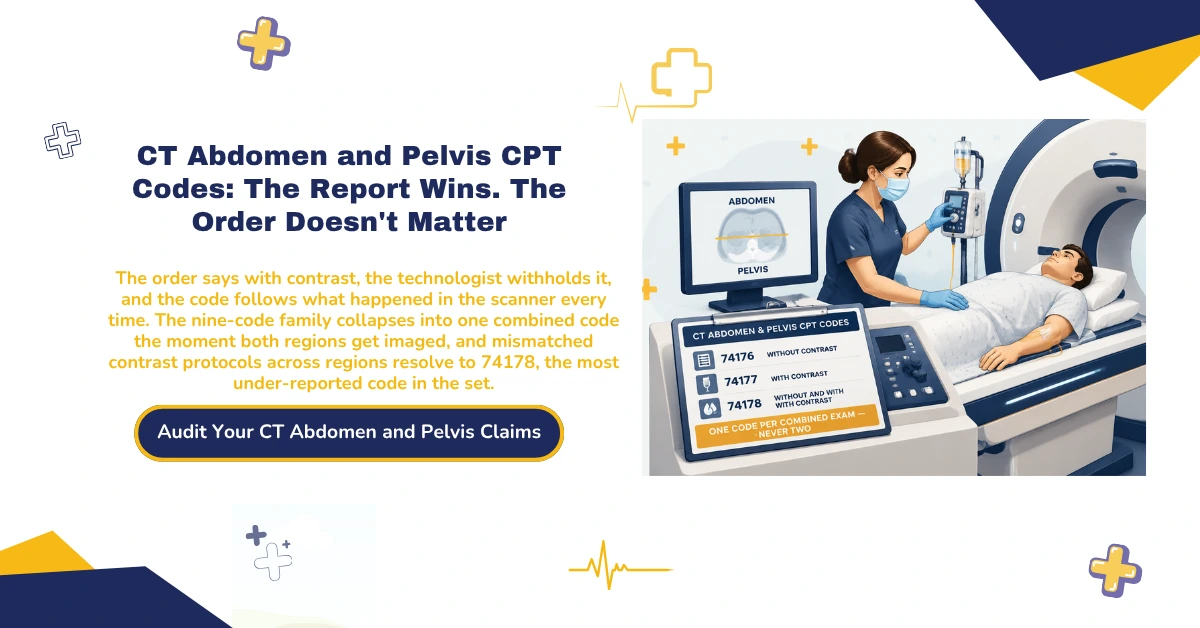
CT abdomen and pelvis CPT codes split into nine diagnostic codes, and two variables decide which one you report: the anatomic region imaged and the contrast status of the study. Each anatomic scope carries three contrast variants. You report one code per combined examination, never two.
The combined family is 74176, 74177, and 74178. Abdomen alone runs 74150, 74160, and 74170. Pelvis alone runs 72192, 72193, and 72194.
The claim comes back three weeks later. The order said with contrast, the radiology report never names a route, and the payer honored the report. The payer downcodes the line on that mismatch, and on post-payment review somebody asks for a refund.
This guide covers the full set of CT abdomen and pelvis CPT codes, the crossover matrix that converts standalone codes into combined ones, the modifier decision, the NCCI and MUE indicators that decide whether a denial can be appealed, the 2026 rate math, and ICD-10 pairing.
If you bill for a radiology group, a freestanding imaging center, or a hospital outpatient department, this is your reference. Same goes for the specialties reading their own studies, where somebody who codes gastroenterology all day touches a CT abdomen and pelvis CPT code twice a week.
Key Takeaways
- Nine CPT codes cover CT of the abdomen, the pelvis, or both, and contrast status selects within each family.
- Only intravenous contrast qualifies a study as with contrast. Oral and rectal contrast don’t.
- Report one code per combined abdomen and pelvis examination. Never two from the same family.
- The radiologist’s report governs contrast status, and the order carries no weight when the two disagree.
- Combined codes replace separate abdomen and pelvis codes when both regions get imaged in one session.
- Appropriate Use Criteria stopped being a Medicare requirement in 2024, and no AUC modifier belongs on the claim.
- Two different Medicare rates circulate for the same code, and the difference is facility versus non-facility.
What Are the CPT Codes for CT Abdomen and Pelvis?
Nine diagnostic codes cover this anatomy, grouped into three families by anatomic scope: abdomen only, pelvis only, and the two regions combined. Contrast status picks one code inside each family. Three CTA codes sit alongside them and follow different rules. If you bill across multiple modalities, our imaging billing by specialty pages cover the payer rules that shift by practice type.
The Complete CT Abdomen and Pelvis Code Family for 2026
Our coding team checked every code below against the current AMA code set rather than copying it from another published list. The status column confirms the code is active for 2026 dates of service.
| Anatomic scope | Without contrast | With contrast | Without then with | 2026 status |
|---|---|---|---|---|
| Abdomen only | 74150 | 74160 | 74170 | Current |
| Pelvis only | 72192 | 72193 | 72194 | Current |
| Abdomen and pelvis combined | 74176 | 74177 | 74178 | Current |
| CTA abdomen and pelvis | 74174 (single code) | n/a | n/a | Current |
| CTA abdomen only | 74175 (single code) | n/a | n/a | Current |
| CTA pelvis only | 72191 (single code) | n/a | n/a | Current |
The three CTA rows break the pattern. They carry no contrast variants, because each one covers the study whether or not the technologist acquired non-contrast images. We checked every descriptor and family assignment against the AMA CPT 2026 code set announcement.
Where the Abdomen Ends and the Pelvis Begins
No. A CT of the abdomen alone stops at the iliac crests. The combined code applies once the field of view crosses that line and the radiologist interprets findings on both sides of it.
Abdomen: Diaphragm down to the iliac crests. Liver, gallbladder, spleen, pancreas, kidneys, adrenal glands, stomach, small bowel, ascending and transverse colon, abdominal aorta, inferior vena cava, and retroperitoneum.
Pelvis: Iliac crests down to the symphysis pubis. Descending and sigmoid colon, rectum, bladder, prostate, uterus and adnexa, iliac vessels, and pelvic lymph nodes.
The billing rule: Field of view crosses the iliac crests plus findings described in both regions equals a combined code.
A report that scanned both regions and describes only abdominal findings won’t support the combined code on audit. The auditor reads the findings section, not the protocol name, and an unexamined pelvis reads as an abdomen-only study.
How Separate Abdomen and Pelvis Codes Convert Into One Combined Code
Two standalone codes collapse into one combined code once both regions get imaged in a single session. The contrast status in each region decides which combined code you land on, and the two regions don’t have to match.
The 2026 Abdomen Plus Pelvis Crossover Matrix
Read the abdomen protocol down the left column and the pelvis protocol across the top. The cell names which of the combined CT abdomen and pelvis CPT codes applies.
| Abdomen protocol | Pelvis without | Pelvis with | Pelvis without then with |
|---|---|---|---|
| Abdomen without | 74176 | 74178 | 74178 |
| Abdomen with | 74178 | 74177 | 74178 |
| Abdomen without then with | 74178 | 74178 | 74178 |
Two of the nine combinations produce something other than 74178. Matching protocols in both regions give you 74176 or the with-contrast code. Every mismatch resolves to 74178, which makes 74178 the most under-reported code in the family.
Why Two Standalone Codes Won’t Pay
Billing 74150 plus 72192 for a single combined study is unbundling, and payer editing systems catch the pair. Reporting the abdomen-only code when the radiologist read the pelvis is undercoding, which costs revenue and creates a documentation accuracy finding in the same claim. Medicare billing rules for this family sit in CMS Article A56421.
Your coder needs the field-of-view statement from the report to make this call. The order states an intent, and you code what the radiologist performed.
How Contrast Status Decides the CT Abdomen and Pelvis CPT Code
Contrast status produces more code-selection denials on this family than any other decision. Three codes exist for each anatomic scope, and one of them matches the study the technologist performed. The report tells you which.
What Counts as With Contrast Under CPT
A study qualifies as with contrast only when somebody administers contrast intravascularly, intra-articularly, or intrathecally. For abdominal and pelvic CT, that means an intravenous injection.
Qualifies: Intravascular, intra-articular, or intrathecal administration
Does not qualify: Oral contrast alone, rectal contrast alone, or both together
What the report must name: The agent, the route, and the volume
Without a documented route, an auditor can’t separate the with-contrast code from the without-contrast code. The reviewer resolves that ambiguity against you, and the line downcodes.
Does Oral or Rectal Contrast Count?
No. Oral and rectal contrast don’t change code selection on a CT claim, and neither does both together.
The trap sits in the technologist note. Oral contrast runs in most abdominal CT protocols, so a note reading “patient received 900 mL oral contrast” looks like contrast documentation to a coder who hasn’t learned the rule. That study is 74176.
The Order Said Contrast and the Technologist Withheld It
Bill the without-contrast code. The creatinine comes back elevated, radiology drops the contrast and scans the patient anyway, and nobody tells billing.
Intent doesn’t pick the code. The performed study does. A documented allergy or renal concern belongs in the record to explain the protocol change, and the claim still goes out as 74176.
When the Order and the Report Disagree
The radiologist’s report governs contrast status on every CT abdomen and pelvis CPT code. A coder working from the order alone can’t see a conflict between the two documents, so the wrong code leaves the building the moment they diverge.
Somebody on your team reads the final report before the claim drops. If the technique section doesn’t name the contrast agent and the route, you’re billing 74176. Building that check into claim generation is what clean claim submission discipline looks like in practice.
Incomplete documentation ranks among the top denial reasons on this code family in Noridian’s published review results, and that category closes once one reviewer reads one field. Contrast mismatch denials stop repeating when the control sits upstream of submission.
When the same contrast mismatch shows up on remittance after remittance, the correction sits in the claim build rather than the appeal letter. One reviewer reading one field before submission closes the whole category.
When to Use CPT 74176 for CT Abdomen and Pelvis Without Contrast
Report 74176 when the technologist images both the abdomen and the pelvis in one session and administers no intravenous contrast at any point in the study. Oral contrast in the protocol doesn’t change that.
What CPT 74176 Covers
The AMA descriptor covers a combined abdomen and pelvis computed tomography performed without contrast material. Five attributes decide whether the cpt code 74176 fits the study in front of you.
Anatomic requirement: Both abdomen and pelvis, one session
Contrast requirement: No intravascular contrast at any phase
Units: One per date of service per examination
Components: Global by default, splits with modifier 26 and modifier TC
Oral contrast: Permitted, and it doesn’t change the code
Clinical Situations That Call for 74176
Four scenarios account for most 74176 claims, and a biller recognizes each one from the indication on the order.
- Suspected nephrolithiasis. Contrast reduces stone conspicuity, so the non-contrast protocol is the clinical standard. Billing a with-contrast code for a renal colic workup is a protocol and code mismatch that payers audit.
- Documented contrast allergy or renal impairment, where the ordering provider or the radiologist withheld contrast.
- Follow-up of a known calcification or a stable non-vascular finding.
- Trauma protocols at facilities that run a non-contrast pass first.
The same three-tier contrast structure runs through every CT body region, and the 74176 cpt code sits in the abdomen and pelvis version of it. Our CT chest contrast triad guide works through the thoracic equivalent.
When 74176 Is the Wrong Code
Three conditions rule out 74176, and each one points to a specific alternative.
Intravenous contrast administered at any phase: Move to the with-contrast code, or to 74178 if a non-contrast pass ran first
Only one anatomic region imaged: Use the abdomen-only or pelvis-only family instead
Non-contrast pass followed by a contrast pass in one session: Report 74178 as a single line
The 74176 cpt code description carries no room for a partial study. A procedure code 74176 claim on a single-region examination reads as a coding error on review, and the reviewer corrects it downward rather than upward.
When to Use CPT 74178 for Without and With Contrast
Report cpt 74178 when a non-contrast acquisition runs first and a contrast-enhanced acquisition follows in the same session, in one region or both. The code answers a protocol mismatch as often as it answers a true dual-phase study.
What CPT 74178 Covers
Five attributes define the cpt code 74178 claim, and the second one is where most coders lose the code.
Dual-phase protocol: Non-contrast phase, then contrast phase, across both regions
Mixed protocol: One region without contrast, the other with contrast, same session
Common indications: CT urography, renal mass characterization, liver lesion characterization, and adrenal characterization
Units: One per date of service
What it replaces: Any combination that would otherwise need two codes from this family
Most published guides describe 74178 as a dual-phase code and stop there. The mixed-protocol case sends more claims to 74178 than the dual-phase case does, and the crossover matrix above shows the reason.
What the Report Must Document for 74178
The technique section names both acquisitions. A report describing only post-contrast findings won’t support the 74178 cpt code description on review, whatever the protocol sheet says.
Required: Explicit documentation of a non-contrast acquisition
Required: Explicit documentation of a contrast-enhanced acquisition
Required: Both acquisitions in the same session
Required: Contrast agent, route, and volume
Not sufficient: A protocol name on its own
Can You Bill 74176 and 74177 Together?
No. When both a non-contrast phase and a contrast phase run in one session, 74178 is the single correct code, and no modifier gets you around the edit.
What happened: A non-contrast phase and a contrast phase in one session
What gets billed wrong: 74176 plus 74177 on the same claim
What the payer sees: Unbundling under NCCI
What to bill instead: 74178, one unit
Modifier workaround: None exists for the same session
One exception survives. Two separate sessions on the same date, each documented on its own, can support both codes with a distinct-service modifier on the second. The documentation bar sits high and the scenario stays rare, so treat it as an exception rather than a workaround.
When Abdomen-Only or Pelvis-Only CT Codes Apply Instead
The combined codes apply when the technologist images both regions. Once the clinical indication limits the study to one region and the field of view matches that limit, you report from a standalone family instead. Six codes cover the two single-region families.
CT Abdomen Only: 74150, 74160, and 74170
The abdomen-only triad follows the same contrast logic as the combined family. Each code carries a typical indication your ordering providers will recognize from their own order sets.
| Code | Contrast protocol | Typical indication |
|---|---|---|
| 74150 | Without contrast | Contrast contraindicated, or follow-up of a stable finding |
| 74160 | With contrast only | Solid organ characterization limited to the abdomen |
| 74170 | Without then with contrast | Lesion characterization needing a pre and post comparison |
An order reading “CT abdomen” that produces a field of view crossing the iliac crests, with pelvic findings in the report, is a combined study. The cpt code 74170 or 74160 on that claim undercodes it, and the pattern stays invisible until somebody audits a batch of them.
CT Pelvis Only: 72192, 72193, and 72194
Pelvis-only studies run a smaller share of volume, which makes this the family most likely to carry a chargemaster entry your team hasn’t reviewed since it went in.
| Code | Contrast protocol | Typical indication |
|---|---|---|
| 72192 | Without contrast | Pelvic pain with contrast contraindicated, or osseous evaluation |
| 72193 | With contrast only | Pelvic mass, abscess, or inflammatory process |
| 72194 | Without then with contrast | Mass characterization needing both phases |
One correction belongs here. Published lists sometimes include 72191 in this family. CPT 72191 reports computed tomographic angiography of the pelvis, not diagnostic CT, and a claim built on that confusion carries the wrong code and the wrong expected payment.
The Undercoding Error That Costs the Most
Undercoding a combined study as one of the abdomen-only CT abdomen and pelvis CPT codes creates two problems in one claim. You leave money on the table, and you create a documentation accuracy finding the moment a compliance reviewer compares the report to the billed code.
The sequence looks the same at every practice that runs into it.
Where it starts: The order says “CT abdomen”
What the technologist does: Extends the field of view past the iliac crests
What the report shows: Findings in both regions
What billing sends: 74160
What the report supports: The combined code matching the contrast protocol
Fixing this costs one workflow change. Your coder reads the field-of-view statement and the findings headings before selecting from the abdomen-only family, and the undercoded claims stop going out.
CTA Abdomen and Pelvis CPT Codes: 74174, 74175, and 72191
Three codes cover computed tomographic angiography of this anatomy, one per anatomic scope. Each one covers the study on its own, whether or not the technologist acquired non-contrast images alongside the angiographic phase.
What CTA Codes Cover
The cpt code for cta abdomen and pelvis is 74174. The single-region codes sit beside it and follow the same structure.
| Code | Anatomic scope | What the code includes |
|---|---|---|
| 74174 | Abdomen and pelvis | Contrast, any non-contrast images, and image post-processing |
| 74175 | Abdomen only | Contrast, any non-contrast images, and image post-processing |
| 72191 | Pelvis only | Contrast, any non-contrast images, and image post-processing |
Unlike diagnostic CT, CTA carries no three-tier contrast structure. One code covers each region. Non-contrast images acquired as part of the CTA protocol sit inside the code, and you don’t bill them on a separate line.
How CTA Differs From CT With Contrast
CTA is not CT with contrast. The protocol times an arterial bolus to opacify vessels during a specific phase, and the descriptor includes the post-processing that generates the vascular reconstructions.
CT with contrast: Portal venous or delayed phase, organ parenchyma focus
CTA: Timed arterial bolus, vascular focus, post-processing included
What decides the code: The protocol the technologist ran and the question the radiologist answered
What doesn’t decide it: The word angiogram appearing on the order
The 74174 cpt code description reads as a vascular study because that’s what the radiologist performed. A report describing organ pathology from a portal venous acquisition supports a diagnostic code, whatever the order called the study.
When CTA Is the Wrong Code
Billing a ct angiography abdomen cpt code for a routine contrast-enhanced study is upcoding, and the report gives the reviewer everything needed to prove it.
Two conditions rule CTA out. The radiologist read the study for organ pathology rather than vascular pathology, or the report never documents the image post-processing the descriptor requires.
Coverage policy adds a second layer. CTA codes sit under different coverage articles than the diagnostic CT abdomen and pelvis CPT codes at several contractors, so the diagnosis list your team checked may never have applied to the claim you filed. Our chest CTA LCD mismatch guide works through that failure on the thoracic side, and the pattern repeats here.
Which Modifiers Apply to CT Abdomen and Pelvis Codes
Every code in this family bills globally by default. A modifier belongs on the claim in two situations: the professional and technical components bill separately, or a distinct same-day service creates a bundling conflict.
Modifier 26 and TC: The Component Split
Radiology services carry two components. The technical side covers the scanner, the technologist, the contrast, and the facility overhead. The professional side covers the radiologist’s interpretation and the signed report.
| Modifier | What it reports | Who bills it | Typical setting |
|---|---|---|---|
| 26 | Interpretation and written report | Interpreting radiologist | Reads a study performed on equipment the group doesn’t own |
| TC | Equipment, technologist, contrast, overhead | Facility or imaging center | Owns the scanner, uses an outside reader |
| None | Both components on one line | Single entity | Freestanding center employing its own reader |
One step belongs in front of every component split, and most published guides skip it. Check the PC/TC indicator in the Medicare Physician Fee Schedule relative value file before you append either modifier. Only codes carrying an indicator of 1 support the split, and you can pull the current values from the CMS fee schedule lookup tool.
The same component logic runs across the imaging code set. Our MRI component split rules guide walks through it claim by claim on a high-volume MRI code.
Global Billing: When No Modifier Belongs
When one entity owns the equipment and employs the reader, the global code goes out with no modifier at all. Appending 26 in that arrangement understates the claim and leaves the technical payment unbilled.
The expensive version runs the other direction. The facility submits the global code, the radiology group submits the global code, and the payer pays one and recoups the other. The payer flags that on audit months later rather than on the remittance, which is why component billing denials age before anyone traces the pattern.
Hospital-based arrangements carry the widest exposure on CT abdomen and pelvis CPT codes, because the facility and the reading group bill from separate systems. Hospital revenue cycle teams need a written component agreement with each reading group before the first claim goes out.
Modifier XS Versus 59 on Same-Day Studies
A patient receives a chest CT and a combined abdomen and pelvis CT on the same date, which happens on most cancer staging and trauma workups. Both studies bill. The payer’s editing system may bundle them without an appropriate modifier, and our CT thorax with contrast billing guide covers that pairing and its recovery path in full.
Four points govern the choice once you reach for a modifier.
Modifier XS: Separate structure. The more specific choice when two studies cover different anatomic sites.
Modifier 59: Distinct procedural service. Still accepted, and less specific on review.
Placement: The distinct-service modifier goes on the lower-valued code in the pair.
What it can’t do: Override a same-session edit between two codes inside one family.
Most teams put the modifier on whichever code the biller reaches for first. That produces repeat denials on claims your coder unbundled the right way, and the appeal fails because the modifier sits on the wrong line.
Modifiers That Do Not Apply
Five modifiers show up on these claims and belong on none of them. Each one carries a reason.
- Modifier 50, bilateral. A CT of the abdomen and pelvis covers both sides of the body by definition, so there’s nothing to report bilaterally.
- Modifiers RT and LT. These regions aren’t lateralized, and a laterality modifier produces a rejection.
- Modifier 51, multiple procedures. Payers apply it. Providers don’t append it to diagnostic radiology lines.
- AUC consultation modifiers. These left Medicare fee-for-service claims in 2024. Section 14 covers the current status.
- Modifiers 52 and 53. These apply when the technologist started the study and stopped it, with the reason documented in the record.
Component billing errors age before anybody sees them, because the remittance shows a payment rather than a denial. By the time the pattern surfaces in an audit letter, the claims sit in the 120-day bucket and the recoupment covers every one of them.
NCCI Edits and MUE Limits on CT Abdomen and Pelvis Claims
Two edit types govern these claims. Procedure-to-procedure edits block specific code pairs. Medically Unlikely Edits cap the units you report per date of service. An indicator attached to each one decides whether a modifier or an appeal can move it.
How Many Units of a Combined CT Code Can You Bill?
One. You report one unit from the combined CT abdomen and pelvis CPT codes per examination per date of service, whatever the image count or the phase count.
Units per exam: One
What doesn’t increase it: Image count, phase count, or reconstruction count
Same-day second study: Needs a separate session plus a distinct-service modifier
What Medicare won’t pay: Any unit above the MUE value for a single examination
Billers sometimes submit two units to represent a dual-phase study. Units don’t work that way. The phase count changes which code you select, and the quantity stays at one.
The PTP Modifier Indicator That Decides If a Modifier Works
Every procedure-to-procedure edit pair carries a modifier indicator, and that single digit tells you whether a modifier can override the edit at all. Teams append 59 or XS to pairs that will never accept one, then appeal a denial that was never appealable.
Indicator 0: No modifier overrides this edit. The second code won’t pay in any documentation scenario.
Indicator 1: A modifier may override the edit when your documentation supports a distinct service.
Indicator 9: The edit doesn’t apply to the pair.
Where to check it: The current quarterly NCCI PTP file, in the modifier indicator column
What it changes: Whether you file a corrected claim or write the line off
Checking the indicator before you append the modifier takes one lookup, and it tells you whether the appeal is worth staffing. Few billing teams run that check on CT abdomen and pelvis CPT codes, which is why appeal queues fill with lines that can’t move.
MUE Adjudication Indicators 1, 2, and 3
Every MUE carries an adjudication indicator that sets how the payer applies the edit and whether anybody can bypass it. Two claims can breach the same MUE value and take completely different resolution paths depending on the MAI.
MAI 1, line edit: Applied per claim line. Your team can sometimes resubmit on separate lines with appropriate modifiers when the documentation supports it.
MAI 2, date-of-service edit, absolute: Policy-based. Units above the value aren’t medically possible. No modifier, no appeal path.
MAI 3, date-of-service edit, clinical benchmark: Units above the value are unlikely and possible. Appealable with documentation.
Where to check it: The current CMS MUE table, in the MAI column
Why it matters: MAI 2 means stop. MAI 1 and MAI 3 mean build a case.
A team that appeals every MUE denial the same way burns staff hours on MAI 2 lines that can’t move, and under-works the MAI 3 lines that would have paid with a note attached.
Why an Edit File From Last Quarter Loses the Appeal
The CMS NCCI Policy Manual Chapter IX updates annually, effective January 1. The procedure-to-procedure edit files update quarterly, effective January 1, April 1, July 1, and October 1, and the 2026 NCCI Medicare Policy Manual carries the full chapter set.
A claim your coder built right under one quarter’s file still denies when the biller checked a different quarter for that date of service. The code was right, the documentation was right, and the appeal fails because the edit was valid on the date of service.
That’s the failure your team won’t see coming, and it repeats until somebody pins the edit check to the date of service rather than to the date of the appeal. Working NCCI bundling denials one at a time recovers single claims while the next batch goes out carrying the same error.
How MPPR Reduces Payment on Same-Day CT Imaging
Medicare reduces payment when a practice bills more than one imaging study on the same date of service. That reduction carries the name Multiple Procedure Payment Reduction, or MPPR, and it hits the CT abdomen and pelvis CPT codes on staging and trauma claims.
What MPPR Does to a Second Imaging Study
MPPR treats the CT abdomen and pelvis CPT codes like any other diagnostic imaging service. The highest-valued study pays in full, and subsequent studies on the same date pay at a reduced rate applied to specific components rather than to the whole allowed amount.
Highest-valued study: Pays at the full allowed amount
Each subsequent study: Reduced, with the technical component taking the larger cut
What it applies to: Diagnostic imaging services on the same date, same patient, same provider or group
What triggers it: Billing two imaging codes, both coded right, on one date
What it is not: A denial, a bundling edit, or a coding error
MPPR arrives as a paid claim at a lower amount. The remittance carries no line announcing the reduction in language a biller reads as policy rather than as a payer mistake.
A Worked Example on a Cancer Staging Claim
A patient carries a newly diagnosed colon malignancy and needs pre-surgical staging. The radiologist performs a CT chest with contrast and a combined CT abdomen and pelvis with contrast on the same date. Both studies are medically necessary and both carry the correct code.
- Both codes go out on one claim, with the distinct-service modifier on the lower-valued line.
- Medicare identifies the higher-valued study and pays it in full.
- The payer reduces the technical component on the second study.
- The remittance shows a paid claim at less than the sum of the two fee schedule amounts.
- Your biller sees an amount that misses the expectation and either appeals it or writes it off.
Neither response is correct. The claim paid the way policy dictates. The only legitimate follow-up verifies the payer applied the reduction to the right component at the right rate, and that check needs an expected amount calculated before the remittance posts.
Why MPPR Reads Like an Underpayment and Gets Written Off
A practice that doesn’t model MPPR into expected reimbursement can’t separate a correct reduction from a real underpayment. Both look like getting paid less than you billed, and only one of them is worth an appeal.
The fix runs through expected-reimbursement modeling at the line level, before the remittance posts. That sits with payment posting and reconciliation rather than with coding, and unmodeled reductions turn into underpayment recovery on aged claims six months later.
The CY 2026 Physician Fee Schedule final rule sets the policy year your expected amounts have to match.
What Medicare Pays for CT Abdomen and Pelvis in 2026
Medicare publishes no single dollar amount for these codes. The payer calculates payment from relative value units adjusted for geography, multiplied by a conversion factor, and the result shifts by setting, by component, and by provider type.
How Medicare Calculates the Payment
Four steps produce the number for your locality.
- Pull the work RVU, the practice expense RVU for your setting, and the malpractice RVU from the current relative value file.
- Apply the work, practice expense, and malpractice GPCI values for your locality.
- Sum the three adjusted RVUs.
- Multiply by the conversion factor that applies to your provider.
Any figure you carry forward for the CT abdomen and pelvis CPT codes needs four labels attached: the setting, the component, the conversion factor, and the year. Strip those labels off a number and you can’t compare it to anything, which produced the discrepancy the next section resolves.
Why Two Different Medicare Rates Circulate for the Same Code
Two figures circulate widely for a combined CT abdomen and pelvis with contrast. One sits near $300 and the other near $445. Both are arithmetically correct, neither carries a label, and the practice expense RVU set explains the gap.
The non-facility figure: Higher practice expense RVUs. Applies to services in a physician office or a freestanding imaging center, where your practice supplies the scanner, the staff, and the overhead.
The facility figure: Lower practice expense RVUs. Applies when the service runs in a facility setting, because the facility bills separately under its own payment system.
Why CT swings wider: The scanner cost sits inside the practice expense component, so the setting gap on imaging codes runs wider than on evaluation and management codes.
What changed for 2026: CMS reduced the portion of facility practice expense RVUs allocated on work RVUs to half the amount allocated to non-facility, which widens the gap.
The practical rule: Never compare a published rate to your own expectation without confirming both describe the same setting and the same component.
A practice reading the $445 figure and billing from a hospital outpatient setting has built a projection it will never hit. A freestanding center reading $300 has understated its own revenue. Same code, same year, opposite errors.
The 2026 Efficiency Adjustment on Radiology
CMS finalized an adjustment that reduces work RVUs and the intraservice portion of physician time for services that aren’t time-based. Diagnostic radiology sits inside that group. Evaluation and management, behavioral health, maternity global codes, and care management sit outside it, and the ACR analysis of the 2026 fee schedule estimates the net effect on diagnostic radiology.
Any revenue projection for these codes built on a prior-year work RVU overstates 2026 receipts. Your controller finds the gap at reconciliation, which is the worst place to find it. Rebuild the projection off the current relative value file.
The Two 2026 Conversion Factors
The fee schedule carries two conversion factors starting in 2026. One applies to qualifying Advanced Alternative Payment Model participants. The other applies to every provider outside that group.
A practice running a single conversion factor across a mixed provider roster will be wrong for part of it. On a high-volume imaging service, that error compounds across hundreds of claims before anybody catches it at month-end close.
Commercial Payer Rates and Why the Published Ranges Disagree
Published guides give at least four different multiplier ranges for commercial reimbursement on this family. None of them names a source, and they contradict each other by a wide margin.
What not to do: Apply a published multiplier to the Medicare rate and treat the result as your expected reimbursement
What to do instead: Pull the payer’s own posted rate from its machine-readable file or from your executed fee schedule
Why: The multiplier is contract-specific, market-specific, and negotiated. A national average describes nobody’s actual contract.
What that gives you: A line-level expected amount your team can reconcile against, instead of a range
Which ICD-10 Codes Support a CT Abdomen and Pelvis Claim
Every claim built on the CT abdomen and pelvis CPT codes needs an ICD-10-CM code that justifies imaging both regions with the contrast protocol the technologist ran. The diagnosis has to match what the radiologist described, and it can’t ride along on the claim as a formality.
The ICD-10 Pairing Table by Clinical Indication
The third column below names the contrast family the diagnosis supports, which is the connection most published lists skip. A renal colic code paired with a with-contrast code is a protocol mismatch, and payers audit for it.
| Clinical indication | ICD-10 | Contrast family it supports | Documentation note |
|---|---|---|---|
| Acute abdomen | R10.0 | With contrast | Specify the quadrant once the exam localizes it |
| Right lower quadrant pain | R10.31 | With contrast | Strongest pairing for an appendicitis workup |
| Left lower quadrant pain | R10.32 | With contrast | Common diverticulitis indication |
| Generalized abdominal pain | R10.84 | With contrast | Weaker than a localized code |
| Unspecified abdominal pain | R10.9 | With contrast | Draws medical necessity review when used alone |
| Flank pain, right | R10.A1 | Without contrast | Renal colic protocol |
| Flank pain, left | R10.A2 | Without contrast | Renal colic protocol |
| Calculus of kidney | N20.0 | Without contrast | Contrast reduces stone conspicuity |
| Calculus of ureter | N20.1 | Without contrast | Same protocol logic |
| Unspecified renal colic | N23 | Without contrast | Pair with the non-contrast protocol |
| Acute appendicitis, unspecified | K35.80 | With contrast | Confirmed post-imaging diagnosis |
| Diverticulitis, large intestine, uncomplicated | K57.32 | With contrast | Specify perforation and abscess status |
| Nausea with vomiting | R11.2 | With contrast | Symptom code, supports the workup |
| Melena | K92.1 | With contrast | GI hemorrhage evaluation |
| GI hemorrhage, unspecified | K92.2 | With contrast | Specify the source once identified |
| Intestinal obstruction, unspecified | K56.609 | With contrast | Specify partial or complete when documented |
| Hepatomegaly | R16.0 | With contrast | Solid organ characterization |
| Malignant ascites | R18.0 | With contrast | Pair with a neoplasm code |
| Intra-abdominal swelling or mass | R19.00 | With contrast | Specify the quadrant once localized |
| Localized enlarged lymph nodes | R59.0 | With contrast | Staging and surveillance |
| Malignant neoplasm of colon, unspecified | C18.9 | With contrast | Specify the site once documented |
| Secondary neoplasm of retroperitoneum and peritoneum | C78.6 | With contrast | Metastatic staging |
| Secondary neoplasm of liver | C78.7 | With contrast | Metastatic staging |
| Abdominal aortic aneurysm without rupture, unspecified | I71.40 | CTA | Never the I71.4 category header |
| Infrarenal AAA without rupture | I71.43 | CTA | Use the specific fifth character |
| Peritoneal abscess | K65.1 | With contrast | Post-surgical evaluation |
| Postprocedural retroperitoneal abscess | K68.11 | With contrast | Post-surgical complication |
| Gross hematuria | R31.0 | Without and with | CT urography protocol |
| Hematuria, unspecified | R31.9 | Without and with | CT urography protocol |
| Acute kidney failure, unspecified | N17.9 | Without contrast | Contrast often withheld in this scenario |
| Fever, unspecified | R50.9 | With contrast | Weak alone, pair with a localizing finding |
| Screening for malignant neoplasm, unspecified | Z12.9 | None | No medical necessity for diagnostic CT on a screening encounter |
Look twice at the N17.9 row. An acute kidney failure code sitting beside a with-contrast code signals a documentation conflict, because clinicians withhold contrast in most of those cases. If the report shows contrast went in anyway, the record has to explain the decision.
Why Code Specificity Decides the Claim
Payers cross-reference the diagnosis against their coverage policy to decide whether the combined contrast study was clinically appropriate. A localized code carries more weight than an unspecified one, and an unspecified code standing alone draws a reviewer.
Reviewers catch more claims on one rule than on any other specificity issue in this family.
The rule: A category header with billable child codes underneath it isn’t billable on its own
The example: I71.4 is a category. Your claim needs I71.40, I71.41, I71.42, or I71.43.
Why it lands here: A CT of the abdomen and pelvis resolves aneurysm location. A report that precise deserves a diagnosis code that matches.
The Sequencing Rule Most Claims Get Wrong
The primary diagnosis has to name the condition that motivated the order. Your radiologist writes four precise paragraphs describing a structural finding, and the claim goes out carrying the unspecified symptom code that sat on the order.
That claim comes back as a medical necessity denial, and working it costs more staff time than the upstream fix would have. Setting the diagnosis pointer from the report’s impression closes the category, and the CO-50 medical necessity appeals that survive are the ones built on a coverage criterion rather than on a restatement.
One caution on the coverage document. LCD L34415 coverage rules apply inside the Medicare Administrative Contractor jurisdiction that published them, and not everywhere. Confirm which contractor processes your claims before you load any LCD diagnosis list into a payer crosswalk.
Prior Authorization Requirements for CT Abdomen and Pelvis
Requirements shift by payer and by line of business, and payers have moved in opposite directions on this code family inside the last two years. Medicare fee-for-service requires none. Most commercial plans and several state Medicaid programs do.
Medicare Fee-for-Service Versus Everyone Else
Five payer categories cover the panel most practices bill, and each one carries a different verification step.
| Payer type | Prior authorization | What to verify |
|---|---|---|
| Medicare fee-for-service | Not required | Documentation and diagnosis linkage instead |
| Medicare Advantage | Usually required | Plan level, often delegated to a benefit manager |
| Commercial | Usually required | Plan level and code level |
| Medicaid managed care | Varies by state and plan | State policy plus plan policy |
| Medicaid fee-for-service | Varies by state | State program notice |
Billing teams run these two gates together and lose both. No authorization step exists on Medicare fee-for-service, and the documentation gate produces denials that read like authorization failures on the remittance. Your appeals staff then works it as an authorization problem and burns the window.
Radiology Benefit Manager Routing
Most major carriers don’t review advanced imaging requests themselves. They delegate to a radiology benefit manager, and your team submits to that manager on its criteria and its timelines.
Identify which manager handles the plan before the first submission. Sending an imaging request to a plan that delegates it produces a delay that reads as a denial, and that delay can outrun your scheduling window.
Benefit manager code lists update on their own schedule, separate from the annual CPT release. Checking CPT changes in January tells you nothing about what a manager added in March. Pulling the current list per payer each quarter is part of what pre-service benefit checks cover before the patient reaches the scanner.
Why the Authorized Code Has to Match the Billed Code
Authorizations on the CT abdomen and pelvis CPT codes have to name the code your radiologist performs. An approval for the without-contrast code won’t cover a with-contrast claim, and that mismatch carries no coding fix after the scan.
What gets authorized: The code on the order
What gets billed: The code the report supports
When they diverge: Somebody added or dropped contrast after the authorization issued
What you can recover: Nothing by recoding. The study already happened.
The control point: Authorize the protocol the radiologist will run, and re-verify if the protocol changes
This failure stings the most, because correct code, correct modifier, and complete documentation still equals a denied claim when the authorization named a different code. Running eligibility checks at scheduling catches it while a fix still exists.
Appropriate Use Criteria Is No Longer a Medicare Requirement
No. Appropriate Use Criteria and Clinical Decision Support Mechanism consultation stopped being Medicare requirements on January 1, 2024. CMS paused implementation of the program and rescinded the regulations at 42 CFR 414.94 in the CY 2024 Physician Fee Schedule Final Rule, and the CMS Appropriate Use Criteria program page no longer lists any qualified mechanisms.
Four items come off your workflow, and one requirement stays.
Remove from the claim: AUC consultation modifiers and the qualified CDSM identifier
Remove from the workflow: CDSM consultation prompts in your EHR order sets
Remove from your checklist: Any AUC step in the pre-submission scrub
Treat with caution: Several current billing guides still list CDSM consultation as required. They describe a rescinded rule.
What still applies: Prior authorization through commercial payers and their benefit managers, which is a separate requirement
Practices still carry AUC prompts in order sets two years after the requirement went away. That’s dead work, and your staff learns to hunt for a claim element that doesn’t exist. Our guide to the AUC pause and what replaced it covers the full regulatory history and the CMS documents behind it.
Authorization gaps are the one imaging denial category with no coding fix available after the fact, because the study already happened. Verifying at scheduling costs minutes and protects the whole claim.
Why CT Abdomen and Pelvis Claims Get Denied and How to Fix Each One
Most denials on this family trace to a short list of repeatable errors. Each one maps to a reason code and, more usefully for your team, to a specific upstream control that stops the next claim from failing the same way.
The Denial Matrix by Reason Code
Thirteen causes account for the bulk of denied CT abdomen and pelvis CPT codes. The fourth column names the stage where the control belongs, because a control placed after submission recovers one claim and prevents none.
| Denial cause | Reason code | What went wrong | Upstream control and stage |
|---|---|---|---|
| Contrast status mismatch | CO-4 or medical review | The report documents no IV contrast, and the claim used a with-contrast code | Pull contrast status from the report at claim generation |
| Two codes from one family | CO-236 or CO-97 | A non-contrast and a contrast code submitted for one session | Route dual-phase studies to 74178 at coding |
| Standalone plus combined same day | CO-97 | An abdomen-only or pelvis-only code billed with a combined code | Run an NCCI check against the current quarter file |
| Missing component modifier | CO-4 | A global code submitted from a facility-based location | Build modifier rules from billing entity and place of service |
| Duplicate global billing | Duplicate claim denial | The facility and the reading group both submitted global | Written component agreement between facility and reader |
| Diagnosis doesn’t support the study | CO-50 | An unspecified symptom code as the sole primary | Set the diagnosis pointer from the report impression |
| Protocol and diagnosis mismatch | CO-50 | A renal colic indication paired with a with-contrast code | Match the diagnosis family to the contrast protocol at coding |
| No active prior authorization | CO-197 | Authorization absent or expired on the date of service | Verify at scheduling and track the expiration date |
| Authorized code differs from billed code | CO-197 | Somebody added or dropped contrast after authorization issued | Authorize the protocol the radiologist will run |
| Units above the MUE value | CO-151 or MUE rejection | Multiple units submitted for one examination | Cap units at one per examination in the claim scrub |
| Records not received | Medical review denial | Nobody answered the additional documentation request in the window | Assign ADR ownership with a calendar deadline |
| Incomplete documentation | Medical review denial | The order, the contrast detail, or a regional finding is missing | Pre-submission checklist that blocks claim release |
| Retired or invalid code | Front-end rejection | The chargemaster carries a superseded code | Annual chargemaster audit against the current code set |
Ask one question to separate a one-off from a pattern. If next month’s report shows the same three categories, the cause sits upstream of your appeal queue, and the claims stacking up there are a symptom rather than the problem.
Reading the Remark Code Before You Choose a Path
The claim adjustment reason code names the category. The remittance advice remark code supplies the detail. A medical necessity category tells you the payer rejected the clinical justification, and the remark code tells you whether the problem was the diagnosis, the documentation, or the coverage policy.
Corrected claim: Your original submission carried a fixable error. Coding, modifier, units, or diagnosis pointer.
Appeal: The submission was correct and the payer’s determination is wrong.
What happens if you pick wrong: The two paths carry different deadlines, and the wrong choice can burn the window on both.
What to read first: The remark code, before the reason code
Our CARC and RARC reference covers how the two code sets work together on a remittance, and the PR-1 patient responsibility guide covers the deductible side of the conversation your front desk ends up having.
Building an Appeal That Argues Instead of Asserting
An appeal on the CT abdomen and pelvis CPT codes needs four things. The coverage criterion the payer says went unmet, the record evidence showing your team met it, the primary source establishing the criterion, and the corrected claim data where a coding error caused the denial.
Most teams skip the third one. An appeal that restates medical necessity is an assertion. An appeal that quotes the criterion from the coverage article and points to the chart element satisfying it is an argument, and payers treat the two as different documents.
Pull denials by reason code each quarter and trace them back to the contrast field and the diagnosis pointer. Fixing the pattern upstream costs less than reworking claims one at a time, which is what denial root-cause analysis is built to do on radiology accounts.
A review of the last several months of your imaging denials shows which of these thirteen categories is producing them and what each one has cost. That report is yours whether or not anything comes of it.
Documentation Required for a Clean CT Abdomen and Pelvis Claim
A clean claim on the CT abdomen and pelvis CPT codes needs three documents to agree: the order, the radiology report, and the claim. When any two of them diverge, the report wins on review, and the claim is the one your team ends up correcting.
What the Order Must Contain
Five elements belong on the order, and the second one prevents the undercoding error in Section 7.
Ordering provider: Name, credential, and signature
Anatomic scope: Both regions named, rather than “CT abdomen” on its own
Contrast protocol: The intended protocol stated
Clinical indication: Specific signs, symptoms, or a working diagnosis. Not “rule out pathology.”
Authorization reference: The authorization number where the payer requires one
Vague orders carry their own denial risk, and they also start the undercoding chain. An order reading “CT abdomen” on a study that imaged both regions sets up the wrong code before anybody touches a claim.
What the Radiology Report Must Document
The report governs. Five elements make it defensible on a chart review, and the technique line does the heaviest work.
Technique: The contrast agent, the route, and the volume, or a statement that nobody administered contrast
Phases: Each acquisition named, so a reviewer can separate a dual-phase study from a single-phase one
Anatomic coverage: Findings described for the abdomen and for the pelvis
Comparison: Prior imaging referenced where it exists
Interpretation: A signed, dated impression answering the clinical question
A report that scanned both regions and describes only abdominal findings won’t support the combined code. A report that never names the route can be downcoded to the without-contrast code, whatever the technologist administered.
What Auditors Look for on Chart Review
Auditors want each element demonstrated on its own rather than inferred from the surrounding chart. A protocol name doesn’t demonstrate a contrast route. An order doesn’t demonstrate that the radiologist interpreted both regions.
Radiology groups miss this exposure. A practice that accepts a referring physician’s order without confirming the clinical detail behind it still carries the audit risk on the professional component, even though another practice wrote the order.
Capture the data before the scan and it survives review. Reconstruct it at billing and it won’t.
CT Abdomen and Pelvis Coding Checklist (2026 PDF)
The download collects every table on this page into one printable reference. Coders search for a PDF because scrolling a web page at a workstation while a claim sits open doesn’t work.
What the file collects: The master code table with its 2026 status column, the crossover matrix, the modifier decision table, the ICD-10 pairing table, the denial matrix, and the pre-submission checklist
Verification date: Printed inside the document rather than only in the filename, so you can tell at a glance whether the copy on your desk is current
Filename: claimmax-ct-abdomen-pelvis-cpt-codes-2026.pdf
Run the checklist against one week of your own CT abdomen and pelvis CPT codes before you circulate it. If it surfaces gaps your current workflow misses, the gap sits in the claim build, and a pre-submission claim scrub is where the correction belongs.
Repeating denial categories point to a workflow gap that hits each claim rather than to a coder having a bad week. Finding which one takes a sorted denial report and an afternoon, and ClaimMax runs that analysis as part of end-to-end revenue cycle work.
CT Abdomen and Pelvis CPT Codes: Frequently Asked Questions
What are the CPT codes for CT abdomen and pelvis?
Nine diagnostic codes cover this anatomy. Abdomen alone runs 74150 without contrast, 74160 with contrast, and 74170 without then with contrast. Pelvis alone runs 72192, 72193, and 72194 in the same order. The combined family runs 74176, 74177, and 74178. Three CTA codes sit alongside them: 74174 for abdomen and pelvis, 74175 for abdomen, and 72191 for pelvis. Report one code per combined examination.
What is procedure 74176?
Procedure code 74176 reports a computed tomography examination covering both the abdomen and the pelvis, performed in one session, with no intravenous contrast administered at any phase. Oral contrast in the protocol doesn’t change the code, because CPT counts a study as with contrast only when somebody administers contrast intravascularly, intra-articularly, or intrathecally. Renal colic protocols and contrast-contraindicated patients account for most 74176 volume.
Can you bill 74176 and 74177 together?
No. Billing 74176 and 74177 for the same session is unbundling under NCCI, and payer editing systems reject the pair. When the technologist runs a non-contrast phase and a contrast phase in one session, 74178 is the single correct code, reported as one unit. No modifier overrides that edit inside the same session. Two separate documented sessions on the same date are the only exception, and the documentation bar sits high.
Does CPT code 74176 need a modifier?
It depends on who bills which component. When one entity owns the scanner and employs the reading radiologist, 74176 goes out globally with no modifier. When a facility performs the study and an outside radiologist reads it, the facility bills 74176 with modifier TC and the radiologist bills 74176 with modifier 26. Check the PC/TC indicator in the fee schedule relative value file before you append either one.
What is CPT code 74178 used for?
CPT 74178 reports a combined abdomen and pelvis CT where a non-contrast acquisition runs first and a contrast-enhanced acquisition follows in the same session, in one region or both. A study with the abdomen imaged with contrast and the pelvis imaged without contrast also resolves to 74178. CT urography, renal mass characterization, and adrenal characterization drive most of the volume.
Does an abdominal CT include the pelvis?
No. A CT of the abdomen covers the diaphragm down to the iliac crests, and the pelvis runs from the iliac crests to the symphysis pubis. They’re separate anatomic regions with separate code families. Once the field of view crosses the iliac crests and the radiologist interprets findings in both regions, you report a combined code rather than an abdomen-only code.
What is the CPT code for CT abdomen and pelvis without contrast?
- The code requires both regions imaged in a single session with no intravascular contrast at any phase. Oral or rectal contrast doesn’t move the study into a with-contrast code, so a patient who drank the barium and received nothing through an IV had a 74176 study. The report has to confirm the absence of intravenous contrast.
What is a CTA abdomen and pelvis used for?
CPT 74174 reports computed tomographic angiography of the abdomen and pelvis, used to evaluate vascular pathology such as aneurysm, dissection, stenosis, or vascular malformation. The protocol times a contrast bolus to opacify vessels during a specific phase, and the code includes image post-processing that generates the vascular reconstructions. One code covers the study whether or not non-contrast images were part of it.
What diagnosis codes support a CT abdomen and pelvis claim?
Localized pain codes such as R10.31 and R10.32 support contrast studies. Obstruction, hemorrhage, and mass codes including K56.609, K92.2, and R19.00 support them as well, along with neoplasm and metastatic codes. Renal calculus codes N20.0 and N20.1 support non-contrast protocols instead, and hematuria codes R31.0 and R31.9 support CT urography. Match the diagnosis to the contrast protocol the radiologist ran.
How many units of a combined CT abdomen and pelvis code can you bill?
One. Medicare pays one unit per combined examination per date of service, and the image count, the phase count, and the reconstruction count don’t change it. A dual-phase study is one unit of 74178, not two units of anything. Check the MUE Adjudication Indicator before appealing a units denial, because an MAI 2 edit carries no appeal path at all.
Does a CT abdomen and pelvis claim need an AUC or CDSM consultation?
No. CMS paused the Appropriate Use Criteria program and rescinded the regulations at 42 CFR 414.94 in the CY 2024 Physician Fee Schedule Final Rule, effective January 1, 2024. No AUC modifier or CDSM identifier belongs on a Medicare fee-for-service claim today. Commercial prior authorization is a separate and live requirement, and several billing guides still conflate the two.
Why do two sources give different Medicare rates for the same CT code?
Because one figure is the non-facility rate and the other is the facility rate, and neither source labels which one it published. Non-facility practice expense RVUs run higher, because they cover the scanner and the staff. Facility RVUs run lower, because the facility bills separately. Label every rate with the setting, the component, the conversion factor, and the year before you compare it to anything.
Our medical billing blog carries single-code guides for the rest of the imaging family, including rate tables and appeal language for the codes that generate the most denials.
How These CT Abdomen and Pelvis CPT Codes Were Verified
Our coding team checked every code on this page against the 2026 CPT code set. Contrast descriptors, family assignments, and status came from AMA and CMS source documents rather than from other published code lists.
That step produced two corrections you’ll find above. The 72191 confusion in Section 7, where published lists file a CTA code under diagnostic pelvis CT, and the AUC status in Section 14, where several current guides describe a requirement CMS rescinded in 2024.
Sources
- AMA, CPT 2026 code set announcement
- CMS, Billing and Coding Article A56421, CT of the Abdomen and Pelvis
- CMS, Local Coverage Determination L34415, CT of the Abdomen and Pelvis
- CMS, NCCI Policy Manual Chapter IX, Radiology Services, revised January 1, 2026
- CMS, 2026 NCCI Medicare Policy Manual, all chapters
- CMS, Appropriate Use Criteria Program status page
- CMS, CY 2026 Physician Fee Schedule Final Rule, CMS-1832-F
- CMS, Physician Fee Schedule Look-Up Tool
- CMS, Medicare Coverage Database
- Noridian Healthcare Solutions, JE Part B medical review results for combined abdomen and pelvis CT with contrast
- ACR, Decoding the 2026 Medicare Physician Fee Schedule Final Rule
One Limitation Worth Stating
The AMA holds copyright on the full CPT descriptors, so this guide paraphrases them rather than reproducing them. If you’re building a chargemaster or an audit tool, confirm each descriptor against a licensed AMA source before you load it.
A second limitation belongs on the coverage side of this topic. L34415 is a Local Coverage Determination, which binds the Medicare Administrative Contractor jurisdiction that published it and no others. Confirm which contractor processes your claims before you apply any LCD diagnosis list, and check your own jurisdiction in the Medicare Coverage Database. That verification step is part of ClaimMax RCM coding standards on every radiology account.