CPT 72146 is the billing code for an MRI of the thoracic spine performed without contrast material. The code covers the spinal canal and its contents from T1 through T12, including the spinal cord, the intervertebral discs, and surrounding soft tissue. No gadolinium enters the patient.
A practice reports 72146 when a radiologist images the mid-back region of the spine without contrast. Billers searching for the mri thoracic spine without contrast cpt code land on this one. The code describes the study the radiologist performed. It does not describe the reason a provider ordered it.
Thoracic runs the lowest volume of the three spine MRI regions in most practices. Your team works 72148 every week and 72141 most weeks. Thoracic shows up a few times a month, so the billing team doesn’t revisit the chargemaster entry or the authorization workflow around it for years at a stretch.
Low volume is what makes CPT code 72146 expensive. A setup error on 72148 surfaces within a week because the volume forces it into view. You won’t catch the same error on thoracic for two years, not until someone pulls the report and compares it against the claim.
This guide stays at the claim level. Anyone searching the cpt code for mri of thoracic spine already has the number, so nothing below repeats it back to you.
The sections below cover 2026 rates by modifier, the reduction that hits a second study in the same session, the documentation that supports medical necessity, the authorization criteria radiology benefit managers apply, and the denial codes with a fix for each one.
Our AAPC-certified coders handle ClaimMax RCM medical billing for imaging practices across all 50 states. Most of what follows comes off remittance advice our team has already read, worked, and appealed.
What CPT Code 72146 Covers
The Official AMA Descriptor
The American Medical Association publishes the descriptor for CPT code 72146 as: magnetic resonance (eg, proton) imaging, spinal canal and contents, thoracic; without contrast material. That wording appears in the CPT codebook and in the AAPC code reference for 72146.
Your payer tools will show you a shorter version of the same thing. CPT descriptors carry AMA copyright, so CMS files and MAC lookup tools display an abbreviated short description instead of the full descriptor. That’s the whole reason one code shows up with two different 72146 cpt code description strings depending on which system your biller opened.
Neither version is wrong. The AMA descriptor governs code selection, while CMS built the short description so Medicare systems could print something inside a fixed field width.
Anatomical Scope: T1 Through T12
CPT 72146 covers the thoracic spinal canal and its contents across the T1 through T12 vertebral levels. The study images the spinal cord, the intervertebral discs, the nerve roots, and the soft tissue surrounding the canal.
The boundary matters more than the range does. T12 meets L1 at the thoracolumbar junction, and that junction is where the thoracic code stops and the lumbar code starts. A study crossing it forces a documentation call rather than a coding call, which Section 4 works through in full.
What Without Contrast Means on This Code
Without contrast means the technologist administered no intravenous contrast agent during the study. No gadolinium. The cpt code for mri of thoracic spine without contrast is 72146.
Code selection follows what the technologist administered, and an ordering provider’s request doesn’t decide it. The thoracic spine mri without contrast cpt code applies only when nothing went into the IV, and the cpt code mri thoracic spine without contrast resolves the same way on any payer’s system.
That distinction costs practices money on a regular basis. Your front desk obtains authorization for a study without contrast, the radiologist decides mid-acquisition that the clinical question needs enhancement, and the claim goes out against an authorization that no longer matches the study performed.
Thoracic sits in the middle of a three-code family, and the contrast status picks which of the three you report. The complete 2026 MRI CPT code list shows every region and contrast status on one page. Section 3 works through the thoracic three.
72146 vs 72147 vs 72157: Choosing the Right Thoracic MRI Code
CPT 72146 reports a thoracic MRI performed without contrast. Use 72147 when the radiologist performed the study with contrast only. Report 72157 when one study included non-contrast sequences followed by contrast and further sequences. Do not report 72146 and 72147 together for the same session.
| Code | What the radiologist performed | 2026 status |
|---|---|---|
| 72146 | Thoracic spine MRI, no contrast administered | Current |
| 72147 | Thoracic spine MRI, contrast administered, no pre-contrast sequences | Current |
| 72157 | Thoracic spine MRI, non-contrast sequences followed by contrast and further sequences | Current |
The thoracic spine MRI code family, including the 72147 cpt code
Why 72147 Almost Never Appears on a Clean Claim
The 72147 cpt code describes a study performed with contrast and no pre-contrast baseline. Spine radiologists rarely work that way. A pre-contrast sequence gives the reader the comparison that makes enhancement meaningful, so most thoracic studies involving gadolinium correctly land on 72157.
Your coder should treat 72147 as a code that needs justification from the report before it goes on a claim. A report showing post-contrast sequences and no pre-contrast series supports 72147. Both series in the same report means the 72157 cpt code applies, and 72147 will draw a review.
The Contrast Decision, in Billing Terms
Radiologists order thoracic MRI without contrast for mid-back pain, numbness, and suspected disc pathology. They add contrast for known or suspected multiple sclerosis, transverse myelitis, tumor, cancer history, spinal infection, and post-operative patients where the clinical question is scar tissue against recurrent disc.
That clinical logic drives the billing logic. The cpt code for mri thoracic spine with and without contrast exists because the radiologist needs both data sets to answer certain questions, and the mri thoracic spine with and without contrast cpt code is 72157 in each of those cases.
Coders who look up cpt code 72157 are usually holding a report with a pre-contrast series and a post-contrast series in it. That report supports one code, not two line items.
Your biller can’t pick the code off the order. An order tells you what the provider wanted. The radiologist’s report tells you what happened in the scanner, and the claim has to match that report.
Code selection follows the completed radiology report. If the report documents post-contrast sequences and the claim reports 72146, the claim is wrong even when the order said without contrast.
Contrast-status mismatches between the order, the authorization, and the report surface weeks later on a remit, long after anyone can fix them cleanly. Our coders read the report against the claim before submission, which catches the mismatch while a corrected claim still costs you nothing.
CPT 72146 Is Thoracic, Not Lumbar: The Wrong-Region Error
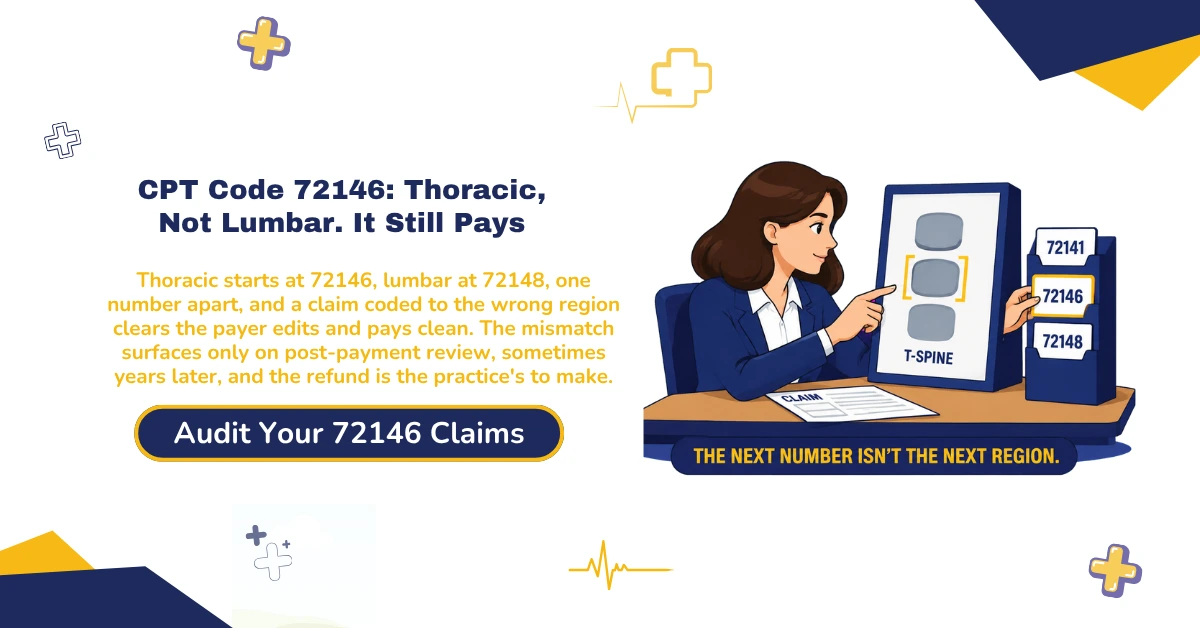
CPT 72146 reports a thoracic spine MRI. Lumbar without contrast is 72148, and cervical without contrast is 72141. Reporting the 72146 cpt code for a lumbar study is a wrong-region error that pays, which is what makes it expensive.
| Spine region | Vertebral levels | Without contrast | With contrast | Without and with |
|---|---|---|---|---|
| Cervical | C1 to C7 | 72141 | 72142 | 72156 |
| Thoracic (T-spine) | T1 to T12 | 72146 | 72147 | 72157 |
| Lumbar | L1 to L5 | 72148 | 72149 | 72158 |
Spine MRI codes by region and contrast status, covering the spine mri cpt code set
Why Thoracic Gets Miscoded More Than Cervical or Lumbar
The numbering causes this, and the anatomy has nothing to do with it. Cervical runs 72141, then 72142, then jumps to 72156. Thoracic starts at 72146 and lumbar starts at 72148.
A coder reaching for the next number in sequence lands two rows from where they meant to be. Schedulers make it worse by writing T-spine on the order, so a biller searching mri t spine cpt has to translate the abbreviation before picking anything. Anyone who’s trained a new coder on the spine family has watched this happen.
Both codes pay and nothing bounces at submission, which is the problem. The error sits quiet until a post-payment reviewer pulls the report, reads thoracic, looks at the claim, and reads lumbar. Our CPT 72148 lumbar MRI billing guide handles the lumbar side of the same problem.
The T12 to L1 Boundary
A study spanning the thoracolumbar junction reports the region the radiologist’s clinical question targets, not the region the scanner’s field of view happened to cover. The mri thoracolumbar spine cpt code follows the impression.
Read the impression section. It names the region under investigation, and that region picks the code. An impression addressing both regions with separate findings and separate conclusions puts you in a two-code situation, and the payment reduction in Section 7 applies to it.
Coders who search for an mri thoracolumbar spine cpt code expecting a single combined code won’t find one. No such code exists. The mri thoracic spine cpt code and the lumbar code stay separate, and your thoracic spine mri cpt selection depends on which question the radiologist answered.
A wrong-region claim that paid is an overpayment. Your practice owns the refund once a reviewer surfaces it. Fixing the chargemaster entry costs an hour of someone’s afternoon. Refunding two years of misrouted claims costs considerably more than that.
Does CPT 72146 Need a Modifier?
CPT 72146 does not require a modifier on every claim. No modifier applies when one entity owns the scanner and employs the interpreting radiologist. A radiologist appends modifier 26 to report the interpretation alone. The facility appends modifier TC to report equipment, technologist, and overhead alone.
Modifier 26 and Modifier TC: Who Bills What
| Billing arrangement | Who bills | Modifier |
|---|---|---|
| One entity owns the scanner and employs the reader | That entity | None, bill globally |
| Facility performs the scan, outside radiologist interprets | The facility | TC |
| Facility performs the scan, outside radiologist interprets | The radiologist | 26 |
| Hospital-employed radiologist reads a hospital study | Facility claim captures it | None separately |
Component billing for the thoracic mri cpt family by arrangement
Modifier 26 carries a documentation prerequisite that trips up more practices than the modifier choice itself. The signed, dated interpretation report has to sit in the record before the claim submits, and it has to contain the clinical indication, the technique, the findings by structure, and the impression.
Billing 26 without that report in place is a compliance exposure rather than a denial risk. RAC contractors pull modifier 26 claims and look for the matching report on post-payment review. Our modifier 26 documentation standard for MRI claims walks through what the report has to show.
Practices with multiple sites get this wrong on tax identification number structure. Two locations under one TIN usually bill globally. Separate TINs split the components, and our guide to TC and 26 billing arrangements covers the variations.
The Tiered Modifier Table
| Tier | Modifier | When it applies |
|---|---|---|
| Applies to most claims | 26 | Professional interpretation billed separately |
| Applies to most claims | TC | Technical component billed separately |
| Applies to most claims | None | Global billing, one entity |
| Situational | 51 | Second and subsequent procedures in the same session |
| Situational | 59 or XS | Distinct study where an NCCI edit would otherwise bundle |
| Situational | 76 or 77 | Repeat study same day, same or different physician |
| Do not use on 72146 | 91 | Repeat clinical diagnostic laboratory test, not imaging |
| Do not use on 72146 | LT or RT | The thoracic spine is a midline structure, not a lateral one |
Which modifiers belong on a thoracic MRI claim and which ones don’t
The bottom two rows save more money than the top three. Coders copy modifier lists between codes, and modifier 91 keeps showing up on imaging claims because somebody pasted it off a lab template. Laterality modifiers arrive the same way, carried over from a knee or shoulder study where RT and LT belong.
Modifier 51 vs Modifier 59: The Distinction That Decides the Claim
Modifier 51 signals multiple separate procedures in the same session that no edit bundles. Use modifier 59 to unbundle services that an NCCI edit would otherwise pair. On a multi-region spine MRI, 51 is correct because no NCCI edit pairs the regions.
Billers reach for 59 out of habit the moment a second study denies. That instinct is wrong here, and it carries a cost beyond the denial. Auditors treat 59 as a modifier of last resort, so appending it where no edit exists puts a flag on a claim that needed 51 and nothing else.
CPT 72146 Reimbursement in 2026: Rates by Modifier and Site of Service
Medicare’s national unadjusted allowed amount for CPT 72146 runs near $190 for the global service in 2026, before any geographic adjustment. Confirm the current figure for your own MAC locality and place of service in the CMS Physician Fee Schedule Look-Up Tool before you quote a number to a payer or a patient.
| Modifier | What the claim bills | Share of the global allowed |
|---|---|---|
| None (global) | Technical and professional together | 100 percent |
| TC | Equipment, technologist, facility overhead | Roughly 64 percent |
| 26 | Interpretation and signed report | Roughly 36 percent |
CPT 72146 payment split by modifier, national unadjusted and pre-GPCI
Why the Technical Component Carries Most of the Payment
CMS builds the practice expense side of this code from real inputs: MRI technologist time, a technologist PACS workstation, a professional PACS workstation, the MR room itself, and per-study consumables. Those inputs dominate the total value, and the interpretation carries the smaller share.
A misapplied TC costs your practice close to twice what a misapplied 26 costs. That ratio is the reason the component split deserves more scrutiny than most billing teams give it, and the reason a chargemaster review should start with the modifier column rather than the fee column.
Commercial Rates Run Well Above Medicare
Commercial payer reimbursement for the mri thoracic spine w/o contrast cpt generally exceeds the Medicare allowed, often by a wide margin. Published transparency-file averages show one national carrier paying more than twice what Medicare allows for the same code while another sits closer to 1.4 times.
That spread is a contracting conversation, not a billing one. Two carriers in your market paying materially different amounts for identical work hands your practice a data point worth taking into the next renewal. Rates vary by market, by contract, and by plan, so pull your own remits before you build an argument on national averages.
Site of Service Changes the Technical Component
The technical component pays differently at POS 11 non-facility than it does at POS 22 on-campus outpatient hospital. A practice billing from a provider-based department without confirming its registration status has a compliance problem sitting underneath the billing problem, and our POS 22 billing requirements guide covers the registration standard.
Every figure on this page is a national unadjusted average before geographic adjustment. Your actual payment depends on the MAC locality, the GPCI factors, the place of service, and your contracted rate. Verify current numbers in the CMS Look-Up Tool before quoting anything to a payer.
Billing CPT 72146 With Another Imaging Study in the Same Session
Two or more advanced imaging studies furnished to the same patient in the same session on the same day under one group NPI trigger a payment reduction. The highest-valued study pays in full.
The technical component on each study after the first pays at 50 percent. Professional components after the first pay at 95 percent. Medicare calls this the Multiple Procedure Payment Reduction, and Noridian MPPR policy sets it out for Jurisdiction E.
MPPR is a reduction rather than a denial. Your claim adjudicated, your second study paid, and the payer applied a published policy to the amount.
The Reduction, in Numbers
| Component | Full value | Reduced value | Reduction |
|---|---|---|---|
| Technical component | Published TC value | Half of it | 50 percent |
| Professional component | Published PC value | 95 percent of it | 5 percent |
How MPPR cuts the second and subsequent studies
CMS applies the reduction on the position that efficiencies exist when one patient receives several imaging services in a single session. California codifies the same percentages in its California radiology multiple-procedure rule, and the Medi-Cal diagnostic radiology manual applies the 100 and 50 split to the technical component for Medi-Cal claims.
Thoracic Plus an Extremity Study: The Common Scenario
A patient arrives for a thoracic spine MRI and a right shoulder MRI in the same visit. Both studies are medically necessary and documented. The remit comes back paying the shoulder in full and paying the thoracic study short, and the payer representative on the phone calls it a CMS adjustment.
The payer denied nothing here. It reduced your second study under MPPR, and the cpt code mri spine claim adjudicated the way the policy says it should. No modifier fixes this, because MPPR is a payment policy rather than an edit.
Splitting the two studies across separate days to dodge the reduction is the wrong answer, and billing managers propose it whenever this comes up. Same-day is the trigger. Sequencing medically necessary services to evade a payment policy creates an exposure worse than the reduction you avoided.
Thoracic With a Second Spine Region
The same rule governs a thoracic study paired with a cervical or lumbar study, and an mri t spine without contrast cpt claim sits in the primary position whenever it carries the higher value. For the reverse case, where lumbar leads and a second spine region follows, our lumbar-primary MPPR scenario walks through the sequencing.
Commercial Payers Apply the Same Rule Under a Different Name
Commercial payers apply equivalent reductions under their own policy names, including Multiple Diagnostic Imaging Reduction, and the percentages and triggers vary by carrier. The UnitedHealthcare MPPR policy defines same session and sets its own percentages.
A practice that reconciles only against Medicare’s version misses the commercial variants, and that’s where underpayments pile up unnoticed. Reductions applied correctly still need checking against your contracted rate. The incorrect ones never surface unless somebody reconciles line by line, which is what our underpayment recovery services team does on imaging remits.
Can You Bill 72146 and 72148 Together?
Yes. CPT code 72146 and CPT 72148 can appear on the same claim when the radiologist imaged both regions and both are medically necessary. Thoracic and lumbar are separate anatomic regions, so the constraints sit in payment and documentation.
No bundling edit exists. Thoracic and lumbar are distinct anatomic regions, so the NCCI Procedure-to-Procedure tables do not pair 72146 and 72148 as mutually exclusive.
Modifier 51 applies to the second study. Report the higher-valued region first, then append modifier 51 to the subsequent region. Modifier 59 is not correct here, because no bundling edit needs bypassing.
MPPR reduces the second study. The highest-valued study pays in full, subsequent technical components pay at 50 percent, and subsequent professional components pay at 95 percent.
Each region needs its own documented medical necessity. A single order reading spine MRI does not support two codes. The clinical note has to explain why both regions were indicated.
What Total Spine Looks Like on the Claim
No single CPT code describes a total spine MRI. A non-contrast total spine study reports 72146 for thoracic, 72148 with modifier 51 for lumbar, and 72141 with modifier 51 for cervical.
Sequence by value, highest first, because the code listed first escapes the reduction. Getting that sequence backward costs real money on a study the radiologist performed and documented correctly, and it’s one of the few billing errors where the fix takes thirty seconds and the recovery takes ninety days.
The Documentation That Survives a Two-Region Audit
The radiology report needs findings organized by region rather than one combined impression. Your ordering note needs a clinical question for each region rather than one indication stretched across both. ICD-10 codes have to differ too, because two regions carrying identical diagnosis codes on one claim reads as a duplicate to most payer edits.
Report templates cause this, and physicians take the blame for it. The radiologist examined both regions and wrote both sets of findings. A template merged them into one impression block, and the claim inherited the merge.
The Three Gates a 72146 Claim Has to Clear
A CPT code 72146 claim clears three independent gates before it pays. Correct coding decides whether the code combination is allowed. Medical necessity decides whether the payer covers the study. Prior authorization decides whether the plan approved it in advance. Clearing one gate satisfies nothing about the other two.
| Gate | The question it answers | Who sets the rule |
|---|---|---|
| Correct coding | Is this code combination allowed on one claim? | CMS, through NCCI edits and MUE limits |
| Medical necessity | Does the payer cover this study for this diagnosis? | CMS through NCD and LCD policy, and commercial plans through their own criteria |
| Prior authorization | Did the plan approve this before the scan? | The plan, usually through a radiology benefit manager |
Three gates, three authorities, three different denials
NCCI Is Not a Medical Necessity Rule
NCCI edits are correct-coding edits. CMS states that they carry no diagnosis basis and function as no part of medical necessity determination. A code pair clearing NCCI can still deny for medical necessity, and a pair failing NCCI has a coding problem rather than a clinical one.
Billers route these two into the wrong queue because they look alike on a remit. A coding denial gets a corrected claim and takes ten minutes. Medical necessity denials get an appeal with records and take ninety days, so the sort is most of the work. Our CARC denial code reference maps which code lands in which track.
The Correct Coding Modifier Indicator
CMS assigns a Correct Coding Modifier Indicator to every NCCI Procedure-to-Procedure edit. The indicator tells your coder whether a modifier is even an option before anyone appends one.
| Indicator | What it means for the edit |
|---|---|
| 0 | No modifier bypasses the edit |
| 1 | A modifier may bypass it when the clinical circumstances support doing so |
| 9 | The edit sits inactive |
Correct Coding Modifier Indicator values
Most billers skip that check and append 59 anyway, which is how a claim picks up an audit flag on top of the denial it already had.
Medically Unlikely Edits and the ABN Trap
A Medically Unlikely Edit caps the units of service one code can report for one patient on one date. Not every code carries a published MUE, and CMS holds some MUE values confidential. CMS guidance states that issuing an Advance Beneficiary Notice based on an MUE is not appropriate.
Front desks hand patients an ABN whenever a denial looks likely, which works for coverage denials and fails here. An ABN cannot shift financial responsibility for a units-of-service edit, so collecting on one exposes your practice rather than protecting it.
Medical Necessity for CPT 72146: The Documentation Payers Require
The documented clinical indication establishes medical necessity for the 72146 cpt code, and the code itself establishes nothing. Most payers apply one of two pathways: a conservative-treatment pathway requiring failed nonoperative care, or an expedited pathway that opens when the exam documents specific neurologic findings.
The Standard Pathway: Failed Conservative Treatment
Widely applied criteria require all three of the elements below together. One out of three fails the standard.
| Requirement | What the note has to show |
|---|---|
| Failed nonoperative treatment | At least six weeks of documented conservative care without improvement |
| Considered for invasive treatment | The patient is a candidate for epidural steroid injection or surgery |
| Functional interference | Specific documented limits on activities of daily living |
Conservative-treatment criteria for the cpt code for mri thoracic spine
A note reading mid-back pain, MRI ordered fails on all three counts even when the pain is real and the study is appropriate. Payers reviewing that note see no treatment history, no surgical candidacy, and no functional impact. Plain radiography is generally expected first when imaging becomes necessary after four to six weeks of conservative management.
Medicare carriers publish these thresholds in a Local Coverage Determination, and the standard carries across the spine family with the region swapped out. Our breakdown of the 72148 LCD L34220 criteria walks the lumbar version of the same test.
The Expedited Pathway: Documented Neurologic Findings
Specific neurologic findings documented on exam generally remove the conservative-treatment waiting period. The NIA thoracic spine MRI guideline names 72146, 72147, and 72157 and sets out the findings below.
| Finding category | Specific documented findings |
|---|---|
| Motor | Extremity muscular weakness |
| Reflex | Pathologic or abnormal reflexes including Babinski, Lhermitte’s sign, and Chaddock sign |
| Sensory | Absent or decreased sensation along a thoracic dermatome, covering pin prick, touch, vibration, proprioception, or temperature |
| Tone | Increased muscle tone or spasticity localized to the thoracic spinal cord |
Neurologic findings that open the expedited pathway
Additional Approved Indications
| Indication | Clinical context |
|---|---|
| Suspected inflammation, infection, or malignancy | Back pain carrying red flag features |
| Known or suspected multiple sclerosis | Demyelinating disease evaluation |
| Preoperative evaluation and planning | Surgical candidacy assessment |
| Prior to spinal cord stimulator placement | Excluding canal stenosis when no recent thoracic imaging exists |
| Suspected CSF leak | Supported by history or exam findings |
| Post-operative or post-procedural evaluation | Cord or nerve root compression, disc pathology, or post-operative infection |
| Treatment response follow-up | Evaluating progress after treatment |
Other clinical contexts that support a CPT code 72146 claim
None of this is your biller’s clinical judgment to make. The billing side controls one thing: whether criteria the physician already met show up in the note before the claim goes out. That’s a workflow question, and it’s where most recoverable revenue on this code disappears.
Does CPT 72146 Require Prior Authorization?
Traditional Medicare Part B generally does not require prior authorization for an outpatient thoracic spine MRI. Medicare Advantage plans and commercial payers frequently do. Requirements vary by plan, by region, and by benefit year, and carriers publish their own lists, including the UnitedHealthcare radiology prior-auth list.
Radiology Benefit Managers Decide Most Commercial Authorizations
Major commercial payers and Medicare Advantage plans delegate advanced imaging authorization to a radiology benefit manager instead of reviewing requests directly. eviCore, Carelon, and NIA each apply their own clinical criteria through their own submission portal.
The plan name on the card tells your front desk almost nothing about which criteria apply or which portal takes the request. A practice treating commercial authorizations the same way across the board will miss on the ones routed to a vendor with no workflow configured, and our radiology benefit manager workflow guide covers how the three vendors differ.
Authorize the Region, Not Spine MRI
The authorization has to cover the thoracic spine by name. An approval issued for a generic spine MRI, or issued for a different region, will not support a CPT 72146 claim even when the study performed was appropriate and documented.
The mismatch pattern runs like this. Your front desk obtains authorization for one region, the ordering provider revises the plan after a conversation with the radiologist, and the study covers a different region. That clinical revision was correct. The authorization never got updated to match it.
Your claim then denies on authorization rather than necessity, and the appeal gets harder because the record shows your practice held approval for something else.
The Contrast-Status Mismatch
The second mismatch pattern involves contrast. Authorization comes through for 72146 without contrast, the radiologist adds contrast mid-study after seeing the initial sequences, and the claim goes out as 72157. The code on the claim has to match the code on the authorization.
Authorization is a pre-service function that produces a post-service consequence, which explains why it fails as often as it does. Staff obtaining it work upstream of the remit. The people reading the remit can’t reach back and fix it. Our prior authorization verification workflow closes that gap by confirming coverage and authorization scope together before the scan gets booked.
Why 72146 Claims Deny, and How to Fix Each One
A denied 72146 cpt code claim carries a CARC code identifying which gate it failed. Routing the denial correctly depends on reading that code. Coding denials get a corrected claim. Clinical and policy denials get an appeal with records attached.
| CARC | What it means | Root cause on a 72146 claim | First recovery action |
|---|---|---|---|
| CO-50 | Non-covered, not deemed medically necessary | Clinical note lacks the conservative-treatment history or the documented neurologic finding | Appeal with records, citing the coverage policy by name |
| CO-11 | Diagnosis inconsistent with the procedure | ICD-10 code fails to support thoracic imaging, or the diagnosis points at another region | Corrected claim carrying the region-appropriate diagnosis |
| CO-16 | Claim lacks information needed for adjudication | Missing modifier, missing referring provider NPI, or missing authorization number | Corrected claim |
| CO-197 | Precertification or authorization absent | No authorization obtained, expired authorization, or authorization issued for a different region or contrast status | Appeal with the authorization record, or a retro-auth request where the plan allows one |
| N115 | Decision based on a Local Coverage Determination | The diagnosis or the clinical documentation falls outside the applicable LCD | Appeal citing the specific LCD section you believe the reviewer misapplied |
Denial codes on a CPT code 72146 claim and the first recovery action for each
Every row above maps to a gate from Section 9, and the fix column tells your biller which queue the denial belongs in. Practices running high thoracic denial volume benefit from routing these through structured denial management services rather than working them in the order they arrive.
The Two Queues
CO-50, CO-197, and N115 are policy and clinical denials, so they belong in the appeal track. Data problems like CO-11 and CO-16 belong in the corrected-claim track. Sorting by track before working the queue beats working denials by date.
A biller who understands that split clears a full queue in an afternoon. One working them by date spends a week and files appeals on claims that needed a resubmission and a corrected field.
The Appeal Language That Gets Paid
Appeals arguing clinical need while skipping the policy citation get rejected, and billing teams write them that way by default. An appeal on CO-50 has to name the coverage policy and the section the reviewer misapplied, then show where in the record the criteria were met. Our appeal and peer-to-peer support builds the packet around that citation.
Four documents belong in the packet: the LCD-aligned or NCD-aligned primary diagnosis, the conservative treatment history or the documented red flag, the signed interpretation report, and the authorization reference where the plan required one.
What the Wrong-Region Error Looks Like After It Pays
A thoracic claim submitted as lumbar clears the payer edits because both codes are valid and both pay. It surfaces on post-payment review when a reviewer compares the report against the claim. Your practice owns the refund at that point, and the volume determines how much it costs.
The Pre-Submission Checklist for a Clean CPT 72146 Claim
Every item below is a submission requirement. A CPT 72146 claim clearing all nine rarely denies on anything your billing team controls.
- The radiology report documents the thoracic region and matches the code submitted
- The contrast status on the claim matches the contrast status documented in the report
- A signed, dated report sits in the record before the claim submits, carrying indication, technique, findings, and impression
- The report date matches the date of service on the claim
- Modifier 26 or TC matches the actual billing arrangement, or no modifier appears for global billing
- The primary ICD-10 code supports thoracic spine imaging under the applicable coverage policy
- The clinical note documents either the conservative-treatment history or a qualifying neurologic finding
- The authorization reference number appears where the payer requires it, and the authorization covers the thoracic region and the contrast status performed
- When a second imaging study appears on the same claim, the higher-valued study sits first and modifier 51 goes on the subsequent study
This checklist belongs in the pre-submission scrub, and billing teams keep running it as a post-denial review instead. Nine items take a minute per claim. The denials they prevent take thirty to ninety days to recover, and some of them never come back at all.
What Changed for Imaging Claims in 2026
Four changes affect how a CPT 72146 claim gets priced or edited in 2026. The descriptor stays the same. Each one moves the numbers or the edits sitting underneath the code.
Quarterly NCCI and MUE Updates
CMS updates the NCCI Procedure-to-Procedure edits and the Medically Unlikely Edit tables at least quarterly. The most recent posting carries an effective date of October 1, 2026 and went up at the start of September 2026.
A claim that paid last quarter can deny this quarter because an edit changed, and nothing in your practice’s workflow announces it. Somebody has to check the quarterly release, which is a task most practices leave unassigned.
The 2026 Differential Conversion Factor
Beginning January 1, 2026, CMS applies a differential conversion factor depending on whether the furnishing clinician qualifies as a Qualifying APM Participant for the year. CMS distributes separate qualifying and non-qualifying fee schedule files, so two practices can collect different amounts for identical work on the same code.
The Medicare Economic Index Increase
The Medicare Economic Index increase for 2026 is 2.7 percent, and that figure feeds practice expense calculations across imaging codes. Practice expense dominates the technical component of this code, so the input matters more here than it does on interpretation-heavy codes.
The AUC Program Remains Paused
The federal Appropriate Use Criteria program has been paused since January 1, 2024. AUC consultation fields are not required on imaging claims while the pause holds. Commercial prior authorization through radiology benefit managers is what gates advanced imaging today.
Guidance published before 2024 still circulates telling practices to populate AUC fields, and some billing systems still carry the requirement in a validation rule. Check your scrubber. A stale AUC edit rejects clean claims for a requirement that no longer exists.
CPT 72146 Frequently Asked Questions
What is CPT 72146?
CPT 72146 is the procedure code for an MRI of the thoracic spine performed without contrast material. The code covers the spinal canal and its contents from T1 through T12, including the spinal cord and the intervertebral discs. No gadolinium is administered during the study.
Is 72146 thoracic or lumbar?
CPT 72146 is thoracic. The lumbar spine MRI code without contrast is 72148, and the cervical spine MRI code without contrast is 72141. Reporting 72146 for a lumbar study is a wrong-region error that will pay on first submission and surface on post-payment review.
What is the difference between 72146 and 72147?
CPT 72146 reports a thoracic spine MRI performed without contrast. The 72147 code reports the same anatomic study performed with contrast and no pre-contrast sequences. A study performed without contrast first and then with contrast reports 72157, which is the code most contrast-enhanced thoracic studies require.
Does CPT 72146 need a modifier?
Not on every claim. One entity that owns the scanner and employs the interpreting radiologist bills globally with no modifier. A radiologist billing interpretation alone appends modifier 26. Facilities billing equipment and technologist time alone append modifier TC. Laterality modifiers do not apply to a midline structure.
Can I bill 72146 and 72148 together?
Yes, when the radiologist imaged both regions and the record documents medical necessity for each one. No NCCI edit pairs the two codes. Append modifier 51 to the second region, sequence the higher-valued study first, and expect the Multiple Procedure Payment Reduction to reduce the subsequent study.
How much does Medicare pay for CPT 72146?
The 2026 national unadjusted Medicare allowed amount runs near 190 dollars for the global service before geographic adjustment. Technical component share is roughly 64 percent of that, with the professional component at roughly 36 percent. Verify your own figure by MAC locality in the CMS Physician Fee Schedule Look-Up Tool.
Does Medicare pay 100% for MRI?
No. Medicare Part B pays 80 percent of the allowed amount after the beneficiary meets the annual deductible, and the beneficiary owes the remaining 20 percent as coinsurance. The Multiple Procedure Payment Reduction applies to the allowed amount before that 80 and 20 split occurs.
Does CPT 72146 require prior authorization?
Traditional Medicare Part B generally does not. Medicare Advantage plans and commercial payers frequently do, and most delegate the decision to a radiology benefit manager such as eviCore, Carelon, or NIA. Confirm that the authorization names the thoracic region and matches the contrast status performed.
Which ICD-10 codes support medical necessity for 72146?
The primary diagnosis has to support thoracic spine imaging under the applicable coverage policy and pair with documentation meeting that policy’s criteria. A thoracic-region diagnosis paired with a note showing no treatment history will still deny, because the diagnosis alone establishes nothing without the supporting clinical record.
Why was my 72146 claim denied?
Four codes account for most of them. CO-50 means the documentation failed to support medical necessity. Authorization was absent, expired, or issued for a different region when CO-197 appears. CO-11 flags a diagnosis conflicting with the procedure, and CO-16 flags a required field missing from the claim.
What code covers a thoracolumbar MRI?
No single code covers a thoracolumbar study. Report the region the radiologist’s clinical question targets, which the impression section of the report identifies. An impression addressing both regions with separate findings and separate conclusions calls for both codes, with modifier 51 on the second.
What is the CPT code for a thoracic spine MRI?
Contrast status decides which of three codes applies. CPT 72146 covers thoracic spine MRI without contrast. The 72147 code covers the study with contrast only. A study performed without contrast first, followed by contrast and further sequences in the same session, reports 72157.
Getting CPT 72146 Claims Paid Consistently
Thoracic runs low volume in most practices, and low volume is what keeps this code off your review list while it costs you money. Your chargemaster entry, your modifier configuration, and the authorization workflow around the 72146 cpt code get reviewed less often than the lumbar equivalent because fewer claims force the issue.
Money leaks from a CPT code 72146 claim in four places. The component split sends the wrong share to the wrong entity. A same-session reduction cuts the second study and no one reconciles it. Your authorization covers a region or contrast status that stopped matching. Notes omit criteria the physician already met.
If thoracic MRI denials keep landing on your remit and the team hasn’t had time to pull them and find the pattern, that’s the cleanup our coders work through most weeks.
Send a sample batch and our team will tell you what they see. Practices wanting the whole front end rebuilt around it can bring us in through full-service medical billing, and we’ll start with the chargemaster.
Most of what this guide covers is workflow rather than coding knowledge. The practices with the cleanest thoracic claims aren’t the ones with the sharpest coders. They’re the ones whose pre-submission process catches the mismatch while a corrected claim still fixes it.