


Subtotal $0.00

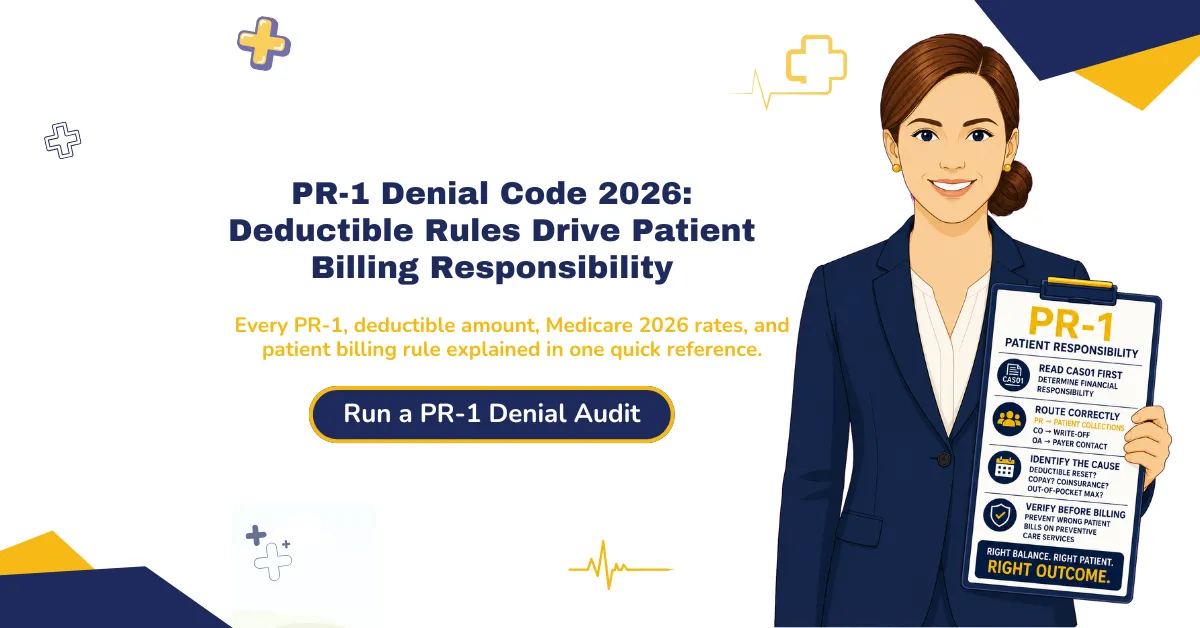
The PR-1 denial code appears on your 835 Electronic Remittance Advice and Explanation of Benefits as a two-part adjustment code. PR stands for Patient Responsibility, which is the Claim Adjustment Group Code. The number 1 is the Claim Adjustment Reason Code (CARC), officially defined by X12 as “Deductible Amount.” Together, PR-1 means the payer processed the claim correctly and applied the allowed amount to the patient’s annual deductible because it hasn’t been met yet. You can bill the patient for this amount. Unlike CO adjustments, which are provider write-offs, a PR adjustment legally transfers the balance to the patient.
In 2026, Medicare Part B deductibles rose to $283 and HDHP out-of-pocket maximums reached $8,500 for individual coverage under IRS Rev. Proc. 2025-19. pr1 denial code volume is higher than ever. This guide covers the official description, 2026 deductibles, the patient statement template, and the quick-fix checklist.
PR-1 Denial Code: Quick Reference
Code: PR-1 Group Code: PR (Patient Responsibility) CARC: 1, Deductible Amount (X12 official) CARC Active Since: January 1, 1995 CARC Last Reviewed: May 1, 2026 (no changes confirmed) Patient Billing Allowed: Yes. PR group code means the patient owes the balance. Bill the patient. Key Action: Verify deductible balance on payer portal. Generate patient statement. Check secondary insurance first.
X12, the ANSI-chartered body that maintains all HIPAA-mandated claim adjustment codes, publishes the CARC list in coordination with the Washington Publishing Company. The pr 1 denial code description is “Deductible Amount” and has not changed since CARC 1 was activated. The pr 01 code that appears on some EOBs and remittances is the same code as PR-1 presented in a different display format by payer-specific billing software.
What Is PR-1 in Medical Billing? The Official Description, Both Code Components, and What Each Means for Your Workflow
PR 1 in medical billing is the combination of the PR Claim Adjustment Group Code and CARC 1. Every billing team needs to understand both components separately before treating the code as a single unit, because the group code (PR) determines who owes the money and the reason code (1) describes what that obligation is. ClaimMax RCM’s revenue cycle management process separates these two fields at the ERA posting stage before routing any adjustment.
The Official CARC 1 Definition From X12
The official CARC 1 definition from X12 is: “Deductible Amount.” X12, the ANSI-chartered body responsible for HIPAA-mandated 835 transaction standards, maintains this code. CARC 1 has been active since January 1, 1995, and was last reviewed May 1, 2026, with no changes to its description. CARC 1 appears in the CAS segment of the 835 as CAS02 = 1, CAS03 = dollar amount applied to deductible.
What “Deductible Amount” means on your remittance: the payer processed the claim correctly, applied the allowed amount to the patient’s annual deductible, and paid zero on this line because the deductible hasn’t been met. This isn’t a claim error. It’s correct adjudication. The fix isn’t a resubmission. The fix is billing the patient. The complete active CARC list is maintained at the X12 CARC official list. This is the same source that defines every group code, reason code, and remark code on your 835 ERA. pr 1 in medical billing starts here.
PR vs CO vs OA: Which Group Code Determines Who Pays
CAQH CORE operating rules govern the 835 transaction standards that produce the CAS segment where the group code appears. The group code in CAS01 is the most operationally important field on the remittance. Every billing team’s posting workflow must check CAS01 before any patient statement generates.
PR (Patient Responsibility): The patient owes the balance. The provider can and should bill the patient directly. PR-1, PR-2, and PR-3 all fall here.
CO (Contractual Obligation): The provider absorbs the balance as a contractual write-off. Under Medicare guidelines, billing the patient for a CO adjustment is a program rule violation.
OA (Other Adjustment): Payer-initiated adjustment that assigns liability to neither party automatically. Contact the payer before posting any write-off or generating a patient statement.
ClaimMax RCM’s revenue cycle management process includes a group code check at the ERA posting stage that routes every PR adjustment to patient AR and every CO adjustment to the write-off queue automatically, before any statement goes out.
How PR-1 Appears on the 835 ERA and EOB
On the 835 transaction, pr1 denial code appears in the CAS segment. CAS01 is PR. CAS02 is 1. CAS03 is the dollar amount applied to the deductible. Your practice management system reads these three fields and displays PR-1 on your denial report. On a paper EOB, it shows as “PR 1” or “PR-1” with payer-specific language such as “deductible not met” or “applied to deductible.” The pr 01 designation on older systems represents the same CARC. PR-1 is post-processing. The claim adjudicated successfully. Resubmitting it accomplishes nothing. Bill the patient.
PR-1 vs CO-1: The Group Code That Determines Whether You Bill the Patient or Write Off the Balance
The reason code 1 means deductible amount no matter which group code precedes it. What changes is who owes that deductible. The group code is the field most billing teams skip. Skipping it creates the most expensive billing compliance errors in the pr 1 in medical billing workflow.
| Code | Official X12 Description | Who Owes | Required Action |
|---|---|---|---|
| PR-1 | Deductible Amount | Patient owes the deductible balance | Verify deductible amount in payer portal. Generate patient statement. Check secondary insurance first. |
| CO-1 | Deductible Amount | Provider absorbs as contractual write-off | Post as contractual adjustment. Do not bill the patient. If applied incorrectly, investigate whether PR should have been used instead. |
| OA-1 | Deductible Amount | Neither party automatically | Contact the payer for clarification before posting write-off or billing patient. Review case by case. |
For Medicare claims, CMS is explicit: Medicare beneficiaries may only be billed when the PR group code appears on the remittance. Billing a patient for a CO-1 adjustment is a program rule violation.
Three expensive consequences of getting the group code wrong: billing the patient for a CO-1 amount violates your payer contract; writing off a PR-1 amount instead of billing the patient leaves collectible revenue on the table; and billing the patient before checking secondary insurance creates statements that may be wrong. The PR group code on every line of your EOB is the billing manager’s compliance signal. Read it before you do anything else.
Is PR-1 the Patient’s Responsibility?
Yes. PR-1 is the patient’s responsibility. The PR group code explicitly assigns financial liability to the patient, not the provider. You can bill the patient. You should bill the patient. This is the opposite of a CO adjustment. CO means provider write-off. PR means patient owes. PR 1 in medical billing is always a patient collections trigger, never a denial investigation item when the group code is correct.
Three Scenarios Where PR-1 Is Valid and Patient Billing Proceeds Immediately
Annual Deductible Not Met: This is the standard PR-1 scenario. The payer applied the allowed amount to the patient’s remaining annual deductible. Verify the applied amount matches the patient’s current deductible balance in the payer portal. If it matches, send the statement today.
HDHP Patient: HDHP patients have minimum deductibles of $1,700 for self-only coverage in 2026 per IRS Rev. Proc. 2025-19. PR-1 fires on virtually every claim until the patient reaches that threshold. Don’t investigate it as an error. Work it as a patient balance. The pr 1 denial code 2026 context for HDHP is expected behavior, not a payer mistake.
Plan Year Just Reset: January through March sees the highest PR-1 volume of the year because deductibles reset on January 1 for most calendar-year plans. This is expected billing behavior.
Three Scenarios Where PR-1 Is Wrong and You Should Not Bill the Patient
ACA Preventive Service Miscoded: Under ACA Section 2713, preventive services must be covered without cost-sharing when provided in-network. If PR-1 appears on an annual wellness visit, a screening colonoscopy at the recommended age, or an approved immunization, the claim was miscoded as diagnostic instead of screening. Submit a corrected claim before billing the patient. Note: Kennedy v. Braidwood Management Inc., currently before the Supreme Court, challenges this ACA provision. Monitor this case for potential 2026-2027 coverage changes. Secondary eligibility verification is distinct from prior authorization but both must be checked before the first patient statement generates. The CMS guidance on ACA preventive services and cost-sharing requirements is at CMS ACA Preventive Services Background.
Deductible Already Met: The payer’s system lags behind deductible accumulation, especially early in the year. Pull the patient’s current year-to-date deductible accumulation from the payer portal before assuming the PR-1 amount is correct.
Secondary Insurance Not Checked: The patient may have secondary coverage that covers the deductible. Bill secondary before billing the patient on any PR-1 balance. pr1 in medical billing always requires a secondary insurance check before any statement generates.
Six Reasons You’re Getting PR-1 Denials and What Each One Means for Your Action Path
Not every PR-1 has the same root cause. The cause determines whether you resubmit a corrected claim, dispute the deductible calculation, bill the patient immediately, or check secondary insurance first. Every item in your PR-1 denial queue is a claim denial only in the display. Most are patient AR opportunities.
Cause 1: The Deductible Hasn’t Been Met Yet
This is the valid, correct PR-1. The patient’s plan year deductible is unmet on the date of service. The payer applied the allowed amount correctly. Don’t appeal this. Don’t resubmit this. Bill the patient for the applied amount. No CO group code adjustment appears on this claim line when PR-1 fires on a valid deductible scenario. This cause accounts for the majority of PR-1 volume in any billing department. Treat it as a patient collections workflow trigger, not a denial management item.
Cause 2: Benefits Weren’t Verified Before the Visit
Your front desk didn’t confirm the patient’s deductible status before the appointment. You billed the payer, the claim processed, and PR-1 appeared because the deductible was still open. The error isn’t in the claim. It’s in the pre-service workflow. Real-time eligibility verification 24 to 48 hours before every appointment is the single most effective process change to reduce surprise PR-1 volume. HDHP patients in particular require proactive verification because their deductibles are substantially higher than standard plans.
ClaimMax RCM’s eligibility verification and prior authorization process confirms the patient’s deductible balance, plan year status, and secondary insurance at scheduling, before the claim is ever created. PR-1 denial code prevention starts at scheduling, not at billing.
Cause 3: Deductible Information in Your Billing System Is Outdated
Your practice management system stores a deductible balance that doesn’t reflect what the patient has actually paid through other providers. Their deductible is closer to being met than your system shows. The fix is pulling the current deductible accumulation directly from the payer portal before every encounter, not relying on a cached balance from the patient’s last visit. CARC 1 on your remittance always reflects the payer’s current record. Your billing system may not match it. The payer portal is the authoritative source. Medicare Part B deductible tracking is especially affected because patients see multiple providers.
Cause 4: Dual Coverage and the Primary Deductible Isn’t Satisfied
When a patient has dual coverage, the primary payer adjudicates first. If the primary plan’s deductible hasn’t been met, PR-1 fires from the primary payer. The secondary plan may cover part or all of that deductible amount depending on its coordination of benefits rules. Medicare Advantage plans and Medigap plans both affect how PR-1 balances carry through secondary adjudication. Always verify secondary insurance before issuing any patient statement on a PR-1 balance. Bill secondary first.
Cause 5: ACA Preventive Service Was Miscoded as Diagnostic
ACA-mandated preventive services must be covered without cost-sharing when provided in-network and billed with the correct screening diagnosis codes. If a coder used diagnostic ICD-10 codes instead of screening codes on an annual wellness visit or colorectal cancer screening, the payer reclassified the service as diagnostic and fired PR-1 incorrectly. Under the No Surprises Act, patients who received a Good Faith Estimate for their visit have additional grounds to dispute an incorrect PR-1 charge. Submit a corrected claim before billing the patient.
Correct coding on preventive services is a core clean claim requirement. ClaimMax RCM’s guide to what is a clean claim in medical billing covers the coding accuracy standards that prevent preventive service PR-1 from the submission stage.
Cause 6: The Plan Year Just Reset
Most commercial and employer-sponsored plans reset deductibles January 1. January through March is your highest PR-1 volume period every year. Patients who met their deductible in November suddenly owe the full deductible again in January. Your team needs a plan year reset communication workflow: ideally a late-December notice to patients explaining their deductible resets in January and what that means for upcoming visits. HDHP patients with HSAs should be reminded at plan year reset that their HSA balance can cover the new deductible period and that pr1 denial code volume will spike in the first quarter.
How the PR-1 Deductible Amount Is Calculated: The Worked Example Every Billing Team Needs
The PR-1 dollar amount isn’t always the full billed charge. It’s calculated from the payer’s allowed amount, not what you billed. Getting this math wrong means overcharging the patient, which is a balance billing compliance risk. The CO-45 adjustment appears on the same claim line as PR-1 in most remittances. Reading them together is the only way to post correctly. This is pr 1 in medical billing applied at the claim line level.
The Worked Example: PR-1 and CO-45 on the Same Claim Line
Use this as your team’s daily reference. An established patient office visit is billed at $200. The payer’s contracted allowed amount is $130. The patient has a $1,500 annual deductible with $1,100 remaining.
CO-45: $70 write-off. This is the difference between your $200 billed charge and the $130 allowed amount. CO group code. Provider absorbs it. The patient doesn’t owe this amount.
PR-1: $130 applied to deductible. This is the patient’s obligation. The allowed amount of $130 applies to the patient’s remaining deductible. You bill the patient $130, not $200.
Billing the patient $200 instead of $130 is a balance billing violation in most states and a potential No Surprises Act exposure. The CMS No Surprises Act resources covering patient billing protections are at CMS No Surprises Act Overview. Correct PR-1 posting, which means separating the CO-45 write-off from the PR-1 patient balance on every claim line, is a core component of ClaimMax RCM’s payment posting service, which reviews every ERA for group code accuracy before posting.
When the Patient Has Partially Met the Deductible: PR-1 Plus PR-2 on the Same Remittance
Same scenario, but the patient has $80 of deductible remaining instead of $1,100. The allowed amount is $130. The adjudication produces three adjustments.
PR-1: $80 applied to the remaining deductible. Patient’s deductible is now fully met. PR-2: $10 coinsurance. Twenty percent of the $50 remaining above the deductible threshold at standard 80/20 split. Payer pays: $40. Eighty percent of the $50 above-deductible amount.
The patient owes $90 total: $80 (PR-1) plus $10 (PR-2). Your patient statement must show both lines separately. A combined “patient balance” without itemized lines creates disputes because patients don’t understand the deductible-versus-coinsurance breakdown. When all three appear: PR-1 satisfies the deductible remainder, PR-2 applies coinsurance, PR-3 may appear as a copay depending on plan design. The pr 1 2 3 in medical billing combination signals the claim crossed the deductible threshold mid-claim. CO-45 still appears on the same line as the contractual write-off. pr1 pr2 pr3 in medical billing all require separate itemized statement lines.
How to Fix a PR-1 Denial: The ClaimMax Quick-Fix Checklist and Patient Statement Template
PR-1 doesn’t resolve through resubmission. It resolves through patient billing. Work through this checklist before sending a single statement. The template below is ready to use the same day. This checklist covers every stage of the PR-1 revenue cycle workflow from ERA posting to patient AR collection. pr 1 in medical billing requires a different resolution path than every other denial code your billing team manages.
PR-1 Quick-Fix Checklist: ClaimMax RCM
Step 1: Confirm CAS01 is PR, not CO. Pull the 835 ERA. Locate the CAS segment for the denied service line. Read CAS01. PR means the patient owes. CO means the provider writes it off. If it says CO, stop. Do not send a patient statement. Investigate whether the group code was applied correctly before any other action.
Step 2: Verify the applied amount against the payer portal. Log into the payer portal. Pull the patient’s current year-to-date deductible accumulation. Confirm the PR-1 amount matches the patient’s remaining deductible balance. If the amount is wrong, file a dispute, not a corrected claim.
Step 3: Check secondary insurance before the statement goes out. Run a 271 eligibility transaction on the secondary plan. Medigap plans may cover the Medicare Part B deductible entirely depending on the plan letter. Medicaid as secondary may cover the patient’s cost-sharing. Bill secondary first. A statement sent to the patient before secondary adjudicates creates billing disputes you can’t win.
Step 4: Confirm the service wasn’t ACA preventive care. Pull the CPT and ICD-10 codes. Cross-reference against your payer’s ACA preventive service list. Annual wellness visits, colorectal cancer screenings, and recommended immunizations cannot generate PR-1 when coded correctly. If it was miscoded, submit the corrected claim before any patient contact.
Step 5: Generate the patient statement and document the posting. Post the PR-1 amount to patient AR the same day the ERA is received. Generate the statement within 24 hours. Offer a payment plan for any balance over $200 to increase collection rates. Document the statement date, the amount, and the payer portal deductible verification in the patient account.
PR-1 Patient Statement Language: Copy and Use
Your insurance plan processed your recent claim. After applying your contracted
rate, your insurance has applied $[AMOUNT] toward your annual deductible. Your
deductible balance is $[REMAINING]. You are responsible for $[PR-1 AMOUNT] for
the service on [DATE OF SERVICE]. This amount has been verified through your
insurance plan’s online portal as of [VERIFICATION DATE]. To pay by phone,
please call [PHONE]. To pay online, please visit [PAYMENT PORTAL URL]. If you
have questions about your deductible, please contact your insurance plan directly
at the member services number on your insurance card.
The template includes the portal verification date because patients who dispute a PR-1 balance almost always challenge whether the deductible calculation was verified. Including that verification date in the statement body eliminates the most common dispute trigger before it starts. For patients who received a Good Faith Estimate before their visit, the PR-1 statement should reference the GFE amount for continuity. Patients expect the statement to align with their pre-visit cost estimate.
CMS guidance on patient billing protections under the No Surprises Act applies whenever the statement amount differs from what a Good Faith Estimate promised. X12 transaction standards govern the 835 ERA format from which every figure in this statement is pulled. The pr 1 denial code patient statement template above captures these regulatory compliance elements in the verification date line.
When PR-1 patient balances are already aging in your AR and the patient statement workflow is behind, every day is a day closer to a collection problem. ClaimMax RCM’s denial management services team identifies PR-1 volume patterns by payer and plan year, works every collectible balance before the 90-day aging threshold, and routes disputed balances through the correct dispute path. When PR-1 patient balances are already past 60 days, ClaimMax RCM’s AR follow-up team deploys a structured 30-60-90 day patient contact workflow that recovers patient AR that ad hoc collections consistently miss.
PR-1, PR-2, and PR-3 in Medical Billing: The Patient Responsibility Code Quick Reference Table
These three codes appear on the same remittance more often than they appear alone. You need to know each one and how they combine before you generate a single patient statement. pr 1 in medical billing is the deductible component. PR-2 and PR-3 are what follows once the deductible clears.
| Code | Official X12 Description | What It Means in Practice | Billing Action |
|---|---|---|---|
| PR-1 | Deductible Amount | Patient hasn’t met annual deductible. Payer applied allowed amount to the deductible balance. | Verify deductible balance in payer portal. Generate patient statement for the applied amount. Check secondary insurance first. |
| PR-2 | Coinsurance Amount | Patient’s percentage share of covered services after the deductible is met. Usually 20% at standard 80/20 split. | Generate patient statement for the coinsurance percentage. Never bill more than the payer’s calculated coinsurance amount. |
| PR-3 | Co-payment Amount | Fixed dollar amount per visit, independent of deductible status. | Collect at time of service. Bill the patient if not collected at check-in. This amount is the same regardless of whether the deductible has been met. |
All three codes share the PR group code, which means all three are patient obligations that providers can legally bill directly, and none of them should appear with a CO prefix on a correctly adjudicated claim. ACA-mandated preventive services never generate PR-1, PR-2, or PR-3 when billed with the correct screening codes. HDHP patients regularly generate all three codes on a single claim line late in the plan year as the deductible clears and coinsurance applies.
The official X12 descriptions for CARC 1, CARC 2, and CARC 3 are maintained at the X12 CARC official list. The PR-1 denial code and its sibling codes are confirmed active in the current X12 library. pr1 in medical billing, pr 1 2 3 in medical billing, and pr1 pr2 pr3 in medical billing all draw from this same official code set.
When all three appear on the same remittance: When a claim generates both PR-1 and PR-2, it means the patient’s deductible was partially met by that claim. PR-1 covers the remaining deductible amount. PR-2 covers the coinsurance on whatever allowed amount exceeds the deductible. The patient owes both. Your statement must show both lines separately with itemized labels.
2026 Deductible Quick Reference: Medicare, HDHP, and ACA Cost-Sharing Amounts in One Place
Every PR-1 denial happens against one of these deductible structures. Your team needs these 2026 figures correct before posting any deductible-related adjustment. These figures were released by CMS on November 14, 2025 and took effect January 1, 2026. pr 1 in medical billing accuracy depends on your team knowing the exact applicable deductible before the patient statement generates. pr 1 denial code 2026 medicare figures are confirmed below.
| Plan Type | 2026 Amount | Notes for Billing Teams |
|---|---|---|
| Medicare Part B (Annual) | $283.00 | Up from $257 in 2025. Applies to all physician services, outpatient care, and durable medical equipment. PR-1 fires on Medicare Part B claims until this amount is satisfied. CMS November 14, 2025 release. |
| Medicare Part A (Per Benefit Period) | $1,736.00 | Up from $1,676 in 2025. Per benefit period, not per calendar year. A new benefit period begins after 60 consecutive days without inpatient care. |
| HDHP Minimum Deductible: Self-Only | $1,700.00 | Up from $1,650 in 2025. Per IRS Rev. Proc. 2025-19. PR-1 fires on every claim until this minimum is reached. Actual HDHP deductibles are often higher. |
| HDHP Minimum Deductible: Family | $3,400.00 | Up from $3,300 in 2025. Per IRS Rev. Proc. 2025-19. |
| HDHP Out-of-Pocket Maximum: Self-Only | $8,500.00 | Up from $8,300 in 2025. This is the OOP cap, not the deductible. Some billing systems use this figure incorrectly as the deductible. The minimum deductible is $1,700. |
| ACA Cost-Sharing Maximum: Self-Only | $10,600.00 | REVISED. Originally announced as $10,150 for 2026, revised to $10,600 per June 2025 final regulation. Commercial plans cannot exceed this OOP limit. |
| ACA Cost-Sharing Maximum: Family | $21,200.00 | REVISED from originally announced $20,300. Verify your billing system uses the revised figure. |
When generating a patient statement, the deductible amounts in this table determine whether the PR-1 dollar amount your payer posted is accurate before the statement goes to the patient. Medicare Advantage plans set their own deductibles. The Medicare Part B $283 figure doesn’t apply to MA claims. HDHP patients with HSAs can use their HSA balance to pay the PR-1 deductible amount. Include this in your patient statement for HDHP accounts. The pr 1 denial code patient statement should reference the applicable plan-specific deductible, not a general figure.
The CMS official 2026 Medicare deductible figures are at the CMS 2026 Medicare Parts A and B Premiums and Deductibles Fact Sheet. The IRS 2026 HDHP minimum deductibles and out-of-pocket maximum figures are at IRS Revenue Procedure 2025-19.
How to Prevent PR-1 Patient Collections Problems Before They Start
Most PR-1 patient collections problems start at the scheduling desk, not at the billing desk. These controls close the workflow gap at three stages. pr 1 in medical billing prevention is a front-desk function as much as a billing function.
Front-End Controls (Before the Appointment)
Verify the patient’s deductible balance and secondary insurance status 24 to 48 hours before every appointment, not at check-in. Deductible status changes between scheduling and service.
Communicate expected patient responsibility before the visit. Tell patients: “Your plan shows $[AMOUNT] remaining on your deductible. Your estimated share for today’s visit is approximately $[AMOUNT].”
Collect estimated patient responsibility at check-in for HDHP accounts. Point-of-service collection dramatically outperforms post-service billing on large deductible balances.
Flag HDHP patients in your practice management system so every front desk team member knows to address deductible responsibility at scheduling and check-in.
ClaimMax RCM’s prior authorization services team runs real-time eligibility checks that confirm deductible balance, plan year status, and secondary coverage at the scheduling stage.
Mid-Cycle and Back-End Controls
Audit preventive service claims before submission. Confirm every ACA-mandated preventive visit uses screening ICD-10 codes, not diagnostic codes. One miscoded preventive claim generates a PR-1 dispute that costs more time than the original visit revenue.
Post PR-1 adjustments to patient AR the same day the ERA is received. PR-1 patient balances that sit in a denial queue with provider-side denials age faster than any other AR category.
Generate patient statements within 24 hours of posting. The first 30 days after the date of service produce the highest patient collection rates.
Review January through March PR-1 volume weekly. Plan year reset spikes require active management, not sitting in an AR aging bucket.
Frequently Asked Questions About PR-1 in Medical Billing
What Is PR-1 in Medical Billing?
PR-1 in medical billing is the pairing of the PR Claim Adjustment Group Code (Patient Responsibility) and CARC 1 (Deductible Amount), as defined by X12. It appears on the 835 ERA when the payer applies the allowed amount to the patient’s annual deductible. The patient owes this balance. The provider can bill the patient directly. pr 1 in medical billing is a patient AR trigger, not a denial investigation item.
Schema Answer: “PR-1 in medical billing pairs PR group code (Patient Responsibility) with CARC 1 (Deductible Amount per X12). The payer applied the allowed amount to the patient’s annual deductible. The patient owes the balance and can be billed.”
What Does Denial Code 1 Mean?
Denial code 1 is CARC 1, officially defined by X12 as “Deductible Amount.” It means the payer applied all or part of the claim’s allowed amount to the patient’s annual deductible. The group code that precedes it determines who owes the money: PR means the patient owes; CO means the provider writes it off.
Schema Answer: “Denial code 1 is CARC 1, defined by X12 as ‘Deductible Amount.’ The group code determines who pays: PR-1 means the patient owes. CO-1 means the provider writes it off.”
Is PR-1 the Patient’s Responsibility?
Yes. PR-1 is the patient’s responsibility. The PR group code explicitly assigns the financial obligation to the patient. The provider can bill the patient for the deductible amount posted on the remittance. PR-1 is a legitimate patient balance, not a provider write-off.
Schema Answer: “Yes. PR-1 is the patient’s responsibility. The PR group code assigns financial liability to the patient. The provider can bill the patient for the deductible amount on the remittance.”
How Do You Fix a PR-1 Denial?
Confirm the group code is PR. Verify the deductible amount against the payer portal. Check secondary insurance before sending a statement. Confirm the service wasn’t ACA-preventive care miscoded as diagnostic. If all four checks confirm the denial is valid, post the PR-1 to patient AR and generate the statement within 24 hours.
Schema Answer: “Confirm PR group code. Verify deductible amount on payer portal. Check secondary insurance. Confirm service wasn’t miscoded preventive care. If all checks pass, post to patient AR and generate statement within 24 hours.”
What Is the Medicare Part B Deductible for 2026 PR-1 Billing?
The 2026 Medicare Part B annual deductible is $283, an increase of $26 from $257 in 2025. CMS announced this on November 14, 2025. PR-1 fires on Medicare Part B claims until the patient satisfies this amount. After $283 is met, Medicare pays 80% of the allowed amount and PR-2 applies for the patient’s 20% coinsurance.
Schema Answer: “The 2026 Medicare Part B deductible is $283 per year, up from $257 in 2025 (CMS, November 14, 2025). PR-1 fires on Medicare Part B claims until this amount is satisfied.”
What Is the Official PR-1 Denial Code Description?
The official PR-1 denial code description is “Deductible Amount” as defined by X12 in the Claim Adjustment Reason Code list. CARC 1 has been active since January 1, 1995 and was last reviewed May 1, 2026 with no changes to its description. The PR prefix confirms the patient is financially responsible for the deductible amount.
Schema Answer: “The official PR-1 description is ‘Deductible Amount’ per X12. CARC 1 has been active since January 1, 1995, last reviewed May 1, 2026. The PR prefix means the patient owes the amount.”
What Does PR-1 Mean for HDHP Patients?
For HDHP patients, PR-1 fires on virtually every claim until the patient meets the minimum deductible. The 2026 HDHP minimum deductible is $1,700 for self-only coverage per IRS Rev. Proc. 2025-19. PR-1 on an HDHP claim is valid expected behavior. Bill the patient and offer a payment plan for balances exceeding $200. HDHP patients with HSAs can use their HSA balance to pay.
Schema Answer: “PR-1 on HDHP claims means the patient hasn’t met the $1,700 minimum deductible (self-only, 2026, IRS Rev. Proc. 2025-19). Bill the patient. HDHP patients with HSAs can pay from their account.”
Can You Appeal a PR-1 Denial Code?
A valid PR-1 denial, where the deductible hasn’t been met, isn’t appealable. You can dispute the deductible calculation if the payer applied the wrong amount. You can submit a corrected claim if the service was ACA-preventive care miscoded as diagnostic. You can file a No Surprises Act patient-provider dispute if the PR-1 amount differs substantially from the patient’s Good Faith Estimate.
Schema Answer: “A valid PR-1 isn’t appealable. Dispute options exist when the payer calculated the wrong deductible amount, when ACA preventive care was miscoded, or when the PR-1 amount conflicts with the patient’s Good Faith Estimate.”
Stop Letting PR-1 Patient Balances Turn Into Bad Debt: How ClaimMax RCM Fixes the Pattern
You’ve got the official X12 description, the group code compliance rules, the 2026 deductible figures, the checklist, and the patient statement template. The gap between having this information and having it built into your billing workflow is where PR-1 patient balances stop being individual collection tasks and start becoming the bad debt write-offs that appear on every monthly AR aging report.
ClaimMax RCM builds the PR-1 workflow your billing team needs: group code verification at ERA posting, deductible balance confirmation before every patient statement, secondary insurance checks before any patient billing, ACA preventive service audits before submission, and a 30-60-90 day patient AR follow-up sequence that keeps deductible balances from aging into uncollectable territory.
ClaimMax RCM’s medical billing service is built for practices that are done treating PR-1 as a patient-by-patient problem. Request a free AR review. We’ll analyze your current PR-1 volume by payer, identify where your deductible balances are aging past 60 days, and show you exactly what it costs your practice every month in uncollected patient responsibility.
All CARC definitions in this article are sourced from the X12 Claim Adjustment Reason Code list maintained by X12 in coordination with the Washington Publishing Company under HIPAA electronic transaction standards. CARC 1 official description: “Deductible Amount.” Active since January 1, 1995. CARC list last reviewed May 1, 2026: no changes to CARC 1 description confirmed. Medicare Part B deductible 2026: $283. Medicare Part A deductible 2026: $1,736 per benefit period. Source: CMS fact sheet, November 14, 2025. HDHP minimum deductibles and out-of-pocket maximums 2026 per IRS Revenue Procedure 2025-19. HDHP minimum deductible: $1,700 self-only, $3,400 family. HDHP out-of-pocket maximum: $8,500 self-only, $17,000 family. ACA cost-sharing maximum 2026: $10,600 self-only, $21,200 family (revised from originally announced $10,150 and $20,300 per June 2025 final regulation). Kennedy v. Braidwood Management Inc. is pending before the Supreme Court as of May 2026. ACA Section 2713 preventive services requirements remain in effect unless and until the Court rules otherwise. No Surprises Act Good Faith Estimate requirements for uninsured and self-pay patients are in full effect. Advanced AEOB for insured patients has not yet been implemented by CMS. All deductible figures, regulatory requirements, and plan parameters are subject to annual change. Verify current deductible balances through your payer portal and confirm applicable regulatory requirements before taking any billing action. This article does not constitute legal, compliance, or financial advice.


