


Subtotal $0.00

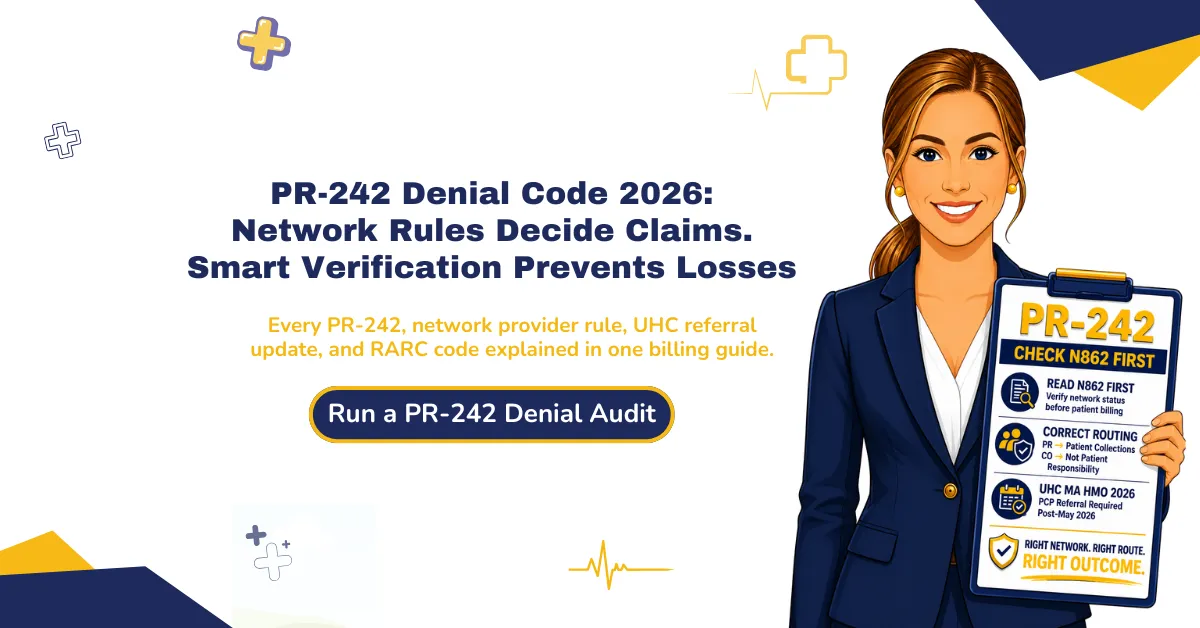
The PR-242 denial code appears on your 835 Electronic Remittance Advice as a two-part code. PR is the Claim Adjustment Group Code, which X12 designates as Patient Responsibility. The number 242 is the Claim Adjustment Reason Code (CARC), officially defined by X12 as “Services not provided by network/primary care providers.” CARC 242 has been active since January 1, 1995, and the CARC list was last reviewed May 1, 2026, confirming CARC 242 remains unchanged and active. When PR-242 appears on your remittance, the patient is responsible for the denied balance. You can bill the patient for a PR group code adjustment after verifying the denial is accurate.
In 2026, with UnitedHealthcare’s Medicare Advantage HMO referral grace period expired as of April 30, 2026, pr-242 denial code volume is higher than at any point in recent years. This guide covers the official X12 definition, the UHC 2026 action template, the RARC crosswalk with No Surprises Act remark codes, and the quick-fix checklist. Revenue cycle teams running pre-2026 managed care billing workflows are creating preventable pr 242 denial code losses and missing appeal rights every billing cycle.
PR-242 Denial Code: Quick Reference
Code: PR-242 CARC: 242: Services not provided by network/primary care providers (X12 official) Group Code: PR (Patient Responsibility) CARC Active Since: January 1, 1995 CARC Replaces: Deactivated CARC 38 CARC Last Reviewed: May 1, 2026 (active and unchanged confirmed) Patient Billing Allowed: Yes. PR group code means the patient owes the balance. Verify NSA remark codes first.
X12, the ANSI-chartered body responsible for HIPAA-mandated 835 transaction standards, publishes the CARC list in coordination with the Washington Publishing Company. CARC 242 replaces deactivated CARC 38, which was split into CARC 242 and CARC 243 for operational precision. Check RARC N862, N878, and N879 before any patient billing. These NSA remark codes restrict patient billing rights regardless of the PR group code prefix. The official description is “Services not provided by network/primary care providers” and has not changed since the code was activated. The pr242 quick reference above gives your billing team the five facts needed before any ERA action.
What Is the PR-242 Denial Code? Official X12 Description and Why Two Codes Exist
Understanding what causes this denial at the code-component level tells your billing team exactly where to start the investigation. Three H3s below cover the official definition, how the code appears on your ERA, and the CARC 38 split that created both CARC 242 and CARC 243.
The Official CARC 242 Definition From X12
The official CARC 242 definition from X12 is: “Services not provided by network/primary care providers.” CARC 242 has been active since January 1, 1995, and was last confirmed unchanged on the CARC list reviewed May 1, 2026. The definition isn’t saying the service was medically unnecessary. It’s not a coding error. It’s saying the provider who delivered the service didn’t meet the patient’s plan requirements for covered care: either out-of-network, outside the primary care channel, or both. The complete active CARC list including CARC 242 is maintained at the X12 CARC official list. The official description “services not provided by network/primary care providers” answers both the network status question and the primary care referral question simultaneously. Patient Responsibility is confirmed by the PR prefix.
How PR-242 Appears on Your 835 ERA and EOB
PR-242 appears in the CAS segment of the 835 transaction. CAS01 is the group code (PR). CAS02 is the reason code (242). CAS03 is the adjustment dollar amount. Your billing software combines these and displays “PR-242” on your denial report. On a paper EOB, it shows as “PR 242” or “PR-242” with payer description language such as “Services not provided by network or primary care providers” or “Out-of-network provider.” The format differs by payer. The meaning is identical across all payers using the X12 835 transaction standard. The denial code pr 242 and the payer-display variants both reference the same CARC 242 regardless of how a specific payer’s billing software formats the display.
ClaimMax RCM’s revenue cycle management process routes PR-242 through a RARC-first triage that separates NSA-protected claims from standard patient billing before any statement generates.
Why CARC 242 and CARC 243 Exist as Two Separate Codes
CARC 242 and CARC 243 both replaced an older, deactivated code: CARC 38, which read “Services not provided or authorized by designated (network/primary care) providers.” X12 split CARC 38 into two operationally distinct codes. CARC 242 covers who rendered the service (network status investigation). CARC 243 covers who authorized the service (referral and authorization investigation). Routing PR-242 to the PR-243 workflow means investigating authorization records for a denial that’s actually about network status. The investigation fails, the appeal fails, and the revenue is lost. The pr-242 denial code description and the PR-243 description sound similar but require completely separate billing workflows.
Can You Bill the Patient for a PR-242 Denial?
Yes. When PR appears as the group code alongside CARC 242 on your remittance, the patient is responsible for the denied balance. You can bill the patient for a pr 242 denial code. That isn’t optional guidance. That is the X12 Patient Responsibility standard.
This is the direct opposite of CO-242. CO group codes (Contractual Obligation) assign the adjustment to the provider as a write-off. The patient cannot be billed. PR group codes transfer the balance to the patient. PR-242 means patient statement. CO-242 means provider write-off. These aren’t interchangeable. The CARC description on both codes reads identically: only the group code prefix determines who owes the money.
Three Scenarios Where PR-242 Generates a Patient Statement Without Hesitation
Out-of-Network Choice: The patient chose an out-of-network provider on a plan restricting coverage to in-network providers. The denial is accurate. The patient owes the balance. Generate the patient statement after verifying the denial. CARC 242 is the correct code for this scenario because the network status of the rendering provider is the cause.
Self-Referral Violation: The patient self-referred to a specialist on an HMO plan that requires PCP gatekeeper referrals. No referral existed. The patient bypassed the plan’s referral requirement. The patient owes the balance. The plan required primary care direction and the patient bypassed it.
Invalid Referral Source: The referral was issued by a provider who isn’t the patient’s designated PCP for the current plan year. The referral is invalid under plan rules. The denial is accurate. The patient owes.
Three Situations Where You Must Verify Before Billing
NSA Remark Code Present: If RARC N862, N878, or N879 accompanies PR-242, the No Surprises Act applies. Patient cost-sharing is capped at the in-network equivalent. Billing the patient for the full PR-242 balance without checking NSA remark codes is a compliance violation. The denial code pr 242 with any of these three RARC codes changes the billing pathway entirely.
NPI or Taxonomy Error: The provider may be technically in-network but the claim was billed under the wrong NPI or taxonomy code. Correct and resubmit before issuing any patient statement. Can we bill the patient for this denial? Not until the NPI enrollment is confirmed.
Secondary Insurance: The patient’s secondary plan may cover part or all of the out-of-pocket balance. Bill secondary before billing the patient on any PR-242 balance.
PR-242 vs PR-243 vs CO-242: The Quick Disambiguation Table Every Billing Team Needs
Four denial codes carry CARC 242 or 243. Each one changes who owes the balance and which investigation your team runs. Getting the group code wrong means billing a patient who shouldn’t pay or writing off a balance they actually owe. The disambiguation table below corrects two wrong definitions currently circulating in billing reference sites. PR group code confirms patient liability. CO group code means provider write-off.
| Code | Official X12 Description | Group Code | Who Owes | Required Action |
|---|---|---|---|---|
| PR-242 | Services not provided by network/primary care providers | PR (Patient Responsibility) | Patient owes the balance | Verify network status. Check NSA remark codes. Generate patient statement if accurate. |
| PR-243 | Services not authorized by network/primary care providers | PR (Patient Responsibility) | Patient may owe | Investigate referral and authorization records. NOT network status. Different workflow from PR-242. |
| CO-242 | Services not provided by network/primary care providers | CO (Contractual Obligation) | Provider absorbs the write-off | Post contractual adjustment. Do not bill the patient. Note: billingfreedom.com and rapidclaims.ai define CO-242 as a medical necessity or coverage denial. Both definitions are factually wrong per the X12 CARC official list. |
| PI-242 | Services not provided by network/primary care providers | PI (Payer Initiated) | Neither party automatically | Contact payer for clarification before posting any write-off or generating any patient statement. |
CO-242 and PR-242 carry the same X12 CARC description but opposite financial consequences because of the group code prefix. Routing CO-242 to patient billing is a compliance violation. The pr-242 denial code and CO-242 share CARC 242 but require completely opposite billing actions.
Six Root Causes of PR-242 Denials: What Your Remittance Queue Is Actually Telling You
The root cause of this denial determines the resolution path. A valid network denial generates a patient statement. An erroneous denial from an NPI error or payer system failure generates a corrected resubmission. Getting this wrong at step one routes the claim into the wrong workflow entirely. HMO plan denials require a referral investigation before any patient contact. Out-of-network denials go straight to patient AR after the RARC check.
Cause 1: Out-of-Network Provider Status
The rendering provider isn’t contracted with the patient’s specific insurance plan on the date of service. Being in-network with the payer generally doesn’t guarantee participation in every plan product the payer administers. HMO, PPO, and EPO products within the same payer can have completely different network panels. PR group code confirms the patient owes this balance. PR-242 fires when the plan restricts coverage to network providers and the rendering provider isn’t on the correct panel. Medicare Advantage HMO products are the highest-volume source of this cause.
Cause 2: UHC 2026 Plan Year Reset and Referral Requirement
This is the most urgent 2026-specific PR-242 cause, and no competitor article addresses it with the operational specificity billing managers need. Effective January 1, 2026, UnitedHealthcare requires PCP referrals for all Medicare Advantage HMO and HMO-POS specialist visits, per UHC provider document PCA-1-25-02706-M&R (December 2025). The grace period ended April 30, 2026. Specialist claims for UHC MA HMO and HMO-POS members without a valid 2026 PCP referral submitted after May 1, 2026 are being denied as PR-242 and classified as provider liability. Patients are not billed for this specific cause. The provider absorbs the denial. The pr 242 denial code uhc 2026 context is a provider write-off, not a patient statement. The UHC referral requirement details are at UnitedHealthcare 2026 Medicare Advantage HMO referral requirements.
Cause 3: Missing or Invalid Prior Authorization
Some managed care plans require pre-authorization for specific services in addition to referrals. When authorization wasn’t obtained, is expired, or doesn’t match the billed CPT code or date, PR-242 fires. Under CMS-0057-F, effective January 1, 2026, payers must provide a specific denial reason when denying prior authorization. That specific reason is now available for your appeal documentation on every authorization-related PR-242. ClaimMax RCM’s prior authorization services verify authorization requirements for every managed care plan before services are scheduled. The pr-242 denial code on authorization-related claims now carries a named specific denial reason under CMS-0057-F that your team can address directly in the appeal.
Cause 4: Patient Self-Referral Violation
On HMO and HMO-POS plans with gatekeeper requirements, patients must see their PCP first and receive a referral before seeing a specialist. When a patient self-refers without a PCP visit, PR-242 fires because the service wasn’t directed through the required primary care channel. The patient is responsible for the balance because they bypassed the plan’s referral protocol. CO group code doesn’t apply here because the plan assigned Patient Responsibility correctly.
Cause 5: Provider Credentialing and NPI Enrollment Gaps
PR-242 fires on claims where the provider is technically in-network but the claim was submitted under the wrong NPI, a group NPI for a provider not enrolled in that specific HMO contract, or with an incorrect taxonomy code. These administrative billing errors create network status misclassification in the payer’s adjudication system. These aren’t legitimate network denials. They’re correctable resubmissions once the NPI or taxonomy error is identified. Note that NPI enrollment gaps often produce PR-242 and PR-243 on adjacent claims from the same encounter. Check both simultaneously. ClaimMax RCM’s credentialing services confirm NPI enrollment status under every managed care plan product before the first claim submits. Cause 5 is always the billing team’s error, not the patient’s.
Cause 6: New Provider Credentialing Window
When a new provider joins a practice and begins seeing patients during the credentialing application window, before the payer has completed enrollment, claims for that provider fire PR-242 even when the provider will eventually be in-network. The payer’s system can’t match the rendering NPI to an active enrollment record. Retroactive credentialing requests with the payer are the standard recovery path for this cause. HMO plans have the longest credentialing timelines and the most common new-provider credentialing window PR-242 volume. CO group code doesn’t apply here unless the payer applies a contractual obligation for the gap period.
PR-242 RARC Crosswalk: How the Remark Code on Your Remittance Routes Your Investigation
The RARC alongside pr 242 denial code is your routing signal. Read it before taking any action. N862, N878, and N879 are the three codes that override the default patient billing pathway entirely. CMS guidance on these three codes is the authoritative source. RARC N130 is the plan benefit design signal that tells your team to pull contract documentation first.
The PR-242 RARC Reference Table
| RARC Code | Official Description | What It Signals for PR-242 | Patient Billing Impact |
|---|---|---|---|
| N130 | Consult plan benefit documents/guidelines for information about restrictions for this service. | Plan benefit design restricts this CPT code to network or PCP-directed care. Pull the managed care contract and benefit grid before any patient statement. | Standard PR-242 patient billing after verifying denial accuracy. |
| N778 | Missing Primary Care Physician Information. | PCP data is missing on the claim. A referral may exist but wasn’t included. Add PCP information and referral number and resubmit before generating any patient statement. | Hold until corrected claim outcome confirmed. |
| N862 | No Surprises Act cost-sharing compliance. | NSA protections apply. Bill only the in-network cost-sharing equivalent, not the full PR-242 balance. | NSA-protected. In-network amount only. |
| N878 | NSA notice-and-consent balance billing prohibition. | Balance billing prohibited under NSA for this service. Initiate NSA open negotiation instead of patient billing. | Prohibited. |
| N879 | NSA balance billing prohibited confirmation. | Same as N878. Initiate IDR within four business days of failed open negotiation. | Prohibited. |
When N862, N878, or N879 accompanies PR-242, stop before generating a patient statement. These three codes signal NSA protections apply regardless of the PR group code prefix. All active RARC descriptions are maintained at the X12 RARC official list. The pr-242 denial code description and RARC combination determines the billing path more than the CARC alone. The denial code pr 242 RARC table above is the first reference in the competitive set providing all five PR-242 remark codes with patient billing impact columns. The pr242 RARC crosswalk covers both standard commercial scenarios (N130, N778) and NSA-protected scenarios (N862, N878, N879) in one table.
When NSA Remark Codes Override Standard Patient Billing
N862, N878, and N879 override the default PR-242 patient billing pathway because the No Surprises Act supersedes the X12 Patient Responsibility group code assignment in specific clinical scenarios. Emergency care and out-of-network services at in-network facilities both trigger NSA protections. When these remark codes appear alongside PR-242, the IDR process, not a patient statement, is the correct next step. Providers have four business days after failed open negotiation to initiate IDR. Missing that window forfeits reimbursement rights permanently. The CMS guidance on No Surprises Act patient billing protections is at CMS No Surprises Act balance billing protections.
For California practices operating under the Knox-Keene Health Care Service Plan Act, the California DMHC has independent jurisdiction over Knox-Keene regulated HMO plans. California providers receiving PR-242 from Knox-Keene plans have access to independent dispute resolution through the DMHC in addition to the federal NSA IDR process, a dual-pathway that providers in other states don’t have. The pr 242 denial code california context under Knox-Keene is a separate recovery channel from the federal IDR track.
How to Fix a PR-242 Denial: The ClaimMax Quick-Fix Checklist, UHC 2026 Template, and Patient Statement Language
PR-242 resolution starts with RARC identification, not patient billing. Work through this checklist before any statement goes out, then use the UHC 2026 template if the denial involves a Medicare Advantage HMO plan. Check for N778 first. Missing PCP information means the denial is correctable before any patient contact. The pr 242 denial code resolution path forks at Step 4: NSA codes go to IDR, valid denials go to patient billing, UHC MA HMO missing-referral denials go to write-off. The five-step resolution tool below covers all four paths.
PR-242 Quick-Fix Checklist: ClaimMax RCM
Step 1: Read the RARC First. Pull the 835 ERA and locate the remark code alongside PR-242. N862, N878, or N879 means NSA protections apply. Stop. Do not generate a patient statement. N778 means missing PCP information: correct and resubmit before any patient contact. N130 means pull the plan benefit documents for the CPT code before any other action.
Step 2: Verify Provider Network Status by Specific Plan Product. Log into the payer portal and confirm the rendering provider’s network status under the specific plan type (HMO, PPO, or EPO) on the date of service. Being in-network with the payer generally doesn’t guarantee participation in every plan product. Search by NPI under the exact plan product, not the payer name.
Step 3: Pull All Referral and Authorization Records. For HMO and HMO-POS denials, confirm whether a valid 2026 referral from the patient’s designated PCP exists, whether it covers the specific CPT code and date, and whether it was submitted before the specialist visit. A 2025 referral doesn’t carry over to the 2026 plan year.
Step 4: Check Secondary Insurance Before Any Patient Statement. The patient’s secondary plan may cover part or all of the out-of-pocket balance. Bill secondary first. A patient statement issued before secondary adjudicates creates billing disputes that cost more to resolve than the original balance. CAS01 shows PR. That PR permits patient billing in standard scenarios but Path 4 is the UHC MA HMO exception where provider liability overrides the PR group code assignment.
Step 5: Determine Your Resolution Path.
- Path 1 (Corrected Resubmission): NPI, taxonomy, or PCP information error. Correct and resubmit.
- Path 2 (Retroactive Authorization): Established patient, administrative oversight. Request retroactive authorization within payer’s allowed window.
- Path 3 (Patient Billing): Denial is accurate, no NSA codes, no secondary coverage. Generate patient statement.
- Path 4 (Provider Liability Write-Off): UHC MA HMO without 2026 referral post-May 1, 2026. Post write-off. Do not bill the patient.
UHC MA HMO Post-Grace-Period Action Template: May 1, 2026 and After: ClaimMax RCM
Claim received PR-242 from UHC Medicare Advantage HMO or HMO-POS?
Step 1: Confirm service date is May 1, 2026 or later.
Step 2: Check payer portal: does a valid 2026 PCP referral exist for
this patient, specialist, and CPT code?
Step 3: If YES referral exists: File appeal with referral documentation.
The denial may be a payer system error.
Step 4: If NO referral exists: Per UHC policy PCA-1-25-02706-M&R,
this denial is classified as provider liability.
Post write-off. Do not bill the patient.
Step 5: For future visits: Contact the patient’s PCP to confirm a 2026
referral is on file before the next appointment.
For service dates before May 1, 2026 (during grace period):
Appeal with documentation. UHC committed not to deny for missing
referrals during the grace period.
PR-242 Patient Statement Language: Copy and Use
Your insurance plan has processed your recent claim and determined that
the service was provided outside your plan’s network or primary care
requirements. The adjustment of $[AMOUNT] has been assigned to you as
patient responsibility under your plan’s out-of-network or referral
requirements. This amount was confirmed through your insurance plan’s
remittance as of [REMITTANCE DATE]. To pay by phone: [PHONE]. To pay
online: [PAYMENT PORTAL]. If you believe this adjustment was applied in
error, contact your insurance plan at the member services number on your
insurance card before your next visit. For services where the No
Surprises Act applies, your responsibility may be limited to the
in-network cost-sharing equivalent. Contact us or your insurer for
clarification.
The No Surprises Act reference in the patient statement is a zero-cost compliance safeguard. If N862, N878, or N879 was missed before the statement went out, the language invites the patient to flag the issue rather than pay an incorrect balance. The pr 242 denial code uhc 2026 template above is a copy-paste decision tool that no other article in the PR-242 SERP provides as a standalone Path 1 through Path 4 decision workflow.
When PR-242 denials are aging past 30 days in your queue without resolution, every day is a day closer to a closed timely filing window. ClaimMax RCM’s denial management services team works PR-242 through RARC-first triage, identifies UHC plan year reset patterns by payer, and routes every correctable denial before the appeal deadline closes. When PR-242 patient balances are already accumulating in your AR, ClaimMax RCM’s AR follow-up team deploys a structured secondary-billing-first workflow before any patient statement generates.
2026 Regulatory Updates That Affect Every PR-242 Denial You Work This Year
Three regulatory changes directly affect how pr 242 denial code denials are generated, appealed, and resolved in 2026. Practices still running pre-2026 managed care billing workflows are creating preventable denials and missing appeal rights these rules created. CMS and UHC both issued operational changes in late 2025 that took effect January 1, 2026, with enforcement milestones that passed in April.
UHC Medicare Advantage HMO Referral Enforcement: Grace Period Expired
UnitedHealthcare’s requirement for PCP referrals on all Medicare Advantage HMO and HMO-POS specialist visits, detailed in document PCA-1-25-02706-M&R (December 2025), went into full enforcement after the April 30, 2026 grace period ended. Specialist claims for UHC MA HMO and HMO-POS members without a valid 2026 PCP referral dated after May 1, 2026 are denied as PR-242 and classified as provider liability. This is the most operationally urgent 2026 change for any practice with UHC Medicare Advantage patients. Every specialist claim now requires a verified 2026 PCP referral before the patient arrives.
CMS-0057-F: How the 2026 Prior Authorization Rule Changes Your PR-242 Appeals
CMS-0057-F, the CMS Interoperability and Prior Authorization Final Rule, went into operational effect January 1, 2026. Payers must now provide a specific reason for denied prior authorization requests. For PR-242 denials rooted in missing authorization, that specific denial reason is now available for your retroactive authorization request and formal appeal. A targeted appeal addressing the specific stated reason has a meaningfully higher success rate than the generic medical necessity letter most billing teams still submit. The full CMS-0057-F requirements are at the CMS-0057-F prior authorization final rule page.
For the broader managed care prior authorization landscape affecting orthopedic and specialty practices, ClaimMax RCM’s guide to prior authorization challenges in orthopedic practices covers the payer-specific authorization failure patterns that generate both PR-242 and CO-197 denials.
CARC and RARC List Confirmation for 2026
The X12 Claim Adjustment Reason Code list was last modified November 1, 2025, and last reviewed May 1, 2026. CARC 242 remains active and unchanged as of this review. The RARC list was last modified March 4, 2026, confirming RARC N862, N878, and N879 are current and active. CMS Transmittal R13666CP confirms the three-times-per-year CARC and RARC update cadence, with the next update cycle expected July 1, 2026.
How to Prevent PR-242 Denials Before They Reach Your Remittance
Most PR-242 denials are preventable before the claim submits. These controls catch network status gaps, referral failures, and NPI enrollment errors at three workflow stages.
Front-End Controls (Before Service Delivery)
Verify the patient’s specific plan type (HMO, PPO, EPO) at scheduling and confirm the rendering provider is enrolled in that specific plan product, not just the payer generally. HMO and HMO-POS panels differ from commercial panels within the same payer.
Confirm the patient’s designated PCP for the current plan year and whether a valid 2026 referral for the specialist visit was submitted by that specific PCP before the appointment. A 2025 referral is invalid for 2026 plan year claims.
Obtain prior authorization for services requiring pre-approval before scheduling. Under CMS-0057-F (January 1, 2026), payers must provide a specific denial reason, but only if you submitted the authorization request first.
Communicate the expected patient responsibility to the patient at scheduling. Include whether the provider is in-network and the out-of-pocket estimate if out-of-network care proceeds.
ClaimMax RCM’s eligibility verification and prior authorization process confirms plan type, network status, and referral requirements at the scheduling stage, before the first claim is ever created.
Mid-Cycle and Back-End Controls
Confirm the rendering NPI and billing NPI match the payer’s enrolled records for the specific plan product before claim submission. A group NPI submitted for a provider not enrolled in the HMO contract generates PR-242 even when the provider is otherwise in-network.
Include the referral number and PCP NPI on every HMO and HMO-POS claim that required a referral. Missing PCP information triggers RARC N778 and produces a preventable correctable denial.
Route PR-242 denials by RARC the same day the ERA posts. N862, N878, and N879 go to NSA compliance review. N778 goes to claim correction. N130 goes to plan benefit document review. Generic denial queues mix PR-242 with CO-242 and delay both.
Build a monthly PR-242 tracking report by payer and plan product. For California practices, flag Knox-Keene regulated HMO plans separately. Those plans follow DMHC jurisdiction in addition to federal NSA rules, and California’s dual-pathway dispute resolution creates additional recovery options through the pr 242 denial code california recovery track that standard commercial PR-242 workflows miss.
PR-242 vs Similar Denial Codes: How to Tell Them Apart When They Land on the Same Remittance
PR-242 produces zero payment and assigns the balance to the patient. So do PR-243, PR-27, and several other codes that appear alongside it in managed care queues. The pr-242 denial code and its adjacent codes share the PR group code but require completely different investigation workflows.
| Code | Official X12 Description | Who Owes | Resolution Path Difference From PR-242 |
|---|---|---|---|
| PR-242 | Services not provided by network/primary care providers | Patient owes | Network status investigation. RARC check first. NSA verification before patient billing. This article. |
| PR-243 | Services not authorized by network/primary care providers | Patient may owe | Authorization and referral investigation, NOT network investigation. Different workflow from PR-242. |
| CO-242 | Services not provided by network/primary care providers | Provider write-off | Same CARC as PR-242 but opposite financial consequence. Do not bill patient. CO group code means contractual write-off. |
| PR-27 | Expenses incurred after coverage terminated | Patient owes | Coverage termination investigation, not network investigation. Different CARC, same PR group code. |
| CO-197 | Precertification/authorization/notification/pre-treatment absent | Provider write-off | Authorization failure without the network compliance issue. Provider absorbs. No patient billing. |
CO-242 and PR-242 carry the same X12 CARC description but opposite financial consequences because of the group code prefix. Routing CO-242 to the patient billing workflow is a compliance violation. Routing PR-242 to the write-off workflow loses collectible patient revenue. The CARC description on PR-242 and CO-242 reads identically. Only the group code tells your team who owes. In the table above, the PR prefix is the single field that separates patient billing from write-off.
Frequently Asked Questions About the PR-242 Denial Code
What Is a PR 242 Code?
PR-242 is a denial code that appears on the 835 ERA when the payer determines services were not provided by a network or primary care provider as required by the patient’s plan. X12 defines CARC 242 as “Services not provided by network/primary care providers.” The PR prefix means Patient Responsibility, so the patient owes the denied balance.
Schema Answer: “PR-242 is CARC 242 on the 835 ERA, defined by X12 as ‘Services not provided by network/primary care providers.’ The PR prefix means Patient Responsibility: the patient owes the denied balance.”
What Does Denial Code 242 Mean?
Denial code 242 means CARC 242 in the X12 claim adjustment code system, officially defined as “Services not provided by network/primary care providers.” The group code that precedes it determines who pays: PR-242 means the patient owes the balance. CO-242 means the provider absorbs the write-off. The same CARC number produces opposite financial outcomes depending on the group code.
Schema Answer: “Denial code 242 is CARC 242, defined by X12 as ‘Services not provided by network/primary care providers.’ PR-242 means patient pays. CO-242 means provider write-off. The group code determines who owes.”
Can You Bill the Patient for a PR-242 Denial?
Yes. PR-242 is a Patient Responsibility denial. The PR group code assigns the financial obligation to the patient. You can bill the patient after verifying network status, checking for NSA remark codes N862, N878, and N879, and confirming no secondary insurance coverage applies.
Schema Answer: “Yes. PR-242 is Patient Responsibility. The PR group code assigns the balance to the patient. Verify NSA remark codes N862, N878, N879 first: those override standard patient billing rights.”
What Does CO-242 Mean?
CO-242 means “Services not provided by network/primary care providers” with the CO (Contractual Obligation) group code. The provider absorbs the write-off. The patient cannot be billed. CO-242 carries the same CARC description as PR-242 but the opposite financial outcome. billingfreedom.com defines CO-242 as a medical necessity denial. That definition is factually wrong per the X12 CARC official list.
Schema Answer: “CO-242 means the same CARC 242 definition as PR-242 but with CO group code (Contractual Obligation). The provider absorbs the write-off. The patient cannot be billed. This is opposite to PR-242.”
What Is PR-243 and How Does It Differ From PR-242?
PR-243 covers services not authorized by network/primary care providers. PR-242 covers services not provided by network/primary care providers. Both codes replaced older CARC 38. PR-242 investigates who rendered the service (network status). PR-243 investigates who authorized the service (referral and authorization records). These require completely different resolution workflows and should never be routed to the same investigation queue.
Schema Answer: “PR-243 is about who authorized the service. PR-242 is about who rendered it. Both replaced CARC 38. Routing PR-242 to PR-243’s authorization investigation workflow fails the appeal every time.”
What Is the Official PR-242 Denial Code Description?
The official PR-242 denial code description from X12 is: “Services not provided by network/primary care providers.” CARC 242 has been active since January 1, 1995 and was last reviewed on the X12 CARC list on May 1, 2026, confirming CARC 242 remains active and unchanged.
Schema Answer: “The official PR-242 description from X12: ‘Services not provided by network/primary care providers.’ CARC 242 active since January 1, 1995, confirmed unchanged on CARC list reviewed May 1, 2026.”
What Is the PR-242 Denial Code in Medical Billing?
In medical billing, PR-242 is the denial code indicating services were not provided by an in-network or primary care provider as required by the patient’s managed care plan. The PR prefix means the patient owes the balance. PR-242 is most common on HMO plans with gatekeeper referral requirements and when patients access out-of-network specialists.
Schema Answer: “PR-242 in medical billing means services weren’t provided by a network or primary care provider per the patient’s managed care plan. Patient owes the balance. Most common on HMO plans with gatekeeper requirements.”
What Happens With PR-242 Denials on UnitedHealthcare Medicare Advantage Plans in 2026?
UnitedHealthcare’s 2026 referral requirement for Medicare Advantage HMO and HMO-POS plans, per document PCA-1-25-02706-M&R, went into full enforcement after the April 30, 2026 grace period ended. Specialist claims for UHC MA HMO patients without a valid 2026 PCP referral dated after May 1, 2026 are denied as PR-242 and classified as provider liability. The patient isn’t billed. The provider posts a write-off.
Schema Answer: “After April 30, 2026 grace period, UHC MA HMO PR-242 denials for missing 2026 referrals are provider liability per PCA-1-25-02706-M&R. Provider posts write-off. Patient is not billed.”
Stop Letting PR-242 Patient Balances and UHC Write-Offs Accumulate: How ClaimMax RCM Fixes the Pattern
You’ve got the X12 definition, the CARC 38 provenance, the UHC 2026 grace period enforcement date, the RARC crosswalk with NSA codes, the five-step checklist, the UHC action template, the patient statement language, and the California Knox-Keene dual-pathway. The gap between having this information and having it built into your daily billing workflow is where PR-242 denials generate incorrect patient statements, missed write-offs, or overlooked NSA compliance violations every billing cycle.
ClaimMax RCM builds the PR-242 workflow into every ERA posting cycle: RARC-first triage that separates NSA-protected claims from patient billing, UHC plan year referral verification before the first specialist claim submits, NPI enrollment confirmation under the correct plan product, and a monthly PR-242 pattern report by payer that catches systematic failures before they compound.
ClaimMax RCM’s medical billing service is built for practices that are done treating PR-242 as a claim-by-claim problem. Request a free managed care denial audit. We’ll analyze your PR-242 volume by payer and plan type, identify your UHC MA HMO referral compliance status, and show you exactly what your practice is writing off versus what your patients actually owe.
All CARC and RARC definitions in this article are sourced from the X12 Claim Adjustment Reason Code list (External Code List 139) and X12 Remittance Advice Remark Code list (External Code List 411), maintained by X12 under HIPAA Administrative Simplification requirements. CARC 242 official description: “Services not provided by network/primary care providers.” CARC 242 active since January 1, 1995. Replaces deactivated CARC 38. CARC list last modified November 1, 2025. CARC list last reviewed May 1, 2026. RARC list last modified March 4, 2026. UnitedHealthcare 2026 Medicare Advantage HMO referral requirement per document PCA-1-25-02706-M&R (December 2025), effective January 1, 2026. Grace period ended April 30, 2026. Post-May 1, 2026 UHC MA HMO denials for missing referrals classified as provider liability per UHC policy. CMS-0057-F Interoperability and Prior Authorization Final Rule effective January 1, 2026, applies to Medicare Advantage organizations, Medicaid managed care plans, CHIP managed care entities, and QHP issuers on the Federally-Facilitated Exchanges. No Surprises Act remark codes N862, N878, N879 are current per RARC list last modified March 4, 2026. California Knox-Keene Health Care Service Plan Act information reflects California DMHC regulatory framework as of May 2026. All billing codes, payer policies, and regulatory requirements are subject to change. Verify current requirements through the X12 official lists, your payer-specific provider manuals, and CMS regulatory guidance before taking any billing action. This article does not constitute legal, compliance, or billing advice.


