CPT code 71260 is the American Medical Association code for “Computed tomography, thorax, diagnostic; with contrast material(s).” It covers a diagnostic chest CT where staff administer intravenous contrast and the scanner captures post-contrast images only. When both a non-contrast and a contrast phase run in one session, 71270 replaces it.
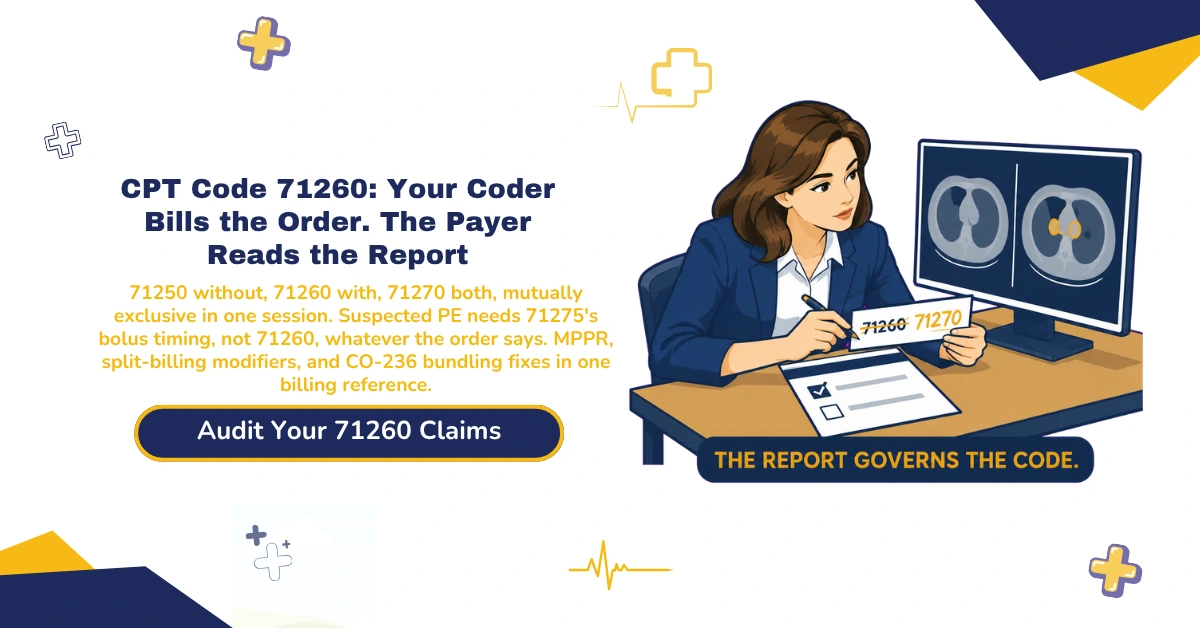
Three codes describe almost the same study. The one that is correct depends on a detail buried in the radiology report. Your order says one thing, the report says another, your coder bills off the order, and the payer reads the report. That claim comes back downcoded weeks later, and by then the correction needs a fresh timely filing clock.
This guide covers the 2026 rate by component and setting. It maps all five chest CT codes, including the two that get confused with 71260 most often. It also covers the covered diagnosis rule your MAC applies, the modifier logic for split billing, the same-day 74177 pairing, and the denial codes that fire when any of those break.
What Is CPT Code 71260 Used For?
Providers order the study covered by cpt code 71260 to evaluate chest structures that a plain radiograph cannot resolve. Contrast enhances soft tissue and vascular detail, which is what lets a radiologist separate a mass from the vessels around it. CMS establishes limited coverage for this code under CMS Article A56580.
What the scan evaluates
A contrast-enhanced study under the cpt code for ct scan of chest covers one anatomic region. Within it, the radiologist reads:
- Lungs and pulmonary parenchyma
- Mediastinum, trachea, and esophagus
- Mediastinal and hilar lymph nodes
- Pleural spaces and pleural surfaces
- Thoracic vasculature, including the aorta and pulmonary vessels
- Chest wall soft tissue
That anatomic scope holds across the whole cpt code for ct thorax family. Contrast status is the only thing that changes which of them you bill. A study ordered for a lung mass and a study ordered for suspected empyema both sit inside the same cpt code for lung ct scope.
Why contrast changes the study
Contrast does three things a non-contrast scan cannot: it resolves vessel borders, it shows the blood supply of a mass, and it separates active inflammation from scar tissue.
Each one is a clinical justification a payer accepts in writing. A radiologist who documents enhancement pattern on a mediastinal node has answered the reviewer’s question before the reviewer asks it.
That is why the contrast decision belongs in the report, not only in the order. The reviewer reads what the radiologist saw, not what the ordering physician hoped to see.
What CPT 71260 does not include
Under the NCCI Policy Manual 2026, Chapter 9, the computed tomography cpt codes include all images needed to complete the study. Multiplanar reconstructions, maximum intensity projections, and volume rendering are integral to the base service. You do not bill them separately.
Two more inclusions catch billing teams off guard. Preliminary radiographs taken before contrast administration are not separately reportable. Delayed imaging radiographs are not either.
An imaging center charging a separate line for MPR on every contrast chest CT is building an overpayment position one claim at a time.
CPT 71250 vs CPT 71260 vs 71270 vs 71271 vs 71275: Choosing the Right Chest CT Code
The imaging protocol performed determines the code. Not the order wording, not physician preference, and not what the scheduler typed into the system. CPT 71250, cpt code 71260, and 71270 are mutually exclusive for a single session, so only one of the three can appear on a claim for one study.
Three codes cover the contrast decision:
- CPT 71250 covers a chest CT with no IV contrast at any point.
- CPT 71260 covers a chest CT with contrast only, where the scanner captures post-contrast images alone.
- CPT 71270 covers a chest CT without contrast followed by contrast in the same session.
Two more codes sit adjacent and get billed by mistake. The full cpt code ct thorax family looks like this.
| Code | What was performed | Correct use | Denial risk if wrong |
|---|---|---|---|
| 71250 | No IV contrast at any point | Non-contrast chest CT, HRCT, nodule surveillance | Downcode when the report shows contrast |
| 71260 | IV contrast only, post-contrast images only | Contrast-enhanced diagnostic chest CT | Bundling denial when paired with 71250 |
| 71270 | Both phases, same session | Dual-phase study | Underpayment when billed as 71260 alone |
| 71271 | Low-dose, non-contrast, screening protocol | Annual LDCT lung cancer screening | Medical necessity denial when billed diagnostic |
| 71275 | CTA with bolus timing and vascular reconstruction | Suspected PE, aortic dissection, vascular pathology | Denies in both directions |
For the full contrast-status breakdown on the non-contrast code, see our CPT 71250 billing guide.
Contrast-tier pricing follows the same pattern across other body regions. Our imaging CPT code reference maps it by modality.
Why 71250 and 71260 cannot be billed together
CPT 71250 and the ct chest cpt code for a contrast study are an NCCI mutually exclusive pair for the same session. When both phases are medically necessary, 71270 is the code. One claim line, not two.
No amount of separate documentation makes that pair billable for a single study. A guide telling you to bill both when each is “separately performed and documented” is describing an exception that does not exist inside one session.
The report governs the code, not the order
Your coder reads the radiology report to pick between the three. The order tells you what someone wanted. The report tells you what the scanner and the radiologist did. The documentation section below covers what that report has to state before a coder can finalize the claim.
CPT 71260 vs 71275: Why Suspected Pulmonary Embolism Is Not a 71260 Study
Suspected pulmonary embolism is reported with 71275, not with cpt code 71260. PE evaluation requires contrast bolus timing synchronized to pulmonary arterial opacification, and that timing protocol defines a CTA. A chest CT with routine contrast timing does not satisfy it, no matter what the order requested.
What you will see published: 71260 is the code for suspected pulmonary embolism.
What is correct: PE workups require CTA bolus timing and vascular reconstruction, so they are reported with 71275.
Why it matters: The I26 pulmonary embolism code family appears on CMS Article A56691, which governs CTA. It does not appear on A56580, which governs diagnostic CT thorax.
What separates a CTA from a contrast CT
Four things distinguish the cta chest cpt code from a routine contrast study:
- Bolus timing synchronized to a target vessel
- Arterial-phase acquisition rather than routine post-contrast timing
- Vascular post-processing and reconstruction
- A report reading the vasculature as the primary finding
A radiology report showing none of those describes a contrast CT. The ct angio chest with contrast cpt code does not apply to it, whatever the requisition said.
The denial that fires in both directions
Bill 71260 for a documented CTA and you underpay your own practice while misrepresenting the service on the claim. Bill the cpt code ct angiogram chest for a routine contrast study and you overstate it, which draws post-payment review.
Your coder fixes this by reading the report for bolus timing language before reaching for the chest cta cpt code. That single check resolves the ambiguity in most cases.
Picture an ED patient with acute dyspnea and an elevated D-dimer. The order reads “CT chest with contrast.” The radiologist runs a PE protocol with bolus tracking and reports segmental filling defects. The order points to 71260. The study performed was 71275, and the report proves it.
For the screening code that sits on the other side of this family, see our LDCT screening code 71271 guide.
When Not to Use CPT Code 71260 and What to Bill Instead
CPT code 71260 is wrong whenever the protocol performed was low-dose, non-contrast, high-resolution, or angiographic. Seven scenarios route away from it, and each one routes somewhere specific.
| Clinical scenario | Do not bill | Bill instead | Reason |
|---|---|---|---|
| Suspected PE or aortic dissection | 71260 | 71275 | CTA bolus timing protocol |
| Nodule surveillance, Fleischner interval | 71260 | 71250 | Surveillance needs no contrast |
| HRCT for ILD, fibrosis, bronchiectasis, COPD | 71260 | 71250 | HRCT protocol is non-contrast by design |
| Annual lung cancer screening, USPSTF criteria | 71260 | 71271 | Screening CT is low-dose, non-contrast |
| Contrast contraindicated: CKD, prior reaction | 71260 | 71250 plus documented reason | Contrast was never administered |
| Both phases performed, same session | 71260 | 71270 | Dual-phase study has its own code |
| Contrast ordered but not administered | 71260 | 71250 | Payer edits compare ordered against administered |
Row five catches teams that plan the code before the scan happens. A patient with chronic kidney disease arrives for a contrast study, the radiologist cancels contrast at the scanner, and the study proceeds without it. The claim is 71250, and the record needs the contraindication written down.
Row seven catches the same failure from the other direction. A ct chest with iv contrast cpt code on the claim, with no contrast administration in the report, fails a payer edit that compares the two fields.
Is there a separate CPT code for high-resolution chest CT?
No. HRCT is a protocol, not a code. Report 71250 when the study runs without contrast, which is the standard HRCT technique for interstitial lung disease.
No hrct cpt code exists in the CPT set. The ct chest high resolution cpt code your scheduler is looking for is 71250, and the same rule holds for any high resolution ct chest cpt code search that turns up a distinct number. Academic radiology departments publish their own code lists on this basis, including the WashU Mallinckrodt CT code list.
Most practices find these routing errors in the report, not the order. When your chest CT denials keep tracing back to protocol mismatches, our denial management services team runs root-cause reviews on imaging claims before they age out of the appeal window.
What Diagnosis Codes Support Medical Necessity for CPT 71260?
Every payer reviewing a contrast chest CT applies a two-question test. Was the chest CT clinically necessary for this patient, and was intravenous contrast required rather than a non-contrast study? The diagnosis code answers the first question. The documentation answers the second.
The three policy layers that govern coverage
Three policy layers decide whether the cpt code for ct of the chest with contrast gets paid. They stack, and your MAC applies all three.
National baseline. NCD 220.1, version 2, effective March 12, 2008, covers CT when the medical and scientific literature supports the scan for the condition and the scan is reasonable and necessary for the individual patient. It also states something few billing guides mention: no general rule requires other diagnostic tests before a CT, though a MAC can determine in a specific case that CT as an initial test was not reasonable and necessary.
Local coverage. LCD L33459 for CT thorax, Computerized Axial Tomography (CT), Thorax, carries revision R14 effective June 11, 2026. That is the contractor policy your MAC adjudicates against, and it is more current than any figure circulating in published 71260 guidance.
Billing companion. Article A56580 establishes limited coverage for 71250, cpt code 71260, and 71270 and carries the ICD-10 list supporting medical necessity. Under revision R6, effective January 1, 2021, CMS revised the descriptors for all three. That revision is why the pre-2021 descriptor still circulating in published guides is wrong.
Covered diagnosis categories
The 71260 cpt code covered list runs contractor by contractor, so a code table copied from another guide tells you nothing about your own jurisdiction. Check these categories against your MAC list:
- Thoracic malignancy, staging, and restaging
- Indeterminate pulmonary nodule characterization
- Mediastinal or hilar lymphadenopathy
- Non-resolving or complicated pneumonia and abscess
- Hemoptysis requiring vascular detail
- Pleural effusion with suspected malignancy
- Sarcoidosis
Why vague indications deny
“Chest pain” does not establish contrast necessity. Neither does “rule out pathology.” A reviewer reading either one has nothing to map against the covered list, and the ct scan of chest with contrast cpt code denies on medical necessity.
Compare that to what survives review: “evaluation of 2.5 cm right upper lobe nodule identified on prior chest radiograph, contrast required to assess vascularity.” Same patient, same scan, different outcome. That is also what the cpt code for ct scan chest with contrast documentation has to carry into an appeal.
Your pulmonology group orders contrast chest CTs every week. The ones that deny share a pattern: a symptom in the indication field where a condition belongs. Our NCCI denial recovery work starts by finding which indications keep repeating.
Documentation Requirements for CPT Code 71260 Claims
The radiology report determines the code. The physician order does not. Before a coder finalizes a claim, the report has to match the 71260 cpt code description: intravenous contrast administered, post-contrast images captured.
The report governs the code, not the order
Your coder cannot bill off the requisition. When the order says non-contrast and the report documents contrast administration, 71260 is what goes on the claim.
What usually happens is the reverse. The cpt code ct chest w contrast sits on the order, the radiologist runs pre-contrast and post-contrast phases, and the coder bills 71260 anyway. The payer reads the report, sees two phases, and downcodes to what it thinks was performed.
Unwinding that costs more than the difference. A corrected claim needs a new submission and a new timely filing clock, and the original denial sits in AR the whole time.
Run the report against the order before the claim leaves your system. Our clean claim requirements guide covers the rest of the pre-submission check.
The seven-item documentation checklist
- Ordering provider identification and the clinical indication stated in the order
- ICD-10 diagnosis confirmed against the MAC covered list before submission
- Explicit statement that staff administered intravenous contrast
- Contrast agent, volume, route, and injection site
- Any adverse reaction, or an explicit negative
- Prior imaging or workup that prompted escalation to contrast
- Radiologist interpretation identifying post-contrast findings
Item 3 is where the cpt chest ct with contrast documentation fails most often. A report saying “with contrast” and nothing else gives a reviewer no confirmation that anything was injected.
What the federal rule requires
The conditions for ordering and documenting diagnostic tests sit at 42 CFR 410.32. The treating physician has to order the test and use the result in managing the beneficiary. A report with no traceable order behind it is a denial no appeal narrative repairs.
Why generic contrast language fails audit
“With contrast” does not satisfy a reviewer. A report naming the agent, the volume, the route, and the timing does, and that is the difference between a ct chest with contrast cpt code claim that survives a post-payment audit and one that does not.
Does CPT 71260 Need a Modifier?
Whether cpt code 71260 needs a modifier depends on who owns the scanner and who reads the study. One entity performing and billing both parts appends nothing. Two entities splitting the work append modifier 26 for the interpretation and modifier TC for the acquisition.
When no modifier is needed
A single entity that owns the scanner and employs or contracts the interpreting radiologist bills the global service. Freestanding imaging centers and independent diagnostic testing facilities sit here most often. Hospital outpatient departments bill the facility service without a modifier on the institutional claim.
When modifier 26 applies
Modifier 26 reports the professional component: the radiologist interpretation and written report. It belongs on the claim when the reading physician or group does not own or operate the equipment, which describes most contracted hospital radiology arrangements.
Coders searching for 71260 interpretation guidance are looking for this modifier. The cpt code for ct chest with contrast carries a PC/TC indicator that permits the split, which is why the same code can generate two claims from two entities.
When modifier TC applies
Modifier TC reports the technical component: equipment, technologist time, supplies, and the contrast material itself. The facility bills TC while the reading group bills 26 against the same code and the same date of service.
That is the standard arrangement for ct chest with contrast cpt billing in a hospital outpatient setting. Our POS 22 hospital outpatient billing guide covers how the place of service code interacts with it.
The split-billing coordination failure
Mismatched codes stall both claims. The facility bills 71250-TC because the order said non-contrast. The radiology group bills the cpt code ct chest with contrast under 71260-26 off the report. The payer sees two entities describing two different studies on one date and holds both.
Nobody catches it until the AR report surfaces two aged lines for the same encounter. Our MRI modifier billing guide shows the same coordination breakdown in lower extremity imaging.
Six modifiers cover every 71260 cpt billing arrangement you will encounter.
| Modifier | Name | When to apply |
|---|---|---|
| None | Global service | One entity performs and bills both components |
| 26 | Professional component | Interpretation only, equipment not owned |
| TC | Technical component | Equipment, technologist, and contrast only |
| 59 | Distinct procedural service | Commercial fallback for same-day multi-imaging |
| XS | Separate structure | Medicare-preferred for distinct anatomic regions |
| 52 | Reduced services | Study not completed as planned, reason documented |
Modifiers that do not belong on 71260
Modifier 91 is Repeat Clinical Diagnostic Laboratory Test. It never applies to a radiology code. Repeat imaging on the same date takes modifier 76 for the same physician or 77 for a different one.
Modifier CR and state Medicaid variation
Some state Medicaid fee-for-service programs require modifier CR to bypass prior authorization for a chest CT tied to suspected or confirmed COVID-19. That requirement is state-specific and does not extend to Medicare fee-for-service.
Check your state provider manual rather than assuming the Medicare rule transfers. Our Medicaid denial codes guide covers the wider set of state-level differences that catch imaging claims.
Can You Bill CPT 71260 and 74177 Together?
Yes. CPT code 71260 and 74177 cover distinct anatomic regions, so both are payable on the same date of service. Append modifier XS to the secondary code for Medicare, or modifier 59 as the commercial fallback, and document a separate clinical indication for each region.
Why modifier 59 keeps getting rejected
Medicare built the X-modifier set to replace the blunt 59 with specific reasons. When the distinction between two services is anatomic, XS names it: separate structure. Submitting 59 where the contractor expects XS trips the edit you were trying to clear.
Check the modifier indicator before overriding anything. Some NCCI edit pairs carry an indicator of 0, and no modifier bypasses those. A biller who appends 59, gets rejected, appends XS, and gets rejected again is fighting an edit that was never modifier-eligible.
Claim line sequencing
List 74177 first as the higher-valued procedure. The cpt code for ct chest abd pelvis with contrast goes on line one, and the chest study follows with the modifier appended. The cpt code ct chest abdomen pelvis with contrast pair sequences like this:
- Global billing: 74177, then 71260-XS
- Professional component only: 74177-26, then 71260-26-XS
Reverse that order and the reduction lands on the wrong line. Your system decides which code sequences first, and procedure code 71260 is the one that should carry the modifier, not the abdomen and pelvis study.
What MPPR does to the payment
Two reductions apply when you bill two imaging studies on one date.
Technical component: Payment is made at 50 percent for subsequent technical component services furnished by the same physician to the same patient in the same session on the same day. See Noridian MPPR policy.
Professional component: The professional component of diagnostic imaging services carries a 5 percent payment reduction on the second and subsequent imaging services, effective January 1, 2017, per CMS status indicator definitions.
The 25 percent professional component figure still circulating in published billing guidance describes the pre-2017 policy. It has been obsolete for nine years.
What this means for your expected reimbursement
Model both studies at full allowable and your revenue projection is wrong before the remittance arrives. The correct expectation is full allowable on the higher-valued study, 50 percent of the technical component on the second, and 95 percent of its professional component.
Picture an oncology staging pair billed globally. Your posting team compares the payment against a full-allowable expectation, flags the difference as an underpayment, and routes it to appeals. That appeal was never going to succeed, because the payer applied MPPR correctly. Our AR follow-up services team separates real underpayments from correctly applied reductions before anyone works them.
How Much Does Medicare Pay for CPT 71260 in 2026?
Payment for cpt code 71260 depends on four variables: the component billed, facility versus non-facility setting, the geographic locality, and the quarter. The Physician Fee Schedule updates quarterly, so any single published rate carries an expiration date whether or not the guide publishing it says so.
What determines the 2026 rate
Four factors set the number:
- The component billed: global, 26, or TC
- Facility versus non-facility place of service
- The Geographic Practice Cost Index for your locality
- The conversion factor tied to your qualifying APM status
The CY2026 Physician Fee Schedule baseline is CMS-1832-F, effective for services furnished on or after January 1, 2026. Our how Medicare rates are calculated guide walks the RVU and conversion factor math step by step.
The 2026 rate table
| Component | Modifier | Work RVU | PE RVU | MP RVU | Total RVU | 2026 national rate |
|---|---|---|---|---|---|---|
| Global | none |
[pull]
[pull]
[pull]
[pull]
[pull]
Professional
26
[pull]
[pull]
[pull]
[pull]
[pull]
Technical
TC
[pull]
[pull]
[pull]
[pull]
[pull]
Source: CY2026 Medicare Physician Fee Schedule, Addendum B, [file version]. National, non-facility, before GPCI adjustment. Verified [date]. Do not publish this table until these values are pulled from Addendum B.
What the 2026 rule changed for imaging
CMS finalized two policies in CY2026 that touch imaging codes. The first applies an efficiency adjustment to the work RVUs of certain non-time-based services. The second reduces the portion of facility practice expense RVUs allocated on the basis of work RVUs.
Both shift the 71260 cpt code rate from where it sat in 2025. Calculate the specific movement from Addendum B rather than accepting a percentage quoted in a guide.
What the patient pays
Medicare publishes an average patient cost for this study in the hospital outpatient and ambulatory surgical center settings through its Medicare procedure price lookup tool. Your front desk needs that figure when a patient asks what the scan will cost.
Almost no billing guide publishes it, which leaves scheduling staff quoting from memory or refusing to quote at all.
Why you cannot quote one number
A rate without a quarter, a setting, and a locality is a guess. Run cpt 71260 through the CMS Physician Fee Schedule Look-Up Tool with your own MAC locality and your own place of service before you commit to a figure with a patient or a payer.
Rate configuration errors do not announce themselves. A practice billing the non-facility rate for a hospital outpatient study overbills every claim until somebody catches it. Our full-service medical billing team validates fee schedule setup by setting and locality before claims go out.
NCCI Bundling Edits and MUE Limits for CPT 71260
Two NCCI systems govern this code. Procedure-to-Procedure edits decide which code pairs you can bill together. Medically Unlikely Edits cap the units you can report per date of service. CMS updates both on a quarterly cycle.
How PTP edits work
Each edit pair has a Column One and a Column Two code. Report both for the same beneficiary on the same date and the payer allows Column One while denying Column Two, unless a permitted NCCI-associated modifier appears on the claim. The modifier indicator decides whether an override exists at all, and an indicator of 0 means no modifier clears it.
The 2026 NCCI policy rules that apply to chest CT
Chapter 9 of the NCCI Policy Manual, effective January 1, 2026, carries four rules that decide contrast chest CT claims:
- Separate codes exist for without contrast, with contrast, and without and with contrast. Bill the code matching the protocol performed.
- The code includes every image needed to complete the study.
- Repeat the imaging in the same encounter for substandard quality or additional views, and you report one unit.
- Preliminary radiographs before contrast administration and delayed imaging radiographs are not separately reportable.
Rule 3 is the one almost no published guide mentions. A technologist repeats the acquisition because the first run was motion-degraded, the charge capture system generates two units, and the claim denies as a duplicate. The cpt code ct chest with without contrast family carries this exposure across all three contrast states.
Our CPT and HCPCS code systems guide covers how NCCI checks combinations across both code sets.
How to verify the current edits yourself
This guide does not publish an MUE value for CPT 71260. It does not publish PTP pair rows either.
CMS distributes both inside quarterly downloadable files, and any figure published without naming the file version is a guess dressed as a fact. A unit cap that was right in Q1 tells you nothing about Q4.
Pull them yourself. Download the current quarter PTP and MUE tables from CMS, filter for 71260, and date-stamp what you find. Files take effect January 1, April 1, July 1, and October 1, and CMS posts each one roughly thirty days ahead of its effective date. The cpt code ct chest with and without contrast pairs move on that same cycle.
Does CPT 71260 Require Prior Authorization?
Medicare fee-for-service does not require prior authorization for cpt code 71260. The claim still faces LCD medical necessity review at adjudication and again in post-payment audit. Commercial payers frequently do require authorization, and the requirement varies by plan and by clinical indication.
Commercial payer patterns
Blue Cross Blue Shield plans commonly require authorization for a non-emergent ct thorax with contrast cpt study, and coverage varies by state plan. UnitedHealthcare routes advanced imaging authorization through clinical decision support workflows. Aetna may require documentation that a non-contrast study or a different modality was tried first.
These patterns change. Verify per plan at scheduling rather than working from a list your team built last year.
Radiology benefit managers
Many commercial payers delegate imaging authorization to a radiology benefit manager running its own clinical criteria. Those criteria can differ from Medicare policy and from specialty society guidance.
A study that meets Medicare criteria for the cpt code for ct scan of the chest can still fail an RBM review, and the appeal goes back to the RBM rather than to the payer. Our eligibility and PA workflow guide covers the two-step check that catches this before the scan is booked.
The AUC program is paused, and what that means for your claims
What you will see published: Providers must consult a Clinical Decision Support Mechanism and report Appropriate Use Criteria data on advanced imaging claims.
What is correct: CMS paused AUC implementation and rescinded the implementing regulation effective January 1, 2024. Providers and suppliers should no longer include AUC consultation information on Medicare fee-for-service claims. That remains true in 2026, and the CMS Appropriate Use Criteria Program page no longer lists any qualified mechanisms.
Why it matters: A clearinghouse still prompting for AUC data or holding claims pending a G-code is enforcing a program that does not exist.
Commercial clinical decision support requirements are a separate matter and continue independently. Our AUC program pause explained coverage on the non-contrast code carries the full program history.
The authorization timing failure
Authorizations expire. Verify status at scheduling and again on the date of service, because an authorization that expired denies the same way one that was never obtained denies.
Authorization tracking is a scheduling problem before it becomes a billing problem. When contrast CT authorizations keep lapsing before the date of service, our prior authorization services team manages the request, tracking, and renewal cycle across payers.
Why CPT Code 71260 Claims Get Denied and How to Fix Each One
Five causes account for most contrast chest CT denials: a diagnosis outside the MAC covered list, absent or expired authorization, a code that does not match the protocol performed, a bundling conflict with 71250, and documentation that never establishes why contrast was required.
| CARC | Description | Root cause on 71260 | First recovery action |
|---|---|---|---|
| CO-50 | Not medically necessary | Diagnosis absent from the MAC covered list under Article A56580, or documentation fails to justify contrast | Appeal with the clinical note, the prior imaging that prompted escalation, and the covered indication mapped to the documented condition |
| CO-197 | Precertification or authorization absent | Commercial authorization never obtained, expired before the date of service, or issued for a different code | Request retro authorization where the payer permits it. Otherwise appeal with the authorization number, approval date, and attached conditions |
| CO-236 | NCCI bundling conflict | 71250 and 71260 submitted for the same session | Correct to 71270 and resubmit. Corrected claim, not an appeal |
| CO-11 | Diagnosis and procedure mismatch | ICD-10 does not support a contrast study | Verify against the MAC list, correct the linkage, resubmit with the interpretive note |
| CO-16 | Missing or invalid information | Authorization number absent, ordering provider NPI missing, or modifier omitted on a split-billed claim | Identify the missing field from the RARC, correct it, resubmit |
Which track each denial belongs in
CO-236, CO-11, and CO-16 are data problems and belong in the corrected-claim track. CO-50 and CO-197 are clinical and policy problems and belong in the appeal track.
Work a corrected claim as an appeal and you burn the timely filing window waiting for a decision on a claim that needed a resubmission. Work an appeal as a corrected claim and the payer processes the same denial twice. Our CARC denial taxonomy breakdown maps the same track logic across ten denial types.
The 71260 cpt code denials that land in the patient responsibility series follow different rules. Our patient deductible denials guide covers those separately.
What a CO-50 appeal packet has to contain
Four items decide whether the appeal survives:
- The complete clinical note, with the indication stated as a condition rather than a symptom
- The prior imaging or workup that prompted escalation to contrast
- The ordering physician attestation
- The specific policy citation you believe the payer misapplied
Name the document and the section. An appeal arguing clinical need without citing the policy gives the reviewer nothing to reconsider. The denial stands on the same grounds it was issued on.
Frequently Asked Questions About CPT Code 71260
What is CPT code 71260 used for?
Providers use it to report a diagnostic chest CT performed with intravenous contrast. The cpt 71260 description covers evaluation of the lungs, mediastinum, pleura, thoracic vasculature, and chest wall when contrast enhancement is needed to characterize a mass, a node, or an infectious process.
What is the difference between CPT 71260 and 71270?
CPT 71260 covers a contrast-only study. The 71270 cpt code covers a non-contrast phase followed by a contrast phase in the same session. Billing 71250 and 71260 separately for one session is not a substitute for 71270. It is a bundling denial.
Can CPT 71250 and 71260 be billed together?
No, not for the same imaging session. They are an NCCI mutually exclusive pair. Report 71270 when both phases are medically necessary. The cpt code 71250 description and the 71260 descriptor describe two different studies, and a single session produces one of them.
Does CPT 71260 include contrast?
Yes. The descriptor requires contrast material. Contrast administration and the radiologist interpretation are both included in the code, so neither is separately billable. When contrast was ordered but never administered, the cpt code for ct chest without contrast applies instead and 71250 goes on the claim.
What diagnosis codes will cover a chest CT?
Your MAC decides. The diagnosis must appear on the covered list under CMS Article A56580, and that list is contractor-specific. Covered categories include thoracic malignancy, indeterminate pulmonary nodules, mediastinal lymphadenopathy, complicated pneumonia, hemoptysis, and pleural effusion with suspected malignancy. Verify against your own contractor before submission.
Does 71260 need a modifier?
It depends on the billing arrangement. One entity performing and billing both components appends no modifier. A radiologist billing interpretation alone appends 26. A facility billing equipment, technologist time, and contrast appends TC.
Can you bill 71260 and 74177 together?
Yes. The two codes cover distinct anatomic regions, so both are payable on the same date of service. Append XS for Medicare or 59 as the commercial fallback, sequence 74177 first as the higher-valued study, and document a separate clinical indication for each region.
What is the difference between a chest CT and a high-resolution chest CT?
HRCT is a protocol, not a separate code. No distinct CPT code exists for high-resolution chest CT. Report 71250 when the HRCT runs without contrast, which is the standard technique for evaluating interstitial lung disease and fibrosis.
Is CPT 71260 still valid in 2026?
Yes. The code remains active with the 71260 cpt code description reading “Computed tomography, thorax, diagnostic; with contrast material(s).” The CY2026 code set neither deleted it nor revised its descriptor.
Why was my CPT 71260 claim denied?
Check the CARC first. CO-50 means the diagnosis missed the covered list or the contrast justification was thin. CO-197 means authorization was absent or expired. CO-236 means a bundling conflict with 71250. CO-11 means a diagnosis mismatch, and CO-16 means a missing field.
ClaimMax RCM: Chest CT Billing Compliance and Denial Recovery for Imaging Practices
At imaging center volume, a first-submission failure rate on contrast chest CT claims is not a billing nuisance. It is AR aging, appeal overhead, and write-off exposure when denials reach the timely filing limit. Most of the denial patterns in this guide get prevented at claim configuration, before the claim ever leaves your system.
ClaimMax RCM reviews ct chest with contrast cpt claims for root-cause denial patterns. The team validates protocol-to-code matching against the radiology report rather than the order, checks modifier configuration on split-billed claims, confirms the diagnosis against your MAC covered list before submission, and files appeals inside payer windows.
Explore how ClaimMax RCM handles imaging claim cycle management end to end.
This guide is written for billing and revenue cycle professionals. It reflects the CY2026 CMS Physician Fee Schedule (CMS-1832-F, [Addendum B version]), NCD 220.1, LCD L33459 (revision R14, effective June 11, 2026), CMS Article A56580, CMS Article A56691, NCCI Policy Manual Chapter 9 (effective January 1, 2026), NCCI PTP [current version], the [current quarter] MUE update, and FY2026 ICD-10-CM (effective October 1, 2025), current as of [publish date]. CPT codes and descriptors are copyrighted by the American Medical Association. Verify all rates, coverage criteria, and payer policies against current CMS, MAC, and payer sources before claim submission. Authored by Mateo Vargas, CPC, CPB, ClaimMax RCM.