
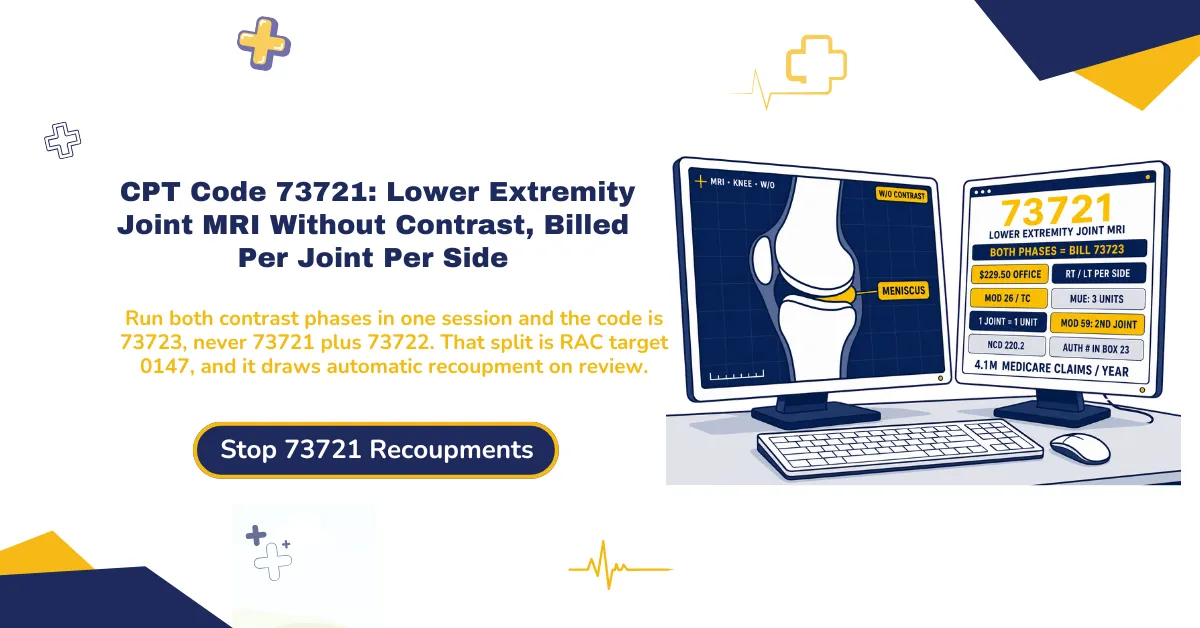
Wrong contrast classification and a missing laterality modifier cost imaging practices revenue every day on cpt code 73721 claims. This guide gives you the verified 2026 rates, the complete modifier table, NCD 220.2 coverage criteria, the California payer prior auth matrix, and the denial codes with the appeal language that recovers them.
Read it if you run an imaging center, a hospital outpatient department, an orthopedic practice, or a billing team that processes lower extremity joint MRI claims. The 73721 cpt code sits at the center of that workload.
CPT code 73721 describes magnetic resonance imaging of any joint of the lower extremity, including the hip, knee, ankle, or foot, performed without contrast material. Imaging centers, hospital outpatient departments, independent diagnostic testing facilities, and orthopedic practices report it when an MRI of a lower extremity joint runs without gadolinium or any other contrast agent.
| Label | Value |
|---|---|
| CPT Code | 73721 |
| AMA Descriptor | Magnetic resonance (e.g., proton) imaging, any joint of lower extremity; without contrast material |
| CMS Short Descriptor | MRI joint of lwr extr w/o dye [VERIFY from the CMS PFS 2026 file] |
| Anatomical Scope | Hip, knee, ankle, or foot joints |
| Contrast Status | Without contrast. No gadolinium administered |
| Work RVU (2026, adjusted) | 1.47 [VERIFY against CMS RVU26B] |
| Non-Facility Rate (Non-QP) | Approximately $229.50 [VERIFY: total RVU x $33.40] |
| Facility Rate (Non-QP) | Approximately $139.20 [VERIFY: total facility RVU x $33.40] |
| OPPS Rate (APC 5523) | $243.77 [VERIFY from 2026 OPPS Addendum B] |
| Patient Average Cost-Share | $66 (Source: Medicare.gov Procedure Price Lookup) |
| Annual Medicare Volume | Approximately 4.1 million claims |
| Coverage Framework | NCD 220.2 (CMS National Coverage Determination for MRI) |
| AUC Requirement | Paused. No AUC order required since January 1, 2024 |
| NCCI Policy | Chapter 9 (Radiology), effective January 1, 2026 |
| MUE Units | 3 units per date of service (effective July 1, 2026) |
The AMA official descriptor for CPT 73721 reads: Magnetic resonance (e.g., proton) imaging, any joint of lower extremity; without contrast material. Medicare processes approximately 4.1 million CPT 73721 claims a year under Part B.
What Is CPT Code 73721?
“Magnetic resonance (e.g., proton) imaging, any joint of lower extremity; without contrast material.”
That callout holds the cpt code 73721 description in its official AMA form, and the 73721 cpt code description matches the AMA wording verbatim. The code covers an MRI of any single lower extremity joint when no contrast goes in.
The code applies to the hip joint, the knee joint, the ankle joint, and the foot joints. It doesn’t cover an MRI of non-joint lower extremity structures, the thigh, the lower leg, or the soft tissue of the foot.
Those fall under CPT 73718 for without-contrast studies. Coders misclassify the code family most often at this joint-versus-non-joint line. You can verify the complete code details at the AAPC code reference.
When Providers Order CPT 73721
A provider orders CPT 73721 to evaluate several joint conditions. The knee list covers meniscal tears and internal derangement; ligament ruptures, including ACL, PCL, MCL, and LCL tears; and articular cartilage lesions and chondral defects.
The code also covers labral tears in the hip joint, stress fractures that a standard X-ray misses, avascular necrosis of the femoral head or tibial plateau, osteomyelitis or suspected joint infection, and unexplained joint pain or effusion after initial imaging.
CPT 73721 evaluates meniscal tears, ligament ruptures, labral tears, articular cartilage lesions, stress fractures, avascular necrosis, osteomyelitis, and unexplained joint effusion that conventional radiography doesn’t capture well.
Procedure Duration and Imaging Sequences
A CPT 73721 study runs 30 to 60 minutes, counting patient preparation, image acquisition, and post-processing by the reading radiologist. The radiologist acquires several pulse sequences, T1-weighted, T2-weighted, proton density, and gradient echo, across the axial, coronal, and sagittal imaging planes.
Before the study starts, the patient removes metal objects and discloses any implanted devices, pacemakers, or metallic hardware to the MRI technician.
CPT 73721 vs 73718 vs 73722 vs 73723: Choosing the Right Lower Extremity MRI Code
Lower extremity MRI billing runs across four related code families, and the wrong pick hands you either a CO-97 bundling denial or a post-payment RAC recoupment. Two decision factors settle every cpt code 73721 family choice: does the imaging target a joint, and did contrast go in. The table sorts the rest.
| CPT Code | Full Description | When to Report |
|---|---|---|
| 73721 | MRI any joint of lower extremity, without contrast | MRI targets a joint (hip, knee, ankle, foot joint). No contrast administered |
| 73722 | MRI any joint of lower extremity, with contrast | MRI targets a joint. Gadolinium administered |
| 73723 | MRI any joint of lower extremity, without and with contrast | Both non-contrast and contrast phases performed in the same session |
| 73718 | MRI lower extremity other than joint, without contrast | MRI targets non-joint structures: thigh, lower leg, soft tissue of foot |
| 73720 | MRI lower extremity other than joint, without and with contrast | Same non-joint structures with both phases |
CPT 73721 covers an MRI of a lower extremity joint without contrast. CPT 73722 covers the same joint with contrast. CPT 73723 covers the same joint performed both without and with contrast in a single session.
CPT 73718 covers an MRI of lower extremity structures that aren’t joints, including the thigh, the lower leg, and the foot soft tissue, without contrast.
The Joint vs. Non-Joint Distinction: CPT 73718 vs CPT 73721
Code CPT 73721 when the MRI study targets a joint capsule and its contents: synovium, cartilage, ligaments, menisci. Code CPT 73718 when the MRI targets the soft tissue, the bone marrow, or the musculature of the extremity outside a joint focus: a thigh muscle mass, lower leg edema, or a foot soft tissue infection with no joint involvement.
The CPT 73718 vs CPT 73721 decision is the joint-versus-non-joint rule, and outpatient radiology billing misapplies it more than any other code family rule. Using CPT 73718 when the physician’s order specifies a joint MRI is a coding error that triggers a CO-11 diagnosis-procedure mismatch denial.
The Critical NCCI Alert: Never Bill 73721 and 73722 Together
CPT codes 73721 and 73722 carry an NCCI Modifier Indicator of 0 for the same date of service. You can’t bill the 73722 cpt code together with 73721 for the same joint under any modifier.
When a lower extremity joint MRI includes both a non-contrast phase and a contrast phase in one session, the only correct code is cpt code 73723. Splitting cpt code 73723 into 73721 plus 73722 for the same joint and date is RAC audit target 0147, and it draws automatic recoupment on post-payment review.
No modifier unbundles a zero-indicator NCCI pair. CMS publishes the NCCI Policy Manual Chapter 9 (Radiology Services, effective January 1, 2026), which governs every procedure-to-procedure edit pair in the radiology code range, including CPT 73721.
You can read it in the NCCI Policy Manual Chapter 9. [VERIFY: confirm the correct direct URL for the 2026 NCCI Policy Manual Chapter 9 (Radiology) before publishing.]
Billing CPT 73721 and CPT 73722 together on the same claim for the same joint on the same date triggers an NCCI bundling denial. When a lower extremity joint MRI runs with both non-contrast and contrast phases in a single session, the only correct code is CPT 73723. That split-billing pattern is RAC audit target 0147.
With the right code selected, the next step that decides claim outcome is documentation of what the procedure involved and why the patient needed it.
What a CPT 73721 MRI Study Involves: Procedure Details Providers Need to Know
Understanding what happens during a cpt code 73721 study helps you write stronger orders, document clinical necessity, and explain the procedure to patients. Three things matter: how long it runs, how the patient prepares, and what the scan answers clinically.
Duration and Imaging Planes
A CPT 73721 study runs 30 to 60 minutes from patient preparation through image acquisition and post-processing. The scan needs no IV access because no gadolinium or contrast agent goes in. The radiologist acquires several pulse sequences, T1-weighted, T2-weighted, proton density, and gradient echo, across the axial, coronal, and sagittal imaging planes.
Together those sequences give the interpreting radiologist a full view of the joint’s bone marrow, cartilage, ligaments, tendons, and synovium. Coders searching the mri knee without contrast cpt code land on 73721 when the knee is the joint imaged.
Patient Preparation Requirements
The patient removes all metal objects before entering the MRI scanner. The patient also discloses any implanted devices, pacemakers, cochlear implants, aneurysm clips, or metallic hardware from prior surgeries before the study proceeds. Facility protocols may add a pregnancy screening and a renal function check even for non-contrast studies, depending on the facility’s policy and the patient’s history.
Before a CPT 73721 study, the patient removes all metal objects and discloses implanted devices, pacemakers, or metallic hardware. Facility protocols may require pregnancy screening and renal function assessment before the study proceeds.
What CPT 73721 Evaluates Clinically
The without-contrast protocol is the first-line MRI for most lower extremity joint evaluations. It shows the internal joint structures in detail without the preparation, cost, or timing constraints of contrast administration. A provider orders it when the clinical question covers structural assessment of ligaments, menisci, cartilage, or bone marrow rather than vascular or neoplastic pathology.
The same mri knee cpt code path applies whenever the knee joint is the structural target. When the clinical question needs enhancement for tumor assessment, infection staging, or post-surgical separation of scar tissue from recurrent pathology, CPT 73722 or 73723 becomes the right code.
Matching the code to the clinical question is what prevents a contrast misclassification denial.
CPT 73721 MRI procedures run 30 to 60 minutes counting patient preparation, image acquisition, and post-processing. The study uses several pulse sequences, T1-weighted, T2-weighted, proton density, and gradient echo, acquired across the axial, coronal, and sagittal imaging planes.
The clinical context the study captures determines the diagnosis that supports it.
Where the study runs determines the 2026 rate that applies. Medicare.gov’s Procedure Price Lookup shows a patient average cost-share of $66 for CPT 73721 outpatient studies, one of the more cost-accessible advanced imaging procedures in musculoskeletal medicine. [VERIFY: confirm the Medicare.gov Procedure Price Lookup URL format returns a CPT 73721 result before publishing.]
2026 Medicare Reimbursement Rates for CPT 73721
An imaging center that bills the non-facility rate for a study performed in a hospital outpatient department overbills. A radiologist who bills the global service when the professional interpretation is the only service rendered misrepresents the claim. Correct rate configuration starts with the verified 2026 figures for this code by setting.
| Setting | POS Code | 2026 Medicare Rate |
|---|---|---|
| Office or private imaging center | POS 11 | Approximately $229.50 [VERIFY: total non-facility RVU x $33.40] |
| Hospital outpatient department | POS 22 | Approximately $139.20 [VERIFY: total facility RVU x $33.40] |
| OPPS (hospital outpatient) | APC 5523 | $243.77 [VERIFY from 2026 OPPS Addendum B] |
| Patient average cost-share | Medicare.gov | $66 (Medicare Procedure Price Lookup) |
[VERIFY: confirm every rate cell marked [VERIFY] against the CMS 2026 PFS RVU26B file (April 2026 release, updated May 1, 2026) before publication. Use the verified figure if it differs from the estimate above.] The hospital outpatient rate reflects the payment rules that apply to POS 22 billing for all diagnostic services.
RVU Breakdown for CPT 73721
CPT 73721 carries a 2026 work RVU near 1.51, adjusted to roughly 1.47 after the 2.5% efficiency adjustment CMS applied across the 2026 PFS. [VERIFY both figures against RVU26B.] The practice expense RVU and the malpractice RVU add to the work RVU to produce the total non-facility and facility figures.
The 2026 PFS applied a negative 2.5% efficiency adjustment to work RVUs across the fee schedule, and CPT 73721 falls inside the affected range. The 73721 cpt code reimbursement a practice collects tracks the total RVU times the applicable conversion factor.
You can confirm your MAC-locality-adjusted rate with the CMS Physician Fee Schedule Lookup Tool.
The 2026 Dual Conversion Factor: What It Means for CPT 73721 Claims
For 2026, CMS runs two conversion factors at the same time, the first year it has done so. Providers with qualifying Alternative Payment Model (QP) status use $33.57 per RVU. All other providers use $33.40.
For CPT 73721, the gap per claim is $0.17 times the total RVU. Across a practice that bills heavy lower extremity MRI volume, QPP participation status moves aggregate annual reimbursement by a real margin.
Confirm your QPP designation before you configure 2026 fee schedules for 73721 claims.
For 2026, CMS applies two conversion factors at once for the first time: $33.57 for providers with qualifying APM participant status and $33.40 for all other providers. That split affects CPT 73721 reimbursement based on each practice’s QPP designation.
Patient Cost-Share vs. Provider Reimbursement: Two Different Numbers
The Medicare.gov Procedure Price Lookup shows an average patient cost-share of $66 for CPT 73721 outpatient studies. That figure reflects the patient’s portion after the Part B deductible and the standard 20% coinsurance on the Medicare-allowed amount.
It isn’t the provider reimbursement rate. A provider who quotes the $66 figure as payment received has confused two separate financial concepts, and patients walk away with the wrong expectation. That confusion answers the common question of whether Medicare covers cpt code 73721: it does, with patient cost-sharing on top of the allowed amount.
Commercial Payer Benchmark Rates
Commercial payers reimburse the mri knee without contrast cpt code, 73721, in a range from $250 to $400. Blue Cross Blue Shield plans land between $275 and $350. UnitedHealthcare and Anthem California plans run from $300 to $400.
Regional and Medicaid managed care plans track closer to the Medicare baseline. Verify your contracted rates before you assume commercial payment equals the Medicare figure.
The 2026 Medicare non-facility national payment for CPT 73721 is approximately $229.50 at the non-QP conversion factor of $33.40. The hospital outpatient OPPS payment under APC 5523 is $243.77. Medicare patients pay an average of $66 in cost-sharing per the Medicare.gov Procedure Price Lookup.
Rate configuration is one issue. Per-joint billing structure and same-day MPPR rules are the second configuration error that drains a practice on CPT 73721 claims.
Per-Joint Billing Rule, Bilateral Reporting, and Same-Day MPPR for CPT 73721
CPT 73721 describes a unilateral study. The code reports imaging of one joint on one side. It doesn’t cover both knees or both hips in a single claim line. The per-joint and per-side rules set how many units you submit and which modifiers you apply.
The Per-Joint Billing Rule
You report cpt code 73721 per joint imaged, not per anatomical region. If the physician orders an MRI of the knee and the ankle on the same leg on the same date, you submit two units of CPT 73721, not one.
Each joint carries its own documentation of clinical necessity and its own line item on the claim. Modifier 59 may belong on the secondary joint to mark a distinct procedural service, depending on payer policy.
The MUE for CPT 73721 is 3 units per date of service, effective July 1, 2026.
The MUE for CPT 73721 is 3 units per date of service, effective July 1, 2026, per the CMS quarterly MUE update posted June 1, 2026.
Bilateral MRI Reporting: Status Indicator 3 Explained
CPT 73721 carries no bilateral default.
The bilateral surgery status indicator for CPT 73721 is 3, so the standard bilateral payment adjustment of 200% for each side doesn’t apply. When the right and left versions of the same joint get imaged on the same date, you report each on a separate claim line, Modifier RT for the right side and Modifier LT for the left.
Medicare pays each at the full individual allowed amount. Some commercial payers accept Modifier 50 for a bilateral study, so verify your payer’s rule before you submit.
For Medicare claims, report bilateral lower extremity joint MRI on separate claim lines with RT and LT modifiers. The bilateral surgery status indicator for CPT 73721 is 3. Standard bilateral procedure payment adjustments do not apply.
CPT 73721 is a unilateral code. The bilateral surgery status indicator for CPT 73721 is 3. For a bilateral MRI of the same joint type on the same date, Medicare requires separate claim lines with RT and LT modifiers, each paying at the full individual allowed amount. Standard bilateral procedure payment adjustments don’t apply.
Same-Day MPPR: When a Second Imaging Study Shares the Date
When CPT 73721 and another diagnostic imaging study land on the same claim for the same patient on the same date, Medicare MPPR rules apply. The study with the higher total RVU pays at 100%.
The secondary study’s technical component drops 50% and the professional component drops 5%. Modifier 59 belongs on the secondary study line. When CPT 73721 for a knee MRI shares a date with a lumbar spine MRI, the MPPR rule names the primary study by total RVU.
Configure your payment reconciliation system to accept the MPPR-reduced secondary payment as correct so it doesn’t route to the denial queue as an underpayment.
ClaimMax’s CPT 72148 billing guide covers the MPPR rules from the lumbar-primary perspective for same-day imaging. [VERIFY: confirm this slug is the published URL before the internal link goes live.]
CMS posted the Q3 2026 MUE quarterly update files on June 1, 2026, effective July 1, 2026. You can verify the MUE value for CPT 73721 in the CMS Practitioner Services MUE file.
Correct billing configuration is half the picture. Coverage approval depends on what the clinical record holds and whether it satisfies Medicare’s medical necessity framework for lower extremity joint MRI.
Medical Necessity for CPT 73721: NCD 220.2 Coverage Criteria and Documentation Standards
A valid CPT code and accurate contrast classification get the claim submitted. They don’t get it paid. Coverage approval depends on whether the clinical record satisfies Medicare’s medical necessity framework for MRI. For cpt code 73721, that framework starts with National Coverage Determination 220.2.
What NCD 220.2 Requires for CPT 73721 Coverage
National Coverage Determination 220.2 is the CMS national coverage policy governing all MRI services under Medicare Part B, including this study. NCD 220.2 sets coverage on three factors. First, the study must be reasonable and necessary for the patient’s specific condition.
Second, an FDA-cleared MRI system operated within its approved parameters must perform the imaging. Third, the treating physician must order the study to manage that patient’s problem.
CPT 73721 carries no joint-specific Local Coverage Determination in most MAC jurisdictions the way lumbar spine MRI does under LCD L34220. NCD 220.2 plus the treating physician’s documentation of medical necessity governs coverage. That comparison answers the search for an lcd for cpt code 73721: in most jurisdictions, none exists, and the national determination governs instead.
Under federal regulation 42 CFR 410.32, Medicare covers a diagnostic test when the treating physician or practitioner who uses the results to manage the patient’s condition orders it. A CPT 73721 study ordered by a provider with no ongoing management relationship with the patient fails this requirement.
Medicare coverage for CPT 73721 runs through National Coverage Determination 220.2, which sets MRI coverage when the study is reasonable and necessary for the individual patient’s condition and an FDA-cleared system performs it within approved parameters.
CPT 73721 carries no joint-specific Local Coverage Determination in most MAC jurisdictions, so the treating physician’s documentation of medical necessity becomes the primary coverage determinant.
Clinical Indications That Support Medical Necessity for CPT 73721
The clinical record establishes medical necessity for CPT 73721 when it shows that an MRI-level evaluation of the joint is required for diagnosis or treatment planning.
Covered presentations include persistent joint pain that hasn’t responded to conservative treatment, plus a suspected ligament tear, meniscal injury, or labral pathology with clinical signs, a stress fracture suspected but unconfirmed on radiograph, and an osteomyelitis or joint infection workup when X-ray or labs fall short.
It also covers an avascular necrosis evaluation and a pre-surgical assessment for joint reconstruction or repair.
Medicare expects documentation of prior evaluation before it approves advanced imaging for non-emergent presentations. A clinical note that records only a symptom with no prior management history draws CO-50 medical necessity denials at both the pre-authorization and the post-payment review stages.
The 6-Item Documentation Checklist for Every CPT 73721 Claim
A documentation set that satisfies both Medicare’s NCD 220.2 requirements and commercial payer medical necessity criteria supports every clean CPT 73721 claim. The checklist below mirrors what payer reviewers look for on pre-authorization requests and what MAC auditors look for during TPE reviews.
- The treating physician’s order, dated before the study, names the specific joint and laterality and specifies without contrast
- The clinical indication ties to the patient’s documented condition, not a bare symptom description
- The prior evaluation history records conservative treatment attempted, dates, and patient response, for non-emergent presentations
- The radiology report confirms in writing that no contrast went in
- The signed interpretation report includes indication, technique, findings by structure, and clinical impression
- For IDTF settings, documentation records the supervision level and personnel qualifications per MAC contractor guidance
For CPT 73721 claims, the clinical record documents the treating physician’s order with the joint and laterality named, the clinical indication tied to the patient’s condition, the prior conservative treatment history for non-emergent presentations, written confirmation that no contrast went in, a complete signed interpretation report, and, for IDTF settings, supervision and personnel documentation per MAC guidance.
When documentation gaps on CPT 73721 claims generate CO-50 denials, ClaimMax RCM’s denial management services find the root cause and fix it at the workflow level.
With medical necessity documented right, the next layer of claim defense is the ICD-10 primary diagnosis that matches the clinical indication and survives payer edit checks.
ICD-10 Codes for CPT 73721: Medical Necessity Documentation by Diagnosis
The payer’s automated edit on every cpt code 73721 claim checks whether the primary ICD-10 diagnosis supports the procedure. A non-specific diagnosis code submitted without corroborating documentation draws a CO-11 denial at the clearinghouse level before a human reviewer touches the claim. The mri knee cpt code pairs with payer edits only when the knee diagnosis carries the matching laterality.
| ICD-10 Code | Description | Documentation Requirement |
|---|---|---|
| M25.361 | Pain in right knee | Conservative treatment history required for non-emergent orders; prior imaging documented |
| M25.362 | Pain in left knee | Same as right knee; laterality in both the order and radiology report must match |
| M23.511 | Chronic instability of right knee | Ligamentous instability confirmed on clinical exam; specific instability type named |
| M23.512 | Chronic instability of left knee | Same as right; laterality explicit in clinical note and order |
| M17.11 | Unilateral primary osteoarthritis, right knee | Degenerative changes documented; clinical question stated (surgical planning, cartilage assessment) |
| M17.12 | Unilateral primary osteoarthritis, left knee | Same; MRI ordered for a specific surgical or treatment planning question |
| S83.511A | Sprain of ACL, right knee, initial encounter | Mechanism of injury documented; neurovascular exam finding recorded |
| S83.512A | Sprain of ACL, left knee, initial encounter | Same; initial encounter coding requires an acute presentation date documented |
| M87.051 | Idiopathic aseptic necrosis of femur, right hip | Risk factors documented; clinical question (extent of necrosis, collapse staging) named |
| M87.052 | Idiopathic aseptic necrosis of femur, left hip | Same as right hip |
| M25.551 | Pain in right hip | Persistent hip pain with failed initial workup; conservative treatment history |
| M25.552 | Pain in left hip | Same as right hip |
[VERIFY: confirm all ICD-10 codes above against the FY2026 ICD-10-CM code set (effective October 1, 2025) before publication. The M23.51x series subcode structure and the S83 series specificity levels changed in recent FY revisions.]
Specificity Rules That Prevent CO-11 Denials
The CO-11 denial hits when the diagnosis code doesn’t support the CPT code billed or when the coder sequences the diagnosis wrong. Two errors drive most CO-11 denials on CPT 73721 claims. The first: a coder uses M25.369 (pain in knee, unspecified) when the clinical note specifies the right or left knee and the order names laterality.
The laterality-specific code, M25.361 or M25.362, has to match the clinical record and the order. The second: a coder sequences a non-musculoskeletal comorbidity as the primary diagnosis when the physician ordered the MRI for a lower extremity joint indication. The joint indication leads. Comorbidities go on secondary lines.
A before-and-after makes the gap concrete. Before: ICD-10 M25.369, pain in knee, unspecified, and the auditor flags under-coding and unclear laterality. After: ICD-10 M25.361, pain in right knee, with a clinical note documenting four weeks of physical therapy without improvement and the ordering physician’s statement that the MRI is required for surgical evaluation.
The second version establishes medical necessity, matches laterality to the order, and satisfies the covered indication.
For CPT 73721 medical necessity documentation, the ICD-10 primary diagnosis names the specific lower extremity joint and laterality. Using M25.369 (pain in knee, unspecified) when the clinical record specifies the right knee draws CO-11 denials and understates the medical necessity evidence in the record.
Verify all diagnosis codes against the official FY2026 ICD-10-CM files at the CMS ICD-10 code lookup. [VERIFY: confirm the URL is the current ICD-10-CM landing page before publishing.]
With the right ICD-10 paired to CPT 73721, the next question every billing team faces is which modifiers the claim needs and when each applies.
Does CPT 73721 Need a Modifier? The Complete 2026 Modifier Decision Table
Does cpt code 73721 need a modifier? Not on every claim. Whether the claim needs one, and which one, turns on three things: the billing arrangement between the radiologist and the facility, the side of the body imaged, and what else shares the claim on the same date of service.
| Billing Scenario | Modifier Required | Key Rule |
|---|---|---|
| Same practice owns the scanner and the radiologist reads the study | None (global billing) | Bill CPT 73721 globally without a modifier |
| Radiologist bills only for professional interpretation and report | Modifier 26 | Signed interpretation report required before billing; report precedes claim submission |
| Facility bills for equipment, staff, and operational costs only | Modifier TC | IDTF, hospital outpatient, or independent imaging center billing the technical side only |
| MRI performed on the right joint | Modifier RT | Required by most commercial payers and Medicare for laterality clarity |
| MRI performed on the left joint | Modifier LT | Required by most commercial payers and Medicare for laterality clarity |
| Both right and left versions of the same joint billed same date (Medicare) | RT + LT on separate claim lines | Status indicator 3 applies; standard bilateral adjustment doesn’t apply |
| Both right and left versions of the same joint (most commercial payers) | Modifier 50 | Verify payer-specific bilateral reporting preference before submitting |
| Second joint imaged on the same date of service | Modifier 59 on secondary line | Documentation must establish distinct medical necessity for each joint |
| Study terminated before completion due to a clinical reason | Modifier 52 | Reason for partial service must be documented in the clinical record |
| Study discontinued for patient safety after initiation | Modifier 53 | Circumstances of discontinuation must be in the record |
| Same radiologist repeats the study on the same day | Modifier 76 | Requires a distinct clinical reason for the repeat |
| Different radiologist repeats the study on the same day | Modifier 77 | Both reads documented separately |
CPT 73721 doesn’t need a modifier on every claim. Modifier 26 applies when you bill only the professional interpretation. Modifier TC applies for the technical component only. Modifier RT or LT meets most payers’ laterality requirement. Modifier 59 applies when a second joint is imaged on the same date as a distinct service.
Modifier 26 and TC: The Split-Billing Rules That Matter Most for CPT 73721
Most CPT 73721 modifier errors sit in the professional and technical component split. The rule: a radiologist bills Modifier 26 when they interpret a study performed at a facility they don’t own or control.
The facility bills Modifier TC for the equipment and staff. Both claims carry the same CPT code, 73721. A CPT mismatch between the two claims, one billing 73721-TC and the other billing 73722-26, signals a coding inconsistency and draws payer inquiry on both claims at once.
The Modifier 26 claim needs a specific documentation foundation before submission: a signed, dated interpretation report with indication, technique, level-by-level findings, and clinical impression. Billing CPT 73721-26 without the completed report in the medical record is a compliance violation.
RAC contractors flag Modifier 26 claims with no corresponding interpretation report on post-payment review.
The OIG has named global billing by radiologists who don’t own the imaging equipment as a recurring overpayment source in the OIG Work Plan. [VERIFY: confirm the OIG Work Plan URL is current and lists radiology service reviews before publishing.] For how Modifier 26 and TC rules carry across diagnostic imaging codes, see ClaimMax’s echocardiogram billing guide covering CPT 93306.
Laterality Modifiers RT and LT: Which Payers Require Them
For CPT 73721, most commercial payers and Medicare require the RT (right side) or LT (left side) laterality modifier on extremity imaging claims. A missing laterality modifier earns a claim correction request or a denial, depending on the payer’s edit logic.
RT or LT has to appear in both the physician’s order and the final radiology report before you append it to the claim. A modifier added to the claim with no matching laterality in the clinical record is an audit exposure.
For CPT 73721: Modifier RT identifies the right lower extremity joint. Modifier LT identifies the left lower extremity joint. Most payers require one of these modifiers on every CPT 73721 claim. Their absence draws a claim correction request or denial.
For CPT 73721, Modifier RT identifies the right lower extremity joint and Modifier LT identifies the left. Most commercial payers and Medicare require one of these laterality modifiers on every CPT 73721 claim. The bilateral surgery status indicator for CPT 73721 is 3, so standard bilateral adjustment rules don’t apply to Medicare claims.
With modifiers applied right, the next revenue protection layer for CPT 73721 claims in the California market is prior authorization.
California Payer Prior Authorization Requirements for CPT 73721
In California, outpatient MRI prior authorization requirements shift across payers, plan types, and benefit tiers. A Blue Shield of California HMO and a Blue Shield of California PPO from the same carrier can carry different authorization rules for cpt code 73721.
Verifying against the patient’s specific plan and benefit tier, not the carrier name alone, is the step that prevents a CO-15 denial. A skipped auth step is the fastest path to losing the 73721 cpt code reimbursement a clean claim would have earned.
| California Payer | Prior Auth Required | Key Documentation Required |
|---|---|---|
| Blue Shield of California | Yes for most commercial plan configurations (verify HMO vs. PPO tier separately) | Clinical notes, conservative treatment history, ordering provider information, CPT 73721 specified in the auth request. Prior auth list updated June 1, 2026. Verify at the AuthAccel provider portal. [VERIFY] |
| Anthem Blue Cross California | Yes for most commercial and Medicare Advantage plans | LCD-aligned clinical documentation; NCD 220.2 criteria reflected in clinical notes. The mri knee without contrast cpt code must match the authorized code exactly. [VERIFY: Anthem CA 2026 provider manual] |
| Health Net (Medi-Cal Managed Care) | Yes, Medi-Cal managed care authorization required | Prior auth plus NCD-aligned documentation; peer-to-peer available for Medi-Cal denials. [VERIFY: Health Net Medi-Cal 2026 provider manual] |
| UnitedHealthcare Community Plan (California Medicaid) | Yes for Medi-Cal managed care enrollment | Clinical review, treatment failure documentation, NCD 220.2 alignment. [VERIFY: UHC Community Plan CA 2026 requirements] |
[NOTE TO WRITER/PUBLISHER: Confirm every [VERIFY] cell against each payer’s 2026 provider manual before publication. This section carries the highest compliance risk if it ships with unconfirmed portal data.]
ClaimMax’s eligibility verification and prior authorization guide walks the complete workflow with a CPT 73721 case study that shows the exact steps that prevent CO-15 denials on California imaging claims.
Common Prior Authorization Failure Points for California Imaging Claims
Five prior authorization errors drive most CO-15 denials on California CPT 73721 claims. First, the practice obtains auth for CPT 73722 with contrast but submits CPT 73721 without contrast, and the CPT mismatch draws CO-15 regardless of the auth.
Second, the authorization reference number goes missing from Box 23 of the CMS-1500. Third, the practice completes auth before the service but the service date falls outside the auth validity window. Fourth, the practice obtains auth for one plan type after the patient changes plan tiers.
Fifth, the practice requests retro authorization for elective imaging after the study finishes, and most California commercial payers reject retro auth for non-emergent MRI.
Most California commercial insurance plans require prior authorization for CPT 73721 before the study runs. Medicare Traditional requires no pre-authorization for CPT 73721. Medicare Advantage plans and California Medicaid managed care plans require prior authorization for outpatient MRI, with the authorization reference number required in Box 23 of the CMS-1500.
For Medi-Cal-specific authorization requirements and managed care billing rules, see ClaimMax’s Medi-Cal billing guide. Blue Shield of California updated its prior authorization list effective June 1, 2026, accessible through AuthAccel at the Blue Shield CA provider portal. [VERIFY: confirm the URL is active and that CPT 73721 MRI imaging appears on the list.]
ClaimMax RCM’s prior authorization services manage the full auth request, tracking, and documentation workflow for imaging procedures across all California payer types.
The authorization layer stops CO-15 denials before the claim submits. The 2026 regulatory updates below affect every CPT 73721 claim that clears authorization.
2026 Regulatory Updates Affecting CPT 73721 Claims
The AUC Program Is Paused: No AUC Order Required on CPT 73721 Claims
CMS paused the Appropriate Use Criteria program for advanced diagnostic imaging, which covered CPT 73721, effective January 1, 2024. CMS rescinded the AUC regulations at 42 CFR 414.94. A CMS.gov status page confirmed this as of March 10, 2026. No AUC order and no Clinical Decision Support Mechanism documentation belongs on any CPT 73721 claim submitted after January 1, 2024.
Several CPT 73721 billing guides indexed in search results still tell providers to obtain AUC orders for lower extremity MRI. That requirement applied before January 1, 2024. It applies to no claim you submit today.
If your EHR or practice management system still prompts for AUC documentation when you enter a 73721 order, suppress that prompt, because it reflects pre-2024 rules.
CMS paused the Appropriate Use Criteria program for advanced diagnostic imaging, including CPT 73721, effective January 1, 2024. CMS rescinded the AUC regulations at 42 CFR 414.94. No AUC order or CDSM documentation belongs on CPT 73721 claims submitted after January 1, 2024.
Providers should not include AUC consultation information on Medicare fee-for-service claims. The CMS AUC program status page confirms the pause. [VERIFY: confirm the current CMS AUC page URL before publishing.]
2026 NCCI Updates and the Quarterly MUE Schedule
NCCI Policy Manual Chapter 9, governing radiology services including CPT 73721, takes effect January 1, 2026. Chapter 9 governs procedure-to-procedure edit pairs within the radiology CPT range and is the authoritative citation for a 73721 bundling denial appeal. When a payer denies a CPT 73721 claim as bundled, cite Chapter 9 for the specific edit rationale in the appeal.
CMS updates the NCCI PTP edit tables on a quarterly cadence: it posted the Q3 2026 edits June 1, 2026, effective July 1, 2026. Update your clearinghouse edit logic on that cadence so new bundling denials don’t slip through.
The MUE for CPT 73721 is 3 units per date of service, effective July 1, 2026, per the CMS Practitioner Services MUE file posted June 1, 2026. Confirm your billing system respects this limit before Q3 claims process.
NCCI Policy Manual Chapter 9, governing radiology services including CPT 73721, takes effect January 1, 2026. The MUE for CPT 73721 is 3 units per date of service, effective July 1, 2026, per the CMS Practitioner Services MUE quarterly update posted June 1, 2026.
The lcd for cpt code 73721 question has no jurisdiction-specific answer in most regions, so NCCI plus NCD 220.2 carry the coverage and bundling logic instead. Confirm the chapter at the NCCI Policy Manual Chapter 9 (radiology). [VERIFY: confirm the Chapter 9 radiology URL versus the Chapter 3 URL used earlier.]
2026 Conversion Factor Recap: Confirming Your QPP Rate Configuration
Section 5 carries the dual conversion factor structure for 2026 ($33.57 for QP participants, $33.40 for all others) with the full rate tables.
One operational reminder here: confirm your QPP participation status in the CMS Quality Payment Program portal before you configure fee schedule benchmarks for CPT 73721 claims in Q3 and Q4 2026. [VERIFY: confirm the QPP portal URL before publishing.]
With regulatory compliance confirmed, the final protection layer is knowing which denial codes hit CPT 73721 claims and how to appeal each one.
Denial Codes, RAC Audit Targets, and Appeal Language for CPT 73721
CPT 73721 denials cluster around five root causes. Each one carries a specific denial code and a documented resolution path. The table maps the denial code to the root cause and the first recovery action, so your team doesn’t rebuild the appeal from scratch each time.
| Denial Code | Description | Root Cause for CPT 73721 | First Recovery Action |
|---|---|---|---|
| CO-50 | Not medically necessary | NCD 220.2 coverage criteria not reflected in clinical documentation; vague diagnosis without prior treatment history | Appeal with the complete clinical note, conservative treatment history, ordering physician attestation, and the NCD 220.2 covered indication mapped to the patient’s documented condition |
| CO-15 | Missing or invalid authorization | Prior auth not obtained, authorization number missing from Box 23, or CPT mismatch between auth and claim | Verify whether retro auth is available; if not, appeal with medical necessity documentation and a payer-specific exception request |
| CO-97 | Bundled service | CPT 73721 and CPT 73722 billed together on the same claim for the same joint and date (NCCI Indicator 0) | Determine from the radiology report which study ran; recode to CPT 73723 if both phases occurred; resubmit as a corrected claim |
| CO-11 | Diagnosis-procedure mismatch | Non-musculoskeletal primary diagnosis, or unspecified ICD-10 when a laterality-specific code exists | Pull the clinical note; recode the primary ICD-10 to the laterality-specific lower extremity joint code; resubmit as a corrected claim with frequency code 7 |
| CO-16 | Missing information or documentation | Incomplete claim submission; missing NPI, authorization number, or required supporting document | Identify the specific missing element from the accompanying REMARK code; supply it through the payer’s designated channel |
| CO-18 | Duplicate claim | Original claim resubmitted before the first adjudicated | Check the original claim status before any resubmission; never resubmit while the original sits in payer hold |
| PR-1 | Patient deductible | Part B deductible not yet met | Bill the patient correctly; no appeal or resubmission required |
RAC Audit Targets: Two High-Risk Patterns for CPT 73721
Two Recovery Audit Contractor patterns drive the largest CPT 73721 recoupment volume. A billing team that processes high-volume lower extremity imaging claims should build edit checks for both.
RAC Target 0147 covers splitting CPT 73723 into CPT 73721 plus CPT 73722 on the same claim for the same joint on the same date. When a lower extremity joint MRI runs both without and with contrast in a single session, the only correct code is CPT 73723.
Separate line items for 73721 and 73722 draw an automatic NCCI bundling denial on first submission and a recoupment on RAC review. No modifier unbundles a zero-indicator NCCI pair.
RAC Target 0062 covers billing the technical component, CPT 73721-TC, for a study performed during a Medicare inpatient admission. The TC of CPT 73721 bundles into the Medicare Part A inpatient payment. Billing 73721-TC apart from that during an inpatient stay draws a recoupment. A facility confirms inpatient versus outpatient status before it submits technical component charges.
RAC 0147 targets split-billing of CPT 73723 into 73721 + 73722 for the same joint on the same date. RAC 0062 targets technical component billing for CPT 73721 during Medicare Part A inpatient admissions. Both draw recoupment on post-payment review.
The technical component of CPT 73721 bundles into Medicare Part A payment during an inpatient admission (RAC Topic 0062). A facility should not bill CPT 73721-TC apart for a study performed on a patient admitted under Medicare Part A inpatient status.
RAC audit target 0147 addresses the bundling violation of splitting CPT 73723, without and with contrast in the same session, into separate CPT 73721 and CPT 73722 charges for the same joint on the same date.
That split-billing pattern draws an NCCI bundling denial on first submission and a recoupment on RAC review. CMS lists the active Recovery Audit Contractor review topics, including 0062 and 0147, on the CMS RAC program page. [VERIFY: confirm RAC topics 0062 and 0147 are listed and active before citing them.]
Pre-Submission Clean Claim Checklist for CPT 73721
Every item on this checklist maps to a denial code in the table above, and it doubles as a clean claim requirement for diagnostic imaging. Clear all nine before the claim leaves your system.
- The CPT code matches the imaging protocol performed: 73721 for without contrast, 73722 for with contrast, 73723 for both phases
- The ICD-10 primary diagnosis is laterality-specific and matches the joint named in the order
- The clinical note documents the specific indication with prior treatment history for non-emergent presentations
- Modifier RT or LT is applied to match the documented joint side
- Modifier 26 or TC matches the actual billing arrangement
- The prior authorization reference number sits in Box 23 for California commercial payers that required it
- AUC documentation is suppressed, since the AUC program has been paused since January 1, 2024
- Per-joint billing is confirmed: separate claim lines with Modifier 59 for each additional joint on the same date
- The original claim status is verified before any resubmission to prevent a CO-18 duplicate denial
For the full CO-18 duplicate claim resolution workflow, see ClaimMax’s CO-18 denial guide. ClaimMax RCM’s denial management services team reviews CPT 73721 and imaging claims for root cause patterns, runs appeals within payer windows, and clears the configuration errors that generate repeat denials.
ClaimMax RCM: CPT 73721 Billing Compliance and Denial Recovery for Imaging Practices
At imaging center volume, a 10% first-submission failure rate on CPT 73721 claims isn’t a billing nuisance. It’s a cash flow problem, with AR aging, appeal overhead, and write-off risk when denials reach the timely filing limit. You can prevent most CPT 73721 denial patterns at the point of claim configuration.
ClaimMax RCM manages lower extremity MRI billing compliance, denial recovery, and California payer prior authorization for imaging practices and orthopedic groups. The team reviews 73721 claims for root cause denial patterns, runs appeals within payer windows, and checks modifier and per-joint billing accuracy before claims leave your system.
Explore our medical billing service to see how ClaimMax manages your imaging claim cycle end to end. Our revenue cycle management services include denial tracking, appeal management, and quarterly billing compliance audits for diagnostic imaging practices. Contact ClaimMax RCM to review your CPT 73721 denial pattern and request a revenue cycle assessment.
This guide is for billing and revenue cycle professionals and reflects the 2026 CMS Physician Fee Schedule (CMS-1832-F, RVU26B), NCD 220.2, NCCI Policy Manual Chapter 9 (effective January 1, 2026), NCCI PTP v32.2, the Q3 2026 MUE update (effective July 1, 2026), and FY2026 ICD-10-CM (effective October 1, 2025) current as of June 6, 2026. CPT codes and descriptors are copyrighted by the American Medical Association. Verify all rates, coverage criteria, RAC topics, and payer policies against current CMS, MAC, and payer sources before claim submission. Authored by Dr. Mateo Vargas, CPC, CPB, ClaimMax RCM.