
| Quick ReferenceWhat it reports: Inpatient or observation consultation, new or established patient, moderate medical decision making.Time threshold: 60 minutes of total time on the date of the encounter, met or exceeded.Level selection: Moderate MDM or total time. History and examination no longer set the level.Medicare: Not recognized for Part B payment since January 1, 2010. Status indicator I.Medicare crosswalk: Bill 99222 for the equivalent initial hospital or observation care.Commercial payers: Many still recognize 99252 through 99255. Verify the policy before submission.Prolonged services: None available at this level. 99418 attaches to 99255 at 95 minutes.Frequency: One consultation per consultant per admission. |
What Is CPT Code 99254?
The 99254 CPT code reports an inpatient or observation consultation for a new or established patient at a moderate level of medical decision making. Another provider has to request it. You pick the level using moderate MDM, or using 60 minutes of total time on the date of the encounter.
Observation patients count here too. The 2023 revision folded observation care into this same descriptor, so your patient doesn’t need a formal inpatient admission for the code to apply.
The active range runs 99252 through 99255. Four levels, and 99254 sits at level four. The rest of the family, plus the Medicare routing that governs all of it, is covered in our inpatient consult CPT codes guide.
A consulting cardiologist or nephrologist reports this after the hospitalist asks for an opinion. Being the first specialist at the bedside doesn’t make the visit a consultation. The request does.
Is CPT 99254 still valid in 2026?
Yes. The code stays active in the current CPT set, and the National Library of Medicine code descriptor carries the government-hosted version of it. Active and payable are two different questions, though. The descriptor governing 2026 dates of service took effect January 1, 2023.
What Changed for CPT 99254 in 2023
Through December 31, 2022, three key components set the level: history, examination, and MDM. The weakest of the three governed the code. From January 1, 2023, only MDM or total time selects it, and the American Medical Association E/M revisions removed 99251 from the range at the same time.
That change reshaped the whole family of inpatient consult codes.
| What it governs | Through December 31, 2022 | From January 1, 2023 |
|---|---|---|
| Codes in the range | 99251 to 99255, five levels | 99252 to 99255, four levels |
| Level selection | History, examination, and MDM together | MDM alone, or total time |
| History and examination | Graded, problem focused to comprehensive | Performed when medically appropriate, not graded |
| Setting | Inpatient consultation only | Inpatient or observation, same four codes |
| Time for 99254 | 80 minutes, typical time, reference only | 60 minutes, threshold that selects the level |
| Prolonged services | No add-on for this family | 99418, with 99255 only, from 95 minutes |
The practical effect cuts both ways. A brief history with a focused exam supports 99254 when the MDM reaches moderate. A comprehensive head-to-toe write-up earns nothing extra, because volume stopped raising the level four years ago.
What the outdated tables still say
Plenty of coding references never got updated. Four errors keep circulating:
- Tables listing 99251 as active. CPT deleted it on January 1, 2023, and it rejects on submission.
- 99252 labeled low MDM. It’s straightforward, not low.
- 99253 labeled low-moderate. That MDM level doesn’t exist. The four levels are straightforward, low, moderate, and high.
- 80 minutes given as the 99254 threshold. That’s the retired typical time. The current threshold is 60.
Moderate MDM Requirements for CPT Code 99254
Moderate MDM means two of the three MDM elements reach the moderate column. The three elements are problems addressed, data reviewed and analyzed, and risk of complications. Two of three carries the level. Not all three, and not one.
That two-of-three rule is where the 99253 vs 99254 decision gets made.
| MDM level | Code | Problems addressed | Data | Risk |
|---|---|---|---|---|
| Straightforward | 99252 | One self-limited or minor problem | Minimal or none | Minimal |
| Low | 99253 | One stable chronic illness, or one acute uncomplicated illness | Limited | Low |
| Moderate | 99254 | Chronic illness with exacerbation, undiagnosed new problem with uncertain prognosis, or acute illness with systemic symptoms | Moderate, including independent interpretation of a test another physician performed | Prescription drug management, or a minor surgery decision with patient risk factors |
| High | 99255 | Severe exacerbation, or a threat to life or bodily function | Extensive | Drug therapy requiring intensive monitoring for toxicity |
Drop one column from moderate to low and the encounter falls to 99253 low MDM threshold territory.
Problems addressed at the moderate level
Acute-on-chronic heart failure qualifies. So does a new problem with uncertain prognosis that needs a workup, or two stable chronic illnesses managed together. Listing a diagnosis isn’t the same as addressing it. Your note has to show what you did about the problem, not that you noticed it.
What counts as moderate data
Independent interpretation means you read the test yourself and documented your reading. Acknowledging the ordering physician’s interpretation doesn’t count. Discussion of management with an external physician counts, as long as you didn’t report that discussion separately.
Moderate risk in practice
Prescription drug management carries most 99254 encounters over the moderate risk line. Adjusting anticoagulation gets you there. So does starting an antibiotic regimen with a monitoring plan, or managing immunosuppressants on an admitted patient. The risk lives in the options you considered, not only the one you chose.
The 99254 Time Requirement: 60 Minutes on the Date of the Encounter
Total time of 60 minutes or more on the date of the encounter supports 99254 on its own. Your MDM level doesn’t have to agree. Below 60 minutes, time supports 99253 or 99252 instead, and the 99254 cpt code description holds either way.
| Total time on the date | Code supported by time |
|---|---|
| 35 to 44 minutes | 99252 |
| 45 to 59 minutes | 99253 |
| 60 to 79 minutes | 99254 |
| 80 minutes or more | 99255 |
99254 covers a 20 minute window. It’s the narrowest band in the family, which is why time-based selection lands here more often than coders expect. Cross 80 and you’re into 99255 high MDM level territory, with no ceiling above it. The AAFP time and MDM thresholds table lays out the same thresholds across the full E/M set.
What counts toward the 60 minutes
Record review counts. So does the face-to-face encounter, ordering tests, interpreting results you didn’t report separately, writing the note, and talking to the requesting provider. All of it has to fall on one calendar date for the 99254 cpt code to hold on time.
What does not count
Clinical staff time stays out. So does resident time under supervision, work performed on any other date, and anything you billed separately. Time logged across the whole admission instead of a single date is the most common audit finding on time-based consultation claims.
Can You Bill a Prolonged Service With CPT 99254?
Short answer: no. There is no prolonged services add-on at the 99254 level.
Under CPT rules, 99418 exists for inpatient and observation prolonged work. It attaches at 99255, starting at 95 minutes. It doesn’t attach to 99254. A consultant who documents 70 minutes has a clean 99254 prolonged service question with a simple answer: nothing goes on top of it.
| Total time documented | Correct reporting |
|---|---|
| 60 to 79 minutes | 99254 alone |
| 80 to 94 minutes | 99255 alone |
| 95 minutes or more | 99255 plus 99418 |
| Any of the above, Medicare patient | None of the above applies |
Why the Medicare answer is different
Three things stack up. Medicare doesn’t pay consultation codes at all. Medicare’s prolonged services code for hospital inpatient and observation visits is G0316, not 99418. And the CMS Evaluation and Management booklet from May 2026 lists consultations as not applicable in its prolonged services table.
That last row catches people. Running a prolonged time analysis on a Medicare consult claim wastes the effort, because the base code was never going to pay.
Documentation Requirements for CPT Code 99254
Three things have to be provable from the record. Another provider asked for the consultation. You rendered an opinion. That opinion went back to the requester in writing. Miss any one of them and the 99254 documentation requirements fail, no matter how strong the clinical work was.
| Element | What must be present | What auditors flag |
|---|---|---|
| The request | Requesting provider’s identity and the clinical question, entered in the shared record | A verbal request with no matching chart entry from either provider |
| History and examination | The scope you judged necessary, with the findings that came out of it | Text cloned from the admitting team’s note with no independent findings |
| MDM or time | Problems addressed, data reviewed, risk carried, or a stated total time | A diagnosis list with no reasoning attached, or time logged across the whole stay |
| The report back | Findings and recommendations visible to the provider who asked | Findings handed over verbally and never written up |
The American Academy of Ophthalmology coding guidance runs through the same failure points from a specialty angle.
The request has to be in the chart
Either provider can record it. The requesting physician or you, it doesn’t matter, as long as the entry carries the reason. A visit the patient or the family asks for isn’t a consultation. Neither is routine co-management of a shared patient.
What satisfies the written report
A shared electronic record satisfies this when your consultation note is visible to the requester. You don’t need a separate letter. You do need an answer to the specific question you were asked.
One consultation per consultant per admission
Bill the consult once. Later visits by the same consultant during that stay move to subsequent hospital care 99233 and its siblings, 99231 through 99233. In a nursing facility, they move to 99307 through 99310 instead, which is the routing most references leave out.
Is CPT 99254 a Transfer of Care?
No. A consultation and a transfer of care are different services, and only one of them gets reported with 99254.
The line is clinical. A consultation means you give an opinion and recommendations while the requesting provider keeps primary management responsibility for the problem. A transfer of care means you’ve taken that responsibility over. Your billing follows the responsibility, not your specialty.
CPT removed its transfer-of-care language from the code set in the 2023 revision. The distinction didn’t disappear, though, because payers kept it. The rule moved out of the codebook and into payer policy, which means you check the plan rather than the manual.
The working test takes one question. If the requesting provider will act on your recommendations, you performed a consultation. If you’re managing the problem going forward, report an initial or subsequent hospital care code instead.
Who Can Bill CPT Code 99254?
Any physician or qualified non-physician practitioner acting as a specialist consultant on an inpatient or observation encounter can bill it, subject to payer rules. You can’t be the attending or admitting provider for that same stay. The cpt code for hospital consult and the code for the admitting physician are two different things.
Three tiers govern who reports the cpt code for inpatient consultation:
- Eligible: specialists with a clinical role separate from the admitting team. Cardiology, nephrology, infectious disease, psychiatry, surgery, neurology.
- Conditionally eligible: nurse practitioners and physician assistants, where the payer allows non-physician practitioners to report consultation codes. Check each policy on its own.
- Not eligible: the attending or admitting provider of record for that admission, plus anyone working in co-management rather than a distinct consultant role.
Split and shared billing
When a physician and an NPP from the same group each perform part of the consultation, split or shared rules and modifier FS come into play. Payer treatment varies more than the CPT language suggests. Confirm the plan’s position before you assign the billing provider, because this one isn’t settled the same way everywhere.
99254 vs 99255: Choosing the Right Level
Four active levels sit in the inpatient consult cpt code family, and the 99254 cpt description falls in the middle of them.
| Code | MDM | Time | Typical encounter | Status |
|---|---|---|---|---|
| 99251 | Not applicable | Not applicable | Formerly the lowest level | Deleted January 1, 2023 |
| 99252 | Straightforward | 35 minutes | Self-limited problem, minimal data | Active |
| 99253 | Low | 45 minutes | One stable chronic illness, limited data | Active |
| 99254 | Moderate | 60 minutes | Worsening chronic illness, independent test interpretation, prescription drug management | Active |
| 99255 | High | 80 minutes | Threat to life or bodily function, emergency major surgery decision | Active |
Start at the bottom with 99252 straightforward MDM level and each step up demands higher MDM or a higher time floor.
The line between 99253 and 99254
Coders miss this boundary more than any other in the family. One stable chronic illness with limited data supports 99253. A condition that’s progressing, with data you interpreted yourself and a plan carrying moderate risk, supports 99254. MDM draws the line, not the length of your write-up. Report the 99254 cpt code on a low-MDM note and you invite a downcode. Hold a moderate encounter at 99253 and you give away reimbursement you earned.
Does Medicare Pay for CPT Code 99254?
No. Original Medicare hasn’t paid consultation codes since January 1, 2010.
CMS removed the whole set, 99241 through 99245 and 99251 through 99255, from Medicare Part B payment through Transmittal 1875, Change Request 6740. Over 15 years later, the policy hasn’t moved. Send 99254 to traditional Medicare and it denies, no matter how strong your documentation is.
Two current federal documents restate the rule for this code year. The Medicare NCCI Policy Manual 2026 covers it in Chapter 11, and the May 2026 MLN Evaluation and Management booklet names the 99242 through 99255 range in plain language. The 99254 cpt code hasn’t been payable under either.
Why the denial is mechanical, not clinical
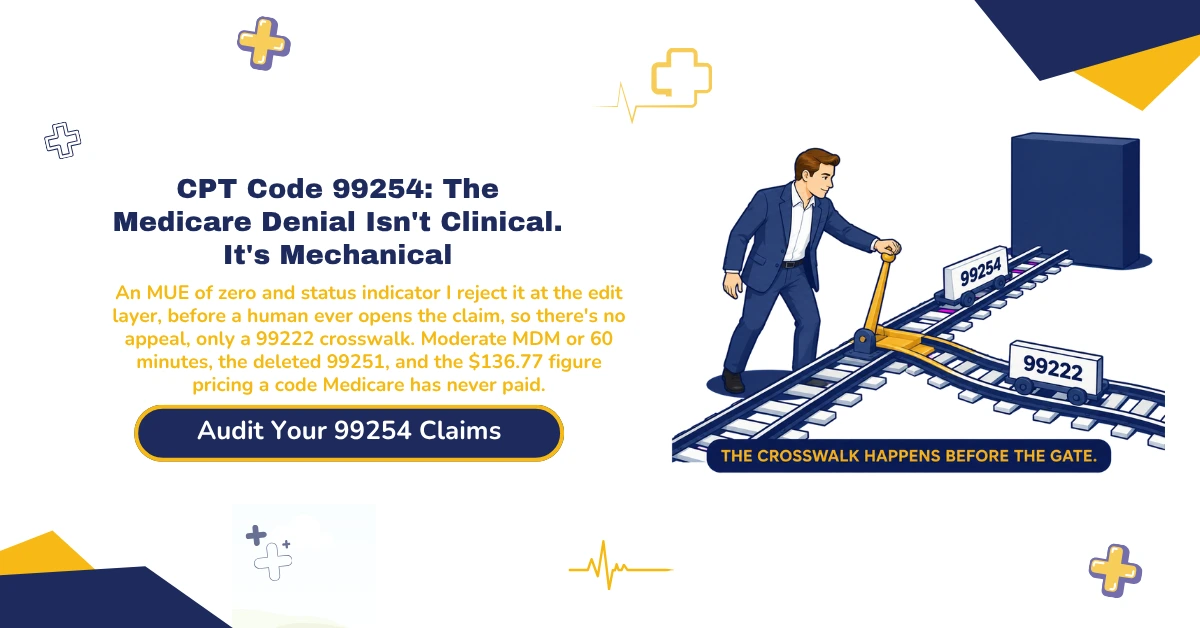
99254 carries a Medically Unlikely Edit of 0 and a Medicare status indicator of I, meaning not valid for Medicare purposes. Those two data points together mean the claim gets rejected at the edit layer. No human reviewer ever opens it. That’s the reason extra documentation changes nothing and the reason there’s no appeal to file.
Medicare Advantage runs on its own rules. Many MA plans follow the CMS position and deny 99254 the same way. Some don’t. Verify MA separately every time instead of extending the traditional Medicare answer to it.
What Is the Replacement Code for 99254? The Medicare Crosswalk
Bill 99222. It’s the Medicare equivalent of 99254 for an initial hospital inpatient or observation encounter.
The full cpt code for inpatient consultation crosswalk, including where initial hospital care 99221 covers two consultation levels, runs like this:
| Consultation code | MDM and time | Medicare replacement | Replacement threshold |
|---|---|---|---|
| 99252 | Straightforward, 35 minutes | 99221 | 40 minutes, straightforward or low |
| 99253 | Low, 45 minutes | 99221 | 40 minutes, straightforward or low |
| 99254 | Moderate, 60 minutes | 99222 | 55 minutes, moderate |
| 99255 | High, 80 minutes | 99223 | 75 minutes, high |
Your MAC publishes its own version of this routing. Palmetto GBA initial hospital services guidance covers the same ground at claim level.
The 60/55 Gap
A 99254 encounter documented at 60 minutes clears the 55-minute floor for 99222 with five minutes to spare. The time pathway carries over clean. The MDM pathway doesn’t carry over on its own. Both codes want moderate MDM, so moderate has to hold up under the initial hospital care rules independently. Treat the crosswalk as one-for-one and you’ll either downcode yourself at 99222 or push into a level your note never supported.
| Crosswalking every Medicare consult by hand is where hospital-based groups lose revenue or compliance ground. If your consultants bill across a mixed payer panel, our hospital revenue cycle management team routes the code before the claim goes out instead of after the denial comes back. |
One modifier note before you move on. The principal physician of record appends modifier AI to the initial hospital care claim to flag who oversees the admission. A consultant crosswalking into 99222 isn’t the principal physician and doesn’t append AI.
99254 RVU, Work RVU, and What the Code Reimburses
Two facts have to sit side by side. The CMS relative value file does list RVU components for 99254. The CMS Physician Fee Schedule Look-Up Tool returns no payment amount for it. Both are true at once, and mixing them up is where the bad numbers start.
Where the $136.77 figure comes from
Search the 99254 rvu and you’ll find dollar figures presented as the national Medicare payment. Around $136.77 shows up most often. That number is total RVUs multiplied by the annual conversion factor, and the arithmetic resolves to the cent. It’s a spreadsheet output, not a payment.
The version that circulates most traces back to a 2024 fee schedule document, which means a 2024 figure gets served as a 2026 answer. Conversion factors change yearly, and the AMA 2026 fee schedule summary covers what moved this year. None of that changes the underlying position: Medicare doesn’t pay 99254 at any amount, in any year, at any locality.
What the RVUs are good for
Two uses hold up. Groups credit consultants for the 99254 work rvu value of the encounter as internal productivity even though the payer never pays the consultation code. Contract benchmarking against commercial rates is the second. Our Medicare RVU reimbursement guide walks through how RVU components translate into an allowed amount when a code is payable.
Neither use requires Medicare to pay the 99254 cpt code, and neither one justifies sending it to Medicare.
For commercial reimbursement, your rate comes from your contract, not a national schedule. Ask each payer for its consultation fee schedule and price the code from that.
Which Payers Reimburse CPT Code 99254 in 2026?
Most commercial insurers never followed the 2010 CMS decision. Plenty still recognize 99252 through 99255. Policies split by carrier, by regional plan, and by employer group contract, so the only reliable answer for cpt 99254 sits in the policy document for the plan on your claim.
| Payer | Position on consultation codes | Policy document |
|---|---|---|
| Wellcare | Inpatient consultation payment policy published | Payment policy CC.PP.038 |
| Health Net (Centene) | Consultation services payment policy published | Payment policy CC.PP.054 |
| Horizon BCBSNJ | Consultation services reimbursement policy published | Reimbursement policy |
| Medica | Initial inpatient consultation policy published | Provider policy |
| Premera Blue Cross | Guidance published on billing consultation codes | Provider news and updates |
Read the current version of each before you rely on it. Payers revise these without announcing it.
How to verify before you submit
Pull the carrier’s consultation services policy from the provider portal. Check that it references the 99252 through 99255 range and not the deleted 99251, because a policy still listing 99251 tells you the edit set went stale. Confirm whether prior authorization applies to specialist consultations in inpatient settings. Then record the payer’s position in your team’s reference file and review it once a year.
State Medicaid programs each set their own position. Some followed Medicare and dropped the codes. Others kept the series, and managed care plans inside a state can land apart from the fee-for-service program. When contract language decides whether the 99254 cpt code 2026 claim pays at all, that’s a payer contracting support question rather than a coding one.
What Are the Modifiers for CPT Code 99254?
Modifiers change how you bill a service without changing the code itself. Five come up often on the 99254 cpt code and the rest of the inpatient and observation consultation family, and payer treatment of each varies more than the CPT definitions let on.
| Modifier | Name | When it applies to 99254 |
|---|---|---|
| 24 | Unrelated E/M during a postoperative period | The consult is unrelated to a procedure your group performed and the patient sits inside its global period |
| 25 | Significant, separately identifiable E/M | The consult falls on the same date as a minor procedure by the same provider and the two are distinct |
| 32 | Mandated services | A third party requires the consultation, such as a workers’ compensation carrier |
| 57 | Decision for surgery | The consult leads to a decision for major surgery the same day or the next day |
| GC | Service performed by a resident under teaching physician supervision | Teaching settings, where the teaching physician was present for the key portions |
Medicare modifiers for 99254 don’t exist, because Medicare doesn’t pay the code. Your modifier question on a Medicare claim attaches to the crosswalked code instead, which is where modifier AI comes back into it. Confirm each commercial payer’s modifier list on its own, since consultation edits are where policies diverge most.
Place of Service Codes and Add-Ons for CPT 99254
Place of service
| POS | Setting | When it applies |
|---|---|---|
| 21 | Inpatient hospital | Formally admitted patient |
| 22 | On-campus outpatient hospital | Observation status on the hospital campus |
| 51 | Inpatient psychiatric facility | Psychiatric admission |
An observation patient isn’t a formal inpatient. Your POS has to match the patient’s status on the date of service, not the building they’re sitting in, and the 99254 cpt code denies on the front end when those two disagree. Our POS 22 billing rules guide covers the on-campus and off-campus split in detail.
Add-on codes most coders miss
Psychotherapy add-on codes 90833, 90836, and 90838 can be reported alongside 99254 when a psychiatrist delivers psychotherapy during the same consultation encounter. Two things follow from that. A psychiatrist billing 99254 alone after a consult that included 30 minutes of psychotherapy leaves the add-on on the table. And when you report a psychotherapy add-on, time can no longer select the E/M level, so the 99254 has to stand on moderate MDM. Our psychotherapy CPT codes guide covers the timing rules on each add-on.
Verify the pairing against the payer’s policy first. A plan that doesn’t recognize 99254 won’t process an add-on attached to it either.
Why CPT 99254 Claims Get Denied
Consultation coding has been an audit target for years. 99254 denial patterns cluster into six causes, and four of them get caught before the claim leaves your practice.
| Denial cause | What happened | Prevention |
|---|---|---|
| Sent to traditional Medicare | Non-covered code, edit-layer rejection | Screen every claim for payer before submission and crosswalk to 99222 |
| Missing documented request | The request was verbal and never reached the chart | Verify the requesting provider and reason are recorded before billing |
| No written report back | Findings communicated verbally only | Add a communication note to the record before closing the consult |
| MDM insufficient for moderate | Note supports low complexity | Document all three MDM components rather than implying complexity |
| Second consult, same admission | One consultation per consultant per admission | Route later visits to 99231 through 99233 |
| Payer doesn’t recognize consults | Plan-level policy exclusion | Verify the consultation policy annually and flag it at charge entry |
Those middle four are 99254 documentation requirements failures, and a pre-submission check catches them.
Reading the remittance
A Medicare non-covered denial and a commercial documentation denial look different on the remittance and need different responses. Categorize by CARC and RARC code instead of logging that a denial happened. The code tells you whether the claim is fixable, rebillable, or dead, and you can’t sort the queue without it.
A worked denial queue catches whatever the pre-submission check missed, as long as somebody opens it inside the appeal window. Our denial management services team categorizes by CARC and RARC on every claim rather than reporting a denial count.
Appeal or Rebill After a 99254 Denial?
It depends on why it denied. A Medicare non-coverage denial can’t be appealed. It has to be rebilled.
| Denial type | Correct action | Why |
|---|---|---|
| Traditional Medicare, non-covered | Rebill as 99222 | Nothing to appeal. The code isn’t payable, so the claim needs the right code, not a stronger argument |
| Commercial, documentation insufficient | Corrected claim or appeal with the record | The code is payable under the plan. The claim needs the missing element |
| Commercial, plan excludes consultations | Rebill as the appropriate E/M for the setting | Policy exclusion, not a documentation failure |
| Downcoded to 99253 | Appeal with the MDM narrative | The level holds if your note supports moderate complexity |
Every path runs against a clock. Corrected claims run against timely filing. Appeals run against the plan’s appeal window, which usually closes sooner. Both clocks start on the denial date, not the date of service, and the 99254 cpt code gets no special treatment on either one.
| Consultation denials sit in the queue because nobody’s certain which path applies. If yours are aging past the appeal window, our aged AR follow-up team works them by payer and aging bucket before the clock runs out. |
CPT Code 99254: Frequently Asked Questions
What is CPT code 99254 used for?
An inpatient or observation consultation at moderate MDM, or 60 minutes of total time, requested by another provider. It’s one of four active inpatient consult cpt code levels.
Is CPT code 99254 covered by Medicare?
No. Medicare hasn’t recognized it for Part B payment since January 1, 2010. Bill 99222 instead for an initial hospital or observation encounter at moderate MDM.
What is the difference between 99254 and 99255?
99254 needs moderate MDM or 60 minutes. 99255 needs high MDM or 80 minutes. The 99254 vs 99255 decision comes down to which column your note supports.
Is CPT 99254 still valid in 2026?
Yes. It stays active in the current CPT set. Payer recognition is a separate question from validity, and you check it per plan.
How many minutes is required for 99254?
60 minutes of total time on the date of the encounter, met or exceeded. Below that, time supports 99253 or 99252 instead.
What is the replacement code for 99254?
99222 for Medicare. It’s the initial hospital inpatient or observation care code at moderate MDM, with a 55-minute time floor.
Can 99254 be billed twice in one admission?
No. One consultation per consultant per admission. Later visits by that same consultant use 99231 through 99233.
Does Medicare Advantage cover 99254?
Many MA plans follow the CMS rule and deny it. Some don’t. Verify each plan on its own before you submit.
Getting 99254 Right, Payer by Payer
Claims that survive review share one trait. The request, the report, and your basis for the level are all findable in the record. Everything else about the 99254 cpt code, the payer routing, the crosswalk, the RVU question, follows from getting those three on paper first.
Grab our one-page 2026 reference covering the 99254 cpt code description, the time thresholds, the Medicare crosswalk, and the payer verification checklist.
| If your consultants bill across a mixed panel and the payer routing isn’t happening before submission, that’s a workflow problem rather than a coding one. ClaimMax RCM medical billing runs the routing, the crosswalk, and the denial queue as one process, and the hospital underpayment recovery side of it catches what the payer paid short of contract. |