CPT code 71271 reports a low-dose CT scan of the thorax performed as an annual lung cancer screening, without contrast material. Medicare covers it once every 12 months for beneficiaries who satisfy all five eligibility criteria in NCD 210.14.
Claims for this code deny even when the patient qualifies on every clinical measure. The failure sits in the diagnosis line more often than in eligibility. This guide covers the primary screening code most published sources get wrong, the two automated CMS edits that reject claims before a human reviews them, payer-specific diagnosis order, and the 2026 rate calculation.
Key Takeaways
- CPT code 71271 covers annual LDCT screening for asymptomatic high-risk patients aged 50 to 77.
- Z12.2 is the correct primary screening diagnosis. Z12.31 is a breast screening code.
- G0296 is required before the first screening only, never as an annual repeat.
- Medicare waives the Part B deductible and coinsurance when the coding is correct.
- Frequency runs once per 12 months, with 11 full months elapsed since the last scan.
What Is CPT Code 71271?
CPT code 71271 is the Category I procedure code for a low-dose computed tomography scan of the thorax, performed as a preventive lung cancer screening in asymptomatic high-risk patients, without contrast material.
The Official CPT 71271 Descriptor
The American Medical Association descriptor reads: “Computed tomography, thorax, low dose for lung cancer screening, without contrast material(s).” CMS publishes the same descriptor in its billing article for the code.
| Field | Detail |
|---|---|
| Code | 71271 |
| Full descriptor | Computed tomography, thorax, low dose for lung cancer screening, without contrast material(s) |
| Code type | CPT Category I |
| Radiology subsection | Diagnostic Radiology (Diagnostic Imaging) Procedures of the Chest |
| Contrast | Without contrast only. No with-contrast variant exists for this code. |
| Companion code | HCPCS G0296, required before the first annual screening |
| Benefit category | Medicare preventive services, no beneficiary cost-sharing when criteria are met |
Four words in that descriptor carry the rule. Thorax rules out abdominal and whole-body studies. Low dose rules out standard-protocol imaging. Screening rules out symptomatic workup. Without contrast rules out any study where the technologist administered intravenous contrast. Source: CMS billing article A58641.
One published radiology billing guide describes 71271 as screening with contrast. The descriptor says without. If the technologist administered contrast, 71271 is the wrong code no matter how the order was written.
What the LDCT Scan Covers
The scan images the lungs, the mediastinum, and the surrounding thoracic structures at a resolution that picks up nodules a few millimeters across. The procedure runs under 10 minutes, uses no intravenous contrast, and needs no patient prep beyond a breath hold.
Coders searching for the low dose CT CPT code or the CPT code for CT scan of lungs land on 71271. That is correct only when the ordering provider ordered a screening.
71271 is a screening code. A patient with a chronic cough, hemoptysis, or unexplained weight loss falls outside it from the moment the order is written, and correct downstream coding does not repair that.
What Replaced HCPCS Code G0297?
CPT code 71271 replaced HCPCS code G0297 for lung cancer screening. CMS end-dated G0297 on December 31, 2020, and 71271 became the required code for dates of service on or after January 1, 2021.
| Code | Status | Applies to dates of service |
|---|---|---|
| G0297 | End-dated December 31, 2020 | Through December 31, 2020 |
| 71271 | Active | On or after January 1, 2021 |
| G0297 after 2020 | Denies | Any date of service after December 31, 2020 |
Practices still submit G0297 in 2026. The code survives in outdated chargemasters, old superbills, and billing templates inherited from a prior vendor. Those claims deny at intake, and the denial reads as an invalid procedure code instead of a retired one, so the biller working it often misses the cause.
One current billing guide gives two different deletion dates for G0297, one in its body and another in its FAQ. The CMS claims-processing instruction settles it. See CMS Transmittal R11388CP. Audit the chargemaster against the current code set once a year, and expect to find other retired codes sitting beside it.
What Is the Difference Between a CT Scan and an LDCT Scan?
A standard chest CT delivers roughly 7 millisieverts of radiation and diagnoses disease in symptomatic patients. An LDCT delivers approximately 1 to 2 millisieverts and screens asymptomatic high-risk patients for lung cancer.
| Attribute | Standard diagnostic chest CT | LDCT screening |
|---|---|---|
| Radiation dose | Approximately 7 mSv | Approximately 1 to 2 mSv |
| Contrast | Often intravenous contrast | No contrast |
| Scan time | Longer acquisition | Under a minute of scan time |
| Patient prep | Prep varies with contrast | Breath hold only |
| Clinical purpose | Diagnose symptoms or stage disease | Screen asymptomatic high-risk patients |
| Billing consequence | 71250, 71260, or 71270 with standard Part B cost-sharing | 71271 with cost-sharing waived |
Why the Radiation Difference Changes the Billing Code
The scanner protocol decides the code, and the order decides the protocol. A screening order on an asymptomatic patient sends the technologist to a low-dose protocol, and 71271 applies. A diagnostic order changes the protocol and the code with it. Our CPT 71250 billing guide covers the diagnostic side in full.
That sequence creates a specific problem for billers. A radiology report describing a low-dose technique on a patient whose chart documents symptoms signals a documentation conflict. Route it back to the ordering provider before the claim goes out, because the low dose chest CT CPT code will not survive a chart review on a symptomatic patient.
Who Qualifies for CPT Code 71271 Under Medicare?
Medicare covers CPT code 71271 for beneficiaries aged 50 to 77 who are asymptomatic, carry a tobacco smoking history of at least 20 pack-years, smoke currently or quit within the last 15 years, and have received an order for LDCT screening.
The Five Eligibility Criteria Under NCD 210.14
| Criterion | Requirement | What the record must show |
|---|---|---|
| Age | 50 to 77 years | Date of birth confirming age at the date of service |
| Symptom status | Asymptomatic | Clinician note confirming no signs or symptoms of lung cancer |
| Smoking history | At least 20 pack-years | Pack-year calculation documented as a number |
| Smoking status | Current smoker, or quit within 15 years | Quit date for former smokers, inside the 15-year window |
| Order | Order for lung cancer screening with LDCT | Order from a physician or qualified non-physician practitioner |
Source: CMS NCD 210.14, Version 2, effective February 10, 2022.
Two details separate a clean chart from a denied one, and published guidance gets both wrong. The NCD asks that the beneficiary receive an order for lung cancer screening with LDCT. It does not specify what the order must contain.
CMS simplified that requirement in the February 2022 reconsideration, and the prescriptive written-order element list from the 2015 version no longer applies.
All five criteria operate together. Miss one and the claim denies for medical necessity even when the other four are documented. Your intake team confirms five discrete data points before the patient reaches the scanner, which puts eligibility verification services at scheduling, ahead of billing.
What Is the Age Range for CPT 71271?
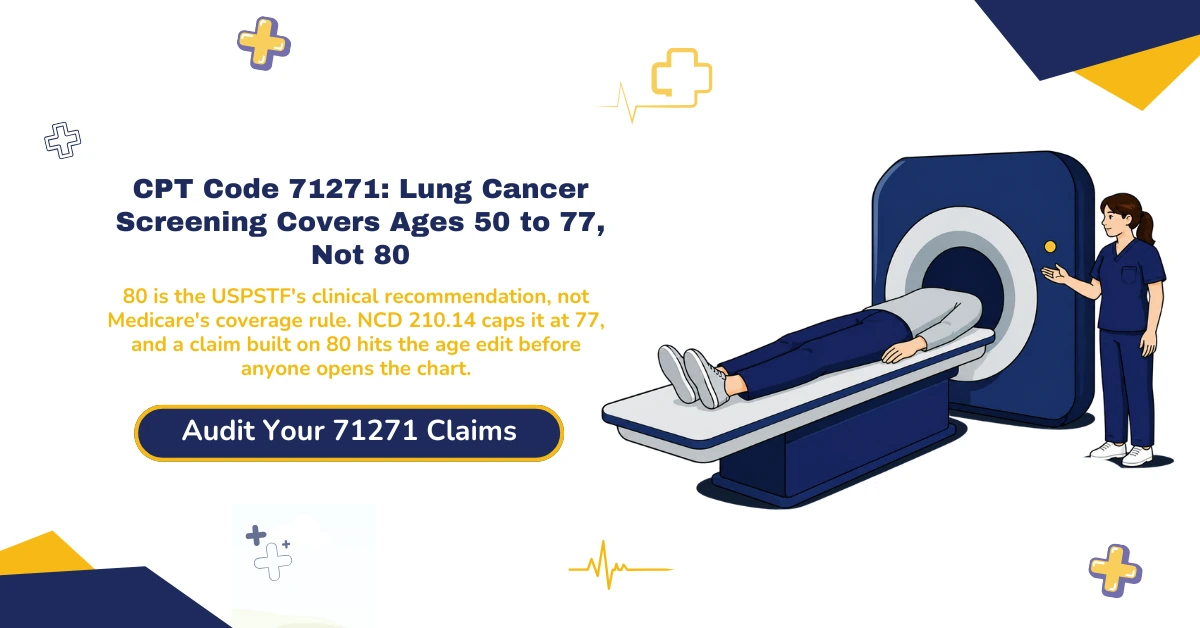
Medicare covers CPT code 71271 from age 50 through age 77. Several published guides list the range as 50 to 80. That figure comes from the USPSTF clinical recommendation, not from the coverage rule, and NCD 210.14 caps Medicare coverage at 77.
A patient aged 78 to 80 meets the national clinical recommendation and sits outside the Medicare benefit. Medicare evaluates age at the date of service.
Schedule and bill the final qualifying screening before the 78th birthday, and flag the transition in your recall workflow. The CPT 71271 age limit catches practices that run recall on a calendar year instead of on the patient date of birth.
How to Calculate 20 Pack-Years
One pack-year equals one pack per day for one year. One pack equals 20 cigarettes.
| Daily consumption | Years smoked | Pack-years |
|---|---|---|
| 1 pack per day | 20 years | 20 pack-years |
| 2 packs per day | 10 years | 20 pack-years |
| Half a pack per day | 40 years | 20 pack-years |
The number has to appear in the record as a number. A note calling the patient a heavy smoker for decades tells an auditor nothing. A note reading 40 pack-years satisfies the criterion and survives review.
When Is HCPCS Code G0296 Required?
HCPCS code G0296 covers the counseling and shared decision-making visit that Medicare requires before a beneficiary first LDCT screening. The requirement applies once. Subsequent annual screenings do not require a repeat G0296.
The CMS descriptor reads: “Counseling visit to discuss need for lung cancer screening using low dose CT scan (LDCT) (service is for eligibility determination and shared decision making).”
The G0296 CPT code description creates two failure modes. Submitting a first-time screening with no G0296 on file denies the 71271. Billing G0296 every year for the same patient overstates the service and creates audit exposure.
What the Shared Decision-Making Visit Must Include
- Determination of beneficiary eligibility.
- Shared decision-making, including the use of one or more decision aids.
- Counseling on adherence to annual screening, the impact of comorbidities, and the patient ability or willingness to undergo diagnosis and treatment.
- Counseling on maintaining abstinence for former smokers, or cessation for current smokers, with information about tobacco cessation interventions where appropriate.
Coders miss the second element. CMS names decision aids in the NCD text, and two documentation checklists that describe themselves as complete leave it out. A visit note recording counseling that never references a decision aid is missing a stated coverage condition. See the CMS decision memo CAG-00439R for the February 2022 changes to this visit.
Billing G0296 and 71271 on the Same Date of Service
Both codes can sit on the same date of service when the record documents them separately. The shared decision-making note has to stand as its own documented element, distinct from any evaluation and management service billed for the same encounter.
Cessation counseling furnished on a different date routes elsewhere. Three to 10 minutes reports under 99406, and more than 10 minutes reports under 99407. Our guide to smoking cessation counseling codes covers the time thresholds and the documentation each one needs.
Record the G0296 date in the chart at the first screening. Without that flag, year two produces either a missing-G0296 denial or a duplicate-G0296 audit trigger. The screening order often originates during a wellness encounter, and our guide to annual wellness visit codes covers how that visit gets documented.
What Diagnosis Codes Cover CPT 71271?
Z12.2, “Encounter for screening for malignant neoplasm of respiratory organs,” is the primary screening diagnosis for CPT code 71271. A tobacco status code documenting smoking history or current nicotine dependence accompanies it.
Z12.2 Is the Primary Screening Diagnosis
Z12.2 sits inside Z12, “Encounter for screening for malignant neoplasms,” in the ICD-10-CM tabular. The alphabetic index maps lung to Z12.2.
Getting the primary position wrong changes the claim. A symptom code such as R05.9, or an abnormal-finding code such as R91.8, in the first position reclassifies the encounter from preventive to diagnostic.
The patient cost-sharing changes, the coverage pathway changes, and the front desk ends up explaining a balance to someone who was told the scan was free. The same trap runs through every preventive screening code, and our Pap smear payer variation guide shows how it plays out on the cytology side.
Z12.31 Is the Breast Screening Mammogram Code
Z12.31 reads “Encounter for screening mammogram for malignant neoplasm of breast.” It belongs to the Z12.3 breast screening family and has no application to a thoracic CT.
| Code | ICD-10-CM descriptor | Correct application |
|---|---|---|
| Z12.2 | Encounter for screening for malignant neoplasm of respiratory organs | LDCT lung cancer screening under CPT 71271 |
| Z12.31 | Encounter for screening mammogram for malignant neoplasm of breast | Screening mammography. Not applicable to chest CT. |
A current coding guide lists Z12.31 as the required primary code for 71271 and describes it as a lung screening code. That description does not match the ICD-10-CM tabular. Appending a breast screening mammogram code to a low-dose chest CT produces a procedure-to-diagnosis mismatch, and the claim denies.
Confirm any primary screening code against the current ICD-10-CM tabular before it enters a payer crosswalk. A wrong code inside a crosswalk repeats on every claim until someone traces the pattern back to its source.
The Tobacco Status Codes That Accompany Z12.2
| Code | Descriptor | Applies to |
|---|---|---|
| Z87.891 | Personal history of nicotine dependence | Former smokers |
| F17.210 | Nicotine dependence, cigarettes, uncomplicated | Current smokers |
| F17.211 | Nicotine dependence, cigarettes, in remission | Patients in documented remission |
| F17.213 | Nicotine dependence, cigarettes, with withdrawal | Current smokers in withdrawal |
| F17.218 | Nicotine dependence, cigarettes, with other nicotine-induced disorders | Current smokers with documented disorders |
| F17.219 | Nicotine dependence, cigarettes, with unspecified nicotine-induced disorders | Current smokers, disorder unspecified |
Two of these get misclassified in published guidance. F17.211 describes remission, and at least one guide lists it under current smokers. The F17.22 family describes chewing tobacco, so F17.223 is not the cigarette equivalent of F17.213.
Why Medicare Denies 71271 at the Claim Edit Level
Medicare runs two automated edits against CPT 71271 claims before any human reviews them. One rejects claims for beneficiaries outside the eligible age range. The other denies claims that arrive without a required tobacco status ICD-10 code.
The Two Automated Edits Every 71271 Claim Passes Through
The Common Working File rejects G0296 and 71271 claim lines when the beneficiary falls outside 50 to 77 at the date of service. For dates of service before February 10, 2022, that edit applied 55 to 77, so a practice reprocessing older claims needs the historical threshold rather than the current one. Noridian MAC guidance covers the jurisdiction-level implementation.
The second edit reads the diagnosis list. CMS claims-processing instructions in Pub 100-04, Chapter 18, Section 220.4 deny G0296 and 71271 lines that arrive without one of the tobacco status codes: Z87.891, F17.210, F17.211, F17.213, F17.218, or F17.219.
That edit explains a contradiction billers run into. Medicare-oriented sources emphasize the tobacco codes while ICD-10 guidance emphasizes Z12.2. Both are correct, and they answer different questions.
Z12.2 establishes the encounter as preventive screening. The tobacco code satisfies the processing logic. A clean claim carries both. Reclassification going the other way leaves the patient with a balance, and our PR-1 patient responsibility denials guide covers the deductible side of that conversation.
A claim can satisfy every clinical eligibility criterion and still deny because the diagnosis list does not contain what the edit expects. The 71271 CPT code medical necessity denial that follows reads as a clinical problem when the cause is a missing secondary diagnosis.
Which Diagnosis Goes in the Primary Position by Payer
Primary diagnosis position rules for CPT 71271 vary by payer. One commercial payer accepts either Z12.2 or Z87.891 in the first position. Another rejects a personal history code in that same position.
| Payer | Accepted primary | Rejected primary | Source and date |
|---|---|---|---|
| Highmark | Z87.891 or Z12.2 | F17.210 | Preventive lung cancer screening coding bulletin, January 21, 2026 |
| Humana | Z12.2 reported as accepted | Z87.891 reported as denying | Biller-reported denial pattern. Verify against current payer policy. |
| Medicare FFS | Z12.2 with tobacco status secondary | Claim lines with no tobacco status code | Pub 100-04, Chapter 18, Section 220.4 |
Two payers, opposite rules, one code, the same year. A practice billing across a mixed panel cannot run a single default sequence and expect it to hold. Build the sequencing rule into the payer crosswalk rather than leaving it to coder memory, and re-verify each position against that payer published bulletin on a fixed interval.
Denials that cluster by payer instead of by patient point to sequencing more often than to eligibility. That pattern surfaces fast in a denial report sorted by payer and reason code, and the fix lives in the workflow. ClaimMax RCM denial management services trace the pattern and rebuild the crosswalk behind it.
How Often Can CPT Code 71271 Be Billed?
Medicare covers CPT code 71271 once every 12 months and requires 11 full months to elapse after the month of the previous screening before a repeat scan qualifies for payment.
The clock runs from the month of the last screening. A patient screened in March 2025 becomes eligible again in March 2026, because the 11 full months run from April 2025 through February 2026.
Store the last screening date in the chart and set the alert at scheduling. Catching a frequency conflict at billing means the scan already happened. Preventive screening codes share this problem, and our DEXA screening frequency rules guide covers the same tracking issue on bone density studies.
What Happens When a Follow-Up Scan Is Needed Sooner
A radiologist who recommends a short-interval follow-up at 3, 6, or 9 months after a nodule finding has ordered a diagnostic study. It reports under a diagnostic chest CT code, most often 71250, and carries standard cost-sharing. Submitting 71271 for that scan breaks the frequency limitation and denies.
The patient consequence lands harder than the denial. Someone told that patient screening costs nothing. A miscoded follow-up generates a balance, and the front desk absorbs the conversation.
CPT 71271 vs 71250, 71260, and 71270
CPT code 71271 is the only chest CT code designated for lung cancer screening. Codes 71250, 71260, and 71270 report diagnostic chest CT distinguished by contrast, and 71275 reports chest CT angiography.
| Code | Descriptor summary | Contrast | Type | Patient cost-sharing |
|---|---|---|---|---|
| 71250 | CT thorax, diagnostic | Without contrast | Diagnostic | Standard Part B |
| 71260 | CT thorax, diagnostic | With contrast | Diagnostic | Standard Part B |
| 71270 | CT thorax, diagnostic | Without, then with contrast | Diagnostic | Standard Part B |
| 71271 | CT thorax, low dose, lung cancer screening | Without contrast | Screening | Waived when criteria are met |
| 71275 | CT angiography, chest, with image post-processing | With contrast | Diagnostic | Standard Part B |
What Is the Difference Between CPT 71250 and 71271?
CPT 71271 is preventive. It applies to asymptomatic patients, bills once every 12 months, and carries no patient cost-sharing. CPT 71250 is diagnostic. It applies to symptomatic patients and short-interval follow-up, undergoes medical necessity review, and carries standard Part B cost-sharing.
Several published comparisons attach an age range of 50 to 80 to CPT 71271. That number belongs to the USPSTF clinical recommendation. Medicare coverage under NCD 210.14 stops at 77, and a claim built on 80 hits the age edit before anyone opens the chart.
The order and the symptom status decide the code. The scanner does not, and neither does contrast status on its own. Our diagnostic chest CT coding guide covers the 71250 frequency limit, the LCD criteria, and the radiology benefit manager routing that applies on the diagnostic side.
When 71260, 71270, or 71275 Applies Instead
CPT 71260 reports diagnostic chest CT with contrast. CPT 71270 reports diagnostic chest CT without contrast followed by contrast. CPT 71275 reports computed tomographic angiography of the chest with contrast and image post-processing.
One operational note matters for radiology groups. A facility and a reading physician who report different codes from this family on the same date of service create a mismatch that signals a documentation inconsistency, and the payer opens inquiry on both claims at once. Both entities report the same code.
Which Modifiers Apply to CPT Code 71271?
CPT code 71271 requires no modifier when one entity bills both components. Modifier 26 reports the professional interpretation alone. Modifier TC reports the technical component alone. Modifier 33 applies on some commercial preventive claims.
Modifier 26 and Modifier TC: The Component Split
Modifier 26 identifies the professional component, meaning the radiologist interpretation and written report. Modifier TC identifies the technical component, meaning the equipment, the technologist, and the facility resources that acquired the images.
| Billing arrangement | Who bills | Modifier |
|---|---|---|
| One entity owns the equipment and employs the reader | That entity bills globally | None |
| Facility performs the scan, outside radiologist reads it | Facility bills the acquisition | TC |
| Facility performs the scan, outside radiologist reads it | Radiologist bills the interpretation | 26 |
| Hospital-employed radiologist reads a hospital study | Facility claim captures the interpretation | None separately |
Check the PC/TC indicator in the Medicare Physician Fee Schedule relative value file before you append either one. Only codes carrying an indicator of 1 support the split. Our MRI lumbar modifier rules guide works through the same component logic on a high-volume MRI code.
Modifier 33 for Commercial Preventive Claims
Modifier 33 signals a preventive service on commercial claims subject to ACA Section 2713 cost-sharing protections. Applicability varies by payer, and this is one of the few places in this guide where a qualifier belongs, because the variation is documented and real.
Check the payer preventive services policy before you append it. Adding 33 where the payer does not expect it triggers a rejection, and so does omitting it where the payer requires it.
Modifiers That Do Not Belong on a 71271 Claim
- LT and RT have no application. A thoracic CT images both lungs in one acquisition, and a laterality modifier on CPT code 71271 produces a rejection.
- Modifier 77 does not fit an annual screening code. CPT 71271 bills once per 12 months, so a same-year repeat is a frequency denial. At least one published guide recommends 77 here.
- Modifier 59 marks a specific determination about distinct procedural services. Treating it as a routine same-day fix invites an audit.
Why Component Billing Is Under Active Audit
CMS lists modifier TC and PC incorrect coding as an approved Recovery Audit Contractor review topic across all A/B MAC jurisdictions, dated August 27, 2025.
The review targets claims where the payer did not apply the correct fee schedule amount for the modifier billed, and findings recover the difference between the original payment and the recalculated one. See CMS RAC audit topic 0116.
A practice that does not own the equipment and the facility bills 26, not global, and documents the arrangement. A radiology group billing globally for studies read at a facility it does not own generates a duplicate-billing denial and an overpayment exposure in the same cycle.
Facility and Radiologist Requirements Under NCD 210.14
NCD 210.14 requires that LDCT screening be furnished in a radiology imaging facility using a standardized lung nodule identification, classification, and reporting system. The reading radiologist must hold board certification or board eligibility with the American Board of Radiology or an equivalent organization.
What the Radiology Facility Must Have
CMS requires a standardized nodule identification, classification, and reporting system. CMS does not name one in the NCD text. One system dominates practice, and calling it a coverage mandate overstates what the rule says.
Accreditation by a specific accrediting body is not an NCD coverage condition either. One published guide describes accreditation as a denial trigger for CPT 71271. That claim does not match the requirement as written.
Is Registry Reporting Still Required?
No. Registry submission stopped being a coverage requirement on February 10, 2022.
The 2015 version of the NCD required facilities to collect and submit data to a CMS-approved registry. The February 2022 reconsideration removed it.
The CMS registry requirement notice now describes that registry as having satisfied the requirement of the prior NCD. Practices still submitting registry data for Medicare coverage purposes are doing work the current rule does not ask for.
Who Bills When an IDTF Performs the Scan
An Independent Diagnostic Testing Facility may perform the LDCT scan once the coverage requirements including the physician order are met. A physician bills it. CMS takes that position because CPT 71271 includes a therapeutic activity: smoking cessation interventions have to be made available to current smokers, and an IDTF enrolls for diagnostic testing only.
The physician and the IDTF need a business arrangement covering that part of the benefit, and the IDTF looks to the physician for payment. A physician billing a purchased service falls under the anti-markup provisions in Pub 100-04, Chapter 13, Section 20.3.
What Medicare Pays for CPT Code 71271 in 2026
Medicare calculates payment for CPT code 71271 from the Physician Fee Schedule, using work, practice expense, and malpractice relative value units adjusted by locality-specific geographic practice cost indices, then multiplied by the applicable conversion factor.
How the Payment Is Calculated
- Pull the work RVU, the practice expense RVU for your setting, and the malpractice RVU from the current relative value file.
- Apply the work, practice expense, and malpractice GPCI values for your locality.
- Sum the three adjusted RVUs.
- Multiply by the conversion factor that applies to your provider.
Pull the current values from the CMS fee schedule lookup before you build a projection. The national figure and your locality figure diverge enough to matter across a screening program running hundreds of scans a year.
Two adjustments drop out of most projections. Sequestration reduces the amount the payer releases. Medicare pays a share of the allowed amount, with the balance falling to the patient on services carrying cost-sharing. Neither one touches the patient portion on a CPT 71271 claim with correct coding, and both affect what the practice collects on the diagnostic codes around it.
The Two 2026 Conversion Factors
The Physician Fee Schedule carries two conversion factors starting in calendar year 2026. One applies to qualifying alternative payment model participants who meet the Advanced APM participation thresholds. The other applies to everyone else. The CY2026 physician fee schedule final rule sets both.
A practice running one conversion factor across a whole provider roster will be wrong for part of it. The error compounds across a high-volume screening program before anyone catches it at reconciliation.
The 2026 Efficiency Adjustment on Radiology
CMS finalized an efficiency adjustment that reduces work RVUs and intraservice time for nearly all Physician Fee Schedule services that are not time-based. Radiology sits inside that group. Evaluation and management, behavioral health, maternity global codes, and care management sit outside it.
Any CPT 71271 revenue projection built on a prior-year work RVU overstates 2026 receipts. The gap surfaces at reconciliation, which is the worst place to find it.
How Commercial Payers Cover CPT 71271
Commercial health plans subject to the Affordable Care Act must cover CPT code 71271 without patient cost-sharing, because low-dose CT lung cancer screening carries a Grade B recommendation from the United States Preventive Services Task Force.
Why ACA Plans Must Cover LDCT Screening
- The National Lung Screening Trial established a mortality benefit for annual LDCT in high-risk populations.
- That evidence supported a USPSTF Grade B recommendation.
- ACA Section 2713 requires non-grandfathered plans to cover USPSTF Grade A and B preventive services without cost-sharing.
- Coverage follows from the grade.
That chain gives billers an appeal basis most of them never use. A commercial plan applying cost-sharing to a clean CPT 71271 claim on an eligible patient has a coding or plan-type problem, and the statutory requirement supports the appeal.
Which Plans Are Exempt
| Plan type | Cost-sharing waiver applies? |
|---|---|
| Non-grandfathered ACA plan, in-network | Yes |
| Grandfathered plan predating the ACA with no significant changes | No |
| Self-insured ERISA plan | Obligations differ. Verify with the plan. |
| Short-term limited-duration plan | Generally outside ACA preventive requirements |
| Out-of-network care under an ACA plan | Standard cost-sharing can apply |
Network status catches billers more often than the plan-type exemptions do. The cost-sharing protection applies to in-network care, and an out-of-network LDCT can carry standard cost-sharing even when the service is preventive and the patient qualifies.
Confirm plan type and network status during verification, not after the patient opens a bill nobody warned them about. Practices running outsourced medical billing build that check into the pre-service workflow.
Does CPT Code 71271 Require Prior Authorization?
Prior authorization requirements for CPT code 71271 vary by payer and by line of business. Medicare fee-for-service requires none. Several commercial and state Medicaid programs require it, and payers have moved in opposite directions on the requirement.
Medicare Fee-for-Service
Medicare fee-for-service requires no prior authorization for CPT 71271. It requires the counseling and shared decision-making visit before the first screening, eligibility documented in the record, and diagnosis codes that clear the automated edits.
Billers conflate the two. No authorization step exists, and the documentation gate produces denials that read like authorization failures on the remittance, which sends the appeal down the wrong path. Your MAC publishes the jurisdiction-level detail, and the Medicare MAC contact directory identifies which contractor processes your claims.
Commercial and Medicaid Payers
| Payer or program | Line of business | Prior authorization | Effective date |
|---|---|---|---|
| Texas Medicaid | Medicaid | Required before the LDCT is performed | Per TMHP provider notice |
| Neighborhood Health Plan of Rhode Island | All lines of business | Removed | January 1, 2025 |
| Blue Cross Blue Shield of Michigan | Most members | Added | Effective March 1 per provider alert |
| Cigna, UnitedHealthcare, Harvard Pilgrim | Commercial | Reported as required. Verify per plan. | Verify current policy |
| Medicare fee-for-service | Part B | Not required | Current |
Three payers moved three different directions on one code inside eighteen months. A practice cannot hold a single default and expect it to survive a mixed payer panel. Verify at the plan level before scheduling. The check takes minutes at intake and costs a rescheduled scan once it happens after.
Radiology Benefit Manager Routing
Most major carriers do not review advanced imaging authorization requests themselves. They delegate to a radiology benefit manager, and the practice submits to that manager on its criteria and its timelines.
Identify which manager handles the plan before the first submission. Sending an imaging authorization request to a plan that delegates it produces a delay that reads as a denial, and that delay can exceed the scheduling window.
Authorization rules for this code move on separate tracks across payers, and a benefit manager sits between the practice and the plan on most of them.
Practices that verify at the plan level before scheduling avoid the rescheduled scan and the appeal behind it. ClaimMax RCM runs pre-service benefit checks 48 to 72 hours ahead of the appointment, confirming coverage, flagging authorization requirements, and identifying the delegated reviewer.
Documentation Required for a Clean 71271 Claim
A compliant CPT code 71271 claim requires a documented order, the patient age at the date of service, a calculated pack-year history, smoking status with a quit date where it applies, asymptomatic status, the G0296 record for first-time screeners, and a structured radiology report.
- Order for LDCT screening from a physician or qualified non-physician practitioner.
- Date of birth confirming age at the date of service.
- Pack-year calculation documented as a number.
- Smoking status with a quit date for former smokers.
- Clinician attestation of asymptomatic status.
- G0296 completion record for the first annual screening.
- Radiologist report using a standardized nodule classification, with the category and the follow-up recommendation.
What Auditors Look for on a 71271 Chart Review
Auditors want each eligibility element demonstrated on its own, not inferred from the surrounding chart. A note describing a long-time smoker does not demonstrate 20 pack-years. A note saying the patient is due for annual screening does not demonstrate asymptomatic status.
The exposure falls on the imaging side in a way that surprises radiology groups. A practice accepting a referring physician order without confirming the clinical details behind it carries the audit risk, even though another practice wrote the order.
Capture smoking history, the pack-year number, and symptom status at scheduling, in structured fields. Data that exists before the scan survives review. Data reconstructed at billing does not.
Why 71271 Claims Get Denied and How to Fix Them
Most CPT code 71271 denials trace to six causes: a missing G0296 for a first-time screener, an incorrect primary diagnosis, a missing tobacco status code, a frequency violation, an eligibility mismatch, or a missing order.
The Six Denial Patterns
| Denial pattern | What went wrong | Prevention control and stage |
|---|---|---|
| Missing G0296 | First annual screening submitted with no counseling visit on file | Flag first-time screeners at scheduling and block claim generation until the G0296 date is recorded |
| Incorrect primary diagnosis | A symptom code, abnormal-finding code, or wrong screening code replaced Z12.2 | Require Z12.2 as primary in the payer crosswalk at coding |
| Missing tobacco status code | Claim failed the automated diagnosis edit despite correct clinical eligibility | Add the tobacco status check to the pre-submission scrub |
| Frequency violation | Submitted inside the 12-month window, often a short-interval follow-up coded as screening | Alert on the last screening date at scheduling |
| Eligibility mismatch | Age, pack-years, quit date, or symptom status outside the criteria | Verify all five criteria at the ordering workflow, not at billing |
| Missing order | Imaging facility submitted with no documented order from a qualified provider | Require the order number at the time of scheduling |
Reading the Denial Code
The claim adjustment reason code names the category. The remittance advice remark code supplies the detail.
A medical necessity category tells you the payer rejected the clinical justification, and the remark code tells you whether the problem was the diagnosis, the documentation, or the coverage policy. Our CARC RARC denial reference covers how the two code sets work together on a remittance.
Read the remark code before you choose between a corrected claim and an appeal. The two paths carry different deadlines, and picking wrong burns the window on both.
Building the Appeal
A CPT code 71271 appeal needs four things: the coverage criterion the payer says went unmet, the record evidence showing it was met, the primary source establishing the criterion, and the corrected claim data where a coding error caused the denial.
Most appeals skip the third one. An appeal that reasserts eligibility is an assertion. An appeal quoting the criterion from the national coverage determination and pointing to the chart element satisfying it is an argument, and payers treat the two differently.
Pull denials by reason code each quarter and trace them back to the primary diagnosis and the G0296 date. Fixing the pattern upstream costs less than reworking claims one at a time, which is the work ClaimMax RCM root-cause denial recovery teams do on radiology accounts.
Check Your MAC Local Coverage Rules Before Billing
NCD 210.14 sets national coverage for CPT code 71271, and Medicare Administrative Contractors publish local coverage articles carrying jurisdiction-level billing and coding detail. Check your MAC guidance alongside the national determination.
A national coverage determination binds every MAC. Local documents cannot contradict it, and they can clarify it or address coverage questions inside the jurisdiction. For a code governed nationally, the local layer supplies billing and coding detail instead of different criteria.
Identify your MAC, search the Medicare Coverage Database for 71271, and open any billing and coding article it returns. The coding information section is where jurisdiction-specific diagnosis lists appear when a MAC publishes one. Searching the 71271 CPT code LCD for your jurisdiction takes minutes and settles questions the national text leaves open.
MAC articles get revised without announcement. A practice that checked once at program launch may be running on superseded guidance, so set a review interval instead of treating it as a one-time task.
CPT Code 71271 Frequently Asked Questions
What does CPT code 71271 mean?
CPT code 71271 reports a low-dose computed tomography scan of the thorax performed as a lung cancer screening, without contrast material. It applies to asymptomatic patients meeting the high-risk criteria, and Medicare covers it once every 12 months. A patient with symptoms falls outside the code, and the study reports under a diagnostic chest CT code instead. The code took effect January 1, 2021.
What diagnosis code is used with CPT 71271?
Z12.2, encounter for screening for malignant neoplasm of respiratory organs, is the primary diagnosis for CPT 71271. A tobacco status code accompanies it, either Z87.891 for former smokers or one of the F17.21 series for current smokers. Z12.31 appears in some published guidance as the primary code for this service. Z12.31 is the screening mammogram code for breast and has no application to a chest CT.
Is G0296 required every year?
No. G0296 covers the counseling and shared decision-making visit Medicare requires before a beneficiary first LDCT screening. Subsequent annual screenings need an order, not a repeat G0296. Billing G0296 every year for the same patient overstates the service and creates audit exposure. Record the date of the first G0296 in the chart so the second-year claim neither repeats it nor loses the reference to it.
Can CPT 71271 be billed more than once a year?
No. Medicare covers CPT 71271 once every 12 months, with 11 full months elapsed after the month of the previous screening. A follow-up scan recommended at 3, 6, or 9 months after a nodule finding is diagnostic, and it reports under a diagnostic chest CT code such as 71250 with standard cost-sharing. Submitting 71271 for a short-interval follow-up breaks the frequency limitation and denies.
Does the patient pay anything for CPT 71271 under Medicare?
No, provided the patient meets the eligibility criteria and the claim carries correct coding. Medicare waives the Part B deductible and coinsurance for this preventive service. The waiver covers the screening itself. A follow-up diagnostic CT ordered after a nodule finding carries standard Part B cost-sharing and bills under a different code, which is where unexpected patient balances originate.
What is the age range for CPT 71271?
Medicare covers CPT 71271 from age 50 through age 77. The USPSTF recommends annual LDCT screening through age 80, which is where the confusion starts. A patient aged 78 to 80 meets the clinical recommendation and falls outside the Medicare benefit. Medicare evaluates age at the date of service, so schedule the final qualifying screening before the 78th birthday.
Does CPT 71271 require a modifier?
No modifier applies when one entity bills both the technical and professional components. Modifier 26 reports the radiologist interpretation alone. Modifier TC reports the equipment and technologist component alone. Modifier 33 applies on some commercial preventive claims, and payer policy decides. LT and RT do not apply, because a thoracic CT images both lungs in one acquisition.
What replaced HCPCS G0297?
CPT 71271 replaced HCPCS G0297. CMS end-dated G0297 on December 31, 2020, and 71271 became the required code for dates of service on or after January 1, 2021. Claims carrying G0297 for services after that date deny. Practices still submitting it are working from a chargemaster or superbill nobody has audited against the current code set.
Getting 71271 Claims Paid the First Time
Three failure points produce most CPT 71271 denials: the primary diagnosis, the G0296 record, and the payer-specific sequencing rule. Your team catches each one at scheduling or coding, and each one costs less to prevent than to appeal.
None of this holds still. Payer rules move, fee schedule values change every January, and MAC articles get revised without notice. A screening program that ran clean last year is not clean this year by default.
Denials that repeat instead of appearing once point to a workflow gap firing on every claim. Identifying which of the three failure points is producing them takes a sorted denial report and an afternoon.