HCPCS code G0296 is the counseling and shared decision-making visit Medicare requires before a patient’s first low-dose CT (LDCT) lung cancer screening. The provider confirms eligibility and walks the patient through a decision aid before ordering the scan. Medicare waives the deductible and coinsurance, so the patient owes nothing when you accept assignment.
Most billers search for it as the G0296 CPT code. The visit pays about $28 in the office, so one rejected line wipes out the margin. Medicare rejects it for three misses: no tobacco diagnosis, a patient outside ages 50 to 77, or a same-day RHC or FQHC visit.
Auditors look for a fourth miss, a note that doesn’t name the decision aid. This guide is for primary care, internal medicine, and pulmonology teams that bill the visit. It covers what CMS checks for in 2026, with the codes, rates, and denial fixes to match.
G0296 Key Facts for 2026
| Item | 2026 fact |
|---|---|
| Code type | HCPCS Level II G-code, maintained by CMS |
| Short descriptor | Visit to determ ldct elig |
| Governing policy | NCD 210.14, effective February 10, 2022 |
| Covered ages under Medicare | 50 to 77 |
| When it’s required | Before the patient’s first LDCT |
| Diagnosis Medicare edits for | Z87.891, F17.210, F17.211, F17.213, F17.218, or F17.219 |
| 2026 national rate, physician fee schedule | $28.72 non-facility, $22.38 facility |
| 2026 hospital outpatient rate | APC 5822, $103.79 |
| Patient cost under Medicare | $0 with assignment |
| Telehealth | Yes, on Medicare’s permanent telehealth list |
| Companion scan code | CPT 71271 |
What Is the G0296 CPT Code?
G0296 is the HCPCS code for a counseling visit to discuss the need for lung cancer screening with LDCT. CMS’s full descriptor reads: “Counseling visit to discuss need for lung cancer screening using low dose CT scan (LDCT) (service is for eligibility determination and shared decision making).” Medicare has paid it since February 5, 2015, and it’s active in 2026.
Is G0296 a CPT Code or a HCPCS Code?
G0296 is a HCPCS Level II code. CMS creates and maintains G-codes, and the AMA doesn’t publish them in the CPT book. Billers still type “CPT code G0296” into search bars, and payer bulletins use the same label. On the claim form, both code sets go in the same procedure field.
The label matters when you look up payer policy. Payers file G-codes under HCPCS, so a portal search under “CPT” can miss the policy that governs your claim. Our guide to HCPCS vs CPT codes explains how the two code sets split.
How G0296 and CPT 71271 Work Together
Medicare’s lung screening benefit runs on two codes. G0296 covers the counseling visit, and CPT 71271 covers the low-dose CT scan itself. CMS ended G0297 on December 31, 2020, and 71271 replaced it for dates of service on or after January 1, 2021.
The NCD doesn’t stop you from holding the visit and the scan on the same day, and many screening programs do both in one trip. Write the counseling visit date on the LDCT order. The imaging site then has proof the visit came first, and your staff won’t field a call asking for it.
| Step | Code | Who bills it |
|---|---|---|
| 1. Eligibility and shared decision-making visit | G0296 | Ordering practitioner |
| 2. Annual screening scan | CPT 71271 | Imaging facility and radiologist |
| 3. Short-interval follow-up scan | CPT 71250 (diagnostic) | Imaging facility |
Scan billing, Lung-RADS follow-ups, and the 11-month spacing rule live in our CPT 71271 billing guide. This guide stays with the counseling visit.
Who Qualifies for G0296 Under Medicare in 2026?
NCD 210.14 sets who is eligible for lung cancer screening under Medicare, and G0296 needs all five criteria on the date of service. The patient is 50 to 77, has no lung cancer symptoms, and has at least 20 pack-years. Current smoking or a quit date within 15 years completes the history, along with an LDCT order on file.
The Five NCD 210.14 Eligibility Criteria
| Criterion | Requirement | What the note must show |
|---|---|---|
| Age | 50 to 77 | Date of birth checked against the date of service |
| Symptoms | None (asymptomatic) | A clear statement of no signs or symptoms of lung cancer |
| Smoking history | At least 20 pack-years | The pack-year total written as a number |
| Smoking status | Current smoker, or quit within 15 years | The quit year for former smokers |
| Order | An order for LDCT screening | The order in the chart |
The order rule changed in 2022. Since February 10, 2022, NCD 210.14 says only that the patient must “receive an order for lung cancer screening with LDCT.” Older CMS lung cancer screening guidelines listed required order elements, and CMS dropped that list. Date of birth, pack-years, and the ordering NPI still belong on the order as good practice.
Symptoms take a patient off the screening path. A 64-year-old with a new cough and weight loss needs a diagnostic workup, so neither G0296 nor 71271 fits that visit. Medicare’s lung screening coverage page lists the same Medicare lung cancer screening conditions in plain language you can share with patients.
G0296 CPT Code Age Limit: 50 to 77
Medicare rejects G0296 and 71271 lines when the patient falls outside ages 50 to 77, for dates of service on or after February 10, 2022. Before that date, the range was 55 to 77. Coverage ends on the patient’s 78th birthday, and Medicare checks age on the date of service.
Watch patients close to their 78th birthday. A patient who’s 77 at scheduling and 78 on the scan date fails the age check, so book the visit and the scan before the birthday. The USPSTF recommends screening through age 80, so some commercial plans pay at 78 to 80 while Medicare lung cancer screening guidelines stop at 77.
Age, plan type, and Medicare Advantage enrollment all show up in a benefits check. Running insurance eligibility verification before the visit catches a wrong birth date or the wrong plan while you can still reschedule.
How to Calculate Pack-Years
Pack-years equal the packs smoked per day multiplied by the years smoked, and one pack holds 20 cigarettes. Auditors want the number in the note. “Heavy smoker for decades” won’t satisfy a reviewer, and “40 pack-years” will.
| Packs per day | Years smoked | Pack-years |
|---|---|---|
| 1 | 20 | 20 |
| 2 | 10 | 20 |
| 0.5 | 40 | 20 |
What a G0296 Visit Must Document
A G0296 note must show four things. Those are an eligibility determination, shared decision-making with a decision aid, counseling on annual adherence and comorbidities, and tobacco counseling. Leave one out and an auditor will treat the visit as a routine office visit, even when the patient qualified.
The Four Elements the NCD Requires
- Eligibility: age, symptom status, the pack-year number, and the quit year
- Shared decision-making with a decision aid: benefits, false positives, overdiagnosis, follow-up testing, and radiation exposure
- Adherence and comorbidities: why annual screening matters, and whether the patient can and will go through diagnosis and treatment
- Tobacco counseling: abstinence for former smokers, cessation and resources for current smokers
NCD 210.14 requires you to document the visit in the medical record, and copied notes are where audits go wrong. A note that repeats last year’s text word for word doesn’t show the conversation happened this year. Reviewers catch that pattern fast when they pull a sample.
Decision Aids: What Counts
The NCD calls for “one or more decision aids” and doesn’t name a required tool. Pick one your clinicians will use and name it in the note. The University of Michigan’s shouldiscreen.com tool is one example screening programs use with patients.
You protect the claim with specific wording. An auditor reading “risks discussed” can’t tell whether anyone used a decision aid. Swap in “reviewed shouldiscreen.com with patient, discussed false positives and radiation,” and the reviewer can confirm the element in one line.
Sample G0296 Documentation Template
Copy this into your EHR as a smart phrase, then adjust the fields to fit your workflow and compliance policy. Each line maps to an NCD element or to the handoff that tells the imaging site the visit happened.
| LUNG CANCER SCREENING COUNSELING AND SHARED DECISION-MAKING (G0296)Date of service: [date] Age: [age] DOB: [date]Symptoms of lung cancer: none reportedSmoking status: [current / former, quit year: ____]Pack-years: [packs per day] x [years] = [total]Decision aid used: [name of tool]Discussed: benefits, false positives, overdiagnosis, follow-up testing, radiationAnnual adherence and comorbidities reviewed: [yes, notes]Willing to undergo diagnosis and treatment: [yes / no]Tobacco counseling: [cessation or abstinence counseling, resources given]Decision: [patient elects screening / declines]LDCT order placed: [date] Counseling visit date written on order: [yes] |
Tobacco Counseling Is Already Inside G0296
G0296 already includes tobacco counseling, so you can’t bill 99406 or 99407 for that same discussion on the same day. The American Lung Association billing guide flags this for screening programs. A separate cessation session on another date follows our 99406 and 99407 rules.
If your notes keep failing audits on the decision aid element, we can help. Our AAPC-certified coders review a sample of your G0296 charts against NCD 210.14 before the claims go out. See how our medical billing services handle preventive coding for primary care and pulmonology practices.
Who Can Furnish and Bill G0296?
Since February 10, 2022, Medicare no longer requires a physician or non-physician practitioner to furnish the G0296 visit themselves. Physicians, nurse practitioners, physician assistants, and clinical nurse specialists bill it under their own NPI. Qualified clinical staff can furnish it incident to a physician’s service in the office.
| Who | Can furnish the visit? | Bills under |
|---|---|---|
| Physician (primary care, pulmonology, oncology, and others) | Yes | Own NPI |
| NP, PA, or CNS | Yes | Own NPI, paid at 85% of the fee schedule amount |
| Nurse or other clinical staff | Yes, incident to | The supervising physician’s or practitioner’s NPI |
Specialists ask on coding forums whether they can bill G0296. NCD 210.14 sets no specialty limit, so a pulmonologist who sees a referred patient for the counseling visit can bill it. If your pulmonology team also bills breathing tests, our guide to pulmonary function test codes covers those claims.
Clinical Staff and Incident-To Billing
CMS removed the rule that a physician or practitioner must furnish the visit in its 2022 coverage update. You can read its reasoning in the CMS final decision memo. Staff visits still follow the incident-to rules in the Medicare Benefit Policy Manual, Chapter 15.
Those rules call for direct supervision, a course of care the physician started, and billing under the supervising practitioner. Picture a nurse navigator who runs the counseling visit while the physician sees patients down the hall. The claim goes out under the physician’s NPI, and the note names the navigator, the decision aid, and the supervising physician.
What Diagnosis Will Cover G0296? ICD-10 Codes Medicare Requires
Medicare pays G0296 only when the claim carries Z87.891 for a former smoker, or F17.210, F17.211, F17.213, F17.218, or F17.219 for a current cigarette smoker. Medicare denies a line without one of these codes with CARC 167. Many payers also want Z12.2, the lung cancer screening ICD-10 code, listed first.
The Six Tobacco Codes in Medicare’s Claim Edit
| ICD-10-CM | Description | Use for |
|---|---|---|
| Z87.891 | Personal history of nicotine dependence | Former smokers |
| F17.210 | Nicotine dependence, cigarettes, uncomplicated | Current smokers |
| F17.211 | Nicotine dependence, cigarettes, in remission | Remission the provider documents |
| F17.213 | Nicotine dependence, cigarettes, with withdrawal | Current smokers in withdrawal |
| F17.218 | Nicotine dependence, cigarettes, with other nicotine-induced disorders | A named nicotine-induced disorder |
| F17.219 | Nicotine dependence, cigarettes, with unspecified nicotine-induced disorders | A disorder the note doesn’t specify |
CMS added this edit to the Claims Processing Manual, Chapter 18, section 220, through CMS Transmittal 11388. A miss comes back with CARC 167, RARC N386, and group code CO, so the practice can’t bill the patient. Before you submit CPT G0296, check that one of these six codes sits on the line.
Where Z12.2 Fits on a G0296 Claim
Z12.2 is the lung cancer screening ICD-10 code, defined as an encounter for screening for malignant neoplasm of respiratory organs. CMS’s edit doesn’t require it. Many payers do, and they disagree on order, so some accept Z87.891 first while others want Z12.2 first.
If a payer hasn’t published a rule, list the ICD-10 code for lung cancer screening first and the tobacco code second. Build each payer’s preference into your charge entry crosswalk, and keep a copy of the policy you followed. Our Z12.2 sequencing by payer notes apply to the scan claim as well.
Diagnosis Codes That Get G0296 Denied
Coders searching for screening for lung cancer ICD-10 options land on lists that mix valid and invalid codes. Watch for four groups:
- F17.21: a category header, not a billable code. A few published guides list it as if you could bill it.
- F17.220 to F17.229: chewing tobacco codes. F17.223 means chewing tobacco with withdrawal, so it won’t pass Medicare’s cigarette edit.
- F17.200 to F17.209 and F17.290 to F17.299: unspecified and other tobacco products. Medicare’s edit leaves them out, though Aetna’s policy accepts F17.290 to F17.299 for its commercial members.
- Symptom codes such as R05.9 (cough) or R91.8 (other nonspecific abnormal finding of lung field): they make the encounter diagnostic, and screening codes no longer apply.
How Often Can You Bill G0296?
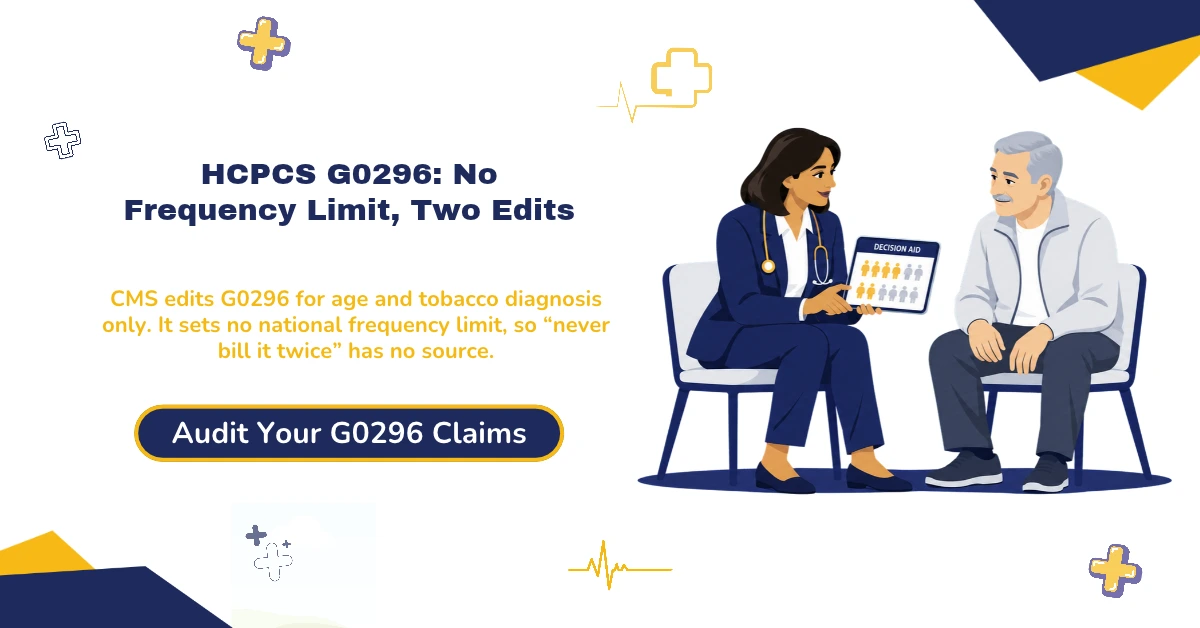
Medicare requires G0296 once, before the patient’s first LDCT, and later annual scans need only an order. CMS’s claims manual sets age and diagnosis edits for G0296 but no national frequency limit. If you repeat the full counseling visit in a later year, document all four NCD elements and confirm your MAC’s position first.
First Year vs Later Years
| Situation | G0296 | Order | CPT 71271 |
|---|---|---|---|
| Year one, before the first LDCT | Required | Required | Once per year |
| Later years | Optional | Required | Once per year, after 11 full months |
| Repeat counseling in a later year | Billable with all four NCD elements documented | Required | Once per year |
Noridian’s lung screening guidance calls counseling in later years optional, and all of the initial requirements apply if you provide it. You have two solid reasons to repeat it: a patient who had the visit years ago and skipped the scan, or one returning after dropping out of screening.
Record the date of the first G0296 in the chart. Without it, your staff field a call from the imaging site in year two, or a clinician repeats a visit the patient didn’t need. The 11-month spacing rule applies to 71271 alone.
G0296 Reimbursement in 2026: RVUs and Medicare Rates
Medicare’s 2026 national rate for G0296 is $28.72 in the office (non-facility) and $22.38 in a facility. Those figures come from 0.86 and 0.67 total RVUs multiplied by the $33.4009 conversion factor. A hospital outpatient department receives $103.79 under APC 5822, and the patient owes nothing when you accept assignment.
G0296 RVU Breakdown for 2026
| Component | Non-facility | Facility |
|---|---|---|
| Work RVU | 0.52 | 0.52 |
| Practice expense RVU | 0.31 | 0.12 |
| Malpractice RVU | 0.03 | 0.03 |
| Total RVU | 0.86 | 0.67 |
| National rate ($33.4009 conversion factor) | $28.72 | $22.38 |
| Qualifying APM participants ($33.5675 conversion factor) | $28.87 | $22.49 |
These are national amounts, and your MAC adjusts them by locality through the GPCI. Visits billed under a nurse practitioner’s or physician assistant’s own NPI pay 85% of these figures. Pull your locality’s amount from the CMS PFS Look-Up Tool before you load the fee schedule.
The G0296 CPT code carries global indicator XXX, so no global period applies. A same-day E/M or follow-up visit doesn’t fall inside a global package for this code.
Hospital, CAH, RHC, and FQHC Payment
| Setting | Type of bill | How Medicare pays G0296 |
|---|---|---|
| Hospital outpatient | 12X, 13X | OPPS, APC 5822, $103.79 in 2026 |
| Skilled nursing facility | 22X, 23X | Physician fee schedule |
| Critical access hospital | 85X | Reasonable cost (Method II professional lines pay from the fee schedule) |
| Rural health clinic | 71X | All-inclusive rate |
| Federally qualified health center | 77X | FQHC prospective payment rate |
CMS Transmittal 11388 lists these bill types, and Medicare waives coinsurance and the deductible in each setting. The 2026 hospital rate appears in the ACR summary of the 2026 OPPS rule.
If a physician sees the patient in a hospital outpatient department, the professional claim pays at the facility rate of $22.38. The hospital bills its own line on the institutional claim. Our hospital revenue cycle support team keeps the two claims matched.
How G0296 Payment Has Changed Since 2016
| Year | Office rate (physician fee schedule) | Hospital outpatient (OPPS) | Source |
|---|---|---|---|
| 2016 | $54.10 | $69.65 | American Thoracic Society |
| 2023 | $28.47 | $75.85 | ACR FAQ |
| 2026 | $28.72 | $103.79 | CMS fee schedule file and ACR 2026 OPPS summary |
The office rate fell about 47% between 2016 and 2026, while the hospital outpatient rate rose about 49%. You can check the starting figures in the American Thoracic Society 2016 rule summary. At under $30 a visit, a practice can’t absorb many rework cycles on this code.
G0296 Billing Guidelines: Same-Day Services and Modifiers
You can bill G0296 on the same day as the LDCT scan (71271), an annual wellness visit, or a medically necessary E/M visit. A separate E/M for a new or existing problem carries modifier 25. Same-day cessation counseling for the same discussion isn’t billable on its own, and RHC or FQHC claims follow a stricter same-day rule.
What You Can Bill With G0296 on the Same Day
| Same-day service | Billable with G0296? | What to do | Source |
|---|---|---|---|
| CPT 71271 (LDCT scan) | Yes | Hold the counseling before the scan and note the visit date on the order | NCD 210.14, ACR FAQ |
| G0438 or G0439 (AWV) | Yes | ACR advises modifier 25; some Medicare Advantage plans restrict pairing with G0438 | ACR FAQ, UHC 2026 guide |
| 99202 to 99215 (E/M for a separate problem) | Yes, if separately identifiable | Modifier 25 on the E/M, with its own assessment and plan in the note | CPT modifier 25, ACR FAQ |
| 99406 or 99407 (cessation counseling) | Not for the same counseling | Bill 99406 or 99407 on a separate date | ALA billing guide |
| Another RHC or FQHC visit (71X, 77X) | No | Expect CARC 97 with RARC M15; the IPPE on an RHC claim is the exception | CMS Transmittal 11388 |
The ACR lung screening FAQ supports billing CPT G0296 with an AWV or a medically necessary E/M on the same day. Our guides to annual wellness visit codes and G0439 subsequent AWV rules cover the visit side of that pairing.
Payers add their own limits. The UnitedHealthcare 2026 preventive guide lets you bill added preventive services alongside G0439, but not alongside G0402 or G0438. That rule belongs to UnitedHealthcare, so build it into that payer’s billing setup.
Does G0296 Need a Modifier?
G0296 doesn’t need a modifier on its own. A standalone office line goes out clean. Four modifiers come up when the visit shares a claim with something else:
- Modifier 25: use it when you bill a separate E/M on the same day. CPT places modifier 25 on the E/M line. ACR’s FAQ says to bill “with the -25 modifier” without naming the line, and some payers want it on G0296, so confirm with your MAC or plan before the first claim.
- Modifier 33: in most cases, skip it. CPT’s definition says modifier 33 doesn’t apply to services already identified as preventive, and G0296 is one. A few commercial payers still ask for it.
- Modifiers 95 and 93: telehealth claims carry them where the payer requires them. From October 1, 2026, RHC and FQHC telehealth lines need one of them.
- Modifier GZ: use it when you expect a denial and have no signed ABN on file. Medicare then denies the line with CARC 50.
A coder on a billing forum described a Medicare Advantage claim with modifiers 25, 59, and 33 stacked on one line. The primary diagnosis was a history code, and the claim kept denying through reconsideration. Extra modifiers can’t fix a sequencing problem, so use only the modifier the situation calls for.
The RHC and FQHC Same-Day Rule
On RHC (71X) and FQHC (77X) claims, Medicare won’t pay G0296 billed on the same date as another visit. The one exception is the Welcome to Medicare visit (IPPE) on an RHC claim. Clinics that want paid counseling visits should schedule them as their own encounter.
If your payers each set their own same-day and modifier rules, we can build them into charge entry. That way G0296, the AWV, and the E/M go out right the first time. Our end-to-end medical billing team handles it for primary care and pulmonology practices.
Can You Bill G0296 via Telehealth in 2026?
Yes. CPT G0296 sits on Medicare’s permanent telehealth list and pays in both facility and non-facility settings. Through December 31, 2027, Medicare patients can receive telehealth anywhere in the US, including at home. Bill POS 10 when the patient is at home, which pays the non-facility rate, and POS 02 for any other location.
CMS allows audio-only telehealth to the home through the same date, according to its CMS telehealth FAQ. Your note still has to show the decision aid. Record how the patient received it, by mail or through the patient portal, and why you didn’t use video. Commercial plans set their own audio-only rules.
RHC and FQHC Telehealth Billing Changed October 1, 2026
For dates of service on or after October 1, 2026, RHCs and FQHCs stop billing G2025 for distant site telehealth. They bill G0296 itself with modifier 95 for audio-video or 93 for audio-only, plus the matching revenue code. CMS set out the change in CR 14468 and MLN Matters MM14468.
The Consolidated Appropriations Act, 2026, lets RHCs and FQHCs serve as distant sites through January 1, 2028. Update your chargemaster and scrubber rules now, since September lines billed as G2025 and October lines billed as G0296 will share one AR cycle. Read our modifier 95 rules for more on the telehealth modifier.
Is G0296 for Medicare Only? Medicare Advantage, Commercial, and Medicaid
No. CMS created G0296, but Medicare Advantage plans must cover it with no cost-sharing in network, and many commercial plans recognize the G0296 CPT code too. Age limits differ: Medicare stops at 77, while commercial plans that follow the USPSTF cover screening through age 80 in most cases. Medicaid coverage depends on the state.
| Payer type | Ages | Patient cost | What to watch |
|---|---|---|---|
| Original Medicare | 50 to 77 | $0 with assignment | Age, diagnosis, and same-day edits |
| Medicare Advantage | 50 to 77 at minimum | $0 in network under 42 CFR 422.100(k) | Plan rules on coding, sequencing, and prior authorization |
| Commercial (ACA plans, in network) | 50 to 80 in most plans | $0 for USPSTF Grade B services | Grandfathered and short-term plans fall outside the mandate; some plans require prior authorization |
| Medicaid | Varies by state | Varies | Expansion adults get USPSTF Grade A and B services with no cost-sharing |
Lung cancer screening under Medicare follows NCD 210.14, and commercial plans write their own policies. Aetna policy CPB 0380 covers screening for ages 50 to 80 and lists G0296. It also accepts Z72.0 and F17.290 to F17.299, codes Medicare’s edit doesn’t take, so you can’t reuse one payer’s crosswalk for another.
The Supreme Court upheld the appointment structure of the task force in Kennedy v. Braidwood Management on June 27, 2025. The ACA rule that plans cover the USPSTF lung cancer recommendation without cost-sharing stays in force. Medicare Advantage plans follow 42 CFR 422.100, which bars cost-sharing for preventive services in network.
Confirm the plan type, and whether a commercial plan holds grandfathered status, before the patient arrives. Our benefit checks before the visit flag those plans early, and our Medicaid billing rules guide covers state program differences.
Why Medicare Denies G0296 Claims and How to Fix Them
Medicare denies G0296 for five coded reasons. An age outside 50 to 77 triggers CARC 6, and a missing tobacco diagnosis triggers CARC 167. Same-day RHC or FQHC visits draw CARC 97, an invalid bill type draws CARC 170, and a GZ line draws CARC 50. You can stop each at the front desk or in charge entry.
| Denial | CARC / RARC / group | Cause | Fix | Prevent it at |
|---|---|---|---|---|
| Age | CARC 6 / none listed / CO | Patient outside 50 to 77 on the date of service | Not correctable for Medicare; check commercial coverage | Scheduling |
| Diagnosis | CARC 167 / N386 / CO | No Z87.891, F17.210, F17.211, F17.213, F17.218, or F17.219 on the line | Corrected claim with the right code | Charge entry |
| Same-day RHC or FQHC visit | CARC 97 / M15 / CO | G0296 billed with another visit on a 71X or 77X claim | Bill G0296 on its own visit date going forward | Scheduling |
| Type of bill | CARC 170 / N95 / CO | A bill type outside the accepted list | Rebill on the correct type of bill | Billing setup |
| Expected denial, no ABN | CARC 50 / none listed / CO | GZ appended to the line | Collect an ABN before the visit when coverage is in doubt | Front desk |
| Scan frequency (71271, not G0296) | CARC 119 / N386 | 71271 billed within 11 full months | Route to the 71271 workflow | Imaging scheduling |
The codes in this table come from CMS Transmittal 11388 and the Medicare Claims Processing Manual, Chapter 18. CMS’s own text disagrees on one remark code. The manual section lists N95 for the type of bill denial, and the transmittal’s requirements table lists N85. Read the remark code on your own remittance.
Fix a G0296 denial for diagnosis with a corrected claim instead of an appeal. You can’t fix an age denial for Medicare, so verify the date of birth at scheduling. Before resubmitting CPT code G0296, check the line against our clean claim standards.
Does CARC 167 or CARC 97 keep showing up on your G0296 lines? Our team traces each denial back to the step that caused it and fixes that step. See how our denial management services work for primary care and pulmonology practices.
G0296 Billing Myths That Still Cause Denials
Some G0296 rules that billers still repeat are out of date or wrong. Most trace back to the 2015 version of NCD 210.14 or to code lists copied from one guide to the next. The table sets each one against CMS policy in 2026.
| Myth | Fact |
|---|---|
| G0296 is a CPT code | It’s a HCPCS Level II code that CMS maintains |
| Only a physician or non-physician practitioner can furnish the visit | CMS removed that restriction on February 10, 2022, and clinical staff can furnish it incident to a physician’s service |
| The order must list date of birth, pack-years, and NPI | CMS no longer specifies what the order must contain |
| You can bill G0296 once in a patient’s lifetime | Medicare requires it once, and no national edit bars a repeat visit with all four elements documented |
| F17.21 covers current smokers | F17.21 is a category header and isn’t billable; use a complete code such as F17.210 |
| G0297 ended in 2021 | CMS retired G0297 after December 31, 2020, and 71271 took over on January 1, 2021 |
| Medicare covers screening to age 80 | Age 80 is the USPSTF limit, and Medicare stops at 77 |
| The radiologist needs 300 chest CT reads | CMS dropped that 2015 rule in 2022 and now requires board certification or board eligibility |
G0296 FAQs
Is the G0296 CPT code still valid in 2026?
Yes. The code is an active HCPCS Level II code in 2026, and Medicare has paid it since February 5, 2015. NCD 210.14, revised effective February 10, 2022, sets the current rules, and the 2026 national office rate is $28.72. Check the annual HCPCS update each January for any change to the descriptor or status.
Can you bill G0296 and 71271 on the same day?
Yes, as long as the counseling happens before the scan. The ordering practitioner bills the visit, and the imaging facility and radiologist bill 71271 on their own claims. Keep the two records apart: the counseling note shows the four NCD elements, and the order carries the visit date. Pairing them lets the patient finish in one trip.
Does Medicare cover CT scans for lung cancer screening?
Yes. Medicare covers one LDCT scan a year for patients aged 50 to 77 who meet the NCD 210.14 criteria, at no cost with assignment. The first scan needs a counseling visit beforehand. A CT ordered for a cough or an abnormal chest finding falls under diagnostic coverage, where the Part B deductible and coinsurance apply.
What ICD-10 lung cancer screening codes go with G0296?
Medicare needs one tobacco code: Z87.891 for former smokers, or F17.210, F17.211, F17.213, F17.218, or F17.219 for current cigarette smokers. Many payers want Z12.2 listed first. Z72.0 passes Aetna’s policy but fails Medicare’s edit. Your history should show the pack-years, plus a quit year for former smokers. Recheck the codes after each October 1 ICD-10-CM update.
Can a nurse or patient navigator run the G0296 visit?
Yes, in a physician’s office, as an incident-to service. The navigator works under direct supervision, and the claim goes out under the supervising practitioner’s NPI. A registered nurse can’t enroll to bill Medicare for this visit. If a supervising physician bills, Medicare pays the full fee schedule rate instead of the 85% rate that NPs and PAs receive.
What happens if the patient turns 78 before the scan?
Medicare’s age edit rejects lines for patients 78 or older on the date of service, so book the visit and the scan before the birthday. A commercial plan that follows the USPSTF may pay through age 80. If an Original Medicare patient wants the scan after turning 78, collect a signed ABN first so you can bill the patient.
Can an RHC or FQHC bill G0296?
Yes. RHCs bill it on a 71X claim under the all-inclusive rate, and FQHCs bill it on a 77X claim under the prospective payment system. Medicare won’t pay it on the same day as another clinic visit, apart from an IPPE on an RHC claim. Since October 1, 2026, telehealth lines carry the code with modifier 95 or 93.
Getting G0296 Paid on the First Pass
Three checks protect your claims for the G0296 CPT code. Confirm the patient’s age and plan at scheduling, name the decision aid in the note, and put a tobacco code that Medicare’s edit accepts on the line. Those steps cover the front desk, the clinician, and the coder.
ClaimMax RCM works with practices across more than 50 specialties. If your team bills lung screening visits alongside AWVs and E/M visits, our coders can review your G0296 claims or support your full revenue cycle management. For a second set of eyes on your claims, talk to our coding team.