
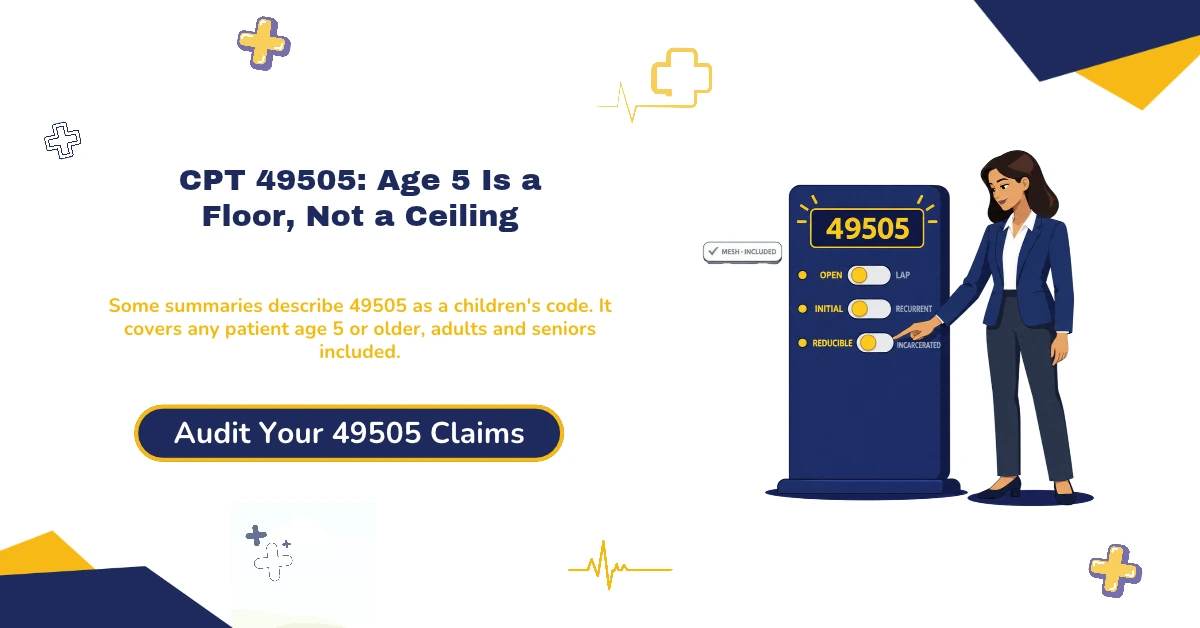
CPT code 49505 reports an open repair of an initial, reducible inguinal hernia in a patient age 5 or older. Adults fall under it too; the age floor only separates it from the pediatric codes. For 2026, Medicare pays a national $508.03 for it, and it carries a 90-day global period.
Most denials on this code come from picking the wrong neighbor: a recurrent hernia billed as initial, or a trapped hernia sent out as reducible. Get the code selection right, keep mesh off the claim, and match each payer’s modifier format, and 49505 pays on the first submission.
What CPT Code 49505 Covers
The 49505 CPT Code Description in Plain Terms
The AMA descriptor reads: “Repair initial inguinal hernia, age 5 years or older; reducible.” In plain terms, it’s an open inguinal hernia repair: the surgeon opens the groin, pushes the hernia contents back into the abdomen, and closes the weak spot in the inguinal canal. Op notes often call it an inguinal herniorrhaphy or hernioplasty.
Some lay summaries describe the patient as “a child, five years of age or older,” and that wording confuses coders. A 30-year-old qualifies. So does an 80-year-old. The age 5 threshold exists to route younger patients to their own codes, and it sets no upper limit.
Four Conditions a 49505 Claim Has to Meet
- Open approach through a groin incision
- Initial repair, with no prior repair on that side
- Patient age 5 or older on the date of surgery
- Reducible hernia contents at the time of repair
Miss any one of the four, and a different code applies. A laparoscopic or robotic repair moves to its own codes, and a documented prior repair on the same side moves the claim to the recurrent codes.
How to Pick the Right Inguinal Hernia Repair CPT Code
The inguinal hernia repair CPT code family runs from 49491 to 49525 for open repairs, plus 49650 and 49651 for laparoscopic work. Three facts on the op note decide the code: the approach, any prior repair on that side, and whether the hernia reduced. Age matters only for initial open repairs.
| Scenario on the op note | CPT code |
|---|---|
| Open, initial, age 5 or older, reducible | 49505 |
| Open, initial, age 5 or older, incarcerated or strangulated | 49507 |
| Open, initial, age 6 months to younger than 5 (reducible / incarcerated) | 49500 / 49501 |
| Open, initial, full-term infant under 6 months or preterm infant over 50 weeks postconception (reducible / incarcerated) | 49495 / 49496 |
| Open, initial, preterm infant up to 50 weeks postconception (reducible / incarcerated) | 49491 / 49492 |
| Open, recurrent, any age (reducible / incarcerated or strangulated) | 49520 / 49521 |
| Open, sliding hernia, any age | 49525 |
| Laparoscopic or robotic (initial / recurrent) | 49650 / 49651 |
CPT 49505 vs 49650: Open vs Laparoscopic Repair
Approach is the only difference between these two. 49505 describes an open repair through a groin incision. 49650 describes a laparoscopic repair through ports with a camera, and a robotic repair reports 49650 as well. Age and reducibility have no bearing on 49650, which our CPT 49650 billing guide covers in full.
Conversions cause the most confusion. If the surgeon starts with a laparoscopic approach and converts to open, report the open code, which is 49505 for an initial reducible hernia. Make sure the op note states the reason for the conversion, such as dense adhesions, unclear anatomy, or bleeding.
CPT 49505 vs 49507 and 49520
CPT code 49507 covers the same open, initial repair in a patient age 5 or older, with one change: the hernia was incarcerated or strangulated. Incarcerated means the contents stayed trapped and wouldn’t reduce. Strangulated means the trapped tissue lost its blood supply. If the surgeon reduced the hernia, 49507 doesn’t fit.
49520 covers a recurrent reducible hernia at any age, so a documented prior repair on the same side sends the claim there. A sliding hernia, where an organ such as the bladder or colon forms part of the sac, goes to 49525 regardless of age or status.
Does CPT 49505 Include Mesh?
Yes. Mesh placement is part of 49505, and the surgeon can’t bill it on a separate line. The 2026 NCCI Policy Manual, Chapter 6 bars mesh or prosthesis implantation codes from being reported with a hernia repair unless CPT instructions allow it. No CPT instruction allows it for an inguinal repair.
Some chargemasters still carry +49568, the old mesh add-on. CPT deleted it on January 1, 2023, and it only ever applied to incisional and ventral repairs. If your system still splits an inguinal hernia repair with mesh into two lines, fix that mapping before the next claim goes out.
The facility claim follows its own rules. A hospital outpatient department can list the mesh under HCPCS C1781, and Medicare packages that payment into the procedure. That line belongs on the hospital’s claim, while the surgeon’s claim carries 49505 alone.
Modifiers for CPT Code 49505
A one-sided repair doesn’t need a modifier under CPT rules, but most payers still want RT or LT. A left inguinal hernia repair goes out as 49505-LT, and a right inguinal hernia repair goes out as 49505-RT. Leaving laterality off is a common route to a CO-4 denial.
Billing a Bilateral Inguinal Hernia Repair
Medicare wants a single line: 49505 with modifier 50 and one unit. Under the CMS Claims Processing Manual, Chapter 12, Medicare pays bilateral procedures at 150% of the one-side amount. At the 2026 national rate, that works out to about $762.05 before geographic adjustment.
Commercial payers split on format. Some accept 49505-50 on one line, and others want two lines with RT and LT. Check each payer’s bilateral policy before you submit, and check the current quarter’s CMS MUE table when a payer questions your units.
Other Modifiers That Show Up With 49505
- 22 when the work ran well past normal, backed by time and findings in the op note
- 51 when the surgeon performs another procedure in the same session
- 59 or XS when a bundled procedure happened at a separate site or incision
If bilateral and laterality edits keep bouncing your hernia claims, a second set of eyes can save weeks of rework. See how our medical billing services handle surgical claims across surgical specialties, including general surgery and ASC cases.
Procedures Billed With 49505: What Bundles and What Doesn’t
Surgeons often fix more than the hernia. Whether an added procedure gets its own line depends on the patient’s age, the incision, and whether the work was separate from the hernia sac.
- Hydrocele excision (55040): bill it on its own line for patients age 5 or older, since only the pediatric codes 49491 to 49501 include hydrocelectomy
- Spermatic cord lipoma (55520): bill it only when the excision was distinct from the hernia sac work, with 59 or XS
- Femoral hernia repair (49550): NCCI bundles it into 49505 on the same side through the same incision, and opposite sides take RT and LT
- Umbilical or ventral hernia at a separate site: report it from 49591 to 49596, based on defect size
The lipoma rule starts the most arguments. Coding Clinic for HCPCS allows 55520 when the op note describes the lipoma excision as separate from the hernia sac dissection. Our breakdown of modifier 59 and X modifiers explains which one fits your scenario.
CPT Code 49505 Reimbursement in 2026
Medicare’s 2026 national payment for CPT code 49505 is $508.03. That figure comes from 15.21 total RVUs multiplied by the $33.4009 conversion factor for practitioners outside qualifying APMs. It’s the facility amount, since surgeons perform this repair in a hospital or ASC, and your MAC locality adjusts it through the GPCIs.
| 2026 Medicare value | CPT 49505 |
|---|---|
| Work RVU | 7.76 |
| Practice expense RVU (facility) | 5.40 |
| Malpractice RVU | 2.05 |
| Total RVU | 15.21 |
| Conversion factor (non-qualifying APM) | $33.4009 |
| National payment | $508.03 |
| Global period | 090 |
Pull your local amount from the CMS PFS Look-Up Tool instead of copying a national figure into your fee schedule. CMS posted the October 2026 RVU release, RVU26D, on August 26, 2026, so use the current quarter when you update charges.
Why the 2026 Rate Dropped While the Conversion Factor Rose
The non-APM conversion factor rose 3.26% for 2026, yet 49505 fell from $515.60 to $508.03, a 1.47% drop. The CY 2026 PFS final rule (CMS-1832-F) cut work RVUs 2.5% for non-time-based services and trimmed indirect practice expense for facility-based work.
Facility Payments for ASC and Hospital Outpatient Cases
The facility bills its own claim. For 2026, Medicare’s national facility rate runs about $3,658 in a hospital outpatient department under APC 5341 and about $1,744 in an ASC. The surgeon’s claim uses POS 22 for on-campus hospital outpatient cases, and our POS 22 billing guide covers that setup.
Patients see a different number. Medicare.gov’s Procedure Price Lookup shows an average patient cost of $449 for 49505 in an ASC and $832 in a hospital outpatient department, with facility and doctor fees combined.
The 90-Day Global Period for 49505
CPT 49505 carries a 090 global period: the day before surgery, the day of surgery, and 90 days after. Related follow-up visits inside that window carry no charge of their own. Many practices log them with 99024 so the visit still shows in the record.
- 57 on the visit where the surgeon decided to operate, if it falls on the day before or the day of surgery
- 24 on an unrelated E/M visit during the 90 days
- 78 for a related return to the operating room, such as a hematoma evacuation
- 79 for an unrelated procedure during the global period
Watch the decision visit. Coders often put 25 on it, and Medicare expects 57 for a 90-day global procedure, as the CMS Global Surgery Booklet lays out.
Documentation and ICD-10 Codes That Support 49505
What the Operative Report Has to Show
- The side repaired, or both sides
- Initial repair, or the date and side of any prior repair
- Reducible, incarcerated, or strangulated status at surgery
- The open approach, plus the reason for any conversion
- Each added procedure, with its site and incision
- Symptoms or exam findings that justify the repair
If the surgeon explores the groin and finds no hernia, don’t send 49505 as though a repair happened. Route that op note to a coder first, since payers vary on how they handle a negative exploration and the claim has to match what the surgeon did.
ICD-10-CM Codes That Match CPT Code 49505
Payers compare the diagnosis against the CPT descriptor, so a recurrent or obstructed diagnosis on a 49505 line invites a CO-11 denial. The K40 codes below are current in the FY 2027 ICD-10-CM code set, which took effect October 1, 2026.
| ICD-10-CM | What it means | Matching CPT |
|---|---|---|
| K40.90 | Unilateral, no obstruction or gangrene, not recurrent | 49505 with RT or LT |
| K40.20 | Bilateral, no obstruction or gangrene, not recurrent | 49505-50 |
| K40.91 / K40.21 | Unilateral / bilateral, no obstruction or gangrene, recurrent | 49520 |
| K40.30 / K40.00 | Unilateral / bilateral, with obstruction, not recurrent | 49507 |
| K40.40 / K40.10 | Unilateral / bilateral, with gangrene, not recurrent | 49507 |
Why CPT 49505 Claims Get Denied
| Denial | What went wrong | Fix |
|---|---|---|
| CO-11 | Recurrent or obstructed diagnosis on a 49505 line | Recode to 49520 or 49507, or correct the diagnosis |
| CO-97 | Mesh, femoral repair, or lipoma billed without separate work | Remove the bundled line, or document the separate site and add 59 or XS |
| CO-4 | Missing RT or LT, or the wrong bilateral format for that payer | Match the payer’s laterality and bilateral format |
| CO-50 | Payer questions medical necessity for an asymptomatic hernia | Document symptoms, exam findings, and the reason for repair |
| CO-197 | No prior authorization on a plan that requires it | Verify authorization when the case gets scheduled |
Most of these start in the op note or the chargemaster. Fix the source once, and the same denial stops repeating across the surgeons in your group. A clean claim on 49505 comes down to those two inputs.
If hernia denials pile up faster than your team can appeal them, our denial management services work each one back to its root cause and fix the workflow behind it.
CPT Code 49505 FAQs
Is CPT 49505 only for children?
No. CPT 49505 covers any patient age 5 or older, adults and seniors included. Patients younger than 5 get the pediatric codes 49491 to 49501, which also include hydrocelectomy. The age wording in the descriptor sets a floor and has no upper limit.
Is CPT 49505 still valid in 2026?
Yes. The 2023 hernia overhaul deleted the old umbilical, ventral, and incisional repair codes and replaced them with 49591 to 49618. The inguinal codes, 49491 to 49525, stayed out of that change, and 49505 remains active for 2026.
Does CPT 49505 need prior authorization?
It depends on the plan. Original Medicare doesn’t require prior authorization for inguinal hernia repair, but many Medicare Advantage and commercial plans do for elective cases. Verify it during scheduling, because a missing authorization leads to a CO-197 denial.
Getting 49505 Claims Paid on the First Pass
Clean 49505 claims come down to three things: the right code for approach, history, and reducibility; mesh kept off the claim; and the modifier format each payer expects. Get those right, and the 49505 CPT code turns into one of the more predictable surgical claims you send.
If your surgical claims need a closer look, ClaimMax RCM can start with a free Revenue Cycle Health Score. It shows where your general surgery claims lose money and what to fix first.
From there, our team can take over coding, submission, and follow-up through full revenue cycle management, so your staff spends less time on rework and more time on patients.