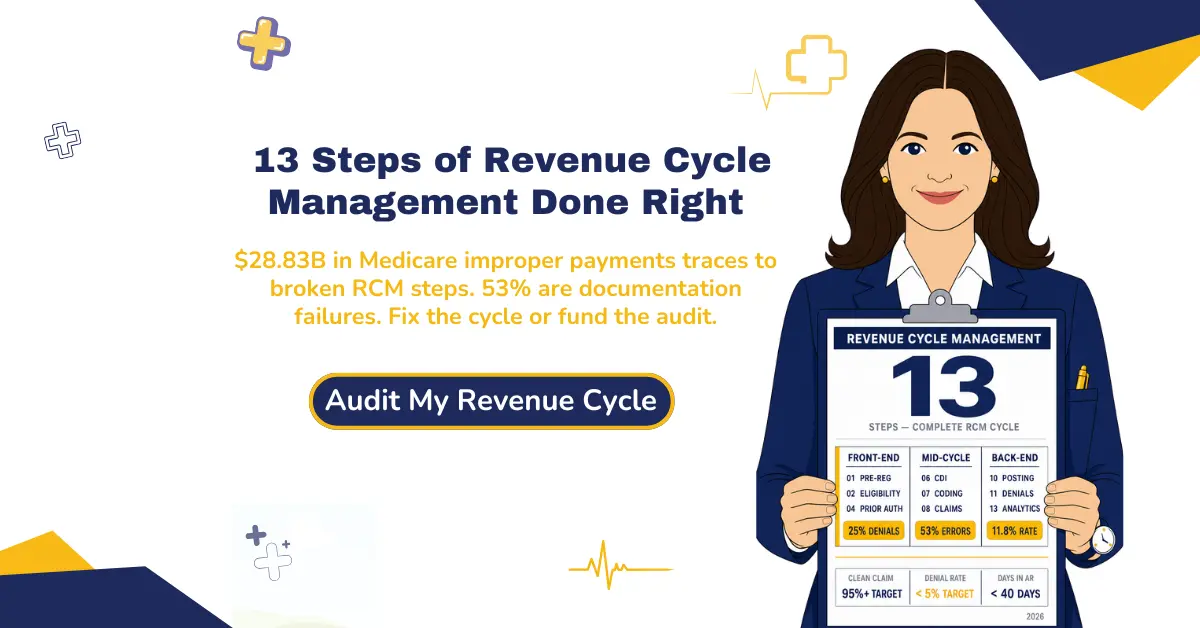
The financial math for healthcare providers in 2026 doesn’t leave room for error. CMS released its FY2025 Medicare Fee-for-Service improper payment data on January 24, 2026, reporting a 6.55% improper payment rate, representing $28.83 billion in improper Medicare payments in a single fiscal year. That number isn’t an abstract policy concern. It’s a direct indicator of how many claims across the industry are failing at some point in the revenue cycle.
The 13 steps of revenue cycle management are the standardized financial workflow that transforms a patient encounter into collected revenue. The cycle starts when a patient schedules an appointment and ends when every dollar owed has been collected, posted, and analyzed. Healthcare providers organize these 13 steps across three phases: front-end (pre-registration through prior authorization), mid-cycle (charge capture through claim submission), and back-end (payment posting through reporting and compliance auditing).
Claimmax RCM’s billing specialists and certified coders work inside this cycle daily, across primary care, behavioral health, cardiology, internal medicine, and specialty practices nationwide. This guide is built from that operational experience, not a textbook. You’ll get the complete 13-step walkthrough, KPI benchmarks from HFMA, 2026 regulatory updates including CMS-0057-F and the April 2026 ICD-10-CM update, denial prevention strategies, and a clear answer to whether you should outsource.
The CMS supplemental data released January 24, 2026, makes the strongest structural argument for getting this right. Insufficient documentation alone accounts for 53% of all Medicare improper payments. That’s not a billing failure. It’s a documentation failure originating in the first five steps of the cycle. Most revenue leakage is front-loaded. Every figure, regulation, and benchmark in this guide reflects data current as of May 2026.
Here’s what you’ll find in this guide: the definition of RCM, why it matters in 2026, a quick reference table covering all 13 steps, the three-phase framework, a complete walkthrough of every step, AI and automation trends, KPI benchmarks, and the outsource decision framework. Start with the section where your practice has the most friction.
What Is Revenue Cycle Management in Healthcare?
Revenue cycle management is the comprehensive financial process healthcare organizations use to track patient care episodes from registration through final payment collection. RCM encompasses patient access, insurance verification, charge capture, medical coding, claim submission, payment posting, denial management, and accounts receivable follow-up. Effective RCM ensures healthcare providers receive full and timely reimbursement for every service rendered.
The cycle’s boundaries matter. It begins the moment a patient schedules an appointment, before any clinical service is delivered. It ends only after every dollar owed has been collected from both payers and patients, payments have been reconciled, and the data has been analyzed for performance optimization. Most RCM failures occur at the cycle’s boundaries, not its middle.
Many practices use “medical billing” and “revenue cycle management” interchangeably. They aren’t the same thing. Medical billing covers a specific segment: coding, claim submission, payment posting, and denial follow-up. RCM covers everything from scheduling through analytics. Understanding the difference between medical billing and full RCM is the starting point for diagnosing where your revenue cycle is actually breaking down.
According to the Healthcare Financial Management Association (HFMA), RCM is organized as a continuous workflow rather than a linear process. AHIMA breaks it into three core stages: front-end processes (registration, insurance verification, authorizations), mid-revenue cycle (coding, documentation, charge capture, utilization review), and back-end processes (claims, denials, reimbursement optimization). This three-stage framework structures every modern RCM operation.
Within those three stages, the standard industry framework breaks the 13 steps of revenue cycle management into discrete, manageable steps. Each step has its own inputs, outputs, performance metrics, and failure modes. Each step is also a control point where you can prevent revenue leakage before it starts.
Why Revenue Cycle Management Matters for Healthcare Providers in 2026
Healthcare finances in 2026 are under pressure from every direction. Staffing shortages have left billing departments running lean. Claim denial rates keep climbing. Operational costs rise while reimbursements stay flat. According to Experian Health’s 2025 State of Claims Survey, 41% of healthcare providers now report denial rates exceeding 10%, up from 30% just three years ago.
The denial numbers are specific and serious. Initial claim denial rates hit 11.8% in 2024, up from 10.2% just a few years earlier. Medicare Advantage denial rates spiked 4.8% from 2023 to 2024 alone, now sitting near 17%, double traditional Medicare. For an average health system, that translates to approximately 110,000 unpaid claims annually. Revenue lost to denied claims now averages 7% of total provider revenue.
The clean claims crisis compounds the problem. According to Experian Health 2025, 68% of healthcare organizations believe submitting a clean claim is harder today than it was a year ago. Half of survey respondents report missing or inaccurate claim data is the number one factor driving rising denial rates, up 4% from 2024. One in three hospitals now reports bad debt levels exceeding $10 million.
For practices running physician groups, outpatient clinics, behavioral health practices, or specialty groups, the question is no longer whether RCM matters. It’s whether your current process can survive the operational pressure of 2026. Practices that treat RCM as a back-office task fall behind. Practices that treat the 13 steps of revenue cycle management as critical financial infrastructure move ahead.
The remainder of this guide walks through each of the 13 steps in detail. If you’re already evaluating outsourcing or upgrading your RCM operation, the team at Claimmax RCM provides comprehensive revenue cycle management services tailored to practices facing exactly these pressures. Otherwise, the next section gives you the complete step reference before the deep dives begin.
The 13 Steps of Revenue Cycle Management at a Glance
The table below summarizes all 13 steps of revenue cycle management with each step’s phase placement, primary function, and 2026 focus. Use this reference to identify which stage of the cycle creates the most revenue leakage in your operation. Each step is detailed in its own section further in this guide.
| Step | Step Name | Phase | Primary Function | 2026 Focus |
|---|---|---|---|---|
| 1 | Patient Pre-Registration and Scheduling | Front-End | Capture demographics and insurance | Telehealth integration |
| 2 | Insurance Verification and Eligibility | Front-End | Confirm coverage via X12 270/271 | Top-5 denial cause prevention |
| 3 | Patient Registration and Check-In | Front-End | Verify identity and collect copays | Electronic ID scanning |
| 4 | Prior Authorization | Front-End | Secure payer pre-approval (X12 278) | CMS-0057-F compliance |
| 5 | Charge Capture | Front-End/Mid-Cycle | Document billable services | AI-driven capture |
| 6 | Clinical Documentation and CDI | Mid-Cycle | Support medical necessity | 53% of CMS errors |
| 7 | Medical Coding | Mid-Cycle | Assign ICD-10, CPT, HCPCS codes | FY2026 ICD-10-CM update |
| 8 | Claim Scrubbing and Submission | Mid-Cycle | Submit clean claims (X12N 837) | 68% say harder than ever |
| 9 | Claim Adjudication and Status | Mid-Cycle | Track claim status (X12 276/277) | Real-time payer adjudication |
| 10 | Payment Posting and Reconciliation | Back-End | Post payments (X12 835/EFT) | Automation priority |
| 11 | Denial Management and Appeals | Back-End | Recover denied revenue | 11.8% denial rate |
| 12 | Patient Billing and Collections | Back-End | Collect patient responsibility | NSA Good Faith Estimates |
| 13 | Reporting, Analytics, and Compliance | Back-End | Monitor KPIs and audit readiness | HFMA MAP Keys |
The 13 steps of revenue cycle management aren’t independent processes. Each step’s output is the next step’s input. A breakdown at any step cascades through the rest of the cycle. The next section explains the three-phase framework that determines how breakdowns at one phase compound into financial losses at later phases.
The 3 Phases of Revenue Cycle Management: Front-End, Mid-Cycle, and Back-End
Industry frameworks from HFMA and AHIMA organize the 13 steps of revenue cycle management into three sequential phases. The front-end phase covers everything before claim submission. The mid-cycle phase captures the clinical encounter and converts it into a billable claim. The back-end phase handles claim processing, payment, and performance analysis. Each phase has distinct tools, KPIs, and failure modes.
The front-end phase covers Steps 1 through 5: patient pre-registration and scheduling, insurance verification, patient registration and check-in, prior authorization, and charge capture. Front-end errors are the most expensive in the entire revenue cycle because they create cascading downstream failures. According to Experian Health 2025, more than 25% of denials trace directly to inaccurate or incomplete data collected at patient intake. Front-end discipline determines back-end revenue.
The mid-cycle phase covers Steps 6 through 9: clinical documentation, medical coding, claim scrubbing and submission, and claim adjudication and status tracking. This is where clinical reality converts into billable data. CMS supplemental data released January 24, 2026, shows insufficient documentation accounts for 53% of all Medicare improper payments. The mid-cycle phase is where audit risk lives.
The back-end phase covers Steps 10 through 13: payment posting and reconciliation, denial management and appeals, patient billing and collections, and reporting and compliance auditing. Back-end performance determines how much of your earned revenue you actually collect. Back-end failure looks like aging accounts receivable, mounting denials, and bad debt. Back-end excellence looks like clean payment cycles, fast denial recovery, and predictable cash flow.
Understanding which phase your revenue cycle is failing in is the first step toward fixing it. The next 13 sections walk through each step in order, covering best practices, 2026 regulatory updates, common errors, KPI targets, and the specific failure modes that drain revenue.
Step 1: Patient Pre-Registration and Scheduling
Patient pre-registration and scheduling is the first step in the revenue cycle. It begins when a patient contacts the practice to schedule an appointment. During this step, the practice captures patient demographics, insurance information, contact details, and visit purpose. Pre-registration sets the foundation for every downstream step in the cycle, from eligibility verification to final payment.
As the front door to the patient experience, scheduling establishes the full flow of the RCM journey. Strategic scheduling helps maintain optimum schedule density so physicians spend appropriate time with patients while still seeing as many patients as possible. Pre-registration allows the practice to capture demographic and insurance information in real time, often while the patient is still on the phone or filling out an online intake form.
This is also where the most expensive errors in the revenue cycle originate. According to Experian Health 2025, more than 25% of denials result from inaccurate or incomplete data collected at patient intake. Errors in pre-registration cascade through every downstream step. A wrong insurance ID number entered here means an eligibility verification failure in Step 2, a denial in Step 11, and revenue loss that traces back to a single data entry mistake at Step 1.
Telehealth services have remained prominent post-pandemic, requiring practices to update pre-registration workflows for virtual encounters. Online registration portals, secure payment capture, and digital ID verification are now standard expectations. Practices managing both in-person and virtual encounters need specialized telehealth medical billing workflows that account for unique billing rules, place-of-service codes, and telehealth modifier requirements.
Best practices for Step 1: use online patient portals to let patients enter and verify their own data. Verify insurance eligibility and coverage in advance through real-time clearinghouse integration. Offer multiple registration channels including in-person, online, and phone. Send appointment reminders to reduce no-show rates. Track registration accuracy rate as a KPI; industry standard is 95% or higher accuracy on initial intake.
Step 1 also intersects with provider-side identity infrastructure. Under HIPAA Administrative Simplification, every covered provider must use a National Provider Identifier (NPI) on every claim and standardized transaction. CMS encourages Medicare enrollment via PECOS and uses CMS-855 forms for new providers. If your practice’s NPI or enrollment data is incorrect at the system level, every claim downstream will be misrouted, mis-paid, or denied. Provider enrollment is the silent prerequisite to Step 1.
Step 2: Insurance Verification and Eligibility (HIPAA X12 270/271)
Insurance verification and eligibility is the second step in the revenue cycle. After a patient schedules and pre-registers, the practice must confirm the patient has active insurance coverage and verify the specific terms of that coverage. This step protects the practice from delivering services that won’t be reimbursed and prepares the patient for any out-of-pocket financial responsibility before the encounter.
Eligibility verification is no longer a phone call. It’s a HIPAA-standard electronic transaction. CMS adopted the X12 5010 270 transaction for eligibility requests and the X12 5010 271 transaction for eligibility responses as the official electronic standard. Operating rules for eligibility transactions have been required for HIPAA-covered entities since January 1, 2013. Modern RCM operations run real-time 270/271 transactions through clearinghouses for every patient before every encounter.
Verifying insurance is part of the eligibility verification step, which is Step 2 in the 13 steps of revenue cycle management framework. This step occurs after pre-registration (Step 1) and before patient registration and check-in (Step 3). Verification should always happen before the patient arrives at the facility, not at the front desk during check-in.
Provider eligibility and coverage errors rank among the top-5 causes of claim denials every year. According to Experian Health 2025, 50% of survey respondents report missing or inaccurate claim data is the number one factor contributing to rising denial rates, up 4% from 2024. Practices that automate real-time 270/271 verification before every encounter cut denials at the source.
A complete eligibility check confirms: the patient’s insurance is active on the date of service, the specific plan covers the planned service, the patient’s deductible status and remaining balance, copay and coinsurance amounts, prior authorization requirements (which trigger Step 4), out-of-pocket maximum status, and coordination of benefits if the patient has secondary or tertiary coverage. Each data point feeds downstream RCM decisions.
Best practices: run eligibility checks 24 to 48 hours before every appointment. Re-verify on the day of service for high-cost procedures. Document the verification result and capture the payer’s eligibility response number for audit trail purposes. Train front-desk staff to read 271 responses and flag coverage gaps. For practices that lack the staffing or technology to automate eligibility at scale, Claimmax RCM’s expert medical billing services handle 270/271 verification as part of standard RCM workflow.
Step 3: Patient Registration and Check-In
Patient registration and check-in is the third step in the revenue cycle. This step happens at the time of the encounter, whether in-person at the front desk or virtually before a telehealth session. During registration, the practice solidifies data collection to ensure the patient’s information is 100% accurate. Address, phone number, date of birth, guarantor, insurance card, and consent forms all get re-verified at this step.
Many organizations now use electronic signature capture and ID scanning to automate verification and reduce data entry errors. Digital intake forms eliminate paperwork errors before they enter the system. Patient portals allow patients to complete intake on their own devices before arriving. The goal is to confirm every data point captured in pre-registration and add anything missing before clinical care begins.
Step 3 is also when copays get collected. Collecting copayments is part of the patient registration and check-in step because the copay amount is already known from the eligibility verification in Step 2. Collecting copays at check-in is significantly more efficient than collecting them later through patient billing in Step 12. Front-desk copay collection brings revenue in immediately. Industry benchmark: collect 90% or more of copays at point of service.
Under the No Surprises Act, once an uninsured or self-pay patient schedules an item or service, the provider or facility must provide a Good Faith Estimate of expected charges. CMS enforces this through its No Surprises Act framework. If the final bill is at least $400 more than the Good Faith Estimate, the patient has 120 calendar days from the initial bill to start a Patient-Provider Dispute Resolution process. Step 3 is when GFE delivery happens for self-pay patients.
Best practices: re-verify insurance and demographic data at every encounter, even for established patients. Capture electronic signatures for all consent forms. Train front-desk staff on No Surprises Act compliance. Track copay collection rate as a KPI. Document any insurance changes immediately and trigger re-verification if coverage has changed since pre-registration.
Step 4: Prior Authorization (HIPAA X12 278)
Prior authorization is the fourth step in the revenue cycle and the most operationally complex front-end step. Before the practice delivers a specific procedure, diagnostic test, or medication, the payer often requires pre-approval to confirm the service is medically necessary and covered under the patient’s plan. Without prior authorization for procedures that require it, the claim will be denied at adjudication, even when the service was clinically appropriate.
The HIPAA-adopted standard for prior authorization is the X12N 278 transaction, classified by CMS as “health care service review information.” Modern practice management systems and EHRs integrate 278 transactions to submit electronic prior authorization requests directly to payers. Manual fax-based prior authorization persists in many organizations but is increasingly obsolete. The 278 transaction reduces administrative burden when payers and providers use it consistently.
Prior authorization is the single largest administrative burden in healthcare today. According to the 2024 American Medical Association Prior Authorization Physician Survey, physicians and their staff spend 13 hours per week completing prior authorizations. Nearly 90% of physicians report prior authorization burden contributes directly to physician burnout. Payers continue tightening prior authorization requirements, especially for expensive treatments, diagnostic imaging, and elective procedures.
CMS-0057-F, the Interoperability and Prior Authorization final rule, took effect January 1, 2026, with initial metrics reporting required by March 31, 2026. The CMS-0057-F final rule applies to Medicare Advantage organizations, state Medicaid and CHIP fee-for-service programs, Medicaid managed care plans, CHIP managed care entities, and Qualified Health Plan issuers on Federally-Facilitated Exchanges. Affected payers must now publicly report prior authorization metrics. Providers can use this transparency to hold payers accountable for excessive denials and slow turnaround.
Prior authorization issues continue to rank as a top operational challenge that triggers claim denials. According to Experian Health 2025, 35% of survey respondents identify authorizations as a primary denial trigger. Common errors: missing prior authorization entirely (CO-197 denial code), authorization received but not documented in the claim, authorization for the wrong CPT code, and authorization expired before service delivery. Each error drives denial work in Step 11.
Best practices: build a prior authorization workflow that flags every CPT code and service requiring authorization before scheduling. Submit authorization requests via X12 278 with complete clinical documentation supporting medical necessity. Track authorization status through the X12 278 response cycle. Document authorization numbers in the patient record and on the claim before submission. Maintain a payer-by-payer reference for which services require authorization. Audit denial reasons monthly to identify recurring authorization gaps.
The combined burden of prior authorization, the regulatory complexity of CMS-0057-F, and constant payer policy changes make prior authorization one of the highest-leverage activities to outsource. At Claimmax RCM, our professional prior authorization services handle the entire authorization lifecycle, from initial verification through appeals on denied requests. We use a structured authorization workflow, secure electronic submission via 278 transactions, and dedicated denial appeal teams to recover authorization-related denials.
Step 5: Charge Capture
Charge capture is the fifth step in the revenue cycle and the bridge between front-end patient access and mid-cycle billing. After the clinical encounter, every billable service, procedure, supply, and time-based code must be captured accurately and completely. Charge capture transforms what happened clinically into what gets billed financially. Missed or inaccurate charges mean services were delivered but never reimbursed, a direct hit to revenue.
In the healthcare revenue cycle, charge capture is essential. It’s the step within the 13 steps of revenue cycle management where earned revenue is most frequently lost without anyone noticing. Every aspect of care must be accurately documented, coded, and translated into a charge before claim creation. According to the Healthcare Financial Management Association, charge capture errors typically cost practices between 1% and 5% of total revenue each year. For a practice generating $5 million in annual revenue, that’s $50,000 to $250,000 in preventable losses.
Common charge capture errors include: services delivered but not entered into the system before billing close, time-based codes captured at the wrong unit count, supply charges missed because they weren’t tied to a billable encounter, modifier omissions that change reimbursement levels, place-of-service codes mismatched between the EHR and the billing system, and split or shared encounters not properly attributed to the rendering provider. Each error type has a specific operational fix.
The 2026 trend reshaping charge capture is AI-driven automation. AI-driven automated charge capture ensures data is captured accurately, in real time, at the point of care, eliminating gaps that traditionally lead to denials and lost revenue. Mobile charge capture applications now synchronize directly with the billing system. Practices adopting AI-assisted charge capture report accuracy improvements of 5% to 15% within the first year.
Best practices: implement electronic charge capture systems integrated with the EHR. Train providers on accurate code selection at the point of care, not retroactively. Run daily charge capture reconciliation between clinical documentation and billing records. Build automated alerts for incomplete charge capture before claim creation. Conduct internal charge capture audits monthly. Track charge lag as a KPI; industry standard is less than 5 days from service delivery to charge entry.
Step 6: Clinical Documentation and CDI
Clinical documentation and Clinical Documentation Improvement (CDI) is the sixth step in the revenue cycle and the heart of the mid-cycle phase. Clinical documentation is the medical record’s narrative of what happened during the encounter: history, exam findings, diagnoses, procedures, time spent, and clinical reasoning. CDI is the structured program that ensures this narrative supports medical necessity, justifies code specificity, and survives payer audits.
Documentation sits at the center of the 13 steps of revenue cycle management. If the medical record doesn’t clearly support the diagnosis, complexity, and treatment choice, the rest of the revenue cycle collapses under audit. According to CMS supplemental data released January 24, 2026, insufficient documentation accounts for 53.0% of all Medicare improper payments. Combined with no documentation (12.0%), incorrect coding (11.1%), and medical necessity errors (15.3%), documentation-related issues drive the overwhelming majority of improper payments measured by the CMS CERT program.
High-performing RCM teams structure documentation in four layers. Registration and intake documentation captures demographics, insurance, policy details, referrals, and authorizations to prevent eligibility and coverage denials. The clinical encounter note captures history, exam findings, risk factors, and test results to support ICD-10 specificity. The assessment and plan documents diagnoses, medical decision-making, treatment, and follow-up to demonstrate medical necessity for CPT and HCPCS codes. The billing and coding summary connects the clinical story to structured claim data through final codes, modifiers, place of service, and rendering provider.
Documentation errors that consistently trigger audit findings include: time-based services billed without documented time, high-level evaluation and management visits billed without supporting complexity, signed but not dated provider notes, missing elements required for specific code categories, unsigned or missing physician orders, and chronic condition documentation that fails MEAT criteria (Monitoring, Evaluation, Assessment, Treatment). Each pattern has a specific CDI workflow remedy.
Modern CDI programs combine concurrent documentation review during the encounter or admission, retrospective audit after discharge but before billing, and provider education that trains clinicians to document for both clinical care and reimbursement. Successful CDI programs measure outcomes through query rate, query response rate, case-mix index improvement, and audit defense success rate.
Best practices: implement structured documentation templates aligned with payer policies and specialty norms. Train providers on documentation that satisfies both clinical care and reimbursement standards. Run concurrent CDI review on all admissions and high-acuity encounters. Audit a statistically valid sample of charts monthly. For Medicare patients, ensure chronic condition documentation meets MEAT criteria annually to support risk adjustment and HCC capture.
Step 7: Medical Coding (ICD-10-CM, CPT, and HCPCS)
Medical coding is the seventh step in the revenue cycle. Certified coders translate clinical documentation into standardized codes that payers use to adjudicate claims. ICD-10-CM codes describe diagnoses and the reasons for medical encounters. CPT codes describe procedures, evaluations, and services provided by clinicians. HCPCS Level II codes describe supplies, equipment, and services not covered by CPT. Together, these code systems form the universal language of healthcare reimbursement.
Coding accuracy is non-negotiable. The ICD-10-CM Official Guidelines for Coding and Reporting, FY 2026 (updated April 1, 2026) are the official rules in effect for the coding period from April 1, 2026 through September 30, 2026. Practices that haven’t updated their coding software, training materials, and audit standards to reflect the April 2026 update are coding against an outdated rule set, which directly creates denial risk.
According to the American Health Information Management Association (AHIMA), up to 50% of denied claims are due to coding errors. Coders must aim for more than 95% accuracy across the full code set, with even higher accuracy required when coding DRGs for inpatient facility claims. In some payer-segment analyses, up to 49% of claims are affected by routine coding and documentation issues that could have been prevented at the coding step.
Coding accuracy becomes especially important in specialty practices where code selection drives reimbursement levels. Occupational therapy practices, for example, manage a complex code set across the 97000 series (Physical Medicine and Rehabilitation), 96000 series (Behavioral Health Assessments), and 98000 series (Remote Therapeutic Monitoring). Practices managing specialty coding without dedicated subject matter expertise see denial rates climb fast.
The 2026 trend reshaping coding is the shift from Computer-Assisted Coding (CAC) to fully autonomous coding. According to GlobeNewswire’s 2025 Market Report, over 30% of US healthcare organizations are piloting or planning autonomous coding implementations. Autonomous coding uses AI to assign codes directly from clinical documentation. For high-volume routine encounters, autonomous coding is delivering accuracy comparable to certified human coders at significantly lower cost.
Best practices: employ AAPC-certified or AHIMA-credentialed coders. Provide continuous training on payer-specific coding rules and the FY2026 mid-year ICD-10-CM update. Conduct monthly coding audits with statistically valid sample sizes. Track coder accuracy, query response rate, and case-mix index trends. For practices without internal coding capacity, evaluate whether autonomous coding pilots or specialized RCM coding services deliver better economics than staffing certified coders internally.
Step 8: Claim Scrubbing and Submission (HIPAA X12N 837)
Claim scrubbing and submission is the eighth step in the revenue cycle. After coding is complete, the practice generates an electronic claim and runs it through a scrubbing engine that checks for errors before transmission. Once the claim passes scrubbing, it gets submitted to the payer through a clearinghouse or directly via secure electronic channels. This step converts billable data into a claim the payer can actually adjudicate.
The HIPAA-adopted standard for healthcare claims is the X12N 837 transaction. CMS recognizes the 837P (professional claims), 837I (institutional claims), and 837D (dental claims) as the official standard formats. Modern RCM operations submit claims electronically through clearinghouses like Availity, Waystar, Trizetto, and Change Healthcare (now Optum). The CMS-1500 form (paper professional) and UB-04 form (paper institutional) remain in use but represent a shrinking minority of claims.
Submitting clean claims is harder than ever. According to Experian Health 2025, 68% of healthcare organizations believe it’s now harder to submit a clean claim than it was a year ago. Half of survey respondents report missing or inaccurate claim data is the number one factor driving rising denial rates, up 4% from 2024. Clean claim rate is one of the most important RCM KPIs, with industry standard at 95% or higher. Practices below 90% are losing significant revenue to rework alone.
Claim scrubbing happens at two layers: practice management system edits catch internal errors before transmission, and clearinghouse edits run payer-specific rules and known denial patterns before forwarding the claim to the payer. Modern scrubbing engines flag missing modifiers, incompatible code combinations, eligibility mismatches, prior authorization gaps, and timely filing risks before the claim ever leaves the practice.
Timely filing matters. Medicare claims are denied for untimely filing if received more than 12 months from the date of service. CMS states this denial is not an initial determination and is not subject to appeal. Once the timely filing window closes, the claim is permanently uncollectable. Commercial payer timely filing windows vary widely from 90 days to 365 days depending on contract terms.
Best practices: run claim scrubbing at both PMS and clearinghouse layers before every submission. Track first-pass clean claim rate as a primary KPI. Audit denied claims monthly to identify recurring scrubbing gaps. Maintain a payer-by-payer reference for timely filing windows. For practices struggling with clean claim rates below 90%, Claimmax RCM’s specialized medical billing services cover claim scrubbing, submission, and rejection management as part of standard workflow.
Step 9: Claim Adjudication and Status Tracking (HIPAA X12 276/277)
Claim adjudication and status tracking is the ninth step in the revenue cycle. After the claim is submitted, the payer enters its adjudication process to determine whether the claim will be approved, denied, or pended for additional information. Adjudication evaluates eligibility, medical necessity, coding accuracy, payer policy compliance, and contracted rates. The output is one of three outcomes: payment in full, partial payment with adjustments, or denial.
While the payer adjudicates, the practice tracks claim status through HIPAA-standard transactions. CMS adopted the X12 276 transaction for claim status inquiries and the X12 277 transaction for claim status responses. Operating rules for claim status transactions have been required for HIPAA-covered entities since January 1, 2013. Modern RCM operations run automated 276 inquiries on submitted claims that haven’t returned a response within expected timeframes.
Adjudication checks patient eligibility on date of service; coverage of the specific service under the patient’s plan; medical necessity per the payer’s local coverage determinations and policies; coding accuracy and code combination logic via NCCI edits; prior authorization status if required; contracted rate application; deductible and out-of-pocket calculations; and timely filing compliance. Each check corresponds to a specific denial code if the claim fails.
Payers have moved aggressively toward real-time adjudication in 2025 and 2026. Faster automated adjudication engines flag errors immediately rather than weeks later. This means practices receive denial decisions faster but also have less time to correct front-end errors before the denial cycle starts. Practices that automate 276/277 status checks within hours of submission catch issues earlier when they’re cheapest to fix.
Best practices: run automated 276 status inquiries on submitted claims at 7, 14, and 21 days post-submission. Build dashboards that flag claims aged beyond expected adjudication timelines. Train AR teams to interpret 277 responses and route them to the appropriate workflow: payment posting, denial management, or appeals. Track adjudication time by payer to identify patterns that affect cash flow forecasting.
Step 10: Payment Posting and Reconciliation (HIPAA X12 835 and EFT)
Payment posting and reconciliation is the tenth step in the revenue cycle. After the payer adjudicates the claim, payment flows to the practice through Electronic Funds Transfer (EFT) and the corresponding remittance information arrives through the Electronic Remittance Advice (ERA). The practice posts the payment to the patient’s account, reconciles the payment against the expected amount, identifies any underpayments or contractual adjustments, and routes denials or rejections to the next workflow.
CMS explains EFT uses the ACH network for fund transfer, while the ERA (the X12 835 transaction) supplies the information about the payment and adjustments. CMS states health plans must conduct EFT and ERA standard transactions with providers when asked under Administrative Simplification rules. All health plans must use Claim Adjustment Reason Codes (CARCs) and Remittance Advice Remark Codes (RARCs) to explain payment adjustments and are not permitted to use proprietary codes in the ERA. The Trace Number (TRN) reassociates EFT payments with their corresponding ERAs.
Effective payment posting accomplishes four things. First, it updates patient accounts so balances reflect actual paid and adjusted amounts. Second, it reconciles payments against expected amounts based on contracted rates, flagging underpayments for follow-up. Third, it categorizes denied or rejected line items so denial management workflows can pick them up. Fourth, it produces the financial data that feeds reporting and analytics in Step 13.
Common payment posting errors include: posting to the wrong patient or claim, missing line-level adjustments that hide underpayments, incorrect contractual write-off amounts, incomplete CARC/RARC interpretation that miscategorizes denials, manual entry errors in high-volume posting, and missed secondary claim triggers when primary payment doesn’t cover the full balance. Each error type has a specific automation remedy through ERA-driven auto-posting.
Best practices: implement automated ERA posting through the practice management system. Reconcile EFT receipts against ERA totals daily using TRN reassociation. Build dashboards that flag underpayments against contracted rates. Train posting staff on CARC/RARC interpretation. Audit a statistically valid sample of posted payments monthly. For practices managing high claim volumes or complex contractual arrangements, Claimmax RCM’s professional payment posting services handle ERA reconciliation, underpayment identification, and posting accuracy as a specialized function.
Step 11: Denial Management and Appeals
Denial management and appeals is the eleventh step in the revenue cycle and the most strategically important back-end function. When a claim is denied, the practice must identify the denial reason, correct the underlying issue, and either resubmit the corrected claim or file a formal appeal. Effective denial management recovers revenue that would otherwise be written off and identifies patterns that prevent future denials at their root cause.
Denial rates have climbed every year since 2022. The initial claim denial rate hit 11.8% in 2024, up from 10.2% just a few years earlier. Medicare Advantage denial rates spiked 4.8% from 2023 to 2024 alone, now sitting near 17%. Commercial plan denial rates average 13.9%. 41% of healthcare providers now report denial rates exceeding 10%, up from 30% in 2022. Revenue lost to denied claims averages 7% of total provider revenue. For an average health system, this translates to approximately 110,000 unpaid claims annually.
Denials cluster into predictable categories with specific Claim Adjustment Reason Codes. Eligibility and coverage denials (CO-22, CO-27) trace to front-end intake errors. Medical necessity denials (CO-50) trace to documentation and coding gaps. Coding and bundling denials (CO-11, CO-97) trace to mid-cycle errors. Prior authorization denials (CO-197) trace to Step 4 gaps. Timely filing denials (CO-29) trace to submission delays. Each category has a specific upstream RCM remedy that prevents it from recurring.
Denied Medicare claims have a structured appeals process. Per CMS, a party generally has 120 days from receipt of the initial claim determination to file a Level 1 appeal (redetermination). CMS publishes the five levels of Medicare claims appeals: redetermination by the Medicare Administrative Contractor, reconsideration by a Qualified Independent Contractor, hearing before an Administrative Law Judge, review by the Medicare Appeals Council, and judicial review in federal district court. Each level has specific filing deadlines and evidentiary standards.
Successful denial programs treat each denial as a feedback signal that something upstream needs repair. Tracking denials by payer, reason code, service line, and financial impact identifies the highest-impact fixes. A primary care practice with 200 patients can lose $15,000 to $30,000 annually to denials that should have been prevented at front-end steps. The cumulative cost of preventable denials adds up fast and rarely shows up clearly until AR aging gets reviewed.
Payers are already using AI-powered algorithms to process and deny claims at unprecedented speeds. According to Experian Health 2025, 67% of providers believe AI can improve claims, but only 14% currently use AI for denial management. The gap between belief and action is the wedge specialized RCM companies fill with denial-focused AI deployments combined with experienced human appeal teams.
Best practices: categorize every denial by reason code and root cause within 48 hours of receipt. File appeals within payer-specific deadlines. Track denial recovery rate as a KPI; industry standard is 65% to 85% recovery on appealed denials. Build root-cause feedback loops from denials back into front-end workflows. At Claimmax RCM, our denial management services catch denial patterns before submission, while our AR follow-up team recovers denials that slip through. Both work the same denial code patterns covered in this guide.
Step 12: Patient Billing and Collections (No Surprises Act Compliance)
Patient billing and collections is the twelfth step in the revenue cycle. After the payer pays its portion of the claim, any remaining balance, including deductibles, coinsurance, copays, and non-covered services, becomes the patient’s responsibility. The practice generates patient statements, communicates the balance, offers payment options, and pursues collection on unpaid balances through structured workflows that protect both cash flow and the patient relationship.
High-deductible health plans have made patient payments a core revenue stream. According to Becker’s 2025 industry data, 81% of patients now value accurate cost estimates before care. Practices that still rely heavily on paper statements experience 20% to 30% slower collection cycles than digital-first peers. The patient is now the second-largest payer for most practices, behind only the largest commercial insurer. Patient collections discipline is no longer optional; it’s a primary revenue driver.
The No Surprises Act created specific obligations for healthcare providers. CMS states that after an uninsured or self-pay patient schedules an item or service, the provider or facility must give a Good Faith Estimate of expected charges. A patient-provider dispute resolution process is available when the actual bill is at least $400 more than the Good Faith Estimate. Patients generally must start the dispute process within 120 calendar days of the initial bill. NSA compliance is enforced through CMS audits.
A structured patient collection process begins before the encounter through eligibility-based estimates. At the encounter, copays get collected at the point of service. After the encounter, statements are sent based on a defined cadence, commonly 30, 60, and 90 days post-payment posting. After 90 days, escalation paths include payment plans, financial assistance evaluation, and ultimately third-party collections. Each touchpoint should provide multiple payment options including online portal, phone, mobile, and in-office payment.
Bad debt is rising. One in three hospitals reports bad debt levels exceeding $10 million, a clear signal that payment collection issues are creating serious revenue leakage across the industry. Practices must distinguish between uncollectable bad debt and undercollected receivables. Disciplined collection workflows recover the latter.
Best practices: provide accurate cost estimates before care for all elective and high-cost services. Collect copays at point of service. Offer multiple payment channels including online portals, mobile payment, and payment plans. Send patient statements within 7 days of insurance payment posting. Train collection staff on NSA compliance and patient communication standards. Track patient collection rate and days in patient AR as KPIs.
Step 13: Reporting, Analytics, and Compliance Auditing
Reporting, analytics, and compliance auditing is the thirteenth step in the revenue cycle and the foundation that turns operational data into strategic decisions. This step covers KPI dashboards, payer performance benchmarking, denial trend analysis, AR aging reports, contract performance reviews, internal compliance audits, and external audit preparation. Reporting closes the cycle by feeding insights from completed encounters back into the front-end workflows that start the next cycle.
HFMA’s MAP Initiative provides a comprehensive revenue cycle strategy designed to help organizations measure performance, apply evidence-based improvement strategies, and perform to the highest standards. The HFMA MAP Initiative provides a standardized framework for measuring performance across the revenue cycle, helping organizations align on key metrics and benchmark RCM effectively. Adoption of MAP Keys allows practices to compare their performance against industry benchmarks rather than relying on internal measures that may understate or overstate actual operational performance.
The critical KPIs every RCM operation should track include: clean claim rate (industry standard 95% or higher), denial rate (target below 5%), days in accounts receivable (target below 40 days), net collection rate (target 95% or higher), gross collection rate (target 75% or higher), first-pass resolution rate (target 95% or higher), AR over 60 days (target below 15%), AR over 90 days (target below 10%), and coder accuracy (target 95% or higher). Each KPI tells a different story about a different stage of the cycle.
Compliance auditing is the audit defense layer of Step 13. Internal audits run a statistically valid sample of charts to verify documentation supports billed services, coding accuracy, modifier appropriateness, and medical necessity. External audits may come from CMS Medicare Administrative Contractors, Recovery Audit Contractors, Comprehensive Error Rate Testing reviewers, or commercial payer audit teams. CMS reports the FY2025 Medicare FFS improper payment rate at 6.55%, representing $28.83 billion in improper payments, much of which traces to documentation and coding errors that internal audits could have prevented.
The 2026 trend in reporting is the shift from retrospective dashboards to predictive analytics. Predictive tools identify patterns in claim denials, patient payment behaviors, and financial performance before problems materialize. McKinsey research suggests AI-enabled analytics could reduce cost to collect by 30% to 60%. Practices investing in predictive RCM analytics are pulling ahead of practices still reporting only on what already happened.
Best practices: adopt HFMA MAP Keys as the KPI standard. Build dashboards that update in real time rather than monthly. Run internal compliance audits on a continuous monthly cadence. Benchmark against MGMA and HFMA industry data, not internal trend lines. For practices that lack internal analytics capacity, Claimmax RCM’s comprehensive RCM solutions include real-time reporting, KPI dashboards, and audit preparation as part of standard service delivery.
2026 RCM Trends: AI, Automation, and What’s Coming Next
Beyond the 13 steps themselves, the broader RCM landscape in 2026 is shifting in ways that affect every stage of the cycle. AI deployment, regulatory changes, payer behavior shifts, and workforce challenges are reshaping how healthcare providers approach revenue cycle management. The trends below define the operational environment every practice will navigate in the next 18 months.
AI is no longer experimental. According to a 2025 HFMA survey of healthcare finance professionals, 27% of organizations are now deploying AI at scale across multiple revenue cycle functions, with another 53% conducting pilots in select areas. McKinsey and Co. projects AI in the revenue cycle could lead to a 30% to 60% reduction in cost to collect, faster cash realization, and a workforce refocused on patient value rather than administrative tasks. Deloitte reports 92% of healthcare leaders believe Generative AI will significantly improve operational efficiency.
The wedge in the 2026 market is the gap between AI belief and AI action. According to Experian Health 2025, 67% of providers believe AI can improve claims, but only 14% currently use AI for denial management. The gap reflects organizational, technical, and budget constraints that smaller practices struggle to overcome. Specialized RCM partners deploy AI infrastructure across many client practices, making the technology accessible to practices that couldn’t justify the investment internally.
The 13 steps of revenue cycle management sit within a growing market. The RCM services market is expected to grow from $86.45 billion in 2025 to $95.22 billion in 2026 and is forecast to reach $154.39 billion by 2031 at a 10.15% CAGR. Hospitals secured a 65.4% revenue share in 2025, while ambulatory surgery centers are growing at a 13.42% CAGR through 2031. Claims and denial management captured 33.4% of 2025 RCM revenue.
The 2026 regulatory landscape brings new compliance pressure. CMS-0057-F prior authorization rules took effect January 1, 2026 with March 31, 2026 metrics reporting. The FY2026 ICD-10-CM Official Guidelines updated April 1, 2026. CMS expanded RADV audits from 50 health plans to 500-plus. Price transparency initiatives require clear cost estimates. Practices not actively tracking these changes will discover them through denials and audits.
The workforce reality is difficult. According to AAPC 2025 data, 63% of healthcare providers report staffing gaps in their RCM departments. With 43% of organizations reporting insufficient staffing in claims operations, rework burden often exceeds capacity. The outsourcing response has been significant: 97% of healthcare organizations now outsource at least one RCM function, and 70% plan to expand outsourcing in the next 18 months. Practices building all 13 steps internally face costs that increasingly don’t pencil out against specialized RCM partners.
Should You Outsource Your Revenue Cycle Management? The Decision Framework
The 13 steps of revenue cycle management can be operated entirely in-house, partially outsourced, or fully outsourced to a specialized RCM partner. The decision isn’t binary, and it isn’t permanent. Most practices land on a hybrid model: in-house clinical and front-desk operations combined with outsourced billing, coding, denial management, and analytics. The right model depends on practice size, specialty mix, in-house capability, technology infrastructure, and growth ambition.
In-house RCM works best for practices with fewer than five providers and stable patient volume, practices with strong existing billing managers and trained coders, practices with EHR-integrated practice management software and clearinghouse relationships, and practices in low-denial-rate payer markets. Even in these cases, in-house RCM requires ongoing investment in coder training, software updates, regulatory tracking, and audit defense. The total cost of internal RCM rarely shows up clearly because much of it is buried in fully-loaded staff costs.
Outsourcing RCM wins when denial rates exceed 8%, days in AR exceed 45 days, the practice can’t afford or recruit credentialed coders and certified billers, the practice operates in multiple states or specialties, the practice manages high-volume payer mixes including Medicare Advantage and complex commercial plans, or the practice is growing faster than internal RCM capacity can scale. Review the ten proven benefits of outsourcing RCM before evaluating RCM partners. Specialized RCM partners deploy AI infrastructure, dedicated denial recovery teams, and regulatory compliance specialists across many practices, distributing the cost in a way internal teams rarely match.
Most modern practices operate a hybrid model: in-house front-desk staff handle scheduling, registration, and patient interactions, while outsourced teams handle eligibility verification, prior authorization, coding, claim submission, denial management, AR follow-up, and analytics. This split keeps the patient relationship in-house while moving the technical and labor-intensive RCM work to specialized teams. The hybrid model captures most of the outsourcing cost benefit while preserving practice autonomy on patient-facing operations.
Before evaluating RCM partners, benchmark current performance against industry standards. Measure clean claim rate, denial rate, days in AR, net collection rate, and total cost of internal RCM including software, staff, training, and audit costs. Compare those numbers against published HFMA and MGMA benchmarks. The performance gap between current state and benchmark typically reveals the financial case for outsourcing.
The decision is yours. The financial reality is increasingly clear: 97% of healthcare organizations outsource at least one RCM function because the math works for the majority of practices. At Claimmax RCM, our free RCM assessment reviews each step of your current revenue cycle, identifies leakage, and shows where outsourcing creates measurable financial improvement.
RCM KPI Benchmarks: 2026 Industry Standards Reference
Every revenue cycle should be measured against industry benchmarks rather than internal trend lines. The table below summarizes the critical KPIs every RCM operation should track, the 2026 industry-standard targets sourced from HFMA, MGMA, and AHIMA, and the upstream RCM step that primarily drives each metric. Practices below benchmark on any KPI have a specific operational fix to investigate.
| KPI | Industry Standard | Drives From Step | What Below-Benchmark Means |
|---|---|---|---|
| Clean Claim Rate | 95% or higher | Steps 5, 7, 8 | Charge capture or coding errors |
| First-Pass Resolution Rate | 95% or higher | Steps 7, 8, 9 | Coding or scrubbing gaps |
| Denial Rate | Below 5% | Steps 1 through 9 (all) | Front-end and mid-cycle errors |
| Days in AR | Below 40 days | Steps 8 through 13 | Submission or follow-up delays |
| AR Over 60 Days | Below 15% | Step 11 | Aging denials not worked |
| AR Over 90 Days | Below 10% | Step 11 | Significant write-off risk |
| Net Collection Rate | 95% or higher | Steps 10 through 12 | Underpayments or write-offs |
| Gross Collection Rate | 75% or higher | Steps 10 through 12 | Contracted rate compliance |
| Coder Accuracy | 95% or higher (DRG higher) | Step 7 | Coding training or audit gaps |
| Patient Collection Rate | 50% or more at point of service | Step 3 | Front-desk discipline |
| Charge Lag | Below 5 days | Step 5 | Charge capture timing |
| Prior Authorization Approval Rate | 90% or higher | Step 4 | Documentation or workflow gaps |
Frequently Asked Questions: 13 Steps of Revenue Cycle Management
Below are answers to the most common questions about the 13 steps of revenue cycle management, written for healthcare providers, practice managers, and RCM directors evaluating their financial operations.
What are the 13 steps of revenue cycle management?
The 13 steps of revenue cycle management are: patient pre-registration and scheduling, insurance verification and eligibility, patient registration and check-in, prior authorization, charge capture, clinical documentation and CDI, medical coding, claim scrubbing and submission, claim adjudication, payment posting, denial management, patient billing and collections, and reporting and compliance auditing. The steps organize across three phases: front-end (Steps 1 through 5), mid-cycle (Steps 6 through 9), and back-end (Steps 10 through 13).
How many steps are in revenue cycle management?
Most modern frameworks describe 13 steps in revenue cycle management, organized across front-end, mid-cycle, and back-end phases. Some practices use 10-step or 12-step frameworks, but the 13-step framework is the most widely adopted industry standard because it captures every distinct workflow with specific KPIs and failure modes. The 13-step structure also maps directly to HFMA MAP Keys performance measurement categories.
What is the difference between front-end, mid-cycle, and back-end RCM?
Front-end RCM (Steps 1 through 5) covers everything before claim submission: patient access, insurance verification, prior authorization, and charge capture. Mid-cycle RCM (Steps 6 through 9) captures the clinical encounter and converts it into a billable claim through documentation, coding, and submission. Back-end RCM (Steps 10 through 13) handles claim processing, payment, denial recovery, patient collections, and analytics. Each phase has distinct tools and KPIs.
What is the first step in the revenue cycle?
The first step in the revenue cycle is patient pre-registration and scheduling. The cycle begins the moment a patient contacts the practice to schedule an appointment, before any clinical service is delivered. Pre-registration captures demographics, insurance information, and visit details, setting the foundation for every downstream step in the cycle.
What is the last step in the revenue cycle?
The last step in the revenue cycle is reporting, analytics, and compliance auditing. This step closes the cycle by analyzing financial data, tracking KPIs against industry benchmarks, conducting internal audits, and feeding insights back into front-end workflows. The cycle is continuous rather than linear, so reporting from one cycle informs the processes of the next.
What is the most important part of revenue cycle management?
No single step is more important than the others, but front-end accuracy has the highest leverage. According to Experian Health 2025, more than 25% of denials trace to inaccurate or incomplete data collected at patient intake. Front-end discipline determines back-end revenue. The mid-cycle documentation step is also critical: CMS data shows 53% of Medicare improper payments stem from insufficient documentation. Both fronts require equal attention.
What are the three pillars of RCM?
The three pillars of RCM are front-end (patient access and verification), mid-cycle (documentation and coding), and back-end (claims, payments, denials, and reporting). Each pillar has specific operational responsibilities, dedicated KPIs, and characteristic failure modes. RCM excellence requires all three pillars to operate in coordination, not as siloed functions.
What is the difference between RCM and medical billing?
Medical billing is a subset of revenue cycle management. Medical billing covers coding, claim submission, payment posting, and denial follow-up, beginning after the clinical encounter and ending when payment arrives. RCM covers the full cycle: scheduling, eligibility, prior authorization, coding, claim submission, denial prevention, AR management, patient collections, and analytics. RCM is strategic and proactive; medical billing is tactical and reactive.
What is RCM in healthcare?
RCM in healthcare is the financial process that transforms patient encounters into collected revenue. It covers every administrative and clinical function tied to patient service revenue, from scheduling through final payment reconciliation. Effective RCM ensures providers receive full and timely reimbursement while maintaining HIPAA, payer, and regulatory compliance. RCM is the financial nervous system of every healthcare organization.
What is the timely filing limit for Medicare claims?
Medicare claims are denied for untimely filing if received more than 12 months from the date of service. CMS states this denial is not an initial determination and is not subject to appeal, meaning the practice cannot recover payment after the timely filing window closes. Commercial payer windows vary widely, ranging from 90 days to 365 days depending on contract terms.
How long does the Medicare appeals process take?
The Medicare appeals process has five levels. A party generally has 120 days from receipt of the initial claim determination to file a Level 1 appeal (redetermination). Subsequent levels include reconsideration by a Qualified Independent Contractor, hearing before an Administrative Law Judge, review by the Medicare Appeals Council, and judicial review in federal district court. Each level has specific filing deadlines and evidentiary standards published by CMS.
How does RCM work in a hospital versus a clinic?
RCM principles are the same across hospitals and clinics, but scale and complexity differ. Hospitals manage UB-04 institutional claims, complex DRG coding, multi-department charge capture, and high-volume facility-level adjudication. Clinics manage CMS-1500 professional claims, E/M coding, and visit-level workflows. The 13 steps apply in both settings; only the technical execution varies by setting.
If your practice manages RCM across primary care, behavioral health, cardiology, internal medicine, or any specialty, the patterns in this guide affect every claim. Reach out to Claimmax RCM for a free practice assessment that reviews your current revenue cycle, identifies leakage, and shows where outsourcing creates measurable financial improvement.
The 13 Steps of Revenue Cycle Management: Final Thoughts
Effective revenue cycle management is the foundation of every financially stable healthcare practice in 2026. Mastering the 13 steps of revenue cycle management isn’t about following a checklist. It’s about building a financial operation that captures every dollar earned, prevents revenue leakage at every step, and adapts to the regulatory and technological changes reshaping healthcare finance. The practices that thrive in 2026 will treat RCM as critical infrastructure rather than back-office overhead.
The data is consistent. Front-end accuracy prevents 25% of denials. Documentation discipline prevents 53% of Medicare improper payments. Coding accuracy prevents up to 50% of preventable denial work. AI deployment reduces cost to collect by 30% to 60%. The financial argument for RCM excellence is no longer theoretical. The remaining question for healthcare providers is whether to build that excellence in-house or partner with specialized RCM teams who already operate it at scale.
At Claimmax RCM, we manage revenue cycles for healthcare providers across primary care, behavioral health, cardiology, internal medicine, and specialty practices nationwide. Our team combines certified billers, AAPC-credentialed coders, AI-driven workflows, and dedicated denial recovery specialists across every step covered in this guide. Reach out to our team to discuss whether outsourcing makes financial sense for your practice. The conversation costs nothing. The leakage in your current cycle does.