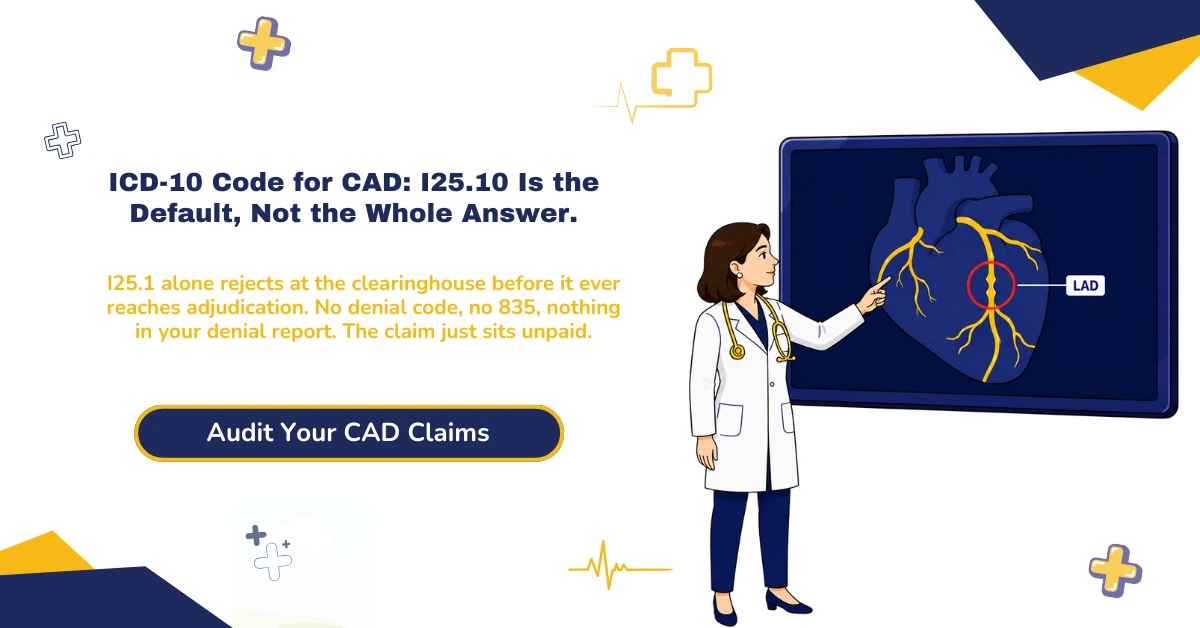
The ICD-10 code for CAD is I25.10, atherosclerotic heart disease of native coronary artery without angina pectoris. This ICD-10-CM code is billable, applies to patients aged 15 to 124, and serves as the default when documentation says CAD and nothing more. Documented angina moves you to the I25.11 codes. Graft disease uses I25.7 or I25.81.
What is the ICD-10 code for CAD?
No single ICD-10-CM code always equals CAD. The code you assign depends on what the physician documented, and three details decide it.
Angina comes first. When the record documents angina, you leave I25.10 and move into the I25.11 combination codes, where the angina type sets the final character.
The vessel decides next. Native coronary arteries route to I25.1. Bypass grafts and the coronary arteries of a transplanted heart route to I25.7 when angina is present, and to I25.81 when it is absent.
Infarction history is the third. A healed myocardial infarction with atherosclerosis still present needs I25.2 reported alongside the current disease code.
When the note says CAD and stops there, the Alphabetic Index sends you to I25.10 by default. That reflects accurate coding when the chart supports nothing more. It reflects a documentation gap when the chart supports more and nobody queried the provider.
Getting the ICD-10 code for CAD right starts with reading past the assessment line into the angiography report and the operative history.
I25.10 at a glance
I25.10 carries a set of attributes that decide whether your claim clears the payer front-end edits. Three of them get missed often enough to cause real revenue loss.
The age edit rejects the code outside 15 to 124 years. The MS-DRG assignment drives inpatient payment, and several published guides list the wrong pair. The HCC status surprises coders who assume a chronic cardiac diagnosis carries risk weight.
Check your grouper version too. CMS moved to v43.1 on April 1, 2026, and most code references still display v43.0.
I25.10 reference data for FY2026
| Field | Value |
|---|---|
| Code | I25.10 |
| Official descriptor | Atherosclerotic heart disease of native coronary artery without angina pectoris |
| CMS short descriptor | Athscl heart disease of native coronary artery w/o ang pctrs |
| Billable | Yes |
| Age edit | 15 to 124 years |
| MS-DRG | 302 and 303, atherosclerosis with and without MCC |
| Grouper version | v43.1, effective April 1, 2026 |
| Category | I25, chronic ischemic heart disease |
| HCC mapping | None under the CMS-HCC model |
Why documentation that says only CAD defaults to I25.10
Ischemic heart disease, coronary heart disease, arteriosclerotic heart disease, and CAD all index to I25.10 when the record documents no angina and names no graft. The Alphabetic Index treats them as the same condition, so the term your physician chose does not change your code.
Defaulting is correct when the chart supports nothing more specific. A cardiologist who documents stable coronary disease with no anginal symptoms has given you I25.10, and that is the accurate assignment.
Defaulting becomes a problem when the chart supports more and nobody queried. Watch for chest pain, exertional discomfort, or an active nitroglycerin prescription sitting in the record while the assessment reads no angina. Those signals contradict I25.10, and an auditor reading the same chart will notice.
Treat I25.10 as a floor. When your documentation supports a more specific code, the ICD-10 code for CAD you submit should reflect it.
CAD with angina: the I25.11 codes
Documented angina takes the patient out of I25.10. ICD-10-CM builds the angina type into the code itself through the fifth and sixth characters, which is why you never report a separate angina code alongside one of these.
Read the assessment for the angina pattern before you assign. The difference between two of these codes is a single word in the physician note, and the wrong pick changes both the risk score and the payer view of medical necessity.
ICD-10 codes for CAD with angina, FY2026
| Code | Official descriptor | Assign when documentation states |
|---|---|---|
| I25.110 | Atherosclerotic heart disease of native coronary artery with unstable angina pectoris | New onset, worsening, crescendo, or rest angina |
| I25.111 | Atherosclerotic heart disease of native coronary artery with angina pectoris with documented spasm | Coronary vasospasm, variant angina, or Prinzmetal angina, confirmed |
| I25.112 | Atherosclerotic heart disease of native coronary artery with refractory angina pectoris | Angina persisting despite maximal medical therapy |
| I25.118 | Atherosclerotic heart disease of native coronary artery with other forms of angina pectoris | Stable angina, chronic exertional angina, angina equivalent |
| I25.119 | Atherosclerotic heart disease of native coronary artery with unspecified angina pectoris | Angina documented, type not stated |
I25.110, unstable angina
I25.110 covers unstable angina, which the physician documents as new onset, worsening in frequency or duration, or occurring at rest. The crescendo pattern is the marker.
Unstable angina here excludes NSTEMI. When troponin confirms infarction, you code I21.4 instead. On an inpatient claim, I25.110 carries higher acuity than I25.10 and changes the DRG the case groups into.
I25.111, angina with documented spasm
I25.111 is atherosclerotic heart disease of native coronary artery with angina pectoris with documented spasm. The physician documents coronary vasospasm, variant angina, or Prinzmetal angina, confirmed on imaging or provocative testing.
Stable angina is not I25.111. Stable angina is I25.118. That distinction gets published incorrectly across coding references and AI-generated answers, and following the wrong one puts an unsupported code on your claim.
The word your physician needs to write is spasm. Without documented spasm, this code does not apply no matter how the chest pain presents.
I25.112, refractory angina
I25.112 covers refractory angina, meaning angina that persists despite maximal medical therapy. CMS added the code effective October 1, 2022, and it remains valid for FY2026. The Society for Cardiovascular Angiography and Interventions documented the full expansion when it took effect.
Most published CAD code lists omit it. The same refractory option exists across the graft series at I25.702, I25.712, I25.722, I25.732, I25.752, I25.762, and I25.792, with I20.2 available when atherosclerosis is not documented.
I25.118, stable and other forms of angina
I25.118 is where stable angina lives. The descriptor reads other forms of angina pectoris, and it covers chronic exertional angina, stable angina, and angina equivalent presentations.
Angina equivalent needs care. When a cardiologist attributes exertional dyspnea to myocardial ischemia, that supports I25.118, though the note has to say angina equivalent or atypical angina. Dyspnea alone does not get you there.
Coders reach for I25.119 on stable angina out of habit. The record described the pattern, so the pattern determines the code.
I25.119, unspecified angina
I25.119 means the physician documented angina and stopped. Use it when the record lacks that detail.
Query before you assign it. Ask whether the angina is unstable, refractory, associated with documented spasm, or stable. Four of those answers give you a more specific code and a more defensible claim.
What is a combination code for CAD and angina pectoris?
A combination code reports two conditions in a single code. ICD-10-CM builds them for CAD with angina in two places: I25.11 for native coronary arteries, and I25.7 for bypass grafts and the coronary arteries of a transplanted heart.
Three rules govern them under the FY2026 Official Guidelines.
First, the combination code reports both the atherosclerosis and the angina. You have captured the full picture in one code.
Second, skip the separate angina code from I20. Reporting I25.10 plus I20.9 when I25.119 describes the same encounter double-codes the condition.
Third, you can assume the causal relationship. When the record documents both atherosclerosis and angina, the Guidelines let you link them without an explicit statement from the physician. You separate them only when the documentation attributes the angina to another cause. Coders query for angina due to CAD language they do not need, and providers get frustrated answering a question the Guidelines already settled.
Sequencing follows the same logic. When the patient is admitted because of an acute myocardial infarction, the AMI sequences before the coronary artery disease.
Splitting a combination code is a documented audit target for OIG and RAC reviewers. It is one of the patterns our denial management services team flags most often in cardiology claim reviews, and a pre-submission edit catches it before a payer does.
Does the patient have a bypass graft or stent?
The vessel decides the code family, and post-surgical patients are where this fork gets missed. A patient with a CABG history can have disease in a native artery, in a graft, or in both, and the operative and angiographic reports are the only place that distinction lives.
Read past the assessment line. The cardiologist wrote which vessel in the catheterization report.
Graft disease with angina uses the I25.7 codes
I25.7 covers atherosclerosis of bypass grafts and of the coronary arteries of a transplanted heart, always with angina present. The parent code is not billable. You need the sixth character for graft type and the seventh for angina type.
ICD-10 graft and transplant codes for CAD with angina
| Subcategory | Graft or vessel type |
|---|---|
| I25.70x | Coronary artery bypass graft, unspecified type |
| I25.71x | Autologous vein bypass graft |
| I25.72x | Autologous artery bypass graft |
| I25.73x | Nonautologous biological bypass graft |
| I25.75x | Native coronary artery of a transplanted heart |
| I25.76x | Bypass graft of a coronary artery of a transplanted heart |
| I25.79x | Other coronary artery bypass graft |
The final character follows one pattern across all seven subcategories: 0 for unstable angina, 1 for angina with documented spasm, 2 for refractory angina, 8 for other forms of angina, and 9 for unspecified angina.
Graft type matters to the code. An autologous vein graft and an autologous artery graft route to different subcategories, so the operative report has to name the conduit.
Graft disease without angina uses I25.810, I25.811, and I25.812
Three codes cover graft and transplant atherosclerosis when the physician documents no angina. I25.810 is atherosclerosis of coronary artery bypass graft(s) without angina pectoris. I25.811 is atherosclerosis of native coronary artery of transplanted heart without angina pectoris. I25.812 is atherosclerosis of bypass graft of coronary artery of transplanted heart without angina pectoris.
I25.811 is a transplanted heart code. Several published guides describe it as the graft-with-angina code, and coders following them assign I25.811 to post-CABG patients with angina. That patient belongs in the I25.7 series.
A stent does not make a vessel non-native
Stenting does not reclassify a coronary artery. A patient with a drug-eluting stent in the left anterior descending artery and no current angina still codes to I25.10, because the LAD remains a native vessel.
Only a surgical bypass graft changes the classification. In-stent restenosis in a native artery stays in the I25.1 series, moving to I25.110 or I25.118 if angina develops.
Report the stent separately when the encounter calls for status. Z95.5 covers presence of a coronary angioplasty implant and graft. Z98.61 covers coronary angioplasty status.
Is there a history of a prior myocardial infarction?
I25.2 and I25.10 belong on the same claim when atherosclerosis persists after a healed infarction. Coding I25.2 alone drops the current disease and weakens your justification for the statin and antiplatelet therapy the physician is still prescribing.
The boundary between acute and old runs at four weeks. An infarction past that window, with no current symptoms and no active treatment for the event itself, codes to I25.2. The I21 series belongs to a current, active infarction.
Sequencing changes when the patient is admitted for the acute event. The AMI code sequences before the coronary artery disease.
Coders looking for a personal history Z code for myocardial infarction will not find one. ICD-10-CM does not include it, and I25.2 carries that function instead. Searching hx of CAD ICD 10 turns up the same gap, with the same answer.
That gap causes confusion in problem list maintenance. A patient with a 2019 infarction and current atherosclerosis carries both codes for as long as the disease stays documented and treated, which for most cardiology patients means every year.
What is the ICD-10 code for atherosclerotic heart disease?
The ICD-10 code for atherosclerotic heart disease is I25.1, completed with a fifth character based on angina status. Documentation without angina gives you I25.10. The CDC ICD-10-CM tabular files list what belongs under I25.1:
- Atherosclerotic cardiovascular disease
- Coronary (artery) atheroma
- Coronary (artery) atherosclerosis
- Coronary (artery) disease
- Coronary (artery) sclerosis
ASHD, ASCVD, coronary arteriosclerosis, and coronary atherosclerosis all land in the same place. Angina status decides the fifth character.
Two distinctions are worth holding. Atherosclerotic heart disease documented without further detail carries an NOS designation that resolves to I25.10. ASCVD documented as a general cardiovascular condition without coronary specificity may belong outside I25 entirely, and aortic atherosclerosis at I70.0 is a separate code with different risk-adjustment behavior.
Can you use I25.1 for reimbursement?
No. I25.1 is a parent code that requires a fifth character before a payer will accept it. Submit it as written and the claim rejects at the clearinghouse.
Several codes in this family look complete and are not.
Billable and non-billable codes in the I25 family
| Code | Billable | Reason |
|---|---|---|
| I25.1 | No | Requires a fifth character |
| I25.10 | Yes | Complete |
| I25.11 | No | Requires a sixth character |
| I25.110 | Yes | Complete |
| I25.7 | No | Requires further characters |
| I25.70 | No | Requires a sixth character |
| I25.700 | Yes | Complete |
| I25.8 | No | Requires further characters |
| I25.81 | No | Requires a sixth character |
| I25.810 | Yes | Complete |
| I25.9 | Yes | Complete |
The consequence catches practices off guard. A non-billable code produces a front-end rejection. It never reaches adjudication, never generates an 835 with a denial reason code, and never shows up in your denial reporting. The claim sits unpaid while your dashboard shows a clean denial rate.
Check your clearinghouse rejection queue separately from your denial queue. Rejections and denials travel different paths, and practices that work only denials lose the rejected claims in silence.
Is there an ICD-10 code for severe or multivessel CAD?
ICD-10-CM has no code for severe coronary artery disease. No code exists for two-vessel disease, three-vessel disease, or triple vessel disease either. Searching multivessel CAD ICD 10 returns results, and none of them point to a severity code, because the code set does not express severity that way.
Severity reaches the payer through four other channels. Angina type carries clinical acuity through the fifth and sixth characters. Chronic total occlusion gets its own code at I25.82. Plaque characterization adds I25.83 or I25.84. Vessel and lesion detail in the documentation supports medical necessity without changing the diagnosis code.
That last channel does the heaviest lifting. A catheterization report documenting three-vessel disease with 90% proximal LAD stenosis assigns the same I25.10 as a mild single-vessel finding. The difference shows up when the payer reviews prior authorization for revascularization, where the documented anatomy decides approval.
Detail codes that change the picture: I25.82, I25.83, and I25.84
The FY2026 tabular carries a use additional code instruction at I25.1. These stop being optional once the physician documents them.
Additional coronary detail codes under FY2026
| Code | Official descriptor | Assign when the record documents |
|---|---|---|
| I25.82 | Chronic total occlusion of coronary artery | Complete, prolonged obstruction of a coronary vessel |
| I25.83 | Coronary atherosclerosis due to lipid rich plaque | Lipid rich plaque identified on imaging or intravascular assessment |
| I25.84 | Coronary atherosclerosis due to calcified coronary lesion | Calcified lesion identified on imaging or calcium scoring |
I25.84 answers a question coders search thousands of times a month. Coronary artery calcification identified as a coronary atherosclerotic lesion codes to I25.84, reported alongside the primary I25 code.
These three codes attach to a primary I25 code rather than replacing it. A patient with CAD, no angina, and a calcified lesion carries I25.10 and I25.84 together.
Cardiologists document plaque morphology as a matter of routine, and coders drop it as a matter of routine. The detail sits in the catheterization report under lesion characteristics, and most abstraction stops at the assessment. Reading two pages deeper captures a code that reflects the complexity of the case.
Codes you must report alongside I25
Two instructions govern what accompanies an I25 code, and coders miss the second one often. The tabular carries a use additional code note at the I25 category level. Separately, the I20 to I25 block carries a code also instruction for hypertension.
Required additional codes at ICD-10-CM category I25
| Condition documented | Code | Instruction source |
|---|---|---|
| Tobacco use | Z72.0 | Use additional code at I25 |
| Tobacco dependence | F17 series | Use additional code at I25 |
| History of tobacco dependence | Z87.891 | Use additional code at I25 |
| Exposure to environmental tobacco smoke | Z77.22 | Use additional code at I25 |
| Occupational exposure to environmental tobacco smoke | Z57.31 | Use additional code at I25 |
| Chronic total occlusion of coronary artery | I25.82 | Use additional code at I25 |
| Hypertension | I10 to I1A | Code also at I20 to I25 |
Hypertension is where the confusion lives. No combination code exists for CAD and hypertension. You report I10 and the appropriate I25 code together. Hypertensive heart disease works differently, because I11 does combine hypertension with the heart involvement, and coders carry that logic across to CAD where it does not apply.
Tobacco status gets dropped more than any other required code. The physician records smoking history in the social history section, the coder abstracts from the assessment, and Z87.891 never makes it onto the claim. The tabular instruction makes it required. Comorbidities on a cardiology problem list run together, and our hyperlipidemia ICD-10 code E78.5 guide covers the same abstraction problem from the lipid side.
Does I25.10 risk adjust under HCC v28?
No. I25.10 does not map to a Hierarchical Condition Category in the CMS-HCC model, and it did not map under the previous version either. A patient carrying that code and nothing else generates no risk adjustment weight from the diagnosis.
The weight sits in the angina codes. When documentation supports one of the I25.11 combination codes, the diagnosis moves into a category that does adjust. One line in a progress note separates the two outcomes.
Coders expect coronary atherosclerosis to adjust because it is chronic, documented, and clinically real. It does not. Being chronic and being risk-adjusting are separate questions, and CMS answers the second one through a mapping file rather than through clinical severity.
That file is where the answer lives. CMS posts the CMS risk adjustment mappings for each payment year, and the midyear or final version is what auditors work from. Every vendor tool and every training slide is a secondary read of that document.
Even for codes that do adjust, capture resets annually. A condition documented in 2025 does not carry into the 2026 risk score on its own. Someone has to document and report it again inside the new calendar year, or the weight disappears from a patient who still has the disease.
For a cardiology practice under a Medicare Advantage contract, this shows up as a documentation problem rather than a billing problem. The claim pays either way. The risk score does not. That is why we handle risk-adjustment capture inside revenue cycle management services instead of treating it as something coding sorts out later.
Comorbidity codes on a cardiology problem list
A coder working a CAD chart is working a problem list. These are the codes that show up alongside it, and the ones that decide whether the annual wellness visit captured the patient accurately.
Conditions commonly documented with coronary artery disease
| Condition | Code | Coding note |
|---|---|---|
| Hyperlipidemia, unspecified | E78.5 | Reported alongside the I25 code |
| Essential hypertension | I10 | Code also at I20 to I25, no combination code exists |
| Hypertensive heart disease with heart failure | I11.0 | Combines hypertension and heart involvement, unlike CAD |
| Hypertensive heart disease without heart failure | I11.9 | Same combination logic |
| Type 2 diabetes without complications | E11.9 | Report separately unless the provider links the conditions |
| Type 2 diabetes with circulatory complications | E11.59 | Requires the provider to document the causal link |
| Ischemic cardiomyopathy | I25.5 | Same I25 category, reported in addition to I25.10 |
| Old myocardial infarction | I25.2 | Reported with I25.10 when disease persists |
| Chronic obstructive pulmonary disease | J44.9 | Frequent comorbidity, adjusts separately |
Diabetes is the one coders argue about. E11.59 requires the provider to state the relationship between the diabetes and the circulatory condition. Absent that statement, report E11.9 and I25.10 separately. Proximity in the note is not a documented link.
These conditions get captured during the annual visit or they do not get captured at all. A chronic condition that goes unreported for a calendar year disappears from the risk score while the patient still has it. Our hypotension ICD-10 codes guide covers the adjacent cardiovascular diagnoses that show up on the same charts.
CPT codes commonly billed with a CAD diagnosis
A diagnosis code alone does not establish medical necessity. The pairing does, and cardiology carries a small set of procedure codes that show up against I25 more than any others.
CPT codes frequently paired with ICD-10 code I25
| CPT | Description | Typical pairing note |
|---|---|---|
| 93000 | Electrocardiogram, complete | Baseline and follow-up |
| 93306 | Transthoracic echocardiogram, complete with Doppler | Function assessment |
| 93015 to 93018 | Cardiovascular stress testing | Component split by professional and technical |
| 93454 | Coronary angiography | Diagnostic catheterization |
| 93458 | Coronary angiography with left heart catheterization | Most common diagnostic pairing |
| 92920 | Percutaneous transluminal coronary angioplasty, single vessel | Intervention |
| 92928 | Percutaneous coronary intervention with stent placement | Intervention |
| 92941 | Percutaneous coronary intervention for acute myocardial infarction | Acute setting |
| 75574 | Coronary CT angiography | Non-invasive assessment |
| 99213 and 99214 | Established patient office visit | Ongoing management |
Echocardiography carries its own payer rules, and our CPT 93306 echocardiography billing guide covers the component split and the documentation a complete study requires.
I25.10 alone often fails to support diagnostic catheterization. An asymptomatic patient does not obviously need an invasive study, and the payer reads it that way. Supporting codes that strengthen the claim include abnormal stress test findings at R94.31, chest pain at R07.9, and family history of ischemic heart disease at Z82.49.
Verify every pairing against the current CPT code set and the applicable payer policy before it goes on a claim. Coverage language changes more often than the code descriptors do.
Why payers deny CAD claims
Six patterns account for most of what our team sees in cardiology denial reviews, and each one traces back to how the ICD-10 code for CAD was selected or supported. Each one has a specific fix, and most of them start in the documentation rather than the billing system.
Split combination codes come first. A biller reports I25.10 plus an I20 angina code when I25.119 covers the encounter, and the reviewer flags the duplication. OIG and RAC reviewers both track this pattern. Report the combination code.
Non-billable parent codes come second. I25.1, I25.11, I25.7, and I25.81 go out as though complete. They reject at the clearinghouse, never reach adjudication, and never appear in your denial reporting. Practices lose these without seeing them.
Medical necessity on diagnostic studies comes third. I25.10 alone supporting a catheterization gives the reviewer nothing to approve. Add the supporting diagnosis codes and the clinical rationale from the note.
The age edit comes fourth. I25.10 applies to patients aged 15 to 124. A pediatric claim carrying it fails a front-end edit before anyone reviews the chart.
Native versus graft mismatch comes fifth. A coder assigns I25.10 to a post-CABG patient whose disease sits in the graft. The operative and angiographic reports carry the answer, and the assessment line does not.
Prior authorization comes sixth. Many payers require authorization for PCI, catheterization, and cardiac surgery, and an asymptomatic patient coded I25.10 with no supporting findings is a common authorization denial. Our prior authorization workflows guide covers where eligibility and authorization checks belong in the schedule.
Most of these start as documentation gaps and surface as billing problems, which is why fixing them at the claim stage costs more than fixing them at the note. If your cardiology denials cluster around these six, our recover denied cardiology claims team works the backlog and the root cause together.
What providers need to document for CAD coding
Five details decide whether a coder can assign the most specific code available. Physicians who capture them in the assessment save the practice a query cycle on every cardiology chart.
Angina status leads, including the type when present. The vessel comes next, whether native artery, bypass graft, or the coronary artery of a transplanted heart. Graft type matters when a graft is involved, because autologous vein and autologous artery route to different subcategories. Prior interventions belong in the note, covering stent, CABG, and PCI history. Comorbidities need an explicit link when the physician believes one exists, since the coder cannot assume it for diabetes.
Poor documentation reads: Patient has CAD.
Good documentation reads: Atherosclerotic disease of the native left anterior descending artery confirmed on angiography, 70% proximal stenosis, no anginal symptoms at rest or with exertion, continuing statin and antiplatelet therapy.
The second version names the vessel, confirms the finding with a study, states angina status as a positive finding rather than by omission, and supports the ongoing therapy on the medication list. A coder reading it assigns I25.10 with confidence, and an auditor reading it finds the support already there.
One query trigger deserves a standing rule. When chest pain, exertional discomfort, or nitrate use appears anywhere in the record while the assessment reads no angina, query before assigning I25.10. Documentation expectations shift by specialty, and our cardiology billing services team builds the query templates around the patterns each specialty produces.
Which ICD-10-CM release applies to your date of service
The release currently in effect is the FY2026 April 1, 2026 update, applicable to encounters from April 1, 2026 through September 30, 2026. Most published CAD guides still reference the October 1, 2025 release, which is one version behind. The CMS ICD-10 code files split the fiscal year into two effective windows.
The April 2026 ICD-10-CM update added no new diagnosis codes, deleted none, and revised none, according to the AAPC April 2026 update summary. It did change instructional notes across the Tabular List, including several Excludes1 notes converted to Excludes2. The procedure code set added roughly 80 codes, and the MS-DRG grouper moved to v43.1.
The current Official Guidelines file carries an April 1, 2026 date with no substantive change to the CAD sections. Treat the date as a version marker rather than as evidence of a rule change.
One operational consequence matters for AR. A claim spanning dates of service before and after April 1, 2026 needs the correct version applied by date of service. For context on the prior release, the AAPC FY2026 update summary documents 487 new codes concentrated in pain and tenderness R codes, cannabis hyperemesis, social determinant Z codes, and behavioral health. Cardiology was not the focus.
What changes on October 1, 2026
FY2027 takes effect October 1, 2026, and CMS and CDC have published the files. Verify any I25 changes against the FY2027 addenda before the effective date rather than assuming the codes carry forward. Practices that manage a code set transition without a denial plan absorb the spike, and our ICD-11 denial prevention playbook covers the workflow that catches transition-period denials inside 24 hours.
Complete list of ICD-10 codes for CAD, FY2026
Every ICD-10 code for CAD sits in category I25, and the table below carries all of them as valid for FY2026, including the refractory angina codes that most published lists omit. Descriptors are reproduced from the tabular without abbreviation.
Complete ICD-10-CM category I25 code list for FY2026
| Code | Official descriptor | Billable |
|---|---|---|
| I25.1 | Atherosclerotic heart disease of native coronary artery | No |
| I25.10 | Atherosclerotic heart disease of native coronary artery without angina pectoris | Yes |
| I25.11 | Atherosclerotic heart disease of native coronary artery with angina pectoris | No |
| I25.110 | Atherosclerotic heart disease of native coronary artery with unstable angina pectoris | Yes |
| I25.111 | Atherosclerotic heart disease of native coronary artery with angina pectoris with documented spasm | Yes |
| I25.112 | Atherosclerotic heart disease of native coronary artery with refractory angina pectoris | Yes |
| I25.118 | Atherosclerotic heart disease of native coronary artery with other forms of angina pectoris | Yes |
| I25.119 | Atherosclerotic heart disease of native coronary artery with unspecified angina pectoris | Yes |
| I25.2 | Old myocardial infarction | Yes |
| I25.3 | Aneurysm of heart | Yes |
| I25.41 | Coronary artery aneurysm | Yes |
| I25.42 | Coronary artery dissection | Yes |
| I25.5 | Ischemic cardiomyopathy | Yes |
| I25.6 | Silent myocardial ischemia | Yes |
| I25.7 | Atherosclerosis of coronary artery bypass graft(s) and coronary artery of transplanted heart with angina pectoris | No |
| I25.70 | Atherosclerosis of coronary artery bypass graft(s), unspecified, with angina pectoris | No |
| I25.700 | Atherosclerosis of coronary artery bypass graft(s), unspecified, with unstable angina pectoris | Yes |
| I25.701 | Atherosclerosis of coronary artery bypass graft(s), unspecified, with angina pectoris with documented spasm | Yes |
| I25.702 | Atherosclerosis of coronary artery bypass graft(s), unspecified, with refractory angina pectoris | Yes |
| I25.708 | Atherosclerosis of coronary artery bypass graft(s), unspecified, with other forms of angina pectoris | Yes |
| I25.709 | Atherosclerosis of coronary artery bypass graft(s), unspecified, with unspecified angina pectoris | Yes |
| I25.71 | Atherosclerosis of autologous vein coronary artery bypass graft(s) with angina pectoris | No |
| I25.710 | Atherosclerosis of autologous vein coronary artery bypass graft(s) with unstable angina pectoris | Yes |
| I25.711 | Atherosclerosis of autologous vein coronary artery bypass graft(s) with angina pectoris with documented spasm | Yes |
| I25.712 | Atherosclerosis of autologous vein coronary artery bypass graft(s) with refractory angina pectoris | Yes |
| I25.718 | Atherosclerosis of autologous vein coronary artery bypass graft(s) with other forms of angina pectoris | Yes |
| I25.719 | Atherosclerosis of autologous vein coronary artery bypass graft(s) with unspecified angina pectoris | Yes |
| I25.72 | Atherosclerosis of autologous artery coronary artery bypass graft(s) with angina pectoris | No |
| I25.720 | Atherosclerosis of autologous artery coronary artery bypass graft(s) with unstable angina pectoris | Yes |
| I25.721 | Atherosclerosis of autologous artery coronary artery bypass graft(s) with angina pectoris with documented spasm | Yes |
| I25.722 | Atherosclerosis of autologous artery coronary artery bypass graft(s) with refractory angina pectoris | Yes |
| I25.728 | Atherosclerosis of autologous artery coronary artery bypass graft(s) with other forms of angina pectoris | Yes |
| I25.729 | Atherosclerosis of autologous artery coronary artery bypass graft(s) with unspecified angina pectoris | Yes |
| I25.73 | Atherosclerosis of nonautologous biological coronary artery bypass graft(s) with angina pectoris | No |
| I25.730 | Atherosclerosis of nonautologous biological coronary artery bypass graft(s) with unstable angina pectoris | Yes |
| I25.731 | Atherosclerosis of nonautologous biological coronary artery bypass graft(s) with angina pectoris with documented spasm | Yes |
| I25.732 | Atherosclerosis of nonautologous biological coronary artery bypass graft(s) with refractory angina pectoris | Yes |
| I25.738 | Atherosclerosis of nonautologous biological coronary artery bypass graft(s) with other forms of angina pectoris | Yes |
| I25.739 | Atherosclerosis of nonautologous biological coronary artery bypass graft(s) with unspecified angina pectoris | Yes |
| I25.75 | Atherosclerosis of native coronary artery of transplanted heart with angina pectoris | No |
| I25.750 | Atherosclerosis of native coronary artery of transplanted heart with unstable angina pectoris | Yes |
| I25.751 | Atherosclerosis of native coronary artery of transplanted heart with angina pectoris with documented spasm | Yes |
| I25.752 | Atherosclerosis of native coronary artery of transplanted heart with refractory angina pectoris | Yes |
| I25.758 | Atherosclerosis of native coronary artery of transplanted heart with other forms of angina pectoris | Yes |
| I25.759 | Atherosclerosis of native coronary artery of transplanted heart with unspecified angina pectoris | Yes |
| I25.76 | Atherosclerosis of bypass graft of coronary artery of transplanted heart with angina pectoris | No |
| I25.760 | Atherosclerosis of bypass graft of coronary artery of transplanted heart with unstable angina pectoris | Yes |
| I25.761 | Atherosclerosis of bypass graft of coronary artery of transplanted heart with angina pectoris with documented spasm | Yes |
| I25.762 | Atherosclerosis of bypass graft of coronary artery of transplanted heart with refractory angina pectoris | Yes |
| I25.768 | Atherosclerosis of bypass graft of coronary artery of transplanted heart with other forms of angina pectoris | Yes |
| I25.769 | Atherosclerosis of bypass graft of coronary artery of transplanted heart with unspecified angina pectoris | Yes |
| I25.79 | Atherosclerosis of other coronary artery bypass graft(s) with angina pectoris | No |
| I25.790 | Atherosclerosis of other coronary artery bypass graft(s) with unstable angina pectoris | Yes |
| I25.791 | Atherosclerosis of other coronary artery bypass graft(s) with angina pectoris with documented spasm | Yes |
| I25.792 | Atherosclerosis of other coronary artery bypass graft(s) with refractory angina pectoris | Yes |
| I25.798 | Atherosclerosis of other coronary artery bypass graft(s) with other forms of angina pectoris | Yes |
| I25.799 | Atherosclerosis of other coronary artery bypass graft(s) with unspecified angina pectoris | Yes |
| I25.81 | Atherosclerosis of other coronary vessels without angina pectoris | No |
| I25.810 | Atherosclerosis of coronary artery bypass graft(s) without angina pectoris | Yes |
| I25.811 | Atherosclerosis of native coronary artery of transplanted heart without angina pectoris | Yes |
| I25.812 | Atherosclerosis of bypass graft of coronary artery of transplanted heart without angina pectoris | Yes |
| I25.82 | Chronic total occlusion of coronary artery | Yes |
| I25.83 | Coronary atherosclerosis due to lipid rich plaque | Yes |
| I25.84 | Coronary atherosclerosis due to calcified coronary lesion | Yes |
| I25.89 | Other forms of chronic ischemic heart disease | Yes |
| I25.9 | Chronic ischemic heart disease, unspecified | Yes |
Frequently asked questions about ICD-10 coding for CAD
What is the ICD-10 code for CAD?
I25.10 is the ICD-10 code for CAD, described as atherosclerotic heart disease of native coronary artery without angina pectoris. It applies when the physician documents coronary artery disease in a native vessel with no angina. Documented angina moves the encounter into the I25.11 combination codes. Disease in a bypass graft or a transplanted heart moves it into I25.7 or I25.81.
Can I use I25.1 for reimbursement?
No. I25.1 is a parent code that requires a fifth character before any payer accepts it. Submitted as written, it rejects at the clearinghouse and never reaches adjudication. Use I25.10 when the record documents no angina, or one of the I25.11 codes when angina is present. The same rule applies to I25.11, I25.7, and I25.81, which all need additional characters.
What is a combination code for CAD and angina pectoris?
A combination code reports the atherosclerosis and the angina together in one code. ICD-10-CM provides I25.11 for native coronary arteries and I25.7 for bypass grafts and transplanted heart vessels. When you use one, skip the separate I20 angina code. The FY2026 Official Guidelines also let you assume the causal relationship between atherosclerosis and angina unless the record attributes the angina to another cause.
What is the ICD-10 code for atherosclerotic heart disease?
I25.1 covers atherosclerotic heart disease, completed with a fifth character based on angina status. Without angina, the code is I25.10. ASHD, ASCVD, coronary atherosclerosis, coronary arteriosclerosis, coronary atheroma, and coronary sclerosis all index to the same category. The term the physician uses does not change the code assignment. Angina status does.
What is the difference between I25.10 and I25.110?
Angina. I25.10 applies when the physician documents coronary atherosclerosis in a native vessel with no angina. I25.110 applies when the same disease presents with unstable angina, meaning new onset, worsening in frequency or duration, or occurring at rest. On an inpatient claim the two codes group into different DRGs, and only the angina code carries risk adjustment weight.
What is the ICD-10 code for CAD with stable angina?
I25.118, atherosclerotic heart disease of native coronary artery with other forms of angina pectoris. Stable angina and chronic exertional angina both belong here. Several published references assign stable angina to I25.119, which is incorrect. I25.119 covers angina documented without a stated type. When the record describes the pattern, the pattern determines the code.
Does I25.10 apply to patients with stents?
Yes, when the stent sits in a native coronary artery and the patient has no current angina. Stenting does not reclassify a vessel as non-native, so a patient with a drug-eluting stent in the LAD still codes to I25.10. Only a surgical bypass graft changes the classification. Report Z95.5 or Z98.61 separately when the encounter calls for status reporting.
Can I25.10 and I25.2 be coded together?
Yes. Report both when atherosclerosis persists after a healed myocardial infarction. I25.10 captures the current disease and I25.2 documents the old infarction. Coding I25.2 alone drops the active condition and weakens support for ongoing statin and antiplatelet therapy. ICD-10-CM includes no personal history Z code for myocardial infarction, so I25.2 carries that role.
Is there an ICD-10 code for severe CAD?
No. ICD-10-CM has no code expressing CAD severity, and none exists for two-vessel, three-vessel, or triple vessel disease. Severity reaches the payer through angina type in the fifth and sixth characters, chronic total occlusion at I25.82, plaque characterization at I25.83 and I25.84, and the vessel detail documented in the catheterization report supporting medical necessity.
Does I25.10 risk adjust under HCC v28?
No. I25.10 carries no Hierarchical Condition Category mapping under the current CMS-HCC model, and it carried none under the prior version. Documentation supporting one of the I25.11 angina codes moves the diagnosis into a category that does adjust. Verify current mappings against the CMS model software and ICD-10 mapping files for the applicable payment year.
How do you code CAD with hypertension?
Report both codes. No combination code exists for coronary artery disease and hypertension, so you assign I10 alongside the appropriate I25 code. The I20 to I25 block carries a code also instruction for hypertension covering the I10 to I1A range. Hypertensive heart disease works differently, since I11 combines hypertension with the heart involvement in a single code.
What was the ICD-9 code for CAD?
Code 414.01, coronary atherosclerosis of native coronary artery, crossed to I25.10 at the ICD-10 transition on October 1, 2015. The crosswalk still matters for legacy accounts receivable, retrospective audits, and any historical claim analysis reaching back before the transition. Current claims require ICD-10-CM codes for all dates of service from October 1, 2015 forward.
CAD coding accuracy shows up in the risk score and the denial rate before it shows up anywhere else on a cardiology P and L. If you want a read on where yours is leaking, a free revenue cycle analysis flags up to three specific gaps before any contract.