R26.81 is the ICD-10-CM code for unsteady gait. The official descriptor is Unsteadiness on feet. The code is billable and specific, so you can report it on a claim for reimbursement.
R26.81 sits under R26, Abnormalities of gait and mobility, a parent category you can’t bill. Nothing about R26.81 changes in FY2027. The code stays valid for dates of service through September 30, 2027.
This guide covers code selection across the R26 family, the Excludes rules most published guidance states backwards, sequencing, CPT pairings, documentation that survives a medical necessity review, and the denial patterns that hit symptom codes hardest.
R26.81 at a Glance: Code Facts for FY2027
Every fact below reflects the FY2026 April 1, 2026 release, which governs dates of service through September 30, 2026. The FY2027 file replaces it on October 1, 2026, and the CMS ICD-10 code updates page carries the full release schedule.
| Field | Value |
|---|---|
| Code | R26.81 |
| Official descriptor | Unsteadiness on feet |
| Billable status | Billable and specific |
| Parent category | R26, Abnormalities of gait and mobility (non-billable) |
| Chapter and block | Chapter 18 (R00-R99), block R25-R29 |
| HIPAA transaction validity | Valid |
| Code set in effect now | FY2026 April 1, 2026 release, dates of service 04/01/2026 to 09/30/2026 |
| Next code set | FY2027, effective 10/01/2026 through 09/30/2027 |
| FY2027 change to R26.81 | None. Descriptor and billable status unchanged. |
| Code history | Effective 10/01/2015. No change in any annual edition through FY2026. |
| MS-DRG grouping (v43.0) | 091, 092, 093 (Other disorders of nervous system with MCC, with CC, without CC/MCC) |
| ICD-9-CM approximate equivalent | 781.2, Abnormality of gait (approximate, not one-to-one) |
What Is Unsteady Gait in ICD-10-CM Terms?
Unsteady gait describes a documented finding: the patient can’t hold a stable base while standing or walking. It assumes no cause and implies no diagnosis. ICD-10-CM captures that finding as R26.81, Unsteadiness on feet.
R26.81 belongs to the symptom chapter of ICD-10-CM. That single classification drives sequencing, medical necessity, and the denial patterns this guide covers later. Coders who treat it as a diagnosis code run into all three problems at once.
How providers document it
These provider phrases support R26.81:
- “unsteady on feet”
- “unsteadiness on feet”
- “gait instability”
- “unsteady gait”
- “requires assistance due to unsteadiness”
Coders assign R26.81 from the provider’s documented statement. Provider wording controls the code selection.
The distinction matters on the claim line. A provider who documents “unsteady gait” and a provider who documents “gait instability” have described the same finding, and both support R26.81. Neither phrase requires a workup result before you can report it.
R26.81 vs R26.0, R26.1, R26.2, R26.89, and R26.9: Which Code to Use
Six codes live in the R26 family, and picking the wrong one is the most common coding error on gait claims.
| Code | Official descriptor | Use when the provider documents | Do not use if | Billable |
|---|---|---|---|---|
| R26.81 | Unsteadiness on feet | Use for general unsteadiness or instability while standing and walking, when no definitive diagnosis explains it. | The record documents ataxia, paralysis, or a specific gait pattern instead. | Yes |
| R26.0 | Ataxic gait | Use if the patient shows a staggering, wide-based, or cerebellar gait and ataxia is documented. | Ataxia appears nowhere in the clinical record. | Yes |
| R26.1 | Paralytic gait | Use when gait abnormality results from documented paralysis or spasticity. | The gait change comes from pain, weakness, or deconditioning. | Yes |
| R26.2 | Difficulty in walking, NEC | Use for general difficulty walking, when the limitation is effort or distance rather than balance. | Unsteadiness on feet or falling is the documented finding. | Yes |
| R26.89 | Other abnormalities of gait and mobility | Use for other documented gait or mobility abnormalities: cautious gait, painful limp, or multifactorial gait problems. | A more specific R26 code fits the documented pattern. | Yes |
| R26.9 | Unspecified abnormalities of gait and mobility | Use only when documentation supports no more specific R26 code. | The record describes the gait well enough to pick a specific code. | Yes |
| R26 | Abnormalities of gait and mobility | Category header only. | Always. Submit a child code. | No |
| R26.8 | Other abnormalities of gait and mobility | Subcategory header only. | Always. Submit R26.81 or R26.89. | No |
Assign the most specific code the documentation supports. R26.89 is the residual code inside the R26.8 subcategory, which means you reach for it after ruling out R26.0, R26.1, R26.2, and R26.81. R26.9 should appear rarely in a practice with strong documentation. Heavy R26.9 volume points at a provider query problem rather than a coding preference.
Excludes1 and Excludes2 for R26.81: What the Tabular Actually Says
The Excludes structure around R26.81 is the most misstated point in published guidance on this code. Getting it wrong produces two problems: bad code pairings on the claim, and appeal letters that cite a rule the tabular doesn’t contain. An invalid or non-specific ICD-10-CM code fires CARC 11 at the payer edit before a human ever reviews the claim, which is where denial management services start earning their keep.
Where the Excludes1 note really sits
The Excludes1 list sits at the R26 category level. It applies across the entire R26 family, including R26.81, and it names four conditions:
- Ataxia NOS (R27.0)
- Hereditary ataxia (G11.-)
- Locomotor (syphilitic) ataxia (A52.11)
- Immobility syndrome (paraplegic) (M62.3)
Excludes1 means the two conditions don’t coexist. If the provider documents ataxia, you code the ataxia and drop the R26 code. The tabular treats them as mutually exclusive presentations, so submitting both on one claim invites an edit.
The R29.6 relationship most guides get backwards
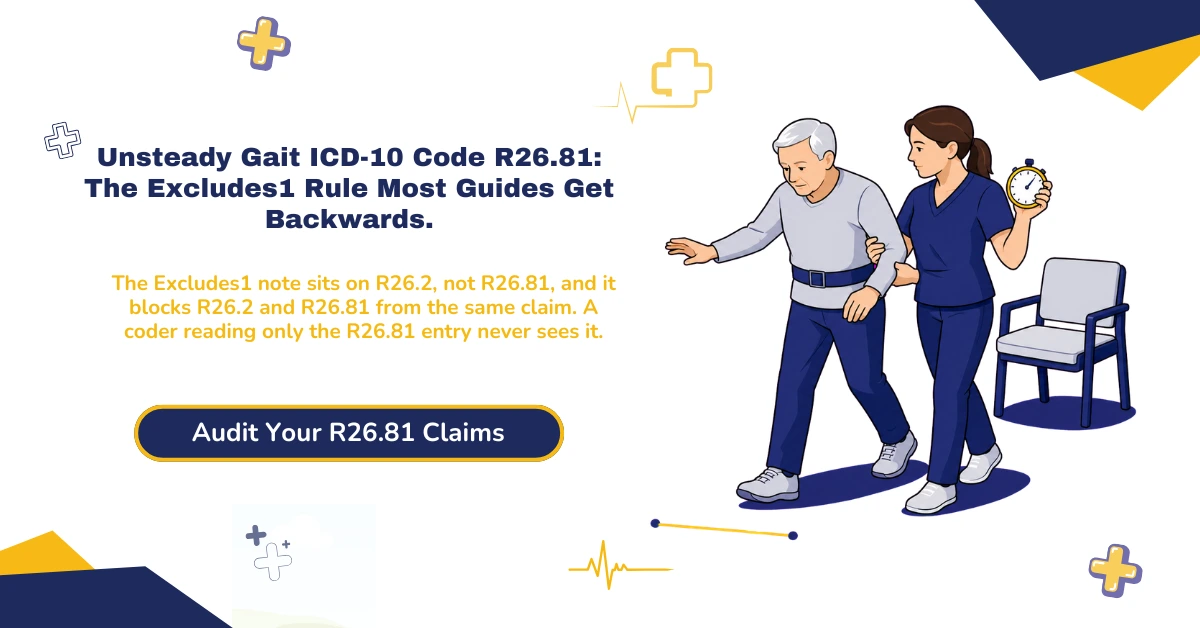
R26.81 carries no Excludes2 note. The R29.6 relationship is a Type 1 Excludes sitting on R26.2, and that note excludes two codes: falling (R29.6) and unsteadiness on feet (R26.81).
The practical consequence lands on your claim line. R26.2 and R26.81 don’t go on the same claim for the same encounter, because the Excludes1 on R26.2 names R26.81 by code. A coder who reads only the R26.81 tabular entry never sees that instruction, since it lives one code away.
Is R26.81 a Billable ICD-10 Code?
Yes. R26.81 is billable and specific, and you can report it for reimbursement on HIPAA-covered transactions. The code took effect October 1, 2015, and it has carried through every annual edition since without a single revision.
The billability map for the family is where practices trip. R26 and R26.8 are both non-billable headers. R26.0, R26.1, R26.2, R26.81, R26.89, and R26.9 are all billable. Submit R26 or R26.8 and the claim bounces before adjudication.
One caution on the word billable. It means the code is valid for submission. Whether the claim pays depends on medical necessity and payer policy, which this guide covers in the documentation and denial sections. Billers who conflate the two spend appeal time defending a code that was never the problem.
When Can You Report R26.81 as a Symptom Code?
R26.81 sits in Chapter 18, the symptoms and signs chapter. Two rules in the Official Guidelines govern when you can report it, and published summaries compress both into a single line: use it when there’s no neurological diagnosis. That shorthand drops the part coders need.
Reporting R26.81 when no definitive diagnosis exists
The Official Guidelines accept codes for symptoms and signs when the provider hasn’t established a related definitive diagnosis. R26.81 covers general unsteadiness, and this is the clean case for it.
Picture the patient mid-workup. The provider documents unsteadiness on feet, orders labs, reviews the medication list, and refers to neurology. Vestibular, neurologic, medication-related, and deconditioning all remain live. R26.81 is the valid reason for the encounter, and the CDC ICD-10-CM release files carry the guideline text behind it.
Reporting R26.81 alongside a confirmed diagnosis
A confirmed diagnosis doesn’t automatically bar R26.81. The governing rule turns on whether the unsteadiness is routinely associated with that disease process. Signs and symptoms routinely associated with a disease process don’t get assigned as additional codes unless the classification instructs otherwise.
So the coder’s question shifts. It stops being “does a diagnosis exist” and becomes “is this unsteadiness integral to that diagnosis, or is it a separately significant condition the team is separately addressing.”
When the record shows the unsteadiness evaluated on its own and treated on its own, reporting R26.81 as an additional code holds up.
A Parkinson’s patient with the expected shuffling gait is the integral case, and you leave R26.81 off. The same patient sent to therapy for a balance program after a fall, with separate goals and separate objective testing, is the separately significant case.
Is R26.81 a Primary or Secondary Diagnosis?
R26.81 works as either, and one test decides it: has the provider established a definitive diagnosis that explains the unsteadiness? Without one, R26.81 is the principal diagnosis. With one, R26.81 follows that diagnosis as an additional code.
The principal case shows up constantly in therapy. A referral arrives reading “gait instability, evaluate and treat,” the record carries no confirmed etiology, and the evaluation is the first workup anyone has done. R26.81 leads the claim.
The secondary case pairs the etiology first. Parkinson’s disease (G20) sequences ahead of R26.81 when the team manages the gait deficit as its own problem. Payer policy on this pairing varies, so check your MAC or the plan’s own policy before you build it into a template.
One failure repeats across audits. Listing R26.81 as principal while a confirmed etiology sits elsewhere on the same claim triggers a sequencing edit, and the fix is a corrected claim rather than an appeal.
Order matters more on inpatient and facility claims than most outpatient billers expect, since sequencing feeds grouping. The MS-DRG section later in this guide shows where that lands.
R29.6 vs Z91.81: Coding Falls Alongside Unsteady Gait
Unsteady gait rarely shows up alone in a chart. Providers document it next to a recent fall or a fall history, and the two fall codes aren’t interchangeable. The Official Guidelines draw this line with unusual clarity, which makes the language quotable in an appeal.
| Code | Descriptor | Report when |
|---|---|---|
| R29.6 | Repeated falls | The patient has recently fallen and the reason for the fall is under investigation. |
| Z91.81 | History of falling | The patient fell in the past and is at risk for future falls. |
Can you report R29.6 and Z91.81 together?
Yes. Both codes go on the claim when the documentation supports each one independently. A patient with a documented fall history who also fell last week, with the cause still under workup, satisfies both descriptions at the same time.
That pairing does real work on the medical necessity side. R29.6 establishes an active clinical question, Z91.81 establishes ongoing risk, and together they explain why a balance and gait intervention is reasonable rather than elective.
Watch the direction of the error. Practices default to Z91.81 for every fall mention because it’s the code they know, which understates a patient under active investigation. Others report R29.6 months after the fall, long after the workup closed, and the record no longer supports it.
What Documentation Supports an R26.81 Claim?
Code selection is the easy part of an R26.81 claim. Payers deny these claims on medical necessity far more often than on code choice, and the gap between a paid claim and an appeal usually comes down to objective data in the note. Medical necessity denials fire under CARC 50 and CARC 119, and medical necessity appeals turn on whether the record carries functional evidence.
Objective measures that strengthen the record
CDC’s STEADI initiative publishes validated cut points, and each one converts a clinical impression into a number a reviewer accepts.
- Timed Up and Go: CDC STEADI Timed Up and Go guidance puts an older adult who takes 12 seconds or longer at risk for falling.
- 4-Stage Balance Test: inability to hold a tandem stand for at least 10 seconds indicates increased fall risk.
- 30-Second Chair Stand: a below-average score for age and sex indicates fall risk.
CDC’s CDC STEADI fall risk assessment materials pair all three into one battery. A number in the note survives a reviewer’s read. “Patient appears unsteady” doesn’t, because the reviewer has no way to test it.
Poor versus strong documentation
| Weak note | Strong note |
|---|---|
| “Patient has trouble walking.” | “Patient demonstrates wide-based gait with lateral sway. TUG completed in 16 seconds. Requires bilateral upper-extremity support for safe ambulation on uneven surfaces.” |
Three elements carry a defensible R26.81 note. Name the specific gait characteristic. Record the objective measure with its value. State the functional impact on a daily activity the patient performs. Miss the third and reviewers read the first two as a screening result rather than a treatable deficit.
Copy the value, not the label. “Berg Balance completed” tells a reviewer nothing. “Berg Balance 38/56” tells them where the patient sits against a validated scale, and it does that without a single sentence of argument.
Codes Commonly Reported With or Mistaken for R26.81
Unsteady gait almost never gets coded alone. Below are the codes that land on the same claim, plus the ones coders confuse it with.
| Code | Descriptor | Relationship to R26.81 |
|---|---|---|
| M62.81 | Muscle weakness (generalized) | Often the underlying cause. Report both when weakness is documented and treated. |
| R53.1 | Weakness | Frequently co-documented. Separate generalized weakness from balance instability. |
| R42 | Dizziness and giddiness | Distinct finding. Vestibular sensation rather than mechanical instability. |
| R29.6 | Repeated falls | Recent fall under investigation. |
| Z91.81 | History of falling | Past fall with ongoing risk. |
| R26.2 | Difficulty in walking, NEC | Excludes1 with R26.81. Not reported together. |
| R27.0 | Ataxia, unspecified | Excludes1 at the R26 category level. |
| R26.89 | Other abnormalities of gait and mobility | Residual code. See the synonym overlap below. |
M62.81 and R26.89 rank among the most common ICD-10 pairings on a physical therapy evaluation claim, and the CPT 97162 billing guide walks through how the diagnosis choice interacts with evaluation complexity.
One overlap catches experienced coders. The approximate synonym list for R26.89 includes the phrase “unsteady when walking,” which reads like a direct match for R26.81. Resolve it this way: report R26.81 when the documented finding is the unsteadiness or instability itself. Report R26.89 when the documented abnormality is a gait pattern or mobility characteristic that happens to present as unsteadiness.
What CPT Codes Pair With R26.81?
R26.81 most often supports CPT 97116 for gait training, 97110 for therapeutic exercise, 97112 for neuromuscular re-education, and 97530 for therapeutic activities, alongside the physical therapy evaluation tiers 97161 through 97163 and the occupational therapy CPT codes evaluation set.
Therapy codes reported against unsteady gait
| CPT | Descriptor | What ties it to R26.81 |
|---|---|---|
| 97116 | Gait training | The note documents a gait deviation being retrained rather than general conditioning. |
| 97112 | Neuromuscular re-education | Balance, proprioception, and postural control appear as the stated targets. |
| 97110 | Therapeutic exercise | Strength or range deficits contributing to the instability are documented. |
| 97530 | Therapeutic activities | Functional tasks affected by the instability are named and trained. |
| 97161 to 97163 | PT evaluation, low to high complexity | Complexity tier matches documented history, examination, and clinical decision-making. |
Four of those five are timed codes. Total treatment minutes have to support the billed units, and mismatches between minutes and units surface in post-payment review rather than at the front end. A practice can bill cleanly for months and then face a recoupment demand covering the whole period.
Diagnosis pointer discipline on the claim line
This failure rarely appears in published guidance. On a multi-line claim, the diagnosis pointer has to connect the R26.81 line to the service R26.81 supports. Billers routinely point every line at the first diagnosis on the claim and move on.
Payer edits check whether the pointed diagnosis supports that specific procedure. A general pointer sitting against a specific technique reads as a mismatch, and it’s one of the more reliable audit triggers in outpatient therapy. The CPT 97140 audit defense guide covers what a probe looks like once that pattern repeats.
One pointer, one clinical relationship, verified per line before the claim leaves.
Which Modifiers Apply to Claims Reported With R26.81?
Modifiers don’t attach to the diagnosis code. They attach to the service lines R26.81 supports, and a missing one produces a denial that reads like a coding problem while sitting in a completely different part of the claim.
- GP identifies services delivered under a physical therapy plan of care and belongs on every Medicare therapy claim line. Omit it and the denial is automatic.
- GO does the same job for occupational therapy.
- KX signals that services above the annual therapy threshold remain medically necessary and that the record supports continued skilled care. Practices treating chronic balance deficits cross that threshold often.
- 59 and the X-series apply when NCCI edits pair therapy codes billed on the same date, and only when the services are clinically distinct.
- CO may be required by some MACs on the professional component in hospital outpatient settings.
Verify the current threshold amount and the KX attestation requirement against your MAC before you build either into a workflow. The dollar figure resets each calendar year, and a template carrying last year’s number produces denials nobody traces back to the template. Catching modifier gaps at pre-submission scrubbing costs far less than working them after the remittance arrives, which is the whole argument for clean claim submission discipline.
Why Was My R26.81 Claim Denied?
Pull the CARC and RARC off the remittance before you touch anything else. The denial reason decides whether you file a corrected claim or a formal appeal, and guessing at it burns days off the filing window. The CARC denial code guide breaks down how to read the pairing.
The four denial patterns that hit symptom codes
| Pattern | Typical CARC | What actually happened | First move |
|---|---|---|---|
| Invalid or non-specific code | CARC 11 | R26 or R26.8 was submitted, or the code doesn’t match the documented finding | Corrected claim with the specific code |
| Medical necessity | CARC 50 | The record shows the symptom but carries no objective measure or functional impact | Appeal with the functional documentation attached |
| Coverage or LCD limitation | CARC 119, CARC 96 | Service exceeded a visit limit or fell outside LCD criteria | Verify the LCD, then appeal or apply the threshold modifier |
| Documentation gap | CARC 27 | Requested records came back incomplete or never arrived | Submit the complete record rather than resubmitting the claim |
A pattern sits behind those four. Symptom codes carry a structural disadvantage at adjudication, because a definitive diagnosis arrives with its own justification built in. R26.81 arrives with none, so the record has to supply it. That’s why R26.81 denials cluster on medical necessity rather than on code validity.
The correctable-versus-appealable test takes two questions. Is the error on the claim? Correct it. Did the payer reject the clinical justification? Appeal it. Filing a corrected claim on a medical necessity denial wastes the effort and leaves the appeal clock running, and clearinghouse rejection causes covers the front-end version of the same distinction.
If the same CARC keeps landing on your therapy claims, the pattern points at a workflow gap rather than a coder. ClaimMax RCM categorizes every denial by root cause within 24 hours and works the pattern instead of the single claim, which is where appeal denied claims recovery starts.
How to Appeal a Denied R26.81 Claim
A medical necessity appeal on a symptom code wins or loses on what you attach. Five elements carry most of the weight.
- The denial reason. Quote the CARC from the remittance and answer that specific rejection rather than restating the clinical case in general terms.
- The objective measure. The TUG time, the balance test result, the specific gait deviation. This is what converts an impression into evidence.
- The functional impact. What the patient can’t do safely, tied to a daily activity rather than to a restatement of the diagnosis.
- The payer’s own policy. Cite the applicable LCD or plan policy and show where your documented findings meet its criteria.
- The skilled-care rationale. Why this required a licensed clinician instead of an unsupervised home program.
Two practical notes close this out. Appeal windows run shorter than most practices assume and vary by payer, and self-funded employer plans follow ERISA timeframes rather than the payer’s standard schedule. If the denial is clinical rather than administrative, a peer-to-peer review often resolves faster than a written appeal.
Denials that sit unworked age past the filing window while nobody owns the queue, and aged AR recovery is where that revenue goes to be found or written off.
Which ICD-10-CM Code Set Applies to Your Date of Service?
Date of service determines the applicable code set. For inpatient claims, the discharge date controls. That one rule causes more October clean-claim failures than most practices track, because EHR pick-lists don’t always cut over on schedule.
| Release | Applies to dates of service | Status as of August 2026 |
|---|---|---|
| FY2026, October 1, 2025 release | 10/01/2025 to 09/30/2026 | Superseded mid-year by the April release |
| FY2026, April 1, 2026 release | 04/01/2026 to 09/30/2026 | Currently in effect |
| FY2027, October 1, 2026 release | 10/01/2026 to 09/30/2027 | Effective October 1, 2026 |
R26.81 doesn’t change in FY2027. The descriptor stays Unsteadiness on feet, the billable status holds, and the code has carried unchanged through every annual edition since October 1, 2015.
Plenty changes around it. CMS files put the FY2027 update at roughly 190 new codes and about 30 deletions across 33 clinical topics, with the additions clustering outside the R26 family. Counts vary by source depending on which file the diff runs against, so confirm against the CMS release directly.
For a therapy or geriatrics practice, the FY2027 task isn’t relearning R26.81. Confirm that the EHR pick-list and the claim scrubber both flipped to the FY2027 file on October 1. That cutover check belongs in the same pre-submission workflow that catches modifier and specificity gaps, which is the operational core of revenue cycle management.
One more window gets missed entirely. The April 1, 2026 release is the set governing claims right now, and CDC and CMS both publish it separately from the October file.
Settings Where R26.81 Is Reported
R26.81 isn’t a physical therapy code. Outpatient therapy, primary care, geriatrics, neurology, home health, and skilled nursing all report it, and the edit logic shifts with the setting.
- Outpatient PT and OT. The highest-volume setting. Therapy modifiers, timed units, and threshold rules govern the claim. Most published guidance stops here.
- Primary care and geriatrics. R26.81 supports the E/M visit where unsteadiness is the presenting complaint and the workup is underway. Fall-risk screening belongs in that note.
- Neurology. Usually a secondary code behind a confirmed diagnosis, reported when the team evaluates the gait deficit on its own.
- Home health. Functional decline documentation drives the episode, and gait instability feeds both the assessment and the plan of care.
- Skilled nursing. Classification and payment logic differ from Part B outpatient. Verify against the facility’s payment model before applying outpatient rules.
- Inpatient. See the MS-DRG section below.
Primary care carries an underused angle. The unsteadiness workup, medication review, referral, and fall-risk screening often support a higher E/M complexity level than the visit gets coded at, and the CPT 99204 documentation standards show where that threshold sits.
Practices billing R26.81 across more than one setting usually find the denial pattern differs by setting rather than by coder. ClaimMax RCM runs the full revenue cycle for outpatient therapy, primary care, and multi-specialty groups under one operational standard.
Frequently Asked Questions About the ICD-10 Code for Unsteady Gait
What is the ICD-10 code for unsteady gait?
R26.81, Unsteadiness on feet. The code is billable and specific. Report it when the provider documents unsteadiness or instability while standing or walking and no definitive diagnosis explaining that finding has been established.
The R26 parent is non-billable. Always report a specific child code.
What is the ICD-10 code for unsteadiness on feet?
R26.81 again. “Unsteadiness on feet” is the official tabular descriptor, and “unsteady gait” is an approximate synonym listed under the same code.
Both provider phrasings support the same code, so the wording in the note doesn’t change your selection.
Is R26.81 billable?
Yes. R26.81 is billable and specific, valid for HIPAA-covered transactions, effective October 1, 2015, and unchanged through FY2027.
R26 and R26.8 are both non-billable headers. Submitting either produces a rejection before adjudication.
When should you use R26.81 instead of R26.89?
Report R26.81 when the documented finding is the unsteadiness itself. Report R26.89 when the documented abnormality is a gait pattern or mobility characteristic such as cautious gait, painful limp, or a multifactorial gait problem.
The approximate synonym lists overlap between the two codes. Let the documented finding decide.
Can you report R26.81 with a neurological diagnosis?
Yes, in some cases. Sequence the confirmed diagnosis first. R26.81 may follow as an additional code when the unsteadiness isn’t routinely associated with that condition and the team evaluates and treats it separately.
When the unsteadiness is integral to the diagnosis, leave it off the claim.
What is unspecified abnormalities of gait and mobility?
R26.9. Report it only when documentation supports no more specific R26 code. It’s billable but non-specific, and heavy use signals a documentation gap rather than a coding preference.
Query the provider before defaulting to R26.9.
MS-DRG Assignment for R26.81
On the inpatient side, R26.81 groups to MS-DRG 091, 092, or 093 under v43.0. Those three cover other disorders of the nervous system with MCC, with CC, and without CC or MCC.
Which one applies depends on documented comorbidities rather than on the gait code. A patient with an unreported CC or MCC lands in 093, and the facility collects at the lowest tier for the same admission and the same clinical work. CDI teams catch this on concurrent review; billing teams catch it never, because the claim looks clean.
Keep the scope honest. R26.81 rarely drives an inpatient admission on its own and usually appears as a secondary code. That’s exactly why the comorbidity capture around it matters more than the gait code selection itself.
Coding and Billing Questions About R26.81
Is R26.81 a primary or secondary diagnosis?
Either one. It’s the principal diagnosis when unsteadiness is the reason for the encounter and no definitive cause has been established. It becomes an additional code when a confirmed diagnosis drives the presentation and the team manages the unsteadiness separately.
What CPT codes are billed with R26.81?
Most often 97116 for gait training, 97110 for therapeutic exercise, 97112 for neuromuscular re-education, 97530 for therapeutic activities, and the PT evaluation tiers 97161 through 97163. Each one needs documentation tying the service to the documented instability.
When do you use R29.6 versus Z91.81?
Report R29.6 when the patient has recently fallen and the reason for the fall is under investigation. Report Z91.81 when the patient fell in the past and remains at risk for future falls.
Can R29.6 and Z91.81 be reported together?
Yes. Both codes go on the claim when documentation supports each one, such as a patient with a fall history who also fell recently with the cause still under workup.
What is the ICD-9 equivalent of R26.81?
The approximate ICD-9-CM equivalent is 781.2, Abnormality of gait. Label it approximate in any crosswalk you build, because the ICD-10-CM R26 series runs more granular and the mapping isn’t one-to-one.
Did R26.81 change in FY2027?
No. The descriptor stays Unsteadiness on feet and the billable status is unchanged. R26.81 has carried through every annual edition since October 1, 2015 without revision.
FY2027 changes cluster outside the R26 family. Confirm your pick-list and claim scrubber cut over on October 1, 2026.
About This Guide
Code details in this guide reflect ICD-10-CM as published by CMS and CDC/NCHS, current as of the FY2026 April 1, 2026 release, with FY2027 taking effect October 1, 2026.
Coding requirements vary by payer policy, clinical documentation, MAC jurisdiction, and regulatory updates. Verify against current official guidelines and your own payer contracts before applying any of this to a live claim.
This guide is written for billing and revenue cycle professionals. It isn’t medical advice, and it doesn’t replace provider clinical judgment or a certified coder’s review of a specific record.
Where This Leaves Your R26.81 Claims
Code selection is the smallest part of this. R26.81 is stable, well defined, and unchanged in FY2027. What moves money is the documentation behind it, the sequencing around it, and the modifier discipline on the service lines it supports.
Symptom codes work harder at adjudication than definitive diagnoses do, because the record has to supply the justification the code doesn’t carry. Practices that fix the documentation upstream stop watching the same CARC repeat downstream.
If your therapy or primary care claims keep coming back on medical necessity, the pattern shows up in remittance data before it shows up in AR aging. ClaimMax RCM runs a free revenue cycle audit that reviews denial rate, days in AR, and coding risk before recommending anything.