CPT code 99308 reports a subsequent nursing facility visit with low medical decision making (MDM) or at least 20 minutes of total time on the date of the encounter. You bill it once per day, after the initial visit, for a resident of a skilled nursing facility or nursing facility.
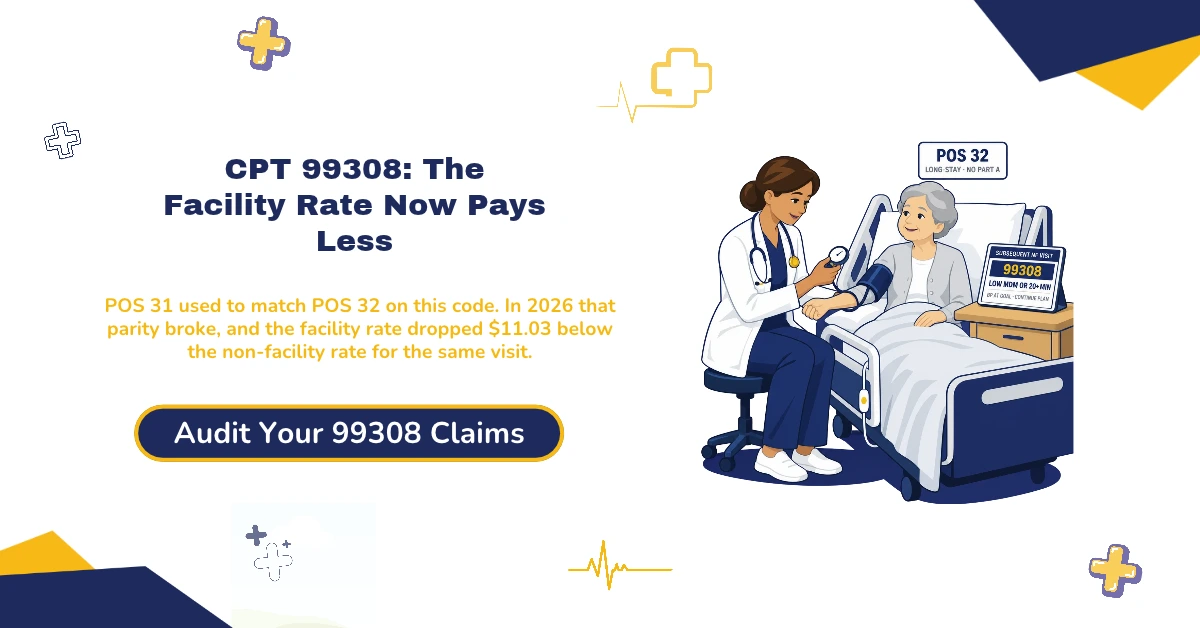
Plenty of billing templates still carry the 2023 threshold of 15 minutes, and some guides still teach the component-based rules CPT retired in 2023. Payment changed too. In 2026, Medicare’s national rate for 99308 is $78.83 at POS 32 and $67.80 at POS 31, a gap of $11.03 per visit.
CPT 99308 service details (2026)
| Field | Value |
|---|---|
| Category | E/M, subsequent nursing facility care, per day (99307 to 99310 family) |
| Medical decision making | Low |
| Time requirement | 20 minutes or more of total time on the date of the encounter (since January 1, 2024) |
| Frequency | One subsequent nursing facility visit per patient, per practitioner, per date of service |
| Place of service | 31 (SNF, Part A stay) or 32 (NF, or SNF without Part A) |
| 2026 Medicare national rate | $78.83 at POS 32, $67.80 at POS 31 (non-QP) |
| Prolonged services add-on | None for 99308 |
| Telehealth | Allowed (POS 02, modifier 95, paid at the facility rate); no frequency cap since January 1, 2026 |
| CMS short descriptor | SBSQ NF CARE LOW MDM 20 |
| Look-alike code | 93308 (limited echocardiogram) |
What is CPT code 99308? Official description and scope
In the 99308 CPT code description, the AMA lists the code as the second of four subsequent nursing facility care levels in the E/M section, 99307 to 99310. CMS shortens the rule to “SBSQ NF CARE LOW MDM 20,” meaning subsequent nursing facility care with low MDM or 20 minutes.
Read the descriptor line by line and you’ll find two layers. Each 99308 visit needs a medically appropriate history, exam, or both. From there, the level comes from low MDM or from at least 20 minutes of total time on the visit date.
How CPT defines a subsequent visit
A visit counts as subsequent once the resident has received any professional service from you during the current stay. Services from a colleague in your group with the exact same specialty and subspecialty count too. New or established patient status doesn’t change anything here.
If the facility discharges and readmits the resident, your first visit of the new stay goes back to the initial nursing facility codes. Across the skilled nursing facility CPT codes, initial care runs 99304 to 99306 and discharge day uses 99315 or 99316. CPT deleted the old annual assessment code, 99318, in 2023.
The initial visit is the full intake workup, and 99308 covers the check-ins after it. CPT applies the same nursing facility CPT codes in psychiatric residential treatment centers and ICF/IID settings. Settle the visit type first. Then score MDM inside the right group of nursing home E/M codes.
What is the time requirement for CPT 99308?
CPT 99308 requires at least 20 minutes of total practitioner time on the date of the encounter when you select the level by time. Nineteen minutes won’t carry it. The AMA raised the threshold from 15 minutes effective January 1, 2024, and that change still trips up billing teams today.
Two references back up the current CPT code 99308 description. AAFP’s E/M time table lists 99308 at low MDM or 20 minutes. AAPC’s 99308 code history logs the change on January 1, 2024, and shows 15 minutes as the prior wording.
What counts toward the 20 minutes
Total time covers the work you do yourself for that resident on that date, at the bedside and away from it. Clinical staff time stays out of the count, and so does time on any service you report with its own code.
- Examining the resident and talking with the resident or family
- Reviewing records, lab results, and imaging reports
- Ordering tests, medications, or referrals
- Talking with the charge nurse or other team members
- Documenting the visit on the same date
Travel and general teaching don’t count, and neither does work on another date. You also need the full 20 minutes. CPT’s E/M guidelines say the stated time must be met or exceeded, so the midpoint rule that rounds up some timed codes doesn’t apply.
One statement of total minutes in the note does the job. A typical line reads: “Total time on this date: 22 minutes, including chart review, exam, and a talk with the charge nurse.” CPT doesn’t require start and stop times, though some commercial payers still ask for them in their contracts.
Drop one older rule from your templates. Before 2023, you could pick a level by time only when counseling filled more than half the visit. CPT removed that condition on January 1, 2023, and some online answers still repeat it.
Table: 99308 time threshold history
| Period | How you select the level | Time threshold | Status |
|---|---|---|---|
| Before 2023 | Two of three components: expanded problem focused interval history, expanded problem focused exam, low MDM | About 15 minutes “typical,” usable only when counseling dominated | Retired |
| January 1, 2023 to December 31, 2023 | Low MDM or total time | 15 minutes, met or exceeded | Superseded |
| January 1, 2024 onward | Low MDM or total time | 20 minutes, met or exceeded | Current in 2026 |
Why some sources still say 15 minutes
You’ll find the old number in three kinds of sources. Google still ranks descriptor PDFs from 2023. CGS, a Medicare contractor, still hosts a 2013 checklist for 99308 that describes 15 minutes at the bedside.
The third source carries more weight. CMS’s CY 2026 Physician Fee Schedule final rule repeats older descriptor wording for the subsequent nursing facility codes in its telehealth section. That passage lists 99308 at 15 minutes. CMS wrote it to set telehealth frequency policy, and the AMA’s CPT code set still governs the time threshold.
CMS’s own 2026 short descriptor ends in “20,” and AAFP’s current table agrees. If a source lists 15 minutes for 99308, it’s quoting the 2023 descriptor. Fix any note template or charge sheet your team built before January 2024 so the threshold reads 20.
Then check your own claims. Pull the 99308 claims you’ve billed by time since January 2024 and look for notes showing 15 to 19 minutes. Unless the MDM in those notes supports low, the time supports 99307, and you’ll want to correct those claims before an auditor finds them.
What counts as low MDM for CPT 99308?
Low MDM for CPT code 99308 means at least two of the three MDM elements reach the low level. The elements are the problems you address, the data you review, and the risk of your management plan. You still document a medically appropriate history and exam, but those no longer set the level.
CMS’s E/M Services guide explains how the AMA scores each element. Score the note in front of you, and two elements at low or higher give you low MDM. The third element can sit lower without pulling the visit down.
Scoring the three MDM elements at the low level
| Element | What counts as low | Nursing facility example |
|---|---|---|
| Problems addressed | Two or more self-limited or minor problems, one stable chronic illness, one acute uncomplicated illness or injury, or one stable acute illness | A check on hypertension that’s at goal |
| Data reviewed and analyzed | Limited: two items from outside notes reviewed, unique test results reviewed, and unique tests ordered, or an assessment that needs an independent historian | Reviewing a BMP result and an outside cardiology note |
| Risk of patient management | Low risk of morbidity from more testing or treatment | Continuing the current plan with routine monitoring |
Watch the word stable. Under the AMA’s definitions, a chronic illness counts as stable only when the resident is at their treatment goal. A resident whose blood pressure sits above goal has a chronic illness with progression, and that moves the problem element up to moderate.
A true 99308 can still include a prescription. Picture a resident with an uncomplicated UTI: you order a urinalysis and start an oral antibiotic. The problem scores low, the data scores minimal, and the prescription scores moderate risk. With two elements at low or higher, the visit supports 99308.
Signs your 99308 should be a 99309
Two common patterns push a visit past low. A moderate problem includes two or more stable chronic illnesses, or one chronic illness that’s getting worse. Prescription drug management counts as moderate risk, and the pair together gives you moderate MDM and 99309, even under 30 minutes.
Take a resident with diabetes and hypertension whose antihypertensive dose you raise. Under skilled nursing facility coding guidelines built on the AMA’s MDM table, that visit supports 99309. Billing it as 99308 costs you $30.73 per visit at POS 31 and $35.74 at POS 32, using 2026 non-QP national rates.
The opposite mistake shows up too. A note that reads “stable, continue current plan,” with no data reviewed and no risk documented, supports 99307 at best. Reviewers downcode those notes on audit, and the fix sits in the template, which should prompt for problem status, data reviewed, the decision, and its risk.
If last month’s nursing facility claims show prescription changes coded as 99308, check whether the same notes address two chronic illnesses. Each match is about $31 left unbilled at POS 31. ClaimMax’s medical billing services begin with a free revenue cycle audit, which can surface this pattern before your next batch goes out.
99307 vs 99308 vs 99309 vs 99310: which level fits?
CPT 99308 sits one level above 99307 and one below 99309 in the subsequent nursing facility family. All four codes share the same setting and the same daily limit. The MDM level and the time threshold separate them: 10 minutes for 99307, 20 for 99308, 30 for 99309, and 45 for 99310.
Table: Subsequent nursing facility levels at a glance (2026)
| Code | MDM level | Time (met or exceeded) | Typical nursing facility scenario | Prolonged add-on |
|---|---|---|---|---|
| 99307 | Straightforward | 10 min | Routine check where nothing changes | None |
| 99308 | Low | 20 min | One stable chronic illness, or one minor acute problem | None |
| 99309 | Moderate | 30 min | A worsening chronic illness, or two chronic illnesses with a prescription change | None |
| 99310 | High | 45 min | An unstable resident, or a decision about hospital transfer | 99418 (CPT) or G0317 (Medicare) |
What is the difference between 99308 and 99309?
Low MDM or 20 minutes supports 99308, while 99309 needs moderate MDM or 30 minutes. The usual tipping point is a moderate problem paired with prescription drug management. Picture a resident with COPD and heart failure whose diuretic dose you raise after a weight gain. That visit reaches 99309 even if it runs under 30 minutes.
What is the difference between 99307 and 99308?
Code 99307 covers straightforward MDM or 10 minutes, such as a visit where the resident is stable and you change nothing. Manage a minor acute problem in that same visit, like constipation treated with an over-the-counter laxative, and the work supports 99308. The problem and the risk both reach low.
Billing by time across the four levels
If you select CPT code 99308 or its siblings by time, the minutes map onto the ladder: 10 supports 99307, 20 supports 99308, 30 supports 99309, and 45 supports 99310. The 99308 CPT code has no prolonged add-on of its own, so extra minutes raise the level instead.
Prolonged time attaches only to 99310. Under CPT, you add 99418 once total time reaches 60 minutes. Medicare doesn’t pay 99418 and uses G0317, starting at 85 minutes and counting time from the day before the visit through three days after. Our guide to prolonged service codes covers the office version.
Code by whichever method supports the higher level. A visit with low MDM and 32 documented minutes bills as 99309 by time, and a 15-minute visit with moderate MDM bills as 99309 by MDM. You don’t need to document time when MDM carries the level.
What is the POS for CPT 99308?
Bill CPT code 99308 with POS 31 when the resident is in a Medicare Part A SNF stay, and with POS 32 when the resident is in a nursing facility or in an SNF stay that Part A isn’t paying. Telehealth visits use POS 02 instead.
POS 31 or POS 32: the Part A test
The skilled nursing facility POS follows the resident’s coverage on the date of service. POS 31 is the place of service code for a skilled nursing facility stay that Part A covers. Once Part A stops paying, the same resident in the same bed takes POS 32 on your next claim.
Table: Choosing POS 31 or POS 32 for 99308
| If the resident on the date of service is… | POS | 2026 national rate for 99308 (non-QP) |
|---|---|---|
| In a Medicare Part A covered SNF stay | 31 | $67.80 |
| A long-term nursing facility resident, past the 100 covered days, or in an SNF stay Part A doesn’t cover | 32 | $78.83 |
| In a dual-certified facility with Part A status unconfirmed | 31, until you verify Part A won’t pay | Rate for the row that applies |
CMS MLN Matters MM13767 describes the edit behind most POS 32 rejections. Since July 2025, Medicare rejects a professional claim with POS 32 when it overlaps a covered Part A SNF stay already on file. Claims that paid before the facility’s stay posted get adjusted.
The 2026 fee schedule made the choice costlier. CMS cut practice expense for facility settings, so POS 31 now pays $11.03 less than POS 32 for the same visit. PALTmed’s 2026 POS analysis puts that gap at about 14%.
Get Part A status from the facility’s census or MDS coordinator before each rounding day. Day 101 of a benefit period flips the resident from POS 31 to POS 32. Hospital returns need a recheck too, because a qualifying readmission can restart Part A coverage and move that resident back to POS 31.
Settings where 99308 doesn’t belong
Some guides still list POS 33 for 99308. Since 2023, assisted living (POS 13), group homes (POS 14), and custodial care facilities (POS 33) use the home and residence codes, with 99347 to 99350 for established residents.
Hospital inpatient and observation stays, LTACHs included, use 99221 to 99223 and 99231 to 99233. Office POS 11 doesn’t fit either. CPT’s nursing facility codes do apply at POS 54 (ICF/IID) and POS 56 (psychiatric residential treatment centers).
Part A status lives in the facility’s system, and that gap is where most POS errors start. ClaimMax’s revenue cycle management team builds a census check into charge entry, so your nursing home billing doesn’t rely on guesswork.
How often can CPT code 99308 be billed?
For CPT 99308, Medicare pays one subsequent nursing facility visit per patient, per practitioner, per date of service. Past that daily limit, frequency follows medical necessity and the federal visit schedule. Medicare sets no weekly cap, though some Medicaid and commercial plans do, so check the plan before you schedule routine rounds.
Mandated visits vs medically necessary visits
Federal nursing home rules at 42 CFR 483.30 set a minimum physician visit schedule for each resident, and the follow-up visits in that schedule bill as 99307 to 99310. A visit counts as timely if it happens no later than 10 days after its due date.
- At least one visit per 30 days for the first 90 days after admission
- At least one visit per 60 days after that
A mandated visit that also manages a medical problem is still one E/M claim. The CPT code for an annual nursing facility visit is no longer 99318, which CPT deleted in 2023. You bill whichever of 99307 to 99310 the work supports.
In an SNF, the physician performs the initial visit. After that, a nurse practitioner, physician assistant, or clinical nurse specialist can alternate the required visits with the physician, at the physician’s option. Medically necessary visits between those dates bill on their own merits.
Two providers, one resident, same day
Practitioners in the same group with the same specialty count as one provider. If two of them see the resident on one date, you submit one claim and take the level from the combined work. Different specialties, such as psychiatry and internal medicine, can each bill when both visits are medically necessary.
Picture two NPs from your group rounding on the same floor Monday, and both drop a 99308 for the same resident. One claim pays. The other denies as a duplicate or pays and turns into a recoupment later, since CMS RAC issue 0061 targets excess units of nursing facility visits.
A consultant’s first visit follows separate nursing facility consult rules, and the consultant’s follow-up visits use 99307 to 99310. Groups with several rounding providers need a same-day duplicate check before claims go out, and it’s one of the first edits worth building into group practice medical billing.
What does CPT code 99308 pay in 2026?
In 2026, Medicare’s national rate for CPT 99308 is $78.83 at POS 32 and $67.80 at POS 31 for clinicians paid at the standard conversion factor of $33.4009. Your actual payment shifts with your locality and provider type, and Qualifying APM Participants (QPs) get a higher conversion factor.
Table: 2026 Medicare national rates for 99308 (national, before geographic adjustment)
| Setting | POS | Total RVUs | 2026 non-QP rate (CF $33.4009) | 2026 QP rate (CF $33.5675) | 2025 rate |
|---|---|---|---|---|---|
| Nursing facility, or SNF without Part A | 32 (non-facility rate) | 2.36 | $78.83 | $79.22 | $71.81 |
| SNF, Part A stay | 31 (facility rate) | 2.03 | $67.80 | $68.14 | $71.81 |
| Telehealth, resident in the facility | 02 (facility rate) | 2.03 | $67.80 | $68.14 | $71.81 |
The gap between the two settings is new for 2026. Nursing facility codes used to carry the same practice expense in both settings, and the 2026 rule changed that. Compared with 2025, the POS 32 rate rose 9.8% and the POS 31 rate fell 5.6%. PALTmed’s table lists $79.22 at POS 32, which is the QP figure.
Table: 99308 RVU components (2026)
| Component | RVUs |
|---|---|
| Work | 1.30 |
| Practice expense, non-facility (POS 32) | 0.98 |
| Practice expense, facility (POS 31 and 02) | 0.65 |
| Malpractice | 0.08 |
| Total | 2.36 non-facility, 2.03 facility |
These values match the October 2026 release (RVU26D) in the CMS PFS relative value files. The table shows allowed amounts. Medicare pays 80% after the Part B deductible, and the resident or a secondary payer covers the rest.
How locality and provider type change the rate
For many long-stay residents, that secondary payer is Medicaid, because they’re dual eligible. State Medicaid billing rules decide how the crossover claim pays. NPs and PAs billing under their own NPI receive 85% of the fee schedule: $67.01 at POS 32 and $57.63 at POS 31 (non-QP).
Locality moves the number further. Using the 2026 GPCIs, 99308 at POS 32 runs from $72.91 in Arkansas to $101.46 in Alaska, and from $63.45 to $89.73 at POS 31. Medicaid, Medicare Advantage, and commercial plans pay by contract, and the MM13767 edit applies to Original Medicare claims.
Take a hypothetical group that bills 400 long-stay visits a month at POS 31 when POS 32 applies. That’s $4,412 a month left uncollected ($11.03 x 400). Track POS and payer mix each month in your RCM services reporting so a gap like that surfaces early.
What could change for 2027
CMS published the CY 2027 PFS proposed rule on July 16, 2026, and the final rule tends to come out in early November. PALTmed is pushing CMS to reverse the lower POS 31 payment. Check the final 2027 rates before you update charge masters or payer contracts in January.
Does CPT 99308 need a modifier?
CPT 99308 doesn’t need a modifier on a routine in-person visit. You add one only when something else applies: a same-day minor procedure (25), real-time video (95), a split or shared SNF visit (FS), or a resident on hospice (GV or GW).
The 99308 CPT code itself carries no modifier requirement, so each nursing facility modifier below answers a specific claim situation. Two of them, FS and the hospice pair, depend on where and why you saw the resident.
Table: Modifiers used with 99308
| Modifier | When it applies to 99308 | Watch for |
|---|---|---|
| 25 | A significant, separately identifiable visit on the same day as a minor procedure, such as debridement or I&D | The note must stand apart from the procedure’s own evaluation |
| 95 | Real-time audio and video telehealth | Pairs with POS 02 and doesn’t change payment |
| FS | A split or shared visit in an SNF (POS 31) | Not allowed on NF (POS 32) visits or on visits the physician must perform in full |
| GV | A hospice resident seen by an attending physician the hospice doesn’t employ or pay, for the terminal condition | Without it, the visit can deny as hospice-covered |
| GW | A hospice resident seen for a problem unrelated to the terminal condition | Name the unrelated problem in the assessment |
| 59 or XE, XP, XS, XU | Not used on 99308; CPT bars modifier 59 from E/M services | Put 59 on the procedure and 25 on the E/M |
| AI | Not used on 99308 | Belongs on 99304 to 99306 billed by the principal physician of record |
| CG | Not required on a 99308 professional claim | Skip it unless a payer policy names it |
Telehealth rules for CPT code 99308 in 2026
CMS ended the telehealth frequency limit on subsequent nursing facility visits as of January 1, 2026, with no sunset date, according to the CMS telehealth FAQ. The written limit had been one telehealth visit per 14 days, and CMS had suspended it through 2025.
Bill POS 02 with modifier 95, and the visit pays the facility rate, the same $67.80 as POS 31 (non-QP). Our POS 02 telehealth billing guide and our modifier 95 rules cover both pieces in detail.
The facility can bill the originating site fee, HCPCS Q3014, which carries a 2026 fee schedule amount of $31.85. Medicare’s audio-only option covers patients in their homes, so a facility resident’s visit needs real-time video. A phone call can’t stand in for 99308, and CPT deleted the phone E/M codes 99441 to 99443 in 2025.
Split or shared visits: SNF yes, NF no
In an SNF, a physician and an NPP from the same group can bill a split or shared 99308 with modifier FS. The exception covers visits CMS requires the physician to perform in full, such as the initial SNF visit. CMS split or shared rules state that nursing facility visits can’t bill this way.
The billing practitioner is whoever performed the substantive portion. CMS defines that as more than half of the combined total time, or a substantive part of the MDM. A guide that bans split or shared billing in all nursing homes is out of date for SNF stays.
CPT code 99308 billing guidelines: documentation checklist
The CPT 99308 description sets the requirements, and your note has to prove each one. A clean note shows four things: the problems you addressed and their status, the data you reviewed, your management decision and its risk, and, for time-based coding, the total minutes for that date.
These seven items are the SNF billing guidelines for the 99308 notes your team writes. Build them into your note template, so the EHR prompts for each item before the provider signs and the coder can score MDM without guessing.
- Date of service and confirmed Part A status, which sets POS 31 or 32
- Reason for the visit, in the nurse’s or resident’s words
- Medically appropriate interval history and exam
- Each problem addressed, with its status: at goal, improving, or worsening
- Test results and outside notes reviewed, named and dated
- The decision and its risk: no change, new order, or prescription change
- For time-based coding, one total-minutes statement listing the activities
| Example: low-MDM 99308 note (de-identified)Subsequent NF visit, POS 32. Long-stay resident; no active Part A per facility census.Reason: nursing flagged one systolic reading of 148; 7-day average 128/76.Interval history: no headache, chest pain, or dizziness; amlodipine 5 mg daily per MAR.Exam: BP 130/78, HR 72, lungs clear, no edema.Data: reviewed BMP dated 9/28 (K 4.1, Cr 1.0) and outside cardiology note dated 9/20.Assessment: essential hypertension (I10), at goal, stable.Plan: continue amlodipine 5 mg; twice-daily BP checks; notify if systolic over 170.Total time on this date: 22 minutes, including chart and lab review, exam, discussion with the charge nurse, and documentation. |
Scoring the example: one stable chronic illness scores low, and two reviewed items give limited data. The decision to continue a prescription can score moderate risk, but problems and data both sit at low, so the MDM is low. On time alone, 22 minutes also supports 99308.
Table: Note phrases that invite downcoding
| Invites downcoding | Write instead |
|---|---|
| “Pt stable, continue meds” | “Hypertension at goal (7-day average 128/76); continue amlodipine 5 mg.” |
| “Labs reviewed” | “Reviewed BMP 9/28: K 4.1, Cr 1.0.” |
| “Spent time with patient” | “Total time on this date: 22 minutes (review, exam, nursing discussion, documentation).” |
Linking the right ICD-10 codes
Link each visit to the condition you managed. Common ICD-10 codes for skilled nursing facility visits include I10 (hypertension), E11.9 (type 2 diabetes without complications), J44.9 (COPD), N39.0 (urinary tract infection), and F03.90 (unspecified dementia). Check each one against the FY2027 code set, which took effect October 1, 2026.
Z51.89 means an encounter for other specified aftercare, and it doesn’t explain why you saw the resident. Putting it first in place of the treated condition is a common trigger for a CARC 11 denial. List the managed condition first and any Z codes after it.
Why 99308 claims get denied and how to fix them
Most CPT code 99308 denials trace back to five fixable causes: the wrong place of service, a second visit on the same day, documentation that doesn’t support low MDM, a missing or wrong modifier, and a diagnosis that doesn’t explain why you saw the resident.
Table: Common 99308 denials, causes, and fixes
| Denial | What it means | Usual cause on 99308 | Fix |
|---|---|---|---|
| CARC 5 | Procedure code inconsistent with the place of service | POS 11, 13, 21, or 33 on a 99308 | Correct the POS, or switch to the right code family |
| Rejection (CR 13767 edit) | Claim rejected before adjudication | POS 32 overlapping a covered Part A SNF stay | Resubmit with POS 31 after checking the census |
| CARC 18 | Exact duplicate claim or service | A second same-day visit from the same group and specialty | Combine the work on one claim and send changes as a replacement claim (frequency code 7) |
| CARC 50 | Not deemed a medical necessity by the payer | Level not supported, or a routine note with no active problem | Appeal with the note mapped to the MDM elements, or correct the level |
| CARC 11 | Diagnosis inconsistent with the procedure | An aftercare Z code listed without the treated condition | Recode with the condition you managed |
| CARC 4 | Procedure code inconsistent with the modifier, or a required modifier missing | Telehealth billed without 95, or FS on a POS 32 visit | Correct the modifier and resubmit |
| CARC 181 | Procedure code invalid on the date of service | 99318 left on an old template | Rebill with the right code from 99307 to 99310 |
| CARC 16 | Claim lacks information or has submission errors | Missing rendering NPI or service facility address | Complete the field and resubmit |
Sort these denials into two tracks. Data errors (CARC 4, 5, 11, 16, and 181) go out as corrected claims. Clinical disputes (CARC 50) go to appeal, with the note mapped to the three MDM elements and the total time if you coded by minutes.
A second same-day visit that got paid still counts as an overpayment. Refund it once you find it, before a recovery auditor does. Fixing the cause matters more than the single claim, since the same template or scheduling habit tends to repeat the error.
Who bills the visit: the SNF or your practice
Facility staff sometimes assume the SNF bills your visit. Under the nursing home billing guidelines in the CMS SNF billing reference, physician services fall outside SNF consolidated billing, so your practice submits 99308 to Part B on its own claim.
If the same CARC keeps coming back on your nursing facility claims, the cause tends to sit in one step of the workflow. ClaimMax’s full-service medical billing team traces each denial back to that step and fixes it there.
CPT 99308 FAQs
What does CPT code 99308 mean?
The 99308 CPT code description covers a subsequent nursing facility visit, billed per day, with low MDM or at least 20 minutes of total time. CMS abbreviates it as “SBSQ NF CARE LOW MDM 20.” In plain words, it’s a follow-up visit for a resident you’ve already seen during the current stay.
Can a nurse practitioner bill 99308?
Yes. An NP can bill 99308 under their own NPI where state scope of practice allows, and Medicare pays 85% of the fee schedule: $67.01 at POS 32 and $57.63 at POS 31 (non-QP). In an SNF, the physician performs the initial visit, and split or shared billing with modifier FS works in SNFs only.
Can 99308 and 99309 be billed on the same day?
No, not by one practitioner or by colleagues in the same group and specialty. Medicare pays one subsequent nursing facility visit per patient, per practitioner, per date. Add up the work from both encounters and bill one code at the level the combined MDM or total time supports, which may turn out to be 99309 or 99310.
Can you bill 99308 on the day of discharge?
No. The practitioner who discharges the resident reports 99315 (30 minutes or less) or 99316 (more than 30 minutes) for that day’s work, including the final exam and discharge paperwork. After the resident goes home, the community clinician who takes over may bill transitional care management codes for the 30 days that follow.
Is 99308 used for assisted living residents?
No. Since January 1, 2023, assisted living residents get the home or residence codes, 99347 to 99350 for established patients, billed with POS 13. That change retired the separate domiciliary codes. CPT code 99308 applies only to residents of an SNF, a nursing facility, an ICF/IID, or a psychiatric residential treatment center.
What replaced CPT 99318 for annual nursing home visits?
No new code replaced it. CPT deleted 99318 on January 1, 2023, so an annual nursing home visit now bills as whichever of 99307 to 99310 the MDM or total time supports. Keep that note focused on the problems you addressed, since the annual label alone doesn’t set the level.
Does CPT 99308 have a global period?
No. The code carries global indicator XXX, so global surgery rules don’t apply to it. If you also perform a minor procedure that day, add modifier 25 to the visit when the E/M work is significant and separately identifiable from the evaluation that comes with the procedure itself.
Get your 99308 claims right before they go out
CPT code 99308 pays in full when the note supports low MDM or clears the 20-minute floor. The claim side matters as much, because POS 31 versus POS 32 sets the rate and drives the CR 13767 rejections covered above.
If you’d like a second set of eyes on your nursing facility claims, ClaimMax RCM starts with a free revenue cycle audit. It’s a 20-minute working session on your actual billing data, with a custom report and zero obligation, so you can see where your nursing home billing stands before you change anything.