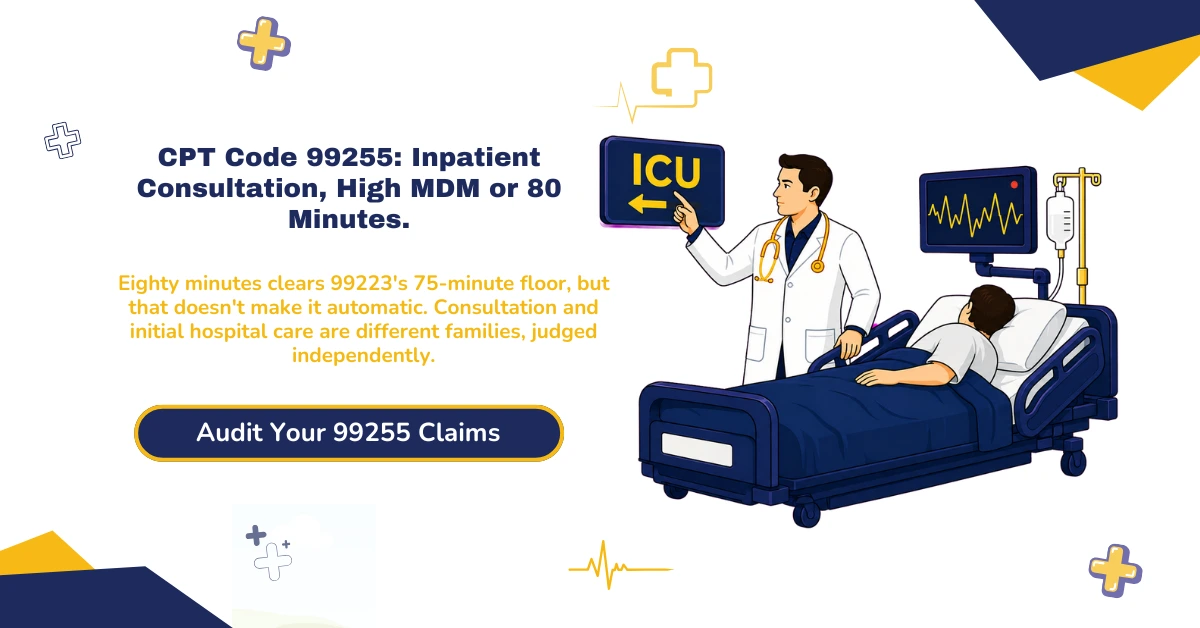
CPT code 99255 reports a level 5 consultation for a hospital inpatient, an observation patient, a nursing facility resident, or a partial hospital patient. The encounter has to support high medical decision making (MDM), or at least 80 minutes of total time on the date of the encounter. The code is still active in 2026, per the AMA’s current E/M descriptors. Medicare doesn’t recognize consultation codes for payment, and commercial policies vary by plan.
Here’s where the billing problem starts. A valid CPT code isn’t automatically a payable one. The note can support 99255 perfectly, with the consultation request documented and 84 minutes recorded. Denials still land when the patient’s plan stopped recognizing consultation codes years ago.
Four decisions control payment on a 99255 CPT code claim, in this order: whether the encounter qualifies as a consultation, whether the note supports high MDM or 80 minutes, whether the plan recognizes the code, and which code replaces it when the plan doesn’t.
Reviewed for 2026. The coding rules and payer policies in this ClaimMax RCM guide were verified through August 6, 2026. Commercial policy changes without notice, so confirm the plan before the claim goes out.
What Are the CPT 99255 Requirements at a Glance?
Five things have to be true. Another practitioner requests the consultation and the record shows it. The patient is an inpatient, observation patient, nursing facility resident, or partial hospital patient. Nobody in your exact same specialty and subspecialty saw the patient earlier in the stay. Documentation reaches high MDM or 80 minutes. Findings go back to the requester in writing.
Full Requirement Set
| Requirement | What CPT 99255 requires |
|---|---|
| Service type | An inpatient, observation, nursing facility, or partial hospital consultation |
| Patient status | New or established patient, both reported with the same code |
| Prior contact | No face-to-face service earlier in the stay from you, or from a partner in your exact same specialty and subspecialty |
| MDM level | High complexity, when medical decision making sets the level |
| Time alternative | 80 minutes or more of total time on the date of the encounter |
| History and exam | Medically appropriate for the problem, but neither one sets the level |
| Consultation request | Documented in the record, from a physician or other appropriate source |
| Written report | Consultant’s opinion and any services ordered, returned to the requester |
| Frequency | Once per consultant per admission, partners in the same specialty included |
| Original Medicare | Consultation codes aren’t recognized for Part B payment |
| Commercial plans | Recognition depends on the specific product and the contract |
| Later encounters | Subsequent care codes for the rest of that stay |
Nothing on that list is optional. A 99255 CPT code claim that clears the MDM bar but skips the written report is still the wrong code. The AAFP table of E/M time and MDM levels confirms the same high MDM and 80-minute thresholds.
When Does an Inpatient Encounter Qualify as a Consultation?
An inpatient encounter qualifies as a consultation when another practitioner asks for your opinion, the record explains why, and your findings go back to them. Specialty alone doesn’t make it a consultation. Neither does being the first specialist at the bedside. Without a documented request and a report back, you’re reporting an initial or subsequent hospital visit, not a 99255 CPT code claim.
The Request, Reason, and Report Test
- Request. A physician or other appropriate source asks for your opinion or advice, and that ask sits in the chart as an order, a note, or a documented verbal request.
- Reason. The record names the specific clinical question, not just the specialty being called.
- Report. Your findings, opinion, and any services ordered go back to the requesting practitioner in writing.
Request and report both come from CPT. The level of detail expected on the reason comes from payer policy and audit practice, which is why a note can pass a coding review and still fail a payer audit. UTMB’s June 2026 coding guidance frames the same three elements for inpatient consultations.
In a hospital chart, the first two look like this: “Cardiology consultation requested by Dr. Lopez for evaluation of new severe systolic dysfunction and inpatient management recommendations.” The report element closes the loop at the end of the note, and naming the requesting practitioner inside that note removes the argument entirely.
What Doesn’t Automatically Qualify
- Standing orders that route every admission to a specialty
- Protocol-driven involvement with no individual request behind it
- A patient or family member asking for the specialist directly
- Routine co-management where nobody actually asked for an opinion
- A consult order with no clinical question attached to it
- A note that never makes its way back to the requester
Transfer of care used to settle this. It doesn’t anymore. The AMA pulled the old transfer-of-care language out of the revised consultation guidelines, so a consultant who starts treatment during the same encounter can still report a consultation when the request, reason, and report are documented. Some payer policies still carry the older wording, so check the plan before you assume. The same three-part test governs outpatient consultation coding, where the request usually arrives as a referral instead of a chart order.
Run this check before the charge goes out. Can you point to who asked, what they asked, what you evaluated, and where you answered them? Four questions, four places in the chart. Miss one and the level does not matter, because it is not a consultation.
How Does High Medical Decision Making Support CPT 99255?
High medical decision making supports a 99255 CPT code claim when two of the three MDM elements reach the high level. Those elements are problems addressed, data reviewed and analyzed, and risk of patient management. One high element is not enough. The AMA’s E/M revisions FAQs state that two of three have to be high before the encounter qualifies as high complexity.
That two-of-three rule is where 99255 notes usually fall short. A note can describe a genuinely unstable patient and still land at moderate, because risk reached high and nobody documented the data work.
Problems Addressed
Two situations hit the high level. One or more chronic illnesses with severe exacerbation, progression, or side effects of treatment. Or an acute or chronic illness or injury that threatens life or bodily function.
Diagnosis count does not move this element at all. “Patient has six diagnoses” tells a reviewer nothing about severity. Compare it to “acute decompensated heart failure with worsening hypoxemia and risk of respiratory failure, actively evaluated and managed.” Same patient, different audit outcome.
Coders don’t get to decide whether a problem is stable or worsening either. The AMA puts that call on the treating physician, which means it has to appear in the note before anyone codes from it.
Data Reviewed and Analyzed
Volume is not the test here. High-level data means the record shows work across at least two of the three data categories:
- Reviewing external notes, reviewing results, ordering tests, or using an independent historian
- Independently interpreting a test someone else performed, when you aren’t billing that interpretation
- Discussing management or test interpretation with an external physician or other qualified health care professional
Moderate needs one category. High needs two. Missing that second category is what drops a 99255 note to 99254.
Risk of Patient Management
Risk lives in the decisions you made, not the diagnosis you found. Four examples reach high:
- Drug therapy requiring intensive monitoring for toxicity
- A decision about emergency major surgery
- A decision to escalate to hospital-level care, such as an ICU transfer
- A decision to limit or withdraw treatment because of poor prognosis
Escalation carries the most weight on inpatient consults. Your patient is already admitted, so the hospitalization decision usually shows up as moving them up a level of care.
Two Notes, Two Outcomes
Supports high MDM. A nephrologist evaluates rapidly worsening renal failure, reviews outside records and serial labs, discusses urgent dialysis planning with the hospitalist, and makes a high-risk treatment decision. Problems, data, and risk all land at high.
Doesn’t support it. A four-page chart review paired with routine medication adjustments stays at moderate. Length isn’t complexity.
How Do You Bill CPT 99255 Using the 80-Minute Rule?
CPT 99255 can be selected by time when the physician or other qualified health care professional performs at least 80 minutes of qualifying work on the date of the encounter. Total time counts, not just bedside time. Your note has to state the total and describe enough of the work to make that number hold up.
Time threshold: 80 minutes must be met or exceeded. CPT’s own wording is “met or exceeded,” which rules out rounding and rules out the midpoint convention some coders still apply. A documented 79 minutes is a 99254.
Which Minutes Count Toward the 80
| Counts toward total time | Doesn’t count |
|---|---|
| Preparing to see the patient | Clinical staff time |
| Reviewing records, imaging, and results | Travel to and from the unit |
| Obtaining or reviewing the history | Work performed on a different calendar date |
| Performing the medically appropriate exam | Time for services reported separately |
| Counseling the patient or family | Minutes already counted toward another code |
| Ordering medications, tests, or procedures | General teaching unrelated to this patient |
| Communicating with other treating professionals | |
| Documenting the encounter | |
| Coordinating care that isn’t separately reported |
Double counting is what gets practices in trouble. Minutes spent on a separately billed procedure can’t also prop up the consultation level.
What Strong Time Documentation Looks Like
Here is a total that survives review: “Total physician time on the date of service was 84 minutes, including review of outside records and imaging, bedside evaluation, discussion with the patient and family, communication with the hospitalist, care planning, and documentation.”
Now the version that fails: “Extended visit, more than one hour.”
Three things are wrong with it. More than an hour doesn’t reach 80 minutes. No exact total appears anywhere in the note. And nothing tells a reviewer which activities filled that time.
Some payers and hospital compliance programs want start and stop times on a time-based 99255 CPT code claim. Others accept a stated total. Check the plan’s documentation requirement before you build a template around either approach.
What Documentation Is Required for a 99255 Claim?
A defensible 99255 CPT code record names the requesting practitioner and the reason for the consult, includes a medically appropriate history or exam, supports either high MDM or 80 minutes, and shows the findings going back to the requester. Miss one of those four and the claim is exposed, no matter how sick the patient was.
The Pre-Bill Documentation Checklist
| Record element | What a reviewer needs to find |
|---|---|
| Requesting practitioner | Name or role of the physician or source who asked |
| Reason for the consult | The specific clinical question, not just the specialty |
| Patient status | Inpatient, observation, or nursing facility, stated plainly |
| History and exam | Medically appropriate for the presenting problem |
| Assessment | The consultant’s clinical opinion in usable terms |
| Problems addressed | Severity, and what was actively managed |
| Data reviewed | Sources, tests, and any outside discussion |
| Risk | The management decision that carried the risk |
| Total time | An exact number, when time sets the level |
| Plan | Recommendations the requester can act on |
| Report back | Where and how the findings were communicated |
| Attestation | Signature, credentials, and date |
Why MDM Notes Fail Review
Four phrases show up constantly in consultation notes and carry no weight on their own: “complex patient,” “multiple comorbidities,” “extensive data,” and “high risk.”
Each phrase needs the clinical fact underneath it. High risk becomes defensible once the note says what the decision was and why it carried risk. That is the line between a conclusion and actual documentation.
What Time-Based Notes Actually Need
State the total, then summarize the qualifying work. A minute-by-minute log isn’t required unless your payer or your own compliance policy demands one, and building physician templates around a rule nobody imposed costs time you won’t get back.
Run This Check Before the Charge Drops
Pre-bill audit prompt. Can your biller point to the request, the reason, the report back, the high MDM or 80 minutes, the patient’s status, the payer’s consultation policy, and the consultant’s role in the stay? Seven answers, all pulled from the record, none from assumption. If any answer needs a guess, the charge isn’t ready to release.
When the same consultation notes keep failing pre-bill review, the ClaimMax medical billing services team can trace whether the breakdown starts in the documentation, the code selection, or the payer rule. Sometimes it’s all three, and knowing which came first changes the fix.
What Is the Difference Between CPT 99254 and 99255?
CPT 99254 requires moderate MDM or at least 60 minutes. CPT 99255 requires high MDM or at least 80 minutes. What separates them is the documented level of work, not the specialist’s title, the patient’s unit, or how many diagnoses got pulled into the assessment.
| Decision factor | 99254 | 99255 |
|---|---|---|
| MDM level | Moderate | High |
| Time threshold | 60 minutes | 80 minutes |
| Problems addressed | Moderate severity, actively managed | Severe exacerbation, or a threat to life or bodily function |
| Data reviewed | One of the three data categories | Two of the three data categories |
| Risk | Moderate, such as prescription drug management | High, such as escalation of care or emergency major surgery |
| Typical error | Undercoding work that already met high | Upcoding because the patient looked sick |
Two Encounters, Side by Side
A 99254 encounter looks like this: the consultant evaluates worsening but stable chronic disease, reviews several tests, and adjusts prescription therapy without making a high-risk management decision.
A 99255 encounter looks different: the consultant evaluates a condition threatening life or bodily function, works across two data categories, and makes a high-risk treatment or escalation decision.
Neither example decides your claim. Code selection runs on the complete note, and two encounters that read alike in a summary can support different levels once you check all three MDM elements.
Both codes remain active in 2026, and both are consultation codes covering the same settings. Only the level moves between them. For the full four-level breakdown, including 99252 and 99253, see our guide to inpatient consult CPT codes.
Does Medicare Pay CPT Code 99255?
No. Original Medicare does not recognize CPT consultation codes, including 99255, for Part B payment, and that has been the rule since January 1, 2010. When a physician performs consultative work for an Original Medicare patient, you report the Medicare-recognized E/M service that matches the setting, the service sequence, and the documented MDM or time. CMS repeats this in its current Evaluation and Management Services guide.
The Exception Most Articles Leave Out
Medicare does pay for a narrow set of telehealth consultation codes. HCPCS G0425 to G0427 cover emergency department or initial inpatient telehealth consultations, and G0406 to G0408 cover follow-up inpatient telehealth consultations.
Those are HCPCS codes with their own telehealth conditions attached. They’re not a workaround for a denied 99255 CPT code claim, and they don’t apply to a bedside consult.
Active in CPT Doesn’t Mean Payable by Medicare
Two different organizations control those two things. The AMA maintains the CPT code set and decides what stays active. CMS decides what Medicare recognizes for payment, and the two lists do not match.
CPT 99255 sits in that gap. On the Physician Fee Schedule, CMS assigns it status indicator I, defined as not valid for Medicare purposes because Medicare uses another code for reporting and payment.
Original Medicare Is Not Medicare Advantage
Original Medicare follows CMS consultation policy. Medicare Advantage plans are separate contracts, and each one sets its own reimbursement rules.
Don’t assume every MA product handles consultation codes identically. Some mirror CMS exactly. Others process them under their own edits. Verifying the specific plan takes a few minutes and beats reworking a batch of claims a month later.
Billing warning. Don’t submit 99255 to Original Medicare because the note supports high MDM or 80 minutes. Documentation strength doesn’t override code recognition. Claims process against the payer’s rules first, and a perfect note can’t fix a code the plan won’t accept.
What Is the 99255 Replacement Code for Medicare?
There is no automatic one-to-one replacement. The correct Medicare code depends on the patient’s status that day, whether your group already saw the patient during the stay, and what your documentation independently supports. Two consultants working the same floor on the same afternoon can end up reporting different code families, and both can be right.
Patient Status Decides the Code Family
Here’s the fork most crosswalks skip entirely. CPT reports consultations for inpatients and observation patients with the same four codes. Medicare doesn’t treat those patients the same way at all.
For a hospital inpatient, a consultant performing the initial evaluation reports an initial hospital inpatient or observation care code.
For a patient in observation, CMS routes it elsewhere. Only the practitioner who ordered observation and carries responsibility for that care bills the initial hospital or observation care codes. Every other practitioner furnishing a consultation or additional evaluation reports office or other outpatient visit codes, 99202 to 99215, under the Medicare Claims Processing Manual, Chapter 12.
Observation is outpatient status. Spending the night in a hospital bed doesn’t change it, and the admission order settles the question, not the floor the patient is on.
Why 99223 Isn’t an Automatic Crosswalk
| Factor | CPT 99255 | CPT 99223 |
|---|---|---|
| Service family | Inpatient or observation consultation | Initial hospital inpatient or observation care |
| MDM required | High | High |
| Time threshold | 80 minutes | 75 minutes |
| Consultation request | Required to report the code | Not a reporting requirement |
| Original Medicare | Not recognized for Part B payment | Recognized when independently supported |
| Automatic swap from 99255 | Not available | No, the code stands on its own merits |
| Same-specialty history | Affects consultation frequency | Decides initial versus subsequent |
Both codes want high MDM, which makes the swap look clean. Look at the time row again. A note documenting 76 minutes misses 99255 and clears 99223, so the two requirements run on separate tracks and each has to be checked on its own.
The Medicare Replacement Decision Sequence
- Confirm the plan type. Original Medicare and Medicare Advantage don’t follow the same consultation rules.
- Confirm patient status on the date of service, taken from the admission order rather than the location.
- For observation patients, report an office or other outpatient E/M code unless your physician ordered the observation care.
- For inpatients, check whether you or a partner in your exact same specialty and subspecialty already had a face-to-face encounter during this stay.
- Decide initial or subsequent from that answer, because a prior group encounter makes the service subsequent care.
- Select the level using documented MDM or total time, then confirm medical necessity supports it.
- Append modifier AI only when your physician is the principal physician of record, then release the claim.
Nothing in that sequence tells you to convert 99255 to 99223. Some encounters land there. Others fall to a lower initial hospital code, to subsequent care codes 99231 to 99233, or to an outpatient visit code, and our guide to initial hospital care leveling walks through how those thresholds work.
Payer edits should flag a consultation code the plan won’t pay. What they shouldn’t do is convert it blindly and call the job finished. The ClaimMax hospital revenue cycle management team checks the status, the provider history, the documentation, and the plan rule before a 99255 replacement code ever reaches the clearinghouse.
Do Commercial Payers Accept the 99255 CPT Code?
Some commercial plans still reimburse the 99255 CPT code. Others adopted Medicare-style rules years ago and require a different E/M code instead. Recognition gets set at the product level, not the brand level, so verify the member’s exact plan, your contract, and the payer’s current reimbursement policy before the claim goes out.
Why the Payer Name Alone Settles Nothing
Consultation policy can differ across all of these, inside the same brand:
- Commercial group versus Individual Exchange product
- Employer plan design
- Medicare Advantage plan
- Medicaid managed care plan
- State licensee, since Blue plans operate separately
- Your specific network contract
- Date of service, because policies carry effective dates
Picture two Blue cards in the same admission. One plan pays consultation codes and the other requires hospital E/M codes. Same logo, same hospital, two different claims. Checking the card tells you almost nothing.
Current Consultation Code Policy Examples
| Payer | Policy position | Policy and date | What to report instead |
|---|---|---|---|
| UnitedHealthcare Commercial and Individual Exchange | Doesn’t reimburse 99242 to 99245 or 99252 to 99255 | Policy 2026R0129A, reviewed July 1, 2026 | The supported office, hospital, nursing facility, or home E/M code |
| Blue Cross and Blue Shield of Texas | Doesn’t reimburse 99242 to 99245 or 99252 to 99255 | Policy CPCP024, effective November 18, 2024 | The E/M code matching the location and complexity |
| Blue Cross and Blue Shield of New Mexico | Same policy number, same outcome | Announced for September 1, 2024, revised to November 18, 2024 | The E/M code matching the location and complexity |
Read the UnitedHealthcare policy closely before you write that payer off entirely. It still considers telehealth consultation HCPCS codes and interprofessional consultation codes 99446 to 99449 and 99451 to 99452, and it requires the requesting provider’s name or NPI on the claim. Blanket statements about a payer “not paying consults” miss both of those.
The New Mexico row matters more than it looks. Same policy number as Texas, same end result, and an effective date that moved once before it landed. Policies shift, and a rule you verified in 2024 isn’t a rule you’ve verified now.
Policy check. Eligibility and active benefits don’t tell you whether a plan reimburses CPT code 99255. Benefits confirm the patient is covered. Reimbursement policy confirms the code is payable, and those live in two different places.
Contract terms and fee schedules affect this too, which is where payer contracting services earn their keep. A plan can recognize a code in policy and still price it differently under your agreement.
Log Five Fields Every Time You Verify
| Field to capture | Why it belongs in the log |
|---|---|
| Payer and product | Recognition is set per product, not per brand |
| Consultation codes accepted | The actual answer you are chasing |
| Alternative code family | What to report when the answer is no |
| Policy effective date | Tells you when the rule changed and what it replaced |
| Verified by, date, and source | Turns a memory into a defensible record |
Which Place of Service Applies to the 99255 CPT Code?
The professional claim reports where the service actually happened, not what the code family is called. POS 21 covers an inpatient hospital. POS 22 covers an on-campus outpatient hospital, which is where most observation patients sit. POS 19 covers an off-campus outpatient hospital department. Observation is outpatient status, no matter which floor the bed is on.
| POS code | Setting | When it applies to a consultation |
|---|---|---|
| 21 | Inpatient hospital | The patient has been formally admitted as an inpatient |
| 22 | On-campus outpatient hospital | Observation or outpatient service on the main hospital campus |
| 19 | Off-campus outpatient hospital | Observation or outpatient service in a provider-based department off campus |
| 31 or 32 | Skilled nursing facility or nursing facility | Consultation for a nursing facility resident |
CMS publishes all of these in its Place of Service Code Set, and POS 19, 21, and 22 all pay at the facility rate. Two of those rows get missed routinely. An observation consult in a qualifying off-campus department needs POS 19, and because CPT covers nursing facility residents under the same four consultation codes, POS 31 or 32 comes into play more often than a hospital-only framing suggests.
The Overnight Trap
Your patient can spend a full night in a hospital bed, on a hospital floor, with hospital nursing, and still be an outpatient the entire time. Bed location is not status.
Pull the admission order. That document decides POS on a CPT code 99255 claim, and a biller who assumes POS 21 from a length of stay will be reworking claims by the end of the month.
Is CPT 99255 Billed on a Professional or Facility Claim?
The consulting physician or other qualified health care professional reports the consultation on a professional claim, using the 837P transaction or the CMS-1500 form. The hospital bills its facility services separately, through the 837I transaction or the CMS-1450, also called the UB-04. Two claims, two submitters, two components of one encounter.
| Claim component | Who submits it | Electronic | Paper form | What it represents |
|---|---|---|---|---|
| Professional service | Physician or QHP | 837P | CMS-1500 | The consultant’s E/M work |
| Institutional service | Hospital or facility | 837I | CMS-1450 (UB-04) | Facility resources and charges |
These aren’t duplicates, and neither substitutes for the other during review. The physician’s note supports the professional service; hospital records support the facility charge. Staff sometimes push the consultant’s code onto the hospital claim, usually in employed-physician settings where both flow through one department, which leaves a professional service nobody billed. Keeping the two reconciled without blending them is core complete revenue cycle management.
Which Codes Apply to Follow-Up Care After the Initial Consultation?
Once the consultation is done, later medically necessary visits during that stay go on subsequent hospital inpatient or observation care codes 99231, 99232, or 99233. Each date gets leveled on its own, using the MDM or total time documented for that day. Reporting a second initial consultation for the same stay isn’t an option.
| Code | MDM | Time |
|---|---|---|
| 99231 | Straightforward or low | 25 minutes |
| 99232 | Moderate | 35 minutes |
| 99233 | High | 50 minutes |
Instability alone doesn’t get you to 99233. A CPT code 99233 claim needs high MDM or 50 documented minutes on that specific date, the same way the initial consultation needed its own support.
The Same-Group Rule Catches People
CMS treats these as per-day services. Physicians in the same specialty within the same group bill as though they were one physician, so two partners rounding on the same patient on the same date don’t generate two claims.
Your cardiologist consults Monday. A partner returns Tuesday to adjust therapy after new results land. Tuesday is a 99231 CPT code claim, or a 99232, or a 99233, depending on that day’s work. It isn’t a second consultation, and splitting it across two claims creates a duplicate rather than more revenue.
Nursing facility consultations follow the same logic with a different code family, using subsequent nursing facility care codes 99307 to 99310.
When Is Modifier AI Used for Hospital Care?
Modifier AI identifies the principal physician of record on an Original Medicare initial hospital care claim. Only that physician appends it, and only to their own initial hospital code. Every other physician reporting an independently supported hospital E/M service during the same stay submits it without modifier AI.
What Modifier AI Actually Does
Medicare created the modifier in Transmittal 1875, effective January 1, 2010, to sort out who is running the admission. Several physicians can report initial hospital care for one patient in a single stay, and AI marks the one overseeing the patient’s care from among all the specialists furnishing their own services.
That is the whole job. The modifier is a role flag, not a service descriptor.
What It Doesn’t Do
- Identify a service as a consultation
- Make 99255 payable under Original Medicare
- Substitute for a documented consultation request
- Establish a level of medical decision making
- Belong on a specialist’s hospital E/M claim by default
Multiple Physicians in One Stay
Physicians in different specialties can each report an independently supported hospital E/M service. Same-specialty partners in the same group can’t, and splitting one group’s daily work across two claims creates a duplicate service rather than additional payment. Each provider’s own documentation has to stand up on its own.
Picture a typical admission. The hospitalist serving as principal physician reports 99223 with AI appended, assuming the note supports that level. A nephrologist called in for acute renal failure reports the hospital E/M code their own documentation supports, with no AI attached.
Neither physician is guaranteed 99223. The role decides the modifier. Documentation decides the level.
Can Prolonged Service Code 99418 Be Billed With the 99255 CPT Code?
Yes, under CPT rules, when three conditions hold. The payer has to recognize consultation codes, you have to select the primary service by time rather than MDM, and total time has to reach 95 minutes. Medicare recognizes neither 99255 nor 99418, and it has no prolonged code available for consultations at all.
| Scenario | Primary service | Prolonged code | First threshold |
|---|---|---|---|
| Payer follows CPT and recognizes consultations | 99255 | +99418 | 95 minutes |
| Medicare initial hospital care | 99223 | G0316 | 90 minutes |
| Medicare subsequent hospital care | 99233 | G0316 | 65 minutes |
| Medicare same-day admission and discharge | 99236 | G0316 | 110 minutes |
| Medicare consultations | Not recognized | None available | Not applicable |
Check Your G0316 Thresholds Against the Correction
Those Medicare numbers trip up more practices than any other line in this article. CMS published 105, 80, and 125 minutes in the CY 2023 Physician Fee Schedule final rule, then corrected all three in March 2023 to 90, 65, and 110.
Widely used coding tables still carry the pre-correction figures. A practice working from one of those is holding back prolonged units it earned, on every time-based hospital visit, for as long as the old numbers stay in the template.
Rules That Decide Whether Any of This Applies
- Select the primary service by time, because prolonged codes don’t attach to MDM-based levels
- Count only physician or QHP time that qualifies toward the primary service
- Leave out minutes belonging to a separately reported service
- Never attach G0316 to CPT 99255, since Medicare recognizes neither
- Skip 99417 for inpatient, observation, or nursing facility consultation work
- Confirm the add-on policy separately, because a plan can accept the primary code and refuse the add-on
99417 or 99418?
CPT 99417 covers prolonged time on office and other outpatient services, outpatient consultations, and home or residence visits. CPT 99418 covers prolonged time on inpatient, observation, and nursing facility services under CPT rules. Getting these backward produces a clean denial with no useful remark code attached.
Can CPT 99255 Be Reported With a Procedure or Critical Care Service?
Only when each service independently meets its own requirements and no minute of time gets counted twice. Modifier 25 can apply to a significant, separately identifiable E/M service performed on the same date as a procedure. Adding it reflexively to clear an edit isn’t modifier use, it’s an audit finding waiting to be written up. The 2026 NCCI Policy Manual is clear that NCCI-associated modifiers belong only where the clinical circumstances support them.
When a Procedure Happens the Same Day
Your record has to show E/M work beyond the routine preservice evaluation, beyond the decision-making already bundled into a minor procedure, beyond usual postoperative work, and beyond anything another reported code already covers.
Clearing that bar takes documentation, not a modifier. Reviewers read the note to find the separately identifiable work, and if it reads like preservice evaluation, that is what it becomes.
When Critical Care Enters the Picture
Critical care has its own clinical definition and its own time rules. A profoundly sick patient doesn’t automatically meet them, and consultants sometimes assume acuity alone qualifies.
Time is where this usually breaks. Minutes counted toward critical care can’t also support the consultation level, so your record needs the two services and their time separated clearly enough that a reviewer can follow the split. Check the plan’s policy before reporting both.
Six Questions Before You Report Both
- Did each service meet its own requirements independently?
- Was the E/M work significant and separately identifiable?
- Did any minute get counted toward both services?
- Does an NCCI procedure-to-procedure edit apply?
- Does the payer permit this combination at all?
- Does the record support the modifier you are about to append?
Why Do 99255 Claims Get Denied?
A denied 99255 CPT code claim traces back to at least nine distinct causes, and the remark code rarely names the real one. The plan may not recognize consultation codes. Documentation may fall short of high MDM or 80 minutes. The request or the report back may be missing, the patient status or POS may be wrong, or the claim may collide with frequency and same-specialty rules. Your next move depends entirely on which one it was.
| Denial cause | What to verify | Likely action |
|---|---|---|
| Plan doesn’t recognize consultation codes | Product policy, contract, date of service | Report the independently supported E/M code |
| High MDM not supported | Problems, data, and risk in the note | Correct to the supported level, or appeal if the record already meets high |
| Time below 80 minutes | Total time stated and work described | Report the level the documentation supports |
| Request or report back missing | Chart, consult order, and communication | Appeal only if contemporaneous documentation already exists |
| Wrong POS or patient status | Admission order and service location | Submit a corrected claim |
| Duplicate initial service | Physician, specialty, group, and date | Review provider history and the service sequence |
| Same-date procedure conflict | NCCI edit and separately identifiable work | Correct the modifier, or appeal with records |
| Medical necessity | Clinical record against payer policy | Appeal when the service is clinically and contractually supported |
| Underpayment, not denial | Contracted rate against the remittance | File an underpayment dispute, not a coding appeal |
That last row gets missed constantly. A paid claim can still be a wrong claim, and coding appeals don’t fix contracted-rate problems.
Corrected Claim or Appeal?
| Submit a corrected claim when | File an appeal when |
|---|---|
| The code selection was wrong | The original claim was correct |
| POS or patient status was wrong | The payer overlooked records you submitted |
| A required modifier was missing | Your contract permits the code |
| Provider information was incorrect | Documentation supports the level reported |
| The claim type itself was wrong | The payer applied the wrong reimbursement policy |
Choosing wrong costs you time you don’t have. Appealing a claim that simply had the wrong POS burns weeks before the payer tells you to correct it, and some filing windows won’t survive that round trip.
Documentation integrity warning. Don’t create a consultation request after the fact, and don’t rewrite a note to make a denied claim payable. A late entry can clarify work that actually happened, where policy allows it, but it can’t manufacture a service requirement that wasn’t there on the date of service. That line is where a billing problem turns into a compliance problem.
When consultation denials keep coming back for different reasons each month, the ClaimMax denial management services team separates coding errors from payer-policy conflicts, documentation gaps, and real appeal opportunities. Sorting them by cause before the claims age out is usually what changes the recovery rate.
What Are the RVUs and Reimbursement for CPT 99255?
There is no universal reimbursement amount. Original Medicare doesn’t pay the code at all, and commercial payment depends on the plan’s fee schedule, your contract, network status, geographic adjustment, and claim-processing rules. Charges, RVUs, allowed amounts, and actual payments are four different numbers, and treating them as one is how practices end up chasing revenue that never existed.
Work RVUs Exist Even Though Medicare Doesn’t Pay
The Physician Fee Schedule relative value file still carries work RVUs for consultation codes, which is why hospital compensation models can credit a consultation while Medicare pays nothing for it. Status indicator I controls payment. The work RVU controls productivity credit.
Anyone looking up the 99255 RVU should pull current values from the CMS Physician Fee Schedule rather than a third-party calculator, and never publish or quote a fixed dollar amount for this code. Our guide to the consultation code RVU comparison works through the arithmetic.
Verifying What a Commercial Plan Actually Owes
Confirm the code is recognized, locate the contracted fee schedule, check the applicable facility rate, and review any modifier impact. Compare the expected allowed amount against the ERA or EOB line by line, which is exactly what payment posting services exist to catch.
Underpayments need their own workflow. A short payment isn’t a denial, and routing it through accounts receivable follow-up as a contracted-rate dispute recovers money that a coding appeal never will.
How ClaimMax Helps Prevent Consultation Coding and Payer Errors
Consultation claims break at seven separate points: payer verification, provider-role review, documentation, code selection, claim submission, payment posting, and denial follow-up. ClaimMax runs those steps as one workflow instead of seven handoffs, so your billing team stops correcting the same preventable issue after every remittance cycle.
Before a consultation claim is released, we confirm patient status against the admission order, the request and report against the chart, and the level against the note. Then we check the plan’s code-recognition policy at the product level, your provider history during that stay, and the required claim fields and modifiers. Contracted payment and denial response run on the back end of the same workflow.
What ClaimMax Charges
ClaimMax medical billing costs 3.49% of collections received from payers. Verification of benefits and prior authorization are included at no additional charge. Provider credentialing costs $120 per insurance.
Those figures are ClaimMax service fees. They aren’t what a payer reimburses for CPT code 99255, and they aren’t tied to any CPT code. The billing percentage applies to collections actually received from payers, and credentialing is priced per insurance carrier, not per provider or per application.
If your team is reworking the same inpatient consultation claims month after month, our medical billing and coding services and credentialing services teams will look at the documentation, the payer rule, the code selection, and the denial workflow together. Request a coding review and we’ll start with whichever piece is costing you the most.
Frequently Asked Questions About CPT 99255
Is CPT 99255 still valid in 2026?
Yes. The 99255 CPT code remains active for inpatient, observation, nursing facility, and partial hospital consultations, and it requires high medical decision making or at least 80 minutes of total time. Active status and payment status are two separate decisions made by two different organizations. The AMA maintains the code. Each payer decides whether it pays for it, and Original Medicare doesn’t.
Does Medicare pay CPT 99255?
No. Original Medicare doesn’t recognize CPT consultation codes for Part B payment, a rule in place since January 1, 2010. It does still pay a narrow set of telehealth consultation HCPCS codes, which don’t apply to a bedside consult. Report the Medicare-recognized E/M service your documentation independently supports. There is no single 99255 replacement code, because the right one depends on patient status. Medicare Advantage plans set their own rules.
What is the difference between 99255 and 99223?
CPT 99255 is a consultation code. CPT 99223 is initial hospital inpatient or observation care. Both require high MDM when the level is set by decision making, but the time thresholds differ: 80 minutes for 99255, 75 for 99223. A note documenting 76 minutes clears 99223 and misses 99255. Original Medicare recognizes 99223 and does not recognize 99255.
Does a long note support high MDM for CPT code 99255?
No. Note length has nothing to do with MDM level. High complexity requires two of the three MDM elements to reach high on their own: problems addressed, data reviewed and analyzed, and risk of patient management. A four-page note describing routine medication adjustments still lands at moderate. A shorter note documenting an ICU escalation decision and two data categories can reach high.
What time statement does a time-based 99255 CPT code claim need?
State an exact total and describe the qualifying work behind it. “Total physician time on the date of service was 84 minutes” followed by the activities performed will survive review. “Extended visit, more than one hour” will not, because it misses the threshold, gives no exact number, and identifies no work. Some payers and hospital compliance policies also want start and stop times.
What code is used for follow-up after 99255?
Subsequent hospital inpatient or observation care codes 99231, 99232, and 99233 cover later visits during the same stay. Level each date independently, using the MDM or total time documented for that day. A persisting problem doesn’t justify repeating the consultation code. For nursing facility residents, subsequent nursing facility care codes 99307 to 99310 apply instead.
Can 99418 be billed with 99255?
Under CPT rules, yes, when the payer recognizes both codes, the primary service was selected by time, and total time reaches 95 minutes. Medicare recognizes neither code. Medicare uses G0316 with eligible hospital E/M services and offers no prolonged code for consultations, so G0316 never pairs with a consultation code on any claim.
Does a consultant append modifier AI?
Generally no. Modifier AI identifies the principal physician of record on an Original Medicare initial hospital care claim, and only that physician appends it. Specialists furnishing their own hospital E/M services during the same stay report those services without AI. The modifier flags a role in the admission. It doesn’t identify a consultation, and it won’t make a consultation code payable.
Should a denied 99255 be corrected or appealed?
That depends on whether the original claim was right. Submit a corrected claim when something on it was wrong: the code, the POS, a missing modifier, or the provider information. File an appeal when the claim was correct and the payer decision should be challenged. Appealing a POS error wastes weeks and can cost you the filing window entirely.