
What CPT Code 99285 Is and What the 2023 AMA Revision Changed About How You Bill It
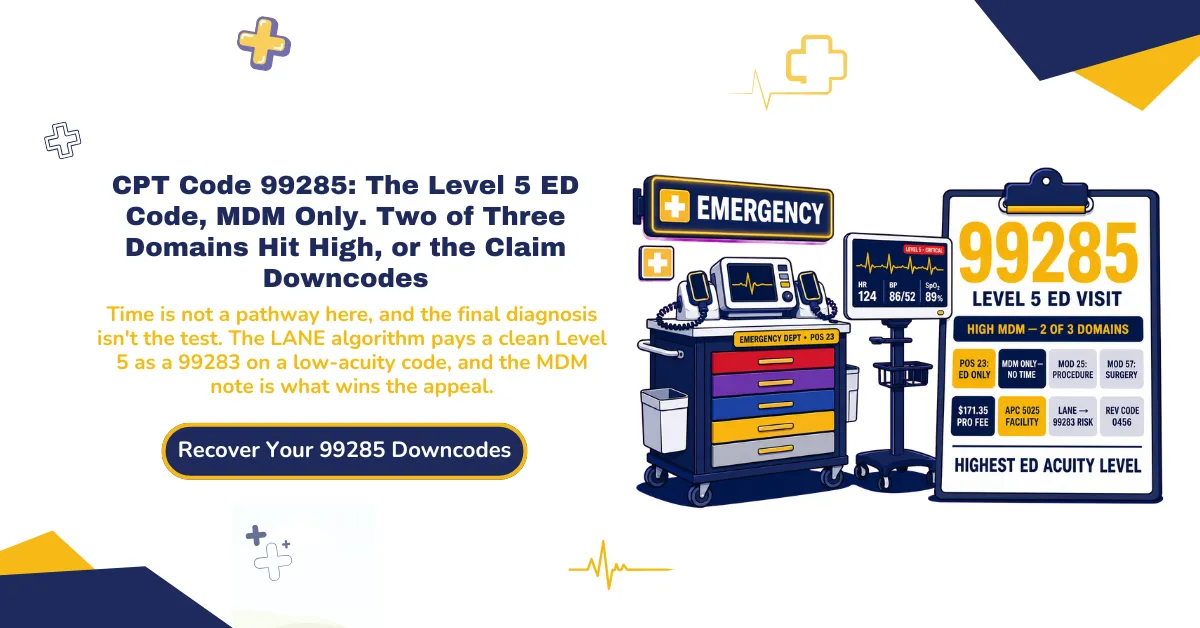
CPT code 99285 is the Level 5 emergency department evaluation and management code. It applies to new and established patients seen in a hospital-based emergency department. Medical decision-making complexity governs code selection on its own. The 2026 AMA CPT descriptor defines it as an ED visit requiring a medically appropriate history and/or examination with high-level medical decision making.
The AMA revised the CPT 99285 descriptor effective January 1, 2023. Before that date, the code required a comprehensive history, a comprehensive examination, and high-complexity MDM, all three as separate qualifying elements.
The 2023 revision removed comprehensive history and comprehensive examination as standalone requirements. The current standard asks for a medically appropriate history and/or examination. High-complexity MDM stays the controlling requirement. ACEP announced these AMA E/M guideline changes for ED codes effective January 1, 2023 (acep.org).
The corrected component standard for 2026:
- MDM complexity: High. The sole code-selection driver.
- History and examination: Medically appropriate. Not required to be comprehensive.
- Code-selection pathway: MDM only. Time is not a qualifying pathway for CPT 99281 through 99285.
- Patient status: New or established.
- Place of service: POS 23, emergency department, only.
ClaimMax RCM manages emergency department billing services for physician groups and hospital-employed providers nationwide, covering MDM documentation coaching, modifier configuration, and LANE downcode appeals.
High-level ED codes carry outsized audit risk. A 2023 OIG report found that Level 5 ED visit billing climbed from 28% to 38% of all emergency department visits over a decade.
CMS and the OIG are expected to release more audit findings in fiscal year 2026. Accurate CPT code 99285 billing starts with the right documentation framework, and that framework changed three years ago. Most billing guides haven’t caught up.
Level 5 and the ED Code Family: Where CPT 99285 Fits Among 99281 Through 99285
The five ED E/M codes share one structural feature: MDM complexity governs level selection for all of them, not time. A provider billing a Level 1 visit and a provider billing the Level 5 code both select on the same MDM framework.
| CPT code | Level | MDM complexity | Typical problem type | 2026 Medicare rate (professional) |
|---|---|---|---|---|
| 99281 | Level 1 | Minimal | Self-limited, minor | ~$24 |
| 99282 | Level 2 | Low | Low-severity acute | ~$46 |
| 99283 | Level 3 | Moderate | Uncomplicated acute illness | ~$90 |
| 99284 | Level 4 | Moderate-high | Acute illness with systemic symptoms | ~$118 |
| 99285 | Level 5 | High | Life-threatening condition | ~$171.35 |
Rates are national averages from the 2026 CMS Physician Fee Schedule. Actual payment varies by MAC locality and GPCI adjustment. Verify your specific rate using the CMS PFS Look-Up Tool (cms.gov/medicare/physician-fee-schedule/search/overview).
The 99283-to-99285 reimbursement gap runs about $81 per claim at Medicare rates. A practice billing a high-MDM encounter as 99283 instead of 99285 absorbs that $81 loss on every claim. At 500 ED encounters a month coded conservatively, that’s $40,500 a year in preventable revenue loss from a single under-coding pattern.
CPT codes 99281 through 99285 apply only to hospital-based emergency departments that hold certified ED status under CPT’s definition. Urgent care centers and freestanding clinics can’t bill these codes regardless of patient acuity.
High-complexity encounters at urgent care bill under CPT 99205 for new patients. Our CPT 99205 billing guide covers that pathway. This exclusion drives the most common place-of-service error in this code family.
Among the five levels, CPT code 99285 level 5 is the only code that requires documented high complexity across at least two of the three MDM domains. A visit that meets one MDM domain at high and two at moderate doesn’t qualify. The 2023 AMA revision created this explicit two-of-three standard. Section 3 breaks down the three domains.
What High Complexity MDM Actually Requires in an Emergency Department Chart (2026 Standard)
The Three MDM Domains That Determine CPT 99285
High complexity MDM for CPT 99285 requires meeting at least two of three domains at the high level. The three domains are Number and Complexity of Problems Addressed, Amount and Complexity of Data Reviewed and Analyzed, and Risk of Complications or Morbidity or Mortality from Patient Management. Meeting two is enough. Meeting one disqualifies Level 5 regardless of diagnosis severity.
| MDM domain | What “high” requires | Common ED documentation failure |
|---|---|---|
| Problems addressed | One or more chronic illnesses with severe exacerbation or progression, or an acute illness or injury posing a threat to life or bodily function | Listing diagnoses without documenting that the provider addressed and managed each one. Six problems listed, one actively managed, can’t reach high complexity |
| Data reviewed | Ordering tests that need independent interpretation, review of external records, or independent interpretation of imaging, tracings, or specimens | Ordering labs and imaging with no interpretation note. The order alone doesn’t count. The provider has to document what the data showed and what decision it drove |
| Risk of management | High-risk treatment such as drug therapy requiring intensive monitoring, a decision for elective major surgery with risk factors, or care limited by social determinants | Implying risk through the presenting complaint. “Chest pain” doesn’t document risk. “Initiation of anticoagulation for suspected PE with contraindication review” does |
New 2026 AMA guidance states that a condition counts toward MDM problem complexity only when the provider assesses, manages, or treats it at the encounter. A chart listing six diagnoses from history but documenting active management of one earns credit for one problem.
This clarification changes how providers should structure the assessment and plan. The CMS Evaluation and Management Services guide MLN006764 carries the federal reference (cms.gov).
The AMA’s own descriptor language and tables sit in the AMA CPT 2023 E/M descriptors and guidelines (ama-assn.org).
The Documentation Phrases That Protect MDM Against Payer Downcoding
These aren’t magic phrases. They’re documentation choices that map to MDM domain requirements. Each phrase below satisfies a different domain.
- Data domain: “Independent interpretation of ECG performed” and “Review of external EMS report confirming prior antihypertensive therapy” each count as one unique data element.
- Risk domain: “High-risk medication initiated; patient counseled regarding bleeding risk and monitoring plan established” documents management risk explicitly.
- Problems domain: “Differential includes acute coronary syndrome, pulmonary embolism, and aortic dissection; workup initiated to stratify risk for each.”
Payer post-pay review algorithms scan ED claims for MDM documentation gaps. An encounter that clinically warranted Level 5 but reads like a Level 3 note earns Level 3 reimbursement. The provider’s complexity was real. The documentation didn’t capture it.
ClaimMax RCM’s revenue cycle management services include provider documentation coaching built for high-level ED codes.
Is CPT 99285 Inpatient or Outpatient? The POS 23 Rule That Determines Where This Code Lives
CPT 99285 is an outpatient code. Even though it’s used in an emergency setting tied to hospital admission, the emergency department operates as an outpatient setting under Medicare billing rules. Place of Service 23 designates the hospital-based emergency room. A claim submitted with any POS other than 23 draws an automatic payer edit rejection for this code.
POS 21 is inpatient hospital. POS 22 is outpatient hospital. POS 23 is emergency room hospital. When a patient is evaluated in the ED and then admitted, the ED provider bills the Level 5 code with POS 23 for the emergency encounter.
The admitting physician bills initial hospital care codes (99221 through 99223) with POS 21 for the admission. These are separate claims, separate encounters, and separate code series. Our POS 22 in medical billing guide maps the outpatient-hospital distinction.
A freestanding emergency clinic without certified hospital-based ED status can’t bill the code under any circumstances. Submitting it from a non-ED setting generates a CO-4 or equivalent edit on POS-to-code incompatibility.
These clinics bill CPT 99205 or CPT 99215 for high-complexity encounters. The POS code on the claim decides which code family is valid, not the clinical acuity of the patient.
| POS code | Setting | CPT code family |
|---|---|---|
| POS 21 | Inpatient hospital | 99221-99223 (initial), 99231-99233 (subsequent) |
| POS 22 | Outpatient hospital | 99202-99215 |
| POS 23 | Emergency department hospital | 99281-99285 |
| POS 11 | Office | 99202-99215 |
| POS 20 | Urgent care | 99202-99215 |
The federal list sits in the CMS Place of Service codes reference .
Does Time Determine CPT 99285? What the AMA and Every Major Payer Say About ED Code Selection
Time doesn’t determine code selection for CPT 99285 or any code in the 99281 through 99285 series. The AMA’s CPT guidelines and UnitedHealthcare’s 2026 E/M reimbursement policy both state that time isn’t a descriptive component for emergency department E/M codes. Code selection rests solely on documented MDM complexity (uhcprovider.com).
This separates ED coding from the other E/M families. Office visit codes (99202 through 99215), inpatient codes (99221 through 99223), and nursing facility codes all allow time as an alternative pathway to MDM-based selection under the 2023 AMA revisions.
ED codes are the exception. Time-based documentation on an ED claim doesn’t support the code level and doesn’t protect against a downcode audit.
Billing teams coaching ED providers should pull time-based language out of their 99285 note templates. Documenting total face-to-face time on an ED claim isn’t harmful, but it adds no coding support. The MDM documentation has to stand on its own. A 90-minute high-acuity encounter with weak MDM documentation earns a Level 3 code.
Several widely circulated ED coding cheat sheets include a “typical time” column next to the 99281 through 99285 codes. That column implies time is a selection factor. It isn’t. Providers who document to that table’s time guidance are documenting correctly under a different standard and wrong under the ED standard.
The AAFP’s coding and documentation guidance confirms that history and exam components no longer factor into ED E/M level selection after the 2023 revision (aafp.org/fpm/coding-and-documentation).
2026 Medicare Rates for CPT Code 99285: Professional Fee, Facility Fee, and What Each Claim Actually Pays
The 2026 national average Medicare payment for CPT 99285 on the professional claim is about $171.35. CMS calculates it by multiplying the code’s total Relative Value Units, 5.13, by the 2026 conversion factor of $33.4009. Payment equals total RVU times conversion factor times the GPCI adjustment for the provider’s MAC locality (cms.gov/medicare/physician-fee-schedule/overview).
The hospital bills a separate claim for the same encounter under the Outpatient Prospective Payment System. For a Level 5 ED visit, the hospital bills under APC 5025 and receives roughly $612 to $630 from Medicare. That facility payment is separate from the physician’s $171.35.
A patient treated for acute chest pain in the ED may get two bills: one from the emergency physician group, roughly $300 to $600 charged, and one from the hospital, roughly $1,000 to $2,500 charged. Each bill reflects a different claim (cms.gov/medicare/payment/prospective-payment-systems/hospital-outpatient).
The hospital’s UB-04 claim for a Level 5 ED visit carries Revenue Code 0456, described as Emergency Room Level 5. Physician groups billing on the CMS-1500 don’t use revenue codes. Teams managing both claim types need to know that Revenue Code 0456 appears only on the UB-04 and routes the OPPS payment for the facility fee.
| Payment type | Payer | Amount | Source |
|---|---|---|---|
| Professional fee | Medicare (national avg) | $171.35 | CMS PFS 2026 |
| Professional fee | Medicare (low, Arkansas) | ~$155 | CMS GPCI data |
| Professional fee | Medicare (high, Alaska) | ~$210 | CMS GPCI data |
| Professional fee | Aetna (commercial) | ~$195 | Payer transparency data |
| Professional fee | Cigna (commercial) | ~$267 | Payer transparency data |
| Facility fee | Medicare OPPS APC 5025 | $612-$630 | CMS OPPS 2026 |
| Total RVU | Medicare | 5.13 | CMS RVU26B |
| Conversion factor | Medicare | $33.4009 | CMS PFS 2026 |
Arkansas and Alaska GPCI-adjusted figures need verification against the CMS PFS Look-Up Tool. The national average, total RVU, conversion factor, APC 5025 range, Aetna, and Cigna figures come from source data.
Rates vary by MAC locality on GPCI adjustments. California providers, where ClaimMax RCM serves a large ED physician client base, bill above the national average because of California’s higher GPCI index.
For commercial benchmarks on a related code, see our BCBS reimbursement rates breakdown. Verify your own locality-adjusted rate through the CMS PFS Look-Up Tool (cms.gov/medicare/physician-fee-schedule/search/overview).
CPT 99285 Modifier Rules for 2026: Modifier 25, Modifier 57, Modifier 27, and Modifier GC Explained
CPT 99285 claims need modifier knowledge in four situations: a procedure performed the same day, a decision for surgery, multiple outpatient hospital E/M services on one date, and teaching physician supervision at an academic center. Each situation uses a different modifier and different supporting documentation.
Modifier 25 with CPT 99285: Same-Day Procedure Claims
Modifier 25 signals a significant, separately identifiable E/M service performed on the same date as a procedure. When an ED physician evaluates a patient and also performs a procedure, a laceration repair, an I&D, or a chest tube placement, Modifier 25 on the 99285 claim marks the E/M as a distinct service beyond the procedure.
The documentation needs a chief complaint and HPI that support the E/M as independently earned. A note covering only the procedure doesn’t support a separate E/M. CMS’s transmittal confirms Modifier 25 must be appended to the ED E/M code when it’s provided on the same date as a diagnostic or therapeutic procedure (cms.gov, transmittal R1890B3).
UnitedHealthcare, Anthem, and several BCBS plans run automated post-pay reviews on 99285 claims that carry Modifier 25. Our clean claim requirements guide covers the configuration that survives those reviews.
Modifier 57 with CPT 99285: Decision for Surgery
Modifier 57 goes on the 99285 claim when the ED evaluation produced the decision to perform a major surgical procedure the same day or the next day. Major surgery carries a 90-day global period. Without Modifier 57, the E/M falls inside the global period, and the payer denies it as included in the surgery payment.
Appendicitis evaluated and taken to appendectomy, penetrating trauma evaluated and taken to exploratory laparotomy, acute limb ischemia evaluated and taken to vascular repair: each one needs Modifier 57 on the 99285 claim.
Modifier 27 with CPT 99285: Multiple Outpatient Hospital E/M Same Date
Modifier 27 identifies multiple outpatient hospital E/M services for the same patient on the same date, by the same or different providers within one hospital system. When a patient gets an ED evaluation (CPT 99285) and an outpatient department consultation at the same hospital on the same date, one claim carries Modifier 27 to prevent a bundling rejection.
This modifier is hospital-setting-specific and doesn’t apply to office or urgent care claims. No competitor billing guide for CPT 99285 covers Modifier 27. It’s the most frequently overlooked modifier in multi-department hospital billing.
Modifier GC with CPT 99285: Teaching Physician Supervision
Academic medical centers and teaching hospitals need Modifier GC on Medicare claims when a resident performs the service under teaching physician supervision. The teaching physician has to be present for the critical or key portion and has to document that presence.
Without Modifier GC on a Medicare claim in a teaching setting, the claim processes as if no resident was involved, which creates a compliance discrepancy in post-payment review.
CPT Code 99285 Clinical Examples: What High-Complexity MDM Looks Like in the Chart
Clinical examples for CPT code 99285 help only when they connect presentation to documentation. The diagnosis alone doesn’t set the code. The MDM documentation sets the code. The three scenarios below show how different presentations each reach high-complexity MDM through different domain combinations.
Scenario 1: Acute Chest Pain Workup (Data Domain Dominant)
A 58-year-old man presents with chest pain radiating to the left arm. The provider orders ECG, serial troponins, chest X-ray, and CBC. The provider documents independent interpretation of the ECG showing ST changes and independent interpretation of the chest X-ray ruling out pneumothorax. The troponin series returns mildly elevated.
The provider reviews the patient’s external cardiology records: “reviewed prior cardiac catheterization report from 2024 showing 70% LAD stenosis.” Three unique data sources, the ECG interpretation, the chest X-ray interpretation, and the external record review, each count toward the Data domain.
Final diagnosis: NSTEMI. Code: CPT code 99285. The high-complexity Data domain plus the high-risk anticoagulation decision satisfies two of three domains at high complexity.
Scenario 2: Sepsis with Hypotension (Problems and Risk Domains Dominant)
A 72-year-old woman presents via EMS with altered mental status and a temperature of 39.8 degrees Celsius. Blood pressure is 82/50. The provider documents the actively addressed problem list: sepsis, septic shock, acute kidney injury with creatinine 2.8 up from a baseline of 1.0, and a suspected urinary source.
The provider documents high-risk management: “initiated vasopressors given refractory hypotension despite 2L IV fluid resuscitation; consulted nephrology given acute kidney injury trajectory; broadened antibiotic coverage to include MRSA given recent hospitalization.”
The Problems domain is satisfied at high complexity through multiple conditions with severe exacerbation and organ involvement. The Risk domain is satisfied through drug therapy requiring intensive monitoring, specifically vasopressors. Two of three domains met. Code: 99285. When you’re coding the low blood pressure itself, our hypotension ICD-10 coding guide covers the I95 family.
Scenario 3: Psychiatric Emergency with Safety Risk (Problems Domain Dominant)
A 34-year-old man presents after a suicide attempt by medication overdose. The provider documents active suicidal ideation with plan and means, a toxic ingestion requiring activated charcoal and telemetry monitoring, and psychiatric consultation. The problem addressed is an acute illness posing an immediate threat to life.
The risk of management includes drug therapy requiring intensive monitoring, here cardiac monitoring for overdose effects, and management of imminent danger requiring psychiatric intervention. Two MDM domains satisfied at high complexity. Code: 99285. This earns Level 5 without trauma or cardiac pathology, a common misconception among providers new to ED billing.
All three scenarios reach CPT code 99285 through different MDM domain combinations. Billing teams should audit their note templates for all three presentation types so the documentation captures the specific domain language rather than the diagnosis alone.
Who Can Report CPT 99285: Provider Eligibility, Supervision Rules, and Teaching Hospital Requirements
Any licensed physician, nurse practitioner, or physician assistant who performs and documents the emergency department evaluation and management service may report CPT 99285. The provider doesn’t need to be permanently assigned to the emergency department.
Any physician who evaluates a patient registered in the ED uses the 99281 through 99285 series for that encounter (CMS Medicare Claims Processing Manual Chapter 12).
Registered nurses, medical assistants, and clinical staff other than licensed independent practitioners can’t independently bill the code. When a nurse practitioner or physician assistant bills it, the service has to meet state scope-of-practice rules and the applicable Medicare or commercial payer supervision requirements for that scenario.
NPs and PAs may bill the code under their own NPI when payer and state rules permit independent billing. Medicare pays NPs and PAs at 100% of the physician fee schedule when they bill independently under their own NPI in a non-incident-to scenario.
In an incident-to scenario in the ED, the rules differ. Confirm the payer policy before selecting the billing NPI.
Academic medical centers billing the code to Medicare have to append Modifier GC when a resident performs the service under teaching physician supervision. The teaching physician has to be physically present for the key or critical portion, which in ED billing usually means the evaluation that forms the basis for the MDM determination.
Without Modifier GC on a Medicare claim in a teaching setting where a resident was involved, the claim carries compliance exposure in post-payment review.
Split and shared ED visits apply when a physician and a non-physician practitioner both see the patient. For 2026, the substantive portion means more than half of total time. Both providers have to be identified in the documentation, and the billing provider is the one who performed the substantive portion.
CPT 99285 vs 99284: The Code-Selection Decision That Generates the Most Denials in Emergency Department Billing
The 99284-to-99285 boundary is where most ED level-up denials start. A provider who documents moderate complexity MDM in a high-acuity encounter codes 99284. A provider who documents high complexity MDM in the same encounter codes 99285. The MDM documentation is the sole determining factor, not the diagnosis or the time spent.
| Factor | CPT 99284 (Level 4) | CPT 99285 (Level 5) |
|---|---|---|
| MDM complexity | Moderate-high | High |
| Problem severity | Acute illness with systemic symptoms | Threat to life or bodily function |
| Two-of-three standard | Two MDM domains at moderate-high | Two MDM domains at high |
| 2026 Medicare professional fee | ~$118 | ~$171.35 |
| Medicare OPPS facility fee | ~$485 (APC 5024) | ~$612-$630 (APC 5025) |
| Revenue code (UB-04) | 0454 | 0456 |
| LANE downcode risk | High when final diagnosis is non-emergent | High when final diagnosis is non-emergent |
| Common presenting scenarios | Pneumonia, kidney stone, head injury with CT, asthma needing IV treatment | Acute MI workup, stroke symptoms, septic shock, major trauma, suicidal patient |
| Audit risk level | Moderate | High (OIG Level 5 trend monitoring active) |
| Common denial when downcoded | CO-50 | CO-50 / LANE auto-downcode to 99283 rate |
APC 5024 (~$485) and Revenue Code 0454 for Level 4 need confirmation against the CMS OPPS 2026 Addendum B and the CMS revenue code table before publishing.
Providers select 99285 on the severity of the presenting complaint, chest pain for example, without confirming that the MDM documentation supports two of three domains at high complexity.
If the chest pain workup was uncomplicated, ECG normal, troponins negative, discharge to follow up, and the note reflects that, a payer algorithm reading “chest pain” paired with Level 5 billing sees a clinical inconsistency and downcodes the claim.
The presenting complaint alone doesn’t earn CPT code 99285. The documented MDM does.
The professional fee difference between 99284 and 99285 at Medicare national average is about $53 per claim. The facility fee difference between APC 5024 and APC 5025 runs about $130 to $145 per encounter.
For a 500-bed hospital system seeing 80,000 ED visits a year, capturing 20% of visits at Level 5 instead of Level 4 represents over $2 million in additional reimbursement at Medicare rates alone. Accurate coding isn’t upcoding. It’s fair payment for documented complexity.
For the outpatient version of this decision, choosing between 99214 and 99215 in office-based E/M, the documentation rules are similar but the time pathway is available. Our CPT 99214 reimbursement guide covers that side.
The LANE Rule: How Payer Algorithms Downcode CPT 99285 to 99283 Based on Final Diagnosis and How to Appeal It
When a Level 5 emergency department claim reaches a payer’s adjudication system with a final diagnosis the algorithm classifies as low-acuity, the claim reimburses at the Level 3 rate. The mechanism runs under different names by payer.
UnitedHealthcare and several BCBS plans apply what their policies call the Low Acuity Non-Emergent rule. The effect is the same across payers: a correctly coded CPT code 99285 claim pays as if it were CPT 99283.
What Triggers the LANE Downcode
Payer algorithms read the primary ICD-10 diagnosis on the claim and compare it against a list of conditions classified as non-emergent. Common diagnoses that trigger automatic LANE downcoding on Level 5 claims include constipation, uncomplicated urinary tract infection, minor sprains, simple wound checks, and mild viral syndrome.
The algorithm doesn’t read the note. It doesn’t evaluate the MDM documentation. It reads the final diagnosis code and applies the downcode if that code sits on its low-acuity list.
A patient who presented with severe abdominal pain, needed an extensive workup to rule out appendicitis and bowel obstruction, and was discharged with a constipation diagnosis earns CPT code 99285 by MDM. The LANE algorithm downcodes the claim to 99283 on the final diagnosis code.
Why the 2023 AMA Revision Makes LANE Appeals Stronger
The 2023 AMA revision changed code selection from diagnosis-based to MDM-based. Before 2023, some payer policies pointed to presenting problem severity as a co-qualifier for Level 5. After 2023, the AMA standard requires only that the documented MDM reaches high complexity. The final diagnosis isn’t part of the selection criteria.
A LANE appeal filed after January 1, 2023, that cites the 2023 AMA MDM standard and shows the note documents two of three MDM elements at high complexity should hold up with any payer whose policy acknowledges the AMA guidelines. Include the AMA descriptor language and the specific MDM documentation from the note in every LANE appeal.
The OIG Context for LANE Enforcement
The OIG’s monitoring of Level 5 ED visit trends, the rise from 28% to 38% over a decade, gives commercial payers the regulatory backdrop for aggressive LANE enforcement.
Payers cite the OIG upward trend and use LANE algorithms as a claims-integrity tool. That’s accurate. What it doesn’t change is the provider’s right to bill what the MDM documentation supports (oig.hhs.gov; cgsmedicare.com).
When ClaimMax RCM audits ED claim portfolios for LANE downcode exposure, the review finds two failure patterns: claims correctly coded and documented that were still downcoded on a diagnosis mismatch, and claims coded at Level 5 without MDM documentation that supports the level.
The first group has strong appeal potential. The second needs documentation improvement before resubmission, which is where our denial management services focus.
LANE Appeal Documentation Checklist
- Pull the provider’s note and confirm two of three MDM domains at high complexity are documented.
- Identify the final diagnosis code that triggered the downcode.
- Cite the 2023 AMA MDM standard: code selection rests on MDM complexity, not presenting problem severity or final diagnosis.
- Attach the provider’s note excerpt showing the MDM documentation.
- Reference the payer’s own E/M policy, which should acknowledge the 2023 AMA standard.
- Submit within the payer’s appeal window, typically 60 to 180 days from remittance.
When you submit a corrected claim after a LANE downcode, leaving off Frequency Code 7 generates a CO-18 duplicate claim denial. Our CO-18 duplicate claim denial guide covers the resubmission protocol for both claim types.
Denial Codes for CPT 99285: CO-50, Modifier 25 Post-Pay Reviews, and the NCCI Bundling Edits That Fire Most Often
CPT code 99285 generates five distinct denial patterns in 2026. Three come from documentation gaps, one from a payer algorithm diagnosis mismatch, and one from modifier or bundling configuration errors. Each has a different root cause and a different resolution workflow. Knowing which pattern fired determines whether the next step is an appeal, a corrected claim, or provider education.
| Denial code | Denial reason | Root cause | Resolution path |
|---|---|---|---|
| CO-50 | Services not deemed medically necessary | MDM documentation doesn’t support Level 5 | Review the note for two-of-three MDM; appeal with the note excerpt and AMA MDM standard if documentation is sufficient; educate the provider if a gap is confirmed |
| CO-97 | Service included in payment for another code | Procedure billed same day without Modifier 25 on 99285 | Verify Modifier 25 on 99285; confirm a separate chief complaint is documented; resubmit with the modifier if missing |
| CO-18 | Duplicate claim | Corrected 99285 claim submitted without Frequency Code 7 | Resubmit as a replacement using Frequency Code 7 in CMS-1500 Box 22 |
| LANE auto-downcode | Reimbursed at the 99283 rate on a low-acuity diagnosis | Final ICD-10 diagnosis on the LANE list despite high-complexity MDM | Appeal with the 2023 AMA MDM standard, note excerpt, and payer E/M policy within the appeal window |
| CO-4 | Procedure inconsistent with modifier or POS | Claim submitted with a POS other than 23 | Verify POS 23 on the claim; correct and resubmit; check EDI submitter configuration if systematic |
CARC codes shift over time, so confirm these against the current X12 definitions before publishing.
CMS’s National Correct Coding Initiative carries Procedure-to-Procedure edits with more than ten codes, including 0362T, 0373T, and 0469T, when billed alongside the code.
An edit with Modifier Indicator 0 can’t be bypassed by any modifier. An edit with Modifier Indicator 1 lets Modifier 59 or an X-modifier (XE, XS, XP, XU) support separate billing when the documentation backs a distinct service (cms.gov, NCCI Procedure-to-Procedure edits).
UnitedHealthcare, Anthem, and several BCBS plans run automated post-pay reviews specifically on ED E/M claims that carry Modifier 25 plus a same-day procedure. The review checks whether the E/M note holds a distinct chief complaint, a distinct HPI, and an independent clinical assessment beyond the procedure indication.
Claims that pass Modifier 25 configuration at submission can still face post-pay recoupment six to eighteen months later. Our eligibility verification workflow confirms the upstream details before the claim goes out.
CO-4 denials from POS configuration errors often surprise billing teams. The claim clears the clearinghouse edit level and reaches the payer before the POS mismatch triggers the denial.
Most POS configuration errors that generate CO-4 denials could have been caught at the clearinghouse level. Our clearinghouse rejection guide covers the edit-rule configuration that catches them.
2026 Pre-Submission Compliance Checklist for CPT 99285: What to Verify Before Every Claim Leaves the Billing System
Run this checklist before submitting any claim for CPT code 99285. Each item maps to a denial pattern from this guide. A claim that clears all ten checkpoints carries the documentation and configuration for first-pass acceptance at the payer.
- MDM domain verification: Confirm two of three MDM domains (Problems, Data, Risk) are documented at high complexity. Pull the note and verify each one explicitly.
- POS code: Confirm Place of Service 23 on the claim. If the patient moved from triage to a certified ED room, POS 23 applies from the moment of ED registration.
- Diagnosis-to-code alignment: Review the primary ICD-10 diagnosis against your payer’s LANE list. If the final diagnosis sits on a low-acuity list, confirm the note’s MDM documentation supports high complexity before submitting. A clean note makes the appeal winnable.
- Modifier 25 (procedure same date): Confirm Modifier 25 is on the 99285 claim and the E/M note carries a separate chief complaint and a distinct clinical assessment beyond the procedure indication.
- Modifier 57 (decision for surgery): If the ED evaluation produced the decision for major surgery the same or following day, confirm Modifier 57 is appended and the decision is documented explicitly.
- NCCI edit check: Confirm no procedure code on the claim is bundled with the code under a Modifier Indicator 0 edit. If Modifier 59 or an X-modifier sits on a companion code, confirm the documentation supports a distinct service.
- Professional vs facility claim separation: If your organization bills both the physician claim (CMS-1500, POS 23) and the hospital facility claim (UB-04, Revenue Code 0456), confirm both are submitted and tracked independently.
- Modifier GC (academic centers): If a resident was involved, confirm Modifier GC is on the Medicare claim and the teaching physician presence note is documented.
- Appeal window tracking: If a prior 99285 claim was downcoded by a LANE algorithm, confirm the appeal deadline is logged in your AR workflow. Most payers allow 60 to 180 days. Missing the window closes the recovery permanently.
- Timely filing verification: Confirm the claim sits within the payer’s timely filing window. Medicare requires 12 months from date of service. Commercial windows run from 90 days to 24 months.
The full revenue cycle management process for ED billing runs from patient registration through payment reconciliation. Our revenue cycle management process guide covers each stage.ClaimMax RCM manages emergency department medical billing for physician groups and hospital-employed providers nationwide. Our billing teams handle MDM documentation audits, LANE downcode appeals, Modifier 25 post-pay reviews, and OIG audit readiness for ED practices billing high volumes of Level 5 encounters.