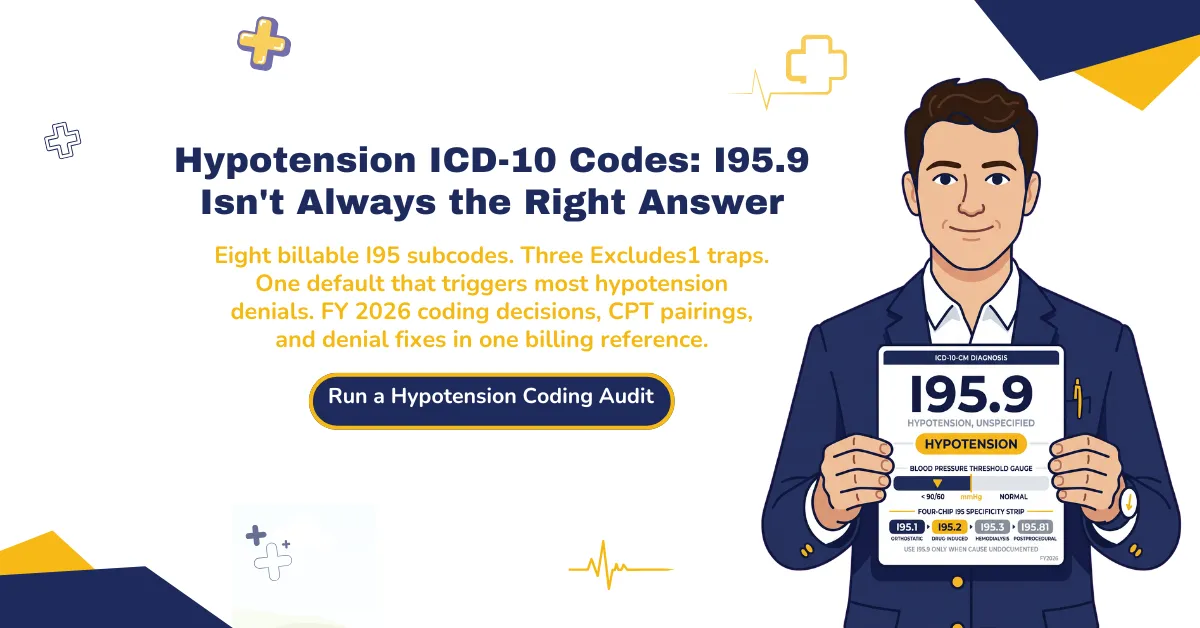
The primary hypotension ICD-10 code is I95.9 (Hypotension, unspecified), used when a provider documents low blood pressure without specifying a cause or type. The full I95 code family spans I95.0 through I95.9, covering idiopathic, orthostatic, drug-induced, hemodialysis-related, postprocedural, and unspecified hypotension under Chapter 9: Diseases of the Circulatory System (I00-I99).
It’s the ICD-10 code for hypotension unspecified that billers reach for most often, and it’s also the code that gets misused most often.
Clinically, hypotension means blood pressure consistently below 90/60 mmHg. Common symptoms include dizziness, syncope, blurred vision, fatigue, and cold or clammy skin. The low blood pressure ICD-10 designation covers a spectrum from isolated readings to chronic diagnoses, and the distinction matters at every step of the billing workflow.
Choosing between I95.9 and a more specific I95 subcode directly affects claim acceptance, denial rates, and payer scrutiny. That choice isn’t just a coding decision. It’s a revenue cycle decision. Practices that default to I95.9 when the documentation supports a more specific code leave themselves exposed to denials and audit risk.
Here’s what this guide covers: every billable I95 subcode with official descriptions, Excludes1 notes that will bounce claims at the clearinghouse, documentation checklists for each code, CPT pairings, denial scenarios with fixes, and payer-specific patterns. This isn’t a reference page. It’s a billing workflow tool.
At ClaimMax RCM, our certified coders process hypotension claims across cardiology, nephrology, and primary care practices daily. Here’s what works and what gets sent back.
Every ICD-10-CM Code for Hypotension: Complete FY 2026 Reference
All hypotension codes fall under category I95, housed within Chapter 9: Diseases of the Circulatory System (I00-I99). These codes have been valid from 2016 through FY2026 with no additions, deletions, or revisions to the I95 family. That “no changes” confirmation matters for coding teams auditing their charge masters.
Critical compliance note: I95 alone is NOT a billable code and is NOT valid for HIPAA-covered transactions. Coders must select a specific subcategory (I95.0 through I95.9). The dx code for hypotension must always be a subcategory code. Per CMS, only “billable/specific ICD-10-CM codes” are valid for claim submission, and I95 without a subcategory doesn’t qualify.
| ICD-10-CM Code | Official Description | Billable | Effective Date | Clinical Use |
|---|---|---|---|---|
| I95.0 | Idiopathic hypotension | Yes | Oct 1, 2025 | Chronic low BP with no identifiable cause; includes pure autonomic failure |
| I95.1 | Orthostatic hypotension | Yes | Oct 1, 2025 | BP drop of 20 mmHg systolic or 10 mmHg diastolic within 3 min of standing |
| I95.2 | Hypotension due to drugs | Yes | Oct 1, 2025 | Drug-induced; requires additional T36-T50 code for the specific drug |
| I95.3 | Hypotension of hemodialysis | Yes | Oct 1, 2025 | Intra-dialytic hypotension during or after dialysis sessions |
| I95.81 | Postprocedural hypotension | Yes | Oct 1, 2025 | Low BP after a procedure; requires documented causal link to the procedure |
| I95.89 | Other hypotension | Yes | Oct 1, 2025 | Chronic hypotension, iatrogenic hypotension, or specified type NEC |
| I95.9 | Hypotension, unspecified | Yes | Oct 1, 2025 | Low BP with no documented cause or type; default when documentation lacks detail |
| R03.1 | Nonspecific low blood-pressure reading | Yes | Oct 1, 2025 | Low BP reading WITHOUT a clinical diagnosis of hypotension |
R03.1 vs. I95.9 is the distinction that trips up billing teams most often. R03.1 is a finding code for an isolated low BP reading that hasn’t been evaluated or diagnosed as hypotension. I95.9 is for diagnosed hypotension where the type is unspecified.
Payers treat them differently. Using R03.1 to support treatment services will result in a denial because a finding doesn’t justify clinical treatment.
The “Other” vs. “Unspecified” distinction matters per FY2026 guidelines: I95.89 means the provider documented a specific type without a dedicated code. I95.9 means documentation lacks detail for a more specific assignment.
Getting these two confused is a coding compliance error. A hypotensive ICD-10 code that defaults to I95.9 when I95.89 is correct signals to payers that the coder isn’t reading the full note.
All I95 codes are valid within MS-DRG v43.0, applicable from October 1, 2025 through September 30, 2026, for HIPAA-covered inpatient transactions. Inpatient billing teams should verify DRG grouping when I95.81 is involved, as postprocedural hypotension can affect complication-level DRG assignment.
The FY2026 update (effective October 1, 2025) introduced 487 new diagnosis codes overall. The I95 hypotension category received no changes. The April 1, 2026 bi-annual update (CMS Transmittal 13490, Change Request 14300) included instructional note changes across the Tabular List but no modifications to I95 codes.
Coders don’t need to worry about new I95 codes for FY2026. Confirm your coding software reflects the FY2026 ICD-10-CM files from CDC/NCHS and the CMS ICD-10 codes page. The FY2026 official guidelines govern all sequencing and specificity decisions.
Selecting the right code starts with understanding what documentation supports it, and what conditions can’t be coded alongside I95 at all.
What Can’t Be Coded with Hypotension: Excludes1 Notes for FY 2026
A Type 1 Excludes note means “not coded here, never at the same time.” If a condition appears on the Excludes1 list for I95, you can’t report both I95 and that condition’s code on the same claim. It’s a hard rule.
Per AAPC’s I95 Excludes notes, violating Excludes1 rules is one of the fastest paths to a clearinghouse-level edit rejection.
Category I95 carries three Excludes1 conditions: cardiovascular collapse (R57.9), maternal hypotension syndrome (O26.5-), and neurogenic orthostatic hypotension ICD-10 code G90.3.
Cardiovascular collapse (R57.9) and hypotension overlap clinically, but ICD-10-CM treats them as mutually exclusive diagnostic concepts. If the provider documents cardiovascular collapse or shock, R57.9 takes precedence. Don’t also report an I95 code. This prevents double-coding of the same hemodynamic event on the same claim.
Maternal hypotension syndrome uses obstetric chapter codes, not circulatory chapter codes. Hypotension in pregnancy ICD-10 coding routes to O26.5-, with trimester-specific subcodes: O26.51 (first trimester), O26.52 (second trimester), and O26.53 (third trimester). Coders in OB-GYN settings who file I95 for pregnancy-related hypotension are coding in the wrong chapter entirely.
The most commonly confused exclusion is neurogenic orthostatic hypotension ICD-10, which maps to G90.3, NOT I95.1. Neurogenic orthostatic hypotension, often associated with Parkinson’s disease, autonomic dysfunction, or pure autonomic failure, is a distinct clinical entity.
The distinction: I95.1 covers standard orthostatic hypotension from positional changes. G90.3 covers orthostatic hypotension ICD-10 scenarios caused by nervous system dysfunction. These two codes cannot appear on the same claim.
Getting this wrong doesn’t just create a coding error. It triggers an Excludes1 edit rejection at the clearinghouse level, before the claim even reaches the payer. The claim bounces back with no payment timeline, and your team has to rework it from scratch.
If Excludes1 edits are showing up in your rejection reports, that’s a workflow problem worth fixing. ClaimMax RCM’s denial management team catches these sequencing errors before claims go out the door.
Now that you know what can’t coexist with I95, the next section breaks down each subcode individually with documentation requirements and common mistakes.
How to Code Each Type of Hypotension with Documentation Checklists
I95.9: When Unspecified Hypotension Is (and Isn’t) the Right Code
I95.9 is the most commonly used hypotension ICD-10 code, and it’s also the most commonly misused. It’s appropriate when the provider documents “hypotension” or “low blood pressure” without specifying a cause, type, or contributing factor. That’s it. No other scenario justifies this code.
The problem isn’t the code. It’s the documentation. When a provider note reads “patient reports dizziness when standing, BP 85/50 supine to 70/45 standing,” that’s orthostatic hypotension.
But if the coder only sees “low BP” in the assessment line, they’ll default to I95.9. That default costs the practice on specificity and often triggers a denial. The ICD-10 code for hypotension unspecified isn’t a safe fallback. It’s a last resort.
Here’s the rule: I95.9 is a placeholder, not a permanent code. If follow-up testing identifies the cause or type, the code must be updated on subsequent claims. A practice that bills I95.9 month after month for the same patient will attract audit attention. Payers track this, and they’ll ask why the cause was never determined.
Documentation minimum for I95.9: a BP reading with date and time, the clinical context for noting it, and any symptoms present. Even for unspecified hypotension, “low BP” alone in the chart doesn’t support the code. Understanding how unspecified coding affects revenue cycle workflow helps coders see why specificity decisions matter downstream.
When you see I95.9 on an encounter: query the provider. Ask whether the hypotension is positional, medication-related, chronic, or associated with a procedure. One query can upgrade the code specificity and prevent a denial.
I95.1: Orthostatic (Postural) Hypotension
Orthostatic hypotension is clinically defined as a systolic BP drop of 20 mmHg or more, or a diastolic drop of 10 mmHg or more, within three minutes of moving from supine or seated to standing. That’s the FY2026 measurement standard. If the provider documents this drop with vitals, I95.1 is the correct orthostatic hypotension ICD-10 code.
Postural hypotension is the same condition. Both terms map to I95.1 in the ICD-10-CM Alphabetic Index. Coders searching “postural hypotension ICD-10” separately won’t find a different code. I95.1 covers both forms. Knowing this prevents unnecessary provider queries and keeps the workflow moving.
Documentation supporting I95.1 must include orthostatic vitals: supine or seated BP, then standing BP at one minute and three minutes. Note symptoms on standing, especially dizziness, lightheadedness, syncope, or near-syncope. Contributing factors like dehydration, medication changes, or prolonged bedrest should be included. They support medical necessity for any follow-up testing billed alongside the orthostasis ICD-10 code.
The critical coding trap: when the orthostatic drop is caused by a medication, the correct code is I95.2 (Hypotension due to drugs), NOT I95.1. The FY2026 Tabular List is explicit about this. I95.2’s “Applicable To” note specifically includes “orthostatic hypotension due to drugs.”
This is one of the most common I95 coding errors. The hypotension due to drugs ICD-10 code applies even when the presentation is positional.
Add an additional code for the adverse effect using T36 through T50 with fifth or sixth character 5 to identify the specific drug. Missing the T-code is a frequent cause of I95.2 claim rework.
I95.2: Drug-Induced Hypotension and Adverse Effect Sequencing
Drug-induced hypotension is common with antihypertensives, diuretics, vasodilators, and psychotropics. When a provider documents that a patient’s low blood pressure is caused by or related to a specific drug, I95.2 is the correct hypotension ICD-10 code. I95.2 alone isn’t enough. The claim needs a companion code to identify the drug.
The FY2026 Official Guidelines lay out three sequencing scenarios. For an adverse effect (drug prescribed correctly and taken properly): code I95.2 first, then the T36 through T50 code with character “5.” This is the most common outpatient scenario.
For prior authorization situations involving high-risk medications, pre-auth documentation may need to accompany the claim.
For poisoning (overdose, wrong substance, or wrong route): sequence reverses. Code the T36 through T50 poisoning code first with the intent character (accidental, intentional, assault, undetermined), then code I95.2 as an additional diagnosis. The T-code drives the claim in poisoning cases.
For underdosing: use T36 through T50 with character “6.” The underdosing code is never listed as the principal or first-listed diagnosis. This applies when the patient took less medication than prescribed and developed hypotension.
Here’s what causes denials with I95.2: the provider documents “low BP probably from lisinopril” but the coder submits I95.2 without the T-code. The payer sees a drug-induced diagnosis with no drug identified. That’s an automatic rejection on most major payer edits.
I95.3: Hypotension of Hemodialysis
I95.3 covers intra-dialytic hypotension, the BP drop that occurs during or immediately after hemodialysis sessions. The “Applicable To” note in the Tabular List specifically includes intradialytic hypotension ICD-10 as a mapped term. Nephrology and dialysis center billing teams use this code routinely, and payers expect it when documentation ties the hypotension to the dialysis session.
Documentation should include pre-dialysis and intra-dialysis BP readings, the timing of the drop relative to the session, any interventions performed (fluid bolus, rate adjustment, session termination), and the patient’s response. Without this detail, payers may downcode to I95.9 or deny for insufficient medical necessity.
I95.81: Postprocedural Hypotension
I95.81 is for hypotension that occurs as a direct result of a procedure. The FY2026 Official Guidelines are clear: the provider must establish a cause-and-effect relationship between the procedure and the hypotension. Simply noting “hypotension after surgery” isn’t sufficient. The provider must document “hypotension DUE TO the procedure.”
The language distinction matters. “Post-op hypotension” is a timing statement. “Hypotension caused by intraoperative blood loss” is a causal statement. Only the causal version supports I95.81. If the provider uses timing language only, query for clarification before assigning this code. Without documented causality, I95.89 or I95.9 may be more defensible.
From a billing perspective, I95.81 falls within MS-DRG grouping related to I97 (Intraoperative and postprocedural complications of the circulatory system). That DRG placement can affect inpatient reimbursement. Verify the documentation supports complication-level coding before assigning I95.81.
Postprocedural hypotension claims are denied more frequently than other I95 codes because payers demand strong causal documentation. If you’re seeing high denial rates on these claims, the fix is almost always in the operative note, not the code selection.
Postprocedural hypotension consistently ranks among the hardest I95 codes to get paid on the first pass. If your team is reworking these claims, ClaimMax RCM’s coding specialists review operative note workflows and fix the documentation gap at the source.
I95.89: Other Hypotension (Chronic, Iatrogenic, Acute)
I95.89 is the “other specified” code. The ICD-10-CM Index maps several terms here: chronic hypotension ICD-10, iatrogenic hypotension, and any documented hypotension that doesn’t fit the more specific subcodes. It’s not a catch-all like I95.9. It’s for situations where the provider documented a specific type that doesn’t have its own four- or five-character code.
For acute hypotension ICD-10 episodes with a known cause (dehydration, acute blood loss), I95.89 is often correct when the etiology isn’t I95.2, I95.3, or I95.81. Document the cause, BP readings, treatment, and patient response. That package supports both the code and related CPT services.
Coders searching for “acute hypotension ICD-10” often expect a dedicated code. There isn’t one. Acute hypotension defaults to I95.9 if the cause is unknown, or I95.89 if a specific cause is documented. Always check the provider note for etiology before defaulting to unspecified. The low blood pressure ICD-10 code assigned here affects whether the claim is payable on first pass.
I95.0: Idiopathic Hypotension
I95.0 is for hypotension with no identifiable cause after clinical evaluation. The key distinction from I95.9: I95.0 means the provider has investigated and confirmed no cause exists. I95.9 means the cause hasn’t been investigated or documented yet. One is a clinical conclusion. The other is a documentation gap.
The idiopathic hypotension ICD-10 assignment requires that the provider has ruled out drug-related, positional, and secondary causes. Without workup documentation, payers may question whether I95.0 is appropriate. Document the specific evaluations performed and the negative findings supporting the idiopathic determination.
History of Hypotension: Coding Resolved Cases
When hypotension has resolved and is no longer an active clinical problem, don’t use any I95 code. Resolved hypotension is coded as personal history using Z86.79 (Personal history of other diseases of the circulatory system). This applies when the provider documents the patient “had hypotension” in the past but it’s no longer present or being treated.
The history of hypotension ICD-10 distinction matters for risk adjustment and longitudinal records. Reporting I95.9 for a resolved condition inflates the patient’s active problem list and can trigger unnecessary payer reviews. Z86.79 keeps the history visible without creating a false active diagnosis.
Commonly Confused Hypotension Codes: I95.9 vs. R03.1 vs. G90.3
Three hypotension-related codes cause the most confusion in billing departments: I95.9 (unspecified hypotension), R03.1 (nonspecific low blood-pressure reading), and G90.3 (neurogenic orthostatic hypotension). They sound similar. They’re not interchangeable. Using the wrong one can result in a denial, an audit, or both. This is where the hypotension ICD-10 code selection requires the most scrutiny.
I95.9 vs. R03.1
I95.9 is a diagnosis code. R03.1 is a findings code. I95.9 means the provider has evaluated the patient and diagnosed hypotension, even if the type is unspecified. R03.1 means a low blood pressure reading was recorded, but the provider hasn’t made a clinical determination that hypotension exists. One is a medical conclusion. The other is a data point.
When to use R03.1: a patient’s vitals show BP of 88/55, but the provider’s note doesn’t address it as a clinical problem and doesn’t document “hypotension” as a diagnosis. The ICD-10 code for hypotension unspecified (I95.9) requires an actual diagnosis, not just a reading. If the chart has the number but no clinical interpretation, R03.1 is the appropriate code.
I95.1 vs. G90.3
I95.1 covers standard orthostatic hypotension ICD-10 from positional changes. G90.3 covers neurogenic orthostatic hypotension, where the positional drop results from autonomic nervous system dysfunction. These two codes cannot coexist on the same claim (Excludes1 note). The documentation must indicate whether the cause is positional mechanics or neurological dysfunction. If it’s neurogenic, G90.3 is the only correct code.
Practical scenario: a patient with Parkinson’s disease presents with dizziness on standing. Orthostatic vitals confirm a 25 mmHg systolic drop. The neurologist documents “orthostatic hypotension secondary to autonomic dysfunction from Parkinson’s.” That’s G90.3, not I95.1. The underlying neurogenic cause changes the code assignment entirely.
I95.89 vs. I95.9
The “Other vs. Unspecified” confusion comes up constantly. I95.89 means the provider documented a specific type that doesn’t have its own dedicated code (chronic, iatrogenic, dehydration-related). I95.9 means the documentation doesn’t specify ANY type. If there’s a documented cause but no matching I95 subcode, it’s I95.89. If there’s nothing documented, it’s I95.9.
Getting these distinctions right doesn’t just prevent denials. It builds a cleaner clinical record, supports risk adjustment accuracy, and reduces audit exposure. Specificity in code selection reflects specificity in clinical documentation, and payers notice both.
CPT Codes That Pair with Hypotension Diagnoses
ICD-10 codes identify the diagnosis. CPT codes identify the service. Payers evaluate both together. If the hypotension ICD-10 code on the claim doesn’t justify the CPT service billed alongside it, the claim gets denied for lack of medical necessity. That linkage isn’t optional. It’s the core of clean claim submission.
The table below maps the CPT codes most frequently paired with hypotension diagnoses. Each pairing includes the clinical scenario where the combination is medically justified.
| CPT Code(s) | Service Description | Hypotension ICD-10 Pairing | When This Combination Is Justified |
|---|---|---|---|
| 99213-99215 | Office/outpatient E/M visits | I95.0, I95.1, I95.2, I95.89, I95.9 | Routine assessment, medication management, follow-up monitoring |
| 93000-93010 | 12-lead ECG | I95.1, I95.9 | Cardiac workup to rule out arrhythmia as hypotension cause |
| 95921 | Autonomic function testing (cardiovagal) | I95.1 | Evaluating autonomic contribution to orthostatic hypotension |
| 95924 | Autonomic function testing (adrenergic) | I95.1 | Confirming neurogenic vs. non-neurogenic orthostatic mechanism |
| 36415 | Venipuncture for lab testing | I95.0, I95.2, I95.89, I95.9 | CBC, BMP, thyroid, kidney function to identify underlying cause |
| 96360-96361 | IV fluid administration | I95.89 (dehydration-related), I95.9 (acute) | Acute symptomatic hypotension requiring hydration |
| 99291-99292 | Critical care services | I95.9 (severe), I95.89 | Hypotension with hemodynamic instability requiring critical care time |
| 93784-93790 | 24-hour ambulatory BP monitoring | I95.0, I95.89, I95.9 | Documenting chronic or episodic hypotension patterns over time |
The autonomic function testing codes (95921 and 95924) are the gap no competitor covers. When ordering tilt-table or autonomic testing for orthostatic hypotension ICD-10, the diagnosis must support medical necessity. I95.1 is the correct pairing. Using I95.9 for autonomic testing creates a mismatch: the test is specific, but the diagnosis isn’t.
IV fluid administration (96360-96361) is a frequent denial trigger. Palmetto GBA’s Local Coverage Determination L35457 specifies that IV fluids are only covered when documented as medically necessary for dehydration, shock, or acute hypotension.
The claim must include BP readings, symptoms, the clinical rationale for IV therapy, and the patient’s response. Missing any element puts the claim at risk.
Ambulatory BP monitoring (93784-93790) is underutilized in hypotension billing. When in-office readings are inconclusive, 24-hour monitoring captures chronic or episodic patterns. Pairing this CPT with I95.0 or I95.89 supports medical necessity. Most practices don’t realize this service is billable for hypotension, not just hypertension.
Critical care services (99291-99292) apply when hypotension becomes hemodynamically significant and requires immediate, life-sustaining interventions. Documentation must include critical care time (at least 30 minutes of direct critical care beyond other billable procedures), specific interventions performed, and clinical justification for critical care level management. Verify payer guidelines before billing.
One rule applies across every pairing in this table: the ICD-10 code must match the level of specificity of the CPT service. A specific diagnostic test demands a specific diagnosis code. Billing autonomic testing with an unspecified hypotension code is asking for a rejection. This CPT-to-diagnosis alignment is a core principle of medical billing and revenue cycle management.
Documentation Checklist: What Providers Must Record for Each Hypotension Code
Coding accuracy starts in the exam room, not the billing department. When providers document hypotension with the right level of detail, coders don’t have to guess, query, or default to I95.9. The checklist below maps each hypotension ICD-10 code to the minimum documentation elements payers expect to see in the medical record.
Use this as a clinical documentation improvement reference. If your documentation includes every element listed for the relevant code, the claim is defensible. If elements are missing, query the provider before submitting. One query now saves a denial later.
| ICD-10 Code | Required Documentation Elements |
|---|---|
| I95.9 (Unspecified) | BP reading with date and time. Symptoms present. Clinical context for noting hypotension. Statement that cause or type is not yet determined. |
| I95.1 (Orthostatic) | Orthostatic vitals: supine/seated BP, then standing BP at 1 and 3 minutes. Measured drop (systolic 20 mmHg or more, OR diastolic 10 mmHg or more). Symptoms on standing. Contributing factors. |
| I95.2 (Drug-induced) | Name of the causative drug. Documentation that hypotension is caused by or related to the drug. T36-T50 code identified. Sequencing determination (adverse effect vs. poisoning vs. underdosing). |
| I95.3 (Hemodialysis) | Pre-dialysis and intra-dialysis BP readings. Timing of BP drop relative to session. Interventions performed. Patient response. |
| I95.81 (Postprocedural) | Procedure name. Causal language: “hypotension DUE TO [procedure].” BP readings pre- and post-procedure. Interventions and response. |
| I95.89 (Other specified) | Specific type documented (chronic, iatrogenic, dehydration-related, acute with cause). BP readings with dates. Treatment plan. Underlying cause if identified. |
| I95.0 (Idiopathic) | Statement that provider evaluated and ruled out drug-related, positional, and secondary causes. Documentation of clinical workup performed. Ongoing BP readings. |
The documentation gap that causes the most denials is the difference between “hypotension” and “why hypotension.” Payers don’t just want to know the patient has low BP. They want the type, the cause if known, the clinical significance, and what the provider is doing about it. That’s what separates I95.9 from a more specific code.
For practices using EHR templates, adding structured fields for orthostatic vitals and a hypotension type dropdown eliminates downstream guesswork. Structured data capture at the point of care reduces I95.9 overuse and the denials that follow.
Clinical documentation improvement isn’t just a coding initiative. It’s a revenue cycle strategy. Every provider who documents hypotension with enough detail to support a specific I95 subcode contributes to cleaner claims, fewer denials, and faster reimbursement.
If your documentation workflow isn’t producing this level of detail consistently, that’s where the revenue leak starts. ClaimMax RCM works with practices to build coding accuracy into the front end of the revenue cycle. Medical billing services that address documentation at the source prevent rework on the back end.
Why Hypotension Claims Get Denied and How to Fix Each One
Denial Reason 1: I95.9 Overuse When Documentation Supports a Specific Code
This is the most common hypotension coding denial. The provider’s note contains enough detail to support a specific I95 subcode, but the coder defaults to I95.9 because the assessment line only says “hypotension.” The payer reviews the full note, sees the specificity gap, and denies for insufficient clinical specificity.
Real scenario: a patient’s encounter documents “dizziness when standing, BP 110/70 seated drops to 82/50 at 2 minutes standing, patient reports near-syncope.” The coder reads the assessment: “hypotension.” Codes I95.9. Denied.
The note clearly describes orthostatic hypotension ICD-10 with documented positional vitals. The correct code was I95.1. The denial was preventable with one query.
The fix: train coders to read the full note, not just the assessment line. If positional vitals exist, it’s orthostatic. If a drug is mentioned as a contributing factor, it’s drug-induced. If a procedure precedes the onset, it’s postprocedural. The assessment line is a summary, not the source of truth for code selection.
Denial Reason 2: ICD-10 and CPT Code Mismatch
Payers expect the diagnosis code to justify the billed service. When the CPT represents a specific procedure but the hypotension ICD-10 code is vague, the claim looks unsupported. IV fluid administration (96360-96361) billed with I95.9 is a common trigger. The payer’s logic: if the hypotension is unspecified, why did the provider decide IV fluids were medically necessary?
Real scenario: an ED physician treats acute hypotension from dehydration, orders IV saline, documents “dehydration with low BP, symptomatic, IV fluids administered.” The coder bills CPT 96360 with I95.9. Denied.
The documentation mentions dehydration as the cause. The correct code is I95.89 (Other hypotension, dehydration-related). Pair that with E86.0 (Dehydration) as an additional diagnosis. Now the ICD codes justify the IV fluid CPT.
Prevention strategy: before submission, verify that every CPT code has a supporting ICD-10 code that explains why that specific service was medically necessary. Claim scrubbing tools catch some mismatches, but human review catches the clinical logic gaps that software misses.
Denial Reason 3: Missing Medical Necessity Documentation
Even with the right codes, payers can deny if supporting documentation is thin. A claim for orthostatic hypotension (I95.1) with tilt-table testing (95921) gets denied if the medical record doesn’t include the clinical rationale for ordering the test. The codes were correct. The documentation didn’t back them up.
What payers look for: objective BP readings with positions and timestamps, documented symptoms and their severity, the clinical question the provider is trying to answer, and the treatment or diagnostic plan. “Low BP, ordered testing” isn’t enough. Payers want the reasoning chain from symptom to assessment to plan.
Real scenario: a cardiologist orders autonomic function testing for recurrent syncope and suspected orthostatic hypotension. The note reads “syncope, check autonomic function.” Denied for medical necessity. The fix: the note should include orthostatic vitals, frequency and severity of syncopal episodes, prior workup results, and the specific clinical question the test is meant to answer.
Prevention: providers need to document the “why” behind every order, not just the “what.” One additional sentence explaining the clinical reasoning can be the difference between a paid claim and a 90-day appeal cycle.
Denial Reason 4: Incomplete Comorbidity and Cause Linkage
Hypotension rarely exists in isolation. When the claim reports hypotension alone without linking it to the underlying cause (heart failure, sepsis, adrenal insufficiency, medication side effects, dehydration), payers see an incomplete clinical picture. That incomplete picture triggers denials or additional information requests.
Real scenario: a patient with congestive heart failure presents with symptomatic hypotension. The coder reports I95.9 as the primary diagnosis. Denied. Hypotension secondary to heart failure should be sequenced with the heart failure code (I50.-) listed first, and I95.9 or I95.89 as an additional diagnosis. The sequencing error made the claim look like it was missing clinical context.
Sequencing rules for secondary hypotension: code the underlying condition first. Add the hypotension code as an additional diagnosis only when it’s clinically significant and independently evaluated or treated. If hypotension is inherent to the primary condition (like in septic shock), it may not be coded separately. Check Excludes1 notes and ICD-10-CM sequencing guidelines before adding I95 as a secondary code.
Prevention: query providers about the relationship between hypotension and coexisting conditions. “Is the hypotension a result of the heart failure, or is it a separate clinical problem?” That one question determines whether you code it and how you sequence it.
Per the CMS Medicare Claims Processing Manual, medical necessity documentation standards apply across all denial types. A structured denial prevention strategy that addresses all four scenarios catches patterns before they compound into aged AR.
Frequently Asked Questions About Hypotension ICD-10 Coding
What Is the ICD-10 Code for Hypotension Unspecified?
The ICD-10-CM code for hypotension, unspecified is I95.9. It’s a billable, specific code valid in the FY 2026 ICD-10-CM set, effective October 1, 2025. It’s used when the provider documents low blood pressure (typically below 90/60 mmHg) without specifying cause or type.
When the provider identifies the type, the code should be updated on subsequent encounters. Defaulting to I95.9 when more detail is available increases denial risk.
What Are the Four Types of Hypotension?
The four primary clinical types are orthostatic (postural) hypotension, chronic (persistent) hypotension, acute (transient) hypotension, and secondary hypotension caused by an underlying condition or medication.
For coding: orthostatic hypotension ICD-10 maps to I95.1, chronic hypotension ICD-10 maps to I95.89, acute hypotension ICD-10 maps to I95.9 or I95.89 depending on documentation, and drug-induced maps to I95.2. Neurogenic orthostatic hypotension codes separately as G90.3, and maternal hypotension syndrome uses O26.5-.
What Is the ICD-10 Diagnosis Code for Low Blood Pressure?
The ICD-10-CM diagnosis code for low blood pressure is I95.9 (Hypotension, unspecified) when the condition is diagnosed but the type isn’t specified, or R03.1 when a low reading is recorded without a clinical diagnosis.
I95.9 is a diagnosis. R03.1 is a finding. Billing treatment services against R03.1 will often be denied because payers require a diagnosed condition to justify treatment.
Is I95.9 a Billable ICD-10 Code?
Yes, I95.9 is a billable, specific ICD-10-CM code valid for reimbursement and HIPAA-covered transactions through September 30, 2026. I95 alone (the parent category) is NOT billable. All subcategory codes (I95.0 through I95.9) are individually billable when properly documented.
Overusing I95.9 when documentation supports a more specific hypotension ICD-10 code invites payer scrutiny and increases denial rates.
How Do You Code Hypotension Due to Medication in ICD-10?
Drug-induced hypotension codes as I95.2 (Hypotension due to drugs), with an additional T36 through T50 code to identify the causative drug. For an adverse effect, sequence I95.2 first, then the T-code with character “5.” Poisoning reverses the sequence. Underdosing uses character “6” and is never principal.
Note: “orthostatic hypotension due to drugs” maps to I95.2, NOT I95.1 (Excludes1 note). This is the most common hypotension due to drugs ICD-10 sequencing error.
What Is the Difference Between I95.9 and R03.1?
I95.9 is a diagnosis code for clinically evaluated hypotension. R03.1 is a findings code for an isolated low reading without a hypotension diagnosis. I95.9 supports clinical services and treatment. R03.1 supports only the observation of a low reading.
Billing treatment services against R03.1 will be denied. Payers require a diagnosed condition to justify treatment. Low blood pressure ICD-10 code selection depends entirely on whether a clinical diagnosis was made.
Accurate Hypotension Coding Protects Your Revenue
Every hypotension ICD-10 code in the I95 family exists because clinical specificity matters. Accurate hypotension ICD-10 code selection is the foundation of a defensible claim. The difference between I95.9 and the right subcode isn’t academic. It’s the difference between a clean claim and a 60-day appeal cycle.
Providers are busy. Clinical encounters don’t always produce textbook-perfect notes. But small documentation improvements, like adding orthostatic vitals or noting the drug relationship, can shift a practice’s denial rate for hypotension claims significantly. The payoff is disproportionate to the effort.
This guide covers the ICD-10-CM FY 2026 code set currently in effect. As CMS releases future updates, we’ll update this resource to reflect any changes to the I95 hypotension category.
If your practice is seeing repeated hypotension coding denials, or if your team needs help aligning documentation with the specificity payers expect, ClaimMax RCM’s billing specialists can review your workflow and identify where the leaks are. Reach out to our team when you’re ready.