The CPT code for laparoscopic cholecystectomy is 47562 for a standard procedure, 47563 when intraoperative cholangiography is performed, and 47564 when the surgeon explores the common bile duct.
Getting the wrong code on even a small share of surgical claims compounds into real revenue loss and audit exposure for your practice.
In 2026, the CMS Physician Fee Schedule final rule (CMS-1832-F) applied a 2.5% efficiency adjustment that cut work RVUs for non-time-based surgical procedures, which lowered the reimbursement floor for all three cholecystectomy codes. Getting each claim right matters more now, not less.
Clean coding on these procedures is the foundation of revenue cycle management for surgical practices, and it starts with reading the operative report before you pick a laparoscopic cholecystectomy CPT code.
Quick Answer: The Three Codes at a Glance
| CPT Code | What It Covers |
|---|---|
| 47562 | Laparoscopic cholecystectomy without cholangiography or duct exploration |
| 47563 | Laparoscopic cholecystectomy with intraoperative cholangiography (fluoroscopy plus contrast injection, not ICG dye) |
| 47564 | Laparoscopic cholecystectomy with exploration of the common bile duct (stone extraction, balloon sweep, or choledochotomy, not passive visualization) |
These three codes form a hierarchy. They should never appear together on the same claim. If the procedure converts to open surgery, report only the open code.
Surgical practices that route cholecystectomy claims through a dedicated surgical billing service before submission catch NCCI edit conflicts and documentation gaps that auditors target. ClaimMax RCM handles surgical CPT coding from operative note to paid claim.
What Changed in 2026: CMS Reimbursement Updates for Cholecystectomy Codes
Practices searching the 2026 laparoscopic cholecystectomy CPT code rules need to know what changed before definitions matter. Four CMS updates reset the payment math for every lap chole claim submitted this year.
The 2026 CMS 2.5% Efficiency Adjustment and What It Means for Surgical Claims
CMS finalized a 2.5% efficiency adjustment that reduces work RVUs and the matching intraservice time for nearly all non-time-based services under CMS-1832-F. That includes CPT 47562, 47563, and 47564. The post-adjustment work RVU for CPT 47562 is 10.21. This isn’t an optional compliance note. It’s the live payment basis for every lap chole claim in 2026.
The non-QP conversion factor is $33.40 and the QP conversion factor is $33.57. At the non-QP factor, the national average Medicare physician payment for CPT 47562 lands near $631.95. CMS documents the figures in the CMS-1832-F Final Rule.
Two Conversion Factors Now Exist for 2026: What QP and Non-QP Practices Need to Know
CMS introduced two separate conversion factors in 2026 for the first time. Qualifying APM participants receive $33.57. Non-qualifying APM participants receive $33.40. Most independent surgical practices and group practices bill under the non-QP rate.
Hospital-employed surgeons should confirm their billing status before assuming which rate applies. The gap looks small per claim, but across a year of cholecystectomy volume it moves real dollars.
Facility Practice Expense RVUs Were Cut 50% in 2026
CMS reduced indirect practice expense RVUs by 50% in the facility setting. Laparoscopic cholecystectomies run mostly in hospital outpatient departments (Place of Service 22 billing rules) and ambulatory surgery centers (POS 24), so this cut lowers the practice expense component of surgeon reimbursement in those settings. Office-based billing isn’t affected, because lap choles aren’t performed in offices.
SAGES 2026 Guideline Update: Routine Intraoperative Cholangiography Is Now Conditionally Recommended
The Society of American Gastrointestinal and Endoscopic Surgeons published a guideline conditionally recommending routine intraoperative cholangiography during laparoscopic cholecystectomy. It’s a shift from the prior selective-use approach. The billing effect is direct: surgeons who follow it perform documented IOC more often, which supports appropriate use of CPT 47563 over 47562.
Claims for 47563 still must document contrast injection, fluoroscopic imaging, and image interpretation. Guideline alignment also strengthens audit defense, because the clinical rationale now carries the backing of the leading surgical society. The guideline sits on the SAGES clinical practice guidelines page.
How to Choose Between CPT 47562, 47563, and 47564: A Step-by-Step Framework
Three questions, asked in order, route any cholecystectomy to the right laparoscopic cholecystectomy CPT code. Each step is a yes or no. The answer points to a code or sends you to the next step.
- Step 1: Was the procedure completed laparoscopically? If the surgeon converted to open, stop here. Report only the open code: CPT 47600 (no cholangiography), CPT 47605 (with cholangiography), or CPT 47610 (with common bile duct exploration). Don’t report a laparoscopic code alongside an open code.
That rule comes straight from the CMS NCCI Policy Manual, Chapter 1, effective January 1, 2026: “The CPT code for the failed laparoscopic cholecystectomy is not separately reportable.”
- Step 2: Was intraoperative cholangiography performed? Cholangiography means contrast dye was injected into the cystic or common bile duct under fluoroscopic guidance, with images obtained and interpreted. If no cholangiography occurred, the code is CPT 47562. If yes, go to Step 3.
| ICG warning: ICG near-infrared fluorescence imaging is not cholangiography. No contrast enters the biliary ducts, and no fluoroscopy is used. If the operative report mentions only ICG-guided visualization, the code is CPT 47562, not 47563. Billing 47563 for ICG-only cases is a primary audit trigger. |
That distinction follows American College of Surgeons coding guidance, which reports CPT 47562 when only fluorescent imaging is used.
- Step 3: Was the common bile duct physically explored? Physical exploration means active intervention: stone extraction, basket retrieval, balloon sweep, choledochotomy, or choledochoscopy. Visualizing or inspecting the duct isn’t exploration. “CBD visualized” in the note doesn’t support CPT 47564. Only active duct intervention justifies 47564.
Decision Summary
| Operative Scenario | Correct CPT Code |
|---|---|
| Laparoscopic removal, no IOC, no duct work | 47562 |
| Laparoscopic removal plus fluoroscopic cholangiogram | 47563 |
| Laparoscopic removal plus duct exploration or intervention | 47564 |
| Procedure converted to open | 47600, 47605, or 47610 |
| ICG fluorescence only (no fluoroscopy or contrast) | 47562 |
The operative report is the only valid source for code selection. Intent, clinical impression, and verbal surgeon statements don’t satisfy payer documentation requirements.
CPT Code 47562: Standard Laparoscopic Cholecystectomy Without Cholangiography
The official AMA CPT descriptor reads: “Laparoscopy, surgical; cholecystectomy.” This code covers the complete laparoscopic removal of the gallbladder when no bile duct imaging and no common bile duct exploration occur during the same session. It’s the most frequently billed laparoscopic cholecystectomy CPT code in general surgery.
CPT 47562 Description, Procedure Steps, and When to Use It
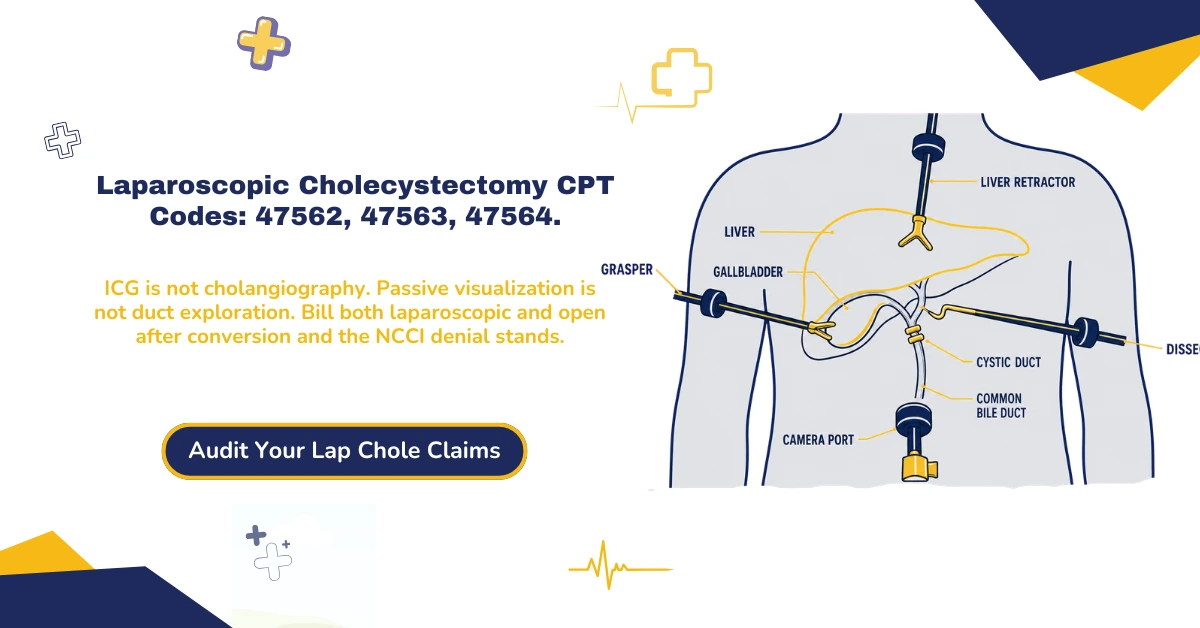
The surgeon establishes laparoscopic access through four ports, inflates the abdomen with carbon dioxide, and achieves the critical view of safety by dissecting the hepatocystic triangle. The surgeon then clips and divides the cystic artery and cystic duct, frees the gallbladder from the liver bed, and removes the specimen through the umbilical port.
Use CPT 47562 when: gallbladder removal is completed laparoscopically, no intraoperative cholangiogram is performed, no exploration of the common bile duct occurs, and the case doesn’t convert to open.
Don’t use CPT 47562 when: cholangiography was performed (use 47563) or the procedure converted to open (use the 47600 series). ICG fluorescence alone doesn’t change the code, so an ICG-only case stays 47562.
Minor lysis of adhesions performed to reach the gallbladder is included in CPT 47562 and isn’t separately reportable. Extensive adhesiolysis that represents a substantially greater service may support Modifier 22 with detailed documentation, which the modifier section below covers.
CPT 47562 Reimbursement: 2026 Medicare Rates, RVU Data, and Site-of-Service Differentials
All figures below come from the 2026 CMS Medicare Physician Fee Schedule (CMS-1832-F) and the CMS OPPS and ASC rate files.
| Metric | 2026 Value |
|---|---|
| Work RVU (wRVU) | 10.21 |
| Malpractice RVU | 1.18 |
| Total RVU (facility) | 18.92 |
| Non-QP conversion factor | $33.40 |
| QP conversion factor | $33.57 |
| Medicare physician payment (national average, facility) | $631.95 |
| Hospital outpatient APC 5361 payment | about $6,176 |
| ASC payment | about $3,031 |
| Global period | 90 days |
The 50% facility PE RVU cut means hospital-employed surgeons and those billing from ASCs collect less in the professional component than they did in 2025. Office-based practices aren’t affected. Verify your locality-adjusted rate at the CMS Physician Fee Schedule lookup.
Medical Necessity and Documentation Requirements for CPT 47562
CMS and commercial payers require documented gallbladder pathology to support CPT 47562. The most common denial reason is “laparoscopic cholecystectomy billed without documented gallbladder pathology.” Acceptable diagnoses include cholelithiasis (K80.20 is the workhorse code for symptomatic gallstones), acute cholecystitis (K81.0), chronic cholecystitis (K81.1), and biliary dyskinesia.
The operative report must document the indication, the surgical approach, achievement of the critical view of safety, the specific clips applied to the cystic duct and artery, and the extraction technique for the specimen.
| Sample documentation: “Patient with symptomatic cholelithiasis, multiple episodes of biliary colic. Ultrasound confirmed multiple gallstones with gallbladder wall thickening. Laparoscopic cholecystectomy performed via 4 ports, gallbladder dissected from liver bed, critical view of safety achieved, cystic duct and artery identified, clipped, and divided. Specimen removed via umbilical port.” |
CPT Code 47563: Laparoscopic Cholecystectomy With Intraoperative Cholangiography
CPT 47563 covers laparoscopic cholecystectomy with intraoperative cholangiography. The AMA descriptor reads: “Laparoscopy, surgical; cholecystectomy with cholangiography.” A catheter was placed in the cystic duct, contrast dye was injected, fluoroscopic images were obtained, and those images were interpreted. Miss any of those four elements in the operative report, and the payer downcodes the claim to 47562.
What Qualifies as Intraoperative Cholangiography Under CPT 47563
Four documentation elements have to appear. First, catheter or cannula placement in the cystic duct or common bile duct. Second, injection of contrast dye into the biliary system. Third, fluoroscopic imaging of the biliary tree with images obtained. Fourth, interpretation of those images with findings recorded in the operative report.
If only ICG fluorescence imaging occurs, none of those four elements is present, and the code stays 47562. This single distinction drives most upcoding audits in laparoscopic cholecystectomy CPT code selection.
When a separate radiologist performs the supervision and interpretation of the cholangiogram, the surgeon reports CPT 47563 (which bundles the injection) and the radiologist reports CPT 74300 for the supervision and interpretation. When the surgeon performs and interprets the imaging independently, CPT 47563 alone captures the full service.
Can You Bill CPT 47563 and 74300 Together?
Yes, under a specific condition. When a radiologist separate from the operating surgeon performs and documents the supervision and interpretation of the cholangiogram, the radiologist bills CPT 74300. The surgeon still reports CPT 47563, which covers the injection.
When one provider performs the entire service, injection, imaging, and interpretation, CPT 47563 alone is correct. Reporting both CPT 47563 and CPT 74300 by the same provider on the same claim is a duplicate billing error that payers reject.
ICG Fluorescence Is Not Cholangiography: The Billing Distinction That Triggers Audits
Indocyanine green (ICG) fluorescence imaging is increasingly common in laparoscopic cholecystectomy. Robotic platforms including the da Vinci system use a mode called Firefly to display ICG fluorescence in near-infrared light, which shows the surgeon the bile duct anatomy. ICG fluorescence still isn’t cholangiography.
No contrast enters the biliary ducts, no fluoroscopy is used, and no diagnostic duct images are produced. Per American College of Surgeons coding guidance, reporting CPT 47563 for a procedure where only ICG guidance was used is incorrect.
The operative report may say “cholangiogram with ICG” or “ICG cholangiogram.” If no contrast dye was injected and no fluoroscopy was used, CPT 47562 is the correct code, not CPT 47563. Payer audit algorithms flag practices with high 47563 ratios relative to 47562, and ICG-for-IOC upcoding is one pattern they catch.
CPT 47563 Reimbursement: 2026 Medicare Rates
| Metric | CPT 47563 (2026) |
|---|---|
| Work RVU (wRVU) | 11.18 |
| Medicare physician payment (national average, facility) | about $684 |
| Global period | 90 days |
The 47563 global period, like 47562, runs 90 days. Every routine post-operative visit inside those 90 days is bundled into the surgical payment and isn’t separately billable.
CPT Code 47564: Laparoscopic Cholecystectomy With Common Bile Duct Exploration
CPT 47564 is the highest-level laparoscopic cholecystectomy CPT code. The AMA descriptor reads: “Laparoscopy, surgical; cholecystectomy with exploration of common bile duct.” This code applies only when the surgeon actively intervenes inside the common bile duct during the same session as the cholecystectomy.
What Is the Difference Between CPT 47563 and CPT 47564?
The difference is active duct intervention. CPT 47563 covers the cholecystectomy plus imaging of the bile ducts by cholangiography. CPT 47564 covers the cholecystectomy plus physical entry into and intervention within the common bile duct.
Intervention means stone extraction by Fogarty catheter, basket retrieval, balloon sweep, choledochotomy, or choledochoscopy. Passive visualization during dissection, the “CBD visualized” note, isn’t exploration and doesn’t support CPT 47564. The operative note must describe the specific intervention performed and its findings.
CPT 47564 Audit Risk: The Global Period and Documentation Standard
CPT 47564 carries many RVUs, so it draws scrutiny. The biggest compliance risk is billing 47564 when the operative report documents only inspection or visualization rather than active intervention. A second risk is overbilling during the 90-day global period, because payers that flag unusual post-operative billing review the practice’s full surgical claim profile.
| CPT Code | Includes | Does Not Include | Global Period |
|---|---|---|---|
| 47562 | Lap chole | Imaging, duct work | 90 days |
| 47563 | Lap chole plus cholangiography | Duct intervention | 90 days |
| 47564 | Lap chole plus duct exploration | Nothing further in same session | 90 days |
CPT 47564 carries a national average facility Medicare physician payment near $1,061 per the 2026 CMS MPFS, with a work RVU of 17.55.
When a Laparoscopic Cholecystectomy Converts to Open: CPT Codes and NCCI Rules
When a laparoscopic cholecystectomy converts to an open procedure during the case, report only the open code. Don’t report both the laparoscopic and open code on the same claim. Per the CMS NCCI Policy Manual, Chapter 1, effective January 1, 2026: “The CPT code for the failed laparoscopic cholecystectomy is not separately reportable.”
The full text sits in NCCI Chapter 1 (2026).
Open Cholecystectomy CPT Codes: 47600, 47605, and 47610
| CPT Code | Description |
|---|---|
| 47600 | Open cholecystectomy without cholangiography |
| 47605 | Open cholecystectomy with cholangiography |
| 47610 | Open cholecystectomy with exploration of common bile duct |
These codes carry higher work RVUs than their laparoscopic counterparts, because open surgery takes greater intraoperative effort. If the laparoscopic approach failed on dense adhesions or unclear anatomy and the surgeon finished open without cholangiography, report only CPT 47600. The laparoscopic attempt is absorbed into the open procedure’s payment.
Modifier 22 for Conversion Cases: What the Operative Note Must Say
Modifier 22 (Increased Procedural Services) may apply to conversion cases when the complexity substantially exceeded the typical open procedure. “Typically difficult” language doesn’t survive payer review. The note has to describe the specific findings that created the added work.
Payers have accepted findings like a gangrenous gallbladder requiring extended dissection, Mirizzi syndrome with bile duct involvement, and dense pericholecystic adhesions from prior abdominal surgery requiring 30 or more additional minutes. Vague phrases such as “difficult anatomy” fall short.
Modifier 22 on cholecystectomy claims is among the most audited modifiers in general surgery. Planned staged procedures may also need prior authorization for surgical procedures before the case is scheduled.
One exception applies. If a diagnostic laparoscopy happened at a prior, separate encounter and the open cholecystectomy follows later, Modifier 58 on the open code allows separate reporting of both.
Robotic-Assisted Laparoscopic Cholecystectomy: CPT Codes and the 2026 Category III Update
There’s no unique CPT code for robotic-assisted laparoscopic cholecystectomy. Report CPT 47562, 47563, or 47564 based on what the surgeon performed, whether or not a robotic platform was used. The robotic system is a surgical technique, not a separately reportable service.
Can You Bill HCPCS S2900 to Medicare for Robotic Cholecystectomy?
No, Medicare doesn’t recognize HCPCS code S2900 (surgical techniques requiring use of robotic surgical systems) for separate payment. CMS treats robotic procedures as clinically equivalent to their non-robotic counterparts for reimbursement. S2900 carries no relative value units in the Medicare Physician Fee Schedule.
Submitting S2900 on a Medicare claim results in rejection. Some commercial payers track robotic utilization through S2900 as a reporting code, but payment policies vary. Verify individual commercial payer contracts before submitting S2900 on any claim.
The AMA CPT 2026 update added new Category III tracking codes covering robotic assistance for select procedures. Category III codes carry no RVUs and stay bundled into the primary procedure payment for Medicare unless a specific payer’s policy permits separate reporting. Verify with each payer before reporting any Category III code alongside the primary lap chole code.
The operative note for a robotic cholecystectomy should document the critical view of safety, cystic duct and artery identification, the robotic approach, and any additional procedures performed. Complex robotic cases with extensively documented added work may support Modifier 22, under the same standard that applies to open conversion cases.
NCCI Bundling Rules for Laparoscopic Cholecystectomy: What Cannot Be Billed Separately
The CMS National Correct Coding Initiative stops practices from billing separately for services already included in the laparoscopic cholecystectomy CPT code. Each edit pairs a Column One code with a Column Two code. When both land on the same claim for the same date of service, the payer pays Column One and denies Column Two.
Per the CMS NCCI Policy Manual effective January 1, 2026, surgical laparoscopy includes diagnostic laparoscopy, which is never separately reportable at the same encounter. The full manual sits on the CMS NCCI Policy Manual page.
Services Bundled Into CPT 47562, 47563, and 47564 (Not Separately Reportable)
The table below maps the services that bundle into the cholecystectomy codes and the narrow exceptions that allow separate reporting.
| Bundled Code | Description | Why Not Separately Reportable | Exception or Modifier |
|---|---|---|---|
| 49320 | Diagnostic laparoscopy | Surgical laparoscopy includes diagnostic laparoscopy (NCCI Ch. 6, 2026) | None |
| 76000 | Fluoroscopy guidance | Bundled into 47563 when cholangiography is performed | None |
| 44180 | Laparoscopic lysis of adhesions | Bundled when adhesiolysis gains access to the gallbladder | Modifier 59 or XS if a separate, documented site |
| 74300 | Radiological supervision and interpretation | Bundled when the surgeon performs the S and I (included in 47563) | Separately reportable by a different radiologist |
| 47550 | Biliary endoscopy (choledochoscopy), add-on | Reported with 47564 when intraoperative duct endoscopy occurs | Reportable with 47564, not 47562 or 47563 alone |
CPT 47562 is bundled to CPT 47605 under NCCI edits, and no modifier allows separate reporting. When cholecystectomy is performed as part of a Whipple procedure (CPT 48150 through 48154), the cholecystectomy is included in the pancreatectomy code and isn’t separately reportable on any line of the claim.
The Modifier 59 and X-Modifier Rules for Cholecystectomy Bundling
Modifier 59 (Distinct Procedural Service) allows separate reporting of a Column Two code when the service is distinct. On cholecystectomy claims, the common legitimate use is separately reportable adhesiolysis (CPT 44180) when the adhesions sit at a separate anatomic site, aren’t integral to gaining access, and the operative report documents that separateness.
CMS prefers the X-modifier family where more specificity helps: XE (separate encounter), XS (separate structure), XP (separate practitioner), and XU (unusual non-overlapping service). Use XS for adhesiolysis at a site separate from the gallbladder field. Document the site, the time spent, and the clinical reason. The detail sits in NCCI Chapter 6 (2026).
Complete Modifier Guide for Laparoscopic Cholecystectomy Claims
Modifier errors are a leading source of lap chole denials. The wrong modifier triggers an NCCI edit rejection. A missing required modifier leaves the service unpaid. The table below maps every modifier relevant to a laparoscopic cholecystectomy CPT code claim, the trigger, the documentation, and the audit risk.
Does CPT 47562 Need a Modifier?
CPT 47562 doesn’t require a modifier for a standard, uncomplicated laparoscopic cholecystectomy. Modifiers get added only when a specific circumstance exists. Applying a modifier without the documented circumstance is a compliance error. Missing a required modifier when the circumstance is present is a revenue error. Both are preventable with the right pre-submission workflow.
Modifier Reference Table for CPT 47562, 47563, and 47564
| Modifier | Name | When to Apply | Documentation Required | Key Audit Risk |
|---|---|---|---|---|
| 22 | Increased Procedural Services | Procedure substantially more complex (gangrenous gallbladder, Mirizzi syndrome, extensive adhesiolysis) | Operative note names specific findings, not generic difficulty language | Most audited modifier in general surgery; vague language overturned on review |
| 51 | Multiple Procedures | Second procedure in the same session | Separate documentation for each procedure | Payers apply payment reductions to secondary procedures |
| 52 | Reduced Services | Procedure partially completed at surgeon’s discretion | Note documents what was reduced and why | Rarely fits cholecystectomy; more common in diagnostic scope |
| 53 | Discontinued Procedure | Procedure stopped after anesthesia for patient safety | Specific reason for stopping documented | Requires anesthesia records to confirm |
| 57 | Decision for Surgery | E/M on same or prior day produced the decision for major surgery | E/M note establishes it was the decision visit | Overused; applies only to 90-day global procedures |
| 58 | Staged Procedure | Procedure planned as part of a staged course | Staging planned before the original procedure | Retroactive staging claims are denied |
| 59 | Distinct Procedural Service | Second procedure distinct in site, session, or structure | See NCCI rules; X-modifiers preferred | Overbroad use triggers unbundling audits |
| 62 | Two Surgeons | Two surgeons each perform distinct portions | Each submits with 62; 62.5% each | Requires documented division of surgical labor |
| 80 | Assistant Surgeon | Assistant surgeon participates | Standard participation documentation | Missing 80 leaves the assistant unpaid |
| XE | Separate Encounter | Service at a different session same day | Session documentation | Preferred by CMS over 59 for encounter-level distinction |
| XS | Separate Structure | Service on an anatomically separate structure | Site-specific documentation | Preferred by CMS for adhesiolysis at a separate site |
Modifier 22 on Cholecystectomy Claims: The Documentation Standard That Payers Enforce
Reviewers look for specific clinical language describing what increased operative time and complexity. Acceptable language names the finding and the added work: “gangrenous gallbladder requiring extended hepatic bed dissection of approximately 45 additional minutes,” or “Mirizzi syndrome with bile duct adherence requiring careful dissection to protect the common hepatic duct.”
Unacceptable language reads as “difficult case,” “challenging anatomy,” or “patient obese.” The additional charge claimed with Modifier 22 has to stay proportionate to the documented additional work.
Global Period, ICD-10 Diagnosis Codes, and Place of Service for Lap Chole Claims
Three claim configuration elements decide whether a lap chole claim pays cleanly: global period management, the right ICD-10 diagnosis code, and the correct Place of Service. All three are addressable before the claim leaves your practice.
What Is the Global Period for CPT 47562, 47563, and 47564?
All three codes, CPT 47562, CPT 47563, and CPT 47564, carry a 90-day global surgical period. Every routine follow-up visit during those 90 days is bundled into the surgical payment and isn’t separately billable. Three exceptions apply.
Modifier 24 allows a separately identifiable E/M during the global period for a new, unrelated condition. Modifier 78 allows reporting a return to the operating room for a related complication. Modifier 79 allows an unrelated procedure during the global period. Any E/M billed inside the 90-day window without a modifier triggers a flag in most payer systems.
What Is the ICD-10 Code for a Laparoscopic Cholecystectomy?
There’s no single ICD-10 code for laparoscopic cholecystectomy. The diagnosis code depends on the patient’s specific gallbladder condition, not the procedure itself.
| ICD-10 Code | Description | When to Use |
|---|---|---|
| K80.20 | Calculus of gallbladder without cholecystitis, without obstruction | Symptomatic gallstones, no active inflammation; the workhorse for elective lap chole |
| K80.00 | Calculus of gallbladder with acute cholecystitis, without obstruction | Acute presentation, stones confirmed |
| K80.10 | Calculus of gallbladder with chronic cholecystitis, without obstruction | Chronic inflammation with stones |
| K80.21 | Calculus of gallbladder without cholecystitis, with obstruction | Stones causing biliary obstruction |
| K81.0 | Acute cholecystitis | Acute cholecystitis confirmed, no stones identified |
| K81.1 | Chronic cholecystitis | Chronic inflammation, no stones |
| K81.9 | Cholecystitis, unspecified | Use only when specificity can’t be determined |
| K82.8 | Other specified diseases of gallbladder | Biliary dyskinesia, polyps |
| K85.10 | Biliary acute pancreatitis without necrosis | Gallstone pancreatitis driving the cholecystectomy |
| Z90.49 | Acquired absence of gallbladder | Post-operative coding once cholecystectomy is complete |
Payers deny elective cholecystectomy claims coded to unspecified categories when more specific options exist. Confirm the documented findings support the code selected. K80.20 is the correct primary diagnosis for most elective lap chole cases. The official code set sits on the CMS ICD-10 codes page.
Is CPT 47562 Inpatient or Outpatient? Place of Service Rules
CPT 47562 is performed in both inpatient and outpatient settings, but the large majority of laparoscopic cholecystectomies happen in outpatient settings. The common Place of Service designations are POS 22 (on-campus outpatient hospital) and POS 24 (ambulatory surgery center). POS 21 (inpatient hospital) applies when the patient is formally admitted.
The POS code decides whether the physician is paid at the facility or non-facility rate. POS 22 and POS 24 both pay at the facility rate, which runs lower than the non-facility rate because the facility separately bills for overhead. For the full breakdown of POS 22 mechanics and rate differentials, see ClaimMax RCM’s Place of Service 22 billing guide.
The 8 Billing Errors That Trigger Denials and Audits on Lap Chole Claims
Five errors account for most laparoscopic cholecystectomy CPT code denials and audit findings. Three more appear less often but carry outsized compliance exposure when they happen. All eight are preventable at the pre-submission stage.
Error 1: Defaulting to CPT 47562 When Cholangiography Was Performed
Coders default to 47562, the routine code, even when the operative report documents contrast injection and fluoroscopic imaging. Review every report for “cholangiogram,” “contrast injection,” “fluoroscopy,” and “imaging findings” before assigning a code. If all four appear, 47563 is correct.
Error 2: Billing CPT 47563 for ICG Fluorescence Only
The inverse error. Coders see “cholangiogram” and assign 47563 without reading further. If the note says “ICG cholangiogram” or “Firefly-assisted visualization” without fluoroscopy and contrast injection, the code is 47562. Payer audit algorithms flag practices with high 47563-to-47562 ratios.
Error 3: Reporting Both Laparoscopic and Open Codes After Conversion
When a lap chole converts to open, only the open code is reportable. Reporting CPT 47562 alongside CPT 47600 on the same claim generates an automatic NCCI edit denial. No modifier overrides it. The NCCI Policy Manual is explicit that the failed laparoscopic procedure isn’t separately reportable.
Error 4: Billing Cholangiography or Fluoroscopy Separately From CPT 47563
CPT 47563 bundles the cholangiography component. Billing CPT 74300 by the same provider who performed the imaging alongside 47563 is a duplicate billing error. CPT 76000 (fluoroscopy) is also bundled. The only exception is a separate radiologist performing the supervision and interpretation, who may bill 74300 independently.
Error 5: Applying Modifier 22 Without Specific Operative Documentation
Modifier 22 without a specific note describing clinical complexity, a gangrenous gallbladder, Mirizzi syndrome, or documented extended operative time with named difficulty, gets denied or recouped on review. “Difficult case” isn’t a clinical finding. Payers require language describing what made this case substantially more complex than a standard cholecystectomy.
Error 6: Billing E/M Services Within the 90-Day Global Period Without a Modifier
Every E/M billed within 90 days of a CPT 47562, 47563, or 47564 claim needs the right modifier. Routine post-operative visits are bundled and unpayable. New, unrelated conditions take Modifier 24, a return to the OR for complications takes Modifier 78, and unrelated procedures take Modifier 79. Missing modifiers create recoupment exposure across the encounter history.
Error 7: Using CPT 47564 for Passive Duct Visualization
“CBD inspected,” “CBD visualized,” or “common bile duct evaluated” doesn’t support CPT 47564. Active intervention, stone extraction, balloon sweep, choledochotomy, or choledochoscopy, is required. Billing 47564 for visualization alone is upcoding, and it raises audit exposure across the practice’s entire cholecystectomy history.
Error 8: Missing the Assistant Surgeon Modifier on Multi-Surgeon Cases
When an assistant surgeon participates, the assistant submits the same primary CPT code with Modifier 80. Without it, the assistant’s claim has no payment basis. Adding it later requires a corrected claim and delays payment. The assistant is reimbursed at 16% of the primary surgeon’s allowable. The fix is pre-submission claim configuration review.
Recurring lap chole denials usually share one root cause: no systematic pre-submission review catches these errors before they reach the payer. ClaimMax RCM’s denial management services identify root-cause patterns across your actual claim file and build the fix into the submission workflow.
Frequently Asked Coding Questions for Laparoscopic Cholecystectomy
These laparoscopic cholecystectomy CPT code questions surface most in coding forums and payer audit disputes. Each answer reflects CMS NCCI guidance and current 2026 billing rules.
Can You Bill CPT 47562 and 49591 Together?
Yes, under specific NCCI conditions. CPT 49591 (initial repair of anterior abdominal hernia, reducible, 3 cm to 10 cm) can be billed with CPT 47562 when the hernia is repaired through a separate incision distinct from the laparoscopic access.
The hernia repair can’t use the same port incision used for gallbladder access. Append Modifier 59 or XS to CPT 49591, and document the separate incision, the defect size, and the repair technique as independent events.
Can You Bill CPT 47562 and 44970 Together?
Yes. CPT 47562 (laparoscopic cholecystectomy) and CPT 44970 (laparoscopic appendectomy) can be billed together when both procedures are performed in the same session, each is fully documented, and the indication for each is independently established. No NCCI bundling edit prohibits the combination. Append Modifier 51 to the secondary procedure. Payers may apply a multiple-procedure payment reduction to the lesser-valued procedure.
What Is the Anesthesia CPT Code for Laparoscopic Cholecystectomy?
The anesthesia CPT code for laparoscopic cholecystectomy is 00790 (anesthesia for intraperitoneal procedures in the upper abdomen, including laparoscopy). The anesthesiologist or CRNA reports 00790 with the physical status modifier (P1 through P6) and any qualifying circumstance codes. The anesthesia provider’s reimbursement uses base units plus time units multiplied by the anesthesia conversion factor, not the surgical RVU structure.
What Is the CPT Code for Laparoscopic Subtotal Cholecystectomy?
There’s no unique CPT code for laparoscopic subtotal cholecystectomy. Report CPT 47562. A subtotal cholecystectomy is a technique, not a separately coded procedure. When the surgeon performs a subtotal resection because complete removal is unsafe, on severe inflammation or unclear anatomy, the code stays 47562.
The operative report must describe the subtotal technique and the clinical reason. Modifier 22 may apply if the complexity substantially exceeded a standard cholecystectomy.
What Is the CPT Code for Laparoscopic Cholecystectomy With Lysis of Adhesions?
There’s no separate CPT code for laparoscopic cholecystectomy with lysis of adhesions. Per the CMS NCCI Policy Manual, lysis of adhesions performed to reach the gallbladder is bundled into CPT 47562 and isn’t separately reportable.
CPT 44180 is separately reportable only when the adhesiolysis is performed on a separate structure, unrelated to gaining access, and documented as a distinct service. In that case, Modifier 59 or XS is required.
SAGES 2026 Guideline on Routine IOC: What It Means for CPT 47563 Billing
The Society of American Gastrointestinal and Endoscopic Surgeons published a clinical practice guideline, highlighted in the ACS Bulletin Brief in April 2026, conditionally recommending routine intraoperative cholangiography during laparoscopic cholecystectomy for adult and pediatric patients. It’s a change from the prior selective-use approach.
The guideline found that routine IOC, compared to selective IOC, improves identification of aberrant biliary anatomy, increases detection of common bile duct stones, and may reduce bile duct injury rates.
It favors IOC over ICG fluorescence and laparoscopic ultrasound in most scenarios because IOC gives better luminal evaluation. The recommendation is conditional, and it emphasizes surgeon proficiency. The full guideline sits on the SAGES clinical practice guidelines page.
For billing, the guideline creates three effects. First, practices that adopt routine IOC generate more 47563 claims relative to 47562, which is clinically and legally defensible when documented correctly.
Second, those 47563 claims carry stronger audit defense, because payers reviewing IOC frequency can no longer call routine IOC a billing anomaly. Third, documentation still has to satisfy the four required elements: catheter placement, contrast injection, fluoroscopic imaging, and image interpretation.
Guideline alignment supplements documentation; it doesn’t replace it. Practices seeing 47563 volume climb after adopting routine IOC should audit their templates to confirm all four elements appear in every operative report before submission. ClaimMax RCM’s medical billing specialists run pre-submission documentation reviews for exactly this purpose.
Documentation Template and Pre-Submission Checklist for Lap Chole Claims
Clean laparoscopic cholecystectomy CPT code claims share one trait: the operative report contains every element the payer’s adjudication system checks before approving payment. The templates below come from the documentation requirements payers and auditors enforce.
Sample Operative Note Language for CPT 47562
| “Patient presented with symptomatic cholelithiasis confirmed by ultrasound demonstrating multiple gallstones with gallbladder wall thickening. After informed consent, the patient was taken to the operating room and positioned supine under general anesthesia. Four-port laparoscopic approach established. Critical view of safety achieved following dissection of the hepatocystic triangle. Cystic duct and cystic artery identified, individually clipped with titanium clips, and divided. Gallbladder dissected from the liver bed using electrocautery. Specimen removed via umbilical port in an endoscopic bag. No cholangiography performed. No bile duct exploration performed. Estimated blood loss: minimal. Patient tolerated the procedure well.” |
Every element here satisfies the documentation requirements payers enforce. The explicit lines “No cholangiography performed. No bile duct exploration performed.” head off downcoding disputes before they start.
Pre-Submission Checklist: 7 Verification Points Before Every Lap Chole Claim
- The ICD-10 diagnosis code is specific and matches the documented clinical findings.
- The CPT code reflects the procedure documented in the operative report.
- Cholangiography claims (47563) document all four elements: catheter placement, contrast injection, fluoroscopy, and image interpretation.
- No laparoscopic and open codes appear together on the same claim.
- Modifier 22 claims include specific clinical language, not generic difficulty statements.
- No E/M codes appear within the 90-day global period without the right modifier.
- The Place of Service code matches the facility type where the procedure was performed.
For the full breakdown of what qualifies as a clean claim under federal billing rules and how to apply these standards across your claim cycle, see ClaimMax RCM’s guide to clean claim standards.
How ClaimMax RCM Handles Laparoscopic Cholecystectomy Billing for Surgical Practices
Laparoscopic cholecystectomy is a high-volume procedure. One coding error repeated across a month of cholecystectomy volume compounds into real revenue loss and audit exposure by year-end.
ClaimMax RCM’s certified coders handle CPT code selection, modifier application, NCCI compliance review, and ICD-10 pairing for every surgical claim before submission. The pre-submission workflow catches the eight error types above before they reach the payer.
ClaimMax RCM’s certified coders review the operative report for every 47562, 47563, and 47564 claim to confirm the code reflects what the surgeon documented. The team applies modifiers correctly, verifies NCCI bundling compliance, and confirms ICD-10 pairings against the documented indication before any claim goes out.
When denials occur, the surgical claim denial recovery team identifies the root cause and builds the correction into the submission workflow so the same denial doesn’t recur.
Surgical practices that want to cut lap chole denial rates, protect revenue during payer audits, and submit clean claims from day one work with a medical billing for surgical practices partner that understands NCCI rules at the code-pair level. Contact ClaimMax RCM to review your current surgical billing workflow.
Sources and Official References
This article reflects CMS data from the Calendar Year 2026 Medicare Physician Fee Schedule Final Rule (CMS-1832-F), published October 31, 2025, available at the CMS-1832-F Final Rule page.
Bundling rules come from the CMS NCCI Policy Manual effective January 1, 2026, Chapter 1 and Chapter 6, available on the CMS NCCI Policy Manual page. Reimbursement rates can be verified with the CMS Physician Fee Schedule lookup.
ICG fluorescence coding guidance reflects published American College of Surgeons coding guidance. Clinical guidance on routine intraoperative cholangiography reflects the SAGES clinical practice guidelines, highlighted in the ACS Bulletin Brief of April 2026. ICD-10 codes reflect the CMS ICD-10 Official Guidelines. Every external link points to a primary government or association source, not a competitor or commercial billing service.