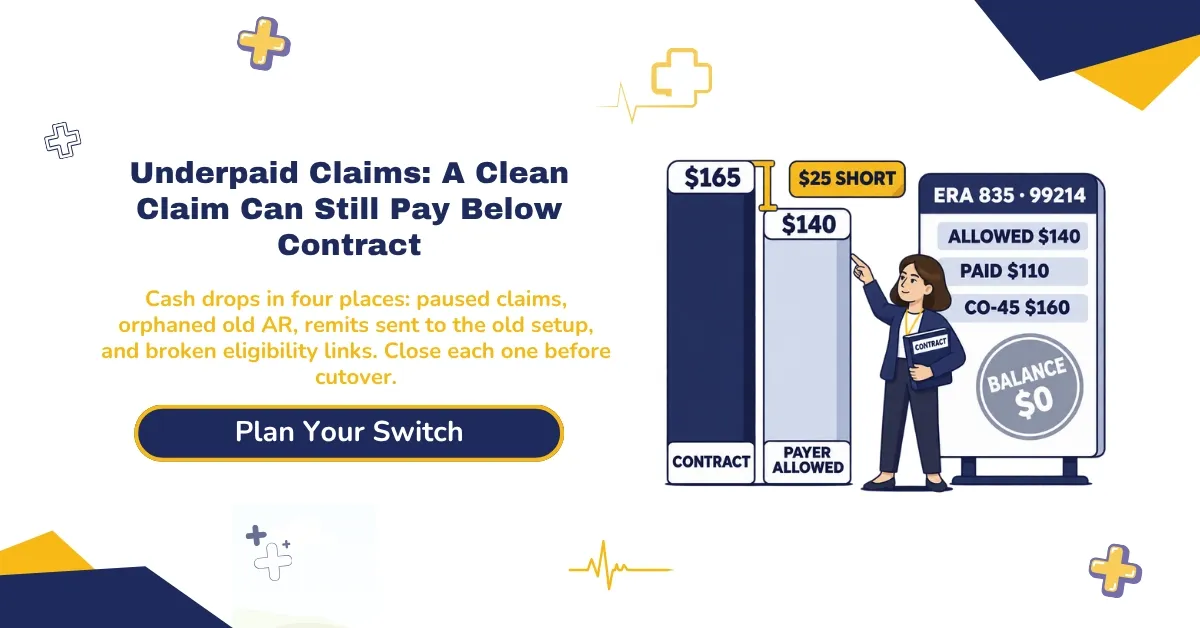
A clean claim is one the payer can process without asking you for anything else. That status has nothing to do with price. The payer’s allowed amount on the ERA 835 can land below your contracted rate, and auto-posting writes the gap off as CO-45. Underpaid claims close at zero balance, so your team never gets a work item.
You’ve seen this play out. The claim cleared the clearinghouse, the ERA posted, and the account closed. Months later, your biller pulls the contract during a 99214 review and finds every visit since January paid $25 short at that payer.
Catching those short pays takes three skills: reading one 835 line against your contract, knowing which adjustments to dispute, and running a weekly variance check. You’ll also need to watch the January 1, 2027 Medicare changes, because they move the rate on any contract that floats with Medicare.
Key Takeaways for Practice Managers
- A clean claim shows the payer could process it; the price comes from a separate pricing step.
- The 835 file shows the payer’s allowed amount and never lists your contract rate.
- Underpaid claims tend to post as routine CO-45 write-offs and close at zero balance.
- Compare AMT*B6, or paid plus patient responsibility, with your contracted allowed amount on every line.
- The January 1, 2027 Medicare changes move rates on any contract that floats with Medicare.
What Does a Clean Claim Guarantee?
A clean claim guarantees one thing: the payer can process it without developing it or requesting more information. Payment at your contracted allowed amount isn’t part of that promise. Pricing happens after acceptance, inside the payer’s adjudication system, and that step is where short payments begin.
The Official Clean Claim Definition
The CMS clean claim definition, published in MLN Matters MM5355, describes a claim that “does not contain a defect requiring the Medicare contractor to investigate or develop prior to adjudication.” That sentence covers processing and stops there. It says nothing about the amount Medicare or any other payer will allow.
Clean status comes from front-end checks. The 999 acknowledgment confirms the file’s syntax, and the 277CA reports whether each claim cleared front-end edits for processing. Our guide to clearinghouse rejections and 277CA walks through each response if your team mixes them up.
Those checks look at the claim’s data: demographics, codes, NPIs, and dates. For the full checklist and the clean claim rate formula, see our clean claim requirements guide. Price is a separate calculation, and the payer’s pricing engine runs it after your claim has passed every check above.
Underpaid Claims vs. Denials vs. Contractual Adjustments
Each of these outcomes leaves a different footprint on the remit, and that footprint decides whether anyone on your team ever touches the account.
| Underpaid claim | Denied claim | Correct contractual adjustment | |
|---|---|---|---|
| What happened | Paid below the contracted allowed amount | Payer refused all or part | Charge reduced to the contracted allowed amount |
| What the 835 shows | CLP02 of 1, CO amount too large | CLP02 of 4, or a $0 line with a denial CARC | CO-45 equals billed minus contract |
| Reaches a denial worklist? | Rarely | Yes | No, and it shouldn’t |
| Recoverable? | Yes, through a payment dispute | Yes, through a corrected claim or appeal | No, it’s a legitimate write-off |
Use one test. If the payer allowed amount sits below your contracted allowed amount for that code, modifier, place of service, and date of service, you’re looking at an underpayment. Posting that gap as a contractual allowance closes the account while the payer’s dispute window keeps running.
Your team works denials because they show up as zeros. Underpaid insurance claims arrive looking finished, which is why underpayment in medical billing survives inside practices with strong denial numbers. A low denial rate tells you nothing about whether payers priced your paid claims right.
Why Underpaid Claims Hide Inside a Paid ERA
Underpaid claims hide because the ERA 835, your electronic remittance advice, reports them as paid. The claim status reads processed, the adjustment carries a routine code, and your posting software writes the difference off. Once the account drops to zero, the shortfall never reaches a worklist unless someone compares the line with the contract.
ERA, 835, and EOB: Same Payment, Three Names
An ERA and an 835 are the same thing. ERA is the business name for electronic remittance advice, and the 835 is the HIPAA standard X12 transaction, version 005010X221A1, that carries it. If your team says “pull the 835 file” or “pull the ERA,” they mean one record.
ERA vs. EOB comes down to format. The EOB is the readable paper or PDF version of the same remittance advice in medical billing, built for people instead of software. Patients get their own EOB too, which is a separate document written for the health plan member.
Some payers still don’t send an 835. The 2025 CAQH Index puts medical plan adoption of fully electronic 835 remittance advice at 87%, down from 89% the year before. That leaves about one in eight remits arriving on paper or as portal PDFs, and your team has to post those by hand.
The Auto-Posting Trap That Closes Short Payments
Auto-posting reads each CAS (claim adjustment) segment on the 835, posts CO amounts as contractual adjustments, moves PR amounts to the patient, and closes the line. Nothing in that logic asks whether the CO amount was the right size. A CO-45 that’s $25 too large posts the same way as a correct one.
Payment audits leave a long gap at a lot of groups. In a February 11, 2025 MGMA Stat poll of 193 practice leaders, 30% audited payer payments against contracted rates monthly and 18% quarterly. Another 30% checked once a year, which gives a short pay up to 12 months to repeat.
The fix starts at posting. Line-level payment posting compares each paid line with the contracted allowed amount before the account closes, so a short pay lands in a queue instead of a write-off. Without that comparison, payment posting in medical billing confirms that money arrived and stops there.
Small numbers hide well. A $9 shortfall on one visit looks like rounding. At 4,000 visits a year with one payer, that same $9 adds up to $36,000 (illustrative math), and nobody sees it unless someone runs the comparison.
How to Read an ERA 835 Line Against Your Contracted Rate
To read an ERA 835 for underpayments, start with each service line’s billed charge, paid amount, adjustments, and allowed amount. Then compare the payer allowed amount with your contracted rate for that code, modifier, place of service, and date of service. The 835 never lists your contract rate, so your team has to bring it.
The 835 Segments That Show an Underpayment
Nine checks across the 835 catch the common underpaid claims. Each one answers a single question about the line, and together they tell you whether the payer priced it the way your contract says.
| Segment | What it means in plain English | What to check |
|---|---|---|
| BPR / TRN | Total payment and trace number for the deposit | BPR total matches the bank deposit; TRN matches the EFT trace |
| CLP | Claim status (CLP02), charge, paid amount, and patient responsibility | Status 1 or 2 means processed. It doesn’t mean priced right |
| SVC01 vs. SVC06 | Code paid vs. code billed (SVC06 appears when the payer changed the code) | A different code means a downcode with no denial |
| SVC02 / SVC03 | Line charge and line payment | Paid plus PR against the contract |
| SVC05 vs. SVC07 | Units paid vs. units billed (SVC07 appears when the two differ) | Units cut on timed codes or drug codes |
| CAS | Group code, CARC, and dollar amount | A CO amount larger than billed minus contract |
| AMT*B6 | The payer allowed amount for the line | Below your contracted allowed amount means an underpayment |
| LQ | Remittance Advice Remark Codes (RARCs) | Context for reductions, plus the 2027 No Surprises Act codes |
| PLB | Provider-level adjustments, such as recoupments and interest | Explains a deposit smaller than the claim payments |
CMS requires every remittance to balance at the service, claim, and provider levels, according to Section 30 of the CMS remittance advice manual (Medicare Claims Processing Manual, Chapter 22). Balanced math proves the payer’s numbers agree with each other, and your contract never enters that calculation.
Worked Example: A 99214 Paid $25 Below Contract
Take one illustrative service line for a 99214 office visit. The remit below is invented for teaching, and the practice’s contracted allowed amount for this code is $165.
CLP*ACCT10457*1*300*110*30*12*PYR8812345~
SVC*HC:99214*300*110**1~
DTM*472*20261103~
CAS*CO*45*160~
CAS*PR*3*30~
AMT*B6*140~
Reading an 835 file works top to bottom. CLP shows a $300 charge, $110 paid, and $30 patient responsibility. SVC repeats the line: 99214, $300 billed, $110 paid, one unit. DTM*472 gives the date of service, November 3, 2026. CAS reports $160 as CO-45 and $30 as PR-3, the copay. AMT*B6 says the payer allowed $140.
| Item | Amount |
|---|---|
| Billed charge | $300 |
| Payer allowed amount (AMT*B6) | $140 |
| Copay (PR-3) | $30 |
| Paid | $110 |
| CO-45 write-off | $160 |
| Contracted allowed amount | $165 |
| Expected payer payment | $135 |
| Expected CO-45 | $135 |
| Shortfall | $25 on one line, with no denial, no remark code, and a zero balance |
Every number balances: $110 paid plus $30 copay plus $160 CO-45 equals the $300 charge. That’s why auto-posting accepts it. The payer priced the visit off an old $140 rate, and the extra $25 went into the write-off column with no denial and no remark code.
Commercial contracts often price E/M codes as a percentage of Medicare, so it helps to know how Medicare prices 99214 before you build your rate table. Keep the allowed amount vs. billed amount distinction straight, too: the billed charge is your number, and the allowed amount is the payer’s.
Three Formulas That Expose the Variance
Three formulas turn the remit into a yes or no answer. Keep them in your posting notes or a spreadsheet, and run them on any line that looks off.
Payer allowed amount = Paid amount + Patient responsibility
Expected payer payment = Contracted allowed amount minus Patient responsibility
Shortfall = Expected payer payment minus Actual paid amount
In the example, $165 minus $30 gives an expected reimbursement of $135. Subtract the $110 the payer sent and the payment variance is $25. If billed minus every CO amount doesn’t match paid plus PR, look for an OA or PI adjustment on that line.
Coinsurance adds a second problem. If the patient owes a percentage, the payer calculated that share on its own low allowed amount, so the patient’s bill is wrong as well. Recalculate the share on your contracted allowed amount before you send a statement.
If your team can’t name the contracted allowed amount for your top 20 codes, that’s the first gap we’d close in a free revenue cycle audit.
Which ERA Adjustments Should You Write Off, Bill, or Dispute?
The group code on each ERA adjustment tells you who owes the money, and the Claim Adjustment Reason Code (CARC) tells you why the payer made the cut. Neither one confirms the amount. Write off what matches your contract, bill the patient the PR amount, and dispute the rest.
CO, PR, OA, and PI Group Codes Explained
- CO, contractual obligation: a contractual adjustment you write off and can’t bill to the patient.
- PR, patient responsibility: deductible, coinsurance, and copay amounts you can bill to the patient.
- OA, other adjustment: often the prior payer’s impact on a secondary claim.
- PI, payer initiated reduction: a valid X12 group code that commercial payers use.
The CMS manual lists CO, OA, and PR as the group codes on Medicare remits. If your office bills a patient for a CO amount, you’ve moved a payer problem onto the patient’s statement, and on assigned Medicare claims you’ve created a compliance problem.
Is CO-45 an Underpayment?
No, not by itself. The CO-45 denial code means “charge exceeds fee schedule/maximum allowable or contracted/legislated fee arrangement,” according to the X12 CARC list, and you’ll see it on most paid lines. You have an underpayment when paid plus patient responsibility comes in below your contracted allowed amount.
Use this rule on every line: if paid plus patient responsibility is less than your contracted allowed amount, the CO-45 write-off is overstated by that same gap. In the 99214 example, $110 plus $30 equals $140, so the $160 CO-45 runs $25 too high.
X12 also attaches a usage note to the code: a CARC 45 adjustment can’t equal the total service or claim charge. If a remit shows CO-45 for the full charge with $0 paid, the payer used the wrong code. Call and ask what the adjustment represents before anyone writes it off.
Claim Adjustment Reason Codes That Hide Short Payments
These CARC codes show up on paid lines all the time. Each one is legitimate in some cases and hides underpaid claims in others, so read them against the contract instead of trusting the label.
| Code | What it means | Legitimate when | Dispute when |
|---|---|---|---|
| CO-45 | Charge exceeds fee schedule or contracted fee | CO equals billed minus contract | Paid plus PR is below contract |
| CO-59 | Processed under multiple or concurrent procedure rules | The reduction follows contract ranking | The wrong line took the cut, or the code is exempt |
| CO-97 | Included in the payment for another service | A true bundle under your contract | A valid modifier and documentation were on the claim |
| CO-131 | Claim-specific negotiated discount | You agreed to that discount | You never agreed to it (possible rented network) |
| CO-253 | Sequestration, reduction in federal payment | Medicare fee-for-service claims | A commercial plan with no contract language allowing it |
| OA-23 | Impact of prior payer adjudication | The secondary claim math is correct | The secondary paid short off the primary’s numbers |
| PR-1, PR-2, PR-3 | Deductible, coinsurance, copay | Matches the patient’s benefits | PR calculated on a low allowed amount |
Medicare sequestration is one cut you shouldn’t fight. CMS applies a 2% reduction to fee-for-service payments and has reported it as CO-253 sequestration (CARC 253) since June 3, 2013, per the CMS sequestration transmittal. That cut comes off after deductible and coinsurance, so the allowed amount on the line stays the same.
Medicare Advantage plans are a different story. An MA plan’s right to take the same 2% depends on your contract wording, so check the payment terms before you accept or dispute it.
RARC codes in the LQ segment add the detail a CARC leaves out, so read them on any line you plan to dispute. If the codes point to a true denial instead of a short pay, move the claim into your denial management services workflow, where your team works it as an appeal.
Seven Reasons Clean Claims Get Paid Below Contract
Underpayments in healthcare tend to trace back to seven causes on clean claims: rates the payer never loaded, the wrong network or product, silent downcoding, bundling cuts, modifier and unit errors, your own charge tripping a lesser-of clause, and recoupments buried in the PLB segment. Each cause leaves a trace on the 835.
1. The Payer Never Loaded Your New Rates
Contracts renew and escalators kick in, but the payer’s pricing system keeps paying from last year’s payer fee schedule. On the 835, the payer allowed amount comes in short by the same dollars on every line for that code, which is how one missed escalator creates hundreds of underpaid claims.
Check the first 10 paid lines after any effective date against the new rate. ClaimMax’s payer contracting services review fee schedule accuracy in your contracts, which gives your posting team a confirmed rate and effective date to check against.
2. The Claim Priced Under the Wrong Network or Product
Sometimes a payer prices your PPO claim from an HMO fee table, or from a rented network your practice never joined. Look for CO-131, a claim-specific negotiated discount, or an allowed amount that matches another product’s rate. Rates differ by plan type and network status, as our breakdown of BCBS rates by plan type shows.
3. Silent E/M Downcoding
Some payers pay a lower E/M level without denying anything. On the 835, SVC01 shows the code the payer paid, and SVC06 shows the code you billed. If those two differ on a 99214 or 99215, the payer downcoded your visit without sending a denial.
One state has pushed back. On March 13, 2026, the Maryland Insurance Administration fined Cigna $80,000 and ordered it to stop its automatic downcoding of E/M claims. Maryland Bulletin 26-9, issued April 7, 2026, bars payers there from lowering a submitted code before getting the information needed to justify it.
4. Bundling and Multiple Procedure Reductions
CO-97 folds a separately payable service into another one, and CO-59 applies multiple procedure rules. Under Medicare’s multiple procedure payment reduction, the procedure with the highest value pays in full and the others take a cut, so a ranking error moves the reduction onto the wrong line. Check whether your contract adopts Medicare’s rule or uses its own.
Valid modifiers matter here as well. Our guide to modifier 59 and NCCI edits covers the cases where a distinct procedural service should be paid outside the bundle.
5. Modifiers and Units Paid Wrong
Medicare-based pricing pays bilateral procedures billed with modifier 50 at 150% of the fee schedule amount. With an illustrative $400 unilateral contract rate, a bilateral line should allow $600. If the payer processes it as unilateral, you’re $200 short on one line.
Payers cut units the same way on timed codes and drug codes. Compare SVC05, the units paid, with SVC07, the units you billed. SVC07 appears on the remit when the two numbers differ, so its presence alone is worth a look.
6. Your Own Charge Triggered a Lesser-Of Clause
Many contracts pay the lower of your billed charge or the contracted rate. The Network Health lesser-of policy, for example, sets the allowed amount at the lesser of the provider’s billed charge or the contractual or fixed rate. Set a charge below your contract rate and you get paid your charge.
That’s a revenue integrity problem on your side, and no payer dispute will fix it. Compare your chargemaster against your highest contracted rates once a year and raise any charge that sits below a contract.
7. Recoupments Hidden in the PLB Segment
A positive PLB amount shrinks the deposit even when every claim on the remit paid right. The WO code marks an overpayment recovery, sometimes for a claim from months earlier. Post each PLB line to a provider-level account and match it to the payer’s recoupment letter before you accept it.
Payers are leaning harder on takebacks. Kodiak Solutions data covering more than 2,300 hospitals and 375,000 physicians shows insurer takebacks reached 1.57% of A/R in the first half of 2026, up from 1.38% a year earlier. Over the same period, the initial denial rate fell to 10.63% from 12.00%, so lower denials didn’t add up to more cash.
What Changes in 2027 for Contracted Rates and ERAs
Three Medicare changes take effect on January 1, 2027: lower conversion factors, a new same-day E/M payment cut, and modifier B1 replacing G2211. A fourth rule puts No Surprises Act remark codes on out-of-network remits. Each one can lower a payment for valid reasons, and each one gives payers new room to create underpaid claims.
Lower Medicare Conversion Factors Hit “% of Medicare” Contracts
The CY 2027 Physician Fee Schedule final rule sets the conversion factor at $32.95 for qualifying APM participants, down 1.83% from $33.57, and at $32.63 for everyone else, down 2.31% from $33.40, according to the CMS 2027 fee schedule rule fact sheet.
Your contract wording decides what that means for commercial pay. If your rates float with Medicare’s current year, a lower January payment is correct. Contracts tied to a fixed base year don’t move with Medicare, so a payer that pays the 2027 number anyway is paying short on every line. Read the rate exhibit before January’s first ERAs arrive.
New Same-Day E/M and Modifier B1 Rules to Watch on Commercial Remits
Starting January 1, 2027, Medicare pays the service with the highest payment at 100% and the other at 80% when a separately identifiable office or outpatient E/M visit happens on the same day as a 0-day global procedure. CMS dropped the proposed 10-day and 90-day globals from the final version.
G2211 becomes modifier B1, which adds 16% to the E/M payment. Modifier B2 adds 32% for practitioners in a Shared Savings Program ACO or a LEAD Model ACO, and its use is voluntary.
Two things deserve a close watch on commercial remits: a payer applying the 80% rule without contract language that allows it, and a payer that doesn’t recognize B1 and pays the base E/M with no denial. Either one leaves a paid line short of your contracted rate.
No Surprises Act Remark Codes Arrive on Out-of-Network ERAs
Payers must use specific CARCs and RARCs on remittances they send to providers outside their network for items and services furnished on or after January 1, 2027, according to the CMS IDR implementation timeline. Those codes tell you whether a claim falls under the No Surprises Act and federal IDR.
The federal IDR administrative fee also dropped from $115 to $15 per party for disputes started on or after June 11, 2026. If your practice bills out of network, set up your 835 parser so those remark codes route to a person instead of posting on their own.
Before January 1, 2027, work through four steps with your billing team:
- Read every “% of Medicare” rate exhibit in your payer contracts.
- Switch E/M templates from G2211 to modifier B1.
- Update CARC and RARC tables in your practice management system and clearinghouse.
- Spot-check the first 25 ERA 835 lines you receive in January 2027.
A Weekly Underpayment Check Any Practice Can Run
A weekly check catches underpaid claims while you still have time to dispute them. Build an expected rate table for your top payers and codes, flag any line where the payer allowed amount falls below it, and fix the auto-posting rules that let short pays close.
Build Your Expected Rate Table
Start with your top five payers and your top 20 CPT codes by volume. For each pair, record the plan or product, modifier, place of service, contracted allowed amount, effective date, and any annual escalator. That table becomes your expected reimbursement benchmark for every paid line.
Pull rates from the contract exhibits first, then the payer portal’s payer fee schedule lookup, and the Medicare fee schedule for any contract priced as a percentage of Medicare. Payment posting sits at step 10 of our 13 steps of revenue cycle management, and this table belongs inside that step.
Raw 835 File or Billing Software Report?
Use your practice management system’s variance report if your contracts live in it. If they don’t, export the 835 file detail for each payer: CLP, SVC, CAS, and AMT*B6. Either way, you’re comparing the same two numbers on every line.
Start by flagging any line where the payer allowed amount runs more than $5 or 2% below contract, then adjust that threshold once you see your volume. Without automation, sample 25 paid lines a week and log each payment variance by payer and code.
Auto-Posting Rules That Stop Short Pays From Closing
Payment posting in medical billing needs exception rules, or every short pay closes on its own. Route a line to a person instead of auto-closing it when one of these five conditions shows up:
- CO-45 is larger than billed minus your contracted allowed amount.
- SVC06 is present, meaning the payer changed the code.
- SVC07 differs from SVC05, meaning the payer cut units.
- CO-131 or a PI group code appears on the line.
- The remit carries a PLB adjustment.
Those five rules turn payer contract compliance into a daily habit instead of a quarterly project. Our medical billing audit checklist covers the same issue as Leak 13 if you want the wider review.
If your team doesn’t have hours each week for this, our ERA payment posting services build these checks into daily posting.
How to Dispute Underpaid Claims and Recover the Money
To dispute underpaid claims, confirm the error belongs to the payer, then send a written dispute that shows your contracted allowed amount, what the payer allowed and paid, the shortfall, and the contract section that sets the rate. File inside the payer’s window and track each claim until the money posts.
Payer Error or Your Error?
Sort the problem before you write a word. Your own coding error, such as a wrong code, modifier, or unit, needs a corrected claim. Payer pricing errors go to a payment dispute or reconsideration. Lesser-of hits mean updating your charges, since the payer paid what your contract allows.
What to Include in an Underpayment Dispute
Put the math where the reviewer sees it first, and include these seven items in every dispute you send:
- Claim number, date of service, and patient account number.
- CPT code, modifier, and units.
- Contracted allowed amount, with the contract section or exhibit and its effective date.
- Payer allowed amount and paid amount from the 835.
- The shortfall calculation.
- A copy of the ERA line.
- A clear request to reprocess at the contract rate and pay the difference.
Those items form the core of your underpayment appeal letter. If one payer underpays the same code over and over, send one cover letter with a claim spreadsheet, and keep tracking each claim’s own deadline.
Deadlines and Escalation
Medicare gives you 120 days from receipt of the initial determination to request a redetermination, and the notice counts as received five calendar days after its date, under the CMS redetermination rules. For providers, the remittance advice is that initial determination notice.
Commercial payers set their own dispute windows in the contract and provider manual, and those windows can differ from your timely filing limit. Log the window for each payer next to its rates, because underpayment recovery ends the day that window closes.
Take patterns to provider relations first, because one corrected rate load can reprocess hundreds of claims. If a fully insured plan keeps ignoring disputes, a complaint to your state insurance department is a legitimate next step. Self-funded ERISA plans sit outside most state insurance law, so check the plan type before you file.
Track Recovery Until the Money Posts
Keep four separate amounts in your log: flagged, disputed, recovered, and closed. Count an underpayment recovery when the payer’s money posts, then apply it to the original line and reverse the wrong CO write-off. Disputes that stall past 30 days belong in AR underpayment follow-up.
Frequently Asked Questions
What Does CO-45 Mean on an ERA?
CO-45 means the charge exceeds the fee schedule, maximum allowable, or contracted or legislated fee arrangement. The CO group code makes it a contractual adjustment you can’t bill to the patient. You’ll see the CO-45 denial code on most ERA 835 lines. Treat it as an underpayment when paid plus patient responsibility falls below your contracted allowed amount.
What Is the Allowed Amount on an EOB?
The allowed amount is the most a payer recognizes for a service under the plan and your contract. It equals the payer’s payment plus the patient’s share: a $110 payment plus a $30 copay means a $140 allowed amount. Compare it with your contracted allowed amount for that code. Gaps below contract point to underpaid claims worth checking.
Can a Clean Claim Still Be Underpaid?
Yes. A clean claim passes front-end edits and adjudicates without the payer asking for more information, and that status has nothing to do with price. The payer’s pricing system sets the allowed amount afterward from whatever rates it has loaded. Old or mismatched rates turn clean claims into underpaid claims with no denial attached.
How Do I Know If Insurance Paid the Correct Amount?
Run three numbers on the line. Add the paid amount and patient responsibility to get the payer allowed amount. Subtract patient responsibility from your contracted allowed amount to get the expected payer payment. Then subtract the actual payment from that figure. Anything above zero is a shortfall, so pull the contract section that sets the rate and open a dispute.
Can I Bill the Patient for an Underpayment?
No, if the payer coded the amount as CO. A CO adjustment is the provider’s responsibility under the contract, and patient statements should carry PR amounts alone. If the payer used a low allowed amount, the patient’s coinsurance may be wrong too, so recalculate it on your contracted allowed amount. Recover the rest from the payer through a dispute.
How Often Should a Practice Audit Payments Against Contracts?
Sample paid lines every week and review each major payer monthly, so a missed rate load shows up within days. In a February 11, 2025 MGMA Stat poll, 30% of practice leaders audited payer payments against contracted rates monthly, 18% quarterly, and 30% once a year. A yearly check leaves short pays running for months before anyone looks.
What Percentage of Medical Claims Are Underpaid?
No current, independently published national rate exists for commercial underpayments. Figures you’ll see repeated online often trace back to old studies or vendor data without a public method. Your own number matters more anyway: divide underpaid lines by total paid lines for each payer, track it monthly, and bring that rate to your next contract negotiation.
Stop Letting Clean Claims Close Short
Underpaid claims slip through when nobody holds the contract up against the remit. Know your contracted allowed amount for the codes you bill most, compare it with each ERA 835 line, and dispute the gap before the window closes. With that routine in place, your team catches underpayment in medical billing before it turns into a write-off.
January 1, 2027 raises the stakes. Rate exhibits tied to Medicare, E/M modifiers, and out-of-network remark codes all change that day, and a payer that loads an update wrong will show it on your first January remits. Check those remits line by line, and bring in full revenue cycle management support for any payer that keeps paying below contract.
If you’d rather have someone else watch every line, ClaimMax RCM’s billing team can take that on. Start with a free billing analysis of your last 90 days of remits, and we’ll show you where payers are paying below contract.