CPT code 77080 covers a DXA bone density scan of the axial skeleton: hips, pelvis, and spine. Bill it once per session. These claims look simple. They deny more often than most practices expect, and usually over the diagnosis code rather than the procedure code.
This guide covers the full code family and the same-day rule for 77080 and 77081. It also carries the ICD-10 codes Medicare pays on, 2026 rates by setting, and the denial codes with appeal language. It’s written for imaging centers, endocrinology and rheumatology practices, orthopedic groups, and billing teams.
Searches for the 77080 cpt code, the dexa scan cpt code, and the bone density cpt code all land on the same procedure. DEXA and DXA are two spellings of one test, and there’s no separate DEXA code.
Table 1. CPT code 77080 at a glance
| Label | Value |
|---|---|
| CPT code | 77080 |
| AMA descriptor | Dual-energy X-ray absorptiometry (DXA), bone density study, 1 or more sites; axial skeleton (eg, hips, pelvis, spine) |
| Anatomy | Hips, pelvis, and spine, known as the axial or central skeleton |
| Billing unit | Once per session, regardless of how many axial sites get scanned |
| Coverage policy | NCD 150.3, with the qualifying conditions at 42 CFR 410.31 |
| Frequency | Once every 24 months. MACs administer that as at least 23 months since the month of the last covered study |
| Patient cost | $0 when coverage conditions are met and the provider accepts assignment |
| Common modifiers | 26, TC, and XU |
| Leading denial | Diagnosis code not on the current covered list |
| Peripheral sites | Use 77081, not 77080 |
What Is CPT Code 77080?
CPT code 77080 is the billing code for a dual-energy X-ray absorptiometry scan of the axial skeleton, meaning the hips, pelvis, and spine. Physicians order it to diagnose osteoporosis and assess fracture risk. They also use it to track whether treatment is working.
The AMA Descriptor for CPT 77080
The AMA descriptor reads: “Dual-energy X-ray absorptiometry (DXA), bone density study, 1 or more sites; axial skeleton (eg, hips, pelvis, spine).” Two phrases in that line decide the claim. Axial skeleton means the central skeleton, so anything peripheral sits outside the 77080 cpt code description. You can confirm the full record at the AAPC code reference.
What a DXA bone density scan measures
Two X-ray beams at different energy levels pass through bone and soft tissue. Bone absorbs more of the beam, and that difference isolates bone mineral content. The scanner reports BMD in grams per square centimeter, and the radiologist turns those numbers into the T-score and Z-score on the final report.
Is CPT 77080 a DEXA scan?
Yes. DEXA and DXA describe the same test, spelled two ways, and no separate DEXA code exists. When the study covers the axial skeleton, the dexa scan cpt code is 77080.
The cpt code for dexa, the cpt code for dexa scan, and the dxa cpt code all point at the same five digits. So does the dexa scan procedure code.
The “1 or more sites” rule
Report 77080 once per session, no matter how many axial sites the tech scans. Both hips plus the lumbar spine in one sitting still bills as a single unit. CMS Article A57132 states this in its limitations section.
Billing two units doesn’t only get the second line rejected. It creates compliance exposure, and repeat the error often enough and an auditor spots the pattern in a claims sample.
The Bone Density Code Family: 77080, 77081, 77085, and 77086
Anatomy and technology pick the code. Two questions settle any bone density cpt code claim. Which part of the skeleton did the tech scan, and did anyone perform a vertebral fracture assessment? Every other bone densitometry cpt code question follows from those two answers.
Table 2. The bone density and dexa scan cpt code family
| Code | Technology | Region | When to report |
|---|---|---|---|
| 77080 | DXA | Axial: hip, pelvis, spine | Standard central study. One unit per session |
| 77081 | DXA | Appendicular: forearm, wrist, heel | Peripheral study when an axial site won’t give a reliable reading |
| 77085 | DXA | Axial plus VFA | Replaces 77080 when a vertebral fracture assessment runs in the same session |
| 77086 | DXA | VFA only | Standalone VFA. Medicare doesn’t cover it under the bone mass measurement benefit |
| 77078 | Quantitative CT | Axial | When DXA would be unreliable, such as spinal hardware or severe deformity |
| 76977 | Ultrasound | Peripheral | Screening tool. Not a diagnostic substitute for DXA |
| G0130 | SEXA | Peripheral | Single-energy X-ray absorptiometry. Still active, low utilization |
| 77089 to 77092 | DXA-derived | Spine | Trabecular bone score family. Separate from VFA |
| 77082 | Deleted | n/a | Retired in 2015. Use 77085 or 77086 |
77080 vs 77081: the site rule
CPT 77081 covers the appendicular skeleton, meaning the forearm, wrist, and heel. Billing 77080 for one of those peripheral sites is the most common reason a bone density scan cpt code claim denies.
Order 77081 when an axial site won’t give a reliable reading, and bilateral hip hardware is the textbook case. Coders hit the same site-mismatch failure on lower extremity MRI billing when they miss the joint versus non-joint line.
77080 vs 77085: replacement, not addition
CPT 77085 covers the axial study plus a vertebral fracture assessment performed in the same session. It replaces cpt 77080 on the claim. Think of it as ordering the combo meal instead of paying for the sandwich twice. Report 77085 only when the tech captured VFA imaging and the physician interpreted it in the report.
77082 Is Deleted: Use 77085 or 77086 Instead
CPT retired 77082 in 2015 when 77085 and 77086 entered the code set. Coders working from an old payer policy or a stale cheat sheet still submit it. VFA performed alongside an axial study is 77085. VFA performed on its own is 77086. Any dexa scan cpt code guidance still listing 77082 as active is out of date.
Don’t confuse 77086 with the trabecular bone score codes
The 77086 cpt code reports standalone vertebral fracture assessment. Trabecular bone score sits in a separate family: cpt 77089, 77090, cpt 77091, and 77092. Mixing the two is a live error on several billing guides currently ranking for this topic. Palmetto GBA BMM guidance lists the full code set a MAC recognizes for bone mass measurement.
Quantitative CT carries its own entry. Report cpt code 77078 when spinal hardware, severe scoliosis, or body habitus would make a DXA reading unreliable. QCT measures volumetric density instead.
Two of these codes can share one claim in narrow circumstances. That pairing generates more coder questions than any other rule in the cpt code for bone density family.
Can You Bill CPT 77080 and 77081 Together?
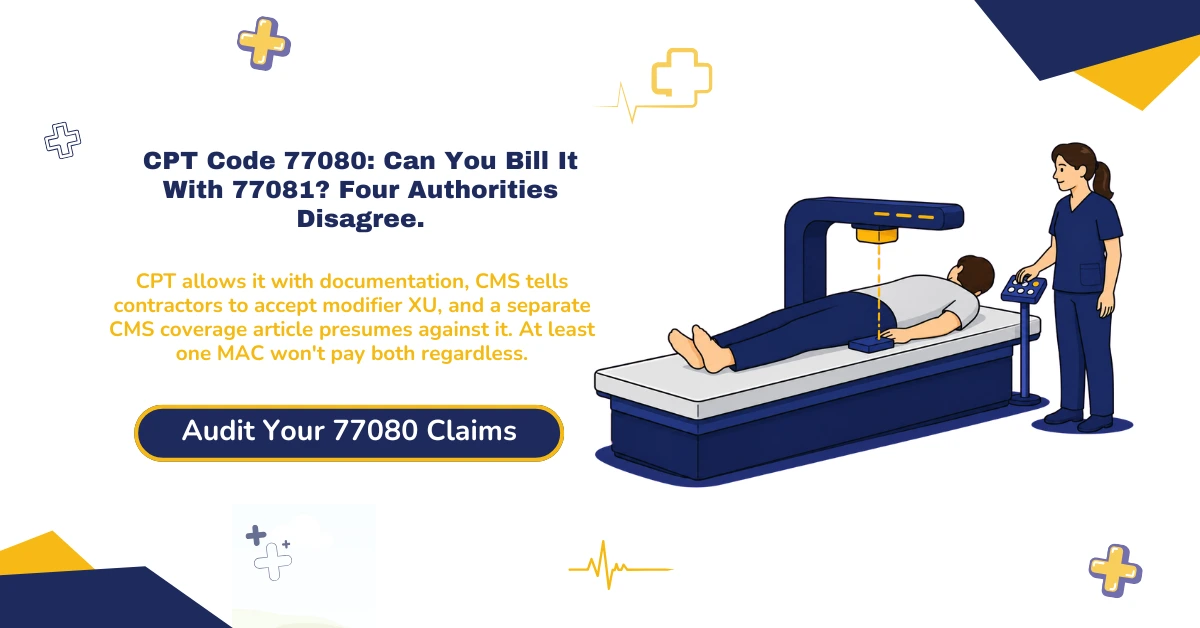
Sometimes, with documentation for each study, and your MAC may still refuse to pay both. Four authorities speak to this pairing and they don’t agree with each other. Most published guidance quotes one of the four and calls the question settled.
What CPT says
Before 2019, guidance held that cpt 77080 already included a peripheral study done the same date. The 2019 CPT codebook changed the instructional note. Both codes became reportable on one date. The physician has to note medical necessity for each, and the second code needs a distinct-service modifier.
What CMS Transmittal 10193 says
In June 2020, CMS issued Transmittal 10193. It tells contractors to accept modifier XU on 77080 when billed with cpt code 77081, and on 77081 when billed with 77085. XU flags a service that doesn’t overlap the primary procedure.
What CMS Article A57132 says
The same CMS system carries a limitation pointing the other way. Article A57132 states it isn’t generally medically necessary to perform both peripheral and axial bone mass measurements on the same date of service. You’ll find that presumption in the article your MAC uses to adjudicate the claim.
What MACs Do in Practice
No contractor guarantees payment on this pairing. WPS Medicare won’t pay both studies on the same date, or within 30 days. It wants proof the first scan used a non-DXA method and a confirming study was needed.
Coders on the AAPC forum report local instructions to bill 77080, 77081, and modifier XU together. The NCCI Policy Manual Chapter 9 carries the edit logic both sides argue from.
The documentation that survives all four
Three things belong in the record before you submit both codes, and you’ll want all three again if the claim goes to appeal:
- A separate order for each study, dated before the scan
- A clinical reason the axial site alone wasn’t sufficient, such as bilateral hip hardware
- Anatomic sites named in the report that match both codes on the claim
Use XU rather than 59, since XU is the modifier CMS named for this family. When two imaging studies share a date, same-day imaging MPPR rules also change what the secondary line pays.
The VFA codes work differently. CPT code 77085 and 77086 never combine with 77080 under any modifier, because each one already includes the axial study.
Does Medicare Cover CPT 77080? NCD 150.3 and the Five Qualifying Conditions
Yes, Medicare Part B covers cpt code 77080 for beneficiaries who qualify. Coverage runs through NCD 150.3, effective January 1, 2007, and the qualifying conditions sit in federal regulation. Nobody gets a covered scan on request alone.
The five qualifying conditions
A beneficiary qualifies when at least one of five conditions applies, listed at 42 CFR 410.31:
- A woman her physician determines to be estrogen-deficient and at clinical risk for osteoporosis
- A patient with vertebral changes shown on an X-ray
- A patient on glucocorticoid therapy equal to 5.0 mg or more of prednisone daily for more than three months
- A patient with primary hyperparathyroidism
- A patient tracked for response to an FDA-approved osteoporosis drug therapy
Name the condition in the ordering note. A referral that says only “bone density screen” leaves the reviewer nothing to work with.
Who can order the scan
The treating physician or a qualified nonphysician practitioner has to order the test and use the result to manage the patient. The Medicare Benefit Policy Manual names four NPP types for this benefit: physician assistant, nurse practitioner, clinical nurse specialist, and certified nurse midwife.
A scan ordered off a standing protocol, with no note tying it to that patient’s risk, draws a medical necessity denial on audit. Auditors look for exactly that pattern.
When Medicare Requires Axial DXA
Monitoring a patient’s response to an FDA-approved osteoporosis drug therapy requires an axial DXA system. The Benefit Policy Manual states it in the coverage conditions.
That rule answers why a follow-up scan on a treated patient takes 77080 and not 77081. Code choice becomes a coverage question here, not a clinical preference. It settles most cpt code dexa disputes on repeat studies.
The supervision requirement
The scan runs under the physician supervision level defined at 42 CFR 410.32(b). Section 11 covers what the supervising and interpreting physicians each have to document.
How Often Will Medicare Pay for CPT 77080?
Medicare covers cpt code 77080 once every 24 months. MACs administer that window as at least 23 months having passed since the month of the last covered bone scan. Novitas Solutions publishes the 23-month framing in its bone mass measurement denial guidance, and the difference between the two numbers costs practices a month of revenue.
Why the count runs from the month, not the date
Scan a patient in March 2024 and a covered repeat opens in February 2026. The clock starts on the month of the prior study, not the calendar date. A gym membership renews the same way, on the first rather than your signup date.
Check the month of the last covered study at scheduling, while you can still move the appointment. Medicare runs the same month-based math across its other screening benefits. The Medicare screening frequency edits on cervical cancer screening run on an identical 23-month threshold.
When Medicare pays sooner
Three documented situations open the window early on a 77080 cpt code frequency question:
- Monitoring a patient’s response to an FDA-approved osteoporosis drug therapy
- Starting or changing long-term glucocorticoid therapy
- A new fracture, where an updated measurement guides the treatment decision
Early repeats draw closer review. The ordering note has to name which NCD 150.3 exception applies. Confirming the prior scan date during verify coverage before scheduling keeps a dexa scan cpt code claim out of the denial queue before it ever submits.
The confirmatory baseline exception
Say the patient’s first scan used something other than central DXA, like heel ultrasound or SEXA. Medicare then covers a follow-up axial DXA sooner to set a baseline. The exception closes when the first test was already a central DXA study. Coders searching the cpt code for dexa run into this rule on transfer patients most often.
What happens when a second practice repeats the scan
Medicare won’t pay a second provider for a repeat scan inside the coverage window unless the confirmatory rules apply. CMS Article A57132 expects you to chase the prior result. Note the attempt when the request goes nowhere. Patients who switch practices generate this denial often, and almost no published guidance covers it.
Is There an Age Limit for CPT Code 77080?
No universal age limit applies to CPT code 77080. NCD 150.3 sets no minimum age, and coverage turns on whether the patient meets a qualifying condition. A 45-year-old on long-term steroids can qualify. A 66-year-old with nothing documented in the chart may not.
Where age rules do apply
Age thresholds come from payer policy. The American College of Radiology and the International Society for Clinical Densitometry both weighed in, and EmblemHealth DXA policy denies DXA screening for males under 70 who carry no risk factors. It denies when Z13.820 is the only diagnosis on the claim.
The Medicare Advantage age rejection
Coders report age-based rejections on Medicare Advantage plans that Traditional Medicare wouldn’t produce, including a 64-year-old female submitted with a screening diagnosis. MA plans layer their own utilization criteria on top of the NCD. Pull the plan’s own policy when a rejection cites age, since the same pattern drives CARC 119 frequency denials across Medicare preventive services.
For a male patient under 70, or a female under 65, note a specific risk factor and code it on the claim. The screening code alone won’t carry those claims through a payer edit. That answers the 77080 cpt code age limit question in the way it matters at submission.
Which ICD-10 Codes Support a CPT 77080 Claim?
An unsupported diagnosis is the leading reason cpt code 77080 claims deny. The procedure code tells the payer what happened. The ICD-10 code tells the payer why, and that answer decides coverage. CMS publishes the payable list in Article A59040, which settles most 77080 cpt code covered diagnosis questions.
Table 3. ICD-10 codes that commonly support a 77080 claim
| ICD-10 code | Description | Indication type |
|---|---|---|
| Z13.820 | Encounter for screening for osteoporosis. Written z13 820 in some payer files | Screening |
| M81.0 | Age-related osteoporosis without current pathological fracture | Diagnostic |
| M80.0- | Age-related osteoporosis with current pathological fracture. Needs a 7th character | Diagnostic |
| M85.8- | Other specified disorders of bone density and structure, covering osteopenia | Diagnostic |
| E21.0 | Primary hyperparathyroidism | Diagnostic |
| Z79.52 | Long-term use of systemic steroids | Risk-factor monitoring |
| Z79.51 | Long-term use of inhaled steroids | Risk-factor monitoring |
| Z79.83 | Long-term use of drugs affecting bone metabolism | Therapy monitoring |
| Z90.721 / Z90.722 | Acquired absence of ovary, unilateral or bilateral | Estrogen-deficiency pathway |
| Z09 | Encounter for follow-up after completed treatment | Post-therapy monitoring |
| N95.1 | Menopausal and female climacteric states | Estrogen-deficiency risk |
The trailing hyphen on M80.0- and M85.8- matters. Submitting M80.0 without a 7th character identifying the episode of care produces an invalid code and an immediate rejection. Codes Z79.83, Z90.721, Z90.722, and Z09 come from official CMS billing guidance and appear on almost no published 77080 code list.
Screening versus monitoring, the distinction coders miss
A first-time screen on a qualifying patient takes Z13.820. A follow-up scan on a diagnosed patient is a monitoring study. It takes a code for the known condition, most often M81.0.
Submit the osteoporosis screening cpt code pairing on a monitoring visit and you misstate the clinical picture. That invites post-payment review. Both scenarios carry $0 patient cost, so the error costs you an audit rather than a copay.
The covered list moves every quarter
The coverage conditions live in the NCD and the Benefit Policy Manual. The payable ICD-10 list lives in a separate CMS file on a quarterly maintenance cycle. An NCD that reads “covered” doesn’t promise your diagnosis sits on the current version of that list.
CMS added the osteopenia codes under M85.8 only after Change Request 9252 left them out. Claims fail the same way when a valid code carries the wrong specificity, the pattern behind screening interval ICD-10 specificity denials on lab panels.
Two scenarios the code lists don’t answer
Working coders ask these two questions on repeat, and no published dexa scan icd 10 guidance answers either one:
- Prostate cancer patients on androgen deprivation therapy. Code the underlying condition and the therapy rather than screening alone, since ADT-related bone loss is a treatment consequence
- Z13.820 versus Z78.0. Z78.0 reports an asymptomatic menopausal state, not a screening encounter, and swapping it in changes what the claim asserts
Check both against the current covered file for your MAC before submitting. Any diagnosis code for dexa scan answer that skips that step is a guess. CMS revises the list four times a year. The icd 10 code for dexa scan you used last quarter may already be off it.
Does CPT Code 77080 Need a Modifier?
Not always. Whether the 77080 cpt code modifier question applies comes down to one thing: who owns the equipment and who reads the study. Get that wrong and the claim either denies or pays the wrong entity.
Table 4. Modifier decision matrix for 77080
| Who owns the equipment | Who reads the study | Modifier | Who bills what |
|---|---|---|---|
| Your practice | Your physician | None (global) | One claim covering the full service |
| Facility | Outside radiologist | 26 | Radiologist bills the interpretation only |
| Facility | Outside radiologist | TC | Facility bills the equipment and staff only |
| Either | Two distinct studies, same date | 59 or XU | XU is the specific choice for this family |
| Either | Scan won’t meet coverage criteria | GA, GZ, or GY | One only. Never combined on the same line |
Modifier 26 and TC: the split that costs the most
The technical component covers the equipment, the tech, the supplies, and the facility overhead. The professional component covers the physician’s interpretation and written report. Bill the code with no modifier and it represents the global service, meaning both halves at once.
Billing global when the facility already claimed the technical side gets the physician’s claim denied for work they were never entitled to bill. That mistake turns the 77080 26 cpt code question into a payer inquiry on both claims at once.
Equipment ownership also decides the place of service, and POS 22 facility rate rules change what a cpt code dexa scan claim pays.
When modifier 59 or XU applies
Use either one to override an NCCI edit covering two distinct services performed the same date. XU is the more specific option and the modifier CMS named for this code family. Section 4 above works through the full 77080 and 77081 analysis, including the contractors that refuse the pairing regardless of the modifier.
The ABN modifiers: GA, GZ, and GY
GA tells the payer you issued an Advance Beneficiary Notice and the patient agreed in writing to accept financial responsibility. GZ says you expect a medical necessity denial and never obtained a signed ABN, which generally means you can’t bill the patient for the balance. GY covers a service Medicare excludes by statute.
Combining two of these on one line gets the claim rejected. Pick the one that matches the situation, and get the ABN signed before the scan rather than after the denial lands.
CPT 77080 Reimbursement: 2026 Medicare Rates by Setting
Medicare pays approximately $39 nationally for cpt code 77080 in 2026, built from 1.18 total RVUs times the $33.4009 conversion factor. Your locality moves that number through the geographic practice cost index. Treat the national figure as a starting point, not a contracted rate.
Table 5. CPT 77080 payment by setting, 2026
| Setting | Basis | Approximate 2026 rate |
|---|---|---|
| Physician fee schedule, non-facility (POS 11) | 1.18 total RVU x $33.4009 | $39 |
| Physician fee schedule, facility (POS 22) | Identical practice expense RVU for imaging codes | $39 |
| Hospital outpatient (OPPS) | APC assignment | $106 |
| Ambulatory surgical center | ASC payment system | $29 |
| Commercial payers, national averages | Published transparency-file data | $50 to $83 |
| Patient cost-share, covered screening | Deductible and coinsurance waived | $0 |
Verify every figure above against the current CMS RVU file, OPPS Addendum B, and ASC Addendum AA. Do it before you set a fee schedule. These come from published aggregations, and a wrong rate on a coding page costs more credibility than it saves time.
The RVU breakdown
Work RVU sits at 0.20, practice expense at 0.96, and malpractice at 0.02, totaling 1.18. One detail surprises practices: for imaging codes in this family, the non-facility and facility practice expense RVUs match. Medicare pays the same whether the scan runs in an office or a hospital outpatient department. Pull your locality figure from the CMS Physician Fee Schedule tool.
Why 2026 carries two conversion factors
CMS finalized $33.4009 for clinicians outside qualifying APM status and $33.5675 for those inside it. On a 1.18-RVU code the per-claim gap is small, and across an imaging practice’s annual volume it stops being small. CMS also applied a negative 2.5% efficiency adjustment across most services, imaging included. That offsets part of the headline increase.
Where commercial rates land
Published transparency-file averages put major national payers between $50 and $83 against a Medicare allowed amount near $39. Pull your own contracted rate before assuming commercial tracks Medicare. The same office, OPPS, and ASC gap runs across musculoskeletal codes. Our orthopedic 2026 rate benchmarks give you a second data point for the cpt code for bone density family.
What the Patient Owes
Nothing, when coverage conditions are met and the provider accepts assignment. Not 20%. The payment figure and the patient cost-share are two different numbers. Quote one as the other and your billing team inherits the problem later. Medicare Procedure Price Lookup publishes the patient-facing side.
Documentation Requirements for CPT 77080 Claims
Technically valid claims fail post-payment review on records more than on coding. Two people own the record. The provider who ordered the scan, and the physician who read it. Auditors check both entries, and a dxa cpt code claim missing either one struggles on appeal.
What the ordering note has to show
The referring provider’s documentation establishes medical necessity. Five elements belong in that note:
- Which of the five qualifying conditions applies, named in plain language
- The specific risk factors supporting that condition
- For steroid cases, the medication, the dose, and the duration
- Prior BMD results and the date, when this scan is a follow-up
- The clinical rationale for the timing of this study
A referral reading “bone density screen” and nothing more hands an auditor a challenge. The diagnosis code on the claim can be correct and the order still fails. One sentence naming the condition closes that gap on any bone density test cpt code order.
What the interpretation report has to show
The report needs the sites scanned, the T-score and Z-score results, and the equipment used. It also needs a clinical read tying those findings back to the ordering indication. A report listing numbers with no clinical context doesn’t meet CMS documentation standards.
One consequence goes further than most practices realize. CMS defines a covered bone mass measurement as a study that includes a physician interpretation. A dexa scan cpt claim with no signed read in the record doesn’t only lose the professional component. It fails the benefit definition, which makes the whole service non-billable.
The order has to come from the treating provider
Section 5 above names the four qualified NPP types Medicare accepts for this benefit. One more point sits alongside it. An order built off a standing protocol, with nothing tying it to that patient’s risk, is the pattern auditors pull samples to find. Complete records drive the clean claim submission requirements that decide first-pass acceptance.
Is CPT 77080 Preventive or Diagnostic?
CPT code 77080 works as either one, and the ICD-10 code decides which. The patient’s cost stays the same across both. Any bone mass measurement meeting NCD 150.3 conditions carries no deductible and no coinsurance when the provider accepts assignment. Screening with Z13.820 and active monitoring both land at $0.
The rule and where it lives
The Medicare Claims Processing Manual states in Chapter 13, Section 140.1 that deductible and coinsurance don’t apply to covered bone mass measurement services. The Affordable Care Act waived cost-sharing on this benefit for dates of service on or after January 1, 2011. That citation settles a bone density scan cpt code cost conversation.
Why patients still get billed 20%
Three situations produce a patient bill on a $0 service:
- The claim failed a frequency or eligibility check, so the payer processed it as non-covered
- The provider didn’t accept assignment on that claim
- Other non-covered services ran during the same encounter and landed on the same statement
Train the front desk to skip collection at check-in on a covered screening. Refunding a copay you shouldn’t have taken burns more staff time than never taking it. It also burns goodwill with a patient you told the cpt code for dexa scan was free.
Commercial plans run a different framework
The USPSTF osteoporosis screening recommendation carries a Grade B for women 65 and older, and for younger postmenopausal women at elevated fracture risk. A Grade A or B rating triggers an ACA requirement that non-grandfathered private plans cover the service without cost-sharing in-network.
Keep the two frameworks separate when you move between claims. Medicare asks whether one of five conditions applies. ACA-compliant commercial plans key off age and a risk score on file. That gap is why an osteoporosis screening cpt code clearing one payer can stall at the other.
Why CPT 77080 Claims Deny, and How to Fix Each One
Most cpt code 77080 denials trace back to five root causes, and each one carries a specific code and a specific fix. Work the code without the root cause and the same denial returns next quarter. Root-cause denial recovery starts by sorting denials into causes rather than clearing them one at a time.
Table 6. CPT 77080 denial codes, causes, and fixes
| Code | What it means | Root cause on 77080 | First fix |
|---|---|---|---|
| CO-50 | Not medically necessary | Diagnosis missing from the covered list, or a screening code used on a monitoring visit | Recode to the condition the record supports and resubmit as corrected |
| CO-151 | Frequency limit or bundled adjustment | Repeat inside the window with no exception on file, or same-date pairing with 77081 | Appeal with the exception records, or apply XU and attach the notes for each study |
| CO-11 | Diagnosis-procedure mismatch | Peripheral site billed under 77080, or a non-musculoskeletal primary diagnosis | Match the code to the site named in the report and resubmit |
| CO-16 | Missing information | Missing NPI, missing modifier, or incomplete claim data | Read the accompanying remark code and supply the one missing element |
| CO-97 | Bundled service | 77080 billed alongside 77085 or 77086 | Pick one. The VFA codes never combine with 77080 |
| N130 | Refer to plan provisions | Payer applying its own utilization criteria over the NCD | Pull the plan’s medical policy rather than the national determination |
Confirm current CARC and RARC descriptions against the official code list first. Build appeal templates after that, not before. The committee revises these definitions and retires codes on a published schedule.
The frequency denial and how to appeal it
CO-151 on a repeat scan usually means the payer counted the window differently or the record never documented an exception. Build the appeal from the ordering note, the report, and a narrative connecting the clinical indication to the applicable NCD 150.3 exception. Attaching the policy language speeds reversal, and the same approach works on CO-151 frequency limit appeals.
The bundling denial
CO-151 also fires as a bundling adjustment when 77080 and 77081 land on the same date. Section 4 works through the four authorities behind that pairing. Confirm from the report which studies ran, apply XU to the appropriate line, and attach the notes supporting each study on its own.
What to check before you appeal anything
Three checks take about four minutes and sort appealable denials from correctable ones:
- Confirm the anatomic site in the report matches the cpt code dexa scan billed
- Confirm the diagnosis sits on the current covered list for that patient’s MAC
- Confirm the date of the last covered study, counting by month rather than by date
Billing errors get corrected and resubmitted. Clinical denials get appealed. Treating both the same way burns the appeal window on claims that only needed a corrected line.
When the same denial keeps coming back
One 77080 denial is a claim. The same denial arriving every month across different patients is a configuration problem sitting upstream in your workflow. Pull the pattern by payer and by CARC code before you appeal the next one.
Say DXA denials keep landing in your queue for reasons your team already fixed. Our aged denial follow-up team works the backlog while the root cause gets corrected at submission.
LCD and MAC Variation: Why Your Neighbor’s Rule Isn’t Yours
The coverage policy is national. The billing rules aren’t. Each MAC publishes its own local coverage determination and its own billing article. Article numbers change by jurisdiction. Citing one LCD as though it applied everywhere is how a billing team ends up following a rule that was never theirs.
Table 7. Where to look up your own bone mass measurement rules
| Contractor | What to look for | Note |
|---|---|---|
| Novitas Solutions | Bone Mass Measurements denial education | Source of the 23-month operational framing |
| Palmetto GBA | Bone Mass Measurement awareness and screening | Also publishes Railroad Medicare medical review activity on DXA |
| WPS Medicare | Same-date and 30-day restrictions on paired studies | Stricter than the transmittal guidance alone |
| Your MAC | The LCD plus its paired billing and coding article | Article numbers vary by jurisdiction. A57132 and A59040 pair with specific LCDs |
Published guidance cites both L36460 and L34639 as though either were universal. Both are real, and both are jurisdictional. No single LCD number governs the dexa cpt code nationally.
Where MACs diverge
Three divergences matter on a 77080 lcd question. Contractors split on same-date pairing of 77080 and 77081, with at least one refusing inside a 30-day window. They split on how much detail an early-repeat exception needs. They also split on whether denial education exists at all.
How to find your rule in two minutes
Identify your MAC by state and Part B jurisdiction. Open the CMS Medicare Coverage Database and search bone mass measurement. Pull both the LCD and its paired billing article. The L34639 billing guidelines show what a paired article looks like. The article carries the limitations that drive denials. The LCD carries the coverage language.
Jurisdiction problems get worse under Medicaid, where each state runs its own rules on top of federal policy. Our state Medicaid payer variation guide covers how far those rules drift from the Medicare baseline.
What Changed for CPT 77080 in 2026
The four DXA procedure codes carry into 2026 unchanged. Payment moved. The covered diagnosis list kept moving on its quarterly cycle. CMS also widened the technologies payable under the same national coverage determination. Any dexa cpt code 2025 crosswalk still works for the procedure codes themselves.
Payment moved, though not the way the headline suggests
Two conversion factors run at once in 2026, and a negative efficiency adjustment applies across most services including diagnostic imaging. Section 10 above carries the figures. What a practice collects depends on the code’s RVUs, the conversion factor that applies, and the locality adjustment. One national number never answers the question alone.
New CT-based bone density codes under the same NCD
The American College of Radiology reports that CMS added payable services under NCD 150.3 through Transmittal 13752. The addition covers CT-based bone strength and fracture risk analysis in the 0554T to 0558T range. Patient coinsurance and deductible are waived.
Two constraints matter. CMS covers these for diagnostic indications and not for monitoring, and they don’t substitute for 77080. Verify the transmittal number and the current status of each Category III code before you bill one.
Commercial policy diverges here. BCBS Mississippi treats vertebral fracture assessment by biomechanical computed tomography as investigational and lists 0743T in its code reference. Medicare paying a service doesn’t mean a commercial plan will.
The covered ICD-10 list gets maintained quarterly
CMS issues routine coding updates to national coverage determinations four times a year. One landed in August 2026 and changed no policy. Your covered-diagnosis list has a version. Last quarter’s version produces this quarter’s denial, which is the operational reason Section 8 tells you to check the current file rather than a saved copy.
CPT Code 77080 FAQ
What is CPT code 77080 used for?
CPT code 77080 reports a DXA scan of the axial skeleton to measure bone mineral density, diagnose osteoporosis, assess fracture risk, and monitor treatment response. It covers the hips, pelvis, and spine. Report it once per session regardless of how many axial sites the tech scans.
Is CPT 77080 a DEXA scan?
Yes. DEXA and DXA name the same test, spelled two ways, and no separate DEXA code exists in the CPT book. When the study covers the axial skeleton, the dexa scan cpt code is 77080. For peripheral sites like the wrist or heel, use 77081.
What is the difference between 77080 and 77085?
CPT 77085 reports the axial DXA study plus a vertebral fracture assessment performed in the same session, and it replaces 77080 on the claim. Report 77085 only when the tech captured VFA imaging and the physician interpreted it. VFA performed alone takes 77086.
How many times can 77080 be billed?
Once per session, regardless of how many axial sites get scanned in that sitting. Medicare covers one study every 24 months for a qualified patient. MACs run that as at least 23 months since the month of the last covered scan, unless an exception is on file.
What modifier do I use with 77080?
None, when one entity owns the equipment, employs the tech, and performs the interpretation. Append modifier 26 when billing the physician interpretation alone. Append TC when billing the technical side alone. Use XU when a distinct second study shares the date of service.
What diagnosis codes cover a bone density scan?
Z13.820 covers a screening encounter. M81.0 and the M80 series cover established osteoporosis, and M85.8 codes cover osteopenia. CMS keeps the payable bone density cpt code list and updates it quarterly. Check any icd 10 code for dexa scan against the current file before you submit.
Does 77080 need prior authorization?
Traditional Medicare requires none. Medicare Advantage plans and many commercial payers do require it, and the requirement often varies by benefit tier within the same carrier. Verify at the plan level rather than the carrier level, because an HMO and a PPO from one insurer can carry different rules.
What is the 77080 CPT code description?
The AMA descriptor reads: “Dual-energy X-ray absorptiometry (DXA), bone density study, 1 or more sites; axial skeleton (eg, hips, pelvis, spine).” The phrase “1 or more sites” sets the billing unit at one per session. “Axial skeleton” rules out every peripheral site on this cpt code for bone density scan.
Where DXA Claims Break, and What ClaimMax RCM Does About It
Bone density denials cluster around three failures. The code doesn’t match the site named in the report. The diagnosis isn’t on the current covered list. The frequency window got counted from the wrong reference point. All three are setup problems rather than knowledge problems. Staff training alone won’t fix them.
ClaimMax RCM reviews imaging claims for root-cause denial patterns by payer and CARC code. We run appeals inside payer windows and fix the submission setup that keeps producing them. Every denial gets categorized by CARC and RARC, appealed through payer-specific workflows, and tracked to resolution. That discipline sits inside our end-to-end revenue cycle operations.
If the 77080 cpt code denials in your queue look familiar, send us one. Not an engagement, not a full audit. One denied claim, and we’ll tell you why it denied and what the appeal needs. You can appeal a denied DXA claim with your own team afterward or hand us the pattern.
This guide reflects CMS policy current as of the publication date below. Verify rates, coverage criteria, and MAC policies against current sources before claim submission. CPT is copyrighted by the American Medical Association.
Sources and Verification
Claims in this guide fall into three confidence levels. Confirmed means traced to a primary CMS, AMA, or federal regulatory source. Supported means backed by several expert sources with no primary document in hand. Verify before relying means the figure comes from published aggregation. Check the source before you build a fee schedule or an appeal on it.
Three items sit in that third group. Every 2026 rate in Table 5, the Transmittal 13752 code range, and the MUE position for this code family. Treat them as directional until you confirm them against the current CMS file.
Coverage and policy
- NCD 150.3, Bone (Mineral) Density Studies
- 42 CFR 410.31, coverage conditions for bone mass measurement
- 42 CFR 410.32(b), physician supervision requirements
- Medicare Benefit Policy Manual, Pub. 100-02, Chapter 15, Section 80.5
- Medicare Claims Processing Manual, Pub. 100-04, Chapter 13, Section 140.1
Billing and coding
- CMS Article A57132, Billing and Coding: Bone Mass Measurement
- CMS Article A59040, ICD-10-CM codes supporting medical necessity
- CMS Transmittal 10193, modifier XU on paired bone density studies
- CMS Transmittal 13752, NCD 150.3 coding revisions
- NCCI Policy Manual, Chapter 9, and the quarterly MUE files
- CMS Physician Fee Schedule Look-Up Tool
Contractor and payer policy
- Novitas Solutions, Bone Mass Measurements denial guidance
- Palmetto GBA, Bone Mass Measurement awareness and screening
- L34639 billing and coding guidelines, as a jurisdictional example
- EmblemHealth, dual-energy X-ray absorptiometry policy
- BCBS Mississippi, vertebral fracture assessment policy
Clinical and code set
- USPSTF, osteoporosis screening recommendation
- AAPC, CPT 77080 code reference
- Medicare.gov, Procedure Price Lookup