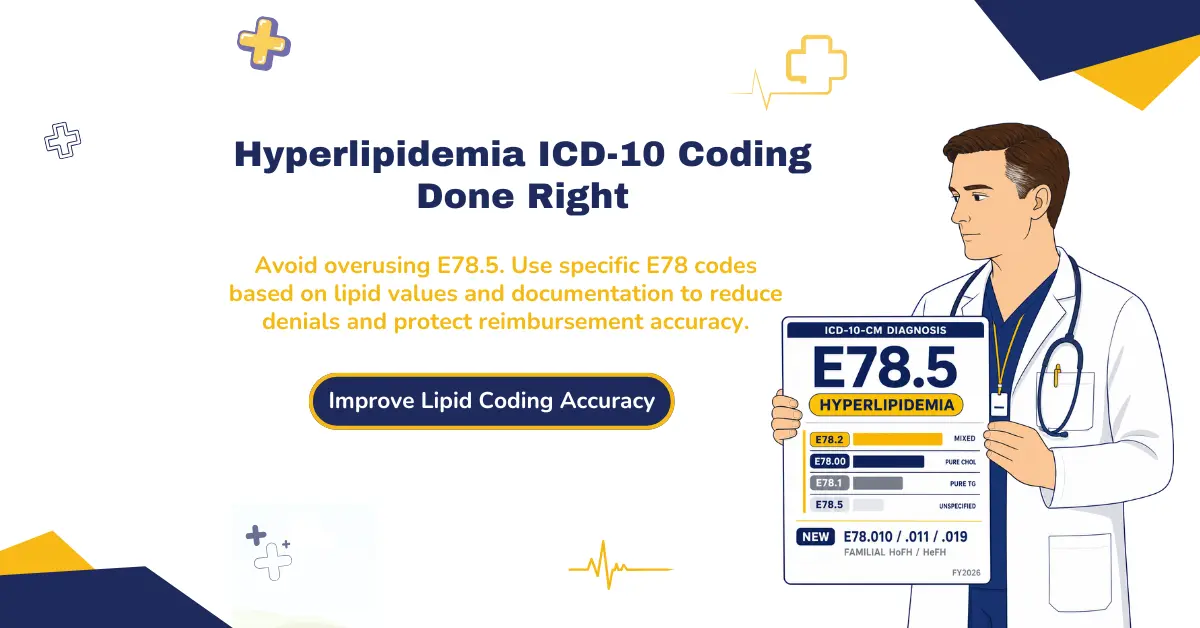
E78.5 is a billable and specific ICD-10-CM code for hyperlipidemia, unspecified, effective for FY2026 and classified under category E78 (Disorders of lipoprotein metabolism and other lipidemias) per the CDC NCHS ICD-10-CM FY2026 release. It is the default code when documentation lacks the specificity to support a more defined lipid disorder, but it is one of the most overused codes in the E78 family.
Here is the real-world problem: E78.5 shows up on the majority of lipid disorder claims, including thousands of claims where E78.2 (mixed hyperlipidemia), E78.00 (pure hypercholesterolemia), or the FY2026 familial hypercholesterolemia expansion codes (E78.010, E78.011, E78.019) would be both appropriate and more defensible. Defaulting to E78.5 when documentation supports a specific code triggers payer reviews, downcoding, and in high-volume practices, persistent denial patterns that compound month over month.
This guide covers everything your coding and billing team needs for accurate hyperlipidemia ICD-10 coding in 2026, using the most current hyperlipidemia ICD 10 code set: the complete E78 code family, the FY2026 updates most teams have not yet integrated, CPT code pairings, sequencing rules for comorbid conditions, Z-code applications, HCC documentation requirements, and a denial-prevention framework built from real claim patterns.
Hyperlipidemia ICD-10 Code List (FY2026 Quick Reference)
The E78 family covers disorders of lipoprotein metabolism and other lipidemias across 18 active and header codes. The table below shows the complete hierarchy: parent codes that are not billable, specific billable subcodes, and FY2026 status for each entry. Coding to the most specific billable subcode is both a clean-claim requirement and a reimbursement protection strategy.
| ICD-10 Code | Description | Billable | FY2026 Status |
|---|---|---|---|
| E78.0 | Pure hypercholesterolemia (parent) | No | Header code |
| E78.00 | Pure hypercholesterolemia, unspecified | Yes | Active |
| E78.01 | Familial hypercholesterolemia (parent) | No | Expanded for FY2026 |
| E78.010 | Homozygous familial hypercholesterolemia (HoFH) | Yes | New for FY2026 |
| E78.011 | Heterozygous familial hypercholesterolemia (HeFH) | Yes | New for FY2026 |
| E78.019 | Familial hypercholesterolemia, unspecified | Yes | New for FY2026 |
| E78.1 | Pure hyperglyceridemia | Yes | Active |
| E78.2 | Mixed hyperlipidemia | Yes | Active (preferred over E78.5 when documented) |
| E78.3 | Hyperchylomicronemia | Yes | Active |
| E78.4 | Other hyperlipidemia (parent) | No | Header code |
| E78.41 | Elevated lipoprotein(a) | Yes | Active |
| E78.49 | Other hyperlipidemia | Yes | Active |
| E78.5 | Hyperlipidemia, unspecified | Yes | Use sparingly |
| E78.6 | Lipoprotein deficiency | Yes | Active |
| E78.70 | Disorder of bile acid and cholesterol metabolism, unspecified | Yes | Active |
| E78.81 | Lipoid dermatoarthritis | Yes | Active |
| E78.89 | Other lipoprotein metabolism disorders | Yes | Active |
| E78.9 | Disorder of lipoprotein metabolism, unspecified | Yes | Active |
Three codes in this table are header codes: E78.0, E78.01, and E78.4. Submitting any of these on a claim triggers automatic rejection because they are not billable. The “Use sparingly” flag on E78.5 is a clinical documentation signal, not a prohibition. Use E78.5 when documentation does not support a more specific code. The sections that follow explain when each code earns its place on a claim and when defaulting to E78.5 costs revenue.
Accurate hyperlipidemia ICD 10 coding to specificity affects three things simultaneously: clean claim rates, audit defensibility, and HCC risk-adjustment accuracy for practices treating Medicare Advantage populations. FY2026 brought the most significant expansion to this code family in years, primarily in the familial hypercholesterolemia branch covered in Section 8.
What Is Hyperlipidemia? (And Why Coding It Right Matters)
Hyperlipidemia is an elevated level of lipids in the blood, including cholesterol, triglycerides, or both, and it raises cardiovascular risk by contributing to atherosclerosis and downstream coronary artery disease. It is classified under ICD-10-CM category E78 as a disorder of lipoprotein metabolism.
The three lipids that matter most for hyperlipidemia ICD 10 coding purposes are LDL cholesterol (low-density lipoprotein, the primary driver of plaque buildup), HDL cholesterol (high-density lipoprotein, which is protective), and triglycerides (blood fats that independently raise cardiovascular and pancreatitis risk when severely elevated). A standard lipid panel measures all three. Hyperlipidemia is asymptomatic in most patients, which is why screening encounters coded to Z13.220 (encounter for screening for lipoid disorders) are common before a formal diagnosis is established.
Here is the thing about hyperlipidemia from a billing perspective: the diagnosis itself is not clinically complex. The coding is where claims get denied, downcoded, or flagged for review. The specific code requires knowing which lipids are elevated, at what levels, whether a familial pattern is documented, and whether comorbid conditions like diabetes or hypertension change the sequencing rules. None of that information lives in the diagnosis code itself. It lives in the chart.
Hyperlipidemia affects a substantial portion of the US adult population. Per CDC data, roughly 86 million US adults have total cholesterol above 200 mg/dL, which means lipid-related claims are among the highest-volume encounters in primary care and cardiology billing. High-volume encounters with the same recurring coding gaps compound into significant revenue leakage over a billing year.
Knowing E78.5 is the starting point for hyperlipidemia ICD 10 code selection. Knowing when not to use it is what protects revenue. The next section works through the distinction between hyperlipidemia and dyslipidemia, which is the first disambiguation decision most coders face.
Hyperlipidemia vs Dyslipidemia: What’s the Coding Difference?
Coders mix up hyperlipidemia and dyslipidemia daily, and payers care about the distinction because the documentation requirements differ and the ICD-10 codes can differ too. The confusion is understandable: both conditions involve lipid abnormalities and both live in the E78 family.
| Feature | Hyperlipidemia | Dyslipidemia |
|---|---|---|
| Definition | Elevated lipids (high) | Any lipid abnormality (high or low) |
| Includes | High cholesterol, high triglycerides | High LDL, low HDL, high triglycerides |
| ICD-10 mapping | E78.0 to E78.9 | Same E78 family, plus low-HDL conditions (E78.6) |
| Documentation needed | Specific elevated lipid type | Specific abnormality (high or low) |
| Patient communication | “High cholesterol” | Less common in patient language |
Clinically, the relationship is clear. Hyperlipidemia is a subset of dyslipidemia: all hyperlipidemia is dyslipidemia, but not all dyslipidemia is hyperlipidemia. A patient with low HDL and normal LDL has dyslipidemia but not hyperlipidemia. A patient with elevated LDL has both.
For hyperlipidemia ICD 10 coding, both conditions often default to E78.5 when the documentation is underspecified, but that is where the revenue loss begins. Proper documentation typically yields E78.00 (pure hypercholesterolemia), E78.1 (pure hyperglyceridemia), E78.2 (mixed hyperlipidemia), or E78.6 (lipoprotein deficiency for low HDL) instead. Each of those codes is more specific, more defensible under audit, and more useful for HCC risk-scoring purposes.
Patient-facing language creates a consistent documentation gap. When the chart says “high cholesterol,” the coder still needs lab values to choose between E78.00 and E78.5. The provider assessment language is a starting point, not a finishing point. Lab results in the same encounter note, accessible to the coder, are often the differentiating factor.
Hyperlipidemia is not the same as high cholesterol. High cholesterol refers specifically to elevated LDL or total cholesterol, while hyperlipidemia is the broader category covering elevated cholesterol, elevated triglycerides, or both. In ICD-10 coding, both terms often map to E78.5 when documentation lacks specificity, but well-documented cases code to E78.00 (cholesterol-only elevation) or E78.2 (cholesterol plus triglycerides).
E78.5: Hyperlipidemia, Unspecified (And Why It’s Costing You Money)
E78.5: Hyperlipidemia, unspecified is a billable ICD-10-CM code, effective for FY2026, classified under category E78 (Disorders of lipoprotein metabolism and other lipidemias). The ICD-9 crosswalk is 272.4 (Other and unspecified hyperlipidemia). It is the appropriate code when documentation does not support a more specific lipid disorder code, and it is the most overused code in the entire E78 family.
The problem is not that E78.5 is wrong. The problem is that coders reach for it when the documentation supports a better code, and payers know the pattern. E78.5 overuse is one of the top-flagged hyperlipidemia ICD 10 coding patterns in AAPC’s E78.5 reference data and in denial-pattern audits across multiple payer types.
When E78.5 Is the Correct Code
Three scenarios support a genuine E78.5 code.
Initial screening visit before lab results return: A patient presents for a wellness visit. Labs are ordered but not yet resulted. The chart says “rule out hyperlipidemia.” That is an E78.5 day because there is no documented specific lipid type to support E78.0, E78.1, or E78.2. The code will likely be updated once results return, but on the date of service, E78.5 is correct.
Referral with unspecified elevated lipids: A patient is referred to cardiology with documentation stating “elevated lipids” but no specific lipid type in the chart and no lab values available at the time of the encounter. Without the specificity to code further, E78.5 is the defensible choice.
Documentation truly lacks specificity: The chart assessment reads “hyperlipidemia” with no further characterization, no lab values referenced, and no clinical language that names a specific lipid disorder. The coder does not have enough information to code further. E78.5 is appropriate, but this is also the signal to query the provider.
When E78.5 Triggers Denials
Four patterns generate the majority of E78.5-related denials and the majority of E78.5-related revenue loss.
Mixed elevation coded as E78.5 instead of E78.2. The most common error in the entire E78 family. The chart shows elevated LDL of 162 mg/dL and elevated triglycerides of 240 mg/dL. Provider assessment: “hyperlipidemia.” Claim goes out as E78.5. The payer’s adjudication engine may accept it, but a post-payment audit surfaces the lab-to-code mismatch. The correct code when both cholesterol and triglycerides are elevated is E78.2: Mixed hyperlipidemia. Coders working from assessment language without reviewing the lab values miss this every time.
Familial hypercholesterolemia coded as E78.5 instead of E78.011 or E78.019. Effective October 1, 2025, the FY2026 update expanded E78.01 into three specific subcodes. Practices that have not updated their code sets are still coding family-history-documented familial hypercholesterolemia patients to E78.5 or the legacy E78.01. The correct codes are E78.010 (homozygous), E78.011 (heterozygous), or E78.019 (unspecified familial type). This is both a denial risk and an HCC risk-adjustment gap.
Diabetic patient coded E78.5 instead of E11.69 plus specific E78.x. When a Type 2 diabetic patient has documented dyslipidemia and the provider language establishes a causal relationship (“diabetic dyslipidemia,” “hyperlipidemia due to diabetes”), the correct code sequence is E11.69 followed by the specific E78.x code for the lipid type. Coding E78.5 alone in this scenario misses both the sequencing requirement and the specificity. Section 12 covers this in full.
Lipid screening coded E78.5 instead of Z13.220. An asymptomatic patient with no documented lipid disorder comes in for a preventive visit. A lipid panel is ordered as part of routine preventive screening. The correct code is Z13.220 (encounter for screening for lipoid disorders), not E78.5. Coding E78.5 applies a diagnostic code to a preventive encounter, which triggers preventive-benefit denials and misrepresents the clinical picture.
Each of these errors stems from documentation gap, template default, or workflow assumption rather than coding knowledge failure. Coding to specificity protects clean claim rates, audit defensibility, and HCC risk-adjustment scores. The denied claims pattern for E78.5 overuse is predictable enough that it shows up in payer data and audit logs before it shows up in your A/R aging report.
If your team is seeing repeat denials on hyperlipidemia claims, the issue is usually documentation specificity, not the codes themselves. Our denial management team reviews these patterns daily. Worth a conversation if it sounds familiar.
E78.2: Mixed Hyperlipidemia (The Specificity Win)
E78.2: Mixed hyperlipidemia is a billable ICD-10-CM code, active for FY2026, that applies when both elevated cholesterol and elevated triglycerides are documented. It maps to Fredrickson Type IIb and Type III hyperlipoproteinemia per the National Lipid Association classification framework. It is the payer-preferred specific code over E78.5 when documentation supports both lipid elevations, and it is the most commonly under-coded specific code in the E78 family.
The hyperlipidemia ICD 10 search cluster including “icd 10 code for mixed hyperlipidemia” exists largely because coders are uncertain whether their documentation supports E78.2 or defaults to E78.5. The answer usually lives in the lab values.
When E78.2 Applies
Documentation must support both lipid elevations. The general clinical thresholds, per NCEP ATP III criteria, are LDL above 130 mg/dL plus triglycerides above 150 mg/dL. A standard lipid panel showing both elevations, combined with a provider assessment that names the condition, supports E78.2.
Real coding scenario: a patient’s lipid panel shows total cholesterol 240 mg/dL, LDL 165 mg/dL, and triglycerides 220 mg/dL. Provider assessment: “mixed hyperlipidemia, initiating statin therapy.” That is a clean E78.2 case. The lab values support both elevations and the assessment language matches.
The ICD-10-CM tabular listing for E78.2 encompasses several combination disorder terms that coders may see in older chart notes: broad-betalipoproteinemia, combined hyperlipidemia NOS, floating-beta lipoproteinemia, and hypercholesteremia with endogenous hyperglyceridemia. When the chart uses any of these terms, E78.2 is the correct code regardless of whether the provider explicitly wrote “mixed hyperlipidemia.”
Critical Coding Note: Don’t Pair E78.2 with E78.00
This is the most common stacking error in the E78 family. Coders sometimes assign both E78.2 and E78.00 on the same claim, reasoning that E78.2 captures the triglyceride elevation and E78.00 captures the cholesterol elevation separately. That logic is wrong.
E78.2 (mixed hyperlipidemia) already contains the hypercholesterolemia component within its definition. The cholesterol elevation is not a separate condition requiring a separate code when E78.2 is on the claim. Coding both creates a duplication that payer edit engines flag for review, and it misrepresents the clinical picture by suggesting two distinct lipid disorders when there is one.
The correct approach: E78.2 alone captures both elevations. When diabetes is also documented, add E11.69 as the appropriate complication code. When hypertension is documented, add I10. When a specific cardiovascular history is relevant, add I25.10 or the appropriate cardiac code. But never stack E78.x codes within the same lipid family for the same lipid finding. Each E78.x code is a standalone classification of the lipid disorder, and only one should appear per claim for any given lipid abnormality.
Payers prefer E78.2 over E78.5 when the documentation supports it. Specificity drives clean claims, defensible documentation, and accurate HCC mapping where applicable. E78.5 is not wrong when E78.2 documentation is absent; it is just incomplete when that documentation is present.
E78.0 and E78.00: Pure Hypercholesterolemia Coding
E78.0 is the non-billable parent header code for pure hypercholesterolemia. The billable specific code is E78.00: Pure hypercholesterolemia, unspecified. Submitting E78.0 on a claim triggers automatic rejection because it is a header code, not a reportable diagnosis. The ICD-9 crosswalk for E78.00 is 272.0.
E78.00 applies when the patient has elevated total cholesterol or elevated LDL with normal triglycerides. The clinical threshold, per NCEP ATP III criteria referenced in the AHA/ACC cholesterol guidelines, is LDL above 130 mg/dL with triglycerides below 150 mg/dL. When both thresholds are met, the lipid disorder is classified as pure hypercholesterolemia, and E78.00 is the appropriate code.
The distinction from E78.5 is documentation-driven. E78.5 applies when the chart lacks the specificity to name the lipid type. E78.00 applies when the chart confirms elevated cholesterol with normal triglycerides. In practice, the lab panel sitting in the same chart note often contains both data points. The coder does not need a provider to write “pure hypercholesterolemia” explicitly; the lab values and the assessment together support the code.
Documentation Requirements for E78.00
Three elements in the chart support E78.00 over E78.5.
Element 1: Lipid panel results with elevated LDL or total cholesterol. The test result must be visible in the chart note, the order, or the result document attached to the encounter. A total cholesterol above 200 mg/dL or LDL above 130 mg/dL is the threshold.
Element 2: Normal triglycerides documented. This is the element coders most often miss. The chart must show that triglycerides are within normal range (below 150 mg/dL per NCEP ATP III). If the triglyceride value is elevated, E78.00 no longer applies and E78.2 becomes the appropriate code.
Element 3: Clinical assessment naming the disorder. The provider assessment should include language such as “elevated LDL,” “pure hypercholesterolemia,” “high cholesterol with normal triglycerides,” or similar. “High cholesterol” alone is ambiguous but sufficient when lab values confirm the pure pattern.
Chart note example supporting E78.00: “Lipid panel reviewed. Total cholesterol 248 mg/dL, LDL 170 mg/dL, HDL 52 mg/dL, triglycerides 98 mg/dL. Assessment: elevated LDL, plan to initiate atorvastatin 20 mg.” All three elements are present. E78.00 is the correct code.
Chart note example that defaults to E78.5: “Assessment: high cholesterol. Plan: start statin, follow up in 3 months.” No lab values referenced, no triglyceride status documented. Without the specificity, E78.5 is the only defensible code. The root issue is documentation quality, not coder error.
When the documentation supports E78.00 but the coder defaults to E78.5, the result is clean reimbursement at a lower specificity level, missed HCC accuracy, and a chart that does not reflect the clinical picture accurately. The next section covers the FY2026 expansion of the familial branch of pure hypercholesterolemia, which is where the most significant coding update in years resides.
FY2026 ICD-10-CM Update: New Familial Hypercholesterolemia Codes
Effective October 1, 2025, and remaining in effect through September 30, 2026 under the April 1, 2026 refresh, the ICD-10-CM Coordination and Maintenance Committee expanded E78.01 (familial hypercholesterolemia, previously a single non-billable parent code) into three specific billable subcodes per CDC NCHS tabular modification documentation. This is the most clinically significant update to the hyperlipidemia coding family in years, and most practices have not yet updated their EHR templates, superbills, or coder reference sheets to reflect it.
The three new subcodes matter for three distinct reasons: specialty drug prior authorization now requires this specificity, HCC risk-adjustment accuracy for Medicare Advantage populations improves with the new codes, and audit defensibility is stronger when the specific familial type is documented and coded.
E78.010: Homozygous Familial Hypercholesterolemia (HoFH)
E78.010 is the billable ICD-10-CM code for homozygous familial hypercholesterolemia, effective FY2026. HoFH is inherited from both parents, meaning the patient carries two defective LDL receptor gene copies.
Untreated LDL-C in HoFH patients typically exceeds 400 mg/dL per CDC/NCHS clinical reference data, and cardiovascular disease onset is earlier and more severe than in any other hyperlipidemia subtype. Treatment requires maximal intensity: high-intensity statins are first-line, but most HoFH patients also need PCSK9 inhibitors (evolocumab or alirocumab), bempedoic acid, or LDL apheresis to reach target LDL levels.
Documentation requirements for E78.010: genetic testing results confirming homozygous LDL receptor mutation, family history of premature cardiovascular disease, and LDL-C persistently above threshold despite maximum tolerated lipid-lowering therapy. The documentation specificity requirement is higher than for most E78 codes because HoFH is rare (approximately 1 in 250,000 to 1 in 1,000,000 globally) and specialty drug prior authorizations for PCSK9 inhibitors and other agents increasingly require E78.010 specifically rather than the legacy E78.01 code.
E78.011: Heterozygous Familial Hypercholesterolemia (HeFH)
E78.011 is the billable ICD-10-CM code for heterozygous familial hypercholesterolemia, effective FY2026. HeFH is inherited from one parent, meaning the patient carries one defective LDL receptor gene copy.
LDL-C in HeFH patients typically exceeds 190 mg/dL per CDC/NCHS reference standards. HeFH is substantially more common than HoFH, affecting approximately 1 in 250 individuals, making it far more likely to appear across cardiology and primary care panels. Statin therapy is first-line for HeFH; many patients who do not reach LDL targets on statins alone qualify for PCSK9 inhibitors when appropriately documented.
Documentation requirements for E78.011: genetic testing confirming heterozygous LDL receptor mutation, or clinical Dutch Lipid Clinic Network criteria scoring, along with family history of early cardiovascular disease and persistently elevated LDL despite therapy. HeFH coding accuracy directly affects HCC risk-adjustment scoring for Medicare Advantage populations, because accurately capturing complex chronic conditions drives the risk score even when individual codes do not map to HCC categories directly.
E78.019: Familial Hypercholesterolemia, Unspecified
E78.019 is the billable ICD-10-CM code for familial hypercholesterolemia when the specific type (homozygous versus heterozygous) is not documented. Use E78.019 only when the chart documents familial hypercholesterolemia as a diagnosis but does not specify whether the pattern is homozygous or heterozygous.
An acceptable E78.019 scenario: the provider notes “family history of high cholesterol, suspected familial hypercholesterolemia, genetic testing ordered and pending.” Familial hypercholesterolemia is documented; the specific type is not yet confirmed. E78.019 is appropriate at this point in the encounter. Once genetic testing returns, the code should be updated to E78.010 or E78.011 based on results.
Payer scrutiny on unspecified familial codes has increased since the FY2026 expansion. When providers can document the specific HoFH or HeFH type based on genetic results or clinical criteria, E78.019 should be reserved only for cases where the type is truly unspecified. Practices should update EHR templates and superbills to include E78.010, E78.011, and E78.019 as selectable options wherever the old E78.01 code previously appeared.
The FY2026 hyperlipidemia ICD 10 expansion is one of the highest-impact lipid coding changes in the past several years. Specialty drug prior authorizations, HCC risk scores, and audit defensibility all benefit directly from coding to the new specificity.
E78.1: Pure Hyperglyceridemia and Elevated Triglycerides
E78.1: Pure hyperglyceridemia is a billable ICD-10-CM code that applies when triglycerides are elevated with normal or near-normal cholesterol levels. The ICD-9 crosswalk is 272.1. Per NCEP ATP III criteria, triglycerides above 150 mg/dL are classified as borderline-high; above 500 mg/dL, pancreatitis risk rises sharply and the condition warrants more aggressive clinical management.
Documentation requirements for E78.1 start with the lipid panel. The claim needs lab values showing elevated triglycerides with LDL and total cholesterol within normal range. Secondary causes of elevated triglycerides should be coded separately when documented, because they represent distinct clinical problems that drive both coding specificity and reimbursement accuracy. Common secondary causes include poorly controlled Type 2 diabetes (E11.65 for diabetic hyperosmolarity or E11.69 for other complications), excessive alcohol use (F10.x), and medication effects from corticosteroids, thiazide diuretics, or certain retinoids. When the provider documents one of these causes as an explanation for the triglyceride elevation, code both the underlying cause and E78.1.
For severe hypertriglyceridemia above 500 mg/dL, treatment often escalates to fibrates (fenofibrate, gemfibrozil) or prescription-grade omega-3 fatty acids. Documentation at this severity level should reflect the clinical urgency, including the pancreatitis risk assessment, the treatment plan, and the monitoring plan.
When E78.1 Is Correct vs E78.2
The decision rule is single and clear. If triglycerides are elevated AND cholesterol is also elevated, code E78.2 (mixed hyperlipidemia). If only triglycerides are elevated with cholesterol in normal range, code E78.1 (pure hyperglyceridemia).
The trap coders hit most often: the provider documents “high triglycerides” in the assessment, and the coder assigns E78.1 without reviewing the full lipid panel. When the total cholesterol or LDL is also elevated in the lab results, E78.2 is the correct code regardless of what the provider’s shorthand assessment language says. The chart note language is the starting point; the lab data finalizes the code selection.
When the chart language does not capture both elevations but the lab values confirm both, the coder has two options: query the provider for clarification or code to the most defensible choice based on available data. For a comprehensive clinical document submitted for a diagnosis encounter, coding E78.2 based on the lab values alone (both cholesterol and triglyceride elevated) is defensible when the assessment language does not contradict it.
Severe hypertriglyceridemia patients on icosapent ethyl (Vascepa) or other prescription omega-3 fatty acids often need specific E78.1 documentation for prior authorization approval. Prior authorization logic for these agents typically requires both the diagnosis code and the supporting lab values. Our prior authorization service handles the volume on lipid specialty drug approvals where documentation specificity drives the approval outcome. Prior auth backlog on lipid specialty drugs is one of the most common revenue drains in cardiology billing. If your team is losing time chasing PCSK9 or icosapent ethyl approvals, our prior authorization service handles the volume.
E78.3: Hyperchylomicronemia (Severe Triglyceride Elevation)
E78.3: Hyperchylomicronemia is a billable ICD-10-CM code for elevated chylomicrons in the blood, typically with triglycerides above 1,000 mg/dL. The code maps to Fredrickson Type I and Type V hyperlipoproteinemia per the National Lipid Association classification framework. The ICD-9 crosswalk is 272.3.
Hyperchylomicronemia carries serious pancreatitis risk and a distinct clinical presentation that separates it from the more common hypertriglyceridemia conditions covered by E78.1. Clinical features include abdominal pain from pancreatic inflammation, eruptive xanthomas (small yellow lipid-filled papules on the skin surface), and lipemia retinalis (a milky appearance of the retinal vessels visible on fundoscopic examination). Underlying causes include genetic lipoprotein lipase deficiency, apolipoprotein C-II deficiency, and severe secondary hypertriglyceridemia from uncontrolled diabetes or sustained high alcohol intake.
Documentation requirements for E78.3: the chart must specify either chylomicron elevation directly, triglycerides above 1,000 mg/dL, or the clinical sequelae listed above. When acute pancreatitis is present and drives the encounter, sequence carefully. Acute pancreatitis (K85.x) typically leads as the principal diagnosis when it is the reason for the inpatient or outpatient visit, with E78.3 following as a contributing or underlying condition. Treatment often includes strict dietary fat restriction (below 10 to 15 grams of fat per day), fibrates, and omega-3 fatty acids in addition to any management of the underlying cause.
From an RCM perspective, E78.3 carries greater clinical complexity than E78.1 and reflects a higher-acuity patient profile relevant to some HCC risk models. Specialty drug prior authorizations for agents such as volanesorsen (for familial chylomicronemia syndrome) require E78.3 documentation specifically. Coders who default to E78.1 or E78.5 for these patients leave both clinical specificity and reimbursement accuracy on the table.
E78.4 Family: Other Hyperlipidemia and Elevated Lipoprotein(a)
E78.4 is the non-billable parent code for other hyperlipidemia. Submitting E78.4 directly on a claim triggers automatic rejection because it is a header code, not a reportable diagnosis. The two billable subcodes under E78.4 are E78.41 (elevated lipoprotein(a)) and E78.49 (other hyperlipidemia), and choosing between them requires reading the chart for specific documentation of the lipid abnormality type.
E78.41: Elevated Lipoprotein(a)
E78.41 is the billable ICD-10-CM code for elevated lipoprotein(a), a genetically determined lipid particle that independently raises both cardiovascular disease risk and aortic stenosis risk beyond what standard lipid measures capture. Per AHA/ACC cholesterol guidelines, Lp(a) is considered clinically significant when it exceeds 50 mg/dL (approximately 125 nmol/L).
Routine lipid panels do not include Lp(a) testing. The provider must specifically order a separate Lp(a) assay (CPT 83695) to capture this value. Without a separate order and result, E78.41 cannot be coded because the clinical basis is absent.
Documentation requirements for E78.41: a laboratory result showing Lp(a) elevation above clinical significance threshold, and a provider assessment naming the elevation as a cardiovascular risk factor. The assessment language should include something like “elevated Lp(a), independent cardiovascular risk factor” or “elevated lipoprotein(a) level.”
Real coding scenario: a cardiology patient has a normal LDL at 112 mg/dL but a strong family history of premature coronary artery disease. The cardiologist orders a one-time Lp(a) test. The result returns at 90 mg/dL. Provider assessment: “Elevated Lp(a), independent CV risk factor, will discuss treatment implications.” This is an E78.41 claim, not an E78.5 claim. The Lp(a) elevation is specific and documented; E78.5 would be both inaccurate and a missed specificity opportunity.
The forward-looking clinical context matters for RCM teams planning now. Several Lp(a)-targeted therapies are in late-stage clinical trials, including lepodisiran and pelacarsen. Once FDA approvals occur, prior authorization for these agents will require E78.41 documentation specifically. Being established in coding E78.41 accurately before those approvals positions practices ahead of the documentation curve.
E78.49: Other Hyperlipidemia
E78.49 is the billable catch-all code for documented lipid disorders that do not fit E78.0 through E78.41. Common applications include familial combined hyperlipidemia (when not otherwise specified by a more specific code), drug-induced hyperlipidemia secondary to a medication class such as retinoids or corticosteroids, and hyperlipidemia secondary to systemic conditions like nephrotic syndrome or hypothyroidism.
Documentation requirement: the chart must name the specific other lipid disorder. Vague language without a named condition defaults to E78.5, not E78.49. E78.49 requires that the provider has identified a specific lipid disorder type and documented it, even if that type does not fit neatly into the E78.0 through E78.41 range.
Familial combined hyperlipidemia is the most common source of E78.49 vs E78.2 confusion. When the chart notes a genetic pattern and family history consistent with familial combined hyperlipidemia, but genetic testing has not confirmed a specific receptor mutation, E78.49 may be more accurate than E78.2 even when both lipid types are elevated. Coders should look for genetic testing references or explicit family history documentation before defaulting to E78.2 in these cases.
Sequencing Hyperlipidemia with Diabetes, Hypertension, and CAD
Sequencing rules for hyperlipidemia ICD 10 combinations under ICD-10-CM Official Guidelines Section I.C.4 require the condition driving the encounter to lead. For lipid disorders combined with metabolic and cardiovascular comorbidities, the rules look simple but documentation requirements often create sequencing traps. Getting the principal diagnosis wrong on these combinations is one of the top three reasons hyperlipidemia claims get denied or downcoded.
Hyperlipidemia Plus Type 2 Diabetes (E11.69 Plus E78.x)
Two distinct scenarios apply when a Type 2 diabetic patient also has hyperlipidemia.
Scenario 1: Causality is documented. When the provider language establishes a causal relationship between the diabetes and the lipid disorder, “diabetic dyslipidemia,” “hyperlipidemia due to diabetes,” or “dyslipidemia associated with Type 2 DM” appears in the assessment. In this scenario, the coding sequence is E11.69 (Type 2 diabetes mellitus with other specified complication) as the principal or primary code, followed by the specific E78.x code for the documented lipid type. If the chart supports both elevated cholesterol and elevated triglycerides, E78.2 follows E11.69. If only LDL is elevated, E78.00 follows E11.69.
Scenario 2: No causal relationship is documented. The chart documents both conditions but does not establish a causal link. Code each condition separately and sequence by encounter focus. Visit for diabetes management with incidental lipid review: lead with E11.x (the appropriate diabetes code for the visit), follow with E78.x. Visit specifically for lipid management with stable, controlled diabetes noted: lead with E78.x, follow with E11.x.
Decision rule: Is causality documented? If yes, E11.69 leads. If no, sequence by visit focus.
The most common error on this combination: coding E78.5 when the specific lipid type is clearly documented in the chart simply because the visit was framed as a diabetes encounter. The diabetes management visit sequencing does not change the E78.x specificity requirement. If the chart shows mixed elevation, E78.2 goes on the claim regardless of which condition drove the encounter.
Hyperlipidemia Plus Hypertension (I10 Plus E78.x)
No causal sequencing is required for the hypertension-hyperlipidemia combination. Both conditions are coded separately and sequenced by encounter focus only. They are not considered clinically causal to each other under ICD-10-CM guidelines.
Visit for blood pressure management with documented stable hyperlipidemia: lead with I10, add E78.x as secondary. Visit for lipid management with stable, well-controlled hypertension: lead with E78.x, follow with I10. When both conditions are addressed equally, the chart should indicate which one drove the encounter. If the chart is unclear, query the provider.
The most common sequencing error here: defaulting to I10 as the principal code regardless of what drove the encounter because hypertension feels clinically more serious. That logic does not match the sequencing guideline. The guideline is encounter-focus driven, not condition-severity driven. For HCC purposes, both conditions contribute independently to the risk score when both are properly documented and coded.
Hyperlipidemia Plus Coronary Artery Disease (I25.10 Plus E78.x)
For patients with established CAD and ongoing lipid management, sequencing depends on the encounter purpose.
CAD-focused visit (chest pain workup, post-MI follow-up, cardiac procedure recovery): I25.10 leads, E78.x follows as secondary. Lipid-focused visit (statin titration, follow-up lipid panel after medication change): E78.x leads, I25.10 follows. When ASCVD is the documented clinical driver of the lipid therapy itself, “lipid management for ASCVD risk reduction” in the assessment language supports E78.x as the visit focus.
The HCC implications on this combination are significant. CAD and hyperlipidemia both contribute to risk-adjustment categories under CMS-HCC v28. Accurate sequencing ensures both conditions are recognized independently by the risk model rather than being overshadowed by a single code.
Sequencing errors on diabetic and cardiac patients are one of the top three reasons lipid disorder claims get denied or downcoded. If your A/R aging report keeps surfacing the same comorbidity combinations, our medical billing service team audits these patterns and identifies the upstream documentation gaps that drive them.
Z-Codes for Lipid Screening, Family History, and Long-Term Statin Therapy
Z-codes capture status, history, and screening contexts that affect lipid coding decisions. Misusing them costs revenue in two ways: preventive services coded as diagnostic get downcoded or denied, and diagnostic services coded as screening miss the medical-necessity justification for the visit. Three Z-codes appear regularly alongside E78.x diagnoses in lipid disorder billing.
Z13.220: Encounter for Screening for Lipoid Disorders
Z13.220 applies when the encounter is purely preventive. The patient is asymptomatic, has no documented lipid disorder, and the lipid panel is being ordered as part of standard preventive screening. This is the correct code for a first-time lipid panel on a patient with no prior lipid diagnosis, no cardiovascular risk factors driving diagnostic intent, and a wellness-visit framing.
Medicare covers lipid screening once every five years for asymptomatic adults under preventive benefits. Commercial plans may allow annual screening under the preventive coverage benefit with no patient cost-sharing. Billing these encounters under Z13.220 routes them to the correct benefit tier.
The critical coding error to avoid: using Z13.220 once a lipid disorder is established. Once the patient has a documented diagnosis of hyperlipidemia, follow-up lipid panels become diagnostic monitoring, not preventive screening. The appropriate code for a repeat lipid panel on an established E78.5 or E78.2 patient is the active E78.x diagnosis code, not Z13.220. Coding Z13.220 on an established patient triggers preventive-benefit denials and undermines medical-necessity documentation for the visit.
Z83.42: Family History of Disorders of Lipoprotein Metabolism
Z83.42 documents family history of hyperlipidemia or familial hypercholesterolemia. This code supplements the active disease code and does not replace it. A patient with documented E78.00 and a confirmed family history of premature coronary artery disease gets coded with both E78.00 and Z83.42 on the claim.
The clinical value of Z83.42 is its support for medical necessity in borderline scenarios. It justifies more aggressive lipid testing, earlier statin initiation, or Lp(a) testing even when the patient’s own lipid values are in borderline ranges. For risk-adjustment purposes, family history Z-codes contribute to the overall clinical picture even when they do not directly drive HCC scoring. Capturing the full clinical context supports both claim defensibility and accurate risk documentation.
Z79.899: Long-Term (Current) Drug Therapy for Statins
Z79.899 applies to ongoing statin therapy as part of the patient’s medication status. It pairs with the active E78.x code for the underlying disorder and does not stand alone. A patient with established E78.2 who has been on atorvastatin for three years presenting for a routine lipid panel and statin refill is coded with E78.2 plus Z79.899.
The clinical and billing value of Z79.899: it supports continuity of care documentation, contributes to medical necessity for ongoing monitoring labs, and signals to payers that the patient is on chronic lipid-lowering therapy, which justifies the monitoring frequency. On claims where testing frequency is a payer concern, the presence of Z79.899 adds clinical context supporting the order.
CPT Codes That Pair with Hyperlipidemia ICD-10 Diagnoses
ICD-10 codes establish the diagnosis. CPT codes establish what was done. For lipid disorders, CPT-ICD pairing accuracy affects both clean claim rates and reimbursement levels. Mismatched pairings flag for payer review because the lab data and the diagnosis code appear on the same claim, and adjudication engines can identify the mismatch. This section walks through the six CPT codes most commonly paired with E78.x diagnoses.
CPT 80061: Lipid Panel
CPT 80061 covers the standard fasting lipid panel: total cholesterol, HDL, calculated LDL, and triglycerides in a single blood draw. It is the most-billed CPT code for hyperlipidemia diagnosis and monitoring and the most common source of CPT-ICD pairing denials.
For diagnostic monitoring on an established E78.x patient: pair with the active E78.x diagnosis code. For preventive screening on an asymptomatic patient: pair with Z13.220. The documentation requirement is a provider order linked to the diagnosis or screening intent.
The specific pairing error: billing CPT 80061 with E78.5 when the lab values returned on that same claim clearly show mixed elevation supporting E78.2, or pure cholesterol elevation supporting E78.00. The payer’s adjudication engine processes the lab result and the diagnosis code together. When the result shows both LDL at 160 and triglycerides at 240 but the diagnosis is E78.5 (unspecified), the mismatch creates a review flag. The result and the code should tell the same clinical story.
| CPT Code | Description | Common ICD-10 Pairings |
|---|---|---|
| 80061 | Lipid panel (TC, HDL, LDL, TG) | E78.0, E78.1, E78.2, E78.5, Z13.220 |
| 82465 | Total cholesterol, serum | E78.00, E78.5 |
| 83718 | HDL cholesterol | E78.6, E78.5 |
| 83721 | LDL cholesterol, direct measurement | E78.00, E78.01, E78.010, E78.011 |
| 84478 | Triglycerides | E78.1, E78.2, E78.3 |
| 83695 | Lipoprotein(a) | E78.41 |
Individual Lipid Component CPT Codes
CPT 82465 (total cholesterol alone) is rarely billed when CPT 80061 is available, but appears in some screening contexts where only total cholesterol is ordered. CPT 83718 (HDL cholesterol) pairs with E78.6 (lipoprotein deficiency) when isolated low HDL is the clinical concern.
CPT 83721 (direct LDL measurement) is the clinically important individual component code. Calculated LDL from the Friedewald equation becomes unreliable when triglycerides exceed 400 mg/dL because the calculation assumes a standard triglyceride-to-VLDL ratio that breaks down at high triglyceride levels. When triglycerides are above 400 mg/dL, providers order CPT 83721 for direct LDL measurement instead of relying on the calculated value. The appropriate ICD-10 pairing follows the specific lipid type: E78.00 or E78.011 when LDL elevation is the focus, E78.2 when it is part of a mixed picture.
CPT 83695 (Lp(a) test) is the partner code for E78.41 and is almost always ordered together with the Lp(a) diagnosis code. This pairing will gain volume as Lp(a)-targeted therapies approach FDA approval.
CPT 84478 (triglycerides alone) appears in monitoring scenarios where only the triglyceride trend is needed, typically in E78.1 or E78.3 patients between full panel draws. The pairing should match the active lipid diagnosis.
CPT-ICD pairing accuracy directly affects revenue cycle management denial rates. Mismatched pairings flag for review. Specific ICD-10 codes paired with the correct CPT support both medical necessity and clean reimbursement.
CPT-ICD mismatches on lipid claims are one of the most common preventable denial patterns we see. If your team is hitting denials on routine 80061 plus E78.x claims, the fix usually lives in the documentation, not the codes. Our revenue cycle management team maps these patterns and rebuilds the workflow.
Hyperlipidemia and HCC Risk Adjustment Under CMS-HCC v28
Under CMS-HCC v28, the current Medicare Advantage risk-adjustment model effective for payment year 2026, specific lipid disorder codes contribute to risk scoring while others do not. Practices treating Medicare Advantage panels lose accuracy in their risk documentation when coders default to non-specific codes despite documentation supporting HCC-relevant specificity.
Which E78 Codes Map to HCC Categories
Under CMS-HCC v28, most uncomplicated hyperlipidemia codes including E78.00, E78.1, E78.2, and E78.5 do not directly map to HCC categories as standalone codes. The exceptions emerge in the combination context.
Familial hypercholesterolemia codes (E78.010, E78.011, E78.019) carry stronger clinical complexity weight in risk models when paired with established cardiovascular disease (I25.10) or documented diabetes (E11.x). The RAF score is driven by the full clinical picture, not by individual codes in isolation. Practices treating Medicare Advantage members benefit from coding every documented condition to its highest specificity, capturing the complete clinical profile each calendar year.
The HCC impact of coding precision on lipid disorder claims is cumulative. A patient with documented HeFH (E78.011), established CAD (I25.10), and Type 2 diabetes (E11.69) has three accurately coded conditions contributing to the risk score. Coding the same patient with E78.5, I25.10, and E11.69 misses the familial hypercholesterolemia specificity and understates the clinical complexity, even though the cardiovascular and diabetes codes are present. Over a Medicare Advantage panel, those understatements aggregate into risk-score inaccuracy.
MEAT Criteria for Defensible Hyperlipidemia Documentation
MEAT stands for Monitor, Evaluate, Assess, Treat. CMS auditors use these criteria to validate that diagnoses appearing on claims were actively addressed during the encounter. For hyperlipidemia coding to hold up under post-payment audit, each documented diagnosis needs MEAT support in the chart note.
Monitor: The condition is being tracked. Example: “Lipid panel reviewed. LDL down from 165 to 132 mg/dL on current atorvastatin 40 mg therapy.”
Evaluate: The condition is being evaluated for status or clinical change. Example: “Patient reports good adherence to atorvastatin 40 mg daily. No muscle complaints or statin side effects noted.”
Assess: The provider’s clinical assessment names the condition explicitly. Example: “Mixed hyperlipidemia, improving on current statin therapy.”
Treat: The treatment plan for the condition is documented. Example: “Continue atorvastatin 40 mg. Recheck fasting lipid panel in three months. Counsel on dietary fat reduction.”
A chart note containing all four MEAT elements supports E78.2 on the claim and protects against post-payment recoupment under CMS audit. A chart note that lists “hyperlipidemia” in the problem list or assessment without any monitoring, evaluation, or treatment documentation is at risk of being downcoded or recouped. The diagnosis code is only as defensible as the documentation supporting it.
Practices operating under value-based contracts or treating Medicare Advantage panels should build MEAT-compliant documentation templates into their EHR for lipid disorder encounters. The documentation work protects both clinical accuracy and reimbursement accuracy.
Top 5 Hyperlipidemia Coding Errors That Trigger Denials
After auditing thousands of hyperlipidemia ICD 10 claims across specialties and payer mixes, five error patterns repeat regardless of practice size, specialty, or coding team experience. Each one is preventable with a single workflow change. Each one compounds month over month when left unaddressed.
Error 1: Defaulting to E78.5 when documentation supports specificity. The most common error in the entire E78 family. The provider note shows “elevated LDL 158, normal triglycerides” but the claim goes out as E78.5 because the assessment language just says “hyperlipidemia.” The result: clean reimbursement, but underpaid relative to E78.00 specificity, under-credited for HCC purposes, and increasingly flagged in payer edit rules that are tightening on the E78.5 default. Fix: when lab values are accessible in the chart, code to the lipid type documented. When assessment language is unclear, query the provider before defaulting to unspecified.
Error 2: Stacking E78.2 and E78.00 on the same claim. Coders assign both codes believing they are separately capturing the cholesterol and triglyceride components. The hypercholesterolemia component is already embedded in E78.2’s definition. Coding both creates a duplication flag that triggers payer review. Fix: E78.2 alone captures both lipid elevations. Add diabetes (E11.69), hypertension (I10), or cardiovascular diagnoses as appropriate, but never stack E78.x codes within the same family for a single lipid finding.
Error 3: Using non-billable parent codes (E78.0 or E78.4) on claims. Both E78.0 and E78.4 are header codes. Submitting either generates automatic rejection. Coders working from EHR templates or superbills that have not been updated since the code family expanded often pull the parent code from a saved favorites list. Fix: audit all EHR templates and superbill pick-lists and replace E78.0 with E78.00 and E78.4 with the appropriate E78.41 or E78.49 subcode.
Error 4: Coding Z13.220 on an established hyperlipidemia patient. Once a lipid disorder is diagnosed and documented, every subsequent lipid panel becomes diagnostic monitoring, not preventive screening. Coding Z13.220 on a patient with an active E78.x diagnosis triggers preventive-benefit misapplication and denies medical necessity for the diagnostic intent. Fix: Z13.220 only applies to asymptomatic patients with no documented lipid disorder on their problem list. For any established patient, code the active E78.x diagnosis with CPT 80061.
Error 5: Missing the FY2026 familial hypercholesterolemia expansion. Practices coding all familial hypercholesterolemia patients to the legacy non-billable E78.01 are leaving specificity, prior authorization support, and risk-adjustment accuracy on the table. Effective October 1, 2025, the correct codes are E78.010 (HoFH), E78.011 (HeFH), and E78.019 (unspecified familial type). Fix: update all EHR problem lists, superbills, and coder reference sheets. Run a quarterly chart review on claims coded E78.01 and update to the new specificity where documentation supports it.
Each of these errors stems from documentation gaps, EHR template lag, or default workflow behavior. None require advanced coding expertise to fix. All require workflow attention and, in most cases, a one-time template update. Practices with persistent denial patterns on lipid claims typically find one or more of these errors at the root of the pattern.
Why Hyperlipidemia Claims Get Denied (And How to Prevent It)
After clean coding, hyperlipidemia claims still get denied. Most denials trace back to four payer adjustment codes that appear repeatedly on lipid claims across payers. Each one signals a specific upstream problem in documentation, workflow, or edit-rule configuration. Recognizing the code is the first step; understanding the root cause is what prevents recurrence.
CO-11: Diagnosis Inconsistent with Procedure
CO-11 is the most common hyperlipidemia denial code. It fires when the ICD-10 code on the claim does not support medical necessity for the CPT code billed.
Real example: a lipid panel (CPT 80061) is billed alongside Z00.00 (encounter for general adult medical examination without abnormal findings). The payer adjudicates the claim and reads the diagnosis as “no abnormal findings.” The lipid panel has no diagnostic justification visible on the claim. The result is a CO-11 denial.
Fix: the diagnosis on the claim must match the clinical intent. For diagnostic monitoring of an established lipid disorder, use the active E78.x code. For preventive screening on an asymptomatic patient, use Z13.220. For wellness visits where a lipid panel is ordered but the results are not yet back, use a pending-results framing that avoids Z00.00 if abnormal results are anticipated.
Also verify the ICD-10 code is on the payer’s covered diagnosis list for the specific CPT. Some payers maintain covered diagnosis lists for lab codes that do not include all E78.x variants. Running a pre-claim check against payer-specific diagnosis-CPT coverage lists is the most effective structural fix for CO-11 on lipid claims.
CO-50: Non-Covered Services Not Deemed Medically Necessary
CO-50 fires when the payer determines the service was not medically necessary based on the documentation. For hyperlipidemia, CO-50 most commonly hits claims for frequent lipid testing on stable patients.
Example: a lipid panel is billed every three months on a patient with stable, well-controlled E78.2 on a consistent statin regimen. The payer’s medical necessity policy allows quarterly testing during active dose titration but limits to semiannual testing once the patient is stable. The claim hits CO-50.
Fix: review payer-specific medical-necessity policies for lipid testing frequency before the claim goes out. When testing falls outside the standard frequency, the chart must include explicit medical-necessity language documenting why the non-standard interval is clinically appropriate: a recent statin change, a comorbidity adjustment, an abnormal prior result requiring shorter monitoring. Without that documentation, expect CO-50 on every out-of-frequency claim. Build a frequency-check step into the pre-authorization workflow for lipid panels on stable patients. Our AR follow-up team tracks these patterns by payer and identifies frequency-based denial clusters before they become aged AR.
CO-16: Missing or Invalid Information
CO-16 is a catch-all denial covering missing modifiers, invalid CPT-ICD combinations, demographic mismatches, and incomplete claim data. For hyperlipidemia claims specifically, CO-16 most commonly surfaces when the ICD-10 code is valid but coded at the wrong specificity level for the payer’s edit rules.
Example: the payer’s adjudication engine requires E78.2 or higher specificity for high-cost lipid lab testing above a frequency threshold. The claim arrives with E78.5. CO-16 fires because the claim data does not meet the payer’s specificity requirement for the service billed, even though E78.5 is technically valid.
Fix: build ICD specificity checks into the pre-claim edit workflow. Many clearinghouse products include payer-specific edit rules that flag generic E78.5 submissions when the payer’s rules require a more specific code. Implement those checks before submission rather than working the denial after the fact. CO-16 is rarely a coding knowledge problem; it is a workflow and edit-rule configuration problem.
N115: Missing Reasonable and Necessary Documentation
N115 is a remark code that accompanies CO-50 on medical-necessity denials where the submitted documentation does not establish necessity. It appears most often on appeal responses when the practice submits an appeal but sends only the lab result without the full encounter note.
Common scenario: the practice appeals a lipid panel denial. The appeal packet includes the lab result showing elevated lipid values. The payer upholds the denial because the submitted documentation does not establish the clinical rationale for the testing interval, the treatment plan, or the provider’s decision-making process.
Fix: appeal documentation must include the complete encounter note showing the provider’s clinical assessment, the monitoring rationale, the treatment plan, and the specific clinical context for the testing frequency. Build a denial-appeal template that automatically pulls the encounter note, the prior lipid trend, the medication list, and the clinical rationale into the appeal packet. An appeal that includes only the lab result will consistently fail on N115 denials regardless of how clear the lab data is.
Hyperlipidemia denials follow patterns. The same four denial codes hit the same workflow gaps month after month. If your A/R aging report shows the same denial reasons recurring on lipid claims, the fix is not more appeals work. It is upstream workflow correction. Our denial management services team maps these patterns by payer and rebuilds the front-end workflow that prevents them. Worth a conversation if you are tired of seeing the same codes come back.
Frequently Asked Questions: Hyperlipidemia ICD-10 Coding
These ten questions reflect the most common PAA queries on hyperlipidemia ICD 10 coding.
What is the ICD-10 code for hyperlipidemia?
The primary ICD-10-CM code for hyperlipidemia is E78.5 (Hyperlipidemia, unspecified). E78.5 is a billable code effective for FY2026, classified under category E78 (Disorders of lipoprotein metabolism and other lipidemias) per the CDC NCHS ICD-10-CM release. When documentation supports a specific lipid type, use E78.00 (pure hypercholesterolemia), E78.1 (pure hyperglyceridemia), or E78.2 (mixed hyperlipidemia) instead of the unspecified default.
Is hyperlipidemia the same as high cholesterol?
Not exactly. Hyperlipidemia is the broader term covering elevated cholesterol, elevated triglycerides, or both. High cholesterol refers specifically to elevated LDL or total cholesterol. In ICD-10 coding, both terms often map to E78.5 when documentation lacks specificity, but well-documented cases code to E78.00 (cholesterol-only elevation) or E78.2 (cholesterol and triglyceride elevation combined).
What is the difference between E78.5 and E78.2?
E78.5 is hyperlipidemia, unspecified, used when the lipid type is not documented. E78.2 is mixed hyperlipidemia, used when both cholesterol and triglycerides are documented as elevated. When the lipid panel shows both elevations, E78.2 is the more specific, payer-preferred code. Defaulting to E78.5 when E78.2 applies is one of the top causes of underpayment on lipid claims.
What is new in FY2026 hyperlipidemia coding?
FY2026 expanded familial hypercholesterolemia (E78.01) into three specific billable codes. E78.010 covers homozygous familial hypercholesterolemia (HoFH). E78.011 covers heterozygous familial hypercholesterolemia (HeFH). E78.019 covers familial hypercholesterolemia, unspecified. The change took effect October 1, 2025, and remains active through September 30, 2026 under the April 1, 2026 FY2026 refresh. Practices should update EHR templates and superbills to include the new codes.
What CPT code pairs with hyperlipidemia ICD-10?
CPT 80061 (lipid panel) is the most common CPT code paired with E78.x diagnoses. It covers total cholesterol, HDL, calculated LDL, and triglycerides in a single test. Other commonly paired codes include CPT 83721 (direct LDL measurement when triglycerides exceed 400 mg/dL), CPT 84478 (triglycerides alone), and CPT 83695 (lipoprotein(a) test, paired with E78.41). CPT-ICD pairing accuracy directly affects clean claim rates.
How do you code diabetes with hyperlipidemia?
When documentation establishes the hyperlipidemia as a diabetic complication, code E11.69 (Type 2 diabetes mellitus with other specified complication) followed by the specific E78.x code for the lipid type. When both conditions are present without a documented causal relationship, sequence by encounter focus. The sequencing rule governing these combinations is found in ICD-10-CM Official Guidelines Section I.C.4.
When should I use Z13.220 instead of E78.5?
Use Z13.220 (encounter for screening for lipoid disorders) only for asymptomatic patients with no documented lipid disorder where the visit is purely preventive. Once hyperlipidemia is established as a diagnosis, follow-up lipid panels become diagnostic monitoring, and the appropriate E78.x code applies. Coding Z13.220 on an established hyperlipidemia patient triggers preventive-benefit denials and misrepresents the clinical intent of the encounter.
Is hyperlipidemia considered a heart problem?
Hyperlipidemia is a cardiovascular risk factor, not a heart disease itself. It contributes to atherosclerosis, which raises the risk of coronary artery disease (I25.10), myocardial infarction (I21.x), and stroke (I63.x). For ICD-10 coding purposes, hyperlipidemia is classified under endocrine and metabolic disorders (category E78), not cardiovascular disorders. Coexisting cardiovascular conditions are coded separately when documented and contribute independently to sequencing and HCC scoring.
What is the ICD-9 equivalent for E78.5?
E78.5 (Hyperlipidemia, unspecified) crosswalks to ICD-9 code 272.4 (Other and unspecified hyperlipidemia). Practices migrating legacy data, comparing historical claim patterns, or auditing pre-2015 records should use this crosswalk. The broader E78.x family maps to the 272.x ICD-9 family, with greater diagnostic specificity available under ICD-10 than was achievable under ICD-9.
How often should hyperlipidemia be screened?
Per AHA/ACC cholesterol guidelines, adults aged 20 and older should have a fasting lipid panel every four to six years if no cardiovascular risk factors are present. Patients with established cardiovascular risk factors, family history of premature CAD, or an existing hyperlipidemia diagnosis follow more frequent monitoring schedules based on treatment phase, clinical response, and payer-specific medical-necessity criteria.
Hyperlipidemia coding looks simple until you are staring at a denial. The codes are stable across the E78 family. The workflows around them are where claims get lost, downcoded, or repeatedly returned. If your team is fighting the same E78.5 default patterns, the same CO-11 or CO-50 denials, or the same FY2026 familial code gaps month after month, reach out to ClaimMax RCM. We handle the upstream work that keeps these claims clean.