
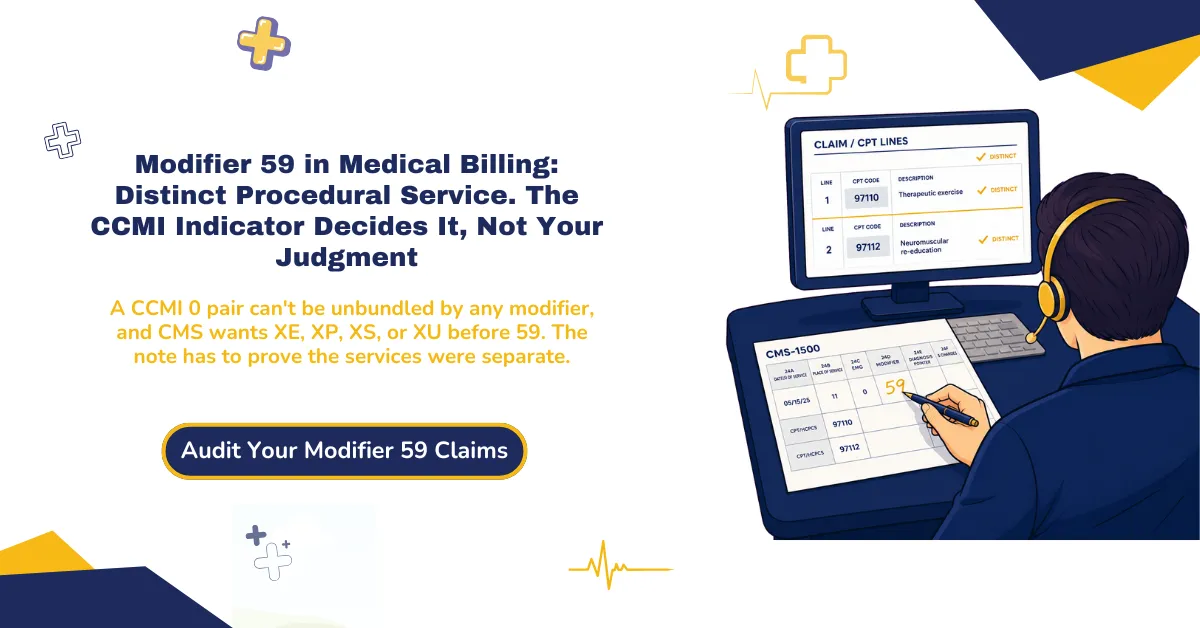
Definition: modifier 59 in medical billing is a CPT modifier that flags a distinct procedural service, telling the payer that two procedures normally bundled under National Correct Coding Initiative (NCCI) edits were separate and independent on the same date of service.
That’s the definition CMS uses in MLN1783722, Proper Use of Modifiers 59, XE, XP, XS, and XU, updated April 2026.
Here’s what it tells the payer in plain terms. This service wasn’t a component of the other one. It stood alone, and it earns separate payment.
Placement is specific. Modifier 59 goes in Box 24D of the CMS-1500 claim form, on the same line as the affected CPT code.
Unbundling is the problem this modifier exists to manage. Unbundling means reporting separately coded procedures that should be billed under a single comprehensive code. Modifier 59 is the override for the legitimate exceptions, the cases where the services were distinct. The full rule set lives in the CMS MLN1783722 guidance.
Modifier 59 Key Facts
| Field | Detail |
|---|---|
| Full name | Distinct Procedural Service |
| Code type | CPT modifier (payment modifier) |
| Governing system | National Correct Coding Initiative (NCCI) |
| Controlling document | CMS MLN1783722, updated April 2026 |
| Claim field | Box 24D, CMS-1500 |
| Most specific alternatives | XE, XP, XS, XU (HCPCS Level II) |
When to Use Modifier 59: The Four Scenarios That Justify a Distinct Service
Four scenarios justify modifier 59 on a claim. Each one describes services that look bundled but stood apart.
Different anatomic sites. Two procedures performed on separate body sites or organs that aren’t normally reported together.
Separate encounters or sessions. The same procedure, or related procedures, performed in distinct sessions on the same day.
Distinct procedures. A procedure that isn’t ordinarily a component of the primary service, performed independently on the same date.
Diagnostic before therapeutic. A diagnostic procedure that provides the clinical basis for the therapeutic procedure that follows, and isn’t a standard component of it. The NCCI Policy Manual 2026 names this one.
Here’s the gate on all four. Documentation has to establish the separateness before modifier 59 goes on the claim, not after the denial shows up.
CMS would rather you reach for a more specific code than 59 whenever one fits. Those are the X modifiers, and they come next.
Is Modifier 59 a Payment Modifier? Payment, Pricing, and Whether It Reduces Reimbursement
Yes: modifier 59 is a payment modifier. It controls whether a secondary procedure gets reimbursed at all, not the rate it’s paid at.
That’s the distinction that trips people up. Modifier 51 triggers a payment reduction on secondary procedures, the multiple-procedure logic that pays the second and later codes at a lower percentage. Modifier 59 doesn’t work that way. It either enables full payment for the distinct service, or it enables none, with no built-in rate cut.
So does modifier 59 reduce reimbursement? Not on its own. And where a more specific X modifier produces the same unbundling effect, CMS prefers the X modifier. Getting modifier 59 in medical billing right is a yes-or-no payment question, not a discount.
Medicare’s X Modifiers: Why CMS Created XE, XP, XS, and XU
The X modifiers are four codes, XE, XP, XS, and XU, that CMS built as more specific subsets of modifier 59. The HCPCS vs CPT codes split matters here: these four are HCPCS Level II, while 59 is a CPT modifier.
CMS created them through Change Request CR8863, effective January 1, 2015. The goal was precision.
Medicare prefers the specific X modifier over 59 whenever one fits, because modifier 59 is, in CMS’s words, “often used incorrectly.” The X modifier tells the reviewer why the service was distinct.
One placement rule from MLN1783722: CMS allows modifiers 59, XE, XP, XS, or XU on either the Column 1 or the Column 2 code of an NCCI edit pair.
Each X modifier answers a different question: encounter, practitioner, structure, or unusual service. Matching the right one is the core skill behind modifier 59, and the four below break down when each applies.
Modifier XE: Separate Encounter
Modifier XE marks a service that’s distinct because it happened during a separate encounter on the same date.
It applies when a second, unrelated procedure happens in a later session, that afternoon or that evening, not as part of the first visit.
Picture a patient seen for an office visit with a nasal endoscopy in the morning, then returning to the ER that afternoon for a separate procedure to control a nasal hemorrhage. The afternoon procedure carries XE on its claim line to show it was a separate encounter.
Plain 59 would say the service was distinct. The XE modifier says why: a different encounter. That specificity is what keeps a reviewer from pulling the records.
Modifier XS: Separate Structure
Modifier XS marks a service that’s distinct because it was performed on a separate organ or anatomic structure.
Two procedures on different structures qualify, for example different joints or separate lesions at different sites.
Take an arthrocentesis on the left knee and a separate aspiration on the right knee. The second line carries XS, paired with the RT and LT anatomic modifiers that name each side.
Here’s the XS trap. Contiguous structures aren’t separate structures. Treat two adjacent areas as distinct when they share the same anatomic site, and CMS rejects it.
Modifier XP: Separate Practitioner
Modifier XP marks a service that’s distinct because a different practitioner performed it.
It applies when two providers each perform a separate procedure on the same patient on the same day.
Two surgeons, each handling a different procedure in the same case, would put XP on the second provider’s line to show the work came from a separate practitioner.
One operational catch sits behind this modifier. Each separately billing practitioner has to be credentialed and enrolled with the payer, or one of the two lines denies regardless of the modifier.
Modifier XU: Unusual Non-Overlapping Service
Modifier XU marks the use of a service that’s distinct because it does not overlap usual components of the main service. That phrase, “does not overlap usual components,” is CMS’s own.
Non-overlapping is the part providers miss. XU is for a service that runs alongside the main procedure without repeating any piece of it.
Think of two different scopes used for different purposes in the same session, or a separate service that shares the date but none of the components of the primary work. The XU modifier covers the distinct service that the other three X modifiers don’t describe.
Here’s the decision cue. Reach for XU when the service is distinct but none of encounter, practitioner, or structure explains why. When the reason is that it didn’t overlap, XU is the code.
The Correct Coding Modifier Indicator: CCMI 0, 1, and 9 Explained
The rule that decides everything: every NCCI edit pair carries a Correct Coding Modifier Indicator, and that indicator, not the provider’s judgment, controls whether a modifier can bypass the edit. The NCCI Policy Manual spells it out.
CCMI 0. The edit can never be bypassed. No modifier overrides it. Append 59 to a CCMI 0 pair and both codes deny.
CCMI 1. The edit may be bypassed with modifier 59 or the appropriate X modifier, but only when documentation supports the distinct-service criteria.
CCMI 9. The edit is void. The deletion date equals the effective date, and the modifier question doesn’t apply to that pair at all.
Here’s the practical move. Check the indicator before you decide whether 59 can help, because modifier 59 in medical billing can’t override an indicator set to 0.
This is where pre-submission scrubbing earns its keep. A clean scrub checks the CCMI indicator on every edit pair before the claim leaves, so a 59 on a CCMI 0 pair never reaches the payer.
When NOT to Use Modifier 59: Prohibited Scenarios and Key Restrictions
Five situations call for something other than modifier 59. Knowing them prevents most of the denials this modifier generates.
Never as a substitute for a more specific modifier. If XE, XP, XS, or XU fits the situation, use it instead of 59.
Never to bypass a CCMI 0 edit. The indicator from the last section controls this one. Both codes deny.
A different diagnosis doesn’t justify it. In CMS’s words, “different diagnoses are not adequate criteria” for use of modifier 59. This is the most misunderstood rule on the topic.
Documentation comes first. The note has to support the distinct service before the modifier goes on the claim, not after a denial prompts a search for justification.
Generally not for separating an E/M from a procedure. That’s modifier 25’s job, and the decision-for-surgery case belongs to modifier 57.
Misuse carries a delayed cost. A wrong 59 clears initial adjudication and pays, then fails the post-payment audit months later, when the money has to come back. That’s why modifier 59 in medical billing belongs in a medical billing services workflow that catches the wrong-59 at pre-submission, before it becomes a denial.
Does Medicare Accept Modifier 59 in 2026? Current Status, the April 2026 Update, and the Q3 2026 NCCI Edits
Yes: Medicare accepts modifier 59 in medical billing in 2026 to bypass NCCI procedure-to-procedure edits on the same date of service, and CMS treats it as a last resort behind the more specific X modifiers.
Two current facts matter. CMS reaffirmed the rules in MLN1783722, updated April 2026, and allows modifiers 59, XE, XP, XS, or XU on either the Column 1 or the Column 2 code of an edit pair.
The second is fresh. The Q3 2026 NCCI PTP edit files, posted June 1, 2026 and effective July 1, 2026, are live now, so review your edit pair list before the effective date.
One caveat. Medicare’s acceptance is conditional on the CCMI indicator and on documentation. It’s never automatic.
Modifier 25 vs. Modifier 59: The Categorical Difference and the Seven-Point Comparison
Here’s the categorical line. Modifier 25 separates a significant, separately identifiable E/M service from a procedure on the same day, while modifier 59 separates two procedures from each other.
| Dimension | Modifier 25 | Modifier 59 |
|---|---|---|
| Core function | Separates a significant, separately identifiable E/M from a procedure | Separates two procedures from each other |
| Code type it attaches to | E/M code | Procedure or HCPCS code |
| When it fails an audit | When the E/M isn’t separately identifiable | When structures are contiguous or the CCMI is 0 |
| OIG risk level | High; E/M billed with a procedure is a named audit target | High; modifier 59 is a named audit target |
| Common misuse | Appended to an E/M that isn’t separately identifiable | Appended to an E/M instead of using 25 |
The single most common cross-error is putting 59 on an E/M code. That’s modifier 25’s job, not 59’s.
When the E/M is significant and separately identifiable from the procedure, 25 is the modifier, and the CPT 99213 billing guide walks through how that E/M gets documented. Mixing these up is one of the costlier mistakes in modifier 59 in medical billing.
Modifier 51 vs. Modifier 59: Multiple Procedures Versus Distinct Procedures
Modifier 51 flags multiple procedures performed in the same session and triggers a payment reduction on the secondary codes. Modifier 59 flags a distinct procedure and carries no rate reduction.
| Element | Modifier 51 | Modifier 59 |
|---|---|---|
| Purpose | Multiple procedures, same session | One distinct, normally bundled procedure |
| Payment effect | Reduces the secondary codes | No rate reduction |
| Unbundles an NCCI edit? | No | Yes, with documentation |
Each fits a different moment. Modifier 51 applies when multiple distinct procedures are expected together and the payer runs multiple-procedure logic. Modifier 59 applies when a normally bundled pair was separate after all.
Here’s the decision that matters. If an NCCI edit bundles the codes, 51 doesn’t unbundle them. Only modifier 59 or the right X modifier does. That ties back to the payment mechanics: 51 is about the rate, 59 is about whether the second code pays at all.
Modifier 59 vs. Modifier 91: The Laboratory Test Distinction
Modifier 59 identifies a distinct laboratory service. Modifier 91 identifies a medically necessary repeat of the same laboratory test on the same day.
| Element | Modifier 59 | Modifier 91 |
|---|---|---|
| What it marks | A distinct lab service | A repeat of the same test, same day |
| Trigger | Two different tests bundled by an edit | The same test run again for a clinical reason |
| Documentation | Separateness of the two services | Medical necessity for the repeat |
The lab mix-up runs both directions. Using 59 for a repeat of the same test belongs to 91. Using 91 to unbundle two different tests belongs to 59.
Each needs its own proof. 59 needs documentation that the two services were distinct. 91 needs documentation that the repeat was medically necessary, not a re-run for convenience.
Modifier Sequencing and Stacking: Where Modifier 59 Goes With RT, LT, 26, and 79
Sequencing matters in modifier 59. It is a payment modifier, so it’s sequenced before location modifiers like RT and LT. The order reads 59, then RT.
With RT or LT. Modifier 59 goes before the anatomic modifier.
With modifier 26. Modifier 26, the professional component, is a pricing modifier and goes before 59. The order is 26, then 59.
With modifier 79. Both can appear on the same claim, but never on the same line. Put 79 on the unrelated post-operative procedure line, and 59 or the X modifier on the separate distinct-procedure line.
With modifier 51. Rare, and resolved by the unbundling rule above: an NCCI edit needs 59 or an X modifier, not 51.
The general principle holds across the board. Pricing and payment modifiers come before location and informational modifiers. For the related rules on telehealth billing, the Modifier 95 billing guide covers that modifier set.
CO-59 Denial Code: Why It Fires and How It Connects to Modifier 59
CO-59, also written CARC 59, is the adjustment code a payer returns when a service is bundled into another already-adjudicated service on the same claim.
Here’s the connection nobody draws. A CO-59 denial often traces straight back to a modifier 59 error: the modifier was omitted when the services were distinct, applied to a CCMI 0 pair that can’t be overridden, or applied without documentation supporting the separateness. The Medicare NCCI FAQ covers the appropriate-use side.
The sequence is short. A provider bills a bundled pair, the NCCI edit fires, and the 835 ERA comes back with CO-59.
Recovery starts with three reads. Pull the CARC and RARC on the 835 ERA, confirm the CCMI indicator on the edit pair, and decide whether 59 or an X modifier was warranted in the first place.
When CO-59 keeps firing on the same code pairs, the cause is a repeatable workflow gap, and NCCI bundling denial recovery runs root-cause analysis on the CARC pattern before resubmission. That’s the core of fixing modifier 59 in medical billing at the source.
How to Appeal a CO-59 Denial: The Six Evidence Elements That Win the Reversal
A CO-59 appeal succeeds when the documentation proves the services were distinct. Six evidence elements carry that proof.
- Separate anatomic site or structure, documented in the note.
- Separate session or time of service, recorded on the chart.
- Separate incision or access, documented where applicable.
- Medical necessity established independently for each service.
- Confirmation that the NCCI edit pair carries CCMI indicator 1. A CCMI 0 pair can’t be appealed on modifier grounds.
- Provider credentials confirming each rendering practitioner, where XP applies.
The deadline is real. Appeal windows run 60 to 180 days from the remittance date, depending on the payer, and the corrected claim has to attach the supporting note, not assert that the services were separate.
ClaimMax builds payer-specific denied claim appeal support with the documentation attached and tracks the recovery to resolution. That’s how a CO-59 tied to modifier 59 in medical billing gets reversed.
Five Modifier 59 Errors That Trigger Audits and Denials
Five modifier 59 errors account for most audit exposure and most CO-59 denials, and four of them are preventable at pre-submission. Tightening these is the heart of clean modifier 59 coding.
- Overuse when a specific X modifier fits. CMS prefers XE, XP, XS, or XU, and defaulting to 59 invites review.
- Appending 59 to a CCMI 0 pair. The edit can’t be overridden, and both codes deny.
- Blanket-policy use. Appending 59 to every bundled denial is a pattern the 2026 compliance literature flags as a documented crisis.
- Retroactive documentation. A note created after the denial, to justify the modifier, exposes the practice to False Claims Act risk.
- Treating contiguous structures as separate sites. This is the most common anatomic misuse CMS names.
The numbers explain the scrutiny. An OIG review of FY 2003 claims found that 40 percent of code pairs billed with modifier 59 failed program requirements, which projected to $59 million in improper payments. You can read the OIG modifier 59 report in full.
Four of the five never reach a payer when the claim runs through a clean scrub. Catching them early is the same discipline that stops clearinghouse rejection causes upstream of the payer.
Modifier 59 Examples by Specialty: Six Clinical Scenarios and the RHC and FQHC Exception
Modifier 59 plays out one way in dermatology and another in the lab. Six scenarios cover the most common correct uses.
Dermatology. Two separate lesion excisions on different sites. The second carries 59 or XS, with the separate-site documentation that wound care CPT codes also depend on.
Orthopedics. Arthrocentesis on two different joints. XS goes on the second, paired with RT and LT.
Physical therapy. 97140 manual therapy and 97530 therapeutic activities in separate 15-minute blocks. 59 goes on 97530, and physical therapy claim denials often trace to this exact pairing.
Surgical. A diagnostic endoscopy that establishes the basis for a therapeutic procedure. That’s the diagnostic-before-therapeutic case, and 59 marks the distinct diagnostic service.
Injection. Separate injections at different anatomic sites on the same day, each distinct from the other.
Gastroenterology. Upper and lower endoscopy in the same session. Use 59 or XU as warranted, and the colonoscopy CPT codes guide covers the bundling edits on those pairs.
One exception sits outside the usual rules. When a patient suffers an illness or injury after the first visit that requires additional treatment the same day, Rural Health Clinics use modifier 59 and Federally Qualified Health Centers use 59 or 25 to support two billable visits on that date.
Modifier 59 Documentation Checklist and 2026 Quick Reference
A modifier 59 claim survives a post-payment audit when the clinical note answers six documentation questions before submission. This checklist turns modifier 59 in medical billing into a pre-submission step.
- Separate anatomic site or structure, named in the note.
- Separate session or time of service, recorded.
- Separate incision or access, where applicable.
- Independent medical necessity for each service.
- CCMI indicator confirmed as 1 on the edit pair.
- Rendering practitioner identified for each line.
| Element | 2026 Rule |
|---|---|
| Full name | Distinct Procedural Service |
| Code type | CPT payment modifier |
| Governing system | National Correct Coding Initiative (NCCI) |
| Controlling document | CMS MLN1783722, April 2026 |
| Claim field | Box 24D, CMS-1500 |
| Most specific alternatives | XE, XP, XS, XU |
| CCMI gate | 0 blocks all modifiers; 1 allows 59 with documentation |
| Different-diagnosis rule | A different diagnosis isn’t adequate criteria |
| Primary denial code | CO-59 (CARC 59) |
Two moves close the loop. ClaimMax runs modifier and NCCI checks in pre-submission scrubbing, and recovers CO-59 denials with payer-specific appeals. The denial recovery specialists start with a free analysis of where these denials are costing you, because a repeating CO-59 is a workflow fix, not a one-off.