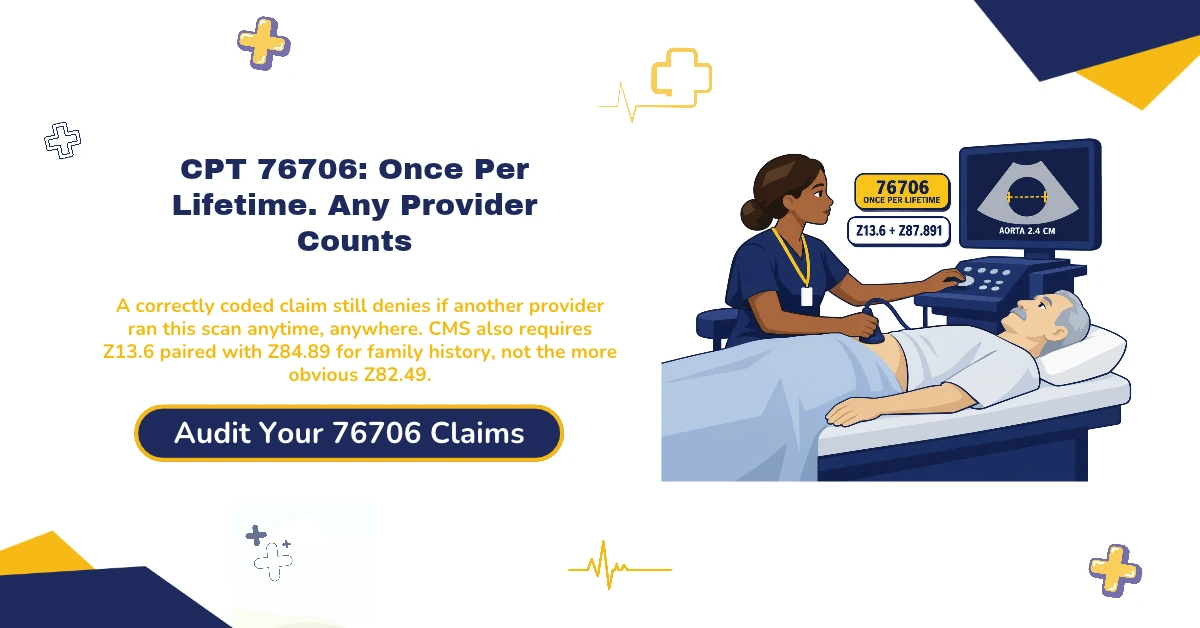
The 76706 CPT code reports a real time ultrasound of the abdominal aorta, with image documentation, done to screen for abdominal aortic aneurysm (AAA). Medicare covers it once per lifetime for referred patients with a qualifying risk factor. Patients owe nothing when the provider accepts assignment.
What changed in 2026: CMS added the Z13.6 diagnosis pairing to its claims manual through Transmittal 13694, effective April 20, 2026. Rates reflect the CY 2026 Physician Fee Schedule.
AAA screening CPT code at a glance
| Field | Detail |
|---|---|
| Code | 76706 (CPT Category I, radiology section) |
| CMS short descriptor | Us abdl aorta screen AAA |
| In use since | January 1, 2017 (replaced HCPCS G0389) |
| Medicare frequency | Once per lifetime, at any provider |
| Required diagnosis pairing | Z13.6 plus a smoking code (Z87.891, F17.210, F17.211, F17.213, F17.218, or F17.219) or a family history code (Z84.89) |
| Modifiers | None for global billing; 26 or TC for split billing |
| Patient cost under Medicare | $0 with assignment; deductible and coinsurance waived |
| 2026 national rate | $105.88 national global, 2026 (non-QP, CMS Physician Fee Schedule) |
| Not for | Symptoms or a known aneurysm; use 76770, 76775, 93978, or 93979 |
You’ll see 76706 orders after wellness visits if you bill for a primary care, cardiology, or vascular practice. Each one is a small claim with strict rules. Medicare won’t pay it if one diagnosis code is wrong, the referral is missing, or another clinic screened the patient years ago.
What Is the 76706 CPT Code?
Code 76706 is the CPT Category I code Medicare uses for a once per lifetime ultrasound screening of the abdominal aorta in patients at risk for abdominal aortic aneurysm. Groups authorized to perform covered diagnostic ultrasound can bill it, including radiology groups, vascular labs, cardiology practices, and hospital outpatient departments.
76706 CPT Code Description: Official and Short Descriptor
Per CMS Pub. 100-04, Chapter 18, Section 110.3.2, the long descriptor for 76706 matches the AMA wording, and CMS restated it in CMS Transmittal 13694 on March 19, 2026. Copy it word for word when you build the charge line in your billing system:
“Ultrasound, abdominal aorta, real time with image documentation, screening study for abdominal aortic aneurysm (AAA).”
CMS uses a short descriptor too: “Us abdl aorta screen AAA.” If you’re comparing the CPT code 76706 description against an order, three terms matter: screening, real time, and documentation. An order that says “rule out AAA” for a patient with back pain fails the first test.
What a 76706 Study Includes
A 76706 study has three parts: real time imaging of the abdominal aorta, a permanent record of the images, and a physician’s interpretation. CMS wrote the interpretation into the screening’s definition at 42 CFR 410.19, so you don’t report the read with a separate code.
Clinicians order it to find an enlarged aorta before it causes harm. Before you bill CPT code 76706, make sure the chart proves all three parts: stored images, the aortic measurement, and a signed report. A scan with no saved images won’t hold up if a payer asks for records.
Symptoms or a Known AAA: When 76706 Is the Wrong Code
The 76706 CPT code is the wrong choice when the patient has symptoms or a known aneurysm. Under 42 CFR 410.19, CMS defines the screening as a service for an asymptomatic individual, so a study ordered for back pain, a pulsatile mass, or a known AAA is a diagnostic exam.
Diagnostic aorta studies carry normal Part B cost sharing. CMS points them to 76770, 76775, 93978, and 93979, and the code comparison later in this guide shows how to pick one. Catch the problem at scheduling: if the order lists symptoms, ask the ordering office for a diagnostic order instead.
Why Older Guides Still List G0389
76706 replaced HCPCS code G0389 on Medicare screening claims starting January 1, 2017. CMS manual text still shows both: G0389 for dates of service from January 1, 2007 through December 31, 2016, and 76706 after that. Old quick reference PDFs that list G0389 alone are out of date.
The AMA added 76706 to CPT for 2017, and CMS retired G0389 once a CPT code covered the service. If your chargemaster or a payer grid still lists G0389, update it for current dates of service. Our guide to HCPCS vs CPT codes explains how the two code sets differ.
76706 Medicare Coverage Guidelines: Who Qualifies for AAA Screening
Medicare covers 76706 for a beneficiary who hasn’t had a prior AAA screening under Medicare, has a referral, and fits a risk category: a family history of AAA, or a man aged 65 to 75 who has smoked at least 100 cigarettes. That’s the rule in 42 CFR 410.19.
The Five Conditions Medicare Checks on a 76706 Claim
Medicare AAA screening coverage under the 76706 CPT code depends on five conditions. If one is missing, Medicare denies the claim, so check each before you schedule the scan. You’ll find most answers on the referral, and the prior screening answer in your MAC portal. Confirm the patient:
- Fits a covered risk category
- Has a referral from a physician, physician assistant, nurse practitioner, or clinical nurse specialist
- Has had no prior AAA screening under Medicare, at any provider
- Has no signs or symptoms of AAA
- Gets the scan from a provider or supplier authorized to furnish covered diagnostic ultrasound
76706 Age Limit and Sex Rules
76706 has no single age limit under Medicare. The AAA screening age range of 65 to 75 belongs to one pathway: men who qualify through smoking history. A family history of AAA qualifies a man or woman at any Medicare age.
If a patient asks, “Is AAA screening only for men?” Medicare’s answer is no: women qualify through family history. Some guides send women or patients outside 65 to 75 to 76775 or 76770. That’s wrong. Code from the reason for the scan; Medicare checks the risk group for coverage.
Medicare eligibility matrix for 76706
| Patient | Medicare coverage under 76706 |
|---|---|
| Man 65 to 75 who has smoked at least 100 cigarettes | Eligible |
| Man 65 to 75 who never smoked and has no family history of AAA | Not eligible (the USPSTF Grade C recommendation doesn’t create Medicare coverage) |
| Man under 65 or over 75 who smoked and has no family history of AAA | Not eligible |
| Any man or woman with a family history of AAA | Eligible, no age limit |
| Woman who smoked and has no family history of AAA | Not eligible |
| Patient with a known AAA or AAA symptoms | Not a screening; bill the diagnostic code that matches the study |
42 CFR 410.19 adds a third pathway for other risk groups the USPSTF recommends, as specified through the national coverage determination process. Medicare.gov and Noridian list the two groups above and no others. Check with your MAC before you rely on that third clause for any patient.
76706 Frequency: Once Per Lifetime, at Any Provider
Medicare pays for the 76706 CPT code once in a beneficiary’s lifetime, and a screening at any provider counts toward that limit. If a clinic in another state billed the screening years ago, Medicare will deny your claim, even if it’s your first visit with the patient.
Check prior use in your MAC’s provider portal before you schedule. Noridian’s portal supports 76706 eligibility checks; if you bill another MAC, look for the preventive services history in its portal. Pair that check with a Medicare benefit verification to spot Medicare Advantage enrollment.
Referral Rules: No Welcome to Medicare Visit Needed Since 2014
A 76706 claim needs a referral, and since January 27, 2014, any physician or qualified nonphysician practitioner can write it. Before that date, the referral had to come out of the initial preventive physical exam (IPPE). CMS made the change in CMS Transmittal R3096CP.
Wellness visits remain a natural place to order the screening, since the provider is already reviewing family and smoking history with the patient. Our breakdown of annual wellness visit codes covers the IPPE (G0402), G0438, and G0439.
What the Patient Pays for 76706
76706 costs the patient $0 when the provider accepts assignment, because Medicare waives the deductible and coinsurance for this screening. Medicare.gov’s coverage page states the same rule. Follow-up studies after a positive screen don’t get the waiver; they carry normal Part B cost sharing.
Covered Diagnosis Codes for 76706: The Z13.6 Pairing Rule
CPT 76706 needs two diagnosis codes on a Medicare claim: Z13.6 (encounter for screening for cardiovascular disorders) plus one risk code. Smoking history takes Z87.891, F17.210, F17.211, F17.213, F17.218, or F17.219; family history takes Z84.89. CMS put this pairing into its claims manual effective April 20, 2026.
AAA Screening ICD-10 Codes Medicare Accepts
76706 claims need Z13.6 plus one risk code from the table, matched to the patient’s pathway. The screening for AAA ICD-10 code is Z13.6, the general code for cardiovascular screening. There’s no separate ICD-10 code for AAA screening, so the second code carries the proof of risk.
Diagnosis codes CMS lists for 76706 (Pub. 100-04, Chapter 18, Section 110.3.2)
| Code | Description | Pathway |
|---|---|---|
| Z13.6 | Encounter for screening for cardiovascular disorders | Required on the claim |
| Z87.891 | Personal history of nicotine dependence | Smoking |
| F17.210 | Nicotine dependence, cigarettes, uncomplicated | Smoking |
| F17.211 | Nicotine dependence, cigarettes, in remission | Smoking |
| F17.213 | Nicotine dependence, cigarettes, with withdrawal | Smoking |
| F17.218 | Nicotine dependence, cigarettes, with other nicotine-induced disorders | Smoking |
| F17.219 | Nicotine dependence, cigarettes, with unspecified nicotine-induced disorders | Smoking |
| Z84.89 | Family history of other specified conditions | Family history |
Link 76706 to Z13.6 and the risk code in the diagnosis pointer. Some billers hesitate to point an imaging line at a Z code, since diagnostic ultrasound needs a sign or symptom. A screening claim reverses that: Medicare wants the screening code plus the risk code, with no symptom code.
What CMS Changed on April 20, 2026
On March 19, 2026, CMS issued Transmittal 13694 (Change Request 14421) to add the 76706 diagnosis codes to Pub. 100-04, Chapter 18, Section 110.3.2. Both its effective date and its implementation date are April 20, 2026. CMS wanted the manual to match the MLN preventive services quick reference.
Z13.6 isn’t a new requirement. Noridian last updated its AAA screening page, which lists the same pairing, on February 16, 2026, about two months before the transmittal took effect. CMS also added a note to the manual that more ICD-10 codes may apply, with an instruction to contact your MAC.
One more check for the new fiscal year: the FY2027 ICD-10-CM update took effect October 1, 2026. Z13.6, Z87.891, the five F17.21x cigarette codes, and Z84.89 remain valid in that code set, so the April 2026 list still applies to current dates of service.
Diagnosis Codes That Sink a 76706 Claim
Medicare denies 76706 screening claims that carry any of these five diagnosis patterns. Two signal a diagnostic study, and three use codes CMS left off its list:
- I71.40 to I71.43 (AAA without rupture) or I71.30 to I71.33 (ruptured AAA), which mean the aneurysm is already known
- Symptom codes such as R10.9 (unspecified abdominal pain), which make the study diagnostic
- Z82.49 (family history of ischemic heart disease and other diseases of the circulatory system)
- Z72.0 (tobacco use)
- F17.20x (unspecified nicotine product), F17.22x (chewing tobacco), or F17.29x (other tobacco product)
Some coding guides suggest Z82.49 as the family history of AAA ICD-10 code, since an aneurysm is a circulatory disease. CMS lists Z84.89 instead. Before you use Z82.49, get your MAC’s acceptance in writing; without it, report Z84.89 and keep the relative’s diagnosis in the note.
Tobacco codes cause trouble on other Medicare screening claims as well. Low dose CT for lung cancer screening pairs a screening code with smoking history codes in a similar way, and our guide to lung cancer screening code 71271 walks through those rules.
If your team keys these pairings by hand, one missing risk code is all Medicare needs to deny the claim. With our medical billing service, we build the Z13.6 pairing check into charge review, so it runs before the claim leaves your system.
76706 vs 76775, 76770, 93978, and 93979: Choosing the Aorta Ultrasound Code
The 76706 CPT code is for a screening study in a patient with no symptoms and no known aneurysm. A limited retroperitoneal ultrasound of the aorta is 76775, a complete retroperitoneal study is 76770, and a duplex scan with Doppler flow analysis is 93978 (complete) or 93979 (limited).
There’s no single CPT code for abdominal aortic aneurysm imaging. You choose by intent first, screening or diagnostic, and then match the technique on the report to one of the four diagnostic codes. Coders who skip the first step end up billing a surveillance scan as a screening.
Which CPT Code for Aorta Ultrasound Fits the Order?
76706 fits one row of the table: screening an eligible patient with no symptoms. Some orders say “US abdominal aorta” and nothing else, so check the notes before you assign a US abdominal aorta CPT code. Your CPT code for aortic ultrasound depends on the order’s reason and the technique.
Aorta ultrasound code decision table
| Clinical situation | Technique | Code |
|---|---|---|
| Asymptomatic screening of an eligible patient | Real time ultrasound with image documentation | 76706 |
| Known AAA follow-up or symptoms, limited view of the aorta | Limited retroperitoneal ultrasound | 76775 |
| Full retroperitoneal survey: kidneys, abdominal aorta, common iliac artery origins, and IVC | Complete retroperitoneal ultrasound | 76770 |
| Duplex of the full course of the aorta, IVC, or iliac vessels | Duplex scan with Doppler flow analysis, complete | 93978 |
| Duplex of one segment or one side | Duplex scan, unilateral or limited | 93979 |
CMS names the same four diagnostic codes in Pub. 100-04, Chapter 18, Section 110.3.2, beside the 76706 descriptor. If a payer questions your code choice, that manual citation and the clinical reason on the order are the two things to show them.
76706 vs 76775: Screening vs a Limited Retroperitoneal Study
The 76706 CPT code describes a screening, and 76775 is a limited diagnostic ultrasound of the same area. Medicare covers 76775 when the diagnosis supports medical necessity under MAC policy. A scan to follow a known aneurysm is diagnostic: 76775 for a limited view, or 76770 for the full retroperitoneum.
Orders that read “US AAA screen” need the risk factor check before you attach the US AAA screening CPT code. You still code a screening order on an ineligible patient as 76706. Medicare will deny it as a statutory exclusion. Talk to the patient about cost before the scan.
76706 vs 93978 and 93979: When Doppler Changes the Code
76706 is a real time screening study, and 93978 and 93979 are duplex scans with Doppler flow analysis. 93978 covers the full course of the aorta, IVC, or iliac vessels, and 93979 covers one segment or one side. Both duplex codes need a diagnostic reason on the claim.
76706 vs duplex aorta codes
| Attribute | 76706 | 93978 | 93979 |
|---|---|---|---|
| Type of exam | Screening ultrasound | Duplex scan, complete | Duplex scan, unilateral or limited |
| Indication | No symptoms, no known AAA, Medicare risk factor | Known or suspected vascular disease | Known or suspected vascular disease |
| Technology | Real time imaging with image documentation | Imaging plus Doppler flow analysis | Imaging plus Doppler flow analysis |
| Coverage area | Abdominal aorta | Full course of the aorta, IVC, or iliac vessels | One segment or one side |
| Restriction | Once per lifetime under Medicare | Medical necessity | Medical necessity |
USPSTF calls abdominal duplex ultrasonography the standard approach for AAA screening. That clinical wording doesn’t change Medicare coding: if the order is a screening for an eligible patient, the claim goes out on 76706, even when the sonographer runs Doppler.
76706 vs 76700 and 76705
76706 is the AAA screening CPT code Medicare recognizes, and 76700 and 76705 are abdominal surveys. 76700 is a complete abdominal ultrasound, and 76705 is limited. Neither carries the preventive waiver under Medicare, though some commercial plans, such as Kaiser Permanente Washington, accept them for AAA screening.
Before you bill 76706 with another ultrasound on the same day, check the current CMS NCCI practitioner PTP file. Pair lists change each quarter, so pull the current file instead of trusting a saved spreadsheet. CMS’s NCCI page links to the current practitioner files.
Does CPT 76706 Need a Modifier? 26, TC, and Global Billing
The 76706 CPT code takes no modifier when one practice owns the ultrasound equipment and its own physician reads the study. Split it when two entities share the work: TC for the scan and 26 for the interpretation. CMS lists TC and 26 for 76706 in Pub. 100-04, Chapter 18.
Who Bills What: Global, TC, and 26
No modifier needed: your practice owns the equipment, performs the 76706 scan, and has its own physician sign the read. That’s a global claim on the CMS-1500, with place of service 11 for an office setting.
Modifier needed: two entities split the work. One entity owns the equipment and bills TC for the scan, and the interpreting physician bills 26 for the read. Each of the two claims carries the same diagnosis pair.
Outpatient hospital work follows its own pattern. Hospitals bill the technical portion on a UB-04 under OPPS, with no TC modifier on the facility line, and the reading physician bills 76706-26 on a CMS-1500 with place of service 22 or 19.
Who bills 76706, on which form, with which modifier
| Arrangement | Who bills | Claim form | Modifier |
|---|---|---|---|
| Practice owns the machine; its physician reads | Practice | CMS-1500, POS 11 | None (global) |
| Hospital outpatient scan; outside physician reads | Hospital (technical portion, under OPPS) | UB-04 | None on the facility line |
| Hospital outpatient scan; outside physician reads | Reading physician | CMS-1500, POS 22 or 19 | 26 |
| Imaging center scans; outside physician bills the interpretation | Imaging center | CMS-1500 | TC |
| Imaging center scans; outside physician bills the interpretation | Reading physician | CMS-1500 | 26 |
Don’t send TC and 26 claims from the same entity for one scan; if you own both parts, bill the global code. Cardiology and vascular groups that read at hospital sites face this split on their hospital imaging, and our cardiology and vascular billing support covers both settings.
Echocardiography uses the same 26 and TC split, with the same office and hospital patterns. If your group bills echo too, our 93306 billing guide covers that code’s payer rules, audit risks, and denial fixes.
Modifiers That Don’t Belong on 76706
Some online code summaries list 33, 59, 76, 77, and 91 as modifiers for 76706. Of those, 59 can apply in narrow cases, and the rest don’t fit a screening ultrasound. Check this table before a claim goes out:
Modifiers to keep off a 76706 screening claim
| Modifier | Why it doesn’t fit 76706 |
|---|---|
| 33 | Noridian says not to add it to a code that its own description identifies as preventive, and the 76706 descriptor says “screening study.” |
| 59 or XU | Use it when the CMS PTP file pairs 76706 with the other code, the edit allows a modifier, and the chart shows a separate service. |
| 76 or 77 | Repeat procedure modifiers don’t fit a once per lifetime screening. |
| 91 | A repeat lab test modifier; it doesn’t apply to imaging. |
| GA, GY, or GZ | Liability modifiers; they belong on the claim when an ABN situation applies, covered in the denial section. |
Noridian’s modifier 33 guidance states the preventive rule in plain terms, and Noridian last updated that page on May 24, 2024. Some commercial plans publish their own modifier 33 rules, so check the payer’s preventive coding guide when you bill outside traditional Medicare.
CPT 76706 Reimbursement in 2026
Medicare’s 2026 national allowed amount for the 76706 CPT code is $105.88 global, from 3.17 total RVUs at the $33.4009 conversion factor. With the deductible and coinsurance waived, Medicare pays that full amount minus the 2% sequestration cut. Locality adjustments move it up or down.
2026 National Medicare Rates and RVUs for 76706
Medicare pays the same national amount for 76706 in facility and nonfacility settings, because its practice expense RVUs match. Each figure in the table is national and unadjusted, for the global service and each component, at both 2026 conversion factors.
76706 2026 fee and RVUs (national, unadjusted)
| Component | RVUs (work / PE / MP) | Non-QP at $33.4009 | QP at $33.5675 | Paid after 2% sequestration (non-QP) |
|---|---|---|---|---|
| Global | 3.17 (0.54 / 2.58 / 0.05) | $105.88 | $106.41 | $103.76 |
| 26 | 0.77 (0.54 / 0.19 / 0.04) | $25.72 | $25.85 | $25.21 |
| TC | 2.40 (0.00 / 2.39 / 0.01) | $80.16 | $80.56 | $78.56 |
QP means qualifying APM participant. CMS set both conversion factors in the CY 2026 PFS final rule (CMS-1832-F). Confirm the component split and your locality’s numbers in the CMS PFS Look-Up Tool before you load your fee schedule.
Why Your 76706 Payment Won’t Match the Table
Your 76706 remittance won’t match the national figure to the cent. Five adjustments account for the gap, and knowing them keeps your team from appealing payments that are correct:
- Locality: geographic practice cost indices (GPCIs) raise or lower the allowed amount by region.
- Sequestration: Medicare takes 2% off after it sets the approved amount and cost share, shown as CARC 253, per First Coast’s sequestration guidance.
- Participation: nonparticipating providers receive 95% of the fee schedule amount, and the patient’s $0 depends on assignment.
- Efficiency adjustment: CMS’s 2.5% cut to work RVUs for services that aren’t time based is already inside the 2026 RVUs, so don’t subtract it again in forecasts.
- Medicare Advantage: MA plans pay what your contract says.
Hospital Outpatient Billing for 76706
Hospitals bill the technical portion of 76706 under OPPS, so the physician fee schedule table doesn’t set their payment. Pull the 2026 APC and payment rate for 76706 from OPPS Addendum B before you quote a number to a hospital client.
For 2027, CMS proposed paying the physician fee schedule equivalent rate for imaging without contrast at excepted off-campus provider-based departments, with rural sole community hospitals exempt. Read the CY 2027 OPPS proposed rule and check whether 76706’s APC falls in that group once CMS finalizes it.
Commercial Payer Rates for 76706
Commercial rates for 76706 come from your contracts, and they vary by plan and region. Each plan’s preventive cost sharing rules set what the patient owes, which can differ from the Medicare $0. Use your own remits and contract fee schedules instead of aggregator averages from the web.
Documentation That Holds Up on a 76706 Claim
A clean 76706 CPT code claim rests on four records: an order or referral from a physician or qualified nonphysician practitioner, a documented risk factor, a note that the patient has no symptoms, and a signed interpretation. NGS lists the order, the risk category, and asymptomatic status as required documentation.
What the Chart Needs Before the 76706 Scan
Before the sonographer starts, the chart for a 76706 screening should hold five items. Your front desk can pull most of them from the referral and the MAC portal before the patient arrives:
- The order or referral, with the ordering provider’s name and NPI
- The risk factor in specific terms: at least 100 cigarettes smoked, or the relative with AAA and that relative’s relationship to the patient
- A statement that the patient has no symptoms and no known aneurysm
- The prior screening check, with the portal result and the date you ran it
- A signed ABN, if you couldn’t confirm prior screening
What the 76706 Report Needs After the Scan
The 76706 report should show real time imaging with stored images, the aortic finding with its measurement, and the reading physician’s signature and date. Under 42 CFR 410.19, the physician’s interpretation is part of the service, so an unsigned report means you can’t support the claim.
Claim Fields Payers Check on 76706
On a 76706 claim, the referring provider and the diagnosis pointers carry the screening rules. Enter the referring provider’s name in Box 17 and the NPI in Box 17b, and point the 76706 line to both Z13.6 and the risk code. Our clean claim requirements guide covers the rest.
RHCs and FQHCs have their own instructions in Pub. 100-04, Chapter 18, Section 110.3.4, titled “RHCs/FQHCs Special Billing Instructions.” If you bill from a clinic setting, read that section before you set up the 76706 charge, since clinic billing rules differ from the CMS-1500 process above.
Why 76706 Claims Get Denied and How to Fix Each One
Denials on the 76706 CPT code come from a short list of gaps, from a missing diagnosis pair to a screening the patient already used. Read the CARC and RARC first. Some denials need a corrected claim, and others need a different code or no rebill at all.
The 76706 Denial Table
Match the denial on your 76706 remittance to the closest row, then confirm the fix against the CARC and RARC your MAC sent. MACs assign their own CARC and RARC pairs, so the codes in the second column show common patterns and may differ on your remit.
76706 denial patterns, causes, and fixes
| Denial pattern | Codes billers see | Root cause | Fix |
|---|---|---|---|
| Diagnosis pair missing or wrong | CO-11, CO-167 | Z13.6 alone, or Z82.49 or Z72.0 in place of a listed code | Corrected claim with listed codes, if the chart supports them |
| Screening already used | CO-119 | Prior screening under Medicare at any provider | Don’t rebill as a screening |
| Patient outside covered groups | Noncovered denial; RARC varies | No family history, or a smoker outside the men 65 to 75 group | Statutory denial; see the ABN rules below |
| Known AAA billed as screening | CO-11 | Surveillance study billed on 76706 | Rebill as 76775, 76770, 93978, or 93979 with a code from I71.40 to I71.43 |
| No referring provider | CO-16 | Box 17 left blank | Corrected claim with the referring provider’s name and NPI |
| Component mismatch | CO-4 | TC or 26 on the wrong claim, or global billed when the hospital took the technical portion | Rebuild the claim to match the modifier table |
| Same day bundling | CO-97 | Pair appears in the PTP edits | Check the PTP file; use a modifier where the edit allows one |
ABN Rules: Why a Repeat 76706 Screening Is a Statutory Denial
NGS’s December 2024 training classifies a second 76706 screening, or any other unmet statutory criterion, as a statutory (technical) denial rather than a medical necessity denial. If prior screening is unclear but the other requirements are met, the NGS preventive services training says to issue the ABN.
On the claim, you show who carries the financial liability with one of three modifiers, and each one has a narrow meaning:
- GA: a signed ABN is on file
- GY: statute excludes the service, or it doesn’t meet a Medicare benefit’s definition
- GZ: you expect a medical necessity denial and have no ABN
CMS covers ABNs for this benefit in Pub. 100-04, Chapter 18, Section 110.3.3. Confirm the modifier with your MAC before you bill the patient; the wrong one can make your practice liable. Our A1c guide shows ABN modifiers GA and GZ on lab claims with frequency limits.
Stop the 76706 Denial at Scheduling
The two denials NGS lists as common for 76706, a missing referral and a second screening, both start before the scan. NGS stopped giving eligibility details, preventive history included, through its IVR on November 18, 2024, so your staff needs the portal for that check.
Add two more steps to the intake call. Confirm whether the patient has switched to Medicare Advantage, and ask the ordering office to state the risk factor in the order. Our guide to eligibility checks before scheduling covers the rest of the front desk work.
If 76706 denials keep coming back with the same CARC, the fix sits upstream at scheduling. Our denial management services team traces each pattern to its source and corrects the intake workflow along with the claim.
76706 Coverage Outside Traditional Medicare
Outside traditional Medicare, the 76706 CPT code follows each payer’s policy. Medicare Advantage plans can’t charge cost sharing for Medicare preventive services in network. Most ACA plans cover the USPSTF Grade B group, men 65 to 75 who ever smoked, at $0 in network. TRICARE covers that same group.
Medicare Advantage and 76706
Under 42 CFR 422.100(k), Medicare Advantage plans can’t charge deductibles, copays, or coinsurance for Medicare preventive services in network, and the 76706 CPT code falls in that group. Plans still run their own edits and network rules, so pull the plan’s preventive policy before you schedule.
Commercial Plans and the USPSTF Grade B Rule
Commercial coverage for 76706 traces back to the USPSTF. Under ACA Section 2713, plans that aren’t grandfathered must cover USPSTF Grade A and B services with no cost sharing in network. The USPSTF aortic aneurysm screening recommendation gives Grade B to men 65 to 75 who have ever smoked.
USPSTF AAA screening grades (December 10, 2019)
| Population | USPSTF grade | What it means for coverage |
|---|---|---|
| Men 65 to 75 who have ever smoked | B | ACA plans cover one screening with no cost sharing in network |
| Men 65 to 75 who have never smoked | C | Selective offer; no ACA mandate |
| Women who have never smoked and have no family history of AAA | D | USPSTF recommends against screening |
| Women 65 to 75 who have ever smoked or have a family history of AAA | I | Evidence insufficient; no ACA mandate |
The USPSTF recommendation dates to December 10, 2019, and it’s still the current final version. There’s no “USPSTF code” for billing: ACA coverage follows the grade, and 76706 is the code you bill. HealthCare.gov’s preventive care list includes one AAA screening for men of specified ages who have ever smoked.
If PR-1 shows up on a 76706 claim, the payer applied the deductible, a sign of diagnostic processing or a plan without the preventive mandate. Check the diagnosis pointers and the payer’s preventive code list first. Our guide to PR-1 deductible denials explains how payers apply that adjustment.
Payer Policies That Don’t Match Medicare for 76706
Commercial and military payers write their own 76706 rules. Aetna CPB 0702 and TRICARE’s AAA coverage page both limit screening to men, and some plans accept more codes than Medicare does. Compare them before you schedule a patient who isn’t on traditional Medicare.
76706 payer policy comparison
| Payer | Who qualifies | Codes listed | Diagnosis codes | Policy date |
|---|---|---|---|---|
| Medicare (traditional) | Family history at any age, either sex; men 65 to 75 who smoked at least 100 cigarettes | 76706 | Z13.6 plus Z87.891, F17.210, F17.211, F17.213, F17.218, or F17.219, or Z13.6 plus Z84.89 | Effective April 20, 2026 |
| Aetna CPB 0702 | Men 65 and older, one time | 76706 | Z13.6, Z87.891, and F17.210 to F17.219 as Aetna lists them | Last reviewed December 19, 2025 |
| Kaiser Permanente Washington (commercial) | Men in the USPSTF ever smoked group | 76706, 76700, 76705, 76770, 76775 | Z13.6, Z87.891, and the F17.21x cigarette codes | Revised August 14, 2026 |
| TRICARE | Men 65 to 75 who have ever smoked, one time | Not listed on the coverage page | Not listed on the coverage page | Updated September 16, 2024 |
Aetna won’t cover a woman with a family history whom Medicare would cover, and Kaiser Washington accepts five codes where Medicare accepts one. Keep Medicare rules off commercial claims, and check the payer’s policy date before each new plan year.
Medicaid and 76706
Medicaid coverage for 76706 varies by state, from the codes accepted to the age and risk rules. Check your state’s provider manual or fee schedule, and see our guide to state Medicaid billing rules for the enrollment and claim basics.
After a Positive Screen: Coding the Follow-Up Studies
Once the 76706 screening shows an aneurysm, later aorta studies are diagnostic. Code each one by technique: 76775, 76770, 93978, or 93979, paired with I71.40 to I71.43 for an unruptured AAA. Expect normal Part B cost sharing, since the screening waiver doesn’t carry over to these studies.
Which AAA CPT Code Fits the Follow-Up After 76706?
For each surveillance scan after 76706, choose the CPT code for ultrasound of abdominal aorta by the technique the order calls for. The I71.4x codes describe location: I71.40 is unspecified, I71.41 is pararenal, I71.42 is juxtarenal, and I71.43 is infrarenal, all without rupture.
Follow-up aorta studies after a positive screen
| Follow-up study | Code | Diagnosis |
|---|---|---|
| Limited retroperitoneal ultrasound of the aorta | 76775 | I71.40 to I71.43 |
| Complete retroperitoneal ultrasound | 76770 | I71.40 to I71.43 |
| Full course duplex of the aorta, IVC, or iliac vessels | 93978 | I71.40 to I71.43 |
| Duplex of one segment or one side | 93979 | I71.40 to I71.43 |
Follow-Up Scan Intervals After a Positive 76706 Screen
Follow-up timing after a positive 76706 screen comes from clinical guidelines, and your job is to match each order to the right code. VA’s AAA screening guidance sets these intervals by size:
- 3.0 to 3.9 cm: recheck in two to three years
- 4.0 to 5.4 cm: recheck in about six months
- Larger than 5.4 cm: the patient and provider discuss next steps, which may include surgery
USPSTF notes that surgical repair is standard for men with an AAA of 5.5 cm or larger, or larger than 4.0 cm with 1.0 cm of growth in a year. Each surveillance scan needs its own order and an I71 diagnosis, and none of them go on 76706.
When the AAA Workup After 76706 Moves to CT Angiography
If imaging after 76706 moves to CT angiography, the codes are 74174 for CTA of the abdomen and pelvis or 74175 for the abdomen alone. Ultrasound stays the screening tool because CT adds radiation and contrast, and our CT abdomen and pelvis codes guide covers the wider CT code family.
76706 Pre-Submission Checklist
Run these seven checks before any 76706 CPT code claim leaves your system. Most of them match a row in the denial table, so a miss here shows up later as a CARC on your remit.
- Risk category documented: family history of AAA, or a man 65 to 75 who smoked at least 100 cigarettes
- Prior Medicare screening checked in the MAC portal, with an ABN on file if you can’t confirm it
- Payer identified as traditional Medicare, Medicare Advantage, or commercial, with its policy checked
- Order on file, with the referring provider’s NPI in Box 17b
- Z13.6 plus the correct risk code linked to the 76706 line
- Signed interpretation with the aortic finding in the chart
- Modifier matched to the arrangement: none, 26, or TC
If your team runs these checks by hand on each preventive claim, that’s work a billing partner can take off your plate. With our revenue cycle management services, we build the checks into scheduling and charge review.
76706 CPT Code FAQs
What is the 76706 CPT code used for?
Providers use 76706 to bill a screening ultrasound of the abdominal aorta for AAA, done in real time with image documentation and a physician’s interpretation. It’s for patients with no symptoms and no known aneurysm. Medicare covers it once per lifetime for referred beneficiaries who meet the risk criteria.
What is the CPT code for AAA screening?
Ultrasound screening for AAA uses 76706, which replaced HCPCS G0389 for Medicare on January 1, 2017. If symptoms or a known aneurysm prompted the study, it isn’t a screening, so bill 76775, 76770, 93978, or 93979 based on the technique. Check the diagnosis pair before you submit.
What diagnosis covers CPT 76706?
For 76706, Medicare wants Z13.6 plus a risk code: Z87.891, F17.210, F17.211, F17.213, F17.218, or F17.219 for smoking history, or Z84.89 for family history. CMS wrote this AAA screening ICD-10 pairing into its claims manual effective April 20, 2026. Commercial plans publish their own lists.
Is CPT code 76706 covered by Medicare?
Yes, Part B covers 76706 once per lifetime when the patient has a referral and a risk factor: a family history of AAA, or a man 65 to 75 who has smoked at least 100 cigarettes. The patient pays nothing when the provider accepts assignment.
Is 76706 a preventive code?
76706 is a preventive code: its descriptor calls it a screening study, and Medicare pays it as a preventive service with the deductible and coinsurance waived. Noridian says not to add modifier 33 to codes that already identify the service as preventive, though some commercial plans set their own rules.
What is the age limit for CPT 76706?
Medicare’s 65 to 75 window for 76706 applies to men who qualify through smoking history. Men and women with a family history of AAA qualify at any age once they’re on Medicare. Commercial plans differ: Aetna, for example, covers men 65 and older.
How often will Medicare pay for 76706?
Medicare pays for 76706 once per lifetime. If the patient already had an AAA screening under Medicare at any provider, a second claim gets a statutory denial. Check prior use in your MAC portal before scheduling, and issue an ABN when you can’t confirm the patient’s screening history.
What is the CPT code for US abdominal aorta?
Your code depends on why the provider ordered the study: screening an eligible patient is 76706. A limited aorta study for symptoms or a known aneurysm is 76775, a complete retroperitoneal study is 76770, and a Doppler duplex is 93978 (complete) or 93979 (limited).
Sources Used for This 76706 Guide
CMS Manuals and Federal Rules
- CMS Transmittal 13694, CR 14421 (issued March 19, 2026)
- CMS Transmittal R3096CP (referral change effective January 27, 2014)
- 42 CFR 410.19, ultrasound screening for abdominal aortic aneurysms
- 42 CFR 422.100, Medicare Advantage preventive cost sharing
- CMS National Correct Coding Initiative edits
- CY 2027 OPPS proposed rule, Federal Register (July 7, 2026)
Payment and MAC Guidance
- CMS Physician Fee Schedule Look-Up Tool
- CMS fact sheet: CY 2026 Physician Fee Schedule final rule (CMS-1832-F)
- First Coast: federal sequestration payment reductions
- Noridian JE Part B: ultrasound screening for AAA
- Noridian JE Part B: modifier 33
- NGS: screening for cardiovascular disease and AAA (December 2024)