
Written by the Claimmax RCM Billing Specialists Team. Reviewed by a Certified Professional Coder (CPC). Last Updated: [April 2026].
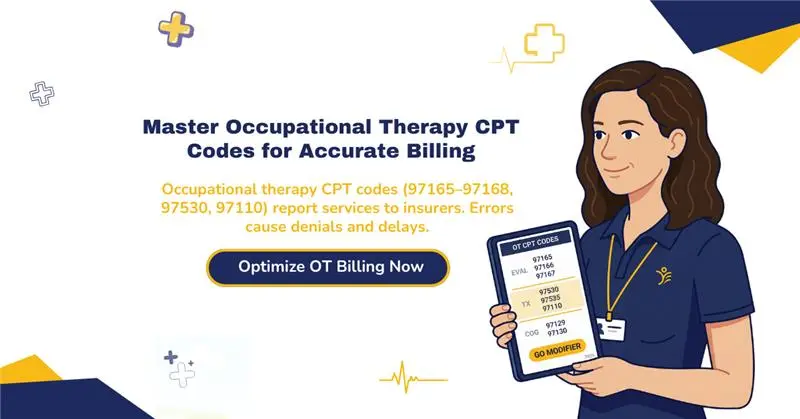
Occupational therapy CPT codes are five-digit numeric codes used by occupational therapists and billing specialists to report services to Medicare, Medicaid, and commercial insurance payers. The most frequently used occupational therapy CPT codes fall into five categories: evaluation and re-evaluation codes (97165, 97166, 97167, 97168), therapeutic procedure codes (97110, 97112, 97530, 97535, 97537), cognitive intervention codes (97129, 97130), modality codes, and assistive technology codes (97755, 97760). Most treatment codes are billed in 15-minute units and require a minimum of 8 minutes of direct, one-on-one patient contact to bill a single unit, per the Medicare 8-Minute Rule established in CMS Medicare Claims Processing Manual, Chapter 5.
A lot changed on January 1, 2026. CMS finalized a permanent efficiency adjustment that reduces reimbursement for evaluation codes, introduced new Remote Therapeutic Monitoring codes that create revenue opportunities many practices aren’t capturing, raised the KX modifier threshold to $2,480, and extended telehealth billing for occupational therapists through December 31, 2027. This guide covers every major occupational therapy billing code, the verified 2026 CMS reimbursement rates, the modifiers required to pass payer edits, the most common reasons OT claims are denied, and how to prevent them.
At Claimmax RCM, our certified billing specialists manage occupational therapy revenue cycles for practices across the country. Every rate, threshold, and billing rule in this guide is sourced directly from CMS and AOTA documentation. If your billing workflow doesn’t match what you read here, that gap is costing your practice real money. Our full RCM services page explains how we close it.
What Are Occupational Therapy CPT Codes and How Are They Used in Billing
Occupational therapy CPT codes are standardized five-digit codes published by the American Medical Association (AMA) and used by occupational therapy practitioners to report services to insurance payers. Medicare, Medicaid, and most commercial insurers require these codes as a condition of reimbursement for all OT services in outpatient, home health, and institutional settings.
Current Procedural Terminology codes have governed healthcare billing since the 1960s. The AMA updates them annually, effective January 1 of each year. For occupational therapy practitioners, the relevant codes appear primarily in the 97000 series (Physical Medicine and Rehabilitation), with additional codes in the 96000 series for behavioral health assessments and the 98000 series for remote therapeutic monitoring services.
The American Occupational Therapy Association publishes an annual reference of frequently used occupational therapy CPT and HCPCS codes. It’s one of the most practical tools available to practitioners who want to verify code applicability before billing. The 2026 AOTA reference reflects codes effective January 1, 2026.
CPT Codes vs. HCPCS Codes: What Occupational Therapists Need to Know
Here’s a distinction that trips up a lot of billing teams. CPT codes are technically Level I HCPCS codes: numeric, five digits, published by the AMA. HCPCS Level II codes are alphanumeric and were developed by CMS to cover services, supplies, and procedures that CPT codes don’t capture.
Most standard OT therapeutic procedures use CPT codes. That’s the default for outpatient and commercial billing. Where it gets more specific is government programs: some Medicare and Medicaid services use HCPCS G-codes instead. Caregiver training is a good example, with G0541, G0542, and G0543 covering those services when the patient isn’t present.
When you’re billing for Medicare or Medicaid, always confirm with your Medicare Administrative Contractor whether a CPT or HCPCS Level II code applies to the specific service. Don’t assume. The wrong code type gets the claim rejected before it’s even reviewed.
Timed vs. Untimed OT CPT Codes: The Foundation of OT Billing
Timed occupational therapy CPT codes are billed in 15-minute units based on direct patient contact time. Untimed codes are billed once per session regardless of how long the session runs. Getting this wrong is one of the most common OT billing errors, and it shows up in both directions: overbilling timed codes and billing evaluation codes multiple times per episode.
| Code Type | Examples | How Billed | Units Per Session | Notes |
| Untimed (service-based) | 97165, 97166, 97167, 97168 | Once per evaluation | 1 per evaluation episode | Never bill multiple units |
| Timed (time-based) | 97530, 97110, 97535, 97112 | Per 15-minute increment | Multiple based on session length | Subject to 8-minute rule |
| Timed (group therapy exception) | 97150 | Once per group session | 1 per member per session | Not based on individual time |
The group therapy row matters more than most practices realize. CPT 97150 isn’t billed by the unit. It’s billed once per patient per group session, regardless of how long the group runs. Billing it like a timed individual treatment code is a consistent source of incorrect claims, and it’s one that competitors in this space frequently explain incorrectly.
OT Evaluation CPT Codes 2026: 97165, 97166, 97167 and 97168 Explained
CMS finalized a permanent -2.5% efficiency adjustment to work relative value units for all non-time-based services, effective January 1, 2026. That includes all four occupational therapy evaluation codes: 97165, 97166, 97167, and 97168. The reduction is permanent, not a temporary budget fix. Practices that rely heavily on evaluation volume need to make sure time-based treatment codes are being billed with precision to offset what’s been lost. Source: CMS CY 2026 Medicare Physician Fee Schedule Final Rule.
| CPT Code | Description | 2025 Non-Facility Rate | 2026 Non-Facility Rate | Change |
| 97165 | OT Evaluation, Low Complexity | $100.60 | ~$98.08 | -2.5% |
| 97166 | OT Evaluation, Moderate Complexity | $100.60 | ~$98.08 | -2.5% |
| 97167 | OT Evaluation, High Complexity | $100.60 | ~$98.08 | -2.5% |
| 97168 | OT Re-evaluation | $69.54 | ~$67.80 | -2.5% |
Source: CMS Physician Fee Schedule Search Tool, MAC: 0000000, non-facility settings. Rates reflect the CY 2026 MPFS Final Rule efficiency adjustment. Always verify current rates for your MAC locality at cms.gov. Commercial and Medicaid rates will differ.
CPT 97165: OT Evaluation, Low Complexity
CPT 97165 is an untimed occupational therapy evaluation code used when a patient presents with one to two performance deficits, requires minimal to no modification of assessment tasks, and involves straightforward clinical decision-making. The evaluation typically runs approximately 30 minutes and includes a brief review of the occupational profile and relevant medical history. This code is billed once per evaluation episode, never in multiple units, and requires the GO modifier when submitted under Medicare Part B. The 2026 Medicare non-facility reimbursement rate is approximately $98.08, subject to locality adjustment. Source: CMS Medicare Claims Processing Manual, Chapter 5; AOTA 2026 Frequently Used OT CPT/HCPCS Codes.
Think of 97165 as your straightforward presentation: one problem, clear history, no complications. If the patient walked in with an isolated wrist injury and no complicating factors, that’s where this code fits.
When to use 97165:
- Patient presents with a single, isolated functional limitation
- Standardized assessments require no task modification to complete
- Clinical decision-making is straightforward, with one to two treatment options
- Medical and therapy history review is brief and focused
Documentation requirements for 97165:
- Occupational profile addressing the presenting problem
- Standardized assessment results identifying one to two performance deficits
- Brief medical history relevant to the presenting problem
- Treatment recommendations based on assessment findings
- Total evaluation time documented
CPT 97166: OT Evaluation, Moderate Complexity
CPT 97166 is an untimed occupational therapy evaluation code used when a patient presents with three to five performance deficits, requires minimal to moderate modification of assessment tasks, and involves moderate clinical decision-making. The evaluation typically runs approximately 45 minutes and includes an expanded review of the occupational profile, medical history, and relevant comorbid conditions. Bill this code once per evaluation episode with the GO modifier under Medicare Part B. The 2026 Medicare non-facility rate is approximately $98.08. Source: AOTA 2026 Frequently Used OT CPT/HCPCS Codes; CMS Medicare Claims Processing Manual, Chapter 5.
97166 is your most commonly billed evaluation code. Most patients don’t arrive with one clean problem. They’ve got multiple conditions affecting function, and the evaluation reflects that complexity.
When to use 97166:
- Patient presents with multiple comorbid conditions affecting occupational performance
- Evaluation requires minimal to moderate task modification or assistance
- A thorough review of medical and therapy records is necessary
- Clinical decision-making involves several treatment option considerations
Documentation requirements for 97166:
- Expanded occupational profile including relevant social and environmental factors
- Review of cognitive, physical, and psychosocial factors as they relate to the presenting problem
- Standardized assessments identifying three to five performance deficits
- Multiple treatment recommendations with clinical rationale
CPT 97167: OT Evaluation, High Complexity
CPT 97167 is an untimed occupational therapy evaluation code used when a patient presents with five or more performance deficits, requires moderate to maximal modification of assessment tasks, and involves complex clinical decision-making. The evaluation typically runs 60 minutes or more and includes a comprehensive review of the occupational profile, all relevant medical and therapy histories, and physical, cognitive, and psychosocial factors. Bill this code once per evaluation episode with the GO modifier under Medicare Part B. The 2026 Medicare non-facility rate is approximately $98.08. Source: AOTA 2026 Frequently Used OT CPT/HCPCS Codes; CMS Medicare Claims Processing Manual, Chapter 5.
This is your stroke patient, your TBI patient, your complex neurological presentation. You spent an hour reviewing records from three other providers before the patient even walked in. That’s high complexity.
When to use 97167:
- Patient presents with neurological, orthopedic, or complex medical conditions with multiple functional limitations
- Therapist must provide a high degree of task modification or assistance to complete the evaluation
- Clinical decision-making requires analysis across multiple body systems
- Evaluation requires consultation with other providers or extensive medical record review
Documentation requirements for 97167:
- Comprehensive occupational profile with full medical, therapy, and psychosocial history
- Standardized assessments identifying five or more performance deficits
- Documentation of the modifications required to complete each assessment
- Complex clinical decision-making rationale with multiple treatment recommendations
CPT 97168: OT Re-evaluation
CPT 97168 is an untimed occupational therapy re-evaluation code used when a patient demonstrates a significant change in functional status that requires a revised plan of care. It’s not for routine progress checks. The code requires a documented, clinically significant change in the patient’s condition that actually alters the course of treatment. Bill 97168 once per re-evaluation episode with the GO modifier under Medicare Part B. The 2026 Medicare non-facility rate is approximately $67.80. Source: AOTA 2026 Frequently Used OT CPT/HCPCS Codes; CMS CY 2026 MPFS.
Here’s where practices consistently get into trouble. A patient plateaus, the therapist does a progress note, and someone bills 97168 thinking it covers that. It doesn’t. The re-evaluation must explain why the original plan of care no longer applies, what specifically changed, and what the revised plan looks like. Bill it for a routine update and you’re looking at a CO-11 denial.
97165 vs. 97166 vs. 97167: Choosing the Right Complexity Level
The complexity level isn’t a judgment call made after the evaluation is written. It comes directly from what the documentation shows. Count the performance deficits. Note the level of modification required. Assess how complex the clinical decision-making actually was. Then select the code that matches.
| Factor | 97165 Low Complexity | 97166 Moderate Complexity | 97167 High Complexity |
| Performance Deficits | 1 to 2 | 3 to 5 | 5 or more |
| Task Modification Required | None to minimal | Minimal to moderate | Moderate to maximal |
| Medical History Review | Brief and focused | Expanded, includes comorbidities | Comprehensive, includes all systems |
| Clinical Decision-Making | Straightforward | Moderate complexity | High complexity |
| Typical Duration | Approximately 30 minutes | Approximately 45 minutes | 60 minutes or more |
| 2026 Non-Facility Rate | ~$98.08 | ~$98.08 | ~$98.08 |
| Modifier Required (Medicare) | GO | GO | GO |
Two rules worth putting in front of your therapists. First: if the patient needed your help to get through the evaluation, it’s not low complexity. Second: if you pulled records from multiple providers or consulted with another clinician during the evaluation, that’s high complexity. Document your reasoning before the claim goes out, not after a denial comes back.
Billing at the wrong complexity level is the second most common cause of OT evaluation claim denials. If your team is uncertain how to apply these criteria to specific patient presentations, Claimmax RCM provides complexity-level audits as part of our denial management services.
Complete 2026 Occupational Therapy CPT Code List with CMS Reimbursement Rates
Rate accuracy matters more than most billing teams realize. Using outdated rates skews your expected reimbursement, throws off your AR projections, and makes it harder to catch underpayments when they happen. The tables below reflect 2026 Medicare non-facility rates from the CMS Physician Fee Schedule Search Tool, national average payment amount, MAC: 0000000.
These rates reflect the CY 2026 MPFS Final Rule, which includes the -2.5% efficiency adjustment on untimed codes and a 3.26% increase to the overall conversion factor, now set at $33.40. All rates are subject to the Multiple Procedure Payment Reduction (MPPR), geographic locality adjustments, and payer-specific contractual rates. Verify rates for your MAC locality at the CMS Physician Fee Schedule Search Tool before submitting claims. Commercial and Medicaid rates will differ from what’s listed here.
OT Evaluation and Re-evaluation Codes: 2026 Rates
| CPT Code | Description | Timed | 2025 Rate | 2026 Rate | Notes |
| 97165 | OT Evaluation, Low Complexity | No | $100.60 | ~$98.08 | GO modifier required |
| 97166 | OT Evaluation, Moderate Complexity | No | $100.60 | ~$98.08 | GO modifier required |
| 97167 | OT Evaluation, High Complexity | No | $100.60 | ~$98.08 | GO modifier required |
| 97168 | OT Re-evaluation | No | $69.54 | ~$67.80 | Significant change required |
OT Therapeutic Procedure Codes: 2026 Rates
These are your highest-volume treatment codes. Most are timed, billed in 15-minute units, and subject to the CMS 8-Minute Rule. The GO modifier is required on every line under Medicare Part B.
| CPT Code | Description | Timed | 2026 Rate Per Unit | Notes |
| 97110 | Therapeutic Exercise | Yes | ~$28.79 | GO modifier required |
| 97112 | Neuromuscular Re-education | Yes | ~$32.02 | GO modifier required |
| 97113 | Aquatic Therapy with Exercises | Yes | ~$36.55 | GO modifier required |
| 97116 | Gait Training | Yes | ~$27.00 | GO modifier required |
| 97124 | Massage | Yes | ~$20.00 | GO modifier required |
| 97140 | Manual Therapy Techniques | Yes | ~$27.17 | NCCI edit pair with 97530 |
| 97150 | Group Therapeutic Procedures | No | ~$17.47 | Per member of group |
| 97530 | Therapeutic Activities | Yes | ~$34.61 | Most billed OT code |
| 97533 | Sensory Integrative Techniques | Yes | Contact CMS | Verify with your MAC |
| 97535 | Self-Care/Home Management Training | Yes | ~$32.02 | GO modifier required |
| 97537 | Community/Work Reintegration | Yes | ~$31.70 | GO modifier required |
| 97542 | Wheelchair Management | Yes | ~$30.73 | GO modifier required |
OT Cognitive Intervention, Assessment, and Specialty Codes: 2026 Rates
Cognitive and developmental codes are underutilized in most OT practices, particularly in pediatric and neurological settings. Verify 97129 and 97130 rates directly with CMS, as those figures weren’t finalized uniformly across all MACs at the time of publication.
| CPT Code | Description | Timed | 2026 Rate | Notes |
| 97129 | Cognitive Function Intervention, Initial 15 min | Yes | Verify with CMS | Cognitive training |
| 97130 | Cognitive Function Intervention, Each Additional 15 min | Yes | Verify with CMS | Add-on to 97129 |
| 97750 | Physical Performance Test | No | ~$33.32 | With report |
| 97755 | Assistive Technology Assessment | No | ~$37.52 | With report |
| 96112 | Developmental Test Administration, First 60 min | No | ~$127.12 | Pediatric OT |
| 96113 | Developmental Test Administration, Add-on 30 min | No | ~$53.37 | Add-on to 96112 |
| 96125 | Standardized Cognitive Performance Testing, Per 60 min | No | ~$99.63 | With report |
| 96127 | Brief Emotional/Behavioral Assessment | No | ~$4.53 | With scoring |
OT Caregiver Training Codes: 2026 Rates
The G-code additions for caregiver training without the patient present are a meaningful expansion for home health and pediatric OT practices. Don’t overlook them.
| CPT/HCPCS Code | Description | Timed | 2026 Rate | Notes |
| 97550 | Caregiver Training, Initial 30 min | No | ~$52.08 | Patient present |
| 97551 | Caregiver Training, Each Additional 15 min | No | ~$25.55 | Add-on to 97550 |
| 97552 | Group Caregiver Training | No | ~$22.00 | Untimed |
| G0541 | Caregiver Training, No Patient Present, Initial 30 min | No | ~$52.08 | New 2025/2026 |
| G0542 | Caregiver Training, No Patient Present, Each Add 15 min | No | ~$25.55 | Add-on to G0541 |
| G0543 | Group Caregiver Training, No Patient Present | No | ~$22.00 | Untimed |
OT Orthotic, Prosthetic, and Wound Care Codes: 2026 Rates
| CPT Code | Description | Timed | 2026 Rate | Notes |
| 97760 | Orthotic Management and Training, Initial | No | ~$45.93 | First encounter |
| 97761 | Prosthetic Training, First Encounter | No | ~$40.43 | First encounter |
| 97763 | Orthotic/Prosthetic Management, Subsequent | No | ~$50.14 | Follow-up |
| 97597 | Wound Debridement, First 20 sq cm | No | ~$96.72 | Within OT scope |
| 97598 | Wound Debridement, Each Additional 20 sq cm | No | ~$43.34 | Add-on to 97597 |
| 97605 | Negative Pressure Wound Therapy, up to 50 sq cm | No | ~$42.05 | Where applicable |
| 97610 | Low Frequency Non-Thermal Ultrasound | No | ~$397.22 | Per day |
2026 Major Updates to Occupational Therapy Billing: What Every Practice Must Know
CMS dropped four changes in the CY 2026 MPFS Final Rule. If you’re running 2025 workflows, you’re already behind. Two changes break compliance. One leaves money on the table. Here’s what changed and what you need to do. Source: CMS CY 2026 MPFS Final Rule.
Update 1 — New Remote Therapeutic Monitoring Codes for 2026
CMS added three RTM codes as “sometimes therapy” on January 1, 2026. Source: CMS MLN Matters MM14250. These occupational therapy cpt codes 2026 updates let you bill for shorter monitoring periods.
| Code | Description | Duration | Status |
| 98985 | RTM device supply, musculoskeletal monitoring | 2 to 15 days | New for 2026 |
| 98984 | RTM device supply, respiratory monitoring | 2 to 15 days | New for 2026 |
| 98979 | RTM treatment management, first 10 minutes per month | Monthly | New for 2026 |
| 98977 | RTM device supply, musculoskeletal | 16 to 30 days | Revised descriptor |
| 98976 | RTM device supply, respiratory | 16 to 30 days | Revised descriptor |
Old rules required 16 to 30 days of data. That didn’t fit short OT episodes. The new 2-to-15-day codes match outpatient visits and home exercise programs. Append the go modifier on RTM lines under an OT plan of care. Add the co modifier if an OTA furnishes the service. Source: CMS MM14250.
If you’re doing remote check-ins without billing RTM, you’re missing revenue. Our team builds RTM workflows for therapy practices. Check our medical billing service to see how we set this up.
Update 2 — The -2.5% Efficiency Adjustment on OT Evaluation Codes
CMS finalized a permanent 2.5% cut to work RVUs for untimed codes. This hits occupational therapy CPT codes 97165, 97166, 97167, and 97168. Source: CMS CY 2026 MPFS Final Rule.
Bill 80 moderate evaluations monthly at the 2025 rate of $100.60? You get $8,048. At the 2026 rate of $98.08, you get $7,846. That’s a $202 monthly loss. You’ll lose $2,424 annually on this code alone.
You can’t recover this cut. Every minute of timed treatment counts now. Missed units mean permanent revenue loss. Strong revenue cycle management tracks these gaps.
Update 3 — The 2026 KX Modifier Threshold: $2,480
The kx modifier threshold for OT is $2,480 in 2026. This is separate from the PT and SLP threshold. Source: CMS MLN Matters MM14315.
| Year | OT Threshold | PT/SLP Combined Threshold |
| 2024 | $2,330 | $2,330 |
| 2025 | $2,410 | $2,410 |
| 2026 | $2,480 | $2,480 |
Hit $2,480 in accumulated charges? Add the kx modifier to every subsequent line. Claims over the threshold without kx get auto-denied. Targeted review starts at $3,000. Set alerts at $2,000 and $2,480 in your system.
Update 4 — Telehealth Extended for OT Through December 31, 2027
Section 6209 of the Consolidated Appropriations Act, 2026 extended OT telehealth through December 31, 2027. Codes 98966 through 98968 are included. Pair the go modifier with Modifier 95 for synchronous video or Modifier GT for interactive audio and video. Source: CMS Therapy Services CY 2026 Updates.
Update 5 — OTA General Supervision Permanently Authorized
General supervision for OTAs in private practice is now permanent. The supervising OT must be available but doesn’t need to be on-site. When OTA time exceeds 10% of the visit, append the co modifier with the go modifier. Payment drops to 85% of the Part B rate. Source: CMS CY 2026 MPFS Final Rule; CMS Medicare Claims Processing Manual, Chapter 5.
Check our prior authorization page for OTA workflow details.
OT Billing Units Explained: The 8-Minute Rule for Occupational Therapy (2026)
Most occupational therapy CPT codes are timed. You bill in 15-minute units. Medicare requires eight minutes of direct contact for one unit. This is the CMS 8-Minute Rule from Chapter 5. Untimed codes like evals bill once per session.
The 8-Minute Rule: Unit Calculation Table for OT
| Minutes of Direct One-on-One Contact | Billable Units |
| Fewer than 8 minutes | 0 units — cannot bill |
| 8 to 22 minutes | 1 unit |
| 23 to 37 minutes | 2 units |
| 38 to 52 minutes | 3 units |
| 53 to 67 minutes | 4 units |
| 68 to 82 minutes | 5 units |
| 83 to 97 minutes | 6 units |
| 98 to 112 minutes | 7 units |
| 113 to 127 minutes | 8 units |
Source: CMS Medicare Claims Processing Manual, Chapter 5. This table covers Medicare. Some commercial payers use AMA rules. That changes how you count ot billing units.
AMA 8-Minute Rule vs CMS 8-Minute Rule: A Critical Distinction
CMS and AMA rules differ. The difference changes your unit count.
CMS sums total timed minutes. Divide by 15. If the remainder is eight or more, you bill an extra unit. This governs occupational therapy billing units for Medicare and Medicaid.
AMA evaluates each service separately. Eight minutes of Code A plus eight minutes of Code B equals two units. CMS sees 16 total minutes and bills one unit. The remainder is one, which is below eight.
Using one rule for all payers causes errors. You’ll underbill commercial claims or overbill Medicare. Your system needs payer-specific logic. We build these rules into client systems. Check our payment posting service to see how accuracy flows to reconciliation.
Multiple Procedure Payment Reduction (MPPR) in 2026
CMS cuts the practice expense component by 50% on the second and subsequent therapy codes billed same day. This applies to ot billing codes marked “always therapy.” The work RVU stays intact. Source: CMS CY 2026 MPFS Final Rule; CMS Medicare Claims Processing Manual.
The CMS physician fee schedule 2026 reflects this reduction. Billing units occupational therapy calculations must account for MPPR to forecast revenue accurately. The 8 minute rule occupational therapy determines units, but MPPR determines final payment on multiple codes.
OT Billing Modifiers 2026: Complete Reference Guide for Occupational Therapy Claims
Medicare needs the go modifier on every OT line. Missing go is the top denial. You also need co for OTA work, kx for thresholds, and modifiers for NCCI edits. Every occupational therapy modifier must match the service and payer rules.
Complete 2026 OT Modifier Reference Table
| Modifier | Full Name | When Required | Paired With | 2026 Notes |
| GO | Occupational Therapy Plan of Care | All outpatient OT claims under Medicare | Always required | Missing GO = automatic denial |
| CO | OTA Service | When OTA provides more than 10% of service time | GO on same line | Triggers 85% payment rate |
| KX | Medical Necessity Attestation | When accumulated charges exceed $2,480 (OT) | GO on same line | 2026 threshold is $2,480 |
| 59 | Distinct Procedural Service | NCCI edit pairs billed separately (different area or time) | Situational | Use only when no more specific modifier applies |
| XS | Separate Structure | NCCI edit, different anatomical structure | 59 alternative | Preferred over 59 when applicable |
| XE | Separate Encounter | NCCI edit, different time within same day | 59 alternative | Preferred over 59 when applicable |
| GP | Physical Therapy Plan of Care | PT services only | Never with GO | Incorrect discipline modifier = denial |
| GN | Speech-Language Pathology Plan of Care | SLP services only | Never with GO | Incorrect discipline modifier = denial |
| 95 | Synchronous Telehealth | Real-time audio/video OT services | GO | Active through Dec 31, 2027 |
| GT | Interactive Telehealth | Audio/video, not necessarily real-time | GO | Confirm payer preference |
| CQ | PTA Service | Physical therapy assistant services | GP | Wrong discipline = denial |
| 52 | Reduced Service | Abbreviated procedure | Situational | Document reason for reduction |
Source: CMS Medicare Claims Processing Manual, Chapter 5; CMS NCCI Policy Manual; AOTA 2026 Frequently Used OT CPT/HCPCS Codes.
NCCI Edit Pairs — The Most Common OT Billing Conflicts
NCCI bundles codes that overlap. You need an ot modifier to unbundle when services are distinct.
| Code Pair | Edit Reason | Correct Modifier | Documentation Required |
| 97140 and 97530 | NCCI bundle — manual therapy and therapeutic activity | 59 or XS | Different body areas, separate time blocks documented |
| 97110 and 97530 | NCCI bundle — therapeutic exercise and therapeutic activity | 59 | Distinct services with different goals documented |
| 97110 and 97140 | NCCI bundle — exercise and manual therapy | 59 or XS | Different anatomical regions documented |
Modifier 59 is an audit trigger. Use it only when documentation proves services were distinct. Document separate areas and times. Overuse violates compliance. Source: CMS NCCI Policy Manual; CMS Modifier 59 and X-Modifier MLN Guidance.
Bad modifiers cost money. We audit occupational therapy billing codes and modifiers before submission. Our AR team fixes denials in 24 hours. Review our AR follow-up service for details.
Check the CMS NCCI Policy Manual for full edit lists. The CMS physician fee schedule 2026 and denial management reports show how modifier errors impact payment. Medical necessity occupational therapy documentation must support every modifier used. Occupational therapy CPT codes require precise modifier application to pass edits.
The Most Billed Occupational Therapy CPT Codes: Complete Billing and Documentation Guide
High-volume codes cause the most revenue loss when billed wrong. Documentation gaps and NCCI conflicts kill payments on these occupational therapy CPT codes. You’ll see denials pile up if your notes don’t match the code definition. Here’s the billing reality for the codes you use daily.
CPT 97530: Therapeutic Activities
CPT code 97530 is a timed code for therapeutic activities that improve functional performance. You bill 15-minute units for dynamic, multi-joint movements like reaching overhead or practicing transfers. Direct contact is required. The 2026 rate is approximately $34.61 per unit. Append the GO modifier. Source: CMS CY 2026 MPFS; AOTA 2026.
| Factor | CPT 97530 Therapeutic Activities | CPT 97110 Therapeutic Exercise |
| Primary Focus | Functional, multi-joint purposeful movements | Isolated strength, range of motion, endurance |
| Example Activities | ADL simulation, transfers, reaching tasks | Knee extensions, bicep curls, grip strengthening |
| Movement Type | Dynamic, multi-joint, real-world functional | Isolated, targeted exercise |
| Documentation Requirement | Must show functional goal and skilled rationale | Must show therapeutic parameters |
| Timed or Untimed | Timed, 15-minute units | Timed, 15-minute units |
| 2026 Medicare Rate | ~$34.61 per unit | ~$28.79 per unit |
| NCCI Edit Conflict | Yes — paired with 97140 and 97110 | Yes — paired with 97530 and 97140 |
| GO Modifier Required | Yes | Yes |
Notes must show the functional goal. Auditors deny CPT code 97530 when notes describe exercises. You must document why the activity requires a therapist. If the task lacks a clear connection to daily life, bill 97110 instead. This distinction protects you during reviews.
The biggest error is billing exercise as activity. CPT code 97530 requires a purposeful task simulating real-world performance. Document the functional connection explicitly. Medical necessity occupational therapy reviews focus on this link.
CPT 97535: Self-Care and Home Management Training
CPT 97535 covers self-care and home management training in 15-minute units. You’re teaching activities of daily living, IADLs, and adaptive equipment use. Think dressing, meal prep, and home safety. The rate is approximately $32.02. GO modifier required. Source: CMS CY 2026 MPFS; AOTA 2026.
| Factor | CPT 97530 Therapeutic Activities | CPT 97535 Self-Care Training |
| Primary Focus | Dynamic functional performance improvement | Building patient independence in daily self-care |
| Scope | Broad functional performance tasks | Specifically ADLs, IADLs, adaptive equipment |
| Setting Applicability | Outpatient, home health, SNF | Outpatient, home health, SNF |
| 2026 Medicare Rate | ~$34.61 per unit | ~$32.02 per unit |
| Documentation Focus | Functional activity description and goal | Independence skill-building rationale |
| GO Modifier Required | Yes | Yes |
Use 97535 when the focus is independence in self-care. CPT code 97530 fits broader functional tasks. Both support activities of daily living goals but target different outcomes.
CPT 97112: Neuromuscular Re-education
CPT 97112 is neuromuscular re-education billed in 15-minute units. You’re working on balance, coordination, and proprioception for sitting and standing. Common for stroke and TBI patients. Rate is approximately $32.02. GO modifier required. Source: CMS CY 2026 MPFS.
CPT 97110: Therapeutic Exercise
CPT 97110 covers therapeutic exercise for strength, endurance, and ROM. Bill 15-minute units for skilled exercise programs. Unskilled exercises don’t count. Rate is approximately $28.79. GO modifier required. These ot cpt codes form the base of many treatment plans.
CPT 97140: Manual Therapy Techniques
Yes, CPT 97140 is used in occupational therapy. This timed code covers manual therapy like joint mobilization and soft tissue work. Hand therapy and scar management use this often. Rate is approximately $27.17. GO modifier required.
CPT 97140 and CPT 97530 are an NCCI pair. You need Modifier 59 or XS to bill both. Document separate body areas and times. Overusing Modifier 59 triggers audits. CPT code 97530 billed with 97140 needs clear separation in the note.
CPT 97150: Group Therapeutic Procedures
CPT 97150 is an untimed code for group therapy. Bill once per patient per session. Time doesn’t matter. You must provide individual instruction within the group. Rate is approximately $17.47. GO modifier required. These ot billing codes help manage caseload efficiency.
CPT 97129 and 97130: Cognitive Function Intervention
CPT 97129 covers cognitive function intervention for the first 15 minutes. You’re targeting memory, reasoning, and executive function. CPT 97130 is the add-on for additional time. Used for TBI and dementia. GO modifier required. Source: AOTA 2026.
Occupational therapy billing for cognitive codes requires specific documentation of deficits. The CMS physician fee schedule 2026 lists rates, but MAC coverage varies. Verify before billing.
Occupational Therapy CPT Codes by Clinical Setting and Patient Population
Code selection depends on setting and patient. Rules change between outpatient, home health, and schools. Verify applicability before you submit. These occupational therapy CPT codes shift based on where you treat and who you treat.
Outpatient OT CPT Codes: Neurological and Orthopedic Rehabilitation
Outpatient revenue comes from specific code pairs. These combinations pass NCCI edits when documented right.
| Clinical Focus | Primary CPT Codes | Notes |
| Stroke rehabilitation | 97530, 97535, 97112, 97129 | GO modifier on all lines |
| Hand therapy post-surgical | 97140, 97530, 97760, 97110 | NCCI edit awareness required |
| Upper extremity orthopedic | 97110, 97140, 97530 | MPPR applies to second and subsequent codes |
| Traumatic brain injury | 97129, 97530, 97535, 97112 | Cognitive codes frequently denied without specific documentation |
| Parkinson’s disease | 97112, 97530, 97535 | Skilled need must be documented at every visit |
Occupational therapy billing codes for outpatient work often combine timed and untimed services. Watch MPPR reductions on multiple timed codes.
Pediatric Occupational Therapy CPT Codes
Pediatric occupational therapy CPT codes include standard 97000 series codes plus developmental testing in the 96000 series. Codes 96112 and 96113 are key for evaluations and pay well.
| CPT Code | Description | Timed | 2026 Rate | Primary Use |
| 96112 | Developmental Test Administration, First 60 min | No | ~$127.12 | Comprehensive developmental evaluation |
| 96113 | Developmental Test Administration, Add-on 30 min | No | ~$53.37 | Extended developmental evaluation |
| 96127 | Brief Emotional/Behavioral Assessment | No | ~$4.53 | ADHD, behavioral screening |
| 97533 | Sensory Integrative Techniques | Yes | Verify with MAC | Sensory processing disorders |
| 97530 | Therapeutic Activities | Yes | ~$34.61/unit | Functional skill development |
| 97535 | Self-Care Training | Yes | ~$32.02/unit | ADL independence building |
| 97129 | Cognitive Function Intervention | Yes | Verify with MAC | Executive function, attention |
Medicaid often covers pediatric OT. Rates and auths vary by state. Workflows differ from Medicare. We handle prior authorization for pediatric practices across state programs. Check our prior authorization page for details.
These ot cpt codes support activities of daily living goals in children. Documentation must show developmental impact.
Occupational Therapy CPT Codes for Autism Spectrum Disorder
Occupational therapy CPT codes for autism spectrum disorder (ICD-10: F84.0) typically include sensory integration, developmental testing, and cognitive codes. Coverage depends on whether you bill under an OT plan or behavioral health plan.
| CPT Code | Description | Clinical Role in ASD Treatment |
| 97533 | Sensory Integrative Techniques | Primary — sensory processing intervention |
| 96112 | Developmental Test Administration | Evaluation — developmental and adaptive behavior |
| 97530 | Therapeutic Activities | Functional skill development, play-based activities |
| 97129 | Cognitive Function Intervention | Executive function, pragmatic communication |
| 97535 | Self-Care Training | ADL independence, self-care routines |
| 96127 | Brief Emotional/Behavioral Assessment | Behavioral screening |
Occupational therapy billing for autism requires clear medical necessity. Payers scrutinize sensory codes. Link interventions to functional outcomes.
Home Health OT CPT Codes
Home health OT follows Part A or Part B rules. Key codes include 97535 for ADLs and 97530 for activities. GO modifier is required for Part B claims. Source: CMS Medicare Benefit Policy Manual, Chapter 7.
Home health providers need active Medicare enrollment. Credentialing gaps delay billing. Our credentialing services keep your enrollment current.
These ot procedure codes align with home safety and independence goals. The CMS physician fee schedule 2026 applies to Part B claims. Activities of daily living training drives most home health visits. Occupational therapy CPT codes 2026 updates don’t change home health core codes, but rate adjustments apply. The go modifier occupational therapy requirement remains strict for Part B. Prior authorization occupational therapy rules may apply for Medicare Advantage home health episodes.
ICD-10 Diagnosis Codes That Support Occupational Therapy Billing: CPT Pairing Reference
Medicare and commercial payers cover occupational therapy when the diagnosis proves skilled need. The ICD-10 code must match the functional limitation and the CPT codes billed. These pairings show the most common accepted combinations for occupational therapy CPT codes.
The diagnosis code alone won’t guarantee payment. Your documentation must show the patient needs skilled care that an aide can’t provide. You also need to document potential for functional progress. Source: CMS Medicare Benefit Policy Manual, Chapter 15.
| Diagnosis | ICD-10 Code | Primary OT CPT Codes | Documentation Priority |
| Cerebrovascular Accident (Stroke) | I63.x | 97530, 97535, 97112, 97129 | Functional baseline and progress toward ADL independence |
| Traumatic Brain Injury | S06.x | 97129, 97530, 97535, 96112 | Cognitive deficits and functional performance impact |
| Hip Fracture | S72.x | 97165/97166, 97110, 97535, 97140 | Weight-bearing restrictions and ADL retraining |
| Rheumatoid Arthritis | M05.x | 97140, 97530, 97760, 97535 | Joint protection, adaptive equipment, functional mobility |
| Parkinson’s Disease | G20 | 97112, 97530, 97535 | Balance, coordination, and ADL independence |
| Autism Spectrum Disorder | F84.0 | 97533, 96112, 97530, 97129 | Sensory processing, developmental performance |
| Cerebral Palsy | G80.x | 97530, 97533, 97112, 97542 | Functional mobility and sensory-motor integration |
| Dementia | F02.x | 97129, 97535, 97530 | Cognitive function support and caregiver training |
| Developmental Delay | F81.x | 96112, 97533, 97530 | Standardized developmental testing results |
| COPD (Home Health) | J44.x | 97535, 97530, 97760 | Energy conservation and home management |
| Rotator Cuff Tear/Repair | M75.1 / S46.0 | 97110, 97140, 97530 | ROM restoration and functional upper extremity use |
| Carpal Tunnel Syndrome | G56.0 | 97140, 97760, 97530, 97110 | Splinting, nerve gliding, functional hand use |
| Multiple Sclerosis | G35 | 97112, 97530, 97535, 97129 | Fatigue management, adaptive strategies |
| Spinal Cord Injury | S14.x/S24.x/S34.x | 97530, 97535, 97542, 97112 | Functional independence, wheelchair management |
Wrong ICD-10 codes cause CO-11 denials. That’s “diagnosis inconsistent with procedure.” We review every pairing before claims go out. Our medical billing service includes full diagnosis validation during claim scrubbing.
Accurate ot cpt codes depend on correct diagnosis linking. These occupational therapy billing codes require specific ICD-10 support. The CMS physician fee schedule 2026 sets rates, but coverage starts with the diagnosis. Cpt codes for occupational therapy must align with activities of daily living goals. Medical necessity occupational therapy reviews focus on this link. Strong denial management prevents these errors.
The Most Common Reasons OT Claims Are Denied and How to Prevent Each One
Denials follow patterns. Every occupational therapy claim denial comes from a specific error. These categories cause most preventable revenue loss. We’ll show the CMS code, the root cause, and how to fix it.
Denial Type 1: Missing or Incorrect Discipline Modifier (CO-4)
The GO modifier is missing from the claim line. Medicare denies this automatically. It also happens when you use GP or GN instead of GO.
Set a hard-stop rule in your billing system. Flag any OT line missing GO before submission. This is a system fix, not a manual check.
Add the correct GO modifier and resubmit as a corrected claim. Most payers accept corrections within the filing window. Note the fix in your billing log.
Denial Type 2: Wrong Complexity Level (CO-11)
The note doesn’t support the evaluation level. You billed 97166 but only documented two deficits. That supports 97165. The payer downcodes or denies.
Therapists must finish the note before billing generates the claim. You can’t code from a verbal report. The note must state deficit count, modification level, and decision-making complexity.
Appeal with the full evaluation note. Explain why the documentation meets the billed level. Reference AMA and AOTA criteria in your letter.
Denial Type 3: Units Exceed Documented Time (CO-97)
Billed units don’t match the session time under the 8-Minute Rule. Billing staff often use scheduled time instead of actual treatment time.
Therapists must document start and stop times for each service. Billing calculates units from documented time only. A 60-minute slot might yield fewer units if intake took time.
Appeal with the treatment note. Show the documented times support the billed units. This works if the payer made a calculation error.
Denial Type 4: No KX Modifier Above Threshold (CO-167)
Charges passed $2,480 and the claim lacks the kx modifier. Medicare denies these automatically.
Track accumulated charges in real time. Set alerts at $2,000 and $2,480. Require kx modifier on every line after the threshold for the rest of the year.
Add the kx modifier and resubmit. Include updated documentation showing continued need. Most MACs process corrected claims if timely filing holds.
Denial Type 5: NCCI Edit Bundle (CO-97)
You billed an edit pair without a modifier. Common example: 97140 with 97530 on the same line.
Run claims through an NCCI checker. Most clearinghouses do this. Document separate body areas and time blocks before submitting paired codes.
Add Modifier 59 or XS and resubmit. Include note excerpts showing distinct services at distinct times. This justifies the override.
Denial Type 6: Medical Necessity Not Established (CO-50)
The note lacks skilled rationale. Phrases like “patient tolerated well” don’t prove need. Reviewers deny when an aide could do the task.
Every note must state the skilled service, why an OT was needed, the functional goal, and measurable progress. Connect treatment to plan of care goals using functional language.
Appeal with specific note sections proving skilled need. Show functional improvement data. Reference CMS Medicare Benefit Policy Manual, Chapter 15, Section 220.
| Denial Type | CMS Denial Code | Root Cause | Prevention | Appeal Path |
| Missing GO modifier | CO-4 | Modifier absent from claim line | Hard-stop billing rule | Add modifier, resubmit corrected claim |
| Wrong complexity level | CO-11 | Note does not support coded level | Code from completed note only | Appeal with full eval note |
| Units exceed documented time | CO-97 | Billed from scheduled, not actual time | Document start/stop times per service | Appeal with time-documented note |
| No KX over threshold | CO-167 | Threshold tracking failure | Automated threshold alerts at $2,000 and $2,480 | Add KX, resubmit corrected claim |
| NCCI edit without modifier | CO-97 | Edit pair not identified pre-submission | NCCI edit checker at clearinghouse | Add Modifier 59/XS, appeal with documentation |
| Medical necessity denied | CO-50 | Vague documentation | Skilled rationale in every note | Appeal with functional progress data |
These denials are preventable. You need claim scrubbing, threshold tracking, and NCCI validation. We build these checks into every workflow. Our denial management services include real-time scrubbing and appeals within 24 hours.
Errors on ot cpt codes often link to complexity denials. NCCI edits block occupational therapy billing codes that overlap. Units errors on ot billing codes cause CO-97. Strong denial management prevents CO-50. Our denial management services track thresholds. Effective denial management catches modifier gaps. CO-50 denies medical necessity occupational therapy claims. Appeals for medical necessity occupational therapy require progress data. Missing kx modifier triggers CO-167. Add the kx modifier to fix it. The go modifier occupational therapy requirement is strict. Revenue cycle management tools track thresholds. Rates in the CMS physician fee schedule 2026 don’t matter if claims deny.
If your denial rate exceeds 5%, you’re losing revenue. A free billing audit will show exactly where the gaps are. We’ll identify the denial types costing you money.
Medicare Occupational Therapy Billing Rules 2026: Coverage, Compliance, and Authorization Requirements
Does Medicare Cover Occupational Therapy Services in 2026
Yes, Medicare Part B covers occupational therapy when services are medically necessary. You need a written plan of care from a physician or qualified practitioner. A licensed OT or supervised OTA must furnish the care. Coverage includes outpatient, home health, and skilled nursing settings.
Services must require skilled judgment. The patient must show potential for functional improvement. A physician must supervise the plan. Review the plan at least every 90 days. Document progress every 10 treatment visits. Source: CMS Medicare Benefit Policy Manual, Chapter 15, Section 220.
Medicare Advantage Prior Authorization for OT Services
Medicare Advantage plans restrict care more than Part B. Prior authorization denial rates have climbed since 2021. Managing auths takes serious operational effort.
Check these items before every episode. Does the plan require auth for evaluations? Is treatment authorized separately? How many units are approved? What clinical criteria apply? What’s the appeal process?
We handle prior authorization for OT practices across multiple MA plans. Our prior authorization service tracks status, units, and expirations. We prevent lapse denials that hurt revenue.
Prior authorization occupational therapy workflows vary by plan. Missing prior authorization occupational therapy steps causes automatic denials. Effective prior authorization occupational therapy management protects cash flow.
OTA Supervision and the 85% Payment Rule in 2026
OTA services exceeding 10% of visit time trigger 85% payment. Append the co modifier occupational therapy indicator with the go modifier occupational therapy tag. General supervision is now permanent for private practice. The OT must be available but not on-site. Source: CMS CY 2026 MPFS Final Rule; CMS Medicare Claims Processing Manual, Chapter 5.
The co modifier occupational therapy rule reduces reimbursement. You must track OTA time accurately. The CMS physician fee schedule 2026 reflects the 85% rate.
Telehealth OT Billing Under Medicare in 2026
OT telehealth is covered through December 31, 2027. This extension comes from Section 6209 of the Consolidated Appropriations Act, 2026. Use GO plus Modifier 95 for synchronous video. Codes 98966 through 98968 are included.
Our telehealth medical billing services configure modifiers and track payer rules. We keep your telehealth claims compliant.
Telehealth affects ot reimbursement rates slightly due to site-of-service rules. Verify ot cpt codes for telehealth eligibility. Some occupational therapy billing codes require specific telehealth modifiers. The CMS physician fee schedule 2026 lists telehealth status indicators. Medical necessity occupational therapy standards still apply to remote visits. Reviews check medical necessity occupational therapy for remote care. Revenue cycle management for telehealth needs specific workflows. The go modifier occupational therapy rule applies to telehealth too.
How Claimmax RCM Manages Occupational Therapy Billing from Evaluation to Payment
Every rule, modifier, and threshold here needs tracking on every claim. That’s operational work. It compounds as volume grows. Claimmax RCM handles full revenue cycle management for OT practices. We cover credentialing through payment posting with OT-specific workflows. You don’t manage spreadsheets. We build the logic into the system.
- Our credentialing services enroll OTs and OTAs before claims submit. This stops credentialing-gap denials that freeze cash flow for new providers.
- The medical billing service scrubs OT CPT codes and ot billing codes for modifiers, NCCI edits, and ICD-10 pairings. We check KX thresholds automatically. Every claim passes validation before it hits the clearinghouse.
- Our prior authorization service manages prior authorization occupational therapy requests. We track units and expirations to prevent lapse denials. You’ll know exactly how many visits remain for each patient.
- We file appeals within 24 hours through our denial management services. Each appeal uses the framework from Section 11. We reference specific CMS denial codes and documentation requirements.
- The AR follow-up team contacts payers before claims age past the appeal window. We work aging reports weekly to keep receivables moving.
- Our payment posting service reconciles ERAs at the code level. We catch underpayments against contracted OT reimbursement rates. You’ll see every variance flagged for recovery.
Denial rates above 5% signal workflow gaps. We run a free billing audit to identify them. You get a written report in 30 minutes. Schedule yours on our contact page. Our revenue cycle management approach closes these gaps permanently.
Frequently Asked Questions About Occupational Therapy CPT Codes and Billing
What CPT codes are used for occupational therapy?
Occupational therapy CPT codes include evaluation codes 97165 through 97168, therapeutic procedures like 97110 and 97530, cognitive codes 97129 and 97130, and modalities such as 97140. Specialty codes cover assistive technology and orthotics. Most treatment codes are timed and billed in 15-minute units based on direct patient contact time.
What is CPT code 97530 for occupational therapy?
CPT code 97530 reports therapeutic activities improving functional performance through dynamic movements like transfers or reaching. Documentation must show skilled rationale and functional goals. This timed code bills in 15-minute units, requires the GO modifier, and reimburses at approximately $34.61 per unit under the CMS physician fee schedule 2026.
What is the difference between CPT 97530 and CPT 97535?
CPT 97530 covers therapeutic activities for broad functional performance. CPT 97535 focuses on self-care and home management training, including activities of daily living instruction. Rates differ, with 97530 paying approximately $34.61 and 97535 paying $32.02 per unit. Both are timed codes billed in 15-minute units with the GO modifier required.
What is the difference between CPT 97165, 97166, and 97167?
CPT 97165 applies to evaluations with one to two deficits. CPT 97166 covers three to five deficits with moderate complexity. CPT 97167 is used for five or more deficits requiring complex reasoning. All three OT evaluation cpt code levels are untimed and billed once per episode. The 2026 non-facility rate for all three is approximately $98.08.
What is CPT 97168 used for in occupational therapy?
CPT 97168 is the re-evaluation code for significant functional changes requiring a revised plan of care. It’s not for routine progress checks. Documentation must explain why the original plan no longer fits the patient’s condition. This untimed code bills once per episode with the GO modifier and pays approximately $67.80 in 2026.
Is CPT 97140 used in occupational therapy?
Yes, CPT 97140 is used for manual therapy techniques like joint mobilization. Occupational therapists use this code frequently in hand therapy and scar management programs. This timed code requires the GO modifier. The go modifier occupational therapy rule applies. Use Modifier 59 or XS when billing 97140 with 97530 on the same date.
What diagnosis codes support occupational therapy coverage?
Medicare covers OT when the diagnosis shows a functional limitation needing skilled care. Common codes include stroke I63.x, brain injury S06.x, and Parkinson’s G20. Upper extremity conditions like carpal tunnel G56.0 also support coverage when functional deficits exist. The ICD-10 must align with functional goals and the CPT codes billed.
What is the 8-minute rule for occupational therapy billing?
The 8-minute rule requires eight minutes of direct contact to bill one unit. Units increase every 15 minutes, with remainders of eight or more earning another unit. This rule determines OT billing units for Medicare claims per CMS guidelines. The 8 minute rule occupational therapy standard prevents unit errors. Commercial payers may use AMA guidelines instead.
What is the 2026 KX modifier threshold for occupational therapy?
The KX modifier threshold is $2,480 for OT in 2026. Append the kx modifier once charges reach this amount to attest medical necessity. Claims over the threshold without KX deny automatically. The targeted medical review threshold remains at $3,000. This update appears in the CMS physician fee schedule 2026 final rule.
What are the new OT CPT codes for 2026?
CMS added RTM codes 98985 and 98984 for device supply over two to 15 days, plus 98979 for treatment management. Code 98977 and 98976 descriptors were also revised for longer monitoring periods. These allow billing for shorter intervals. They require the GO modifier under an OT plan of care effective January 1, 2026.
Does Medicare cover occupational therapy in 2026?
Yes, Medicare Part B covers OT in 2026 for medically necessary services under a certified plan of care. There’s no annual cap, but the $2,480 threshold requires attestation. Telehealth coverage continues through December 31, 2027. Occupational therapy assistants may furnish services under general supervision with appropriate modifier usage. Providers must document skilled need.
Here are the optimized meta elements containing the Primary Keyword (PKW) **”occupational therapy CPT codes”**, adhering strictly to recommended character limits and SEO best practices.